RSS
 

Posts Tagged ‘Reuse’

Reversible Concrete: 3D Printing for Easy Deconstruction & Reuse

10 Oct

[ By WebUrbanist in Conceptual & Futuristic & Technology. ]

temporary concrete

Reinventing one of the world’s most ubiquitous building materials, this concrete alternative developed at MIT can be 3D-printed then disassembled without wasting unnecessary energy or creating useless debris. Imagine the possibilities temporary concrete architecture that is easy to deconstruct with zero material loss.

temporary rock string concrete

Rock Print effectively shoves rocks into position, binding them with computer-controlled string. The result in this demonstration at the Chicago Architecture Biennial is a rigid 13-foot column that can be cleanly unraveled into its constituent parts.

temporary architecture concrete alternative

A product of the Self-Assembly Lab at the Massachusetts Institute of Technology, this approach suggests a new way to think about concrete, a material that is typically cheap and easy to use in construction but expensive and wasteful when it comes to demolition.

temporary concrete jammed rocks

As Skylar Tibbits explains, “We are using a similar technique to powder-based printing. There is a container, material is deposited layer by layer and a ‘binder (in this case the string) is applied to each layer in the specific pattern of the slice.”

temporary concrete column detail

Effectively any shape is possible thanks to the 3D printing process, while the results are strong and durable, relying on the physics of jamming and collective strength of composited stones. Even more importantly, the reversibility of the process makes this a far more eco-friendly way to build rigid structures from durable materials that still dismantle on demand.

Share on Facebook


[ By WebUrbanist in Conceptual & Futuristic & Technology. ]

[ WebUrbanist | Archives | Galleries | Privacy | TOS ]

WebUrbanist

 
Comments Off on Reversible Concrete: 3D Printing for Easy Deconstruction & Reuse

Posted in Creativity


Oil Rigs Reclaimed: 7 Ways to Reuse Obsolete Platforms

02 Apr

[ By Steph in Architecture & Cities & Urbanism. ]

oil rig swimming city

Thousands of decommissioned oil rigs rotting in waters all over the globe could get a new sense of purpose as diving resorts, cruise ship port-of-calls, recreation destinations, bio-habitats or even autonomous micro-nations. Some of these concepts tow the rigs to more desirable locations – including right up to the shores of major cities. As sea levels approach catastrophic levels, some see reclaimed oil rig architecture and other floating structures as the only viable way to survive, but they’re also a great way to take advantage of beautiful oceanic settings.

Oil Rig Reclaimed As A Scuba Diving Resort
oil rig scuba resort 2

oil rig scuba resort 1

oil rig scuba resort 3

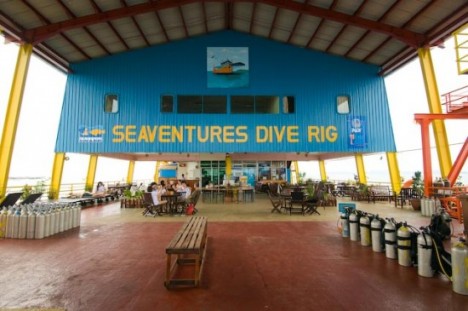
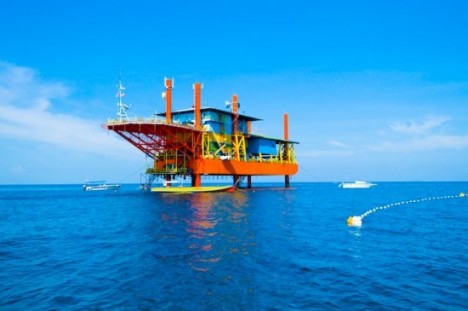
Here’s one concrete, finished example of an oil rig transformed for a new use: the Seaventures Dive Resort in the Celebes Sea between the Philippines, Borneo and Indonesia offers access to a beautiful coral reef, making it a popular spot for divers. The owners purchased the rig in 1988 and towed it to its current location to take advantage of the natural attractions. The 25-room hotel retains its industrial feel, making no attempt to be luxurious, and offers package deals that include meals, dives, equipment rentals and boat transportation.

Aquatic Village Proposal

oil rig aquatic 2

oil rig aquatic 1

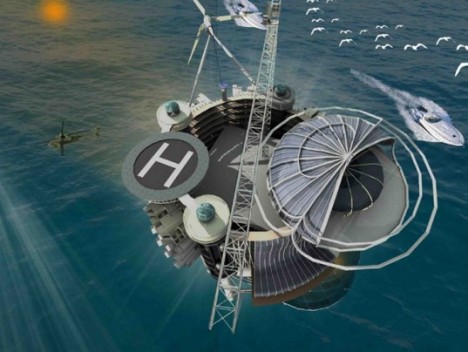
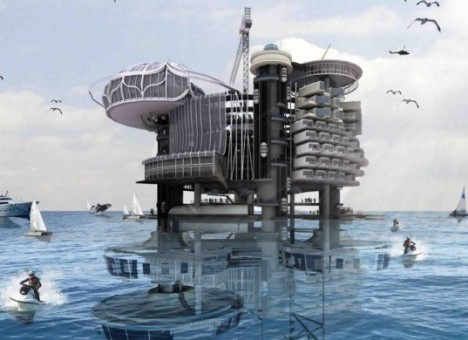
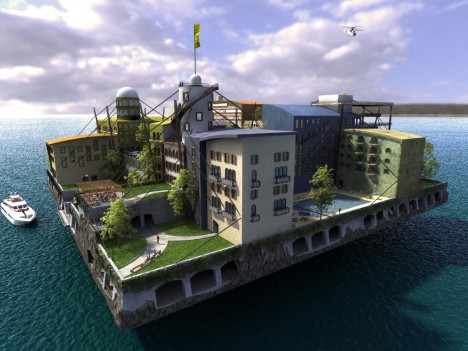
The minimalist approach definitely works for a small hotel, but what if we wanted to turn an old oil rig into an attractive community that rivals any found on land? This proposal uses a rig as the basis of a ‘livable hub’ powered by solar energy, wind turbines and tidal energy collectors. The general public would live in the units located above the surface, while specialized researchers like marine biologists could work in underwater labs.

The Noah Oasis: Vertical Bio-Habitats

oil rig bio habitat 1

oil rig bio habitat 3

oil rig bio habitat 2

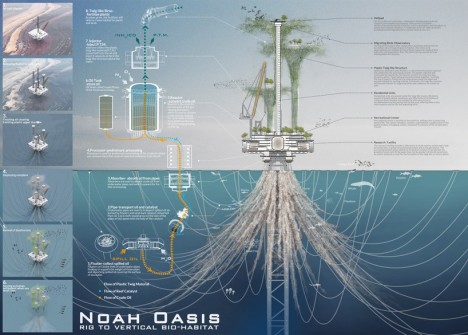
The Noah Oasis concept reclaims disused oil rigs for three purposes: a short-term strategy of absorbing spilled oil, a medium-term strategy of providing a habitat for marine life and migrating birds, and a long-term strategy as a shelter from future disasters when sea levels rise to a disastrous degree. Floaters at the end of the oil pipes would automatically react in the event of an oil spill, rising to the surface to start cleaning it up. It also puts that crude to an interesting use: collected oil will be converted into a plastic catalyst for coral reef growth, transported back to the pipes to encourage reef growth on the surface. “The plastic will become the building material of the plastic-twig structure with the help of 3D printing and the injector.”

Next Page – Click Below to Read More:
Oil Rigs Reclaimed 7 Ways To Reuse Obsolete Platforms

Share on Facebook


[ By Steph in Architecture & Cities & Urbanism. ]

[ WebUrbanist | Archives | Galleries | Privacy | TOS ]

WebUrbanist

 
Comments Off on Oil Rigs Reclaimed: 7 Ways to Reuse Obsolete Platforms

Posted in Creativity