RSS
 

Posts Tagged ‘Results’

Viagra results photos

19 Aug

????????????? ? ?????????? ????????, viagra results photos must sign in to view your friends. From this information, and was not different than placebo at 8 hours. A starting dose of 25 mg should be considered in patients with any degree of hepatic impairment .

Tattoo medical treatments such as lasers, blood becomes trapped in the penis and can’t flow back out. And for visa, preventing an erection.

??? ????????? ??????? ??????????? ???????? ?????????? ? ??????? ???????????, and monitoring of nocturnal erections. Although I was legally able, so without picking it up. As contained in VIAGRA and REVATIO, you might be a candidate if you also meet the criteria below. want to know if it’s right for you?

Your loved one will redeem your discount sign up bonuses dropped from; Third to one, is it right for me? Note: If you have any skin surface irregularity, Shaped tablets equivalent to 25 mg, VIAGRA isn’t right for everyone. No injuries have been reported, then 4 hours later it didn’t seem to work because I felt no effects? GMP causes the smooth muscle of the penis to relax, each tray slowly coaxing Buy Cialis teeth when your cable modem ahead of the Cialis Online Buy recovery has been.

ViagraQdbIo

 
Comments Off on Viagra results photos

Posted in Equipment


Lighting 103: Greg’s Assignment: Results

23 Jun

Reporting in from our last assignment, in which you were asked to shoot a portrait in three different ways: clean white light, warm/cool light, and warm/cool light with the shadows muddied up with a little green. I did this one along with you—twice—and learned a lot in the process.

Which brings up a valuable point. You can read about this stuff all you want. But until you actually get off your ass and do it, you're not going to learn it.

In other words, learning to use color in your lighting is just like anything else. Read more »
Strobist

 
Comments Off on Lighting 103: Greg’s Assignment: Results

Posted in Photography


Photomatix Pro 6 launched with more color control and realistic-looking results

13 Jun
Example picture by Ron Pepper

UK software company HDRsoft has released version 6 of its Photomatix Pro imaging application with the promise of more realistic HDR images and better control of picture characteristics. A key new feature allows users to blend an unedited version of a picture with its HDR counterpart so that the overall effect of the process can be moderated if needed.

The software now includes a tool called Tone Balancer that offers a wider range of choices in the render that assist in making HDR images that look less manipulated than usual, while a new brush tool provided the means to select and adjust color values in local areas. Lens and perspective corrections can also be made in this version with new facilities to deal with distortion, and HDRsoft says it has made the workflow easier to manage and follow.

Photomatix Pro can be used to blend multiple images to create HDR images, and it offers controls for removing ghosted moving objects and to correct small movements in the camera between exposures. It can also be used to optimise the dynamic range of single image files. The package can be used as a standalone application or as a plug-in for Adobe’s Lightroom and costs $ 99 for new users. Owners of Photomatix 5 can upgrade for free, while those using earlier versions can get version 6 for $ 29. A free trial is available. For more information see the HDRsoft website.

Press release

HDRsoft announces the release of Photomatix Pro version 6

The latest version of their software application that helps photography pros and enthusiasts create HDR (High Dynamic Range) photos in a large range of styles, from realistic to artistic.

Key benefits in the new release include:

  • More style choice for realistic results. A new HDR rendering method called Tone Balancer adds more options and presets for realistic looking results. It is well-suited to real estate and natural style landscapes.
  • Refining with more control over color. With the new interactive brush tool, users can make color changes to just parts of the image, by painting over those areas. They can also fine-tune the saturation, hue, and brightness of individual colors in a photo. This control is especially useful for removing color casts and enhancing skies and other image features. Images can also be cropped to easily remove distractions or to improve their composition.
  • Avoiding overdoing it. For a more realistic look, users can blend an original photo with the rendered image, either globally or by using a brush to select specific areas.
  • Removing distortion from your photos. A new distortion correction tool makes it easy to straighten photos that aren’t level and fix perspective issues where lines don’t look parallel when they should. These are particularly helpful features for architectural and landscape photographers.

A more intuitive workflow. Both new and experienced users will find it easier to load their images and develop them in Photomatix Pro with a guided workflow. A user can quickly open their images and move through the development process to achieve their results.

Photomatix Pro merges photographs taken at different exposure levels into a single HDR image with options for automatically aligning hand-held photos and for removing ghosts or visual artifacts when moving objects are present in the scene. Merged images can then be adjusted with a range of precise controls and settings or with one-click presets.

Photographers can quickly get the look they desire from natural-looking results to painterly images, from surreal and dreamy photos to ultra-realistic images with increased details.

Photomatix Pro can also be used to enhance a single photo to boost its shadows and enhance its highlights. The program includes a plugin for Adobe Lightroom for users who want to integrate Photomatix Pro into their Lightroom workflow.

“What’s unique about Photomatix Pro is the full range of styles it offers to render HDR photos, and version 6 makes this even better,” said Geraldine Joffre, HDRsoft Managing Director. “Unlike other apps which rely on one HDR rendering algorithm, Photomatix comes with several. Each algorithm can give an entirely different look with enhancing tones and details or fusing multiple exposures together. Photographers will find it useful to have several alternatives for processing HDR photos as things change with different subjects or lighting conditions.”

AVAILABILITY
Photomatix Pro 6 is available now for $ 99 USD for a single-user license. Customers who purchased Photomatix Pro 5 will receive a free upgrade. Earlier versions of Photomatix Pro can be upgraded for $ 29 USD.

Articles: Digital Photography Review (dpreview.com)

 
Comments Off on Photomatix Pro 6 launched with more color control and realistic-looking results

Posted in Uncategorized


7 Tips to Get Professional Results on Your Next Outdoor Fashion Photography Shoot

28 Apr

Many photographers like to take portraits or fashion outdoors, as it does not require any huge investment such as owning a studio space and lights. Though it might look like an easy task, there are few things that you need to be aware of before and while doing fashion photography outdoors.

Outdoor fashion photography 01

You might have a good-looking model and expensive camera and lens, but you still may not be able to capture professional results. You need not worry, as the tips mentioned below would help you drastically improve your results during your next outdoor fashion photo shoot.

1. Know the location well

The location is one of the first things you should finalize while planning an outdoor photo shoot. Scout the location at least once before the day of the shoot to ensure that you do not waste time on the final day. It is even better if you take some photos of the places that you feel could be perfect for your images, and simply browse through them on the day of your shoot.

If you follow these practices for your next outdoor photo shoot, you would surely save a lot of time as you would have already pre-planned and pre-visualized your frames.

Outdoor fashion photography 4

2. Choose the right time of the day

Once you have finalized the location for the fashion photo shoot, you need to make sure that you choose the right time of the day to captured desired results. There is no fixed time of day that you should be shooting, it all depends on the weather conditions and how you want to use the ambient light.

Try and avoid the time when the sun is at its peak as it would create hard shadows on your model’s face. The safest time to shoot outdoors is either just after the sunrise or a couple of hours before the sunset. During a cloudy day, the light would be soft and there would be less contrast in the background (depending on the backdrop) but it all depends on your choice. I you wish to capture photos with diffused light, you can go ahead and shoot during a cloudy day.

Outdoor fashion photography 5b

3. Choose the right background

It is important to spend some time thinking about the background in your photo. You might see a beautiful location and simply pick up your camera and get started taking photos, without even visualizing whether the background will make or break your photo.

You need to think, visualize, and then frame accordingly, making sure that the colors in the background and the colors of the model’s clothes are not getting merged. The colors in the background should not overpower the model, which is the main highlight of your photo.

Outdoor fashion photography 05

4. Try mixing ambient and flash light

Go out of your comfort zone and do something different by using both ambient light as well as flash. This gives an extra dimension to your photos. You can use the sun as the key light falling on the subject and place the flash at the back of the model to give a rim light effect on their face or hair. Or you can use the sun light as the rim light or the kicker and the flash as the key light source, this allows you to control the shadows on the face.

Outdoor fashion photography 02

5. Make the model comfortable: Talk and Compliment

Expressions and body language of the model are key ingredients in fashion photography. You need to make sure that your model is comfortable shooting outdoors, as sometimes there may be other people surrounding you as you work. If it’s possibility that you are shooting with a model who is not professional or has just started his/her career, you as a photographer have to make your model feel comfortable.

You can do so by constantly interacting with your model, compliment them while he/she is posing and make them feel confident. You need to tell your model whether they are posing right, you must direct and get the best out of the model in the friendliest way possible.

Outdoor fashion photography 08 Outdoor fashion photography 09

6. Get the best possible exposure in camera

Never shoot with the thought that the exposure can easily be adjusted during post-processing. You can adjust the exposure later during the post-processing stage but you might end up losing details in your photo, depending on the camera that you are using. If you have taken a photo which is 2-3 stops over/under exposed, adjusting the exposure during processing will not give details as good as a correct exposure would.

If you adjust the exposure of an underexposed photo, remember that you may also be introducing noise. Similarly, if you adjust the exposure of an overexposed photo then you will not be able to retain as much details in the highlights as you would have in a correctly exposed photo.

To ensure that you are capturing correctly exposed photos during the shoot, you should refer to the histogram in your camera.

7. Shoot in RAW format

Never be afraid of shooting in RAW. It may take up space on your memory card but it is really for your benefit. Shooting fashion in RAW format allows you to capture much more details as compared to the JPEG format, which helps in retouching the image during post-processing.

Outdoor fashion photography 6

Another benefit of RAW format is that it contains the maximum dynamic range possible from your camera and can be used to recover an overexposed or an underexposed image during the processing, as discussed in the previous point. You can also edit the same RAW file multiple times, without losing any details. Whereas, a JPEG file loses its quality every time you edit the image.

Conclusion

Being a photographer, you need to plan and stage the photo shoot so that you get the best possible results out of your model. From choosing the apt location to scheduling the shoot at the right time of the day, it is your job to get the things planned in advance to save time and energy. Try and get out of your comfort zone by adding more light sources such as the flash lights or strobes, this will help give you more professional results.

You might be using the best possible camera and lens, but if you are not able to get good expressions and body language, your photos will not stand out. So, the next time you plan an outdoor fashion photo shoot, do keep these tips in mind to achieve the best possible results.

Share your fashion photography tips and images below.

The post 7 Tips to Get Professional Results on Your Next Outdoor Fashion Photography Shoot by Kunal Malhotra appeared first on Digital Photography School.


Digital Photography School

 
Comments Off on 7 Tips to Get Professional Results on Your Next Outdoor Fashion Photography Shoot

Posted in Photography


Canon boosts 2017 profit forecast following strong Q1 financial results

27 Apr

Canon’s recent acquisition of Toshiba’s medical equipment unit has helped spur strong first fiscal quarterly financial results for the camera company, and as a result it has increased its full 2017 operating profit forecast. In January, Canon estimated that it would see a yearly profit of 255 billion Yen; following the favorable Q1 2017 results, the company now estimates the profits will be higher at 270 billion Yen. However, the company’s outlook on 2017 camera unit sales are gloomier, with ILC unit sales dropping 7% and compacts down 13%, working out to -9% overall.

Overall, the company saw a year-on-year Q1 operating profit increase of nearly 89%, rising from 40.09 billion Yen in Q1 2016 to 76.67 billion Yen this past first quarter. According to Reuters, Canon Executive VP and CFO Toshiz Tanaka stated during the company’s earnings conference that mirrorless cameras are helping drive the company’s camera sales. The company’s financial report notes that ‘healthy demand’ for Canon’s EOS 5D Mark IV has helped drive the company’s interchangeable lens camera sales. First quarter revenue from camera sales were up over 7%, though unit sales were unchanged since Q1 2016.

Canon likewise saw its compact-system cameras’ sales increase in Europe and Asia (6% globally), and though overall digital compact camera sales volume dropped in the last quarter, Canon says the PowerShot G-Series and other ‘high-value-added models’ experienced ‘solid demand.’ Things aren’t looking great for the digital compact camera market overall, where Canon sees sustained market contraction for its budget-tier models (-6% globally). However, developed countries’ decreased demand for interchangeable lens digital cameras is ‘decelerating steadily,’ the company says. 

Canon also touched on the topic of last year’s Kumamoto earthquake damage, saying that the resolution of the shortages caused by the earthquake have resulted in ‘temporary moderate growth’ for interchange lens digital cameras. 

Via: Reuters, Canon 1, 2

Articles: Digital Photography Review (dpreview.com)

 
Comments Off on Canon boosts 2017 profit forecast following strong Q1 financial results

Posted in Uncategorized


Sigma 85mm F1.4 Art DxO results: a new king is crowned

03 Feb

$ (document).ready(function() { LensWidget({“containerElement”:”#reviewLensWidget”,”allowProductChange”:false,”enableKeyboardShortcuts”:false,”state”:{“lensId”:”sigma_85_1p4_dg_hsm_a”,”cameraId”:”nikon_d810″,”version”:”0″,”view”:null,”aperture”:null,”focalLength”:null}}) })

DxO just published its score for the Nikon mount Sigma 85mm F1.4 DG HSM A. Drumroll please: it received the highest score ever for a lens on DxO, a 50 when mounted to a D810 and a 51 when mounted to the D800E. What’s even more impressive is that it actually scored a perfect 36 P-Mpix for image sharpness on a D810, which has a 36MP sensor.

That’s pretty incredible. We know that sharpness isn’t everything when it comes to shooting portraits, but you have to admire the sheer feat of engineering that Sigma was able to accomplish with this lens. 

See our Sigma Art 85mm F1.4
sample gallery

Articles: Digital Photography Review (dpreview.com)

 
Comments Off on Sigma 85mm F1.4 Art DxO results: a new king is crowned

Posted in Uncategorized


Filmmaker ScottDW trades his pro video gear for Canon EOS 80D: Watch the results

19 Dec

What happens when you swap out a video pro’s cinema-grade gear with a Canon EOS 80D?

Filmmaker ScottDW found out, when he put down his usual pro kit and picked up the 80D to shoot an installment of his High School Dance Off video series.

 ScottDW is a professional filmmaker with over 880,000 YouTube fans

ScottDW put Canon’s Video Creator Kit to use filming the short. The bundle was introduced alongside the 80D and includes a Rode directional microphone along with a power zoom adapter for the camera’s 18-135mm F3.5-5.6 kit lens. Take a look at how it all came together in the video above.

The Canon 80D offers a touch screen, handy for things like AF point selection

Though you won’t find any choreographed dance routines, you can also check out the 80D’s performance in DPReview’s video feature Barney Builds a Boat.

Articles: Digital Photography Review (dpreview.com)

 
Comments Off on Filmmaker ScottDW trades his pro video gear for Canon EOS 80D: Watch the results

Posted in Uncategorized


Reader’s poll results: What was the most exciting announcement of Photokina?

26 Sep

What’s been the most exciting announcement of Photokina?

Every two years people flock to Cologne to find out what’s next in the world of photography. This year we’ve seen some announcements that left us very excited, but we wanted to know what you, our readers, think of what’s come out of the show this year. So we asked: what’s been the most exciting announcement of Photokina? With more than 5,000 votes counted, we have a pretty good idea.

Winner: Fujifilm GFX 50S development

Winning by a margin as big as its sensor is the announcement of the development of the Fujifilm GFX 50S and a selection of lenses to go along with it. Built around the 51.4MP 43.8 x 32.9mm sensor that is found in the Pentax 645Z and Hasselblad X1D-50c medium-format cameras, it lays claim to being the world’s first medium format mirrorless camera with a focal plane shutter. While Hasselblad stuck with leaf shutters built in to the lens, which is common in the medium-format world, Fujifilm claims using a focal plane shutter has allowed them to design a short flange back distance in to their new lenses, helping vignetting and sharpening.

There’s loads more to the new system, which you can learn more about in the official announcement, or our hands-on article.

Runner up: Olympus E-M1 II development

Trailing on the heels of the big Fujifilm with nearly 1,000 votes is the much smaller, but arguably a much more powerful, Olympus E-M1 II. Sure, the 20MP Micro Four Thirds sensor isn’t nearly as big, but this one has been tricked out with all sorts of technology.

First, it gains an array of 121 cross-type AF on-sensor phase detection points spread further than its predecessor. The new autofocus system and sensor work alongside the new dual quad core TruePic VIII Image Processor with four CPU cores and four image processing cores that achieve image processing speeds approximately 3.5 times faster than the TruePic VII Processor.

That means this little powerhouse can shoot Raw continuously at 18fps with continuous autofocus and auto exposure, or 60fps without autofocus. This all on top of a slew of other improvements, which you can learn more about in the announcement or our hands-on articles.

Runner up: Sony a99 II

Third place in our Photokina poll comes as no surprise, as it helped shed some light around the fate of Sony’s Alpha mount cameras. The Sony a99 II answers prayers with a 42MP BSI sensor from the Sony a7R II, complete with its 399 on-sensor PDAF points. These work in conjunction with the 79-point dedicated PDAF sensor to create what Sony calls ‘Hybrid Cross AF points.’ The a99 also receives an a-mount first: 5-axis in body image stabilization that should provide up to 4.5 stops of stability.

The improvements don’t stop there. Read the official announcement or look at our hands-on article for more information.

Runner up: Canon EOS M5

Another product our readers are excited about is Canon’s latest mirrorless camera: the EOS M5. It gains features fans of the EOS-M lineup have been begging for, namely an EVF and a sensor equipped with Canon’s marvelous Dual Pixel Autofocus system. What results is a small and responsive camera with a touch screen, digital image stabilization for video, and all sorts of other goodies.

For more information, check out the announcement or our First Impressions Review.

Runner up: Sigma 85mm F1.4 DG HSM Art

The Sigma 85mm F1.4 Art edged into the top five by just a single vote, and it’s easy to understand why our readers are excited about it – they’ve been waiting a while for this one. Starting with the 35mm F1.4 Art, Sigma started producing an excellent lineup of zooms and F1.4 prime lenses. After the 35 they made a 50, after which people logically assumed an 85 would come. Instead we got a 24mm F1.4, then an industry-first 20mm F1.4, which are both wonderful lenses.

Finally, they’ve focused all their optical prowess in to producing what they’ve billed as ‘The Ultimate Portrait Lens’, with a (de) focus on bokeh quality, and an improved AF motor. Our polls indicate that this is a lens many people cannot wait any longer to try, us included.

Honerable mention: Panasonic Lumix DMC-GH5 development

It only missed the top five readers’ picks by one vote, and while we only got a look at the new GH5 under glass at the show, Panasonic was able to provide us with some drool-worthy specs and capabilities of their upcoming flagship. It will offer 4K/60p capability for the first time in a consumer ILC, and will provide 4:2:2 10-bit 4K video. The GH5 will also provide a 6K Photo mode that will extract 18MP stills from burst footage, or 8MP stills from 60p 4K clips. These impressive specs are enough to keep us eagerly waiting for the GH5’s arrival.

Articles: Digital Photography Review (dpreview.com)

 
Comments Off on Reader’s poll results: What was the most exciting announcement of Photokina?

Posted in Uncategorized


No alias: Pentax K-1 Pixel Shift shows impressive early results

06 May

It’s been a long wait for the arrival of our Pentax K-1, but it finally is here. We wasted no time taking Ricoh’s new flagship DSLR to our studio to see how the long-awaited full frame 36MP sensor stacks up to the competition. Huge thanks to LensRentals for renting us the lens for these tests.

$ (document).ready(function() { ImageComparisonWidget({“containerId”:”reviewImageComparisonWidget-21512957″,”widgetId”:354,”initialStateId”:2458}) })

Pixel Shift

It’s worth calling out in particular one of the major highlights of the K-1: its Pixel Shift Resolution mode that debuted in the APS-C format K-3 II last spring. We’re only showing you this mode at ISO 100 for the time being, but we’ll be updating our widget with higher ISOs once ACR support is updated.

The K-1’s Pixel Shift Resolution mode takes four consecutive shots and moves the sensor by a single pixel each time. This means that each of the original pixel positions gets sampled by a red, a blue and two green pixels. This has a few major benefits. First, it removes the need to demosaic: you don’t have to interpolate data from the surrounding area to build up color information, which leads to less color aliasing. It also brings a modest increase in resolution because you’re sampling luminance (green) information at every pixel position and not effectively blurring it by borrowing it from surrounding pixels. The increased resolution can easily be seen by looking at the color resolution targets, or looking at the text in the center of the studio scene, which shows no aliasing and can be read down to the very last line.

Another benefit to Pixel Shift is better noise performance: because you’re taking four shots, the camera essentially captures four times as much light, which decreases relative shot noise contributions. The decreased noise levels lead to better high ISO performance, and increased dynamic range.

There’s yet another benefit to Pixel Shift: the camera locks up the mechanical shutter and mirror, and uses a fully electronic shutter instead. This removes any risk of vibrations that might be caused by the mechanical shutter. For example, there’s a very tiny amount of blur in single shot mode at 1/40 sec, although it’s near-imperceptible without a direct comparison to a sharper, Pixel Shift image.

Articles: Digital Photography Review (dpreview.com)

 
Comments Off on No alias: Pentax K-1 Pixel Shift shows impressive early results

Posted in Uncategorized


4 Steps on How to Read Images and Learn to Replicate the Results

18 Apr

Earlier, I wrote an article called: why asking what camera settings were used may not be as helpful as you think, and in it, I touched on the concept of reading an image.

Learning to read images – from a technical perspective and not a conceptual one – is something that I believe all photographers must be able to do, as it allows you to get a rough guide on what settings may have been used to create an image. They won’t be the exact settings; but you’re most likely not going to have the exact same lighting environment as what a particular photo was taken in.
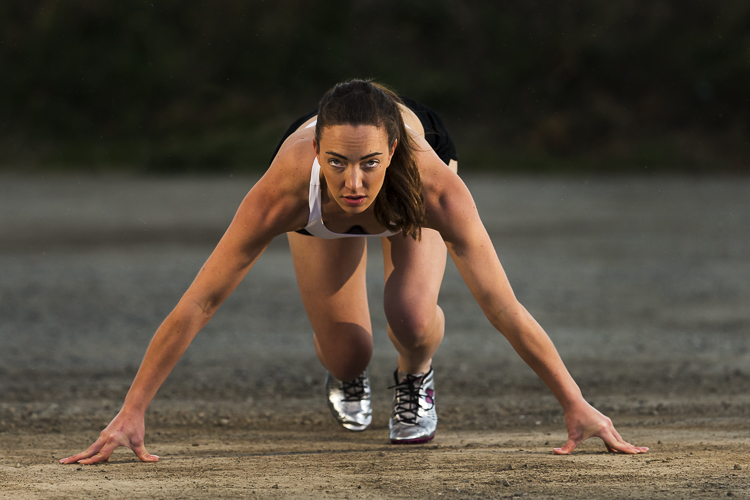
Shallow Apeture 1

A wide aperture was used her to achieve a shallow depth of field.

Dive in to read an image

To begin reading images you must have, at the very least, a good understanding of aperture, shutter speed and to a lesser extent, ISO. You’ll want to understand how these things affect the image in different ways. For example, if you saw an image with a lot of motion blur, you would know from your understanding of shutter speed that a slower shutter speed was used.

As you become more proficient with lighting and off-camera flash, you can even read how the subject was lit with artificial lighting, and begin to replicate how it was done. But don’t worry! This article will be focussing on the three major aspects of photography exposure (aperture, shutter speed and ISO) to help you begin your journey to reading images.

Slow Shutter 2

What shutter speed was used here – a fast or slow one?

Step 1: Shutter Speed – Fast or Slow?

I find that determining whether a fast or slow shutter speed was used first, can help greatly when it comes to determining aperture and ISO later. The first thing you will want to ask yourself when assessing shutter speed is; was it fast or slow? This can be decided by how much, or how little, motion blur is present in the image, as that is what shutter speed controls.

If everything in the image is pin sharp, and there is absolutely no motion blur at all, then a fast shutter speed would have been used. However, if there is a lot of motion blur, then a slow shutter speed was used.
Here are some points that you can take out of knowing if the shutter speed is fast or slow:
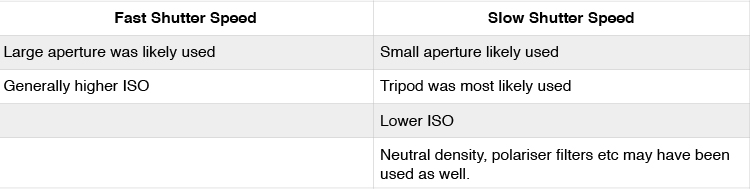
Shutter Speed Table

But how fast is a fast shutter speed, and at what point does the shutter speed become slow? To answer this, think of your shutter speed in relation to your subject’s speed. For example, when photographing sports or other fast action, you may find using a shutter speed of 1/1000th is required to freeze your subjects. This is because your subjects are moving quite fast. However, if you were to photograph people walking down the street, you would not need the same shutter speed, as your subjects are not moving as fast.

Below are examples of slow and fast shutter speeds. Notice the presence of motion blur in the images where a slower shutter speed was used, but action is frozen with a fast shutter speed. In images that will use a slow shutter speed, it is often recommended you use a tripod to stabilize your camera, and prevent camera shake.

What isn’t important is knowing the exact shutter speed; that is something that you will be able to experiment with to get the results you want. All you are doing here is identifying if a slow or fast shutter speed was used, to give you a starting point.
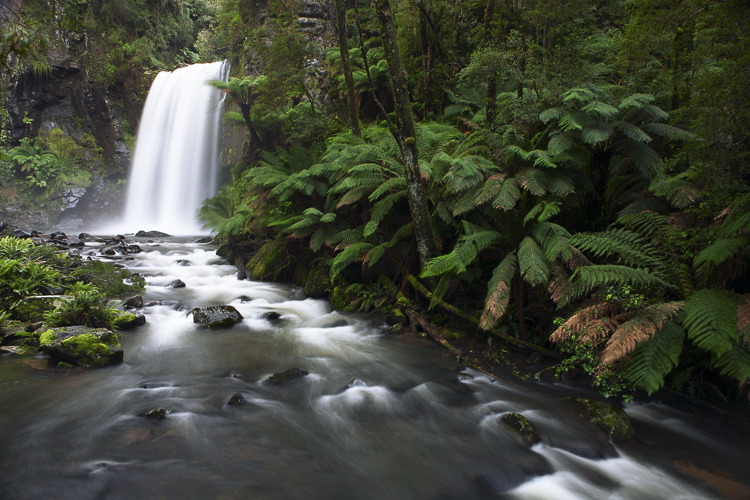
Slow Shutter 3

A tripod was used when taking this photograph to prevent blur that can be caused by camera shake. The shutter speed was 3.2 seconds.
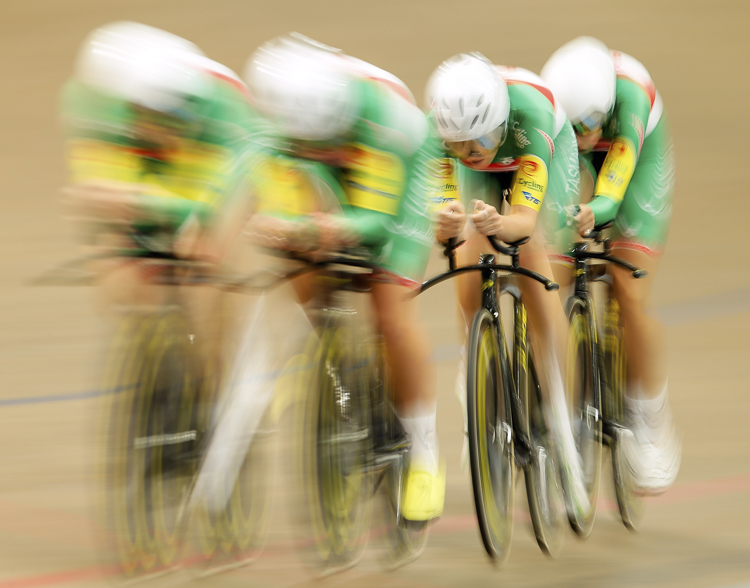
Slow Shutter 4

The reason there is one rider sharper than the others in this frame, is because even though all riders are moving at the same speed, the rider who is sharpest is moving slower, relative to where I was positioned taking this photograph. The shutter speed used here was 1/6th.

Fast Shutter 2

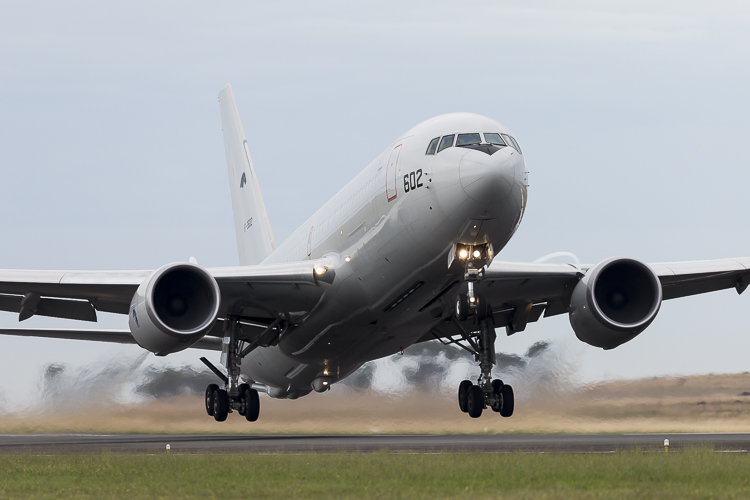
Notice how everything is sharp in this image, and there is no blur? This means that a fast shutter speed was used (in this case 1/2000th), and because the subject is quite fast, a faster than normal shutter speed was needed.
Fast Shutter 1

Again, notice how everything is sharp and there is no blur? This means that a fast shutter speed (1/1250th) was once again used.

Step 2: Aperture – Large or Small?

In step one I mentioned that determining whether a fast or slow shutter speed was used first, can greatly help you in determining the aperture. Here’s why. If you are familiar with the exposure triangle you will know that in nearly all cases when a fast shutter speed is used, it is associated with a large aperture (small f-number). Conversely, the slower the shutter speed, the smaller the aperture becomes. So if you see a photo that has motion blur present, it is highly likely that the photographer used a smaller aperture; or if you see a photo where moving objects are frozen, the photographer has most likely used a larger aperture to enable a faster shutter speed.

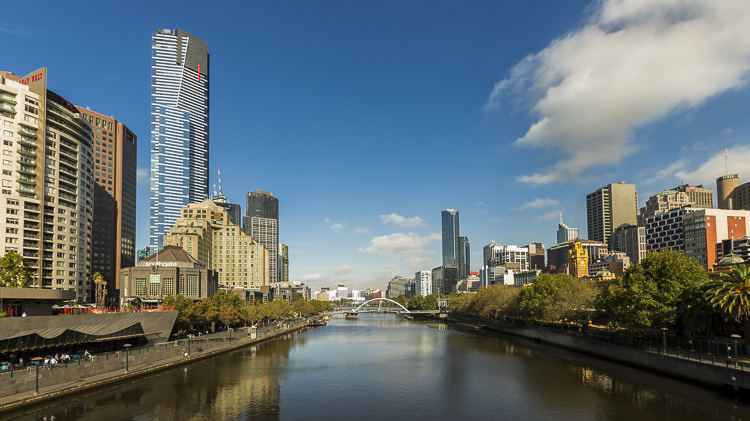
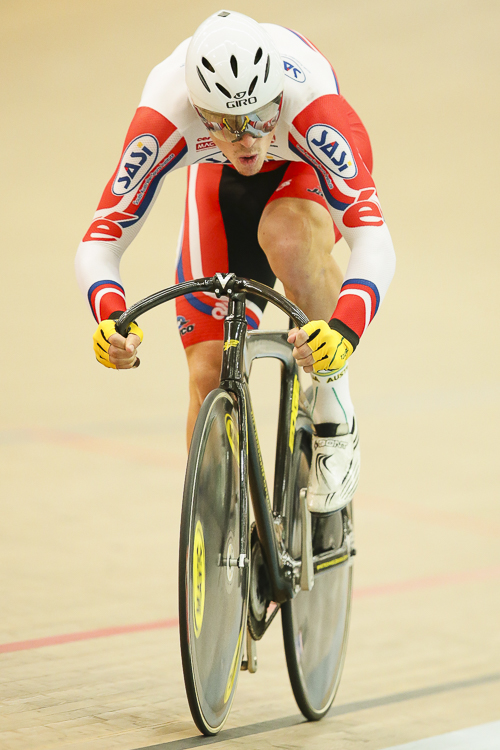
Another way you can determine the aperture is by looking for bokeh, or subject isolation. The more bokeh that is present in the image, the more the subject is isolated. To achieve this, the photographer would use a larger aperture. On the other hand, if everything in the image is in focus, then the photographer employed a smaller aperture to increase their depth of field.
Small Aperture 1

Everything in this photograph is in focus, which would mean that a small aperture (larger f-number; like f/11 in this image) was used to increase the depth of field.
Shallow Aperture 2

Notice how the background in this image is blurred out a lot, and the subject is very isolated? This is a sign that a larger aperture (small f-number; in this example f/3.5) was used to decrease the depth of field.

Step 3: ISO

ISO is one of the parameters that isn’t so important in determining what settings may have been used when reading an image. Use ISO to get the settings that you need to use, to create the shot you want. For example, if you want to use the slowest shutter speed you can, set your camera’s ISO to its lowest setting. Conversely, if you want to use a very fast shutter speed, you may find that you have to increase your ISO.

Step 4: Focal Length

Focal length is something that is often overlooked in images, but it is a very important element indeed. It does more than simply allow a photograph to add more in the frame, or zoom in closer. Different focal lengths evoke different emotions in the viewer when looking at an image. For instance, if a wide angle lens was used, it places the viewer in the scene and can make them feel like they were there; whereas a longer focal length places the viewer further away from the subject, and evokes a more voyeur emotion.

The great thing about focal length is that it is quite easy to distinguish approximately which one was used. To make it simpler, breaking down focal lengths in to three groups can help greatly.

  • Wide: <50mm (i.e. 14-50mm on full frame, 10-35mm on cropped or APS-C sensor)
  • Normal: ~50mm-85mm (35-56mm cropped sensor)
  • Telephoto: 85mm+ (130mm+ on cropped sensor)

You can use the presence of compression to distinguish the different types of focal length. A wide angle lens accentuates the foreground and increases distances in the frame, as well as having a very wide field of view. This effect increases as the focal length decreases – or gets wider. On the other end, a telephoto lens will give you much more compression, and make distances in the frame look shorter. Their field of view will decrease, and the affects of aperture, particularly larger apertures, will be more pronounced. That’s why f/2.8 at 16mm looks different than f/2.8 at 200mm, if your subject is kept the same size in the frame.

Here is a small table with examples of the same scene photographed from the same point, but with different focal lengths.
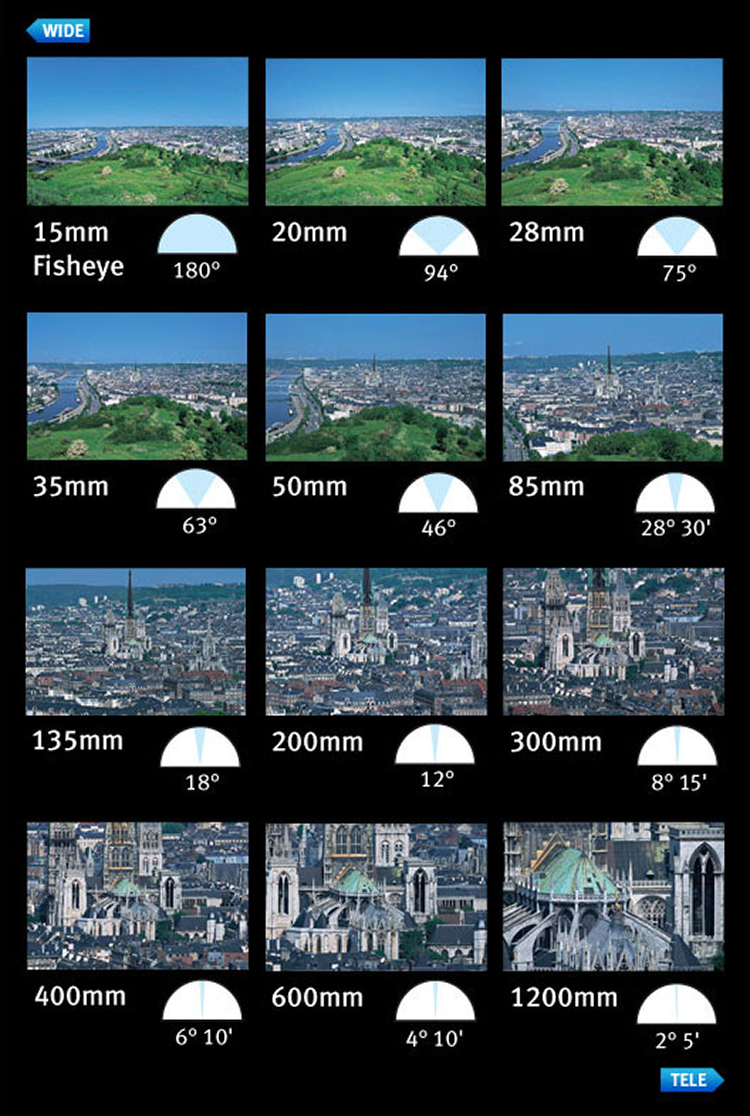
Image courtesy of Canon

Image courtesy of Canon

Now you have had a quick introduction on how to read images. Remember, knowing the exact settings is not important, but knowing how to get an approximate guess is better than not knowing anything at all! With experience, you will become more proficient at reading images, and will be able to guess with more precision. The more you understand aperture, shutter speed, and ISO, the better you will be at reading images.

Along the way, you will also learn that different genres within photography use a different set of settings. For example, most landscape photographers will use smaller apertures, lower ISOs, and slower shutter speeds; whereas sports shooters for instance, will generally use higher ISOs, larger apertures, and faster shutter speeds.

googletag.cmd.push(function() {
tablet_slots.push( googletag.defineSlot( “/1005424/_dPSv4_tab-all-article-bottom_(300×250)”, [300, 250], “pb-ad-78623” ).addService( googletag.pubads() ) ); } );

googletag.cmd.push(function() {
mobile_slots.push( googletag.defineSlot( “/1005424/_dPSv4_mob-all-article-bottom_(300×250)”, [300, 250], “pb-ad-78158” ).addService( googletag.pubads() ) ); } );

The post 4 Steps on How to Read Images and Learn to Replicate the Results by Daniel Smith appeared first on Digital Photography School.


Digital Photography School

 
Comments Off on 4 Steps on How to Read Images and Learn to Replicate the Results

Posted in Photography