RSS
 

Posts Tagged ‘production’

Samsung lens production issues could delay Galaxy S5

18 Mar

samsunga53.png

With its 16MP ISOCELL 1/2.6-inch sensor, F2.2 aperture, 4K video, reflector integrated LED-flash, water-resistant body and hybrid AF-system, the recently announced Samsung Galaxy S5 looks like one of 2014’s hottest options for mobile photographers. However problems in the manufacturing process of the S5’s new 6-element lens could delay its release in some markets. Learn more 

News: Digital Photography Review (dpreview.com)

 
Comments Off on Samsung lens production issues could delay Galaxy S5

Posted in Uncategorized


Blackmagic Production Camera 4K available now for $3000

11 Feb

blackmagicproductioncamera4kfront.png

Blackmagic Design has announced it is shipping its 4K, global-shutter camera for $ 1000 less than originally suggested. The Blackmagic Production Camera 4K is built around a Super 35mm (roughly APS-C-sized) sensor and can shoot 4K and 1080p footage in Apple ProRes 422 (HQ) or Adobe CinemaDNG Raw formats, direct to SSD. The camera offers 4K at 30p, 25p, 24p and NTSC equivalents. It has a Canon EF-compatible lens mount, offering electronic aperture control with Canon and Zeiss lenses. It is available for $ 2,995.

News: Digital Photography Review (dpreview.com)

 
Comments Off on Blackmagic Production Camera 4K available now for $3000

Posted in Uncategorized


Poll update – what post production software do you use the most?

23 Dec

We ran this poll last in February of 2009, so I thought it was time for an update to see if there have been any changes since last time. I’m especially curious about any Adobe offerings since the Creative Cloud too affect. Has that swayed your software choice?

Tell us what post production software you use the most. If you use more than one, indicate the one you use most often, for most of your editing needs. For example I use Lightroom and Photoshop CC, but LR5 is my primary tool as I use it for 90% of my editing.

By filling this in you will also be giving us direction in what types of articles and tutorials we post in the future. So please share and add a comment below if you want to give us additional information.

>I’ve included the eight most popular tools mentioned last time we asked this question to readers (I’ve combined all Photoshop versions into one for simplicity). I know others of you use Noise Ninja, Bibble Pro, ACDSee and others – feel free to tick the ‘others’ option and tell us in comments below what ‘other’ one you’ve chosen.

If you use more than one feel free to tell us about that too.

Note: There is a poll embedded within this post, please visit the site to participate in this post’s poll.

The post Poll update – what post production software do you use the most? by Darlene Hildebrandt appeared first on Digital Photography School.


Digital Photography School

 
Comments Off on Poll update – what post production software do you use the most?

Posted in Photography


Deal 9: Discover the Secrets of Post Production for Just $7

22 Dec

On the 9th day of our countdown we’re putting up for grabs our very own post-processing eBook “Photo Nuts and Post” for just $ 7.

To order before time runs out head here.
Photo nuts and post 1

A little bit of info about this Post Processing eBook

The creative choices and opportunities in ‘post’ are almost as great as they are in the capture of the photo itself, and almost every photo can be improved with a little post-processing.

Photo Nuts and Post will help you tackle post processing head-on and give you the tools and the courage you need to make it work for you.

Today it’s a steal at just $ 7 (normally $ 29.99) — but the clock is ticking – this offer lasts for 24 hours only.

Want the Complete Neil Creek eBook Collection?

NewImage
Photo Nuts and Post is just one of 5 dPS eBooks by Neil Creek.

Today you can grab the entire photo nuts collection of 4 eBooks plus we’ll include our Trick Photography eBook for just $ 39.99 (normally $ 120).

That’s $ 8 per eBook and a pretty massive saving!

In the bundle you’ll get:

  • Photo Nuts and Bolts – Know Your Camera and Take Better Photos
  • Photo Nuts and Shots – Tools and Techniques for Creative Photography
  • Photo Nuts and Post – A Guide to Post-Processing
  • Photo Nuts and Gear – Know Your Gear and Take Better Photos
  • Photo Magic – Special Effects Photography Made Easy

This bundle is ideal for anyone wanting to get creative control over their camera and create beautiful images.

Grab Yours Today

The choice is yours – you can grab Photo Nuts and Post for $ 7 or pick up the whole Neil Creek Collection – it’s totally up to you.

All the details can be found here – but don’t delay, this deal lasts only for 24 hours.

The post Deal 9: Discover the Secrets of Post Production for Just $ 7 by Darren Rowse appeared first on Digital Photography School.


Digital Photography School

 
Comments Off on Deal 9: Discover the Secrets of Post Production for Just $7

Posted in Photography


Matching the Production Style to the Image – High Energy Means High Contrast

31 Oct

Introduction

The Following is an excerpt from the SLR Lounge Lightroom Preset System v5 and accompanying workshop from the Lightroom Workshop Collection v5.  The Lightroom Preset System is designed to take you from Ordinary to Extraordinary photos in just a few seconds and clicks within Lightroom 4 and Lightroom 5.

Overview

One thing that we like to do within our studio is match the post production style to the overall emotion and story within the image. We feel that doing so leads to a much stronger overall image.

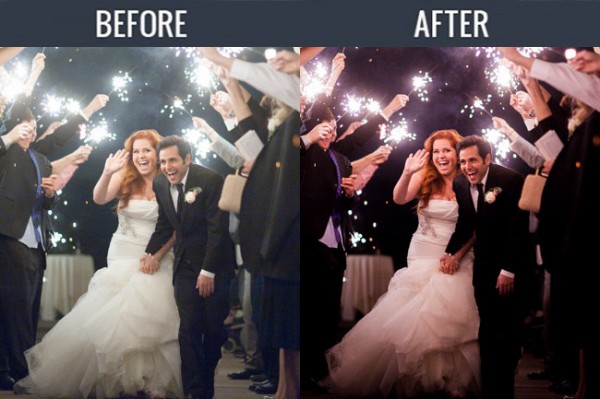
So in scenes that have a lot of energy, we want to emphasize the excitement with a colorful, high contrast production style. For this tutorial, we are using this sparkler exit photo which should be well complimented by the high contrast edit. The SLR Lounge Lightroom Preset System v5 has presets specifically for high contrast portraits which we are going to apply to this photo. Not to worry, we are going to demonstrate all of the settings below.

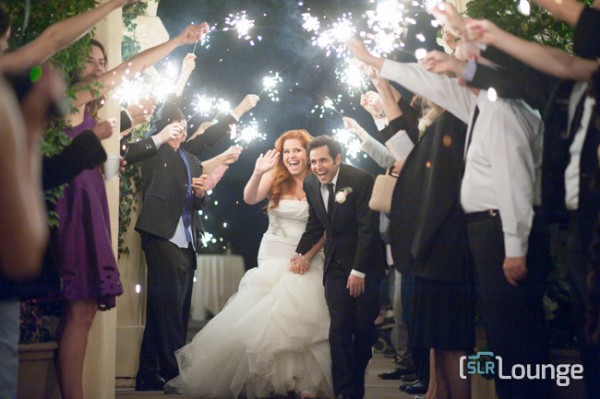
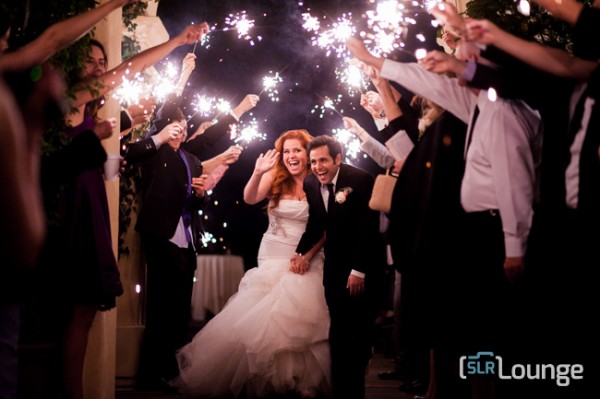
Here is what our image looks like before and after our presets are applied.

beforeandafter

Lightroom Preset System v5 Mixology

For those who have the Preset System, you can follow the Mixology Recipe below to get to the same results. If you don’t have the Preset System, please read the article or watch the video below to see exactly how this look was achieved.

Develop Mixology
01-10 BASE-SOFT: 14a. Heavy Crush – Skin Desat

Local Adjustment
Radial Filter: 03 Burn (Darken) -0.5 Stop (watch video tutorial for reference)

Written Tutorial

Step 1: Checking the EXIF data

Screen-Shot-2013-08-12-at-3.40.04-PM

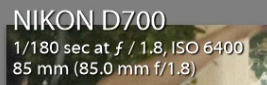
The first thing we generally do is take a look at how the image was shot. Doing so, gives us a lot of information on things we need to look out for when post producing. To check the EXIF data press ”i”.  This image was shot with a Nikon D700 at ISO 6400. This is important to keep in mind because Nikon cameras tend to shoot skin tones slightly green, and this high of an ISO might also present a noise issue.

Step 2: Apply Preset

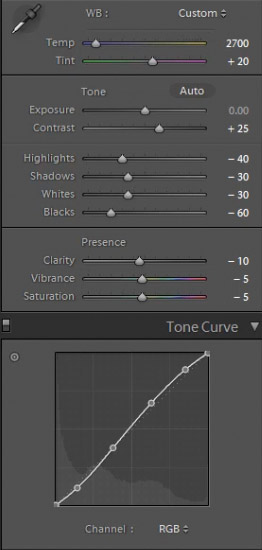
After we adjust Color Temperature and Tint to taste, we apply the “01-10 BASE-SOFT: 14a. Heavy Crush – Skin Desat” preset. This preset adds contrast to the photo and makes adjustments to desaturate skin tones.  The Contrast is being raised and the Shadows and Blacks are being dropped in order to boost overall image contrast. To flatten out the highlights over skin tones, we have dropped the Highlights and Whites.  In the Tone Curve we have a subtle “S” shaped contrast boosting tone curve to add a bit of contrast back specifically where we need it.

Here are the final Basic and Tone Curve Panel settings:

developpanal

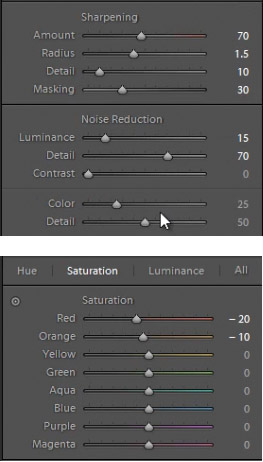
We have our standard Sharpening and Noise Reduction adjustments applied to this image. Even though this image was shot at a high ISO,the D700 takes such great photos at ISO 6400 that we don’t have to raise any of the Noise Reduction Luminance beyond what we already have.

In the HSL our Reds and Oranges are slightly dropped in order to desaturate heavy reds and oranges that can appear within skin tones when we are doing a high contrast edit.

developsettings1

Step 3: Add Radial Filter

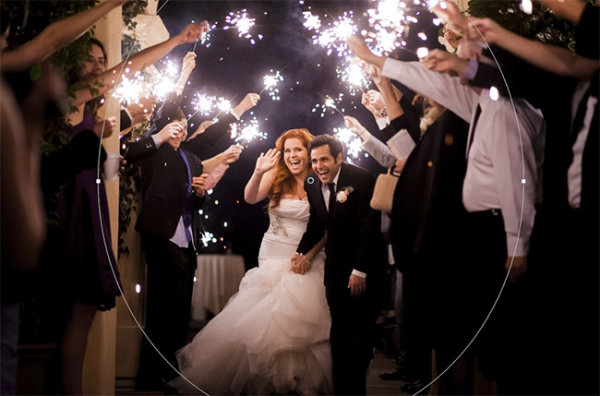
The last thing we’re going to do is add a Radial Filter to this image. This filter is unique to Lightroom 5, but Lightroom 4 users can get the same effect by adjusting the vignette settings, or by using an Adjustment Brush and painting around the outside of the image.

radialfilter

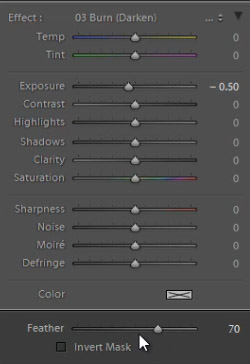
We’re pairing the Radial Filter with our “03 Burn (Darken) -0.5 Stops” preset to get a nice vignette around our couple. We adjust the Feather to 70 to make the effect more subtle.

radialfiltersettings

Some people may comment that shadow details are being clipped, but that’s okay for this image. Remember, we edited this image to fit the mood and energy, not for it to be technically “color correct.” Making this high energy photo a high contrast one is a stylistic choice, and we love the way it looks. Here’s what our photo looks like before and after our edit.

Before

lightroom-5-tutorial-high-contrast-portrait-0001

After

lightroom-5-tutorial-high-contrast-portrait-0002

Watch the Video Tutorial

If you would like to see exactly how all of the settings and adjustments were applied, please watch the video from the SLRLounge youtube video channel.

Conclusion and Learn More

We hope you all enjoyed this tutorial. If you are interested in learning more or purchasing the SLR Lounge Lightroom Preset System v5 or the newly released Lightroom Workshop Collection v5, please click any of the links in this article.

Post originally from: Digital Photography Tips.

Check out our more Photography Tips at Photography Tips for Beginners, Portrait Photography Tips and Wedding Photography Tips.

Matching the Production Style to the Image – High Energy Means High Contrast

The post Matching the Production Style to the Image – High Energy Means High Contrast by Post Production Pye appeared first on Digital Photography School.


Digital Photography School

 
Comments Off on Matching the Production Style to the Image – High Energy Means High Contrast

Posted in Photography


Samurai Girl Composite: Behind the Scenes Post Production Walk Through

29 Aug

by Tom Di Maggio

In this article I’ll show you how the “Samurai Girl” picture was done step by step. In addition there is a speed art video at the end of the article that shows the whole process from start to end in a 05:47 minutes Youtube video. It should make the whole process clearer.

Feel free to send me your questions via email at tom@purple-monkey.com
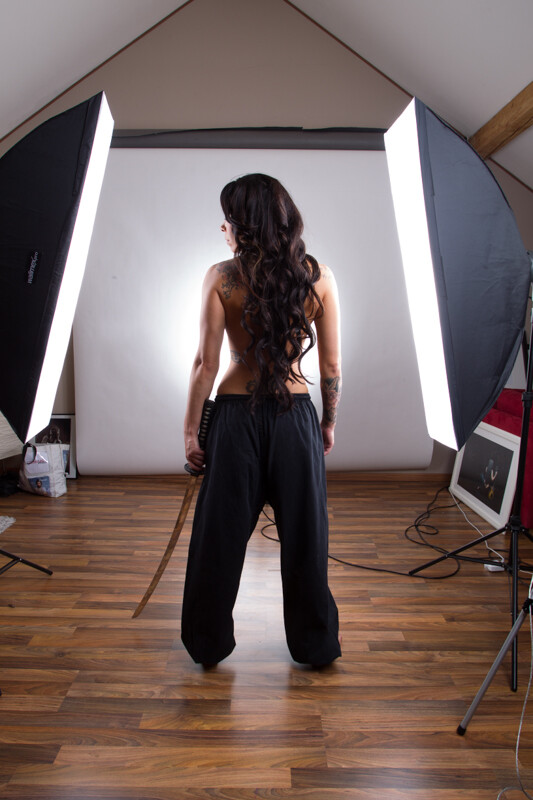
1 Base Image Jessica

Here is the image as it was shot. Before I start to extract the subject I use a technique to create that look on my models that consists of 6 Layers. I will write a separate tutorial on that topic, as it will deviate too much from the point of this tutorial.
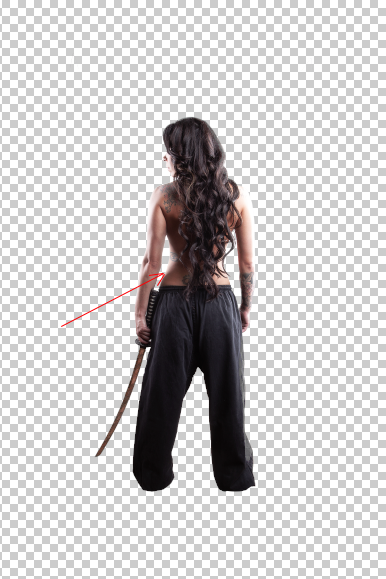
2 Model Liquify copy

I started with cutting out Jessica from the background. When you know that you are going to extract the subject for a photo manipulation or composite, make sure you shoot them on a background that will create an nice contrast around the edges. It will make your life a lot easier for the extraction process. The method I use to extract my subjects varies a lot depending on the need and the situation. The tools I usually use are the Pen Tool, Brush, Refine Edge, Lasso, Quick Selection and the Blending Option effects. In this case I used a mixture of Pen Tool, Brush and Refine Edges.
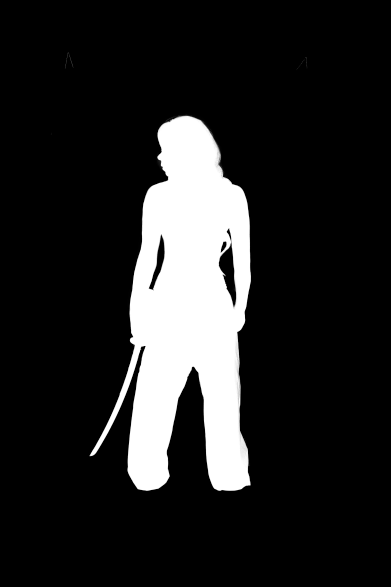
3 Mask

Here is a picture of the finished mask. I like to check the mask for imperfections by “Alt” clicking on the layer mask.. What I also do a lot is to check the mask against a white and a black background. I will usually show you all the imperfections on the mask especially fringing. If the extraction looks good against both backgrounds, then you can be sure that you won’t need many adjustments anymore against your final background.
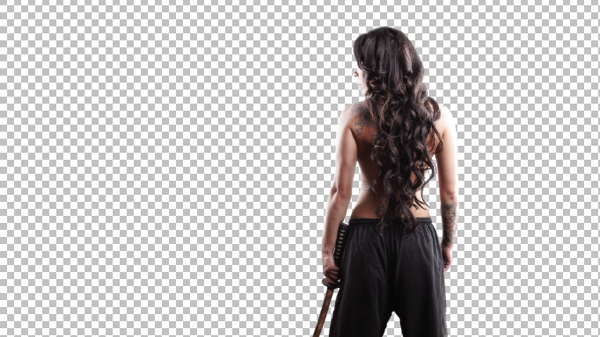
4 Integrate into Image

I usually work on picture in the 16:9 format. Sometimes I quickly sketch my ideas on a piece of paper or on the iPad. I basically gives me an idea about the composition of the image. As soon as Jessica was extracted from the background I moved her over to the canvas using the move too. I scaled her down and positioned here approximately. I slightly corrected her position once the background was inserted.
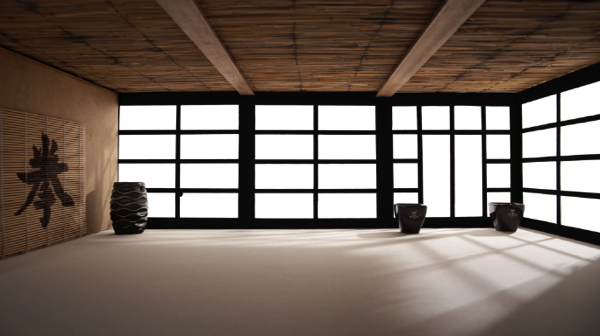
5 Original BG

At this point I also imported my background in order to see what color corrections would be needed to integrate Jessica into it. When I opened the stock image for my background I saw some things that would need modification.
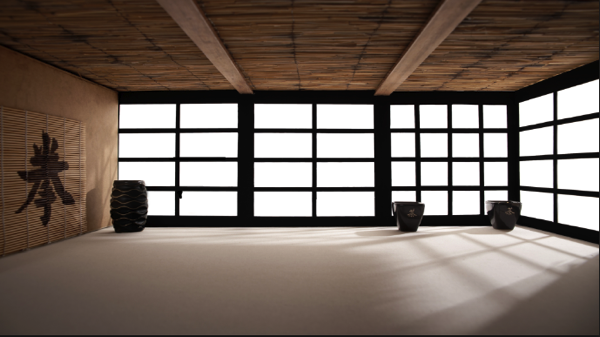
7 Corrected Bg

I didn’t like the doors on the right side as it would look weird when Jessica would be in position. So I just added some horizontal bars to solve that issue.
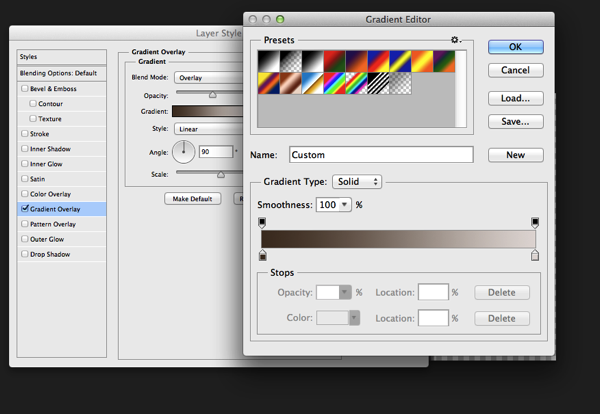
6 Gradient for Model

The first step I used to integrate Jessica was a Gradient map. The colors I used for the shadows was a sample of the wooden door frame (very dark brown) and for the highlights I used a sample of the Tatami. I lowered the opacity to about 45% to achieve an acceptable value. It’s important when you use this method that you use colors that are already present in the palette of the image.
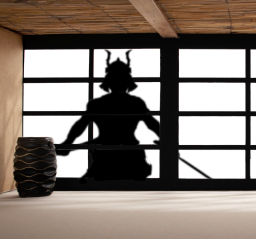
8 Samurai

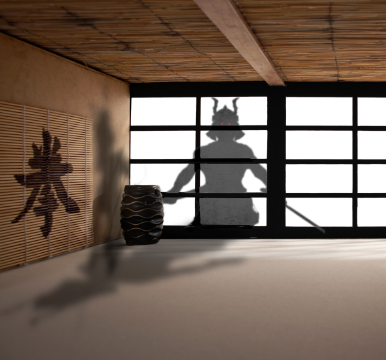
Next step was to integrate the Samurai. I’ve build the Samurai out of several stock photos and used an adjustment layer to darken it to complete black. I used a layer mask to hide the wooden frame of the window.
9 Samurai Eyes

In order to make it more realistic I’ve added a dirty texture on top of the Samurai with a blending mode Overly and I slightly blurred him, since what we actually see is a shadow on the fabric. I then added the eyes with the brush tool and some subtle outer glow effects.

Next step was to create the shadows on the floor and the wall. I duplicate the Samurai Layer and used distort and warp to adjust it’s shape. I also painted the shadows onto the barrel, in the original picture the barrel was brightly lit from the right side. Since the Samurai is standing in front of it, the light source would be blocked.
13 Overlay Color

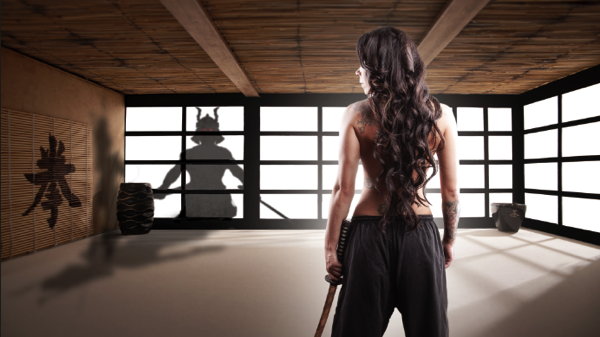
To blend everything together I use a simple technique that is not well known out there. I merge all the Layers together onto a new Layer ( Shift+Ctrl+Alt+E (PC) or Shift+Command+Option+E (Mac) ) and then use the Blur Average Filter. Switch the blend mode to overlay and reduce the opacity until the color matches. I then used the Tilt-Shift filter to align the average depth of field of Jessica to the background.
14 tilt Shift and Light

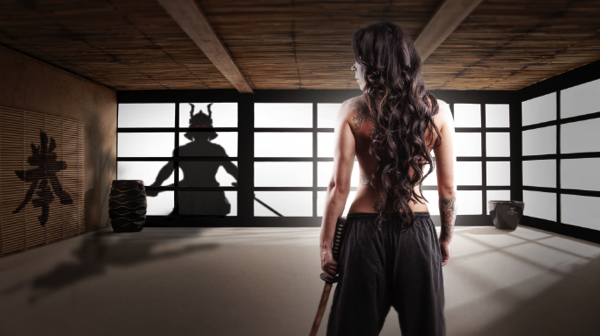
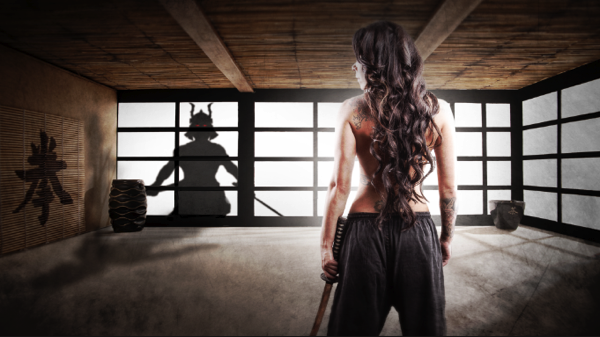
Finally I created a new layer on top of it change it’s blending mode to overlay and painted with a soft black brush around the samurai and around Jessica in order to direct the viewers eye through the picture. A last step was to lay a grungy texture in overlay over the whole image and reduce it’s opacity quite a bit.
15 Final

I try to do a maximum in Photoshop in terms of light and shadows. But when I finish an image I always have some fun in Lightroom with some presets or simply play around with the sliders. Some times I end up not using any of it, but most of the time I find some settings that adds value to the overall image. Now there is no secret to this, I just play around with Clarity, Blacks, Temperature, and Contrast until I see it going somewhere. In this case I added some contrast, quite a bit of Clarity and slightly desaturated the image.
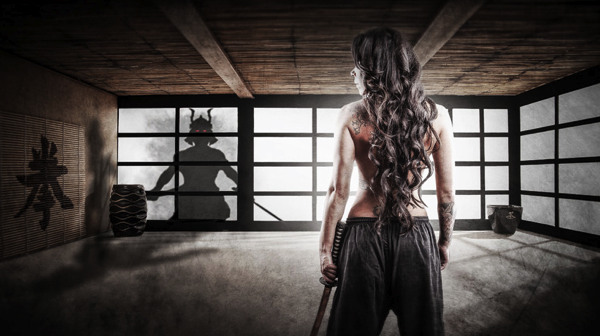
16 Final LR

Here’s the video of the whole process dialed up to about 1000%

Check out more of Tom Di Maggio’s work at his websites at TomDiMaggio.com, Purple-Monkey.com” and on Facebook.

Post originally from: Digital Photography Tips.

Check out our more Photography Tips at Photography Tips for Beginners, Portrait Photography Tips and Wedding Photography Tips.

Samurai Girl Composite: Behind the Scenes Post Production Walk Through


Digital Photography School

 
Comments Off on Samurai Girl Composite: Behind the Scenes Post Production Walk Through

Posted in Photography


10 August, 2013 – Edward Curtis and Helicopter Production

10 Aug

Two new articles grace our pages today. The first is titled Edward Curtis, The Man Who Never Slept, by Eric Miola.

The second is the opening helicopter sequence to our Capture One 7 video training tutorial, which we just completed shooting. A helicopter sequence? Seriously? Yup.

"Having been to Antarctica with Michael and Kevin, I would say after having traveled the world and shot nearly my entire life as an exhibiting photographer,  it was one of my highlights in my life and I talk about it, all the time.  The images and experience of seeing something visionary and nearly extinct from the world, to see and experience the wildlife and scenery that does not fear humans is amazing.  The images I shot there won me two Smithsonian awards and nearly 18 other international awards". – Tim Wolcott

 Find Out More Now
These Expeditions Will Sell Out Quickly. They Always Do

 Find Out More Now
These Expeditions Will Sell Out Quickly. They Always Do


The Luminous Landscape – What’s New

 
Comments Off on 10 August, 2013 – Edward Curtis and Helicopter Production

Posted in News


Lomography raises more than $1M for production of new Petzval lenses

09 Aug

Petzval.png

Lomography’s campaign to raise funds to bring the centuries-old Petzval lens back into production via Kickstarter has now raised more than $ 1 million – ten times the original target. The ‘New Petzval’ lens looks and functions much like the originals, with a brass exterior, and the aim is to produce it in both Canon EF- and Nikon F- mounts. The lens is expected to be available next spring. 

News: Digital Photography Review (dpreview.com)

 
Comments Off on Lomography raises more than $1M for production of new Petzval lenses

Posted in Uncategorized


Lomography raises more than $1M for production of new Petzval lenses

09 Aug

Petzval.png

Lomography’s campaign to raise funds to bring the centuries-old Petzval lens back into production via Kickstarter has now raised more than $ 1 million – ten times the original target. The ‘New Petzval’ lens looks and functions much like the originals, with a brass exterior, and the aim is to produce it in both Canon EF- and Nikon F- mounts. The lens is expected to be available next spring. 

News: Digital Photography Review (dpreview.com)

 
Comments Off on Lomography raises more than $1M for production of new Petzval lenses

Posted in Uncategorized


6 August, 2013 – The Setup…preparing for our next video production

06 Aug

Here’s s short video showing taking apart my studio to set up for filming our next major training video – this time on Capture One 7. Four hours in 45 seconds.

"Having been to Antarctica with Michael and Kevin, I would say after having traveled the world and shot nearly my entire life as an exhibiting photographer,  it was one of my highlights in my life and I talk about it, all the time.  The images and experience of seeing something visionary and nearly extinct from the world, to see and experience the wildlife and scenery that does not fear humans is amazing.  The images I shot there won me two Smithsonian awards and nearly 18 other international awards". – Tim Wolcott

 Find Out More Now
These Expeditions Will Sell Out Quickly. They Always Do


The Luminous Landscape – What’s New

 
Comments Off on 6 August, 2013 – The Setup…preparing for our next video production

Posted in News