RSS
 

Posts Tagged ‘Practicing’

How Practicing Abstract Photography Can Influence Your Photography

05 Feb

The post How Practicing Abstract Photography Can Influence Your Photography appeared first on Digital Photography School. It was authored by Megan Kennedy.

practicing-abstract-photography

Also known as experimental, non-objective or conceptual photography, abstract photography depicts imagery removed from the immediately identifiable subject matter. Gaining momentum at the hands of photographers like Alvin Langdon Coburn and Paul Strand, practicing abstract photography explores the bare bones of image-making.

Abstraction has performed a critical role in pushing the boundaries of the photographic medium. In this article, we’ll look at ways in which abstract photography can inspire your creative approach to all photographic genres.

Practicing abstract photography slow shutter speed

f/18.0, 1/25, ISO 400, Canon 5D Mk II with a Canon EF 24-105mm f/4L IS USM lens

Focusing on detail

One of the most predominant ways to create abstracted imagery is through isolation.

Isolation in abstraction involves zooming in on detail, creating a study of subject matter that may otherwise go unnoticed. Through isolation, context is replaced with an emphasis on intimate detail. By elevating detail, the unnoticed subject matter is given a new visual significance.

Abstraction places a great deal of importance on details. As a result, many abstract photographers develop a strong sense of detail in any situation.

Naturally, an eye trained for subtle details proves useful in other facets of photography too. It allows a photographer to pinpoint interesting elements of a scene with greater efficiency.

By practicing abstract photography, the photographer becomes attuned to the visual weight of unique subject matter. This translates to deeper, more engaging photography as a whole.

Image: f/7.1, 1/400, ISO 100, Canon 5D Mk II with a Canon EF 24-105mm f/4L IS USM lens

f/7.1, 1/400, ISO 100, Canon 5D Mk II with a Canon EF 24-105mm f/4L IS USM lens

Experimentation

Abstraction expands on our understanding of the photographic medium through re-invention.

Of course, experimentation is not limited to abstraction. However, abstract photography emphasizes alternative approaches to subject matter. This stimulates creative thought which then flows through to other areas of photography.

Alternative processes, in-camera techniques, image manipulation…abstraction emphasizes the expression of fresh creative possibilities through constant experimentation.

Photographers like Andrew S. Gray, Wolfgang Tilmans and Barbara Kasten all push the boundaries of photographic art. Their work, and the work of countless other abstract photographers, is proof that practicing abstract photography expands the creative horizon of photography as a whole.

Practicing abstract photography experiment

f/1.8, 1 second, ISO 100, Canon 5D Mk II with a Canon EF 50mm f/1.8 II lens

Creating something unique

Abstract photography is highly subjective – every photographer approaches abstraction from a unique perspective.

This means that individual emotions, experiences, and ideas are embedded in abstract visual responses. The more you practice abstract photography, the easier it will be to identify abstract subject matter that fascinates you. It will open up more and more opportunities to hone your skills.

There is no right or wrong way to create your own abstract photography.

In fact, you may not even need a camera.

Because of this, practicing abstract photography provides a free space to forge a unique aesthetic that inevitably carries through to other facets of photography.

Practicing abstract photography blue unique

f/4.0, 1/40, ISO 500, Canon 5D Mk II with a Canon EF 24-105 f/4L IS USM lens

Pressing the reset button

Adhering to the more formal qualities of photography can sometimes culminate in creative fatigue. Abstraction tends to relax the grip of the photographic convention, adhering instead to the instinctual responses of the photographer.

This means that practicing abstract photography can provide a much-needed reset button for photographers suffering from creative weariness.

Abstraction beckons the photographer to capture subject matter that resonates on a personal level. Satisfying lines, intriguing textures, ephemeral colors…Practicing abstract photography reconnects a photographer with the basics of photography and creativity.

Practicing abstract photography color

f/2.2, 1/800, ISO 100, Canon 5D Mk II with a Canon EF 50mm f/1.8 II lens fitted with a 36mm Kenko extension tube

Honing in on composition

Although lacking in objective subject matter, abstraction still relies on the principals and elements of design to cultivate imagery. Elements like form, line, color, and texture are as relevant to abstract photography as they are any other genre. Likewise, precepts such as the rule of thirds or leading lines can also shape the way an abstract image is digested.

Practicing abstract photography coaxes out reflexive responses to image-making, revealing gaps in compositional knowledge and introducing new approaches to subject matter.

Compositional instincts honed within the bounds of abstraction spill over to other types of photography too, revealing practical insights into your own image-making process.

Practicing abstract photography composition pattern

f/4.0, 1/15, ISO 1250, Canon 5D Mk II with a Canon EF 25-105 f/4L IS USM II lens

Conclusion

Abstract photography is sometimes approached with confusion or trepidation. However, in practice, abstract photography is often a liberating and invigorating undertaking.

Though lacking in specific subject matter, abstract photography operates on creativity, critical thinking, and personal growth. Without the freedom that abstract photography affords, photography would be a much more rigid and prescriptive undertaking.

Abstract photography encourages a focus on detail, experimentation, and skill. It can also be a welcome respite from creative fatigue. Availing itself to the unique inclinations of the individual photographer, practicing abstract photography builds on the foundations of the photographic process.

Share with us your abstract photography in the comments!

The post How Practicing Abstract Photography Can Influence Your Photography appeared first on Digital Photography School. It was authored by Megan Kennedy.


Digital Photography School

 
Comments Off on How Practicing Abstract Photography Can Influence Your Photography

Posted in Photography


12 Tips for Practicing Good Camera Etiquette When Photographing Events

07 Jul

It’s easy to get excited about having a good camera you can take with you to various events and activities. Being able to record the event in images to print or share is exciting and sometimes a nice thing to do for the people holding the event. But do you follow good camera etiquette? And what does that even entail? Let’s have a look.

camera etiquette - concert photograph

Low light situation with bright coloured stage lights made this shot difficult. I wanted to capture the colours of the lights, so I chose not to use my flash.

People attending the event may appreciate being on the other side of your lens. Some people are uncomfortable when faced with big professional looking cameras. Other people just want you to sit down and stop blocking the view for everyone behind you.

It can be a challenge to balance your desire to capture those special moments against a level of intrusiveness into the occasion. What are your options? What should you consider in advance?

camera etiquette - 2 ladies dancing

#1 – Is it appropriate?

Some religious ceremonies may not be the place to take a camera along. Photographing other people’s children is now something to be done with caution for a variety of security reasons. Are you blocking the view of other participants? Are you being a distraction? Have you just blinded everyone with your flash?

Were you asked to bring your camera along to the event and shoot? Have you got permission or approval to be shooting? These days it can be assumed that images will be shared online, not everyone may want to have their images shared, or to be tagged or identified in some way.

You can share relevant images of an event without showing the faces of attendees

#2 – Use discretion in your approach

So you rock up with a big DSLR body, big long lens, and your camera is clicking away audibly over the hushed sounds in a church. People are looking at you over their shoulder, others are grumbling about you being in their way. Maybe your flash just scared the birthday boy and he is now crying and scared? Sound familiar?

Being there with your camera doesn’t give you the right to impose or interfere with the event. Even a professional wedding photographer is there to be discrete, to capture the images without being the focus of the event. So standing up in the audience, blocking the view behind you isn’t okay. Distracting the performers or people involved with the loud shutter sound is not okay. Getting in the way of people to get the perfect shot is not the point of the event from everyone else’s point of view. They probably paid to be there too.

If you can’t get into the front row easily, if you feel you have to use your flash in a dark venue, if you are getting in the way of attendees or other people, then learn to identify a better time and place to be shooting. Enjoy the event instead and put the camera away.

good camera etiquette

Flash was used in this instance with the permission of the dancer, who was performing for our camera club. I specifically wanted to throw the background into darkness so the bright colours of her outfit glowed.

#3 – Get permission

Have you checked that cameras and photography will even be allowed at the event? Plenty of concerts, plays and similar events specifically ban photography. Sometimes they will announce it on stage before the curtain rises. Some venues specifically ban professional looking equipment, so are you prepared to have yours confiscated at the gate?

Depending on the country you live in, people have rights over how images of them are used. So they have the right to deny you the ability to take shots of them, especially at a private or family event. Not only should you ask for permission to shoot in advance, you should also clarify about what will happen to the images. Will you be sharing them online? Are people okay with that? Do you have model releases for images you might want to use commercially or in competitions?

good camera etiquette

This steampunk lady and her partner not only agreed to pose, they also signed model releases for me.

Are you shooting architecture? Have you checked what approvals may be required? Many buildings that you may assume have public access are actually privately owned. Some do have limitations on photography, especially if it’s a busy space and you want to set up a tripod in the middle of it. It is easy to think you have the right to shoot anywhere you want, but to avoid an uncomfortable situation with a security guard or police, do your homework in advance.

good camera etiquette

A day out shooting airsoft was lots of fun – I was taken along by one of the organizers who made sure I followed all the safety protocols.

#4 – Flash is rarely a good idea

Many events are held in quite dark spaces like; concerts, plays, musical events, sports, dancing, etc. Everyone in the audience is sitting in the dark, watching the action happen under the stage lights. Imagine how annoying it must be for someone to stand near the edge of the stage and light up the place with a camera flash repeatedly. Imagine how annoying and distracting (and potentially dangerous) it must be for the performers to have the flash bombarding them.

If you are in a low light situation where you cannot obtain good images with the gear you have, then put it away. If you need to do a lot of low light work, you may want to consider investing in a body with good ISO performance and a fast prime lens. But otherwise, don’t be the jerk with the camera spoiling it for everyone else by having your own fireworks show while you are trying to shoot.

good camera etiquette

Shooting an indoor swing dance event using a 50mm f/1.4 prime lens to maximize the use of available light and reduce the need to use flash allowed for more intimate images, as the dancers didn’t notice I was there most of the time.

#5 – Avoid conflict

Are you at a wedding or other event where a professional shooter has been engaged? Did you go up to them, introduce yourself, mention you had a camera and ask if it was alright with them if you grabbed a few frames for your own personal records? Did you gracefully put your camera away when they said no, that they didn’t appreciate an amateur getting in the way? Do you respect the wishes of the people organizing the event and allow the professional to do their job?

Did you avoid conflict with someone being paid to do their job, or did you cause a scene or aggravate them with your attitude? Were you professional?

If someone asked you not to take photos of them, did you agree? If someone asked you not to post images of them online, did you shrug and do it anyway? Did you consider your right to shoot and post more important than that of the people whose images you are using to promote yourself?

Are you covered legally if something bad happens as a result of your photography interference?

good camera etiquette.

This lady walked into my shot and is saying oops!

#6 – Participate and be present

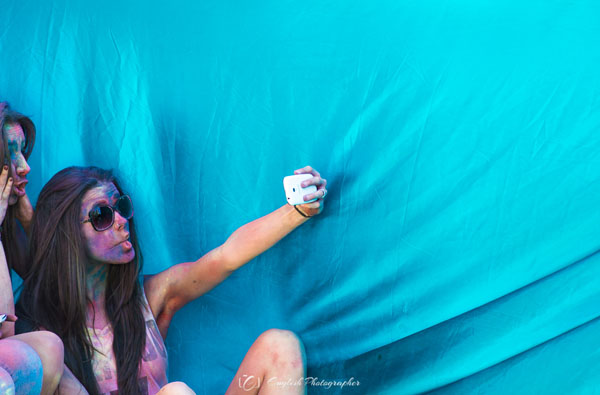
How many times do you get asked along to a family event or social occasion? A few?  People are generally pleased to see you and chat and catch up about things. What happens when you bring your camera out? Are people then avoiding you? Do the invites stop coming?

Ask yourself an important question at any event you are tempted to take your camera along to – especially if it involves family or friends. What is more important – the people you are with and the event you are celebrating or is it your camera and photography?

Sometimes it is more appropriate for you to leave the camera behind, to actually be present and participate in the moment. To talk to and connect with people without the barrier of a camera lens between you.

Pick your occasions, your sister may be delighted by your offer to shoot your niece’s first school play outing (but the school or the other parents may not be). Or you could sit in the audience and enjoy the special moment for what it is.

good camera etiquette

Don’t forget to enjoy the barbecue!

#7 – Personal security

Walking the streets, or being in a big crowd with expensive camera gear hanging off your shoulder can be a dangerous exercise. Camera gear is obvious, people see you using it, and the big flashy stuff is usually worth a reasonable amount. Are you paying attention to your personal security and that of your gear? Do you want to be out alone at night in the city getting the gritty street shots?

Traveling to other countries is exciting, but they have different laws and situations. Have you studied in advance to make sure you are not causing any offences? Do you walk around with big branded straps on your camera and on your bags? Are you a walking advertisement for expensive camera gear just waiting to be grabbed when you leave it on a chair in a restaurant? Dress to blend in when you can.

camera etiquette

#8 – Don’t waste people’s time

Is your camera all set up and good to go for the lighting conditions you might encounter? Or are you standing there fiddling with the buttons while your subjects stand there awkwardly, wondering what’s going on?

good camera etiquette

Be ready to capture the best and most genuine smiles.

#9 – Engage your subject

This may well depend on the circumstances, but an image of someone looking at the camera and sharing some emotion makes for a far more powerful image, than a furtive capture from the sidelines. Take the time to say hello, introduce yourself, and explain why you are taking pictures.

Ask their name, if they are okay with you photographing them. Talk a bit about the event, get them interacting with you. Be sincere, everyone has an interesting story to tell, if only you take the time to listen. A few minutes is all it takes but the difference in the quality of the images will be huge. Plus it’s polite to treat people like people, and not just objects for your photography amusement.

good camera etiquette

I spent an afternoon with these lovely ladies at a Zombie Run and we had lots of time to get to know each other. So they were happy to spend some time lurching towards my camera when I proposed the idea.

#10 – Don’t compete for attention

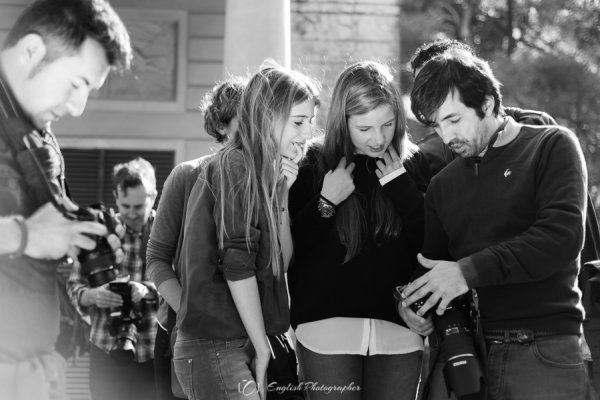
If there are several photographers at an event clamouring for attention, you will get different people looking in different directions within the same image. The end result is not as nice as it can be, and can matter for things like group wedding shots. So wait your turn to get in front of the subject, don’t try to shoot at the same time as someone else (especially a hired pro doing their job!), and potentially ruin both your images.

good camera etiquette

I have the attention of two of the three guys, the one on the right is looking at another shooter next to me.

#11 – Take no for an answer

Some people hate having their photo taken, regardless of the situation or approach. There are many reasons for people not to want to be in front of your camera, so be respectful of their wishes. If they ask you to delete any images they are in from your memory card, then do it. If asked not to post images of people online, don’t. Your rights as a photographer are not more important than those of the your subjects.

good camera etiquette

#12 – Act professional even if you aren’t a pro

Lots of photographers hope to make money out of their hobby and interacting with customers is a key part of the business. Even if you are new and learning, be professional and courteous. Eventually when you are taking paying customers, you will have developed good habits and hopefully a good reputation as well. It will pay off. Have a business card with some contact information to assure people you aren’t a creep with a camera, but a genuine photographer. Who knows, it might also generate some new business for you.

good camera etiquette - dance troupe

This troupe performed at an event I was at and while I was taking some portraits in the lobby they saw me and asked me to photograph them. As I was happy to do that, then they asked if I could get a shot of this guy doing a high kick. The lighting was terrible and my camera wasn’t really up to it, but I agreed, took a few shots, and emailed the best ones to them the next day.

Conclusion

Remember that when you turn up at an event with your camera, it isn’t about you and your photography. It’s about recording the event in a way that doesn’t interfere with it, or disturb the other people or patrons attending. Respect people’s wishes and privacy, ask permission, follow good camera etiquette and everyone will be a lot happier about the situation. Don’t be a jerk, no one appreciates that.

The post 12 Tips for Practicing Good Camera Etiquette When Photographing Events by Stacey Hill appeared first on Digital Photography School.


Digital Photography School

 
Comments Off on 12 Tips for Practicing Good Camera Etiquette When Photographing Events

Posted in Photography


Stop Collecting Tips and Start Practicing Photography

23 May

Young photographers are often better at digital photography than older photographers. This article will explain why this might be, and how you can improve your skills faster. You may be surprised to hear that IQ (Intelligence Quotient) apparently peaks at age fourteen.

Now, IQ is a deeply flawed measure of intelligence, and fourteen year olds certainly shouldn’t take over the world; but the young brain has incredible processing power.

young-photographers_8915-600

As we age, we lose this raw speed and (hopefully) replace it with shortcuts, experience and ‘wisdom’. This allows us to make better choices and retain the illusion of intelligence, but it also limits our creativity. Incensed? Read on…

Knowledge versus understanding

A quick mathematics question; what’s 8 squared? Ask a child and they’ll have to work it out. You probably know it’s 64 without thinking. This is knowledge; remembered facts.

Remember Pythagoras’ Theorem? Maybe you even know the same explanation, ‘the square of the hypotenuse is equal to the sum of the squares of the other two sides’. This is knowledge; a tool. Ask a mathematician and they’ll be able to prove it and explain why it’s true. This is understanding.

art-photography_1712Ask a layperson about the white balance setting on your camera. They’ll probably have no clue what you mean. Ask an average photographer and they’ll be able to tell you it controls the colour cast. Ask a physicist and they’ll understand far more deeply what’s going on and why.

Knowledge is very useful. It’s quick to learn by rote. How else can a young child pick up concepts that took the greatest geniuses years to develop? Most education equips us to slot into a role in a business. Understanding isn’t normally necessary. It’s enough to know that e=mc2 – only a few people need to understand the implications of this equation. Some of them for work; and others to satisfy a yearning to understand.

Precisely because our society values superficial understanding, it doesn’t occur to us to make knowledge our own, to transform it into understanding. We think that by knowing the name of something that we understand it. A brown-throated thrush. Satori. Light.

Make the leap from words to visuals

Words are useful; they allow us to communicate. But they’re really quite limited, and the language you speak tends to limit what you can think. Philosophers are acutely aware of this. So are mystics, and as artists, we’re always seeking to move beyond the cage that words present. Try defining love – or even the smell of fresh roses.

To communicate understandings, ideas and feelings, we have to package them up into sentences (parcels of knowledge) and share them with others, who then unpack them in the light of their own unique experience to create their personal understandings. I normally teach one-to-one, but when I teach bigger classes there’s a tendency for students to just collect the parcels and never unwrap them.

We are particularly prone to this, because Holistic Photography is both a craft and an art. We can certainly learn the first bit; apertures, shutter speeds, the inverse square law; but we often falter with the latter. The Golden Mean? That’s just another technique.

barcelona-sagrada-familia_1902

Sagrada Familia in Barcelona, from a different point of view

What ends up happening is that our head becomes so filled up with knowledge that it blinds us to the world around us. We’ll visit the famous cathedral that we read about in the guidebooks and have such a strong preconception about what it must be like that we fail to notice how it looks at the specific time that we’re there. When I’m teaching photography courses in Barcelona, the Sagrada Familia is a major attraction; but there are a myriad ways of photographing it that are overlooked. If we’re photographing people, we may get so stuck in our heads thinking about lighting ratios or the half-remembered tips of a ‘how to pose your model‘ article that we’re not available to make the human connection which leads to the poses that look best. We get stuck in our heads and cease feeling or seeing.

Stand in front of Rothko’s multiforms in a gallery if you get the chance. You can’t quite explain why, but they move you, if you let them. Van Gogh isn’t treasured (now) because of his technique, but because of the way he expressed his internal world, which happened to match our own at moments. Because while we’re all different, we’re also all the same.

There is a visual language. You can learn it in art school. Complementary colour schemes for emphasis, how different shapes can give different meanings, and where to put things in your frame and why. But to understand how to create, you’ll have to feel in your own body what works for you, and let your own mind tell you what’s right or wrong.

image-1

Theory versus action

Young photographers look for knowledge online. They have access to more information than they can ever read. Most are open to learning, so they progress rapidly. Like the zen master said, your cup can’t be full if you want to put more in it.

But they also have the benefit of few responsibilities, short attention spans and huge amounts of time. They underestimate the importance of learning from others. So they read a bit, get bored, and just play with the camera. Digital is free to experiment with, so they make thousands of mistakes and try things we never would. Then, when they reach a barrier, Google instantly provides the answer. It’s no wonder that they learn far faster.

imageCompare the contrary method. To get a big stack of books and methodically work your way through them, supplemented by overpriced photography magazines. Let’s not forget the millions of photography articles online as well. It’s addictive. Our brain rewards us for learning. We feel like we’re improving. But content is a trap, and too much information atrophies or paralyzes us.

Information with application is different. If we can immediately use what we’re learning, we’ll assimilate it faster and retain more. I studied French for almost a decade and can hardly hold a conversation, but speaking Spanish with my Peruvian girlfriend makes it much easier to learn.

There needs to be a balance. I see some photographers who learned a few techniques back when film was still popular, and have just stuck with them. If it’s not broken, don’t fix it, they reason. But no, you need to be constantly evolving, learning form others and letting your photography keep pace with your own evolution.

But chances are if you’re reading this, you’re taking in too much information without applying it. Get a little bit of relevant theory and then practice, practice, practice until you understand it well enough to integrate it with your vision. Then seek out another bit of knowledge to turn into understanding.

The takeaway from this is that we’re really not as capable as we might imagine. Nor do we understand how to best work with our psychology to make the most of our energies. We try to learn the ‘right’ settings by looking at the aperture, shutter speed and ISO used in photos we admire. But our brain hasn’t evolved to memorize numbers.

photographers_9490

It can however tell you if a drinks can is full or not just by picking it up. Far better it is then to develop the muscle memory associated with changing the settings on your camera. Work on specific areas until they’re second-nature and you’ll find your photography will improve far faster.

Go forth and practice!

So that’s enough theory for now. Here’s a test; set an alarm to ring in a couple of hours then carry on with whatever you were doing. Try and remember what this article was about. If you can’t remember what you read, then there was no point in spending your time to read it. There’s a wealth of knowledge available that can push your photography to the highest levels; but only you can unpack it into understandings. Make it applicable. Make it stick. Use it. Make it your own.

The post Stop Collecting Tips and Start Practicing Photography by Ben Evans appeared first on Digital Photography School.


Digital Photography School

 
Comments Off on Stop Collecting Tips and Start Practicing Photography

Posted in Photography