RSS
 

Posts Tagged ‘portraits’

Video: Taking natural light portraits in a backyard shed

11 Aug

Photographer Irene Rudnyk has published a new video demonstrating how she captured portraits in her backyard using a garden shed and natural light. The process was fairly simple, involving a backdrop, large circular reflector, and two-step ladder, the total cost of which was minimal, camera gear aside.

The portraits were captured using a Mamiya 645 camera with a Mamiya 80mm F1.9 lens and Porta 400 film, as well as on digital using a Canon 5D Mark III with a Canon 85mm F1.2 lens. Two of the portraits captured during the photoshoot are available on Rudnyk’s Instagram account. Rudnyk’s other work can be found on 500px.

Articles: Digital Photography Review (dpreview.com)

 
Comments Off on Video: Taking natural light portraits in a backyard shed

Posted in Uncategorized


How to Take Better Beach Portraits at Anytime of the Day

30 Jul

The post How to Take Better Beach Portraits at Anytime of the Day appeared first on Digital Photography School. It was authored by Jackie Lamas.

Golden hour is famous for being the most ideal lighting for portraits, especially at a beach location. Unfortunately, sometimes, the golden hour isn’t an option. Therefore, it’s essential to know how to photograph portraits at any time of the day. That way, you can always create beautiful photos for clients.

Know where the sun is at all times

First, you’ll need to know where the sun is at all times. The easiest way to do this is to use an ephemeris (I personally use this one). This is a tool that can help you see where the sun will be at any time during the day.

Here you can see where the sun will rise from, set, and the times when these will be happening during the day.

Before, or even while you’re scheduling your session, you can quickly check this tool to see the sunrise, midday, and sunset times.

An ephemeris can give you the details on the direction the light is coming from at a particular point in the world. Simply plug in the location of your session, and you can see all of the important details.

Here we can see where the sun will be on this particular day at the same time on the opposite coast in Mexico from the previous photos.

This is really helpful since no beach is alike and the direction of light differs from one side of the world to another. For example, in California, the sun sets behind the beach. Whereas on the east coast, the sun sets in the opposite direction.

Here we can see where the sun will be on this particular day at the same time on the opposite coast in Mexico from the previous photos.

Also, different beaches may face differently and therefore it’s good to know where the sun will be during your session.

Morning light

Morning light on a beach is magical. It has a whole different color temperature than that of the golden hour and can provide a nice soft glow if you have your session early enough.

The light is a little bluer, and depending on the beach where your session is taking place, the sun can rise overlooking the ocean or peaking through the trees. For example, a beach on the east coast like Cancun can mean during your session in the morning you’ll catch the sunrise behind the beach.

Alternatively, on a beach in California, you’ll catch the sun hitting the water from the land side. This will give you that beautiful yellowish-blue glow if your session is before 9 o’clock in the morning.

On the left we see the sun rising behind the bay and at right is after the sun is nearing midday.

Use a simple reflector to bounce light back onto your subject if you feel the sunrise light causes shadows. This is especially useful if sunrise is behind the water at the beach.

Midday light

Midday light at a beach is pretty harsh and therefore it’s good to have some kind of additional lighting equipment to help with shadows. You can use an external flash, popup flash, or a reflector.

Seeing the shadows in front of your clients means the sun is behind them. This family is lit with an external flash mounted on-camera pointed directly at them.

You can also go without an additional light source. However, it’s good to underexpose your photos a bit so you can bring up the shadows in your editing software. Otherwise, you’ll end up with really blown out skies. Of course, this all depends on your style of photography.

Using the sand as a natural reflector helps to bounce light back onto your clients as we can see in both of these photos.

When the sun is at it’s highest point during the day, it might be a good time to take your clients under the shade of some trees nearby or opt to have more playful photos of the family. Have your client’s walk, run, splash in the water, build sandcastles, or just have a bit of fun together.

The sun is at it’s highest at different times around the world, so make sure to check the ephemeris for your exact location to know the time.

Same session, same beach, one photo with flash and one photo without.

Once the sun passes the highest point, it will be at a bit of an angle as it starts to go down for sunset. This is the sweet spot of photographing during midday sun at the beach!

Flash was used to correctly expose the photo and fill in shadows caused by the sun.

When the sun is at a bit of an angle, you can pose your clients with the sun behind them to alleviate having the sun in their eyes. This means you’ll be in the sun, but it’s better than having your clients facing the sun. This avoids causing shadows, uneven lighting, and squinting. The sand can also work as a natural reflector, bouncing light back into their faces.

After midday light

After midday light can be different in the winter than in the summer given that daylight savings can change the amount of light you have left. Either way, the sun sits lower to be at an angle behind your clients. All while still hitting the sand to reflect some light into your client’s faces.

During this time, depending on the angle of light, you can get some really interesting light. It gets more golden by the hour as you approach sunset.

Still, if you find yourself at a beach where the light is still harsh during this time, try and angle your clients away from the sun. You can also try and use your external lighting to help fill in some light.

Golden Hour (Sunset)

Actual sunset only lasts about 5-10 minutes. However, golden hour is just that – about an hour before the sun dips behind the horizon, which means the angle of the light is pretty low and directional. It can mean flooding your photos with lots of that pretty golden light. However, it also makes it difficult to capture your clients evenly lit against the background.

This is especially troublesome if the sun sets behind the water. It can be difficult capturing the beautiful colors of the sunset while also lighting your clients.

Using a flash or external light source pointed directly at your clients can help light them while capturing the sunset behind. You can also underexpose your photo a bit to bring up the shadows later without compromising the sunset.

Try silhouetting your clients behind with the sunset light to offer a different look to the final images.

Golden hour is also a perfect time to turn your clients toward the setting sun to get that beautiful golden color cast on their skin tones and in the overall look of the photo.

Blue hour (After sunset)

Blue hour is the 20-30 minutes (sometimes less time) after the sun has completely gone from view. Blue hour is nice to photograph in because of the beautiful sunset colors like blue, orange, pink, and purples that come out after sunset. The lighting is a bit darker, so you might need a tripod.

During the blue hour, you can get some additional light on your clients by facing them where the sun has set.

During this time you can attempt some slow shutter speed photos while your clients hold still. Getting the movement in water can create a more fine art approach to beach photos!

During any time of day try these ideas:

Cloudy days are perfect for photographing at any time during the day. However, you might not get the sunset as bright as on a clear day.

It doesn’t matter the time of day, it’s good to get variety in your portraits during beach sessions. For that try some of these ideas:

  • Rock formations/caves as backgrounds and also shelter from harsh light.
  • Trees can provide shade as well if the light is harsh and the day is particularly hot.
  • Around town can also serve as a nice background for photos while you’re waiting for the midday sun to angle a bit.
  • Up high can also serve as a nice way to keep clients out of harsh sunlight. For example, a balcony in their hotel room, a higher terrace with some shade that overlooks the ocean, etc.
  • Photographing more lifestyle-type photos with the family playing, getting in the water, and just having a “beach day”.

If you are waiting for the sun to go down a bit, you can take some portraits near trees that aren’t directly on the beach. This also adds variety to the final images.

Conclusion

Photographing at the beach during golden hour isn’t the only time that you can create one-of-a-kind and amazingly beautiful images for your clients.

Taking cover in caves or using rock formations as backgrounds can also help keep your client out of direct sunlight.

It is incredibly beneficial to learn to photograph at the beach at any time of the day. Moreover, it can mean the difference between a client choosing you and another photographer.


better-beach-portraits

The post How to Take Better Beach Portraits at Anytime of the Day appeared first on Digital Photography School. It was authored by Jackie Lamas.


Digital Photography School

 
Comments Off on How to Take Better Beach Portraits at Anytime of the Day

Posted in Photography


How to Shoot Animal Portraits [video]

21 Jul

The post How to Shoot Animal Portraits appeared first on Digital Photography School. It was authored by Caz Nowaczyk.

animal-portraits

In this video from the crew over at Cooph, Vincent Lagrange, shows you how to shoot animal portraits that have style and tell the story behind the animal.

?

These are the key things Lagrange points out in the video:

Purity

Animals don’t need makeup or a stylist – they have their own unique look to photograph from the get-go.

animal-portraits

Technique

  • Build a good relationship with the animal.
  • Create a soft light setting. Avoid flash so that the animal is as relaxed as possible.
  • Create a quiet atmosphere
  • Communicate with sound.
  • Only use food when the shoot is becoming difficult.

animal-portraits

Approach

  • Don’t start directly photographing the animal. Spend some time with it first.
  • If the animal doesn’t want to be photographed, then don’t. Let it rest and then try again. It is not an object.
  • Have patience

Equipment

  • For the larger portraits, Vincent uses the Leica S medium format camera.
  • When he is on the road, he uses the Leica M.
  • He always uses fixed lenses – never zooms.
  • He also never uses continuous shooting mode. He invests time in composing and doing single shots and keeping it quiet.

You may also find the following helpful:

  • Five Tips for Creative Pet Photography
  • Tips for Great Lighting for Pet Photography
  • 6 Tips for Working with Unruly Animals in Pet Photography
  • Why Taking Pictures of Your Pets Will Help Make You a Better Photographer
  • Five Things You Need to Know Before Starting a Pet Photography Business


The post How to Shoot Animal Portraits appeared first on Digital Photography School. It was authored by Caz Nowaczyk.


Digital Photography School

 
Comments Off on How to Shoot Animal Portraits [video]

Posted in Photography


4 Tips for Achieving Flattering Portraits

19 Jul

The post 4 Tips for Achieving Flattering Portraits appeared first on Digital Photography School. It was authored by Lily Sawyer.

Flattering portraits rarely happen as a default. Some people are photogenic, yes, and look good at every angle. But often, we work hard to get flattering photos that the sitter loves. There is no one-trick as every person’s face, form, and shape are different. We have to tailor our angles to each portrait sitter. However, there are basic fundamental tools we can use that help us achieve flattering portraits.

dps-tips-flattering-photos-lily-sawyer-photo

1. Use the right lens

Having photographed people for a decade now, I have learned that there is no great all-around lens that can do the best job for everything. Sure there are good lenses that achieve good results, but I’d favor specialist lenses for specific purposes.

dps-tips-flattering-photos-lily-sawyer-photo

Let’s take portraits, for example. A basic kit lens that comes with a camera purchase is usually an 18mm – 55mm zoom. It is expected to be good for wide angles and normal-range views. Yes, it’s good for day-to-day standard snaps. But for portraits? A longer zoom, such as the 85mm, 105mm, and 200mm, are a much better choice for stunning portraits. These give a shallow depth of field, great compression to the background and produce flattering portraits. There is no distortion similar to what you would get when using wider lenses for portraits.

You can read more about choosing the best portrait lens on here.

2. Use the right angle for the person

Many women I have photographed do not like having their portrait taken. They are aware of various imperfections on their faces, angles they do not like, and features they are self-conscious about. This is normal and certainly rings true for me. I’m the worst portrait sitter.

dps-tips-flattering-photos-lily-sawyer-photo

In order to achieve portraits that women like, I usually shoot both sides and show them the first few photos I take on the LCD screen of the camera. They choose a preferred side, and we take a few more from that angle. The worst thoughts are usually just in their minds. When they see their photos, even on the back of the camera, they realize it’s not as bad as they thought and there is a better side. They usually relax more from then on.

Generally, I photograph at slightly higher than eye level for most women. This angle hides any unwanted necklines, slims down cheeks and tapers the face down a little for a more flattering portrait.

If I’m photographing from an even higher level than usual, I ask them to look up at me just ever so slightly, and that gives me a confident posture and stance too.

With men, it is usually quite the opposite. Most male portraits get taken within seconds. I find them less self-conscious with a “let’s get on with it, over and done with attitude” in a nice way. I ask them to stand as they usually do. If they slouch, I ask them to straighten their spines a bit, square their shoulders and look straight into the camera. Sometimes I get them to lean slightly against a wall. I generally photograph men at eye-level.

dps-tips-flattering-photos-lily-sawyer-photo

Children, on the other hand, I look best when photographed from waist high. That means I’m always a little lower than them – often sitting on the floor and looking up to them a bit. This means they don’t look too small, and they get a boost of confidence that they are being looked up at and not down to. Children often look down towards whatever they are holding or playing with. By shooting from a lower angle, I get to see their faces clearly too.

3. Use the right type of lighting

Simply put, short lighting is when the shadowed side of the face is closer to the camera. Being in the shadow, this side of the face is darker and therefore usually ‘shorter’ in terms of the span of the light hitting this side of the face. Broad lighting is the opposite when lit and the brighter side of the face is closer to the camera. Because it’s brighter, it appears much broader with more light reaching much of the area of the face.

dps-tips-flattering-photos-lily-sawyer-photo

Short lighting makes the face appear slimmer due to the shadows created on the face. This can also produce strong contrasts although you can soften the dark areas by using a reflector.

Broad lighting helps in making the face appear wider. Because this area is usually brightly lit compared to other areas, stronger contrast between dark and light is usually created.

Use these two lighting types to the advantage of the sitter for more flattering outcomes. You can read a more in-depth explanation of these two types of lighting on here.

4. Crop correctly

Because I always edit my photographs, I feel I can afford to change my composition in post-processing rather than always trying to get everything right in-camera. Don’t get me wrong, I strive to get my compositions right, but I have found I can always tweak it in post to improve it. I shoot fast and can’t always get the horizontals completely straight, so I correct this in post. This means I have to shoot a little wider than the final outcome.

dps-tips-flattering-photos-lily-sawyer-photo

I have no problems with cropping as long as it’s not too aggressive and there are ample pixels left in the image to produce great prints.

There are a few caveats in cropping though. For flattering portraits, never crop or compose your photos so that the edges and tangents are on body joints like elbows, knees, neck, wrist, shoulders and across the belly. These look odd and somewhat disturbing. Always crop in between or partway through the joints, so chest, arms, hips, leg, calves, forehead are acceptable. You can read more about tips on cropping to improve your image on here.

I have photographed many a woman who was very conscious of her body. For example, she was self-conscious of her arms, and yet she turns up in a sleeveless top. In those cases, I zoom in and crop the arms lengthways down so the photo only shows a third of the bare arm.

dps-tips-flattering-photos-lily-sawyer-photo

You can also crop to reposition your image and strengthen your composition as a result. I find using the rule of thirds as a very strong compositional tool and tend to lean towards it a lot. A symmetrical composition is also strong and effective. This is a good article on factors to consider when composing portraits.

I hope you found these four tips for flattering portraits helpful. If you have more tips to contribute, share them on here in the comments below.


achieving-flattering-portraits

The post 4 Tips for Achieving Flattering Portraits appeared first on Digital Photography School. It was authored by Lily Sawyer.


Digital Photography School

 
Comments Off on 4 Tips for Achieving Flattering Portraits

Posted in Photography


Samsung researchers create AI that transforms still images into talking portraits

24 May

Researchers with the Samsung AI Center in Moscow and the Skolkovo Institute of Science and Technology have published a new paper detailing the creation of software that generates 3D animated heads from a single still image. Unlike previously detailed AI systems capable of generating photo-realistic portraits, the new technology produces moving, talking heads that, though not perfect, are highly realistic.

‘Practical scenarios’ require a system that can be trained using only a few—or even a single —of a person rather than an extensive image dataset, the newly published study explains. To satisfy this requirement, researchers created a system for which ‘training can be based on just a few images and done quickly, despite the need to tune tens of millions of parameters.’

Using generative adversarial networks, researchers were able to animate painted portraits in addition to images, producing, among other things, a talking, moving version of the Mona Lisa. As demonstrated in a video detailing the study (below), final results vary in quality and realism, with some being arguably indistinguishable (at least at low resolutions) from real videos.

The researchers explain in their paper that the use of additional images to train the system results in life-like final results:

Crucially, only a handful of photographs (as little as one) is needed to create a new model, whereas the model trained on 32 images achieves perfect realism and personalization score in our user study (for 224p static images).

Some other issues remain with this type of system, the researchers note, including a ‘noticeable personality mismatch’ between the person featured in the still image(s) and the talking individual used to animate the portrait. The researchers explain, ‘if one wants to create “fake” puppeteering videos without such mismatch, some landmark adaptation is needed.’

The technology remains viable for purposes that don’t necessarily require a personality match, but rather the simple animation of a character that exists only as a small series of still images. Thus far, the technology only works on faces and the upper parts of one’s torso. It’s unclear whether the researchers plan to expand the system to include other body parts.

Samsung’s study joins past AI-based portrait work from NVIDIA, as well as non-portrait AI image generation, including the system NVIDIA debuted earlier this year — one capable of rapidly converting simple sketches into complex landscape images.

Articles: Digital Photography Review (dpreview.com)

 
Comments Off on Samsung researchers create AI that transforms still images into talking portraits

Posted in Uncategorized


3 Fun Backgrounds for Portraits and Photo Booths You Can Create at Home

19 May

The post 3 Fun Backgrounds for Portraits and Photo Booths You Can Create at Home appeared first on Digital Photography School. It was authored by Erin Fitzgibbon.

Bring out your Creativity

With our phones becoming an essential tool in our lives, we’ve started integrating them into our daily routines. We use them to document events and milestones, and then share them on social media.

One trend that seems set to continue is having photo booths at events and even gatherings. Guests are invited to shoot photos in front of a fun background to help document the memories of that special day.

And photographers are always looking for great studio backdrops to help make portraits interesting.

Keeping both scenarios in mind, I’ve put together three examples of easy-to-create backdrops that can be used in all sorts of situations. So whether you’re a serious portrait photographer who wants to create something unique for your business or a creative individual who wants to give your guests with something fun during an event, here are step-by-step instructions for creating some pretty cool backgrounds.

1# String and a Theme

For this creative effort all you need is a lot of string and some paper clips. I’ve used this technique with everything from displaying art to creating a fun backdrop  for portraits in support of Down Syndrome awareness.

(The creases in the fabric can easily be removed in Photoshop. I just wanted to show exactly how it looked.)

Created using some friends’ socks, two pieces of white fabric and some push pins.

The steps are quite simple.

  1. Get some string. (I’m partial to either black string or brown hemp-based string.)
  2. Using strong tape or hooks, run the string back and forth across the area you’ll be shooting. This works best on a blank wall or a plain backdrop cloth. (If you don’t have a backdrop cloth, iron a bed sheet and hang it up using thumbtacks.)
  3. Attach whatever theme items you’ve chosen at random places along the string using paper clips.
  4. Take some test photos to make sure you like the look of your backdrop.


I hung the socks from the string using bobby pins.

Here’s a background we made for a school. The design was created for World Down Syndrome Day. Everyone was encouraged to raise awareness by wearing crazy socks. So we created this simple background and then took photos of the students in front of the socks. It was easy to set up, and a lot of fun to shoot.


2# Paint Splatters and a Tri-Fold Display Board

Remember those tri-fold display boards we all bought to make our science fair projects? Well, here’s a backdrop you can make using that school day staple. It’s also easy to transport – just fold it up and away you go. It’s also a great way to use up any paint you have sitting around in the basement. 

I used some acrylic paint and a palette knife for this background. I decided to smear it this time, but you can also splatter the paint.

  1. Buy a tri-fold display board (black or white) from the dollar store.
  2. Choose some paint colors that go with your theme (or use whatever you have lying around in the basement). If the paint is too thick to splatter, adding water can help make it more pliable.
  3. Take the tri-fold board outside (or put down a lot of newspaper on the kitchen floor).
  4. Using a variety of brush sizes, randomly drip, splash or flick paint onto the tri-fold.
  5. Let it dry for several hours before moving the board.

If you load the knife with a few colors and drag it across the palette you get lots of mixing and color variation.

Here’s the full tri-fold display board. While the background isn’t very big, it’s quite portable. However, it does limit how much you see. But keep in mind you can always use a zoom lens and have your subject stand at a distance from the background. After all, a lot of DIY is about making do with what you have.

A simply white tri-board can be really useful. And in a pinch it can also be used as a reflector.

3# Brown Paper and Old Books

For this one you’ll need a roll of craft paper, which you can either hang from a studio backdrop or improvise by taping it to the wall. But you’ll have to be gentle with this backdrop, and if your guests or clients aren’t careful they could easily rip the paper.

Next, choose some books that have significance to your event. If it’s a baby shower, old children’s books might be a good choice for the background.

(I realize that some people think dismantling a book for a backdrop is blasphemous. Personally, I think it’s a great way to give it another purpose instead of having it just sit on the shelf. If this really bothers you, use newspapers instead.)

  1. Gather up old books you won’t be reading again, or visit the library and ask for any damaged books they’ll be throwing away. Flea markets and garage sales are also great places to find books.
  2. Cut pages out of the books that you find visually appealing
  3. Glue the pages to the long strip of brown craft paper you hung up
  4. Apply as many pages as you see fit. (You may want to use only a few pages, while someone else may want to completely cover the brown paper.)
  5. Carefully adjust the roll of paper so guests can easily stand in front of your backdrop

I used pages from an old Writer’s Market to create this background. The nice thing is I can roll it up and take it anywhere.

I also like the look of this background with a black and white treatment.

A classic black and white portrait in front is quite pleasing.

Other Ideas

Here’s are some more ideas for backgrounds.

  1. Run party streamers diagonally down the wall in a variety of colors.
  2. Hang homemade snowflakes from the ceiling.
  3. Hang Christmas lights behind a bed sheet for a glowing look.
  4. Collect fall leaves and glue them to brown paper.
  5. Use old rolls of wallpaper and drape them behind your subject. (No gluing required.)

There are countless ways to create an inspiring look for portraits. Don’t be afraid to be creative and use items you have lying around the house. And please share your ideas and examples. We’d love to see what items you use to make something truly fun and creative. 

The post 3 Fun Backgrounds for Portraits and Photo Booths You Can Create at Home appeared first on Digital Photography School. It was authored by Erin Fitzgibbon.


Digital Photography School

 
Comments Off on 3 Fun Backgrounds for Portraits and Photo Booths You Can Create at Home

Posted in Photography


How to Create Dramatic Portraits with Shadow Photography [video]

10 May

The post How to Create Dramatic Portraits with Shadow Photography appeared first on Digital Photography School. It was authored by Caz Nowaczyk.

In this video by Shutterstock Tutorials, Robbie Janney shows you how to create dramatic portraits with shadow photography by using everyday objects to create those shadows.

?

Shadow portraits

If you are after something different to do with your portraits, using shadows can create dramatic effects and make your photos stand out.

Shadow photography is an interesting niche to explore. You can achieve it by doing the following:

What you need:

  • A hard key light
  • A backlight (like a Quasar or similar)
  • Backdrop
  • Some cool household items that light can pass through (colanders, wicker baskets, film strips etc.

When shooting through the objects, the light can become softer instead of the hard light you are trying to achieve. This problem can be attributed to the light source’s aperture. Similar to your camera, when you want an image with nice sharp edges, you close your aperture to one of its smallest settings.

It’s the same with your light source. Just in this instance, you’re limiting the amount of light being put out, not absorbed. This limits the amount of diffraction that your light projects creating a harsher shadow when passing through your opaque object.

Most lights won’t have an aperture setting, so to cut down the beam of light, cut a hole in a piece of black cardboard and put that close to your light source using a stand to narrow the light beam. You can even change the shape of the hole in your cardboard for different effects.

Once you have your studio setup, and light ready, get creative with your shots by changing up the angle of light, subject, or the type of object you are sending the light through.

Experiment to get your best shots.

Have fun and share your shots in the comments below.


You may also find the following helpful:

  • 4 Beginner Tips for Creating Dramatic Portraits with One Flash
  • How to Create Dramatic Portraits in Your Garage
  • 5 Tips How to Set Up a Home Studio for Dramatic Portraits
  • How to Create Dark and Dramatic Backgrounds Using High-Speed Sync
  • How to Make a Dramatic Portrait with Light Painting Using Items Found in Your Home


The post How to Create Dramatic Portraits with Shadow Photography appeared first on Digital Photography School. It was authored by Caz Nowaczyk.


Digital Photography School

 
Comments Off on How to Create Dramatic Portraits with Shadow Photography [video]

Posted in Photography


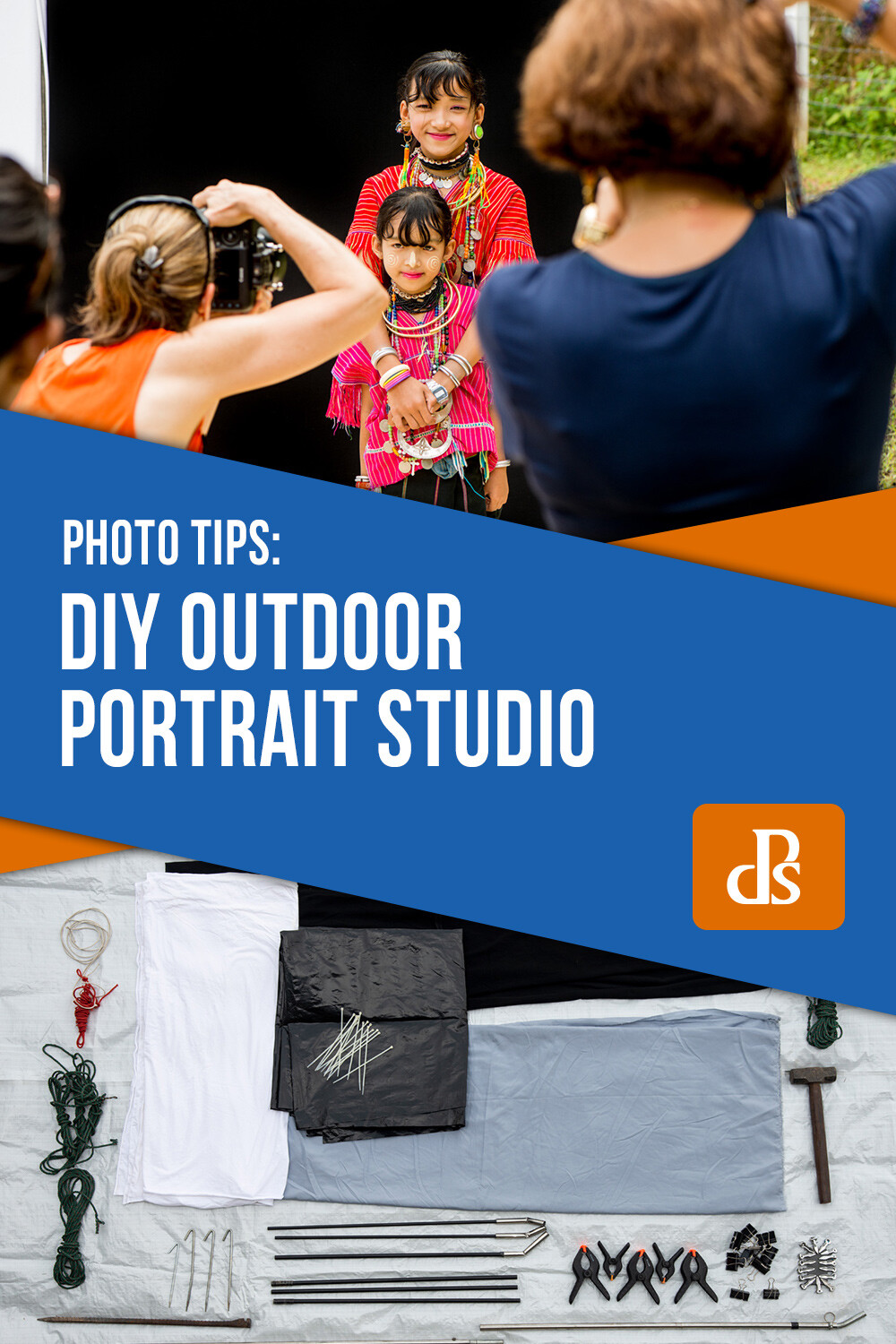
How To Use an Outdoor Studio for Natural Portraits

09 May

The post How To Use an Outdoor Studio for Natural Portraits appeared first on Digital Photography School. It was authored by Kevin Landwer-Johan.

I’ve grown to really love making portraits of people. My preferred way of working is on location with my natural light outdoor studio.

How To Use an Outdoor Studio for Natural Portraits Two Karen Men

© Kevin Landwer-Johan

For many years I had a dedicated studio set up in my home. During this time I hosted many travelers who passed through Chiang Mai. I made photographs of them all and we had a lot of fun making them. However, I was never so comfortable using studio strobes inside as I am working with my outdoor studio.

How To Use an Outdoor Studio for Natural Portraits Indoor Studio Portraits

Indoor studio portraits. © Kevin Landwer-Johan

Inspired by Vogue photographer, Irving Penn

Early on in my photography experience, I became aware of American photographer Irving Penn (1917-2009). He’s celebrated as one of Vogue magazine’s top photographers. Penn produced more covers for them than any other photographer over the 60 years he worked with the magazine.

Fashion photography has never been much of an interest for me. What attracted me to Penn’s mastery was the portraits he made outside his magazine work. Often he would stay on in these exotic locations where his assignments took him, and he’d make portraits of the locals.

He outlines some of these experiences in his book ‘Worlds in a Small Room.’ In the book, he tells how he developed a portable daylight studio he could set up on location. This allowed him control of the background and lighting.

Living in northern Thailand, I have opportunities to visit mountain villages and photograph indigenous hill tribe peoples. So I decided to design and build my own portable daylight portrait studio.

Setting my studio up in villages allows me to make studio portraits of people as they remain in their own environments.

How To Use an Outdoor Studio for Natural Portraits Three Karen Men

© Kevin Landwer-Johan

How I designed and built my outdoor studio

This was a completely DIY project, so you could easily copy the idea and make your own.

My studio has metamorphosed over the years. It now comprises of:

  • Three stainless steel tube uprights
  • One black and one white background
  • A shade cloth above the backgrounds
  • Reflectors
  • A bunch of clips, ropes, steel rods, and tent pegs
How To Use an Outdoor Studio for Natural Portraits Outdoor Studio Materials

Everything for my outdoor studio.

Because I often work alone my studio needed to be easily portable, unlike Penn’s which was large, bulky and required several assistants to set it up. I had to sacrifice size to make it practical. You could design a larger, less-portable studio for use in your backyard.

Originally I made upright supports using fiberglass tent poles. These proved too flimsy, so I replaced them with more sturdy stainless steel. I have also enlarged the background area and included a white background. My initial design only had a short black background. Now I also use reflectors to enhance and balance the light.

How To Use an Outdoor Studio for Natural Portraits

© Kevin Landwer-Johan

Control natural light using an outdoor studio

I prefer to set the studio up in the morning or later in the afternoon. If the sun is too high overhead, the light is more difficult to work with.

Choosing a location where the sun will be behind the backdrop is important. This helps to provide a hair light. The piece of thin grey nylon fabric I set up above the backdrops softens this hair light.

If the ground where I’m setting up is bare earth, that is perfect. Light reflects off the light colored soil up into the faces of my subjects. This is good for Asian skin tones, but not so good for Caucasians as it has a slight yellow/orange tone.

How To Use an Outdoor Studio for Natural Portraits Lahu Man Smoking

© Kevin Landwer-Johan

When I have to set up on a lawn, I lay down some white or light tan plastic sheeting to provide some uplighting. Without this, the grass would reflect an unpleasant green cast onto the people’s faces.

In the early days of using my studio, this was all I did to manipulate the light. Now I also use a large foldable reflector to bounce more light onto my subjects. This gives a little more control of the shadows.

The background fabric is a very stretchy polyester. It does not wrinkle and can be pulled tight between the uprights, so it’s flat. Behind the black background, I add a sheet of thick black polythene sheeting. This completely blocks out the sun which would otherwise partially shine through the fabric.

How To Use an Outdoor Studio for Natural Portraits Using the Outdoor Studio

© Kevin Landwer-Johan

Balancing the light

Your exposure settings are critical. A lot of light shines through the white background, while none shines through the black. Including too much of either background in your exposure calculations will result in an underexposed or overexposed subject.

You need to take your exposure reading from your subject’s face only. Using manual mode, once you have it set correctly, you won’t need to change it unless the light changes. This will happen if the sun goes behind a cloud or you bounce more light onto your subject with the reflector.

You can use the same exposure settings for both backgrounds because the light on your subject’s face does not change.

How To Use an Outdoor Studio for Natural Portraits Kayan Long Neck Woman on a White Background

© Kevin Landwer-Johan

If you take a light reading from the white background, you will see it is far brighter than your subject. Taking a reading from the black background will show there’s much less light reflecting off it than your subject. These contrasts help you achieve a pure white and pure black background.

The thin fabric above the background reduces the light and prohibits full sunshine from affecting your subject. You need to make sure your subject is not too far from the background; otherwise, the sunlight might hit their head directly.

How To Use an Outdoor Studio for Natural Portraits Two Kayan Long Neck Girls

© Kevin Landwer-Johan

Make your own outdoor studio

Putting together your own outdoor studio is relatively easy and cheap. You can use it anywhere there’s sufficient space. You don’t need to buy expensive lighting equipment or have a large studio space. The materials are inexpensive, and it’s portable so that you can use it anywhere.

Working outside you are reliant on good weather. It’s best when the sun is shining, but you can still use it under an overcast sky.

Photographing with available light is so much fun, especially when you have a little control over how it affects your subjects.

We’s love to see photos of your outdoor studio in the comments below.


The post How To Use an Outdoor Studio for Natural Portraits appeared first on Digital Photography School. It was authored by Kevin Landwer-Johan.


Digital Photography School

 
Comments Off on How To Use an Outdoor Studio for Natural Portraits

Posted in Photography


5 Tips for Photographing Portfolio-Worthy Costume Portraits

18 Apr

The post 5 Tips for Photographing Portfolio-Worthy Costume Portraits appeared first on Digital Photography School. It was authored by Charlie Moss.

There’s been an explosion of interest in photographing costume portraits over the last few years. From movie cosplays to historically-inspired portraits – there’s no end to the kind of costumes that could make their way into your portrait portfolio.

Shooting someone who is playing a role can bring a whole new dimension to your images. It can add depth and vibrancy to your portfolio. People often lose their inhibitions about being in front of the camera if they are pretending to be someone else!

With that in mind, here are my top five tips for creating portfolio-worthy costume portraits.

1 - 5 Tips for Photographing Portfolio-Worthy Costume Portraits - charlie moss

1. Be inspired by history

Fabulous costume portraits have been created throughout history, both in photography and in other kinds of art. Julia Margaret Cameron, for example, was a British photographer born in 1815 who used to shoot people dressed up as characters from Shakespeare. Her contemporary, David Wilkie Wynfield, would photograph his friends wearing fancy dress in the style of the great 16th-Century Venetian artist, Titian.

And don’t just stop at taking inspiration from photographer either – there are thousands of years of portraits to take inspiration from. In the portrait above, I took inspiration from a painting called La belle ferronnière by Leonardo da Vinci. Other times I’ve been inspired by different historical artists – Rembrandt lighting is a popular technique amongst photographers too and a great place to start!

Never be afraid to try self-portraiture when you’re experimenting with different lighting and looks inspired by historical portraits. It can take a bit of practice to get it right, and you will almost certainly be your most patient model! The shot above is the result of an hour locked in my studio experimenting with light and self-portraiture. I cannot recommend the Fujifilm camera system and app highly enough for shooting self portraits. You can focus and shoot at the touch of your phone screen!

Costume portraits are a great excuse to step away from the kind of lighting that you would usually use and try something different. If you always use studio lights then how about trying some available light? That’s how artists would have mostly worked in the past, and if it worked for them then it must be worth trying! Equally, if you usually work with available light then perhaps this is an excellent opportunity to step outside your comfort zone and try something tight and controlled with studio lights?

2 - 5 Tips for Photographing Portfolio-Worthy Costume Portraits - charlie moss

2. Check the costume faithfulness

I’m not suggesting for one moment that you should become a victim to historical or film accuracy in your costume portraits. But it does pay to just think through all of the elements that your subject is wearing or surrounded by.

In a costume portrait, even more so than a regular portrait, every aspect of the costume and any props contribute to the story being told by the final image. Ideally, nothing should appear in the final image that wasn’t intentionally put there to be a part of the story.

So if you are shooting a portrait inspired by a period of history, or perhaps inspired by a film or comic book, just take a little time to research your inspiration before scheduling a shoot. Check that your costume, accessories, and props aren’t going to be jarring to the story you are trying to tell.

This is where it might be worthwhile working with costume designers if you are new to styling costume portraits. Their expertise and advice on putting together and styling different kinds of costumes could save you an awful lot of time and heartache in the long run! Of course, there are always opportunities to hire costumes from theatres too – it can be a surprisingly cost-effective option.

3 - 5 Tips for Photographing Portfolio-Worthy Costume Portraits - charlie moss

3. Set the scene

Think about the scene that you want your character to inhabit. Are they royalty sitting atop a beautiful throne, or are they a post-apocalyptic warrior tracking danger through the forest? Scouting out a location and sourcing props to suit can be half of the fun when it comes to staging a costume portrait!

You can find great locations in the most surprising places. I have shot in front of huge roller shutter doors on industrial estates, in a scrubby bit of forest that looked like a dreamy estate in the final images, and against an old stone wall in my back garden. With the right lighting, lens selection, framing choices, and post-processing the most unexpected locations can look great in portraits.

But, of course, there’s always the option to head into the studio! Taking a subject into the studio and placing them against a plain backdrop can serve to really highlight the story you are telling through their costume and appearance. It puts the focus squarely onto the subject. This style of studio shooting can be a double-edged sword. There’s less room for mistakes in this kind of controlled studio portrait, but the payoff can be more than worth it when it comes to portfolio-worthy images.

4 - 5 Tips for Photographing Portfolio-Worthy Costume Portraits - charlie moss

4. Give your subject a character

When people usually sit for portraits they are playing themselves. So when you have someone sit for a costume portrait, it is helpful if you can have them play a role. It can help them to get into character more quickly and easily.

Before you do the shoot – while you’re pulling together your styling and location – think about the character that you’re looking to capture and write down a few thoughts as part of a shoot plan.

Are they a brooding young Victorian poet who lost their love? Perhaps they’re an underground rebel trying to uncover a government conspiracy four decades in the future? This is the driving force behind the entire shoot, so gear everything towards bringing this character to life.

Once you have your subject dressed up and with makeup done, equipped with props, and in the location you have chosen, all these elements should come together to help them portray the character. It’s their portrayal of the character that will shine through, tell the story, and truly make your shots portfolio-worthy.

5 - 5 Tips for Photographing Portfolio-Worthy Costume Portraits - charlie moss

5. Don’t forget the post-processing

You’ve styled an amazing shoot in a fantastically atmospheric location with a great team, and you’ve collaboratively told a compelling story. So what is next? Post-processing – that’s what.

The choices you make on the computer or in the darkroom after the shoot really help you focus the storytelling. Good post-processing can help elevate a portrait to something extraordinary.

You can make stylistic choices in post-processing that you may not otherwise make if you were shooting regular headshots or family portraits. For instance, when I shoot images with an apocalyptic theme, I tend to add lots of layers over the top to create a grungy look to the piece. If I am shooting something inspired by a sci-fi movie, then I often choose to push the colors quite hard to resemble the film grading used by cinematographers. Moreover, if I shoot something medieval- or viking-ish, I usually dull all the colors down and make the finished shots look “dusty” and worn.

With practice, you’ll find your style for post-processing costume portraits. Don’t be afraid to step outside of your comfort zone and do something different from your usual approach. Everything about these images is already completely different from how most people would approach a regular portrait. It’s a chance to experiment!

6 - 5 Tips for Photographing Portfolio-Worthy Costume Portraits - charlie moss

Now that you’re armed with my top tips for shooting costume portraits, it’s time to try it out yourself! Remember to create a character, set the scene, and think about every element that you’re placing in the image. That way, you’ll tell a compelling and consistent story that shines through in the final image.

I’d love to see your attempts at shooting costume portraits. Post an image in the comments for everyone to see!

The post 5 Tips for Photographing Portfolio-Worthy Costume Portraits appeared first on Digital Photography School. It was authored by Charlie Moss.


Digital Photography School

 
Comments Off on 5 Tips for Photographing Portfolio-Worthy Costume Portraits

Posted in Photography


Video: This $100 projector lens has beautiful bokeh and is perfect for portraits

02 Apr

Photographer and YouTuber Mathieu Stern is no stranger to finding and adapting unusual lenses, but his latest find might just be the best projector lens he’s ever come across.

The Isco MC 65mm F2 lens, which can be found for around $ 100 on eBay, is an old projector lens that was used for 35m cinema projectors. As with most previous projector lenses Stern has adapted, there was no official way to adapt it to a modern lens mount. So, Stern got creative and used a little bit of rubber from a bike inner tube along with the barrel of an Helios 44 lens to create a worthwhile body for the adapted lens. From there, Stern used a proper adapter to give the lens infinity focus and it was ready to roll.

Surprisingly, the lens produces impressive results in both photos and video, despite its limitation of being permanently stuck at F2 due to the lack of an aperture diaphragm. In the center, it appears to be sharp, but it does get soft quickly towards the edges. Colors render beautifully and the bokeh looks both distinct and pleasing.

Sure, it might not have the best resolution, but it certainly has a distinct look and considering it only costs $ 100, a few spare parts and a little elbow grease, it’s relatively cheap. To see more unusual lenses from Stern’s collection, head over to his Weird Lenses Museum.

Articles: Digital Photography Review (dpreview.com)

 
Comments Off on Video: This $100 projector lens has beautiful bokeh and is perfect for portraits

Posted in Uncategorized