RSS
 

Posts Tagged ‘plus’

Review of the Sigma 150-600mm Contemporary Lens Plus TC-1401 Teleconverter Bundle

31 May

One of my favorite subjects to photograph is wildlife, so when asked to review the Sigma 150-600mm lens, I was excited about the opportunity to see how its results compared to my Tamron 150-600mm.
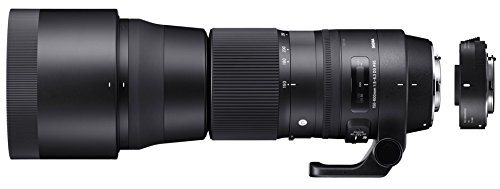
Sigma 150-600mm

In addition, Sigma recently began offering a bundle for their 150-600mm with a 1.4x teleconverter. Since I shoot mainly with a Nikon D750 full frame, the lens bundled with a 1.4x TC interested me very much. The 1.4x TC makes the 600mm, an 840mm on a full frame camera, so in theory this allows my full frame camera to shoot wildlife with nearly the same zoom factor as a crop sensor. (Nikon crop sensors are 1.5 and Canon, 1.6)

There are two things to consider when looking at a new lens:

  1. First is its ease of use
  2. Second is the quality of its optics.

In this article I’ll be applying both of these considerations as I review Sigma’s new bundle, and make comparisons between the Sigma and Tamron lenses. All images in this article were captured with the Sigma 150-600mm with the 1.4x TC.

sigma-150-600-4

Focusing

The Tamron features a larger, thicker focusing ring than the Sigma, which makes it easier to manually focus the lens. As for the Sigma, it has an extra setting on the autofocus switch for manual override (MO) which combines autofocus with an option to manually focus. I did not notice any major difference in the focusing responsiveness between the two lenses. Both did a fair job when grabbing focus, though neither lens is going to focus as quickly as a much more costly 600mm prime lens. The minimum focusing distance on the Tamron is just slightly less than the Sigma – not a game changer, but nevertheless a plus for the Tamron.

Focus Limiter switch

While both lenses have a focus limiter switch, with settings between Full and 10m (Sigma) or 15m (Tamron) to infinity, the Sigma features a third option on the limiter switch for 10m to 2.8m. In my testing, this third option proved very useful and was easy to locate and use, in order to focus on closer objects much quicker.

Customization

A feature the Sigma lens offers that the Tamron does not is an extra customization switch, which provides for an optional USB docking station (purchased separately). This allows a photographer to create two customized setting for OS (Optical Stabilization), AF, and focus-distance limits, and can also be used to download firmware updates directly to the lens.

sigma-150-600-5

Zoom Lock

Both the Tamron and the Sigma have a locking switch to prevent zoom creep at 150mm. However, the Sigma can also lock at several other focal settings, and what is even better, a quick twist of the zoom ring will unlock the it, without having to fumble around to find the switch. (In some cases this might be the difference between capturing and missing a killer shot!)

I found that my Tamron lens crept more than the Sigma, but this could be caused by the fact that it is an older lens with more use. Still, the lock switch on the Sigma is a great feature, especially since one can “soft lock” at many focal lengths.

Image Stabilization

Both lenses have their own image stabilization systems: Tamron’s VC (Vibration Compensation) and Sigma’s OS (Optical Stabilization). The Tamron has a simple on and off for the VC, while the Sigma has two settings: #1 is the standard setting for normal lens movement, and setting #2 is used for hand-held panning on a vertical plane, which will correct for up and down movement in subjects, such as birds in flight.

sigma-150-600-3

Zoom Ring

The zoom ring on the Sigma turns counter clock-wise, which is no big deal for Canon shooters. But for Nikon users, this is opposite from the normal zoom rotation on most Nikon lenses. It’s not a big deal, but does take some getting used to.

Tripod Collar

Both lens come standard with a tripod collar, but the foot on the Sigma collar is much smaller than the Tamron’s. This is only a minor problem, but I found a solution for it. I added a 5 inch quick release plate to the foot, which makes a great handle to carry the Sigma lens, as well as a plate to connect to a tripod.

sigma-150-600-1

Image Quality

Here is where the comparison gets tougher, as both lenses are much sharper at the shorter focal lengths, and both are softer at the longer focal lengths. Both are sharper when stopped down to f/8 or f/9, than wide open. In my opinion, the difference in image quality between the two is negligible. There is no clear winner here, both having areas where they are slightly better than the other.

The addition of the 1.4x TC to the Sigma when stopped down, doesn’t seem to affect the image quality. The Sigma seems to have a clear advantage when it comes to chromatic aberration (CA), and even using the 1.4x TC there was noticeably less fringing in high contrast areas, when compared to the Tamron. Of course, CA is very easily corrected in Camera RAW or Lightroom when shooting in RAW.


sigma-150-600-7

sigma-150-600-6

Warranty

The advantage for warranty goes to Tamron, which offers a 6 year one, compared to 4 years with the Sigma. Still, in my opinion, both lenses are well constructed, and I am not convinced how much of an advantage that is, as most warranty issues show up early on.

1.4x Teleconverter

Adding the bundle of the 1.4x TC, and the 150-600mm Sigma can get your full frame camera back in the field when it comes to wildlife photography. While adding the teleconverter seems to slow the autofocus a bit, I shot with this bundle on both my crop sensor and full frame sensor cameras, and I believe the autofocus was more responsive on the full frame.

NOTE: Before purchasing the 1.4x TC, make sure the camera will autofocus at f/8. Many entry model DSLRs will not autofocus above f/5.6, so while this bundle may fit those cameras, manual focus will be necessary. Other models may only autofocus on the center focus point, and still others may have a limited number of focus points with the 1.4x TC.

Adding the 1.4x TC did seem to give a softer image when the lens was extended to 600mm (840mm), but if you stop down to f/10 to f/11 the images are nearly as sharp as at 600mm without the TC. Of course, stopping down means either using a slower shutter speed or a higher ISO, which may add some blur or noise to an image. I did find that the OS on the Sigma did a nice job of reducing camera shake, when hand holding at slower shutter speeds.
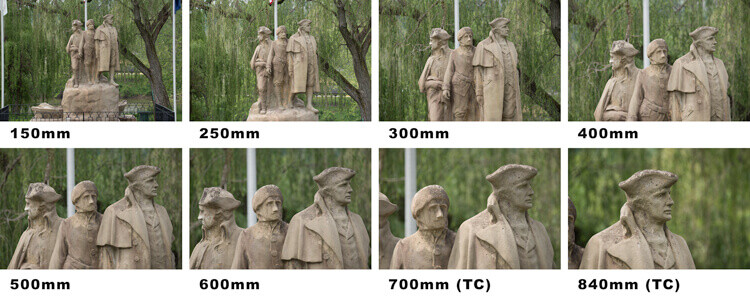
The above images show the range and extra reach of the Sigma 150-600mm with the last 2 images having the 1.4 TC added for an extra 240mm of reach.

The above images show the range and extra reach of the Sigma 150-600mm with the last two images having the 1.4x TC added for an extra 240mm of reach.

Tips

The rule of thumb when shooting with long focal lengths is to set the shutter speed equal to, or greater than the focal length, so remember that when by adding the 1.4x TC to a 600mm, one is now shooting at 840mm on a full frame, and 1260 mm on a crop sensor. For sharp images, a shutter speed over 1/1000th of a second is a must.

When carrying your camera with a large lens such as these 150-600mm lenses, it’s best to hold them by the lens rather than your camera. These lenses weigh much more than your camera and can put a lot of stress on the lens mount if carried by the camera. Likewise, when mounting on a tripod, always use the tripod collar to reduce stress on your camera’s lens mount (it is better balanced using the collar and won’t be front heavy).

Conclusion

Both the Tamron and Sigma lenses are well designed, and for the price range are great equipment investments. As mentioned earlier, I feel the image quality compared very closely. The Sigma does offer some useful extra features, out-weighing the issues of the smaller focusing ring and the counter-clockwise turning of the zoom ring for a Nikon shooter.

If you currently have a Tamron it may not be worth making a switch. But with the addition of the 1.4x TC, the Sigma bundle offers a great setup for full frame cameras, as well as crop sensors for some extra reach. So if you are looking for some extra reach (and we all are) the addition of the 1.4 TC to the Sigma may be a game changer. It was for me!

As a result of my review of the Sigma bundle for this article, I sold my Tamron 150-600mm, and purchased the Sigma 150-600mm bundled with the 1.4 TC, to extend the usage of my full frame Nikon D750, especially for photographing wildlife.

googletag.cmd.push(function() {
tablet_slots.push( googletag.defineSlot( “/1005424/_dPSv4_tab-all-article-bottom_(300×250)”, [300, 250], “pb-ad-78623” ).addService( googletag.pubads() ) ); } );

googletag.cmd.push(function() {
mobile_slots.push( googletag.defineSlot( “/1005424/_dPSv4_mob-all-article-bottom_(300×250)”, [300, 250], “pb-ad-78158” ).addService( googletag.pubads() ) ); } );

The post Review of the Sigma 150-600mm Contemporary Lens Plus TC-1401 Teleconverter Bundle by Bruce Wunderlich appeared first on Digital Photography School.


Digital Photography School

 
Comments Off on Review of the Sigma 150-600mm Contemporary Lens Plus TC-1401 Teleconverter Bundle

Posted in Photography


Lenovo’s Moto G Plus comes with 1/2.4-inch sensor and fingerprint reader

18 May

$ (document).ready(function() { SampleGalleryV2({“containerId”:”embeddedSampleGallery_3124387172″,”galleryId”:”3124387172″,”isEmbeddedWidget”:true,”standalone”:false,”selectedImageIndex”:0,”startInCommentsView”:false,”isMobile”:false}) });

Motorola’s Moto G series has always been one of the best options for smartphone users looking for top performance at mid-range pricing. Now, the first new G model has been launched since Motorola became a Lenovo company. True to form, the Moto G Plus offers several features we are used to seeing on high-end devices and a promising-looking camera specification.

An Omnivsion OV16860 1/2.4-inch 16MP sensor with a large pixel size of 1.34um is paired with a fast F2.0 aperture, on-sensor phase detection and laser-assisted AF. There is also a dual-LED flash and a 5MP front camera with F2.2 aperture. On the software side of things a new Pro mode allows for manual control over shutter speed and other essential shooting parameters.

Like all recent Moto devices, the Moto G Plus comes with a ‘pure’ version of Android 6.0, without any manufacturer-specific add-ons, to keep things as responsive and smooth as possible. Google Photos is the default photos app and includes two years of free storage at original image quality for Moto G buyers.

The OS and other software is powered by a 1.5 GHz Qualcomm Snapdragon 617 chipset with octa-core CPU and 550 MHz Adreno 405 GPU. There are 2GB of RAM and microSD-expandable storage options ranging from 16 to 64GB. Images can be viewed and composed on a 5.5-inch 1080p display that is covered with Corning Gorilla Glass 3 for protection. 

The 3000 mAh battery features Motorola’s TurboPower charging which can provide approximately 6 hours worth of power in 15 minutes of charging. A fingerprint reader at the front increases security and provides a convenient way of unlocking the device. The Lenovo Moto G Plus has first been launched in India where it will be exclusive to Amazon.in and start at approximately $ 200 for the base 16GB version. Pricing for other regions has not been revealed yet. With the Moto G Plus Lenovo has also launched the 4th generation of the standard Moto G model which comes with identical processor specifications but has to make do without the fingerprint reader and, with a 13MP Sony IMX214 image sensor, offers a very similar camera specification to last year’s Moto G. 

Key specifications:

  • Omnivsion OV16860 1/2.4-inch 16MP sensor
  • F2.0 aperture
  • On-sensor phase detection and laser-assisted AF
  • 1080p video
  • 520p slow-motion video
  • Dual-LED flash
  • Manual control over shutter speed
  • 5MP / F2.2 front camera
  • Android 6.0
  • 5.5-inch 1080p display (401 ppi)
  • 1.5 GHz Qualcomm Snapdragon 617 chipset with octa-core CPU 
  • 2GB RAM / 16, 32 or 64GB storage
  • MicroSD support up to 128GB
  • 3000 mAh battery with quick charging
  • Fingerprint reader

Articles: Digital Photography Review (dpreview.com)

 
Comments Off on Lenovo’s Moto G Plus comes with 1/2.4-inch sensor and fingerprint reader

Posted in Uncategorized


DxOMark Mobile Report: Lenovo Moto G Plus

17 May

DxOMark Mobile Report: Lenovo Moto G Plus

Summary

The Moto G Plus is the newest arrival in the Moto G series of mid-range smartphones. With a 1/2.4-inch Omnivsion OV16860 16MP sensor with a large pixel size of 1.34um, F2.0 aperture, on-sensor phase detection and laser-assisted AF the camera specification would look right at home on a high-end device. You can read our first impressions review of the Moto G Plus here.

In its DxOMark test the Moto G Plus scores 84 points, which puts it on the same level as current flagship phones, such as the Apple iPhone 6s Plus, Google Nexus 6P or Motorola/Lenovo’s own Droid Turbo 2/Moto X Force. When shooting still images the testers liked the “very good detail preservation” in bright light, the “fast and accurate autofocus” and “good noise reduction in outdoor conditions”. They also noted the colors, which are “vivid and pleasant” in daylight and the good white balance in low and artificial light. On the downside, outdoor images show “some loss of detail in the shadow areas”, a “slightly bluish cast is sometimes visible in outdoor scenes” and “some irregularities in HDR activation and white balance are visible”. Some outdoor images also showed a “cyan shift close to sky saturation”.

In video mode the DxOMark team liked the “good stabilization both in bright light and indoor conditions, good color rendering and white balance, fast autofocus convergence and good noise reduction in outdoor conditions”. However, they also found that “from macro to infinity, some steps during the autofocus convergence are visible” and saw “occasional autofocus inaccuracies in low light”. “In low light some detail is lost and luminance noise is visible” and there are “visible steps in exposure adaptation”.

Still Photography

Color, Exposure and Contrast

The DxOMark team found the Lenovo Moto G Plus images to show “vivid and pleasant color”, with good white balance and without any color shading. Target exposure is generally good. However, in difficult light situations highlights are occasionally clipped, “some irregularities in HDR activation are visible” and a “slightly bluish cast” sometimes appears in daylight images. In low light “very slight color shading is visible.”

Overall DxOMark awarded the Lenovo Moto G Plus scores of:

  • 4.4 out of 5 for Exposure
  • 4.5 out of 5 for White Balance accuracy
  • 3.9 out of 5 for Color shading in low light*
  • 4.5 out of 5 for Color shading in bright light*
  • 3.0 out of 5 for Color Rendering in low light
  • 4.5 out of 5 for Color Rendering in bright light

*Color Shading is the nasty habit cellphone cameras have of rendering different areas of the frame with different color shifts, resulting in pictures with, for example, pinkish centers and greenish corners.

Noise and Details

DxOMark’s engineers reported that the Lenovo Moto G Plus images show “very good detail and good noise reduction in outdoor conditions”. However, there is also “some luminance noise and some loss of detail in low light”.

Texture Acutance

Texture acutance is a way of measuring the ability of a camera to capture images that preserve fine details, particularly the kind of low contrast detail (such as fine foliage, hair or fur) that can be blurred away by noise reduction or obliterated by excessive sharpening.

Sharpness is an important part of the quality of an image, but while it’s easy to look at an image and decide visually whether it’s sharp or not, the objective measurement of sharpness is less straightforward.

An image can be defined as ‘sharp’ if edges are sharp and if fine details are visible. In-camera processing means that it’s possible to have one of these (sharp edges) but not the other (fine details). Conventional MTF measurements tell us how sharp an edge is, but have drawbacks when it comes to measuring fine detail preservation. Image processing algorithms can detect edges and enhance their sharpness, but they can also find homogeneous areas and smooth them out to reduce noise.

Texture acutance, on the other hand, can qualify sharpness in terms of preservation of fine details, without being fooled by edge enhancement algorithms.

A dead leaf pattern is designed to measure texture acutance. It’s obtained by drawing random shapes that occlude each other in the plane, like dead leaves falling from a tree. The statistics of this model follow the distribution statistics in natural images.

In this example from a DSLR without edge enhancement, sharpness seems equal on edge and on texture. Many details are visible in the texture.

In this second example, edges have been digitally enhanced, and the edge looks over sharp, with visible processing halos (‘ringing’). On the texture part, many details have disappeared.

At first sight, the images from these two cameras may appear equally sharp. A sharpness measurement on edges will indeed confirm this impression, and will even show that the second camera is sharper. But a closer examination of low contrasted textures shows that the first camera has better preservation of fine details than the second. The purpose of the texture acutance measurement is to qualify this difference.

Note: Acutance is a single value metric calculated from a MTF result. Acutance is used to assess the sharpness of an image as viewed by the human visual system, and is dependent on the viewing conditions (size of image, size of screen or print, viewing distance). Only the values of texture acutance are given here. The measurements are expressed as a percentage of the theoretical maximum for the chosen viewing condition. The higher the score, the more details can be seen in an image. 
 
For all DxOMark Mobile data presented on connect.dpreview.com we’re only showing 8MP equivalent values, which gives us a level playing field for comparison between smartphone cameras with different megapixel values by normalizing all to 8MP (suitable for fairly large prints). DxOMark also offers this data for lower resolution use-cases (web and onscreen). For more information on DxOMark’s testing methodology and acutance measurements please visit the website at www.dxomark.com.
 Texture acutance is a touch higher under daylight than tungsten light. 
In bright light the Moto G Plus is up with the best but drops off a little at lower light levels.

Edge Acutance

Edge acutance is a measure of edge sharpness in images captured by the phone’s camera. Again we’re only looking at the most demanding of the three viewing conditions that DxOMark reports on – the 8MP equivalent.
 In terms of edge acutance the Moto G Plus is performing on flagship level. 
 Edge acutance is very consistent across all light levels. 

Visual Noise

Visual noise is a value designed to assess the noise in an image as perceived by the human visual system, depending on the viewing condition (size of image, size of screen or print, viewing distance). The measurements have no units and can be simply viewed as the weighted average of noise standard deviation for each channel in the CIE L*a*b* color space. The lower the measurement, the less noise in the image.

 The Moto G Plus noise levels compare well to the competition at all light levels
 Measured noise levels only increase moderately in lower light.

Noise and Detail Perceptual scoring

DxOMark engineers don’t just point camera phones at charts, they also take and analyze plenty of real-world shots and score them accordingly. Their findings for the Lenovo Moto G Plus are:

Natural scene

  • Texture (bright light): 4.8 out of 5
  • Texture (low light): 3.7 out of 5
  • Noise (bright light): 4.1 out of 5
  • Noise (low light) 3.9 out of 5
 Bright light sample shot
 100% crop: good noise reduction  100% crop: good detail preservation
 Low light (20 Lux) studio shot
100% crop: some luminance noise in areas of plain color 100% crop: some very fine detail is being lost

Artifacts

Phone cameras, like entry-level compact cameras, tend to suffer from artifacts such as sharpening halos, color fringing, vignetting (shading) and distortion, which can have an impact on the visual appeal of the end result. DxOMark engineers measure and analyze a range of artifacts. Their findings after testing the Lenovo Moto G Plus are shown below:

  • Cyan shift close to sky saturation visible in outdoor shots
  • Some color fringing noticeable in backlit scenes
  • Moiré is occasionally visible

Perceptual Scores

  • Sharpness 4.5 out of 5
  • Color fringing 3.6 out of 5

Measured findings

  • Ringing center 7.6%
  • Ringing corner 4.9%
  • Max geometric distortion -0.4%
  • Luminance shading 9.4%

Distortion and Chromatic Aberrations

The graph shows the magnification from center to edge (with the center normalized to 1). The Lenovo Moto G Plus shows a very slight pincushion distortion, which you are not going to notice in normal photography.
 Chromatic aberrations are well under control.

Autofocus

DxOMark also tests autofocus accuracy and reliability by measuring how much the acutance – or sharpness – varies with each shot over a series of 30 exposures (defocusing then using the autofocus for each one). As with other tests these results are dependent on the viewing conditions (a little bit out of focus matters a lot less with a small web image than a full 8MP shot viewed at 100%). Using the 8MP equivalent setting, the Lenovo Moto G Plus performs very well in all light conditions. The overall score is 95/100 in bright light and 87/100 in low light.

Pros: 

  • Accurate and repeatable autofocus in all conditions

Cons:

  • Strong instabilities and overshoots in preview mode, particularly in low light
  • Slow convergence, particularly in low light
Autofocus repeatability – average acutance difference with best focus: low light 3.26%, bright light 1.63%

Flash

The Lenovo Moto G Plus offers a dual-LED flash for illumination in very low light. DxOMark scored the camera a 77/100 overall for its flash performance. 

Pros: 

  • Good exposure and vivid colors
  • Pleasant colors when flash is mixed with tungsten light

Cons:

  • Some focus and exposure irregularities
  • Noticeable hue non-uniformity in the field
  • Noise and attenuation visible in the corners

Overall DxOMark Mobile Score for Photo: 84 / 100


Video Capture

DxOMark engineers put phone cameras through a similarly grueling set of video tests, and you can read their full findings on the DxOMark website here. Overall, DxOMark found the Lenovo Moto G Plus video mode to perform very well, with fast autofocus, good stabilization and good color. On the downside, some stepping can be visible when the AF is adjusting and luminance noise is visible in low light footage.

Pros: 

  • Good stabilization
  • Good color rendering and white balance
  • Fast autofocus convergence
  • Good noise reduction in outdoor conditions

Cons: 

  • Some steps are visible during autofocus convergence in bright light
  • Occasional autofocus inaccuracies in low light
  • In low light some detail is lost and luminance noise is visible
  • Visible steps in exposure adaptation

Overall DxOMark Mobile Score for Video: 81 / 100

DXOMark Mobile Score
84

DXOMark Image Quality Assessment

With a DxOMark Mobile score of 84 the Lenovo Moto G Plus performs on the same level as flagship models, such as the Apple iPhone 6s Plus, Google Nexus 6P or Motorola’s own Moto X Force / Droid Turbo 2, in the DxOMark smartphone rankings.  The test team liked the good detail in bright light, good color, low noise levels and reliable AF in bright light. However, they also found some loss of detail in the shadows and an occasional slightly cool color cast.  

In video mode the Moto G Plus has efficient stabilization, good color and very decent noise reduction in bright light. However, testers also found some AF inaccuracies and luminance noise in low light. For a more detailed analysis, visit www.dxomark.com.

Photo Mobile Score 85   Video Mobile Score 81
Exposure and Contrast 84   Exposure and Contrast 84
Color 85   Color 81
Autofocus 91   Autofocus 75
Texture 85   Texture 83
Noise 86   Noise 85
Photo Artifacts 85   Video Artifacts 80
Flash 77   Stabilization 81

Articles: Digital Photography Review (dpreview.com)

 
Comments Off on DxOMark Mobile Report: Lenovo Moto G Plus

Posted in Uncategorized


Above and beyond: Lenovo Moto G Plus first impressions review

17 May

The Moto G Plus is a brand new model in Motorola’s Moto G mid-range series, but its camera specification looks pretty much top-notch. A 1/2.4-inch Omnivsion OV16860 16MP sensor with a large pixel size of 1.34um is paired with a fast F2.0 aperture. Its contrast detect autofocus is supported by on-sensor phase detection and a laser to measure subject distance. A dual-LED flash is on board for shooting in very dark conditions, and in the camera app a new Professional mode allows for manual control over the most important shooting parameters like shutter speed and ISO.

The new Professional mode allows for manual control over shutter speed and other shooting parameters via a range of virtual dials. It’s also possible to display just one dial at a time.

We have had the chance to use the Moto G Plus for a couple of days before launch and shot a good number of samples in a variety of situations. Read on for our first impressions of the new smartphone and its camera. 

Image Quality

In bright light the Moto G Plus 16MP camera module does a very good job at resolving detail. Thanks to very well balanced sharpening and noise reduction, fine textures and low contrast detail, such as the trees in the distance in the left sample below, are rendered very nicely. The lens in our test unit is sharp,  with only some minor softness toward the edges. Skin tones look natural and color is overall pleasantly neutral, without any white balance issues in natural light. 

 ISO 64, 1/1236 sec  ISO 64, 1/137 sec
 100% crop  100% crop

Some luminance noise is visible in blue skies but it is finely grained and not too intrusive. In the shadow areas some smearing of detail is noticeable, but again this is well within acceptable limits. Shadow noise is very well controlled as well.

 ISO 64, 1/2836 sec  ISO 64, 1/450 sec
 100% crop  100% crop

The well-balanced approach toward noise reduction is maintained throughout the ISO range and while noise and the effects of noise reduction inevitably become more evident in lower light the Moto G Plus performs very well in dimmer conditions. 

 ISO 160, 1/33 sec  ISO 400, 1/30 sec
 100% crop  100% crop

In lower light shutter speeds are reduced down to 1/15 sec which, without optical image stabilization, can result in the occasional shaky image. However, as long as you keep your hands steady the Moto captures very good detail, color and exposures in lower light. Both images below were shot in fairly dim conditions. In the one on the right the camera deals particularly well with the mix of artificial and very low natural light.

 ISO 640, 1/20 sec  ISO 800, 1/15 sec
 100% crop  100% crop

Like on the higher-end Moto models, the Moto G Plus offers a multi-frame Night Mode that kicks in when things get too dark. This allows for decent exposures of even very dark scenes, such as the image on the left below which was captured in a museum in very low light. We also liked the Moto G Plus flash performance which delivered well-exposed images with good color and detail during our brief test. 

 ISO 1250 1/15 sec  ISO 2000, 1/15 sec, flash on
 100% crop  100% crop

Special modes

The Moto G Plus comes with the same panorama mode as previous Moto devices and image output is very similar. Stitching is generally very good but panorama mode does not deal well with moving subjects in the scene. At under 3000 pixels the output size is very small. 

 Vertical panorama, 2472 x 704 pixels

HDR mode works in the conventional way and combines several exposures into one. On the Moto G Plus the effect is much more pronounced in shadow areas, which are noticeably lifted while highlights are only recovered minimally. 

ISO 64, 1/1196 sec,  HDR off  ISO 64, 1/1158 sec, HDR on

In video mode the Moto G Plus can capture 1080p footage at 30 frames per second that is digitally stabilized. Detail is good, the autofocus tends to be stable and the stabilization works efficiently, making for smooth panning and stable hand-held recording.

First impressions

During our testing we were impressed with the image output produced by the Moto G Plus. The large pixels in combination with very well-balanced image processing result in image quality that we would typically expect from devices in a higher price category. Images show good detail and well-controlled noise levels across the ISO range. Colors are pleasantly natural, even in difficult light situations, and thanks to its night mode the Moto is capable of capturing decent exposures even at very low light levels. On the downside, in dim conditions camera shake can lead to some image blur, though it is typically only noticeable at a 100% view.

The new Professional mode is good news for those mobile photographers who want maximum control over the capture process, and the large 1080p display is nice for viewing and composing images. The fingerprint sensor performs very swiftly and increases the security of your image and video files that are stored on the device. The plastic back is in line with a mid-ranger but overall the Moto G Plus looks like a great option for consumers who want excellent camera performance without spending money on a flagship device.

Articles: Digital Photography Review (dpreview.com)

 
Comments Off on Above and beyond: Lenovo Moto G Plus first impressions review

Posted in Uncategorized


Samsung unveils 256GB EVO Plus microSD card

13 May

Samsung has introduced the EVO Plus 256GB UHS-1 Class 10 microSD card. According to Samsung, the new EVO Plus card has the highest capacity in its class, and is able to hold up to 12 hours of UHD video, 33 hours of Full HD video and up to 55,200 photographs.

The Samsung EVO Plus 256GB microSD card offers write speeds up to 90MB/s and read speeds up to 95MB/s, as well as the maker’s ‘4-Proof’ durability — it is magnet-proof, temperature-proof, waterproof, and x-ray-proof. A 10-year limited warranty accompanies the durability promises.

Samsung will launch its new storage card in the U.S., Europe, China and beyond (totaling 50+ countries) next month for $ 249.99.

Via: Samsung

Articles: Digital Photography Review (dpreview.com)

 
Comments Off on Samsung unveils 256GB EVO Plus microSD card

Posted in Uncategorized


Elinchrom launches new EL-Skyport Plus system to include hotshoe flashes in wireless lighting networks

05 May

$ (document).ready(function() { SampleGalleryV2({“containerId”:”embeddedSampleGallery_9814466852″,”galleryId”:”9814466852″,”isEmbeddedWidget”:true,”standalone”:false,”selectedImageIndex”:0,”startInCommentsView”:false,”isMobile”:false}) });

Swiss studio flash manufacturer Elinchrom has launched the next generation of its Skyport wireless triggering system that allows photographers to include hotshoe flash units in their lighting set-ups. The EL-Skyport Plus system includes a newly designed transmitter that has a swivelling head that the company says helps to optimize reception, while the new receiver features a hotshoe mount for triggering ‘almost any’ brand of hotshoe flash.

The units work via 2.4Ghz radio communications, have a range of 656ft/200m and offer 16 channels with four groups.

The EL-Skyport Transmitter Plus costs $ 89.99 and the kit that includes the transmitter and the hotshoe receiver costs $ 139.99.

For more information visit the Elinchrom website.


Press release:

The Latest Evolution of the Skyport

Introducing the New EL-Skyport Plus System

The next generation Skyport is here and allows you to take full control of your flashes from the palm of your hands.

The EL-Skyport Plus follows the successful launch of the EL-Skyport Transmitter Plus HS for Canon® and Nikon®, for those shooters requiring Hi-Sync. The new EL-Skyport Plus system is compact and robust, using readily available AA batteries. The Skyport Plus offers an extended range of up to 656 feet (200 m) and controls the power of all Skyport enabled Elinchrom flash units. With eight individual frequencies and the choice of standard and speed protocols, there are 16 frequency options, each with four groups. The EL-Skyport Transmitter Plus is compatible with almost every camera. The transmitter head folds down for reduced profile and easier subject viewing while shooting.

Compatible with Most Flash Systems
The EL-Skyport Receiver Plus will trigger almost every flash system and features a built-in hot shoe to trigger speedlights, while enabling them to also be conveniently mounted onto a lighting stand.
When used in conjunction with a Skyport HS Plus Transmitter, most speedlights set at full power can also be incorporated into Hi-Sync applications (using high shutter sync speeds to freeze motion and control ambient light).

“Elinchrom has long prided itself on providing as much control as possible to its photographers. The new Skyport Plus continues that tradition by allowing shooters to take and maintain complete control no matter what they are shooting. When it comes to Living Light, no company does it better than Elinchrom.” said Jan Lederman, MAC Group President.

The Elinchrom Skyport Plus system is retro compatible with the existing Skyport Speed system, and forward compatible to the additional frequencies offered by the latest Elinchrom ELB and ELC units.

EL-Skyport Plus To Go Contents
* EL-Skyport Transmitter Plus contains:
* EL-Skyport Transmitter Plus
* 2.5 mm to PC sync cord
* Wrist strap
* 2-year warranty

EL-Skyport Universal Plus set contains:
* EL-Skyport Transmitter Plus
* EL-Skyport Receiver Plus
* 2.5 mm to PC sync cord
* 3.5 mm to 3.5 mm sync cord
* 3.5 mm to 6.35 mm adapter
* Wrist strap
* 2-year warranty

Articles: Digital Photography Review (dpreview.com)

 
Comments Off on Elinchrom launches new EL-Skyport Plus system to include hotshoe flashes in wireless lighting networks

Posted in Uncategorized


Huawei launches P9 and P9 Plus with Leica dual-camera

06 Apr

Huawei has launched the P9 and P9 Plus in London today. The new models jointly replace last year’s P8 and are the first products coming out of Huawei’s collaboration with camera maker Leica. Read more

Articles: Digital Photography Review (dpreview.com)

 
Comments Off on Huawei launches P9 and P9 Plus with Leica dual-camera

Posted in Uncategorized


DxOMark Mobile Report added to our iPhone 6s Plus review

23 Dec

DxOMark has just released its full report into the technical ins and outs and real-world performance of the iPhone 6s Plus’s 12MP camera. We’ve added DxO’s findings into our previously-published in-depth review of the iPhone 6s Plus and you can read the whole thing over at connect.dpreview.com

Articles: Digital Photography Review (dpreview.com)

 
Comments Off on DxOMark Mobile Report added to our iPhone 6s Plus review

Posted in Uncategorized


DxOMark Mobile Report added to our iPhone 6s Plus review

22 Dec

DxOMark has just released its full report into the technical ins and outs and real-world performance of the iPhone 6s Plus’s 12MP camera. We’ve added DxO’s findings into our previously-published in-depth review of the iPhone 6s Plus and you can read the whole thing over at connect.dpreview.com

Articles: Digital Photography Review (dpreview.com)

 
Comments Off on DxOMark Mobile Report added to our iPhone 6s Plus review

Posted in Uncategorized


Apple iPhone 6s Plus camera review

01 Dec

The iPhone 6s Plus is the iPhone 6s’ bigger brother and, apart from the larger 5.5-inch screen, mainly distinguishes itself from the smaller model by offering optical image stabilization system in its camera module. Compared to its predecessor, the 6s Plus ups camera resolution to 12MP, adds 50% more phase detection sensors and is capable of 4K footage. Our review tests its camera performance. Read more

Articles: Digital Photography Review (dpreview.com)

 
Comments Off on Apple iPhone 6s Plus camera review

Posted in Uncategorized