RSS
 

Posts Tagged ‘Photos’

5 Reasons to Use Prime Lenses For Better Photos

08 Nov

The difference between prime lenses and zoom lenses can often be a source of confusion for photographers who are picking up a camera for the first time.

I remember when I first started with photography, wondering why someone would choose a lens with a fixed focal length over one with a whole range of focal lengths built into one.

Surely that would mean creating more work for yourself?!

Fast forward a few years, and I’d stepped into the world of wedding photography with my chunky DSLR and equally chunky 24-70mm zoom lens. Shooting an entire wedding with just that one lens was a piece of cake – I could go from wide-angle shots of the church to a tight, flattering portrait shot with just a twist of the zoom ring.

I’d found the perfect tool for the job… but I had to admit – it wasn’t enjoyable.

Then I started reading more about prime lenses and their various advantages. The only compromise was that I’d have walk closer to my subject, rather than just zooming in with my lens. I looked down and remembered I had two good legs, so I decided to take up the challenge!

I’m not going to tell you that prime lenses are better than zoom lenses, as they aren’t. Neither one is better than the other – it just depends on your needs.

What I’d like to do with this article is to explain why I believe that using prime lenses has helped me to produce better photos. I hope that it gives you some perspective on why you may want to choose a prime lens over a zoom lens too.

1. Composition

5 Reasons to Use Prime Lenses For Better Photos 1

I’m not saying I couldn’t have composed this photo with a zoom lens, but using a lens with a fixed focal length helped me pre-visualise the shot before I took it, making the whole process much faster.

Some might think that being able to change your composition with a zoom lens without even moving your feet would be an advantage.

However, I found it confusing to have an entire range of focal lengths literally at my fingers, and wouldn’t know where to stand before I lifted the lens to my eye. After all, a quick swivel of the barrel would ‘correct’ any distance issues, so standing in just the right spot seemed less critical.

Prepare to spit out your coffee at your screen with my next statement: Zooms can make you a bit lazy with your compositions.

However, using a prime lens encourages you to envisage the composition by the constraints of your focal length. You get set in place to take the shot even before holding the camera to your eye.

The more you get used to using just one focal length, the quicker you’ll be able to visualize your final shot by looking at the scene (with your eyes, sans camera!). In my opinion, zoom lenses with their myriad focal length options don’t encourage you to develop this skill as much.

2. Light

5 Reasons to Use Prime Lenses For Better Photos 2

In the last light of the day, capturing this image without a fast prime lens (shot at f/1.4) could have proven difficult.

Prime lenses, in general, have wider maximum apertures than zooms. More light is let in when the shutter opens, meaning you’ll be able to get the exposure you need in a low light situation without having to increase your ISO or lower your shutter speed.

Being able to shoot with a lower ISO means clearer images. And being able to use a faster shutter speed will help to improve the sharpness of your shot.

If you’ve ever wondered why those indoor shots of your kids taken with your kit lens (I’m guessing it’s a f/3.5-5.6 zoom, or similar) are slightly blurry, there’s a good chance it’s because your lens isn’t letting in enough light. Your camera is slowing down the shutter speed a bit too much to compensate.

By investing in a f/1.8 prime lens, for example, you give your camera more of a fighting chance. You allow it to take advantage of higher shutter speeds to produce sharper images.

3. Depth of Field

5 Reasons to Use Prime Lenses For Better Photos 3

By shooting wide open (f/1.4), brings the viewer’s attention to the bride’s face, despite its unusual positioning in the frame.

Now, depth of field is the main reason most photographers love using prime lenses. Prime lenses have a wider maximum aperture than zooms, enabling you to take advantage of a shallower depth of field.

Depth of Field refers to the range of focus in your image. Shooting at a wide aperture of f/1.4 provides more out-of-focus blurring effect (‘bokeh’) than there would be if you were to shoot at f/2.8. Assuming that all other variables remain constant.

The ability to blur the area both in front and behind your subject using a wide aperture helps to separate your subject from other elements in the photo. The subject stands out more.

You can still produce nice bokeh with a telephoto zoom lens by shooting at the maximum aperture at a longer focal length. In turn, altering perspective and creating a different look to the image.

While shooting with a wide aperture won’t make you a better photographer, it does allow a higher degree of creative control over your image. Being able to fine tune what is and isn’t in focus in your picture using a wider aperture is just one other great way to take your photography to the next level.

4. Size/Weight

5 Reasons to Use Prime Lenses For Better Photos 4

You may require more than one prime lens to allow you to shoot subjects at various distances. The size/weight of each lens is usually much less than a zoom.

Size and weight of your lens is a subjective one. I think that in general, every photographer would prefer to have a lighter lens on their camera, given a choice!

When I switched from using a heavy 24-70mm zoom to a lightweight 35mm prime lens, it was as if I’d bought a whole new camera. The shooting experience just felt so much better.

Now I’m not suggesting that just by having a smaller, lighter camera in your hands, that you’ll be able to produce better photos. However, the shooting experience will undoubtedly be more pleasurable. Having fun with your photography is an excellent catalyst for taking more pictures, which will eventually mean you’ll improve. You see what I’m getting at here?!

One thing to note: a prime lens doesn’t necessarily mean it’ll be small and light. Indeed, many fast (i.e., wide aperture) prime lenses are rather large and heavy. Similarly, there are plenty of small, lightweight zooms.

For the most part, you’ll be able to find a small, lightweight prime lens that offers all the advantages listed in this article. I guarantee it’ll feel better on the end of your camera than a zoom.

5. Image Quality

5 Reasons to Use Prime Lenses For Better Photos 5

Ok, hold your horses for a second. I don’t want to wage a prime versus zoom war here! The difference in sharpness and general image quality between these two types of modern-day lenses is, for the most part, indiscernible.

However, the above statement is only valid for expensive, ‘pro-grade’ zoom lenses – usually the ones with a fixed aperture, i.e., a zoom lens which doesn’t automatically change its aperture when you twist the zoom ring. Or only ones that contain a large amount of high-quality glass.

Fixed aperture zooms are bigger, heavier, more expensive, and usually on par in image quality with even the best prime lenses.

Instead, I’m referring to the difference in image quality between a cheap prime lens and a cheap zoom lens. For around $ 100, you’ll be able to get a much sharper image from a cheap prime lens than you would an equivalent zoom.

All the major camera brands offer a cheap prime lens that ticks the above boxes. It’ll be able to knock the socks off the zoom lens that came with your camera.

Final Comment

I used zoom lenses for the first few months in my career as a wedding photographer, then switched to primes. I’ve never looked back.

I currently shoot with a 35mm lens for 99% of the wedding day. When I can’t get close enough to the action, I use an 85mm lens. Having only two focal lengths to think about is incredibly liberating. Through consistently limiting my focal length options, I’m able to ‘see’ in 35mm or 85mm terms, whether the camera is to my eye or not.

I appreciate zoom lenses have their place and are an excellent choice for many photographers. That said, I encourage you to have a play around with a prime lens to see how it can improve your photography too.

The post 5 Reasons to Use Prime Lenses For Better Photos appeared first on Digital Photography School.

Digital Photography School

 
Comments Off on 5 Reasons to Use Prime Lenses For Better Photos

Posted in Photography


Why Limiting Free Users to 1,000 Photos on Flickr is a Smart Move

02 Nov

Tim O'Reilly

Yesterday Flickr made their first big restructuring announcement since recently being purchased by SmugMug. Beginning next year on January 8th, Flickr will limit free accounts to 1,000 photos. The previously offered free 1 terabyte of storage goes away. At the same time Flickr is returning their paid pro account to unlimited storage which had been their original offer before capping new Pro accounts at 1 terabyte back in 2013. If you were Pro before 2013 you were considered “old school” Pro and kept your unlimited storage, but new accounts were limited. Now all Pro accounts are back to being unlimited.

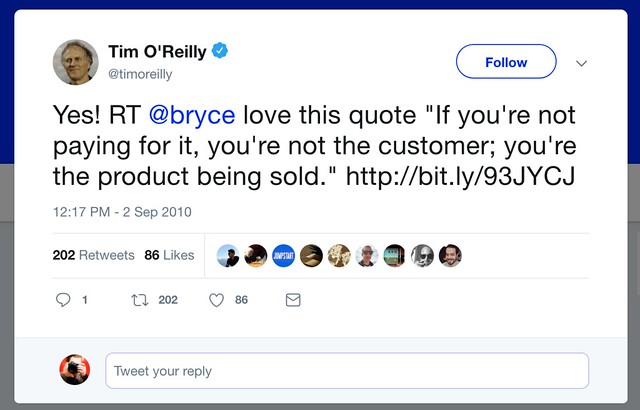
In 1973 the artists Richard Serra and Carlota Fay Schoolman broadcast a short video titled “Television Delivers People”. In that video a simple assertion was made: the product of television. commercial television. is the audience. Television delivers people to an advertiser. Since then, various influential individuals from Tim O’Reilly to Steve Wozniak to Apple CEO Tim Cook have all repeated the mantra: “if you’re not paying for it, you’re not the customer, you’re the product being sold.”

To put things more simply, there are two viable business models on the internet today to deliver service. There is a paid subscription model and there is a “free” model where business sell your data and make money on advertising everything from Butterfinger candy bars on Instagram to “brain force” pills via Alex Jones.

Personally I prefer to pay for an ad-free online experience which is one of the reasons why I’ve enjoyed Flickr so much where I’ve had an opportunity to pay annually since I joined the service back in 2003. Flickr delivers a clean user interface, full high res photos, a compelling app for my iPhone, unlimited storage, kick ass organizational tools, a social community to engage with, search tools, stats, and much more.

At $ 50/year (well technically $ 49.99 but I like to round up) I think Flickr delivers tremendous value. I have spent thousands of hours of my life on the site — thousands of ad-free hours not just for me, but for any of my friends or even strangers who happen to land on my photo page too. I am more than happy to pay this every year and will continue to do so until I die most likely. Hopefully I will figure out a way to even continue paying after I die as my personal life goal is to publish 1,000,000 photos before I die and then let that archive of work stand in all perpetuity after I am gone.

So obviously Flickr works for me, but what about all those people who don’t/haven’t paid and just want to use the service for “free.”

I believe that one of the reasons why Flickr was sold by Oath (who had purchased Yahoo’s content businesses) to Smugmug was because Oath realized that a hybrid subscription/free service doesn’t really work. It’s the same reason why Facebook is so resistant to offering a paid ad-free option to customers.

Oath is basically an advertising company and when you are advertising at people you need to be able to advertise to your most profitable customers to make the service work. When you give your most profitable customers (i.e. the ones with money) the option to pay to opt out of ads they do and will. What you are left with is a bunch of accounts by heavy users who are either poor Americans or more likely poor overseas accounts or very light users who can put up with ads but won’t see very many because they are only on your site 2 minutes a week. Whatever the case, you are basically providing a terabyte of enterprise storage, bandwidth, support, etc., to customers who cannot economically be supported by advertising.

In order for Flickr to survive it has to be a long-term profitable business. SmugMug knows a thing or two about how to do this as their primary model for over a decade has been entirely subscription based. As someone who wants to be able to host my photos on Flickr for the 50 remaining years I likely have left on this planet (and even after my death) in order to publish 1,000,000 photos, it’s important to me that Flickr has a long-term viable business model. This means that strongly encouraging free users (who are not currently paying their way) to migrate to paid Pro is important.

I do think it is important for Flickr to offer a free account in order to give people an opportunity to try out the service to see if it is for them. 1,000 photos gives you plenty of opportunity to do just that. It gives you hundreds, even thousands, of hours to explore and enjoy the service without paying — but if you are a heavy user of the site and are using over 1,000 photos of space, at some point you ought to pay.

By the way, Flickr’s original deal when I started with them was that they would only show your most recent 100 photos if you were a free account and the Pro account cost $ 60 (or $ 59.99) per year. So you might say the current account that gives you 10x that or 1,000 is 10x more generous than the original Flickr from way back.

Besides the obvious business model reasons why this is a smart decision for Flickr and their users, there are other important reasons this makes Flickr better as well. One of the things I noticed after Flickr began offering 1 terabyte for free to users was that many users simply began using Flickr as a backup site for all of their photos. Instead of sharing their best photos with a community, they simply dumped everything on their hard drive to Flickr and left and went away. These photos were then indexed for search and populated the service littering it with low quality content (screengrabs, 1,000 bad photos in a row of fireworks, 3,000 poorly composed photos in a row of somebody’s sister’s wedding, etc.). By focusing Flickr’s vision on photo sharing and community rather than simply another online photo backup dump this makes the visual experience better for those of us who are actually there to share photos and engage with each other.

Also, if people are willing to pay for something they tend to put more effort into it. If you are paying for something and perceive it’s value you’ll care more, contribute more and be a part of something. These are the accounts that I value on Flickr the most.

Yesterday morning I had an opportunity to talk to Don MacAskill (SmugMug/Flickr CEO) about this most recent decision that Flickr is making on the phone. Don is someone who cares deeply about Flickr and its community. How many CEOs do you know that spend an entire day interacting with users in an online forum about a big change like this?

I truly believe that yesterday’s decision not only paves the way to make Flickr viable for many years ahead, but that it paves the way for Don and his team to continue to spend money growing and building out the site for the community that is there and loves the service so much.

There are still so many great things that can be done with Flickr going forward. Groups need work. Search needs work. Community needs work. The app needs work. All of these things do cost money though and by getting rid of the massive storage/bandwidth demands of 1 terabyte free accounts and gaining more paid subscribers, this will allow Flickr to do this important work to continue making Flickr the best photo sharing site on the internet for all of us who are a part of the Flickr community and love the site so much.

I do understand that people don’t always want to pay for things, but I think that the right people will pay for Flickr because it provides them tremendous value. I pay for my Adobe Lightroom subscription. I pay for my Netflix account. I pay for these things because they provide me value. This is also why I pay for Flickr and will continue doing so many years into the future.

Unfortunately as we have seen with services like Friendfeed (purchased by Facebook) or even Google+ (in the process of being killed by Google) social networks oftentimes get shut down. It is very important to me that Flickr remains profitable for the long-term so that I can count on it being there many, many years from now. I think yesterday’s decision helps make Flickr more economically viable and sustainable many years into the future.

You can find me on Flickr here.

[disclosure, I know people and have friends that work at both Flickr and SmugMug]


Thomas Hawk Digital Connection

 
Comments Off on Why Limiting Free Users to 1,000 Photos on Flickr is a Smart Move

Posted in Photography


How to Take Better Winter Landscape Photos

01 Nov

Winter is personally my least favorite time of year – it’s cold, it’s depressing, there’s barely any sun out. But one thing that even I have to admit is that winter landscapes make for positively fantastic photographs – if you know how to approach them.  There are a couple of issues that even amateur photographers will notice when they take Continue Reading

The post How to Take Better Winter Landscape Photos appeared first on Photodoto.


Photodoto

 
Comments Off on How to Take Better Winter Landscape Photos

Posted in Photography


How to Use a Black and White Filter to Improve Your Photos

24 Oct

In photography, you’re always looking for that extra percentage improvement in your work. One of the best ways you can quickly get this improvement is by using a black and white filter.

Those interested in black and white photography should know about the various filter options available to them. In this article, you’ll discover how to get more dramatic photos simply by changing the color of light coming into your camera.

So read on and find out which filters those are, and when and where best to use them. Now you’ll know all there is to know about the black and white filter options!

How to Use a Black and White Filter to Improve Your Photos 1

Using yellow, orange or red filters on a partially cloudy day will give you good results.

The Classic Black and White Filter Group

The workhorse filters for black and white photography are undoubtedly the red, orange and yellow filters. These filters can add more punch and drama to your scene, so let’s take a look at what they do and why they’re important.

Yellow Filter

Adding this filter to the front of your lens will add more contrast, which will lead to a more dramatic look. The main way this happens is that the yellow filter will darken the skies while keeping the clouds white. To get the most out of this you’ll need to be photographing on a partially cloudy day. The filter will also add more contrast to the foliage for your nature landscapes. Now, if you’re a cityscape photographer those darker skies will make a skyscraper building jump out of the frame more. This filter will reduce the amount of light coming into the camera, so be aware of this and compensate by increasing the exposure value if needed.

How to Use a Black and White Filter to Improve Your Photos 2

Buildings will stand out more against the sky when you use filters.

Orange Filter

You may have guessed that using orange as opposed to yellow will in effect dial up all of the effects that the yellow filter makes. Whether you want to darken those skies more is an artistic choice, but it’s always worth having an orange filter in the bag to give you that option. This filter further reduces the amount of light coming into the camera by about 1 stop.

Red Filter

Using this black and white filter gives your photo a dark foreboding look, and makes the viewer sense an incoming storm. It does this because the blue skies become black when you use this filter, so the clouds have a lot of mood and drama to them. Whether your an urban or nature photographer, this filter ensures that those particular elements jump out of the frame much more. Again, as you dial up the contrast that a red filter applies, you reduce the amount of light coming into the camera. You’ll lose around 2 stops of light with a red filter on your lens.

How to Use a Black and White Filter to Improve Your Photos 3

The use of a red filter will give a really moody foreboding look. In this photo, you can see Sinabung volcano in the background.

Other Filter Options For Black and White Photography

There are plenty of other filters. Indeed, circular polarizing filters and neutral density filters work just as well for black and white photography. This article looks to concentrate on filters specific to black and white photography. So beyond the prominent red, orange and yellow filters, what else is out there? The answer is more colored filters – green and blue.

  • Green filter – Use this filter when photographing foliage, it brightens those areas of the image that contain green.
  • Blue filter – This filter works in almost the opposite way of red, orange and yellow filters. It darkens the warm colors and is used to separate images that have a mixture of colors. Another application for this filter is when there is mist or fog. In these scenes, using this filter adds even more mood to your photo.
How to Use a Black and White Filter to Improve Your Photos 4

Street photography is an area that’s popular for black and white photographers.

Using Graduated Filters

The use of graduated filters for landscape photography is still very popular, even with the dawn of post-processing in photography. The aspiration to get the photo right in camera is still very much alive, and it’s great to cut down on extra post-processing if you can. In black and white photography you can use neutral density filters to balance the light out across the frame. There are also sunset filters that can be used to add reds and oranges to the top half of an image. These filters can also be used in black and white photography to selectively add the filter color effect to certain parts of the photo, giving you a little more creative control over your final result.

Screw-on Filters, or a Stacking System?

Filters come in broadly two types; Circular-shaped filters that screw onto the front of your lens and square or rectangular-shaped filters that attach to a bracket. So which system is the best for you? Those looking to use one filter at a time might find the screw-on filters work better. These filters are made of glass and are also more resilient as a result. The stacking option gives you a choice to line up several filters, one in front of the other, and to adjust the horizon line for any graduated filters you may have. So what’s the best system? There are advantages to both, but if pressed, the stacking system is a nice option.

How to Use a Black and White Filter to Improve Your Photos 5

The use of the correct black and white filter can add more mood to a scene.

How About Post-Processing?

These days you can produce an excellent black and white photo through post-processing. There is less need to use filters, and unless you’re using film, the use of physical filters is somewhat redundant. While this is true in some areas of photography, the pervading mantra is it’s better to get your photo right in-camera.

Nik Silver Efex

There is still a place for post-processing though, and one of the best programs out there for this is Nik Silver Efex. This program has a range of filters as well – though not the circular or screw on variety! You can use the program to add either red, orange or yellow to your image. Beyond that are filters like push-process that add contrast and punch to your photo. Finally, you can color cast your photo and add a vignette to it. All the effects you could create in a dark room, are now possible with post-processing.

How to Use a Black and White Filter to Improve Your Photos 6

Of course, you can use programs like Silver Efex to create black and white photos during post-processing.

Try Out a Black and White Filter!

Many people who like photography will no doubt be familiar with these black and white filter options. Which ones do you find the most effective? We’d love to hear your opinions in the comments section.

Those who are new to black and white photography, have you considered using filters? Which are you more likely to use; digital versions or a filter you can attach to your lens? Once again, please share your experience of filters with the community!

Now all that’s left is to go out and make some stunning black and white photos!


The post How to Use a Black and White Filter to Improve Your Photos appeared first on Digital Photography School.


Digital Photography School

 
Comments Off on How to Use a Black and White Filter to Improve Your Photos

Posted in Photography


Lexar’s new USB 3.0 flash drive uses your fingerprint to keep your photos safe

23 Oct

Lexar has announced a new flash drive that features a fingerprint reader to protect its content from unauthorised access. The JumpDrive Fingerprint F35 can record up to ten fingerprints to allow it to be shared between users, and it comes with the fingerprint software already loaded.

Lexar claims recognising a user’s fingerprint takes less than a second, and the drives have read speeds of up to 150MB/s. While normal memory is compatible with Mac, PC and Linux, the fingerprint software is Windows-only.

The JumpDrive Fingerprint F35 will be available in capacities of 32GB, 64GB, 128GB and 256GB and will cost €29.99/$ 32.99 (32GB), €44.99/$ 49.99 (64GB), €79.99/89.99 (128GB). The 256GB version will arrive later this year, and will cost €149.99/169.99. Each of the drives comes with a three-year limited warranty.

For more information see the Lexar website.

Press release:

Lexar Announces New JumpDrive® Fingerprint F35 with an Added Touch of Security

New USB 3.0 Flash Drive Securely Protects Files Using 256-bit AES Encryption

Key messages:

  • Up to 10 fingerprint IDs allowed
  • Ultra-fast recognition – less than 1 second
  • Easy set-up, no software driver needed
  • Securely protects files using an advanced security solution with 256-bit AES encryption

Lexar, a leading global brand of flash memory solutions, today announced the new Lexar® JumpDrive® Fingerprint F35 USB 3.0 Flash Drive.

One of the most secure USB 3.0 flash drives available, Lexar JumpDrive F35 uses an ultra-fast fingerprint authentication that allows you to protect your data against unauthorized users – in under one second so that you will have no discernible impact on workflow. The F35 can save up to 10 fingerprint IDs, making sure only you and your closest collaborators have access to your files. It also boasts an easy set-up with no software driver required*, so you can quickly start transferring your files with speeds up to 150MB/s**. And for added peace of mind, it also features an advanced 256-bit AES security solution to protect your valuable files.

“The F35 combines reliable and secure data storage with biometric technology to prevent unauthorized access to your files – adding an extra layer of security for your drive by using fingerprint authentication. It is ideal for business professionals and photographers who require high-privacy protection to meet their needs,” said Joel Boquiren, Director of Global Marketing.

The Lexar JumpDrive Fingerprint F35 USB 3.0 Flash Drive is compatible with PC and Mac®* systems and comes with a three-year limited warranty***. It will be available in 32GB, 64GB, 128GB and 256GB capacities with read speeds of 150MB/s**. The new Lexar JumpDrive F35 is available now at MSRP of €29.99 (32GB), €44.99 (64GB), €79.99 (128GB), and the 256GB version will be €149.99, arriving in Q4 of this year. For more information visit www.lexar.com

Lexar will be exhibiting new product demonstrations at this year’s PhotoPlus Expo held at Javits Convention Center in New York City, New York, from October 25th – 27th.

*Fingerprint registration software only compatible with Windows XP, Vista, 7, 8, 10. Software required to create/edit accounts and adjust partition size. Regular flash drive use compatible with Windows, Linux and macOS.
**Up to 150MB/s read transfer, write speeds lower. Speeds based on internal testing. Actual performance may vary.
***http://www.lexar.com/support/warranties/

About Lexar
For more than 20 years, Lexar has been a trusted leading global brand of memory solutions. Our award-winning lineup includes memory cards, USB flash drives, card readers, and solid-state drives. With so many options, it’s easy to find the right Lexar solution to fit your needs. All Lexar product designs undergo extensive testing in the Lexar Quality Labs with more than 1,100 digital devices, to ensure performance, quality, compatibility, and reliability. Lexar products are available worldwide at major retail and e-tail stores. For more information or support, visit www.lexar.com.

About Longsys
Longsys – a leader in consumer NAND flash applications, is committed to supporting Lexar in its quest to reach new achievements in high-performance, quality, and reliability while maintaining its position as a leading global brand in memory cards, USB flash drives, readers, and storage drives for retail and OEM customers.

Articles: Digital Photography Review (dpreview.com)

 
Comments Off on Lexar’s new USB 3.0 flash drive uses your fingerprint to keep your photos safe

Posted in Uncategorized


How to Take Better Photos of Festivals and Celebrations

19 Oct

?

Mitchell K is not only a brilliant photographer, but also creates the most engaging videos of his travels. This one is no exception, and whilst a little longer than the videos we normally share, it’s an engaging, informative and inspiring lesson from Mitchell on how to get better photos at festivals and celebrations.

The video was filmed in a few locations in Peru. I’ll share parts of my adventure. You’ll even see how I almost killed myself driving over a high mountain pass at night. The main focus, though – is on the travel photography tips and advice. When you finish watching this video, you’ll have a much better idea about photographing festivals, celebrations and gatherings of people. It is almost 30 minutes long, but, I do really believe that it’s worth your time.
– Mitchell Kanashkevich

Mitchell has authored 3 great books for dPS – if you love his style, grab this quick offer to get 50% off these titles. Just use the code MITCHELLK50 (expires 31 October 2018):

Transcending Travel


Captivating Color

Natural Light

You can also check out more free tips on the blog:

Photographing Festivals and Events – Tips for Travel Photographers

Beginner’s Guide to Photographing Festivals

20 Tips for Photographing Historical Reenactments and Festivals

The post How to Take Better Photos of Festivals and Celebrations appeared first on Digital Photography School.


Digital Photography School

 
Comments Off on How to Take Better Photos of Festivals and Celebrations

Posted in Photography


5 Tips for Taking Beautiful Photos of Nature

11 Oct

An example of taking beautiful photos of nature

Nature photography encompasses a wide range of photos taken outdoors, and conveys natural elements such as landscapes, wildlife, plants, trees and flowers.

Whether you’re photographing sweeping natural scenes or close-ups of flowers, nature photography can be incredibly rewarding. Here are five tips for taking beautiful photographs of nature.

Focus on the foreground

Being out in nature can be incredibly rewarding. And not just for photography. The fresh air, the scenery, and the experience itself are all great incentives to head outdoors with your camera.

An example of taking beautiful photos of nature

When capturing beautiful scenes in nature, your picture can benefit from a bit of foreground interest. When you find a magical landscape to photograph, do it some justice by including something interesting in the foreground. I see many nature photos showing empty landscapes and skies without any consideration for the foreground.

Don’t get me wrong. Nature images can look great with an atmospheric sky and inviting view. But adding a foreground will help make your image stand out. Throw in a rock or some flowers to your image, and the photo becomes much more striking. In this nature photo I included some dandelions in the foreground to accentuate the scene.


Balance the photo

An example of taking beautiful photos of nature

Have you ever taken photos in nature and been disappointed with the images you produced? Returning from a photography outing with images that please you can be a challenge. So my next tip is to make your photos more balanced. Capture images of nature with careful consideration of what you include in the frame, and balance all of those elements.

For example, you maybe able to bring certain parts of the landscape together to improve your image, such as trees and mist. When you’re shooting outdoors, what things can you identify that would make a visually pleasing image?

An example of taking beautiful photos of nature


Use the right gear

Depending on the subject you’re photographing, it’s important to choose the right gear to get the best out of your images. Close-ups of insects or flowers would be best suited to a macro lens, which lets you get nearer to your subject. When faced with a wide vista, use a wide-angle lens to record a greater field of view.

On the other hand, if you’re shooting wildlife, telephoto and zoom lenses are usually the best option as they can help you zoom in closer to your subject. These aren’t hard and fast rules, but rather suggestions on what generally works regarding lens choice.

For example, if you’re photographing animals in a zoo, a wide-angle lens may be better than a telephoto lens if you want to capture more of the scene than just the animal, or if you’re positioned close to them.

An example of taking beautiful photos of nature

Capture different seasons

The advantage of nature photography is it can be done at any time during the year and in different seasons. Summer is a great time to document lush landscapes and green foliage when everything is in full bloom, whereas spring and autumn can provide blooming flowers, cooler climates, atmospheric weather and the occasional mist. The added benefit of autumn is the change in colours of autumn foliage, giving you opportunities for vibrant photos.

An example of taking beautiful photos of nature

Winter is another wonderful time to capture the brilliance of nature. While it can be harsh and cold, it can also be strikingly beautiful. A sprinkling of snow can look good in any nature photo.

An example of taking beautiful photos of nature

Snow can add contrast in landscape vistas. For example, the snow in this scene helps the dark silhouetted tree stand out. I also find that snow-capped mountains are wonderful subjects to photograph during the winter season.


Make the most of your natural surroundings

You don’t have to live in a beautiful and remote location to find amazing subjects of nature. You’ll find an abundance of things waiting to be photographed in your local area. I took this photograph five minutes from my home. Go outside and explore your own surroundings, and take photos in the best natural places close to home.

An example of taking beautiful photos of nature


Conclusion

Capturing photos of nature can be truly rewarding, and a great opportunity to be photographing outdoors.

Whether you’re a landscape photographer or prefer to shoot plants or wildlife, try putting these tips into practice. And feel free share your images and any other comments or tips below.

The post 5 Tips for Taking Beautiful Photos of Nature appeared first on Digital Photography School.


Digital Photography School

 
Comments Off on 5 Tips for Taking Beautiful Photos of Nature

Posted in Photography


How To Feel Confident About Having Your Photos Critiqued

10 Oct

We all like other people seeing our photographs, but not many photographers like to hear what other people really think of their photos. Getting a ‘thumbs up’ on Facebook or a ‘heart’ on Instagram is okay. Even a few emoticons can be very encouraging.

But while they might make you feel good for a little while, they won’t help you grow as a photographer. Deep down you know most people have just scrolled past your photo. And your mother always sends a smiley face.

Thai Model and Elephant in a natural forest setting ©Kevin Landwer-Johan

©Kevin Landwer-Johan

Taking the bold step of asking for a genuine critique on your photos is a lot different.

It can be incredibly encouraging. You may get unexpected positive feedback on an aspect of your photography you weren’t fully aware of.

But you may also be devastated. Someone who shows little empathy and no care while sharing their thoughts about your photos can do more harm than good. You may also start feeling negative from the words of someone who isn’t experienced enough in photography.

Here are some steps to help you make a good choice in asking someone for an appraisal of your work.

Before you offer any of your photos for review, do some research.

  1. Is the person offering critique an experienced photographer?
  2. Do you like their photographic style?
  3. Do you appreciate their approach to critiquing photos?
  4. Do they ask questions about your experience before critiquing?
  5. Do they express a balanced perspective?
Waterfall photo made using a slow shutter speed©Kevin Landwer-Johan

©Kevin Landwer-Johan

How Can Having Your Photos Critiqued Help Improve Your Photography?

A constructive critique of your photographs can help you see them from another perspective. A good critique will include a healthy balance of positive encouragement and constructive feedback on how an image could be improved.

Something good can almost always be said about a photo. But beware of falseness. No-one wants a fake review of their work. A helpful positive analysis is more than just a few nice adjectives. The critic should tell you why they like your photo and describe the outstanding aspects.

The best constructive feedback is carefully worded and gentle. Honesty isn’t kind if it’s delivered with brutal assertion. And negative feedback spoken harshly doesn’t help anybody. It may make the critic feel superior, but being on the receiving end isn’t encouraging. A critique of anyone’s photos should’t be about the person offering the analysis. It should be about the photo, and directed primarily to the photographer.

A good critique should include a clear explanation of the weaknesses in a photo, along with suggestions of how it could have been improved. Sometimes when talking about a photo I’ll share ways it can be improved simply by a different crop or alternative post-processing.

©Kevin Landwer-Johan Beautiful young Thai woman poses against a dark background with pink fabric.

©Kevin Landwer-Johan

Choosing the Right Critic for You

Being confident and comfortable with the person offering their opinion is important. We all see the world differently, and express what we see in diverse ways. Finding the right person to learn from as they talk about your photos is essential to it being a positive experience.

To help find an appropriate person, ask yourself these questions.

1. Is the person offering critique an experienced photographer?

Having someone less experienced than you are, or minimally more experienced, will rarely be helpful. Having a group of friends to hang out with and discuss each other’s images is different because the relationship is casual.

Find a mature person with a good deal of experience. They’ll be able to offer their opinion in positive and helpful ways based on their experience.

©Kevin Landwer-Johan frog sitting the a pond close up

©Kevin Landwer-Johan

2. Do you like their photographic style?

There’s not much point asking someone who only photographs landscapes to comment on your street or sports photos. Hopefully you can find someone whose work is close to your own style (or what you are aspiring to) and have them critique your photos.

You should be able to see enough of their work to help you make this choice. Having an appreciation for the type of photography they create will help you relate more easily.

Leaves folded into flowers ©Kevin Landwer-Johan

©Kevin Landwer-Johan

3. Do you appreciate their approach to critiquing photos?

Accepting and appreciating the way a critic expresses themselves is very important. They may be extremely knowledgeable and experienced, but if they come across as arrogant their critique won’t be easy to receive.

If you can attend a session where they’re reviewing someone else’s photos, go along and observe. Maybe they have some video or written critiques online. Check them out and see if you’re confident they’ll be honest and respectful about your photos.

Durian fruit ©Kevin Landwer-Johan

©Kevin Landwer-Johan

4. Do they ask questions about your experience before critiquing?

If they know nothing about your experience or you want to express, the critique may not be helpful. I find it helpful to know a photographer’s experience level before offering my thoughts on their photos.

This information gives insight into the technical experience, and sometimes the creative expression. Most of all, it will give the critic the depth of information to offer. Giving a beginner too much detail about how to improve their composition may be detrimental. You need to clearly understand what the critic is telling you. For the same reason, I avoid using too much photography jargon when making critiques.

Market Porter at Muang Mai Market in Chiang Mai, Thailand ©Kevin Landwer-Johan

©Kevin Landwer-Johan

5. Do they express a balanced perspective?

Receiving a balanced appraisal of most (if not all) aspects of your photograph is helpful. But this may not be possible (or even necessary), depending on the photo.

I always look to include commentary on:

  • Exposure
  • Composition
  • Color
  • Tone
  • Timing
  • Feeling

The best photo critiques include a balanced mix of technical and creative – left and right brain perspective.

©Kevin Landwer-Johan Tropical Flowers close up

©Kevin Landwer-Johan

Where to Find the Right Critic

The easiest way  to find someone to critique your photos these days is online. Do a search on Google or YouTube, or check out the link in my bio.

You could also try your local camera club. It will be worth doing your research carefully first. Sometimes these groups offer a group critique of members’ photos. You need a pretty thick skin to endure this. You’ll have people with a range of skill levels and temperaments all wanting to give their opinions.

gold Buddhist chedi against a blue sky taken during a Chiang Mai Photo Workshop ©Kevin Landwer-Johan

©Kevin Landwer-Johan

Be Encouraged

Give it a try. Having your photos critiqued can be extremely helpful to your development as a photographer. I regret not having much of an opportunity for my photos to be looked over and spoken about. Now I enjoy being able to offer this as a service to encourage photographers.

The post How To Feel Confident About Having Your Photos Critiqued appeared first on Digital Photography School.


Digital Photography School

 
Comments Off on How To Feel Confident About Having Your Photos Critiqued

Posted in Photography


How to Take Better Concert Photos

29 Sep

COOPH has released a 4-minute video with photographer Michael Agel, decoding the mystery behind shooting great concert photos. Concerts and gigs typically feature challenging, but also very unique, lighting situations.

This can make for incredible images, but if you don’t know exactly how to handle the drastic lighting changes and colors then it could go very wrong for you!

Better concert photos

?

“Photography, for me, is painting with light,” says Agel. “You have to look where there is interesting light, and create a good image.”

Agel is also a big advocate of putting down the camera and building rapport with the musicians you are shooting. This will help you to create better shots, but also avoid potentially disastrous situations (such as standing in front of a confetti cannon that’s about to go off!

Staying invisible will help you to nail those perfect shots; knowing when and how to choose your moments is paramount. You don’t want to get in between the singer and the crowd, and it’s key things like this that will make for a much smoother shoot – and hopefully get you booked again!

Check out the full video above to hear from Agel himself and see more of his work.

More reading

For more on concert photography check out these dPS articles:

  • 11 Ideas for More Unique Concert Photos
  • Tips for Doing Concert Photography like a Pro
  • 5 Tips for Better Concert Photography in Low Light Conditions
  • Concert Photography 101: Cameras and Lenses for Beginners
  • 10 Must-Have Camera Settings for Concert Photography
  • Anatomy of a Concert Photography Shoot

The post How to Take Better Concert Photos appeared first on Digital Photography School.


Digital Photography School

 
Comments Off on How to Take Better Concert Photos

Posted in Photography