RSS
 

Posts Tagged ‘Photography’

The Real Consequences of Taking a Break from Photography

16 Apr

The post The Real Consequences of Taking a Break from Photography appeared first on Digital Photography School. It was authored by John McIntire.

Have you ever felt fed up with your photography? Disillusioned? Frustrated? Uninspired? Burnt out? If that’s the case for you, you are not alone in those feelings. Most of us feel that way at some point or another, often on multiple occasions. Fortunately, there is and always has been a lot of sound advice available for when you feel that way.

Advice that prompts you to try new techniques for a different perspective and a fresh outlook is one great example of common advice that may help you to overcome the frustration.

Sometimes doing something different, like getting out of the studio, can be enough to give you a fresh perspective on things.

This article discusses one particular piece of common advice that’s given to photographers a lot. You will have probably heard (or read it) given to someone else at some point, even if it hasn’t been given to you. That advice is when you feel this way, take a break from photography. On the surface, this can seem like a great idea and a great piece of advice. However, once you dig a bit deeper and dissect the possible outcomes (as this article does), you should see that the repercussions of following through with a break from photography can be significant.

Where is this coming from

This topic is quite personal. I followed this advice several years ago after struggling with severe burn out. Because of this, the topics discussed in this article are based on some of the things I experienced after taking a break. That said, even though this is quite personal, I try to keep that aspect out of this article as much as possible and keep things analytical and leave the anecdotes to a minimum.

Even so, you’re situation and experiences won’t be the same as mine. I may have experienced these consequences, but that doesn’t mean you will. If you are considering taking a break from your photography, do have a good, hard think about if any of this applies to you.

There are benefits

Taking a break did allow me the chance to spend time creating images that matter to no one other than me.

As mentioned, the advice photographers often get is to take a break from photography. This does have some benefits (and I did experience those).

By taking a step back, you can gain both space and time to give things an honest appraisal and discover exactly what is causing the feelings of frustration that led you to the point of wanting to take a break in the first place. This a huge advantage and if used well, you can take that insight and fix, or cut out, whatever was causing your frustrations.

Some of the things that are easier to evaluate from a safe distance include: what you like and don’t like, the direction your photography is heading in, your working habits, and your personal values and how they apply to your photography.

I used to use a white background a lot because I loved it. At some point, I stopped loving it and became bored, but didn’t realize until I took a long step back.

That time can also give you the opportunity to let some information sink in. If there’s a concept or a technique that you just can’t wrap your head around, stepping away from actively pursuing it gives your brain the opportunity to work on the problem in the background.

The downsides

While the positive consequences of taking a break can be obvious, some of the potential negative consequences are less so.

Habits and systems

As you develop as a photographer, so does your list of processes and systems that help you achieve what you do. A post-processing workflow is just one example of something that may be disrupted by taking an extended break from photography.

If you’ve been involved with photography for any amount of time, you have gradually built a series of habits and systems that you go through every time you take photos. This could be your post-processing workflow, it could be the way you research locations, or it could be the way you conduct yourself on social media.

The thing is, these habits and processes were built step by step. You didn’t just wake up one day and have a complete post-processing workflow in place.

When you decide to take a break, you’re taking a break from your habits and routines. If these were developed over years of practice and daily ritual, what happens when your break is over? Chances are, when you come back, you may very well struggle to jump back into those complex habits. Instead of building things up gradually, you are trying to get back into a routine all at once. This can extremely difficult at the best of times.

While on my break, I spent a fair amount of time shooting landscapes for fun and as an excuse to be outside. While fun, landscape photography requires a very different approach and set of processes to portraits.

If you think about this just in the context of social media, posting content everyday (or at least regularly) can be a significant job with plenty of work going into each post. Stopping that routine and then trying to come back to it months later could be overwhelming and it might take significant effort to overcome a challenge like that.

Once you add that to the possibility that once you step away from social media, you may very well recognize just how toxic it can be, which makes it all the harder to willingly step back into that arena.

Things change

Depending on how long your break is for, things that you take for granted can change dramatically. My break lasted a couple of years. In that time, Photoshop transformed into something only slightly recognizable. Lightroom transformed into the go-to for photographers, and Instagram went from iOS users only to taking over the world.

You can probably see the disadvantages here. In this technological world, everything changes at a ridiculous pace. By taking time out, you are removing yourself from a position where you can adjust to these changes as they happen. When you decide to come back, you now have an enormous workload of stuff that you have to learn or relearn just to put yourself at the same level you were before.

People change

If you’re a portrait photographer, or any sort of social photographer, this is probably the most applicable point to you.

Much as the tools of the trade change over time, so will your network. Once you’re on a break, any previous contacts or clients will move on and find another photographer. Models, make-up artist and other collaborators may move on or change focus themselves.

Over time, your network of clients, collaborators and co-conspirators changes organically. However, if you’re on a break, you don’t have as many opportunities to add new people to your network.

This applies equally to social media and real life networking.

If you weren’t on a break, this would still happen, but your network would still be growing naturally. However, if you’re not there to grow that network, the holes that these people leave will be empty once your break is over. If your break is an extended one over a couple years, you may come back to find that the network that you put a significant amount of time and effort into building is decimated.

Piecing it back together

All of these things on their own may not seem insurmountable, but once you add them all together, they can accumulate to an enormous challenge that will set you back in both time and effort.

Having to refocus on these things also means that once you’ve decided that you’re ready to come back to photography, you have to put a great deal of time into the things that aren’t photography.

For a lot of people who are frustrated and disillusioned with their photography, it is often these ancillary administrative tasks that cause the feelings of frustration and disillusionment in the first place.

Weigh your choices

If you are in a position where you are considering taking a break, I understand and I empathize. A lot of photographers have been there before.

Before you make a decision, please, please take the time to consider all of the possible consequences of taking a break.

Again, my circumstances will be different from yours and your consequences may not look remotely like mine, but there will be consequences that you may not be able to see yet. Please try to take them into account.

Have you taken a break from photography or considering it? Feel free to share your experiences in the comments below.

The post The Real Consequences of Taking a Break from Photography appeared first on Digital Photography School. It was authored by John McIntire.

Digital Photography School

 
Comments Off on The Real Consequences of Taking a Break from Photography

Posted in Photography


Mastering Color Series – The Psychology and Evolution of the Color BLUE and its use in Photography

15 Apr

The post Mastering Color Series – The Psychology and Evolution of the Color BLUE and its use in Photography appeared first on Digital Photography School. It was authored by Megan Kennedy.

As one of the three primary colors in traditional colour theory and the RGB colour model, blue’s greatest impact is in its capacity to convey strong emotion. Painter Vincent van Gogh once said “I never get tired of the blue sky”, his fascination proving integral to many of his most famous paintings. In this article, we’ll have a detailed look at the history of blue in visual arts and what it means for your photography.

The psychology of blue

Color has a profound effect on our psychology. Rayleigh scattering, an optical phenomenon that causes the sea and sky to appear blue, forges a psychological association between the color blue and the perceived qualities of blue in nature. For example, the ancient duality of the sea and the sky generates a visual relationship between blue and impressions of consistency and trust. Blue’s associations with water tie it to cleanliness and refreshment but also tears. Consequently, a person experiencing sadness is said to be feeling blue.

The cool light of winter and the blue tint of ice draws connections between blue and the cold. Clear blue skies have become synonymous with happiness, relaxation and tranquility. The blue tint of daylight helps regulate our circadian rhythms. Blue also lowers stress levels, stimulating calm. This has practical applications; hospitals are often painted in shades of blue to help ease patient anxiety. Additionally, many medications are dispensed in blue pill form.

Blue is believed to symbolize the male gender in the Western cultures – though this hasn’t always been the case. In China, blue manifests itself as a color of healing, relaxation and immortality. In countries like Turkey, Greece and Albania, blue is said to repel evil. Hindu tradition associates blue with Krishna, a deity that embodies love, virtue and divinity. Furthermore, in German, Swedish and Norwegian languages, a naive person is said to look upon the world with a blue eye.

Jodhpur – the blue city of India.

The evolution of the color blue

Egyptian blue

Egyptian blue is considered to be the first synthetic pigment. Produced by the ancient Egyptians from around 2,200 BC, Egyptian blue was made from a mixture of ground limestone, sand and a copper-containing mineral (like azurite or malachite). The mixture was heated up to 1650°F, producing an opaque blue glass. The glass was then crushed and combined with thickening agents for application.

Associated with the River Nile and the sky, ancient Egyptians used Egyptian blue to paint murals, statues and ceramics. Eventually, Egyptian blue spread to the Near East, the Eastern Mediterranean and the Roman Empire. Egyptian blue’s usage continued throughout the Late and Greco-Roman periods. However, the pigment died out in the 4th century AD, when the recipe for its manufacture was lost.

Ultramarine

Lapis lazuli first appeared as a pigment in 6th to 7th century AD paintings in Afghanistani Zoroastrian and Buddhist temples. During the 14th and 15th centuries, Italian traders shipped the pigment to Europe. There, it was called ultramarine or ultramarinus (meaning beyond the sea in Latin).

For centuries, the cost of ultramarine pigment rivaled the price of gold. Subsequently, artists used ultramarine in only the most imperative aspects of a painting. This judicious application culminated in associations between the color blue and status.

Ultramarine remained almost prohibitively expensive until an artificial process was discovered in 1828 by Jean Baptiste Guimet. Commercial production of the synthetic ultramarine had commenced by 1830, and became known as French ultramarine.

Cobalt blue

In the 8th and 9th centuries, cobalt blue was used to color porcelain and jewelry in China. An alumina-based version of cobalt blue was later discovered by the French chemist, Louis Jacques Thénard in 1802. Commercial production of the pigment began in France in 1807.

Lightfast, stable and compatible with other pigments, Impressionists such as Pierre-Auguste Renoir and Claude Monet readily adopted cobalt blue as an alternative to pricey ultramarine. Post-Impressionists such as Vincent van Gogh and Paul Cezanne also made use of cobalt blue. According to the Musee d’Orsay, van Gogh used a combination of Prussian blue, cobalt and ultramarine to create the nighttime hues of Starry Night Over the Rhone. Van Gogh himself stated that “cobalt is a divine color and there is nothing so beautiful for creating atmosphere…”

Cerulean

Cerulean is a Latin word which translates as sky blue. Originally composed of cobalt magnesium stannate, cerulean was refined by a process developed in 1805 by Andreas Höpfner in Germany. Cerulean wasn’t sold as an artist’s pigment until 1860 by Rowney and Company. When it did become available, however, the color, ranging between azure and dark sky blue, proved popular among artists.

In 1999, Pantone released a statement declaring Cerulean Blue as the color for the millennium. Leatrice Eiseman, executive director of the Pantone Color Institute, stated that “…cerulean blue could bring on a certain peace because it reminds you of time spent outdoors, on a beach, near the water…in addition, it makes the unknown a little less frightening because the sky…is a constant…that’s the dependability factor of blue.”

Lisa Herbert, vice president, corporate communications worldwide, Pantone Inc., went on to say “our studies show that blue is the leading favorite color…regardless of culture, gender or geographic origin….[in the] U.S. [and] Europe and Asia as well. We’ve chosen cerulean blue as the official color for the millennium because of its mass appeal.”

Cerulean is the Latin word for sky blue

Prussian blue

Prussian blue was apparently discovered by accident. Around 1706, pigment and dye producer Johann Jacob Diesbach was mixing crushed cochineal insects, iron sulfate and potash to create cochineal red lake. Unbeknownst to him, the potash he used was contaminated with animal blood. The resulting concoction turned out to be the first modern synthetic pigment, a rich, dark blue that was quickly recognized for its artistic applications.

Inexpensive, easily produced, non-toxic, and intensely colored, Prussian blue spread throughout the art world. Pieter van der Werff’s The Entombment of Christ is the oldest known example of Prussian blue in an artwork. Other early examples include Antoine Watteau’s Pilgrimage to Cythera and paintings produced in Berlin in 1710 by Antoine Pesne.

Japanese woodblock artist Katsushika Hokusai used Prussian blue (as well as indigo dye) to create the Great Wave off Kanagawa. In 1842, English scientist and astronomer Sir John Herschel’s experimentations with Prussian blue led to the invention of the cyanotype.

International Klein blue

International Klein Blue (IKB) is a deep blue hue developed by French artist Yves Klein and Edouard Adam, a Parisian art paint supplier. Klein suspended his favorite ultramarine pigment in a matte, synthetic resin binder made of petroleum extracts. This allowed the rich blue hue to be applied without the loss of vibrancy. Single-colored canvases as well as elaborate performative undertakings were underpinned by Klein’s extensive use of the brilliant IKB.

YInMn blue

Much like Prussian blue, YlnMn (pronounced Yin Min) blue was discovered by accident. In 2009 at Oregon State University, Professor Mas Subramanian and his then-graduate student Andrew E. Smith were investigating new materials for making electronics. The pair were experimenting with the properties of manganese oxide by heating it to approximately 2000 °F. What emerged from the furnace however, was a striking blue compound.  Named after its chemical makeup of yttrium, indium, and manganese, YlnMn blue pigment was released for commercial use in June 2016. According to paint company Derivan YlnMn blue is “non-toxic with excellent archival attributes”.

Blue in visual arts

Ancient art to the Renaissance

Blue is an enduring presence throughout art history. Ancient Egyptians decorated murals and tombs with shades of blue. The walls of Roman villas in Pompeii had frescoes of blue skies. Greek artists used blue as a background colour behind the friezes on Greek temples and to colour the beards of statues.

Dark blue was widely used in the decoration of churches in the Byzantine Empire. Byzantine art depicted Christ and the Virgin Mary dressed in dark blue or purple. Elaborate dark blue and turquoise tiles were used to decorate mosques and palaces from Spain to Central Asia.

At the beginning of the Middle Ages in Europe, blue played a less significant role to that of other colors. However, in the 12th century, painters in Italy and greater Europe were instructed by the Roman Catholic Church to paint the robes of the Virgin Mary with ultramarine, the newest and most expensive pigment at the time. The Virgin Mother’s updated wardrobe resulted in blue being associated with holiness, humility and virtue.

During the Renaissance, artists began to paint the world as it was seen in real life, mixing blue hues with lead white paint to articulate shadows and highlights. In Titian’s Noli me Tangere and Bacchus and Ariadne, different shades of blue are layered to cultivate depth and tension. In another example, Raphael’s Madonna of the Meadow depicts Mary wearing a deep blue mantle set against a red dress, a striking contrast against a background populated with brown and light blue hues.

Rococo to contemporary art

The Rococo art movement depicted mythology and light-hearted portrayals of upper-class domestic life with pastel blue skies and rich blue furnishings. Romanticism used blue predominantly to convey drama in the heavens, and Impressionists like Claude Monet used blue to investigate light and movement in both natural and artificial landscapes.

Emphasizing strong colour over the representational, Fauvist Henri Matisse’s figures in Dance circle naked under an open blue sky. Expressionist van Gogh’s seminal Starry Night, conveys the night sky in active blues and yellows. Cubist Pablo Picasso’s extensive use of Prussian blue defined his Blue Period while Surrealists adopted blue to simultaneously orientate and disorientate the viewer.

From the 20th century artists began to free themselves from the confines of the literal. As a result, artists looked to color as a tool to channel emotion. Exemplified in abstract expressionism, Jackson Pollock‘s Blue Poles, is made up of chaotic strands of blacks, greens, oranges, whites, yellows and grays tempered by nine vertical blue lines. Mark Rothko experimented extensively with blue, as did Barnett Newman, both artists using color as a device to transcend the confines of the canvas. And Helen Frankenthaler‘s stained blues emphasize both the flattening and dimensionality of space.

With the arrival of modern technologies and materials, contemporary examples of blue in art are rich and varied. Roger Hiorns’ crystalline Seizure, transformed space with color, light and chemistry. Katharina Fritsch’s Hahn/Cock plays with our sense of scale and relationship to animals. And Anish Kapoor’s Sky Mirror, Blue challenges our perceptions of an urban environment, re-imagining the landscape through the lens of a large, blue concave mirror.

Blue in photography

Birthed from nature and art, blue’s associations play a critical role in conveying the nature of the photographic image. Luigi Ghirri explored the relationship between shape and space by incorporating large fields of blue sky into his imagery. Color pioneer Martin Parr makes use of rich blues to create a surreal juxtaposition between subject, object and nature. Bill Henson uses blue hues to cultivate experiential photographic dramas. David Burdeny photographs precision landscapes, using blue to illustrate the materiality of his abstract vistas. While Gregory Crewdson and Didier Massard both use blue to signal time, place and atmosphere throughout their imagery.

The color blue has other applications in photography too. Occurring just after sunset and just before sunrise, the blue hour is a period when the sun drops below the horizon and residual sunlight takes on a blue hue. Valued for its soft quality of light, blue hour is popular with portrait and landscape photographers. In addition, blue filters (applied on-camera or in post production) are used in black and white photography to increase the appearance of mist and haze.

Conclusion

Yves Klein once said “blue has no dimensions, it is beyond dimensions”. Over history, blue has communicated the ineffable, transcending colour and touching on our spirituality and sense of self. Associated with nature, calm, reverence, purity, trust and sorrow, blue embodies the visual weight of emotion and human experience.

Have you used blue in your photography? Feel free to share them with us in the comments below.

You may also like:

Mastering Color Series – The Psychology and Evolution of the Color RED and it’s use in Photography

Mastering Color Series – The Psychology and Evolution of the Color YELLOW and its use in Photography


mastering color series - Blue

The post Mastering Color Series – The Psychology and Evolution of the Color BLUE and its use in Photography appeared first on Digital Photography School. It was authored by Megan Kennedy.


Digital Photography School

 
Comments Off on Mastering Color Series – The Psychology and Evolution of the Color BLUE and its use in Photography

Posted in Photography


Weekly Photography Challenge – Minimalism

13 Apr

The post Weekly Photography Challenge – Minimalism appeared first on Digital Photography School. It was authored by Caz Nowaczyk.

This week’s photography challenge topic is MINIMALISM!

Katie Treadway

Your photos can include anything that is minimalist. It can be landscape, street, abstract, objects or anything really! They can be color, black and white, moody or bright. You get the picture! Have fun, and I look forward to seeing what you come up with!

Raychan

Some Inst-piration from some Instagrammers:


View this post on Instagram


A post shared by Hello!! (@esraatayel) on


View this post on Instagram


A post shared by Glaycheong Matt (@glaycheong_visual_diary) on


View this post on Instagram


A post shared by ????? ???????? (@ceritanyapanjang_) on


View this post on Instagram


A post shared by Alex Neaga (@alex_neaga) on


View this post on Instagram


A post shared by hüseyinopruklu (@huseyinopruklu) on


Check out some of the articles below that give you tips on this week’s challenge.

Tips for Shooting MINIMALISM

The Minimalist Landscape Photographer: What do you really need?

Tips for Minimalist Photography in an Urban Environment

5 Guidelines of Minimalist Photography to Help Improve Your Work

Minimalism: Using Negative Space In Your Photographs

Minimalist Photography ~ 4 Tips To Keep It Simple With A Maximum Impact

Minimalism in Photography


Weekly Photography Challenge – MINIMALISM

Simply upload your shot into the comment field (look for the little camera icon in the Disqus comments section) and they’ll get embedded for us all to see or if you’d prefer, upload them to your favorite photo-sharing site and leave the link to them. Show me your best images in this week’s challenge.

Share in the dPS Facebook Group

You can also share your images in the dPS Facebook group as the challenge is posted there each week as well.

If you tag your photos on Flickr, Instagram, Twitter or other sites – tag them as #DPSminimalism to help others find them. Linking back to this page might also help others know what you’re doing so that they can share in the fun.

The post Weekly Photography Challenge – Minimalism appeared first on Digital Photography School. It was authored by Caz Nowaczyk.


Digital Photography School

 
Comments Off on Weekly Photography Challenge – Minimalism

Posted in Photography


5 Surprising Macro Photography Ideas to Jumpstart Your Creativity

09 Apr

The post 5 Surprising Macro Photography Ideas to Jumpstart Your Creativity appeared first on Digital Photography School. It was authored by Jaymes Dempsey.

Are you struggling to come up with amazing macro photography ideas?

Do you need a bit of a creativity jumpstart?

That’s okay! Because in this article, I’ll give you 5 macro photography ideas – all geared toward getting you out of that creative rut.

Are you ready to start taking stunning macro photos again?

Then let’s get started.

1. Find lights in the background for amazing bokeh

One of the best ways to do creative macro photography…

…is to capture gorgeous bokeh.

(That is, a beautiful, smooth, creamy background.)

And here’s how you do that:

First, find a subject that you really like. A flower, an insect, or some plant life will all work well.

Choose a wide aperture (one in the f/2.8 to f/5.6 range).

Then zoom in, until you’ve isolated just your subject.

Here comes the important part:

Slowly move around your subject, while looking through your camera’s viewfinder. The key is to find a ‘bokeh-generating’ background.

Now, bokeh-generating backgrounds involve light. The best bokeh often comes from bright lights and colors in the background.

More specifically, look for pinpricks of light and colorful reflections.

For instance, sun coming through trees creates amazing bokeh – because the trees break up the light.

Leaves in golden-hour light also create gorgeous bokeh. The golden light on the leaves reflects and makes a creamy, colorful backdrop.

Most scenes have at least a few bokeh options – so don’t settle for a subpar choice.

Instead, use the bokeh to create a masterpiece!

2. Shoot into the sun for gorgeous backlit macro photography

Nature photographers often shoot using frontlight – where the light comes from over the photographer’s shoulder, and lands on the subject.

This often works well. But it can get boring after a while.

If you want to get creative…

…try using backlight.

Backlight comes from behind your subject. It’s great for creating silhouettes – and it’s also great for producing creative lighting effects.

The light can pass through part of your subject, making it turn translucent.

And backlight can also create bright flares of light. When done right, this creates some stunning effects.

However, you should position the sun carefully.

If you get the naked sun in your frame, the whole shot will be ruined because the sun is simply too bright to be rendered by your camera.

Instead, put your macro photography subject in front of the sun. That way, the sun is blocked from view. But you still get some gorgeous effects.

In fact, I recommend experimenting with this. Try changing your angle slightly, so that the sun is placed behind different parts of your subject.

You’ll manage to capture some stunning shots – shots which you probably wouldn’t have initially imagined!

3. Shoot against a white sky for a gorgeous high-key look

Here’s a favorite macro photography idea of mine.

I use it all the time when I’m in a pinch!

Fortunately, it’s really simple:

Shoot against a white sky.

Let me explain:

One of the most important parts of a macro photo…

…is the background.

Without a beautiful background, your macro photos will often fall flat.

Now, the best backgrounds are simple and uniform.

And one of the great ways to create a uniform background?

Rely on the sky!

This works especially well on cloudy days. All you have to do is find a subject – then get down low. In fact, you often have to get lower than your subject.

Make sure that the background is completely covered by clouds.

Then photograph your subject and watch as it stands out against a gorgeous white backdrop!

(If the shot is slightly too dark, don’t worry. You can always lift the whites in post-processing.)

4. Freelens for stunning selective focus

Here’s another great macro photography idea for when you’re in a rut:

Freelens!

I’m a huge fan of this technique – because it gets striking, unique images.

Here’s how it works:

Turn on your camera, and make sure that your lens is focused to infinity.

Then turn your camera off, and detach the lens.

(I suggest you use a backup camera and backup lens for this because there is a risk of damaging your equipment.)

Now, the best lenses for macro freelensing are in the 50mm range. I’ve found that 50mm creates a nice balance of background blur and sharp focus.

Once you’ve detached the lens, turn your camera back on.

Then…

Experiment!

Note: With freelensing, you don’t focus by turning a focus ring. Instead, you focus by changing the position of the lens relative to the camera.

So keep the lens detached, and move it around at different angles.

Look for macro subjects, and see what happens when you shoot them with a freelensing setup. Also, notice how pulling the lens away from the camera increases the magnification of the lens. It also allows in more light – creating artistic light leaks!

Freelensing is a bit addictive. Once you’ve started, you’ll struggle to stop – because there are so many opportunities for gorgeous macro photos!

5. Shoot through a second subject for an incredible foreground

If you want an idea for especially creative macro photography…

…why not try ‘shooting through,’ or ‘cramming’?

First, find a macro subject. Flowers work especially well for this because they’re so colorful.

Get in close, and focus your lens on that subject. Choose a wide aperture, in the f/2.8 to f/5.6 range.

Then find a second subject. Place it in front of your lens. The second subject should be colorful – and ideally, similar to the first subject.

And…shoot!

The second subject (which remains out of focus) will create a beautiful foreground wash. One that looks great in macro photography.

Now, you don’t want to completely cover your lens with the foreground subject. Instead, place it partially into the scene. That way, it will create a nice wash, without dominating the shot.

This may take a bit of experimentation. But if you’re patient, you’ll capture some gorgeous macro photos.

And your creative muscle will feel energized again!

Creative macro photography ideas: next steps

Hopefully, you’re now feeling excited about macro photography again.

After all, you have lots of ideas for original, creative shots!

The key is to use them. So get out and shoot!

Have any more macro photography ideas? Share them in the comments!

The post 5 Surprising Macro Photography Ideas to Jumpstart Your Creativity appeared first on Digital Photography School. It was authored by Jaymes Dempsey.


Digital Photography School

 
Comments Off on 5 Surprising Macro Photography Ideas to Jumpstart Your Creativity

Posted in Photography


6 Methods to Create Dynamic in Your Photography [video]

06 Apr

The post 6 Methods to Create Dynamic in Your Photography appeared first on Digital Photography School. It was authored by Caz Nowaczyk.

In this video from our friends over at Cooph, you’ll learn 6 methods to create dynamic in your photography.

?


The video covers these 6 tips:

1. Power of Color

Scout a vibrant location, and find your angle.

Look for color blocking opportunities. Look for vivid backgrounds that are perfect for graphic needs.

2. Black and White

Look for things like parking ramps as they provide great contrast and depth. Shoot roofs that cast interesting shadows.

3. Motion Blur

Create dynamic by panning. Pan subjects passing on the street. Rig your tripod up in the back of your vehicle and photograph long exposures for light trails and movement. (Be sure you and your gear are safe and secure here.)

Or frame the cockpit instead!

4. Zoom Blur

Zoom out and expose long for interesting effects.

Define a focal point of interest, shoot and zoom!

Shoot at night using long exposures and zooming effects. Shooting buildings with all their lights can make for great effects!

5. Rectangles

Use places like stairways that have long vanishing points. Here straight lines become dynamic! Coupled with light and shadow, you can get some really interesting shots! Also, look for sharp corners and lines that draw the viewer’s eye throughout your frame.

6. Perspective

Seek high buildings, get down low and angle your camera from a low angle, pointing upward for epic perspective!

Crawl under a grid (if you really want to, and can find one!) and shoot your subject standing on the grid above for a cool urban look.

Find a low, infrequently used tunnel. Get low and create lines in your images.


You may also find the following article helpful:

Get Low and Aim High – How to Use Low-Angle Photography to Great Effect

9 Creative Architecture Photography Techniques for Amazing Photos!

How to do Light Painting Photography Art with Endless Possibilities

5 Photography Hacks to Improve Your Creative Photography

The dPS Top Street Photography Tips of 2018

The post 6 Methods to Create Dynamic in Your Photography appeared first on Digital Photography School. It was authored by Caz Nowaczyk.


Digital Photography School

 
Comments Off on 6 Methods to Create Dynamic in Your Photography [video]

Posted in Photography


Weekly Photography Challenge – Bicycles

06 Apr

The post Weekly Photography Challenge – Bicycles appeared first on Digital Photography School. It was authored by Caz Nowaczyk.

This week’s photography challenge topic is BICYCLES!

Flo Karr

Your photos can include anything that has bicycles. It can be motion-blurred, cropped, minimalist, color-based, use nature, objects or anything really! They can be color, black and white, moody or bright. You get the picture! Have fun, and I look forward to seeing what you come up with!

Emily Levine


Some Inst-piration from some Instagrammers:


View this post on Instagram


A post shared by RITIHK SANTHALIA | ?? (@the.speaking.lenses) on


View this post on Instagram


A post shared by Locke Cheng (@lockelei) on


View this post on Instagram


A post shared by Ventsislav K Valev (@ventsislavvalev) on


View this post on Instagram


A post shared by Andy | 16 (@andyvisualz) on


View this post on Instagram


A post shared by ?? MD ?? (@daversa_marco) on

Check out some of the articles below that give you tips on this week’s challenge.

Tips for Shooting BICYCLES

6 Tips to Master Panning Photography

The dPS Top Street Photography Tips of 2018

How to Avoid Distracting Backgrounds in Street Photography

Which Street Photography Lens is Right for You?

How to Tell a Story With Your Street Photography


Weekly Photography Challenge – BICYCLES

Simply upload your shot into the comment field (look for the little camera icon in the Disqus comments section) and they’ll get embedded for us all to see or if you’d prefer, upload them to your favorite photo-sharing site and leave the link to them. Show me your best images in this week’s challenge.

Share in the dPS Facebook Group

You can also share your images in the dPS Facebook group as the challenge is posted there each week as well.

If you tag your photos on Flickr, Instagram, Twitter or other sites – tag them as #DPSbicycles to help others find them. Linking back to this page might also help others know what you’re doing so that they can share in the fun.

The post Weekly Photography Challenge – Bicycles appeared first on Digital Photography School. It was authored by Caz Nowaczyk.


Digital Photography School

 
Comments Off on Weekly Photography Challenge – Bicycles

Posted in Photography


Real Estate Photography: Artificial Light versus Natural Light

05 Apr

The post Real Estate Photography: Artificial Light versus Natural Light appeared first on Digital Photography School. It was authored by Nisha Ramroop.

Architecture: Michael Vail Design. Photo: © Sallie Moffatt.

This article is written by Nisha Ramroop and Ron Pepper.

Real estate interior photography can seem simple, but that impression can change when trying to capture a space that has big bright window views, and many areas of light and shadow inside. Often, it’s important to achieve balance amongst the bright and dark areas, whilst also capturing the view outside the window.

In this article, we’ll discuss shooting interiors using various lighting methods. These methods include using single and multiple Speedlight flashes, larger strobe lights, and using bracketed exposures for HDR.

Artificial lighting

Speedlight flash

The term ‘Speedlight’ refers to the kind of flash that can be connected to the camera’s hot shoe. These battery-powered flash units are very versatile and relatively inexpensive (often available used) because they can also be used off-camera. Nikon uses this term for this kind of flash, Canon uses the very similar ‘Speedlite’ and others might say ‘on-camera flash’ or other terms.

Architecture: Michael Vail Design. Photo: © Sallie Moffatt.

Using only a single Speedlight flash with your camera to light a room can be a good way to capture interiors quickly with minimal equipment. This does require some practice and a powerful Speedlight.

Usually, you want to retain detail in the brightest part of your room (either the view through the window or in a light fixture) and build your flash lighting around that.

To achieve this, you need to establish a base shot which exposes for the window view. If the window is the brightest area in the room, the rest of the room gets underexposed. Thus you need to light the underexposed areas of your room with your flash. Experiment with your flash at different power levels to equalize the light in the room. You can also use a light meter to measure the light being thrown in a particular area. This helps you adjust the flash output deliberately.

Lighting equipment enables you to fill areas of shadow to capture details in those dark areas. A powerful technique is to “Bounce” your Speedlight flash off a wall or ceiling to fill your areas of shadow more evenly.

Note: While bouncing flash softens the light before it hits your subject and gives you non-directional light, you can use it to supplement any directional light, so that the shadows from your natural light source make sense.

Keep in mind the following technical details, when finding the perfect balance using flash:

  • Your shutter speed does not affect the flash settings – it only affects the ambient light in your room (ambient light refers to any continuous light sources in the room. For example, sun or lamps). If you slow your shutter speed, it raises all the ambient light levels, which means it also affects the view out of your window.
  • The aperture affects both the flash and ambient light because a smaller aperture reduces the amount of all light that passes through the lens.
  • ISO also affects both flash and ambient light. It does this by altering the camera’s sensitivity to light.

Pros

  • Image almost finished in-camera, very little post-processing
  • Enables you to have creative control over the final image
  • Allows you to choose your best angle/composition early in the process and light for that specifically
  • You don’t need a tripod
  • Less camera equipment needed

Cons

  • Depending on the room, you may need more than one flash/light
  • These smaller flashes produce more “hard” light when fired directly into the scene
  • Some expertise is required. If done incorrectly, you may end up with inconsistent shadows to your natural light source or appear unnatural/fake
  • Your exterior needs to be correctly metered to your camera’s flash sync speed
  • Cost and management of batteries

Note: Using only one speed light can be tricky to achieve balanced light when window sources are large with bright sunlight.

Using multiple Speedlights with a remote trigger

Using multiple Speedlights on stands with a remote trigger can be handy when shooting larger spaces with overbearing natural light sources coming through the window. In some cases, you may need between two and four Speedlights to allow for enough internal light to equalize strong external window light – especially if shooting with direct sun outside the window. Shooting with multiple flashes allows you to get the right shot with a single image, rather than having to use bracketed exposures.

Architecture: Michael Vail Design. Photo: © Sallie Moffatt.

Pros

  • Allows fine control over the interior lighting
  • It allows you to light more dark areas
  • You can set each individual flash unit’s exposure to your needs
  • No need for a tripod

Cons

  • Relatively complex set-up normally requiring an experienced photographer
  • Carrying needed equipment can be challenging
  • Multiple points of (battery) failure
  • Need to set flashes so they are not in the shot
  • While no tripod is needed, multiple light stands are needed

Strobe lights

Here a ‘strobe’ refers to larger, more powerful lights. Modern strobes are powered by batteries. In the past (and lower-end current strobes), strobes needed to be plugged into electrical power or large battery packs.

Architecture: Michael Vail Design. Photo: © Sallie Moffatt.

Strobe Lights can be great to use for interior real estate photography, particularly if there is a large window light source. The greater power brings flexibility. For instance, adding a light modifier makes the light softer, avoiding harsh shadows that happen with smaller flashes.

Set your strobe light/s for the darker areas of the room. Depending on your shooting angle, you could set the strobe behind your camera line and bounce flash off the wall or ceiling above or behind you to fill any shadows in front of you.

Pros

  • A larger light source means softer, more attractive light
  • Full control over lighting
  • Tripod optional
  • Light is white and clean
  • Can solve color cast

Cons

  • Equipment is heavy to carry
  • Expensive compared to Speedlights
  • Can be hard to set up in small spaces
  • May need to be plugged in if not a higher-end battery-powered strobe

Natural or available light

There is an alternative to using artificial lighting to capture a room with bright and dark areas. Perhaps using Speedlights or strobes isn’t possible because the photographer doesn’t have this equipment, doesn’t know how to use it, or simply prefers the technique below.

Architecture: Michael Vail Design. Photo: © Sallie Moffatt.

We face the same challenge that the camera can see either the bright area, or the dark area, but not both. This can be solved, not by adding light, but by adding more exposures from the camera.

High Dynamic Range (HDR)

When using natural light for real estate interiors, there is some level of post-processing involved. One of the most common processing techniques used is High Dynamic Range (HDR) processing. The HDR technique means that you’ll take bracketed exposures using the camera, then they are combined using HDR software.

Architecture: Michael Vail Design. Photo: © Sallie Moffatt.

1. Bracketing exposures

So where do you start to capture the dynamic range of your interior (what your eyes see)? Since you may be working with a scene of high contrast, start with a process called “Exposure Bracketing.”

Exposure Bracketing is where you take (a minimum) of three identically composed images at different exposures. The first image uses the settings recommended by the camera. Then one or more images are intentionally overexposed, and one or more get deliberately underexposed.

One of the challenges with getting that first image (where the camera recommends settings for as properly exposed) is that the camera can choose the shutter speed based on the bright window light. This selection can leave the rest of the image too underexposed. A good solution for this underexposure is to lock your exposure on an area that is neither too bright nor too dark and use that as your baseline shot. When taking bracketed images indoors, use a tripod. Keep your aperture constant, ISO low, and vary your shutter speeds to achieve your different exposures.

Most DSLR cameras now have built-in bracketing called “Automatic Exposure Bracketing” (AEB), making it an easy, one-click process. If you are unfamiliar with this term, your camera manual is an excellent source for learning about this cool feature, and videos showing how to set AEB on many popular cameras are here.

If you are familiar with AEB, go ahead and set the exposure compensation values to plus and minus 2 EV (+/-2EV) or the maximum exposure increment (EV spacing) your camera allows. Your camera display should now show three exposure markers: one underexposed by 2-stops (-2EV), one correctly exposed (0), and one overexposed by 2-stops (+2EV). These represent the three shots that the camera takes.

Important note: The example above is for a three-shot HDR image. If your camera is capable of taking more pictures for HDR merging (some take 5 or 7), you can use the maximum number of shots available to you.

Put your camera into its Continuous Shooting Mode, compose your image and take your shots. Minimizing shake is highly recommended, so use a remote shutter release or timer where possible. Your bracketed images are now ready for the next step.

2. HDR software

As expressed previously, combining these bracketed images ensures you get a properly exposed image. This method is especially useful when you have challenging lighting situations and is a popular processing method for real estate photographers. Photomatix Pro is one of the top software used by professionals for the merging process.

One of the unspoken rules of real estate photography is that the vertical lines must, well, be vertical. Also, the horizon must be level. This is easy to achieve by leveling the camera. However, if you find that the image isn’t quite level, The Finishing Touch Panel in Photomatix Pro allows you to correct perspective issues with ease.

Benefits of using this method:

  • Easy to learn shooting technique
  • Fast shooting with a little practice
  • Minimal equipment needed (camera/lens and tripod,)
  • Natural shadows
  • No heavy equipment to lug around/set up
  • Some flexibility with composition
  • Great for shooting virtually any space
  • Compact gear — photographer can pick up tripod/camera and put it down for next shot

Challenges

  • Shooting angles may be limited, to avoid flare, etc.
  • Color cast happens more compared to using artificial light
  • Post-processing required
  • Memory needed to save the bracketed photos
  • A tripod is required

Architecture: Michael Vail Design. Photo: © Sallie Moffatt.

Conclusion

As noted, there are pros and cons to each lighting method when photographing real estate interiors. When deciding which method is best for you, consider the needs of the shoot you are undertaking.

If you are a beginner, it is also good practice to experiment first with natural light. Doing so helps you understand how light works before you move on to adding artificial light to your room.

If you are comfortable adding light, remember to keep it soft and be aware of your light direction at all times. If you are shooting with available light, master your processing techniques. Use HDR software such as Photomatix Pro to combine your Exposure Bracketed photos and achieve a nice exposure balance.

No matter what technique you use, some key things to remember are: show details, balance your well-lit areas against those in the shadows and show the space in the most flattering way – just as you see it as you walk in the room.

Disclaimer: HDR Soft is a paid partner of DPS.

The post Real Estate Photography: Artificial Light versus Natural Light appeared first on Digital Photography School. It was authored by Nisha Ramroop.


Digital Photography School

 
Comments Off on Real Estate Photography: Artificial Light versus Natural Light

Posted in Photography


Mastering Color Series – The Psychology and Evolution of the Color YELLOW and its use in Photography

04 Apr

The post Mastering Color Series – The Psychology and Evolution of the Color YELLOW and its use in Photography appeared first on Digital Photography School. It was authored by Megan Kennedy.

In her diary, Frida Kahlo once wrote, “Yellow: madness, sickness, fear (part of the sun and of joy).” As one of the oldest pigments used by humans, the spectrum of attributes associated with yellow makes it an enduring presence in art and design. In this article, we’ll look at the evolution and artistic impact of yellow from prehistoric to contemporary visual arts.

The psychology of yellow

As one of yellow’s oldest embodiments, the sun and yellow are inextricably linked, the qualities of the sun (warmth, energy, and radiance) reflected in human perceptions of the color yellow. Throughout history, the sun came to be viewed by many cultures as a figure of heavenly might. As a result, yellow has also inherited connotations of power, knowledge, imperishability, and status.

Many associations attributed to yellow originate in nature. For example, sunlight shifting the darkness of night has forged a relationship between yellow and joy. Spring-blooming flowers like daffodils, dandelions, wattle, and forsythia draw connections between yellow, rebirth and renewal. The yellowing of Autumnal leaves cultivates associations of change, balance, and age. Vibrant hues of lemons, bananas, and corn characterize yellow as a color of nourishment.

And in some cases, dangerous plants, insects and animals, exhibit yellow as a sign of warning.

Yellow has strong historical and cultural significance in China, where it is the color of glory, royalty, happiness, and wisdom. However, in many Latin American cultures, yellow is associated with death, sorrow, and mourning. Similarly, yellow is seen as a color of mourning in some parts of the Middle East.

In Japanese culture, yellow signifies courage, refinement and wealth. In Africa, yellow is worn to signify high-ranking members of a community. Saffron, a bright orange-yellow is considered sacred in India, representing selflessness and courage.

Yellow’s high visibility sees extensive use in safety equipment and signage. Due to its reflective properties, however, yellow can also lead to visual fatigue. Yellow’s associations with energy can be related to impulsivity and egotism. A close relative of gold, yellow is associated with money, wealth and sometimes greed. To be called yellow-bellied is to be called a coward.

The evolution of the color yellow

Yellow ochre

A natural clay earth pigment, yellow ocher’s availability and versatility saw wide-spread use from the prehistoric period. Gavin Evans, writer of The Story of Colour: an Exploration of the Hidden Messages of the Spectrum, states that “in the Bomvu Ridge area of Swaziland, archaeologists have found 40,000-year-old mines used to dig out red and yellow ochre, thought to be used for body paint.”

Ancient cave paintings made with yellow ochre pigments have been found at Pech Merle in France, Lascaux cave and at the cave of Altamira in Spain. The Aboriginals of Australia have painted with yellow ochres for over 40,000 years.

Today, artists continue to use yellow ochre in traditional forms and in modern paints.

Orpiment

Borrowing its name from the Latin word auripigmentum (aurum meaning gold and pigmentum meaning pigment), orpiment is found in volcanic fumaroles and hydro-thermal veins and hot springs. A richly colored orange-yellow arsenic sulfide, orpiment’s striking color captured the interest of both Chinese and Western alchemists looking for ways to create gold. Although highly toxic, orpiment saw use in Egypt, Persia, Asia, and Rome.

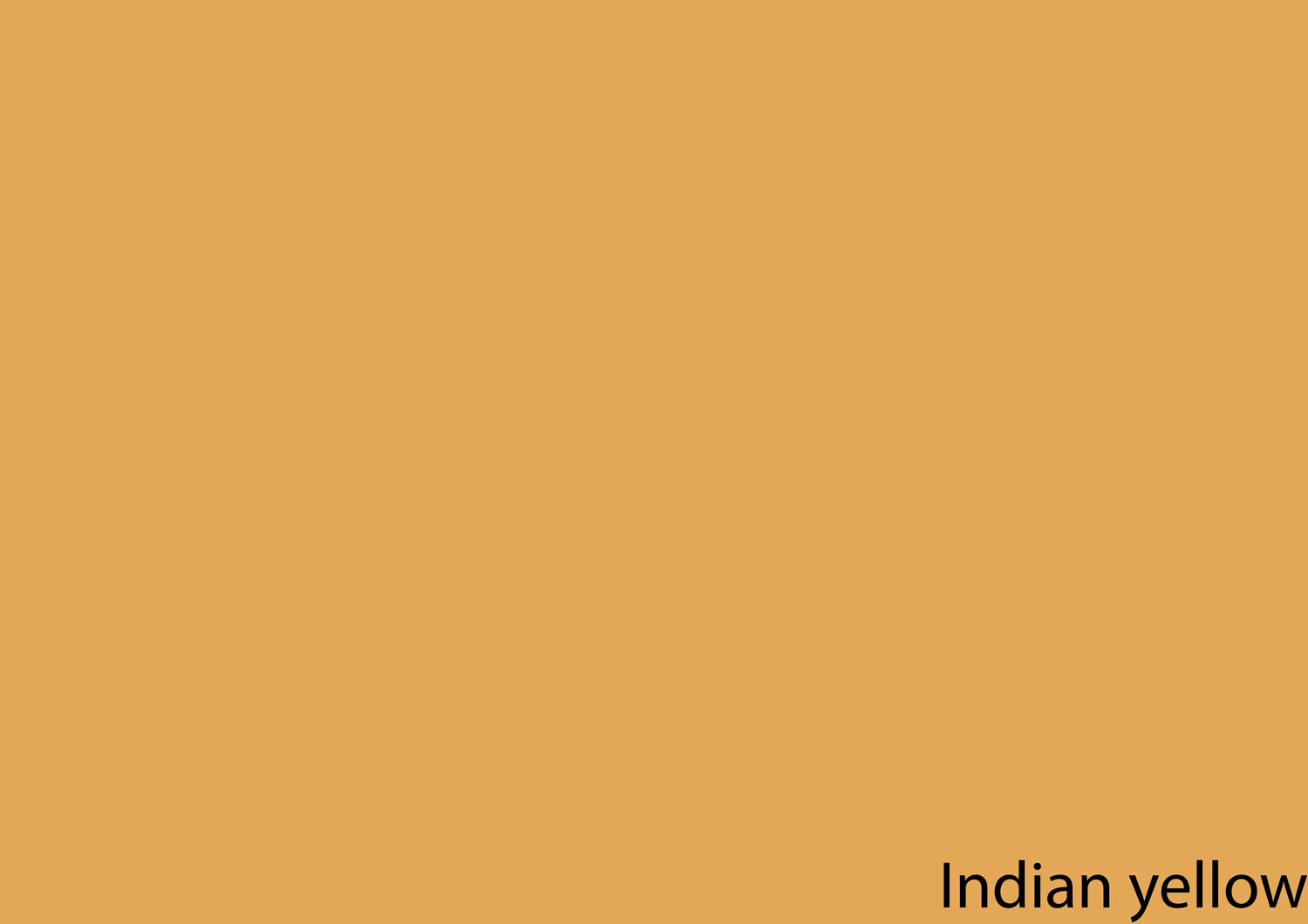
Indian yellow

Indian yellow was widely used in Indian watercolor and tempera-like paints. Noted for its use in Rajput-Mughal paintings from the 16th to the 19th century, Indian yellow was also used throughout Europe from the 17th to the 19th century.

Indian yellow pigments were said to have been produced in rural India from the urine of cattle fed solely on water and mango leaves. Today, a synthetic Indian yellow hue is manufactured using a mixture of nickel aso, arylide yellow, and quinacridone burnt orange.

Lead-tin yellow

Lead-tin yellow takes on two different forms. According to ColourLex, “the first and more frequently used is called Lead-tin-yellow type I and is a mixed oxide of both elements tin and lead… Lead-tin-yellow type II possibly contains traces of silica and also pure tin oxide.” The earliest occurrence of lead-tin yellow dates back to the 1300s. It was most frequently used in the 15th, 16th and 17th centuries. Johannes Vermeer, Titian and Anthony van Dyck all made use of lead-tin yellow in their paintings.

Chrome yellow

When chromium was discovered in 1797 by French chemist Louis Vauquelin, lead chromate was synthesized and used as a pigment. In use by the second decade of the nineteenth century, chrome yellow’s toxicity and it’s inherent tendency to oxidize over time and darken on exposure to oxygen meant it was largely replaced by cadmium yellow.

Joseph Mallord William Turner made use of chrome yellow for highlights in his dramatic Romantic paintings. In aviation, the well-loved Piper J-3 Cub adopted chrome yellow as its standard color. Because of this, chrome yellow and similar equivalents are known as Cub yellow in aviation circles.

Cadmium yellow

Much of the cadmium produced worldwide is used in rechargeable nickel-cadmium batteries. However, a portion of cadmium goes to the manufacture of cadmium pigments, a family of vibrant reds, yellows, and oranges. First discovered in 1817, good permanence and tinting properties mean cadmium yellow has remained in use since it began production in 1840. Claude Monet’s Wheatstacks (Sunset Snow Effect) and Still Life with Apples and Grapes are two examples of cadmium yellow’s application in art.

Arylide yellow

Arylide yellow (also known as Hansa yellow and Monoazo yellow) are a family of organic compounds used as industrial colorants for plastics, building paints, inks, oil paints, acrylics, and watercolors. Discovered in 1909 by Hermann Wagner in Germany, arylide yellow became commercially available around 1925 and has been used predominantly as a replacement for cadmium yellow since 1950. Alexander Calder and Jackson Pollock employed arylide yellow in their artworks.

Yellow in visual arts

Yellow’s propensity to capture attention makes it a commanding presence in visual art. Ancient Egyptians used yellow ocher to paint women’s skin tones and depict deities. Yellow ochre was also a staple on the palettes of Roman artists, who used it to lay down backgrounds and paint flesh-tones.

During the Medieval period, Judas Iscariot came to be depicted in yellow. The exact reasons for this are unclear. Nevertheless, Judas’ portrayal quickly garnered associations between yellow and jealousy, unease, tension, and betrayal. Despite its negative associations, however, artists continued to draw on yellow as a color of life and abundance. As one of the first artists to use commercially manufactured paints, Vincent van Gogh’s famous fascination with yellow culminated in numerous artworks including A Field Of Yellow Flowers, Dunes and his study of Sunflowers.

Painted during his Golden Period, Gustav Klimt’s, The Kiss is structured around luxuriant yellows and gold leaf. Pier Mondrian included yellow within his bold compositions of color and line. Artists like Mark Rothko and Willem de Kooning also used yellow to foster lightness and movement within their paintings and Andy Warhol used vibrant shades of yellow to add a blocky, surrealistic tone to his images of pop culture icons and everyday objects.

With the arrival of the 21st century came the rise of new artistic materials and technologies. Olafur Eliasson’s The Weather Project generates an atmosphere suffused with the breathtaking light of an artificial yellow sun. Yayoi Kusama’s infinity rooms, seemingly endless fields of yellow pumpkins dotted with black polka dots, play with the nature and psychology of seeing. And James Turrell harnesses the changeable quality of light through his Skyspaces, which hem the yellow light of the morning and evening each day.

Yellow in Photography

The evocative nature of yellow and its associations with treachery, betrayal, joy, warning, and nature remain just as poignant within the frame of the photograph. Street photographer Saul Leiter incorporated swaths of yellow into his street scenes, adding a palpable rhythm to his work. Mark Cohens’ image of a blond boy brashly smoking into the camera lens is punctuated by the boy’s bright yellow skivvy. Gregory Crewdson often incorporates yellow light emanating from lamps or house windows, juxtaposing homeliness with palpable unrest. Frans Lanting’s depiction of a leopard stalking in grass explores yellow in the natural environment. Kyle Jeffers uses yellow to accent architectural landscapes and Annette Horn’s yellow images trace the energetic properties of yellow on the 2-dimensional photographic plane.

Yellow can also be applied as a creative tool in photography. Golden hour, the period of daylight that occurs just after sunrise and just before sunset, has a distinctively yellow hue. During this window, daylight is at its softest and warmest, creating opportunities for dynamic portraiture and landscape photography. Generally the most subtle of colored filters, yellow filters are used in black and white photography to darken skies slightly, and boost the contrast of green foliage. In portraiture, yellow filters also deliver warmer skin tones.

Conclusion

Yellow’s vibrancy has resonated with artists and viewers for thousands of years. As the most vivid color on the visible spectrum, yellow reflects the dynamics of life. Charged with associations of joy, rebirth, renewal, change and energy, yellow’s use in art has also communicated portrayals of jealousy, betrayal, and greed. Yellow’s vibrancy, versatility, and accessibility connects to audiences through associations drawn from both visual arts and the world around us.

Do you use the color yellow in your photography? Feel free to share your images and thoughts in the comments below.

You may also like:

Mastering Color Series – The Psychology and Evolution of the Color RED and its use in Photography


The post Mastering Color Series – The Psychology and Evolution of the Color YELLOW and its use in Photography appeared first on Digital Photography School. It was authored by Megan Kennedy.


Digital Photography School

 
Comments Off on Mastering Color Series – The Psychology and Evolution of the Color YELLOW and its use in Photography

Posted in Photography


Video: ‘Process’ shares the thoughtful, methodical work of analogue photography

01 Apr

Director Will Campbell has shared Process, a three-minute short film that dives into the passionate work of Scott Folsom, a photographer Campbell says possess ‘a deep well of wisdom and knowledge when it comes to large format, analog photography and development processes.’

Throughout the video, we get an abstracted behind-the-scenes look at how Folsom goes about capturing and processing his slow, methodical work. It’s worth noting that despite the emphasis on large format photography in both the description and title of the film, this particular video shows Folsom is using a 612 panorama back on the rear of a 4×5 view camera.

‘The modern digital camera allows us to easily shoot hundreds of frames, edit them, and upload our favorites to the internet within minutes,’ says Campbell in the video’s description. ‘This is a very different experience to that of the large format photographer. For them the process is arduous, analog and anything but instant.’

Articles: Digital Photography Review (dpreview.com)

 
Comments Off on Video: ‘Process’ shares the thoughtful, methodical work of analogue photography

Posted in Uncategorized


Weekly Photography Challenge – Beaches

30 Mar

The post Weekly Photography Challenge – Beaches appeared first on Digital Photography School. It was authored by Caz Nowaczyk.

This week’s photography challenge topic is BEACHES!

Ethan Robertson

Your photos can include anything that has beaches or beach elements. It can be long exposures, details, waves, beach towels, seashells on the beach, people on the beach, minimalist, color-based, or anything really! They can be color, black and white, moody or bright. You get the picture! Have fun, and I look forward to seeing what you come up with!

Some Inst-piration from some Instagrammers:


View this post on Instagram


A post shared by @billywillgo on


View this post on Instagram


A post shared by Shad Giordano (@elementalscape) on


View this post on Instagram


A post shared by Patrick Noack (@patrick.noack) on


View this post on Instagram


A post shared by Jared Jeffs (@jaredjeffsphotography) on


View this post on Instagram


A post shared by Angela DiLoreto (@angelamdiloreto) on


View this post on Instagram


A post shared by 3 Brothers | Hawaii + Travel (@threeifbysea) on


View this post on Instagram


A post shared by nature_treasures (@nature_treasures_ok) on


View this post on Instagram


A post shared by Bronfer (@bronfer) on


Check out some of the articles below that give you tips on this week’s challenge.

Tips for Shooting BEACHES


Step-by-step Guide to Long Exposure Photography

A Guide to Shooting Long Exposure Landscape Photos

How to Shoot Long Exposure Seascape Photography

5 Photography Mistakes You Need to Avoid When Shooting Seascapes

4 Tips for More Dramatic Beach Photos

Beach Photography and Digital Camera Maintenance


Weekly Photography Challenge – BEACHES

Simply upload your shot into the comment field (look for the little camera icon in the Disqus comments section) and they’ll get embedded for us all to see or if you’d prefer, upload them to your favorite photo-sharing site and leave the link to them. Show me your best images in this week’s challenge.

Share in the dPS Facebook Group

You can also share your images in the dPS Facebook group as the challenge is posted there each week as well.

If you tag your photos on Flickr, Instagram, Twitter or other sites – tag them as #DPSbeaches to help others find them. Linking back to this page might also help others know what you’re doing so that they can share in the fun.

The post Weekly Photography Challenge – Beaches appeared first on Digital Photography School. It was authored by Caz Nowaczyk.


Digital Photography School

 
Comments Off on Weekly Photography Challenge – Beaches

Posted in Photography