RSS
 

Posts Tagged ‘Photography’

10 Tips for Improving Your Wildlife Photography

18 Oct

The post 10 Tips for Improving Your Wildlife Photography appeared first on Digital Photography School. It was authored by Guest Contributor.

A guest post by wildlife photographer Morkel Erasmus.

wildlife photography tips

Ever since DSLRs became readily available, more photography enthusiasts have started venturing into wildlife photography.

It seems that wildlife photography, in conjunction with landscape photography, has really seen a huge growth spurt over the last few years, at least as it pertains to the number of people practicing it as serious hobbyists or budding professionals.

This is especially true in my native country of South Africa, where it’s long been many a family’s tradition to visit legendary self-drive safari locations such as Kruger National Park. Having neighboring countries like Namibia, Botswana, and Zimbabwe doesn’t affect this trend negatively!

Yet spend some time on your favorite online photography forum (at least those that allow the posting of photos) or on other sites like Facebook or Flickr where photosharing is common, and you might notice that not every photo taken of a wild animal really speaks to you.

I’m not sure whether many folks just snap away and hope the image comes out half-decent, or whether many just think they’re doing their subjects justice (when that is not at all the case). Let me say outright that no offense is intended, and I also take photos that fall into the above categories.

In fact, I do it on every photographic trip I take.

But it’s stepping beyond that and getting a rare wildlife image that ticks all the right boxes that we all need to strive for. And we must be prepared when the opportunity comes along.

zebras fighting

In today’s article, I will attempt to provide you with some easy-to-apply tips and advice for improving your wildlife photography.

Some of these tips might seem like common sense, and you’ve probably read a similar list of “how-tos” elsewhere. But remember that common sense is not so common at all these days and that everyone has their own take on things, however similar it may be.

I do think I will cover a few points that are not just based on pure technical skill; photography is, after all, an art-form. Sometimes we need to be freed up to capture the vision we have in our mind’s eye, rather than stick to conventions and norms.

Here is a quick overview of the points I will cover in this article:

  1. Know your gear
  2. Know the wildlife
  3. Know the wildlife photography “rules;” break the wildlife photography “rules”
  4. Work the light
  5. Shoot wider; shoot closer
  6. The more, the merrier
  7. How low can you go?
  8. The content-technical dichotomy
  9. Patience isn’t a virtue; it’s a necessity
  10. Be there and enjoy it

These are the points that I try to cover when leading a photographic safari or presenting a workshop.

(Also note that I include the genre of bird photography in my definition of wildlife photography.)

Let’s get cracking!

a wildlife photography example of a lion on a dune

1. Know your gear

This sounds like the biggest cliché, but you know that it’s true.

The really great, action-packed moments in wildlife photography last, on average (based on my experience), between 5 and 20 seconds. If you are not deeply familiar with the settings of your camera or the abilities of your chosen lens, you will either miss the shot or blow the images you do manage to capture.

Here’s what’s important:

  • Know the minimum shutter speed at which you can obtain a sharp image with your camera/lens combo
  • Know any added margins that the in-camera or in-lens stabilization gives you
  • Know how to quickly toggle between focus points or focus modes
  • Know how high you can push your camera’s ISO setting and still achieve acceptable results

In general, I like to say that you need to be able to make most, if not all, of the necessary adjustments to your exposure/focus settings without lifting your eye from the viewfinder.

The action you see between the cheetahs in the following image lasted all of 10 seconds, even though we sat with them for more than an hour:

cheetahs playing

2. Know the wildlife

This goes without saying, right? Since much of wildlife photography is based upon capturing fleeting moments of natural history (read: interesting poses or behavior), it pays to be able to somewhat predict your subject’s behavior beforehand.

Granted, not every species is as predictable as the next. But there are patterns of behavior ingrained into every animal species. Knowing your subject can make the difference between being ready and prepared for capturing that “golden moment” and watching in agony as it flies by.

Now, there is only one way to get to know wildlife:

Spend time with it. Don’t just hang around for a few minutes and seek out the next subject if the one you are observing or photographing isn’t delivering the goods. Sit with wildlife. Watch wildlife. Wait.

(This also ties into patience, which I will discuss in more detail later.)

This image was captured by knowing what the Lilac-breasted Roller was going to do to its grasshopper-lunch, and being ready for it:

roller eating lunch

3. Know the wildlife photography “rules;” break the wildlife photography “rules”

There are certain unwritten rules that form the foundation of good photography, regardless of genre. And, of course, then there are certain “rules” that find their application mostly in the genre of wildlife photography.

Understanding proper exposure and the use of the histogram, as well as creating proper compositions using a guideline such as the rule of thirds, are all important to ingrain in your subconscious. You want to be able to instantly capture that fleeting moment properly.

In wildlife photography, much is made about eye contact with the subject, as this gives life to the image. In the case of avian photography (birds), you can take this a step further: the head angle in relation to the camera’s imaging sensor needs to be at least perpendicular to it, but ideally turned a few degrees towards the sensor (and therefore turned towards the viewer, who ultimately gets to view the image captured by the sensor).

The image below, for example, follows strong rule-of-thirds compositional guidelines:
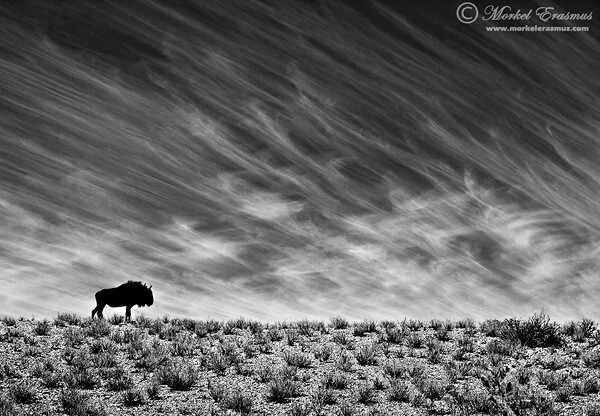
wildebeest on a dune as stunning wildlife photography

Once you know the “rules” and the guidelines, and once you know when and how to apply them, it’s time to start breaking them. You should test the boundaries a bit, you know? You don’t want your photos to always look like the standard images that every photographer is getting.

Take a look at the image below. I mentioned the “need” for eye contact. Yet sometimes it can work to shoot an image in which the subject is not giving the photographer eye contact (this often means the animal is busy with something else and too busy to turn its attention to you).

thirsty Zebra foal makes for intimate wildlife photography

4. Work the light

The first piece of advice I got from a professional wildlife photographer when I started shooting is to stick to the hours of golden light.

This means getting up early in the morning and being in the field before sunrise, and going out in the afternoon to make the most of the last hours of sunlight. The light at midday (mostly between 11:00 and 16:00, at least where I live) is generally harsh and robs images of that spunk that they need. The exception is on overcast days, when the clouds act like a massive softbox and filter out the light evenly.

On days like that, I shoot all day (as long as there are willing subjects!).

Since photography is all about painting with light, you need to know how to use the light to your advantage in wildlife photography. Often, we will find ourselves in a position where the light isn’t ideal or, heaven forbid, the light is sweet but from the wrong direction (and we aren’t in a position to move to a better spot).

The good news is that light from the wrong direction can add lots of mood to an image. Shooting into the light is tricky to pull off, but if you adhere to my first tip (to know your gear), you can get some pretty interesting images from a less-than-ideal light position. The image below is one such photo:

backlit sprinboks at dawn

5. Shoot wider; shoot closer

Too many wildlife photographers get fixated on what I call the “focal-length debacle,” where it becomes an obsession to have the longest/biggest lens possible.

Now, I know this is location-dependent, as you might need more than 600mm just to get any shot at all in certain wide-open spaces. But the issue I want to tackle is more related to our obsession to get as close as possible to the animals and isolate them totally from their environment. The result is often an image that looks like it could be taken of a captive subject in a controlled location, with a perfectly smooth background and no idea of the real environment in which the animal finds itself.

Instead, challenge yourself to shoot at a wider angle to give the viewer a better idea of where you took the image and where your subject has to eke out a living in the wild. This is applicable to any species you photograph, from a squirrel to a deer to an elephant.

The elephant below was photographed with a wide-angle lens and a polarizing filter to give you a sense of the environment, as well as to make the most of the clouds and sky:

elephant in the landscape as wildlife photography

The flip side to shooting wider is (you guessed it!) shooting closer.

And I mean way closer. Get in-your-face close (by changing your position or by using a longer lens with an optional teleconverter) to create different and interesting studies of the animals and birds you photograph. This will also help you think in terms of more abstract compositional arrangements.

Have a look at this photo of a Cape buffalo, for example:

buffalo abstract close-up of ear

6. The more, the merrier

No real intricate explanation needed on this one. In wildlife photography, one is company and two is often a crowd, especially when there’s food or shelter involved. If you have a good view of more than one member of a species, stay a while!

Look at the images below. First up: a solitary African spoonbill, minding its own business on a perch, happy as can be. Throw another spoonbill into the mix, and you have a recipe for good interaction:

spoonbills in the trees; the more the merrier wildlife photography tip

7. How low can you go?

This is not a trick question, nor is it a call to do the limbo. The point of view of a wildlife photograph is just about everything. How you portray your subject can make all the difference in the world.

In short, try to get an eye-level perspective (or go even lower if you can). This brings the viewer of your image right into the scene and confronts them with the view of the world from your subject’s perspective.

Obviously, what counts as eye-level is relative (you will pretty much always be at a lower perspective than a giraffe, for example), but you get the idea.

Always bear in mind the constraints of your environment. In most reserves in South Africa, you are not allowed to get out of your vehicle in the field. This restricts you to a certain perspective.

Look at the images below for illustration. The first African painted dog was photographed from an open game viewer. The result is a somewhat bland shot; it’s nothing special to my eyes.

The second image, however, was taken lying flat on my stomach in a sandy riverbed not 20 meters from the pack of canines, and the alpha male was checking me out. This perspective makes the image come alive.

wild dogs

8. The content-technical dichotomy

This is an interesting one. Does great content trump a technically great image that includes average content every time?

It may be different where you live, but I am particularly relating this one to the African safari experience. Every tourist wants to see the “big 5,” or at least a lion. But if you’ve ever spent time around wild lions in the daytime, you will know that they are actually shoddy models for photography. They sleep up to 20 hours per day.

Conversely, I have had great photo opportunities from impala, who are the most common ungulate you’ll come across down here in the bush. My advice to the discerning photographer would be to look for great opportunities regardless of the species when the light is good!

Have a look at the contrast between these two images: an impala jumping gracefully and a “standard” portrait of a male lion, both in good light. Which do you prefer?

a lion (above) and a leaping impala (below)

Let’s use a second example, lest it look like I am becoming blasé about the subjects I am fortunate to be able to photograph in our wonderful part of the world:

Squirrels.

Everyone photographs squirrels, right? In the images below, the top squirrel is munching something with nice soft light and a nice low angle. And at the bottom, a mommy is carrying her youngster at a precarious height over a large branch at speed by biting down on the youngster’s stomach flap with it holding on for dear life. The light in the tree canopy wasn’t the best, but this is clearly a case of content trumping a technically good image.

squirrels

The jury is still out on this one. Awesome sightings of lions won’t always provide awesome images. Learn to see the potential in the mundane to create amazing photographic moments, then go out and make good images.

The obvious ideal is to capture a wildlife image with great content in great light shot with just the right settings: the utopian photo that most of us will never get right.

9. Patience isn’t a virtue; it’s a necessity

As a wildlife photographer, your images are predicated on the fact that things in nature are unpredictable.

Anything can happen at any time, but most things happen only rarely. Or, at the very least, they rarely coincide with the exact time that you are in that specific spot.

It is therefore imperative that you become patient. Very patient.

Now, I sometimes catch myself being very impatient out in the field. It’s something you constantly have to work on.

In fact, it’s almost a culmination of many of the things we’ve discussed so far. Observing your subjects and getting to know their behavioral patterns requires a great deal of patience.

Often, the implication is that you need to return to the same spot for days before things start to happen. And even if you do that, you run the risk of nothing happening and wasting your time.

The image below was captured after staking out the tree with the impala kill for more than five hours. I had also driven past this tree many times earlier that day to see if there was any action. I knew the leopard would return, but I had no guarantee that it would return before nightfall.

a leopard ascends a tree to find its kill

10. Be there and enjoy it

I will conclude this lengthy article with the following advice (I do hope you haven’t been bored to tears reading this!):

Be there and enjoy it!

running cheetah wildlife photography example

By this, I don’t just mean that you need to physically show up and be at the right place at the right time (although of course that applies).

I actually mean that you need to be present in the moment. Don’t get so caught up in the technical issues and your settings that you don’t take in the moments you are witnessing while out photographing birds and wildlife. We need to be mindful of the privilege of spending time in nature and being in places where humans haven’t quite exerted their full force.

landing kingfisher wildlife photography example

Maybe for you this is just the most isolated spot in your local park where you can sit and observe and photograph squirrels and birds. Or maybe it’s facing a wild Kodiak bear on the Alaskan floodplains.

giraffe with a rainbow in the background wildlife photography

Regardless, enjoy what you are doing! Have fun doing it! How does it help us to spend so much time on this amazing hobby cum art form if we are not enjoying the time spent?

I hope these wildlife photography tips will stand you in good stead out there in the field. They have for me. Good light and good sightings to you all!

About the author: Morkel Erasmus

After having been an avid naturalist from a very young age, picking up a camera for the first time early in 2009 proved to be a pivotal moment in the life of Morkel Erasmus. Since then, he has been infused with an unbridled passion for capturing forever fleeting moments of natural history and sharing them with people to showcase the wonderful natural heritage of his native Southern Africa, and to create awareness to conserve this heritage for future generations.

“I absolutely love being in the wild and unspoiled places of this world,” says Morkel, “and living in South Africa means there are plenty of those to choose from.”

An industrial engineer by profession and an accomplished artist across many genres, from music to poetry, Morkel has always enjoyed whatever allows him to express his creativity to the fullest. Photography turned out to be the perfect marriage of his engineering brain and artistic soul. Showing off God’s glorious creation is something he enjoys immensely. He is also a Nikon South Africa ambassador.

Besides being widely published, Morkel has been honored for his commitment to his craft with various awards in the short span of his photographic career, most notably by receiving a “Highly Commended” award for one of his images in the 2010 BBC Veolia Wildlife Photographer of the Year competition. Morkel is a devoted husband and a proud father of a beautiful daughter and soon-to-be-born son.

See more from Morkel on his homepage or blog, and connect with him on Facebook, Twitter, 500px, and on Instagram.

The post 10 Tips for Improving Your Wildlife Photography appeared first on Digital Photography School. It was authored by Guest Contributor.


Digital Photography School

 
Comments Off on 10 Tips for Improving Your Wildlife Photography

Posted in Photography


Photography as Therapy: How To Keep Your Mind Positively Occupied

17 Oct

The post Photography as Therapy: How To Keep Your Mind Positively Occupied appeared first on Digital Photography School. It was authored by Kevin Landwer-Johan.

Using your camera as a tool for photography as therapy is a healthy habit to develop. Often artists produce some of their best work when they are feeling pressured or stressed. Creative expression is a fabulous way to release tension when you are feeling down.

Creative minds tend to be more sensitive and respond differently to the stresses life can bring. By picking up your camera and engaging in the creative expression of photography, therapy happens.

photography as therapy meditating
© Kevin Landwer-Johan

Why it’s good to engage in photography as therapy

By picking up your camera and taking photos, you are helping your mind focus on something other than what’s causing you stress.

(Unless your camera or creative process is the cause of your angst, that is. Hopefully, that is not the case.)

I know that, whenever I am taking photos of a subject I find interesting, I am in a very different mental space. I concentrate more intensely and can easily forget about what might be worrying me.

Focus on what you enjoy and it will be therapeutic. As you have your camera in hand and give your attention to being creative, your mind will give more space to positive, constructive thoughts than the negative ones you may have been dwelling on.

Meditate on what you are doing. The more you can clear your mind of thoughts that are worrying you and concentrate on taking photos, the more you will see great results. If you can, follow your feelings as you are taking photographs. Infuse the feelings into your pictures, and you may soon begin to feel better as your mood changes.

Being creative generally requires positivity to a certain degree for most artists. As you put your energy into taking photos, you will hopefully notice a change as you stick to your constructive thoughts. The more you focus on taking photos, the more your negative thoughts and feelings will diminish.

Woman taking a photo for photography therapy
© Kevin Landwer-Johan

Regularly practice photography therapy

The more frequently you do anything, the better you become at doing it. Photography as therapy, when practiced frequently, can help improve how you feel.

Concentrating when you’re stressed can be challenging. By committing to regularly taking photos, even for 15 minutes a day, you’ll most likely find that you can concentrate better and for longer. You’ll also see an improvement in your photography skills and creative expression.

Make time to take photos. Photography therapy will not happen unless you commit time and energy. As you press on and make a daily habit of photography, you will experience being more satisfied and will feel free from what’s been bothering you.

Photography is not likely to eliminate all your problems, but it can at least give your mind a break from them. 

You may also find that, as you have your camera in hand and your attention is given to positive thoughts, potential solutions to your problems will come to mind. 

Woman with a film camera for photography as therapy
© Kevin Landwer-Johan

Work on a photography project

To help keep yourself engaged in photography, having a project to regularly work on is beneficial. Knowing each day what you’ll photograph means you can grab your camera and take photos without having to search for a subject.

If you’re someone who finds it challenging to find new subjects, creating a project for yourself will enable you to be more productive. That way, you won’t waste time trying to decide what to photograph.

Pick a theme for your photography project that you know you’ll enjoy. Photographing what you love will naturally help you take more creative photos. By capturing the same subject or theme over a period of time, you’ll make more diverse photos than if you only photograph a subject occasionally.

Working on a photography project will help you develop as an artist. Once you’ve been working on your project for a while, you’ll be able to look back over the body of work you’ve created and see how you are progressing.

Take the time to study the photos you’ve made. Analyze them and consider how you’d like to progress with your project. By reflecting on the photographs you are making, you can discover new ways of seeing and expressing yourself through your photography.

I love gardening and being in my garden, but I have never been particularly interested in photographing it. Now I am challenging myself to take photos in my garden often because I want to get better at this style of photography.

Without commitment and without pushing myself to photograph my garden regularly, I know I’ll never get better at it. I’m not expecting to take masterpiece photos as I begin. But I do hope that, in time, I’ll be able to capture some images that I’ll be satisfied with. 

Pressing forward with this project has challenged me to improve my photography. The deliberate concentration helps me to remain focused on my creative expression. When I have time, or when I see that the light is particularly beautiful, I can pick up my camera and begin photographing without having to stop and think about what to take pictures of.

tricycle taxi project photo
© Kevin Landwer-Johan

Get inspired by the photography of others

If you’re not sure where to start, pick up a book or look at the websites of some of your favorite photographers. 

When you are stressed and in need of some photography therapy, it can be difficult to find inspiration on your own. At times like this, it’s helpful to look at the work of other photographers with an open mind; that way, you can find new ideas. 

Don’t confine your sources of inspiration to photography. Draw ideas from music and other art forms. You might pick a theme to photograph based on one of your favorite songs or movies. Think outside the box a little more than normal as you look, listen, and feel the art you love.

Learn by mimicking, in some ways, other creatives you admire. Picasso said, “Good artists copy, great artists steal.” Take ideas from others and make them your own. Don’t merely copy something that you like. Put your own expression into it so that you truly own it.

Two Kayan long neck girls
© Kevin Landwer-Johan

Share your photography therapy experience

Many photographers prefer to work alone. Being with your camera and having no one else around can help you concentrate better. But, at times, being with other photographers and comparing notes is helpful, too. Group photography therapy can help you develop your creative expression in new ways.

Find a few people who enjoy the same style of photography and subject matter as you. Plan photography sessions together and engage with each other as you are taking your pictures.

Get together over a coffee and discuss your photos. This will help you all grow as you discover how others see and photograph the same subjects. It’s not a competition. Don’t make it one. Treat it as an encouraging time to build each other up, and you’ll all begin to see an improvement in the pictures you’re taking. 

Two cameras for photography therapy
© Pansa Landwer-Johan

Photography as therapy: Conclusion

Be purposeful about photography as therapy. Practice being mindful and having your camera in your hands frequently. 

As you make yourself take photographs regularly, you’ll begin to notice how much easier it is to concentrate on what you are doing. You’ll start to see your creativity increase, your photography improve, and the stresses of life begin to fade away.

The post Photography as Therapy: How To Keep Your Mind Positively Occupied appeared first on Digital Photography School. It was authored by Kevin Landwer-Johan.


Digital Photography School

 
Comments Off on Photography as Therapy: How To Keep Your Mind Positively Occupied

Posted in Photography


Weekly Photography Challenge – bicycle

17 Oct

The post Weekly Photography Challenge – bicycle appeared first on Digital Photography School. It was authored by Sime.

I guess you could say we’re being very specific, but not very specific this week! ‘Bicycle‘ is our #dPSWeeklyChallenge theme! The reason being is that I managed to get my old bike going today and got out of the house to whip around the neighbourhood. Riding in the sun made me think of some amazing cycling photos I’ve seen over the years, and thought it’d be fun to see what we can come up with! Your entry can be a photograph of your bike, of a street with bicycles, a race, whatever you would like as long as the main subject includes a bicycle of some description, perhaps you could try your hand at product photography and photograph a part of your bike? So many options! #dPSBicycle

Missed a dPS Weekly Challenge? We’ve made a special home for them all! Here

Weekly Photography Challenge – bicycle

You could make it an abstract, like my photograph above (oddly, from a series I call ‘stuff stuck in stuff) or it could be from an organized ride, like the photograph below.

Weekly Photography Challenge – bicycle

Or it could just be a random scene of two chaps cruising down a street somewhere in Cuba. We look forward to seeing your entry in this week’s Digital Photography School Weekly Challenge!

Weekly Photography Challenge – bicycle

Great! Where do I upload my photos?

Simply upload your shot into the comments field (look for the little camera icon in the Disqus comments section) and they’ll get embedded for us all to see. Or, if you’d prefer, upload them to your favourite photo-sharing site and leave the link to them.

Weekly Photography Challenge – Looking Up

Share in the dPS Facebook Group

You can also share your images in the dPS Facebook group as the challenge is posted there each week as well.

If you tag your photos on FlickrInstagramTwitter or other sites – tag them as #DPSBicycle to help others find them. Linking back to this page might also help others know what you’re doing so that they can share in the fun.

Follow us on Instagram?

The post Weekly Photography Challenge – bicycle appeared first on Digital Photography School. It was authored by Sime.


Digital Photography School

 
Comments Off on Weekly Photography Challenge – bicycle

Posted in Photography


11 Things to Experiment With When Starting Out in Digital Photography

15 Oct

The post 11 Things to Experiment With When Starting Out in Digital Photography appeared first on Digital Photography School. It was authored by Megan Kennedy.

Starting out in digital photography can seem a little daunting. With so many avenues to explore, it can be hard to pinpoint exactly where to begin. Here are 11 things to experiment with when first taking up photography.

experiment when starting out in digital photography wattle flower
Canon 5D Mark II | Canon EF 50mm f/1.8 II with extension tubes | 1/250 sec | f/7.1 | ISO 100

1. Semi-automatic and manual modes

When first getting started in photography, it can be tempting to switch a camera over to Auto mode and forget about making manual adjustments, especially when starting out in digital photography. Why make manual adjustments when the camera can do it all for you, right?

The truth is that shooting with Auto mode sacrifices experience, flexibility, and control. If you can avoid Auto mode, you should.

Now, the prospect of shooting in Manual can prove overwhelming to start with. Fortunately, there are often semi-automatic modes available in-camera to bridge the gap between Manual and Auto.

Shutter Priority allows you to alter shutter speed while the camera automatically adjusts the aperture. Aperture Priority is similar, but it allows you to change the aperture while the camera adjusts the shutter speed instead.

experiment when starting out in digital photography spider's web
Canon 5D Mark II | Canon EF 50mm f/1.8 II with extension tubes | 1/125 sec | f/1.8 | ISO 800

Shutter Priority and Aperture Priority facilitate a creative approach to photography while allowing the camera to manage some of the load in maintaining a decent exposure. This balance of functionality allows you to experiment, which in turn helps you develop a good sense of the right settings for any circumstance.

And after becoming familiar with the dynamics of semi-automatic modes, graduating to Manual is a lot more fluid, when you can finally take full advantage of the camera as a creative tool.

2. ISO

ISO is a little misunderstood; there’s a great video about it here. But in basic terms, ISO is a setting that brightens an image in-camera. As the ISO value is increased, images grow progressively lighter. It’s a function that is useful for photography in darker environments.

However, raising the ISO value also increases noise, which can compromise the quality of a digital image.

Experimenting with ISO will give you a sense of how your images will turn out in low-light situations. By becoming familiar with ISO and its trade-offs, you can learn to anticipate the outcome of a photograph, maintaining as strong image quality as possible in a variety of environments.

3. Metering modes

In-camera metering is how a camera determines the appropriate exposure for a given situation. Metering modes refer to the method the metering system uses to evaluate a scene.

starting out in digital photography metering modes

Different metering modes allow photographers to select the ideal settings for a particular situation. For example, Matrix metering (Nikon)/Evaluative metering (Canon) measures the light intensity at several zones in a scene, then combines the results to find the average settings for the exposure. Spot metering, on the other hand, measures only a very small portion of a scene to determine exposure settings.

While Matrix/Evaluative metering is useful for situations with evenly-distributed tones, Spot metering is ideal for metering in high-contrast scenarios. Experimenting with metering modes exposes a user to effective ways of working in different lighting conditions, leading to greater creative and technical control.

4. White balance

Different lighting conditions can impact the color temperature of the overall photo. For example, fluorescent lights can generate a different color cast than the afternoon sun. To rectify this, many digital cameras offer a function that balances the whites in a scene in order to make images appear more natural.

Experimenting with preset or custom white balance modes can help achieve a more aesthetically pleasing result in-camera. Although white balance can be set to Auto, the camera doesn’t always get it right. Trying out custom or preset white balance functions prepares a photographer for tricky lighting situations down the track.

5. Manual focus

As a beginner photographer, achieving sharp images can be a challenge. Although a camera’s autofocus function is quick and relatively easy to use, shooting with manual focus can sometimes be the difference between successful and unsuccessful images.

Often, manual focus is much more effective than autofocus in low-light and low-contrast conditions, and shooting through objects (like glass or fencing) with autofocus engaged can be a frustrating experience. The autofocus system may even get confused when the user is trying to focus on a fast-moving subject.

starting out in digital photography manual focus
Canon 5D Mark II | Canon EF 50mm f/1.8 II with extension tubes | 1/125 sec | f/4.0 | ISO 800

While autofocus may be convenient in some situations, switching to manual focus can play a vital role in creating quality images. Experimenting with manual focus when starting out in digital photography builds and reinforces technical experience. Using manual focus also fosters a greater awareness of camera capabilities and generates a more diverse range of images.

6. Composition

Throughout the history of visual art, concepts have emerged to aid in the formulation of impactful imagery. Composition refers to the organization of visual elements within an artwork. Whether it’s a painting, a photograph, or a sculpture, all art hinges on composition.

Experimenting with composition allows photographers in the early stages of their practice to arm themselves with helpful knowledge that has been passed down by artists. By experimenting with compositional elements (such as perspective, the rule of thirds, and leading lines), new photographers can quickly start to identify and utilize key visual aspects of a scene.

7. Abstraction

Wikipedia defines abstract photography as “a means of depicting a visual image that does not have an immediate association with the object world and that has been created through the use of photographic equipment, processes, or materials.”

Basically, abstract photographers generate subject matter that prioritizes aesthetic experience over conventional discernibility.

starting out in digital photography abstraction
Left: Canon 5D Mark II | Canon EF 24-105mm f/4L IS USM | 1/250 sec | f/8.0 | ISO 100
Right: Canon 5D Mark II | Canon EF 24-105mm f/4L IS USM | 1/250 sec | f/6.3 | ISO 100

Abstraction is a unique facet of photography in that it encourages a more experimental approach to the photo-making process.

By taking advantage of abstraction, those starting out in digital photography are free to experiment beyond the conventional notion of a photograph. This experimentation will inevitably inform other areas of a new photographer’s practice, building experience and developing individual perspective.

8. Subject matter

There is nothing wrong with specializing, but tackling a range of different photographic fields expands your photographic experience. And it can also completely alter the way you approach your preferred subject matter.

For example, landscape photography can reveal opportunities for beautiful outdoor portraits. Abstract photography can impact the way motion is expressed in action shots. Street photography can help you develop an eye for subtle photographic opportunities. Macro photography will help you notice small details.

In short, experience with different photographic subjects can feed into one another in surprising ways. Experimenting with a variety of subjects is a solid means of developing a well-rounded photographic approach.

9. Perspective

One of the reasons photography is so effective is because it challenges both the photographer’s and the viewer’s comprehension of the world. However, it can be easy to get into the habit of photographing subjects from the same eye-level viewpoint, especially when starting out.

starting out in digital photography plane
Canon 5D Mark II | Canon EF 24-105mm f/4L IS USM | 1/160 sec | f/9.0 | ISO 100

We all know the saying, “Show, don’t tell.” Moving around with the camera is one of the simplest ways to convey a unique photographic experience. You can shoot from above your subject, below your subject, or off to the side.

And by experimenting with different camera positions, you explore the nature of photography and the world we live in. By photographing from interesting or unusual perspectives, the physicality of the image-making process is emphasized, providing a unique insight into the world through the experience of the photographer.

10. Post-production

Getting it right in-camera is ideal, but sometimes a bit of work in post-production is necessary. Becoming familiar with digital post-production techniques can be very handy, especially because even minor adjustments can create a positive impact. In addition, editing can affect your overall approach to digital image-making by revealing photographic techniques that work well or need improvement.

Photoshop is a great tool for editing images, but there are also free applications such as GIMP to make use of. With practice, you can develop a sense of how to bring the best out of a photograph.

11. Accessories

There are plenty of ways to expand your creative image-making through economical accessories.

For example, extension tubes are a cheap way of getting into macro photography. Filters can significantly alter the outcome of a photograph. And a budget tripod will help you achieve sharp images. Renting or buying second-hand is also a viable option. In some cases, digital photographers can even make use of old lenses designed for film cameras.

Investing in economical accessories allows new photographers to experiment with engaging techniques without breaking the bank.

starting out in digital photography flower
Extension tubes are a cheaper alternative to a macro lens. Canon 5D Mark II | Canon EF 50mm f/1.8 II with extension tubes | 1/2000 sec | f/2.5 | ISO 500

Starting Out in Digital Photography: Conclusion

While there are plenty of considerations to take into account when starting out in digital photography, experimenting with technical settings, creative approaches, and accessories gives you a strong foundation for future photography endeavors.

And this allows for a more comprehensive skillset and well-developed creative instincts.

Now over to you:

Have you tried experimenting with any of these items? What are you going to experiment with first? Leave a comment and let us know!

The post 11 Things to Experiment With When Starting Out in Digital Photography appeared first on Digital Photography School. It was authored by Megan Kennedy.


Digital Photography School

 
Comments Off on 11 Things to Experiment With When Starting Out in Digital Photography

Posted in Photography


Weekly Photography Challenge – Iconic

10 Oct

The post Weekly Photography Challenge – Iconic appeared first on Digital Photography School. It was authored by Sime.

This week we want to see something iconic, that can be a landmark or place or just something that you think people will immediately recognise, like… A certain brand of toothpaste, for example, photographed in an interesting way (Bonus points if you try that!) or the London Eye! (This was a photo I made of the Eye in 2007… on a 6mp camera… those days were fun!) It just has to be instantly recognisable to the viewer. Do your best and have fun! #dPSIconic – Think outside the box!

Weekly Photography Challenge – Iconic
London Eye by night | Canon 30D f/4.5 for 4 seconds at 17mm

If you don’t have an iconic building handy, think smaller like ‘Lego’ for example, most people know what Lego is! (Or have stepped on it in the dead of night while checking on the sleeping kids!) The goal is to photograph something instantly recognisable and try to do it in an interesting way!

Weekly Photography Challenge – Iconic

Great! Where do I upload my photos?

Simply upload your shot into the comments field (look for the little camera icon in the Disqus comments section) and they’ll get embedded for us all to see. Or, if you’d prefer, upload them to your favourite photo-sharing site and leave the link to them.

Weekly Photography Challenge – Looking Up

Share in the dPS Facebook Group

You can also share your images in the dPS Facebook group as the challenge is posted there each week as well.

If you tag your photos on FlickrInstagramTwitter or other sites – tag them as #DPSIconic to help others find them. Linking back to this page might also help others know what you’re doing so that they can share in the fun.

Follow us on Instagram?

The post Weekly Photography Challenge – Iconic appeared first on Digital Photography School. It was authored by Sime.


Digital Photography School

 
Comments Off on Weekly Photography Challenge – Iconic

Posted in Photography


Video: The impact of hand-colorized photos on photography in 19th century Japan

07 Oct

For many years, photography was strictly a monochromatic medium. While images offered people detailed depictions of people and places, without color, some people found photographs to be incomplete. In a new video, Vox shares the history of colorized photos and the important role Japan played in the colorization of black and white images.

Japan’s role in the international economy throughout the 18th and 19th centuries was tumultuous, at best. For over 200 years, Japan had closed itself off from the rest of the world, forbidding many from entering the island country. However, a United States naval expedition of warships arrived on Japanese coasts in 1854 and the US forced Japan to open its ports to foreign enterprise and visitors. Travelers and enterprising individuals from around the world traveled to Japan to visit and open businesses. As Vox notes, photography became a burgeoning industry.

Foreign photographers such as Felice Beato and Baron Raimund von Stillfried opened photo studio operations in Japan. Rather than sell customers monochrome images, which were all they could produce with their cameras of the day, photographers like Beato and von Stillfried hired local artists from the ukiyo-e woodblock industry to apply watercolors to black and white prints. Eventually, some of these artists branched out their own.

Time doesn’t stand still, and photography technology became more affordable and amateurs were able to capture their own images, leading to a downturn in the Japanese souvenir photo industry. However, the hand-colored photos from 19th century Japan have had a long-lasting impact. In the video below, Vox shares insight into the history of colorized photos in Japan and shows off beautiful examples that highlight what made, and continues to make, colorized images from Japan so desirable but also potentially problematic in informing a complicated understanding of Japan in the 19th century.

As the video above showcases, when Japanese apprentices branched out from foreign-owned photography studios, some opted to create elaborate depictions of historic Japanese culture to sell to foreigners. One of these apprentices that started his own photography operation was Kusakabe Kimbei. In his work, it’s clear how meticulously crafted some images were, with Kimbei even going so far as to simulate rain using scratches on glass plates and pinning a subject’s clothing to the background to create the appearance of wind. These techniques and resulting images draw on various tropes in traditional Japanese fine art. There are many similarities in composition and subject matter between traditional ukiyo-e woodblock prints and 19th century colorized photos.

The topic brings to light a very interesting discussion on how photography shapes the understanding of a place and time. People often think about photos as realistic representation, whereas a painting doesn’t carry the same weight nor birth the same expectations. However, the early era of the Japanese photo industry was, of course, a for-profit endeavor. Photographers, both foreign and Japanese, wanted to sell a certain idea of Japan to outsiders, and this meant staging scenes, relying on outdated dress and even capitalizing on stereotypes.

If you’d like to learn more about this intriguing topic, Vox offers suggested reading. A Good Type: Tourism and Science in Early Japanese Photographs by David Odo. Sites of ‘Disconnectedness’: The Port City of Yokohama, Souvenir Photograph, and its Audience by Mio Wakita-Elis. Photography in Japan 1853-1912 by Terry Bennett. To view more videos from Vox, including other videos in their ‘Darkroom’ series which shares insight into the history of photography, click here.

Articles: Digital Photography Review (dpreview.com)

 
Comments Off on Video: The impact of hand-colorized photos on photography in 19th century Japan

Posted in Uncategorized


6 Tips for Near-Macro Photography with a Telephoto Lens

04 Oct

The post 6 Tips for Near-Macro Photography with a Telephoto Lens appeared first on Digital Photography School. It was authored by Elliot Hook.

Macro photography is the art of capturing the fine detail of very small subjects that may not be seen by the naked eye. Technically, to fall under the category of “macro,” the subject should be captured with a reproduction ratio of 1:1 (i.e., the subject will be captured on the sensor at 100% life-size).

Macro lenses are specially designed to minimize the focusing distance, allowing the photographer to get closer to the subject and therefore increase the reproduction ratio.

There are a number of techniques that can be used to help achieve the desired magnification without a dedicated lens (extension tubes, close-up filters, and reversing rings). However, one of the less common techniques is to use something that you probably already have in your bag: a telephoto lens.

Milking Bonnet Fungi (Mycena galopus)

Milking Bonnet Fungi (Mycena galopus)

Telephoto lenses offer extreme magnification, but generally have much larger minimum focusing distances. This pushes the photographer farther from the subject and therefore reduces the reproduction ratio. Some telephoto lenses, when combined with camera systems utilizing smaller sensors, are able to offer 1:1 magnification (true macro). However, typically, telephoto lenses are limited to close-up photography at near-macro reproduction ratios.

Using a telephoto lens for this kind of work offers a couple of advantages over a dedicated macro lens that are a direct result of the large minimum focus distance. Because the working distance to the subject is in the region of 1 meter (compared to the 15-30 cm working distance of standard macro lenses), the risk of disturbing your subject as you compose your shot is much reduced.

Also, given the extra distance between the camera and the subject, you are much less likely to cast a shadow over your subject, and you have a lot of freedom with the lighting you can employ to light the subject, both natural and flash.

Common Blue butterflies, mating (Polyommatus icarus)

Common Blue butterflies, mating (Polyommatus icarus)

Using a telephoto lens for such precise work is not without challenge, so here are a few tips to help maximize your chances of getting that near-macro shot with your telephoto lens:

  1. Due to the extreme focal length, the risk of reduced sharpness due to camera shake is higher. Therefore, it is imperative to use a tripod and a remote shutter release to try to limit lens/camera movement.
  2. Even on a tripod, images can still suffer from camera shake. Try to use a tripod collar for your telephoto lens, so that the lens is clamped directly to the tripod, reducing the chances of “lens wobble.” If not, use the “1/focal length’” shutter speed rule to help capture sharp images. (I always use 1/effective focal length, where you multiply your focal length by the sensor crop factor to give the focal length in 35 mm terms.)
  3. Be aware of the depth of field. Using extreme focal lengths at such close distances can reduce the depth of field to fractions of a millimetre. Therefore, to ensure the subject is sharp throughout, use a small enough aperture to ensure the depth of field extends across your whole subject (there are websites and apps to help you do this).
  4. If you want to capture your subject in focus from front to back, ensure that it is parallel to your sensor. The depth of field will be so narrow at the extreme focal lengths that you may not have more than a few millimetres to play with. Therefore, position yourself accordingly to maximize your chances of capturing a sharp image.
  5. If your telephoto lens as an AF/MF switch, switch it to manual focus and compose/focus the shot manually. You may find that, when focusing manually, the minimum focusing distance decreases, meaning that you can get closer to your subject, increasing the magnification.
  6. Use a teleconverter to increase the focal length, but retain the same minimum focusing distance. This will allow you to significantly increase the magnification of the subject, without having to move any further away. Increasing the focal length in this way will have consequences on your choice of shutter speed and aperture, but as long as it is taken into consideration, a teleconverter can successfully be used to increase the reproduction ratio.
Common Blue Damselfly (Enallagma cyathigerum)

Common Blue Damselfly (Enallagma cyathigerum)

Using a telephoto lens for near-macro photography will typically not allow you to magnify your subject as far as if you were using a dedicated macro lens, but you will be able to test the water to see if macro photography is something you enjoy without having to splash out on any additional kit.

If you do decide that macro photography is for you, by putting this technique into practice, you will learn a lot of good fieldcraft that will be beneficial when you get around to picking up that new macro lens.

The post 6 Tips for Near-Macro Photography with a Telephoto Lens appeared first on Digital Photography School. It was authored by Elliot Hook.


Digital Photography School

 
Comments Off on 6 Tips for Near-Macro Photography with a Telephoto Lens

Posted in Photography


Wedding Photography – 21 Tips for Amateur Wedding Photographers

03 Oct

The post Wedding Photography – 21 Tips for Amateur Wedding Photographers appeared first on Digital Photography School. It was authored by Darren Rowse.

Wedding Photography Tips

“Help me, I’m photographing my first wedding! Give me some wedding photography tips, please!”

It’s a question that photographers frequently ask. So while I’m not a pro wedding photographer, I thought it was time to share a few tips on the topic of wedding photography.

I’ll leave the technical tips for photographing a wedding to the pros. But, as someone who has been asked to photograph numerous friends’ and family’s weddings, here are a few suggestions.

1. Create a shot list

Wedding Photography Shot List

One of the most helpful tips I’ve been given regarding wedding photography is to get the couple to think ahead about the shots that they’d like you to capture on the day.

Then compile a list so that you can check each shot off. This is particularly helpful in family shots. There’s nothing worse than getting the photos back and realizing you didn’t photograph the happy couple with Grandma!

2. Wedding photography family photo coordinator

I find that the family photo part of the day can be quite stressful. People are going everywhere, you’re unaware of the different family dynamics at play, and people are in a “festive spirit” (and have often been drinking a few spirits) to the point that it can be quite chaotic.

Get the couple to nominate a family member (or one for each side of the family) who can be the “director” of the shoot. They can round everyone up, help get them in the shot, and keep things moving so that the couple can get back to the party.

Wedding Photography Tips

3. Scout the location

Visit the locations of the different places that you’ll be shooting before the big day.

While I’m sure most pros don’t do this, I find it really helpful to know where we’re going, to have an idea of a few positions for shots, and to know how the light might come into play. Before one or two weddings, I’ve even visited locations with the couples and took a few test shots (these made nice “engagement photos”).

4. In wedding photography, preparation is key

So much can go wrong on the day, so you need to be well-prepared. Have a backup plan (in case of bad weather), have batteries charged, memory cards blank, think about routes and times to get to places. Get an itinerary of the full day so you know what’s happening next. If you can, attend the rehearsal of the ceremony, where you’ll gather a lot of great information about possible positions to shoot from, the lighting, the order of the ceremony, etc.

5. Set expectations with the couple

Show the couple your work/style. Find out what they want to achieve, how many shots they want, what key things they want to be recorded, how the shots will be used (for prints, etc.). If you’re charging them for the event, make sure you have the agreement of price in place upfront.

6. Turn off the sound on your camera

Beeps during speeches, the kiss, and vows don’t add to the event. Switch off your camera sounds beforehand and keep them off.

Wedding Photography

7. Shoot the small details

Photograph rings, backs of dresses, shoes, flowers, table settings, menus, etc. These help give the end album an extra dimension. Flick through a wedding magazine at a newsstand for a little inspiration.

8. Use two cameras

Beg, borrow, hire, or steal an extra camera for the day, and set it up with a different lens. I try to shoot with one wide-angle lens (great for candid shots and in tight spaces, particularly before the ceremony in the preparation stage of the day) and one longer lens (it can be handy to have something as large as 200mm if you can get your hands on one; I use a 70-200mm).

9. Consider a second wedding photographer

Having a second photographer can be a great strategy. It means less moving around during ceremony and speeches, and it allows for one photographer to capture the formal shots while the other gets candid shots. It also takes a little pressure off you as “the one” who has to get every shot!

10. Be bold but not obtrusive

Wedding Photography Tutorial

Timidity won’t get you “the shot,” so sometimes you need to be bold to capture a moment.

However, timing is everything, and thinking ahead to get in the right position for key moments is important so as not to disrupt the event.

In a ceremony, I try to move around at least 4-5 times, but I try to time my move to coincide with songs, sermons, or longer readings. During the formal shots, be bold, know what you want, and ask for it from the couple and their party. You’re driving the show at this point of the day and need to keep things moving.

11. Learn how to use diffused light

The ability to bounce a flash or to diffuse it is key. You’ll find in many churches that light is very low. If you’re allowed to use a flash (and some churches don’t allow it), think about whether bouncing the flash will work (remember that if you bounce your flash off a colored surface it will add a color cast to the picture), or whether you might want to buy a flash diffuser to soften the light.

If you can’t use a flash, you’ll need to use a fast lens at wide apertures and/or bump up the ISO. A lens with image stabilization might also help. Learn more about using flash diffusers and reflectors.

12. Shoot in RAW

I know that many readers feel that they don’t have the time for shooting in RAW (due to extra processing), but a wedding is one time that it can be particularly useful, as RAW gives so much more flexibility to manipulate shots after taking them. Weddings can present photographers with tricky lighting that results in the need to manipulate exposure and white balance after the fact, and RAW will help with this considerably.

Wedding Photography

13. Display your shots at the reception

One of the great things about digital photography is the immediacy of it as a medium. One of the fun things I’ve seen more and more photographers doing recently is taking a computer to the reception, uploading shots taken earlier in the day, and letting them rotate as a slideshow during the evening. This adds a fun element to the night.

14. Consider your backgrounds

One of the challenges of weddings is that there are often people going everywhere, including the backgrounds of your shots. Particularly with the formal shots, scope out the area where they’ll be taken ahead of time and look for good backgrounds.

Ideally, you’ll want uncluttered areas and shaded spots out of direct sunlight where there’s unlikely to be a great aunt wandering into the back of the shot. Read more on getting backgrounds right.

15. Don’t discard your “mistakes”

The temptation with digital is to check images as you go and to delete those that don’t work immediately. The problem with this is that you might just be getting rid of some of the more interesting and useable images. Keep in mind that images can be cropped or manipulated later to give you some more artsy/abstract looking shots that can add real interest to the end album.

Wedding Photography picture

16. Change your perspective

Get a little creative with your shots. While the majority of the images in the end album will probably be fairly “normal” or formal poses, make sure you mix things up a little by taking shots from down low, up high, at a wide angle, etc.

17. Wedding group shots

One thing I’ve done at every wedding I’ve photographed is attempted to photograph everyone who is in attendance in one shot. The way I’ve done this is to arrange for a place that I can get up high above everyone straight after the ceremony. This might mean getting a tall ladder, using a balcony, or even climbing on a roof. The beauty of getting up high is that you include everyone’s face, and you can fit a lot of people in a single shot.

The key is to quickly be able to get everyone to the place you want them to stand, and to be ready to get the shot without having everyone stand around for too long. I’ve found that the best way to get everyone to the spot is to get the bride and groom there and to have a couple of helpers herd everyone in that direction. Read more on how to take group photos.

18. Fill flash

When shooting outside after a ceremony or during the posed shots, you’ll probably want to keep your flash attached to give a little fill flash. I tend to dial the flash back a little (a stop or two) so that shots are not blown out. But, particularly in backlit or midday shooting conditions where there can be a lot of shadow, fill flash is a must. Read more about using fill flash.

19. Continuous shooting mode

Having the ability to shoot a lot of images fast is very handy on a wedding day, so switch your camera to its continuous shooting mode and use it. Sometimes it’s the shot you take a second after the formal or posed shot when everyone is relaxing that really captures the moment!

Wedding Photography Rain

20. Expect the unexpected

One more piece of advice that someone gave me on my own wedding day: “Things will go wrong, but they can be the best parts of the day.”

In every wedding that I’ve participated in, something tends to go wrong with the day. The best man can’t find the ring, the rain pours down just as the ceremony ends, the groom forgets to do up his fly, the flower girl decides to sit down in the middle of the aisle, or the bride can’t remember her vows.

These moments can feel a little panicky at the time. But it’s these moments that can actually make a day and give the bride and groom memories. Attempt to capture them, and you could end up with some fun images that sum up the day really well.

I still remember the first wedding I photographed, where the bride and groom’s car crashed into a tram on the way to the park where we were going to take photos. The bride was in tears, the groom stressed out. But after we’d all calmed down, people began to see some of the funny side of the moment, and we even took a couple of shots before driving on to the park. They were among everyone’s favorites.

21. Have fun

Weddings are about celebrating; they should be fun. The more fun you have as the photographer, the more relaxed those you are photographing will be. Perhaps the best way to loosen people up is to smile as the photographer (warning: I always come home from photographing weddings with sore jaws and cheeks because of my smiling strategy).

The post Wedding Photography – 21 Tips for Amateur Wedding Photographers appeared first on Digital Photography School. It was authored by Darren Rowse.


Digital Photography School

 
Comments Off on Wedding Photography – 21 Tips for Amateur Wedding Photographers

Posted in Photography


Weekly Photography Challenge – Minimalism

03 Oct

The post Weekly Photography Challenge – Minimalism appeared first on Digital Photography School. It was authored by Sime.

From a recent dPS article by one of our authors, Simon Bond, we’re going to revisit ‘Photographic Minimalism’ (Don’t worry, it’s easy and fun!)

What is minimalism?

Minimalism, as the name suggests, is about keeping things simple. It means avoiding clutter, which in photography equates to removing unwanted elements from your photos.

You do want a main subject, though; this is needed for the minimalist parts of your photos to have something to contrast with. Make sure you tag your photo #dPSMinimalism wherever you choose to share it!

photographic minimalism fisherman example
Shooting upward toward the fisherman helped produce a minimalist photo.

Or maybe a ship on the horizon? Whatever your photograph might be, do your best to show us that photographic minimalism! (Bit confused, check out this article)

Weekly Photography Challenge - Minimalism

Great! Where do I upload my photos?

Simply upload your shot into the comments field (look for the little camera icon in the Disqus comments section) and they’ll get embedded for us all to see. Or, if you’d prefer, upload them to your favourite photo-sharing site and leave the link to them.

Weekly Photography Challenge – Looking Up

Share in the dPS Facebook Group

You can also share your images in the dPS Facebook group as the challenge is posted there each week as well.

If you tag your photos on Flickr, Instagram, Twitter or other sites – tag them as #DPSMinimalism to help others find them. Linking back to this page might also help others know what you’re doing so that they can share in the fun.

Follow us on Instagram?

The post Weekly Photography Challenge – Minimalism appeared first on Digital Photography School. It was authored by Sime.


Digital Photography School

 
Comments Off on Weekly Photography Challenge – Minimalism

Posted in Photography


How Expanding Curiosity and Knowledge in Photography Can Help You Improve

29 Sep

The post How Expanding Curiosity and Knowledge in Photography Can Help You Improve appeared first on Digital Photography School. It was authored by Kevin Landwer-Johan.

Maintaining curiosity and knowledge in photography is key to helping you improve your craft. Having a good grasp of your chosen subject material will keep you inspired and full of fresh ideas.

It’s easy to photograph what you find attractive. When you have a deeper understanding of what you enjoy, looking at your photos will have more depth and meaning.

In this article, we’ll take a look at some of the ways you can develop curiosity and knowledge in photography that will help viewers engage more with your photographs.

Akha woman picking coffee for curiosity and knowledge in photography
Nikon D700 | 24mm |1/60 sec | f/5 | ISO 800 | Manual Mode | Spot Metering

Photograph what you’re passionate about

Start with what’s easy. Photograph what you love. When you do this, you’re already well on your way to creating more intimate photos. 

Having feelings for your subject helps you see it differently than when you photograph something that looks nice but that you don’t care about. A snapshot made with feeling can be less technically correct but more engaging.

If you have more of a connection to, and concentration on, your camera, rather than your subject, you run the risk of taking technically-correct but otherwise dull photos. Curiosity and knowledge in photography must reach beyond cameras, lenses, and accessories. 

Develop a curiosity for your subject. Learn more about it. You will learn to love what you photograph or you’ll grow indifferent. If you lose interest in your subject, find something else to photograph that captures your imagination.

When your imagination is captured, your photos are more likely to capture the imagination of those who see them.

Akha woman drying coffee for curiosity and knowledge in photography
Nikon D700 | 55mm | 1/125 sec | f/7.1 | ISO 320 | Manual Mode | Pattern Metering

Take time to learn

Learning about a topic is easier than ever these days. We have millions of web pages, Youtube videos, forums, and podcasts online. These will teach you anything you desire to learn.

Then there are books, galleries, movies, and all manner of other visually stimulating ways to learn more about your favorite subject.

Open your imagination and you can learn anything you like. Combining your love of photography with becoming an expert on what you enjoy taking pictures of helps you improve.

With a more advanced understanding of the nuances of your subject, you’ll take more intimate, engaging photos of it. If you lack understanding, you’re more likely to miss seeing the subtle aspects that will make your pictures pop. 

Even if you’ve been photographing the same subject for many years, I’m sure there’s something else you can learn about it. If you’re not sure that there is, start teaching someone. Once you start teaching about any subject you’re interested in, you’ll soon discover how much more you want to know about it.

Laptop and coffee for curiosity and knowledge in photography
Nikon D800 | 105mm | 1/125 sec | f/4 | ISO 640 | Manual Mode | Spot Metering

Commit time and effort to develop your knowledge

Studying a subject until you’re an expert takes commitment. The best photographers know this by experience.

Look at portfolios of any truly successful photographers (not ones who’ve merely acquired large social media followings), and you’ll see what I mean. Their work displays the intimate connection that they have with their subjects.

This takes time and commitment to build. It does not happen quickly or frivolously.

For example, if you love the architecture of the city you live in and photograph it often, take some time to learn more about it. Study its history. Who designed it? Why does it have character? How has it evolved over time? Once you understand the answers to these and other questions, you’ll start to look at your neighborhood in a new light.

Use the internet. Visit your local library. Search out the work of other photographers who have a similar interest. Google is a great source of images. Type in any location and you’ll find others have photographed it and shared their images.

Find well-known photographers whose style and subject material you appreciate. Study how they compose their pictures. When do they take them? Look at the type of light that’s predominant in many of their photos.

You can research any subject you can think of. Taking time to do so on a regular basis will help you become a better photographer. You don’t always have to be out and about with your camera to learn to take better photos.

Taking photos frequently certainly does help you build camera skills, but photography is more than just about using your camera.

Roasting coffee
Nikon D200 | 18mm | 1/4 sec | f/8 | ISO 200 | Manual Mode | Pattern Metering

Maintain your curiosity and knowledge in photography

No matter how long or how often you’ve photographed a particular subject, it’s best to maintain a curiosity for it. 

Explore new ways to photograph the same subject over and over. This should be a healthy challenge. If you find it repeatedly becoming a bit of a drag, consider starting to photograph something different.

The more curiosity you maintain, the more interesting your photos will be to others. Once you’ve covered all the more traditional approaches to taking pictures of a particular subject, a healthy curiosity will lead you further. Your creative journey can really come alive.

Push yourself out of your comfort zone. Think of ways to make new, fresh pictures that you normally would not take. Looking at the work of other photographers is one of the best ways to discover how you can do this.

Photograph your subject in light you normally wouldn’t use. If you typically work with a long lens, use a wide-angle lens next time. Explore alternative angles and different ways of seeing the same thing. You might surprise yourself with the results.

Be prolific. The more time you spend learning about your subject, the more you’ll want to get out and take photos of it. Frequently using your camera helps you remain immersed. This is also how to maintain healthy levels of inspiration.

coffee cups
Nikon D200 | 50mm | 1/8 sec | f/16 | ISO 400 | Manual Mode | Pattern Metering

Conclusion

Start with what you love. This makes learning easy and fun. Becoming immersed in a subject you are halfhearted about can lead to discouragement. Whatever subjects you photograph should be a pleasure to study and become an expert about.

Curiosity and knowledge in photography will improve the level of engagement viewers have with your art. Taking a serious approach to learning more and developing a more informed appreciation of your subject will elevate your photography experience.

The post How Expanding Curiosity and Knowledge in Photography Can Help You Improve appeared first on Digital Photography School. It was authored by Kevin Landwer-Johan.


Digital Photography School

 
Comments Off on How Expanding Curiosity and Knowledge in Photography Can Help You Improve

Posted in Photography