Visiting Peru, specifically Manchu Picchu, was something I wanted to experience ever since I wrote a school report on it in the fourth grade. The idea that there was a civilization of Incans living in the mountains hundreds of years ago, having such a thriving existence was extremely mind-boggling for a young boy growing up in the suburbs of Chicago. A different civilization from mine, living not only in the jungle but the mountain jungle made me want to visit and see what it was all about.
For such a special trip I decided to pack not only my regular travel camera gear but also my Panon 120 camera
Fast forward about 50 years, when my wife and I were planning on going to see Machu Picchu and other areas of Peru. Our trip would take us to Lima first – we’d then take the train to Cusco for a few nights, then onto Machu Picchu. My wife thought it would be great to splurge, and she found Belmond Sanctuary Lodge just a few hundred feet from the gates of the park. It was considerably more expensive than staying down in Agua Caliente and taking the bus up to Machu Picchu, but we bit the bullet and did it. Photographically, the decision was well-worth the price.
The medium format panorama camera Dan lugged to Machu Picchu.
For such a special trip, I wanted to make photographic memories unlike those I’d seen before. I decided to pack not only my regular travel camera gear but also my Panon 120 camera, as I thought it would be great to get some panoramic shots of Machu Picchu. It would also be fun to shoot some 120 film. I took ten rolls of film to shoot specifically at Machu Picchu, five rolls of color and five rolls of black and white.
The camera produces six approximately 2″ x 4 3/8″ images on a 120 roll of film.
Let me give you a little background on the camera and how it operates. It was made by the Showa Company, which was started by Nakayama Shozo in 1952 in Tokyo, Japan. Showa’s best-known camera is the Widelux cameras, which began in 1958 and is, in my opinion, the standard in 35mm panoramic cameras.
The Panon is kind of a beast to use. It weighs in at 2.2kg (4.9lb) with the case. It measures 16cm wide (6.5″) x 14cm tall (5.5″) x 11cm deep (4.5″). On top of the camera are the main controls, the shutter speed dial, the shutter release, pop-up viewfinder, bubble level and winding knob. There is also a diagram of the angle of view you see printed on the top.
The camera comes with a 50mm F2.8 Konishiruku Hexon lens that rotates from the left side to the right when it is cocked and ready to go. To operate the camera, you manually pull the lens to the left, set your shutter speed, and pull up the pop-up viewfinder to get the approximate view. I always check the angle on the top before I press the shutter button. You have three speeds to choose from when shooting: 1/200, 1/50, and 1/2 sec. The aperture settings are inside the lens area, and you manually set that by rotating the dial from F2.8 to F11. There’s no meter, so you’ll need to use an external meter for exposure.
The busses taking the tourists back to Agua Caliente leave at 4:00 pm and the park is almost empty from 4:15-5:30pm when it closes. It’s magical.
Loading the film is a bit tricky. There’s a film insert that you take out once you take the bottom of the camera off (see photos of it in the gallery at the end). This is held on with locking knobs. On the side of the film insert is a diagram with arrows showing the direction of the film. Once you load the film onto the insert, you pop it back into the camera and put back on the bottom cover. If the film insert is in upside down, the plate won’t go back on the camera. I’ve done this several times while on the trip.
The camera produces six approximately 2″ x 4 3/8″ images on a 120 roll of film.
The park at Machu Picchu opens at 6:00 am, and people start to arrive by either walking up the trail or taking the bus from Agua Caliente at around 5:15 am. We got in line at around 5:45 am as there was a good crowd by then. We stayed for a while during the morning hours, then went back to the sanctuary for breakfast and rested. We headed back to the park in the afternoon.
Here is the best reason to stay at Belmond Sanctuary: The busses taking the tourists back to Agua Caliente leave at 4:00 pm and the park is almost empty from 4:15-5:30 pm when it closes. It’s magical. You almost have the whole park to yourself and maybe 50 other people. You can sit and see the wondrous site or snap photos, all with virtually no people in the sight.
I think I got some pretty fantastic images and recommend you take a special camera when you visit a once-in-a-lifetime spot.
For more of Dan Cuny’s analog work, head here.
Gallery
$ (document).ready(function() { SampleGalleryV2({“containerId”:”embeddedSampleGallery_9554772805″,”galleryId”:”9554772805″,”isEmbeddedWidget”:true,”selectedImageIndex”:0,”isMobile”:false}) }); Articles: Digital Photography Review (dpreview.com)
In this week’s edition of Film Fridays – brought to us by our friends at 35mmc.com – photographer Dan Cuny takes us on a trip back in time to an era of rock and roll when venues didn’t restrict cameras, tickets cost no more than $ 6, ISO 200 film was considered ‘fast’ and standing ten feet away from David Bowie’s thrusting hips was an ordinary Saturday night affair.
Click the link for Cuny’s insights into the era and plenty more photographs of rock and roll legends including George Harrison, Blondie, Freddie Mercury and more.
Read: Photographing concerts in the 1970’s and 80’s
About Film Fridays: We recently launched an analog forum and in a continuing effort to promote the fun of the medium, we’ll be sharing film-related content on Fridays, including articles from our friends at 35mmc.
The post Posing Guide: 21 Sample Poses to Get You Started with Photographing Men appeared first on Digital Photography School. It was authored by Guest Contributor.
Previously we’ve created posing guides with suggested sample poses to help you get started posing women (also see part 2 for posing women), posing children, posing couples, posing groups, and posing weddings, so today let’s look at some sample starting poses for photographing men.
Men are usually less comfortable with being photographed, so it’s important to set them at ease with posing in order to get good results.
It is always a good idea to prepare before the photoshoot.
Just one more piece of advice: Involve your subject in the process!
He will feel more confident knowing the plan, what he has to “do,” and what kind of outcome is expected. Showing this kind of posing cheat sheet to your model is indeed a very good way to prepare your subject for a photoshoot and make him feel more relaxed and confident at the same time.
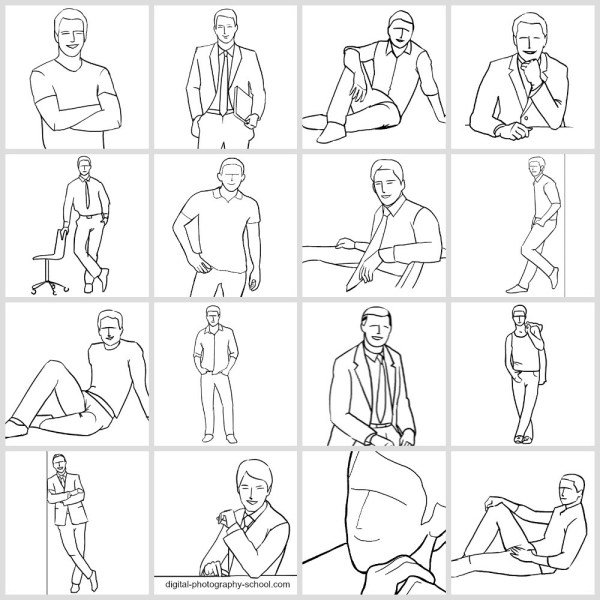
So, let’s look at some sample poses for men
1. Very simple pose for a man’s portrait: An upper body shot with crossed arms.
Two things to take care of: Shoulders should be pulled back a little, stomach muscles kept in check.
2. Crossed arms work very well in full height shots as well. In addition, ask him to cross one leg in front of the other. But make sure the body weight is not supported equally on both legs; otherwise, that would look just awkward!
3. A recurring question from your subject might be “Where shall I put my hands?” The solution is actually quite simple. There are four places to keep in mind (mixed in any combination, utilizing both hands).
#1. Loosely by the side.
#2. On the hips.
#3. In the pockets.
#4. Both hands crossed on the chest.
And in addition, hands should always be relaxed, which means no muscle pressure, except when you are photographing a bodybuilder.
4. A casual pose for a man standing upright. Men indeed have a problem with placing their hands; by keeping them fully or partly in the side pockets, you have a sure way to achieve a natural and relaxed pose.
5. Just a slight variation on the previous pose. A piece of clothing over the shoulder, merely a thumb in the pocket, and legs crossed work very well.
6. For a sitting pose, putting the ankle of one leg onto the knee of the other looks relaxed and natural. Shoot slightly from above.
7. Leaning against a wall is just another variant for upright posing.
8. The sideways way of leaning against the same wall. Works very well for both casual and formal shots.
9. A very simple pose for a formal portrait. Items held in the hand (e.g. a laptop, books, or even tools) can work as indicators of the subject’s occupation.
10. Against common belief, it is absolutely fine to make shots of a man sitting partly on a desk. For formal portraits, such a pose might counteract rigidness.
11. A very simple pose for a portrait: A man sitting at a desk. To reveal the subject’s profession, place work-related items on the desk.
12. A slight variation of the previous pose. Very appropriate for formal portraits.
13. To show the work environment while removing the distance created by a foreground object like a desk, take your shot from the backside. The result will be formal but inviting at the same time.
14. A man supporting himself on a desk with arms crossed. Again, you could place work-related items on the desk to point to the subject’s profession.
15. Using a chair as a prop can make a portrait more engaging and interesting. Very suitable when introducing creative people in their work environment.
16. Sitting comfortably in a chair usually works for corporate and formal portraits.
17. An easy and natural pose with a man sitting on the ground. Try different shooting directions and angles.
18. Another variant of a man’s pose while sitting on the ground. Suitable for outdoor locations.
19. An easy and relaxed-looking pose for a sitting man.
20. Informal pose. The man is sitting on the ground resting his back against the wall or some object.
21. Finally, let your subject be the protagonist of your picture. Never be afraid to crop tightly around the model’s face.
That should offer a starting point. Again, remember that there are no absolutes; each sample pose might and should be adjusted depending on your shooting environment and scenario. There is no need to overdo anything.
In reality, all you need for good people portraits is simplicity:
Simple backgrounds, simple clothing, simple poses, and natural expressions.
Check out our other Posing Guides:
Posing Guide: Sample Poses for Photographing Women (Part 1)
Posing Guide: Sample Poses for Photographing Women (Part 2)
Posing Guide: Sample Poses for Photographing Children
Posing Guide: Sample Poses for Photographing Couples
Posing Guide: Sample Poses for Photographing Groups of People
Posing Guide: Sample Poses for Photographing Weddings
Grab Our Guide to Portrait Posing
Kaspars Grinvalds is a photographer working and living in Riga, Latvia. He is the author of Posing App where more poses and tips about people photography are available.
The post Posing Guide: 21 Sample Poses to Get You Started with Photographing Men appeared first on Digital Photography School. It was authored by Guest Contributor.
The post Posing Guide: 21 Sample Poses to Get You Started with Photographing Women – Part I appeared first on Digital Photography School. It was authored by Guest Contributor.
This is the first in a series of Posing Guides with suggested starting poses for photographing different subjects. We are starting with the female posing guide.
Also in the series check out our posing guides for posing children, posing couples, posing groups and posing weddings.
Sample Poses to Get You Started with Photographing Women
If you ever run out of ideas, get stuck in creativity or simply need some guidance when shooting female subjects, you may use following posing samples as a “posing cheat sheet”. Many pro photographers use such a technique when preparing for and during the photo shoot.
The poses in this article are selected as an initial reference. I would advise you to look at the poses together with your subject, especially if she’s inexperienced. During a photo shoot, don’t hesitate to discuss with the subject which pose is or isn’t working in any particular situation. It’s usually very productive and you both will feel more confident in what you are doing.
OK, let’s start, one by one.
1. Very simple portrait pose to start with. Have the model look over her shoulder. Note how unusual and interesting a portrait might look, if shot simply from a different angle.
2. In portrait photography, hands are usually not visible or at least not dominant. However, you might get creative by asking the model to play around with her hands trying different positions around her head or face. Keep in mind, though: No flat palms, and the hands should only show their sides!
3. You might be familiar with composition rules like the rule of thirds. In a similar way, pleasing effects can be created by using diagonals. Also remember that you don’t need to always hold your camera on a perfectly even level. Don’t be afraid to tilt it, you might achieve some interesting and unusual perspectives.
4. A really nice and lovely pose with a model sitting. The knees have to touch each other. Shoot slightly from above.
5. Another open and inviting pose with the model lying on the ground. Get down and take your shot nearly from the ground level.
6. Just a variation for a pose with the model lying on the ground. Both hands might as well be resting on the ground. Works very well outdoors, on the grass or in a wild flower meadow, for example.
7. A basic easy pose, yet looks absolutely stunning. Get down and shoot nearly from a ground level. Then try to move gradually around the model while making shots. Also ask your model to change head and hand positions.
8. Another easy yet gorgeous pose for all body types. Try different hand and leg positioning. And remember to focus on the model’s eyes!
9. A really lovely pose. Works well in different surface settings: The model, for example, might lie on a bed, on the ground, in the grass, or on a sandy beach. Shoot from a very low angle and focus on the eyes.
10. Gorgeous and easy pose for a model sitting on the ground.
11. Another simple and friendly pose for a model sitting on the ground. Try different directions and angles.
12. A wonderful way to demonstrate the beauty of a model’s physique. Works very well as a silhouette when shooting against a bright background.
13. A simple and casual looking pose. Lots of variations are possible. Ask the model to twist her body, experiment with hand positioning and try different head turns.
14. Another very simple and elegant pose. The model is turned slightly to the side, hands in back pockets.
15. Leaning slightly forward can be a very attractive gesture. It is a subtle way to emphasize upper body shapes.
16. A sensual pose. By holding the hands above the head body curves are emphasized. Works with fit body types.
17. Endless variations are possible for posing in full height. This pose is just the starting point. Ask the model to slightly turn her body, change hand positioning, change head and eye directions etc.
18. A relaxed pose with the model standing upright and supporting her back against a wall. Remember that the model may use a wall not only to support her back, but also to put her hands on, or resting a leg against it.
19. Note that full height settings are very demanding and work well only with slim to athletic body types. Posing guidelines are simple: The body should be arched in an S shape, hands should be relaxed, while the weight finds support on just one leg.
20. An exquisite pose for slim to athletic models. Many variations are possible. In order to find the best posture, tell the model to slowly move her hands and twist her body constantly. When you see a good variant, ask your model to hold still and take some pictures. Repeat for a full set.
21. An absolutely romantic and delicate pose. Any kind of cloth (even a curtain) can be used. Note that the back doesn’t need to be completely bare. Sometimes as little as a bare shoulder could work pretty well.
So, there’s something for you to start with. Hope you will find at least couple of poses to work with in different shooting scenarios! Keep in mind that each of the initial sample poses is meant to be only a starting point. Each pose has endless variations! Just be creative and adjust the pose as needed (for example, try different shooting angles and ask your subject to change hand, head and leg positioning etc.)
Check out our other Posing Guides:
Posing Guide: Sample poses for photographing Women Part 1
Posing Guide: Sample posees for photographing Women Part 2
Posing Guide: Sample poses for photographing Men
Posing Guide: Sample Poses for photographing Children
Posing Guide: Sample Poses for Photographing Couples
Posing Guide: Sample Poses for Photographing Groups of People
Posing Guide: Sample Poses for Photographing Weddings
Grab Our Guide to Portrait Posing
Kaspars Grinvalds is a photographer working and living in Riga, Latvia. He is the author of Posing App where more poses and tips about people photography are available.
The post Posing Guide: 21 Sample Poses to Get You Started with Photographing Women – Part I appeared first on Digital Photography School. It was authored by Guest Contributor.
The post 7 Essential Tips for Photographing Business Events and Conferences appeared first on Digital Photography School. It was authored by James Maher.
Photographing business events is a lesson in extremes. One day you might be photographing a fascinating gala with incredible lighting and a lot of alcohol and energy. Then another day, you might be forcing yourself to pay attention while capturing an insurance industry conference in a dimly lit hotel ballroom, waiting for one person to make a single joke so people will laugh or smile during a talk on offshore tax havens.
In both cases, you have to do the best job you can to come back with the best possible photography from the day. You have to be prepared for the worst lighting, awkward people, and speeches that will cause even the most focused business professionals to nod off in their chair.
Here are some tips that have allowed me to always be prepared.
1. Before the job/being professional
1/200s at f/5.6, ISO 800.
The more prepared you are before a job starts, the smoother the day will go, and that starts with communication.
Provide your client with quick responses to make sure you don’t get beat out by competitors. Make sure you understand all the details of the event and what will be required of you and explain everything that you will provide the client. The better the communication when photographing business events, the fewer surprises will happen during the day.
Provide an official PDF quote on branded letterhead (it’s a nice touch) and always make sure to use a contract. I know this can be stressful for those just starting, but have a standard contract created that you can easily alter for each job, and it will quickly become a simple step in the process.
1/30s at f/2.8, ISO 3200.
Price yourself well. Do some research on event photographers in the area and value your services. Consider your expenses, travel time, shooting time, and editing time. On top of this, consider the time you spend marketing to get these jobs, your overall business expenses, and your personal expenses.
If you under-charge, you may make a little money, but you will quickly be out of business as well as hurting your competitors at the same time. Your work is valuable.
Always make sure to bring backup equipment for everything vital to the day. Bring an extra camera, lens, flash unit, batteries, and more CF cards than you need. The more prepared you are, the less will go wrong.
Finally, dress the part. This tip segways into the next topic about making people comfortable. As a photographer, people are watching you. Cameras stand out, and as much as you want to lay low to capture the best candid moments, you will be a focus of people’s attention.
Because of this, you need to make the best impression possible, While it may feel superficial, the better you dress, the more people will respect you and believe that you are doing a good job (because they often aren’t speaking to you, just seeing you working). It’s simple, but it works.
2. Make people feel comfortable
1/160s at f/3.5, ISO 800.
Your job as a photographer is to capture people looking happy and comfortable. The first step to doing this is making yourself look comfortable. The more comfortable and pleasant you look, the more relaxed people will feel around you, so remind yourself to keep a smile on your face.
Early on, I smile at people and give a quick hello or nod to some of the guests if the situation warrants it. If people look like they want to avoid me, I’m happy to let them. This makes me look non-threatening.
As the event goes on, people will begin to forget about you. However, the earlier you make people feel comfortable around you, the quicker this will occur.
3. Fast equipment
1/160s at f/4.5, ISO 6400.
In my experience, a majority of business events are in places with terrible lighting, so having the right equipment is necessary. You need to have a fast lens (that goes to f/2.8 or even faster), a flash unit, and a camera that can shoot well at high ISOs of at least ISO 3200 (which most new cameras can do these days).
My main event lenses are the Canon 24-70 f2.8 and the Canon 70-200 f2.8. This will cover everything from the overall room shots, the walk-around cocktail photographs, the group shots, to the detailed speaker photographs.
If you are on a budget, a 50mm f1.8 lens is a fantastic and affordable lens for event photography. However, the prime focal length will cause some significant constraints.
For photographing business events in darker environments, I will raise my ISO to 1600 and often 3200. My camera can handle this level of ISO (and 6400 if I really need) without clients noticing and it allows me to always be able to shoot with f2.8 lenses instead of needing faster ones.
1/125s at f/6.3, ISO 1600.
Now, even though you need to be able to shoot at f/2.8 when the lighting warrants, that doesn’t mean that I always do this. Often you will want more depth of field to show the full venue or multiple subjects sharp.
Particularly when photographing groups of people, I will always try to be around f/4 at least when it’s possible. Photographing a group at f/2.8 will often have the center person sharp while the edge subjects (or people standing too far forward) can be quite blurry.
Finally, you need a reliable flash unit. This will allow your subjects to stand out from the background and give them a pleasing light source much more flattering than your typical overhead ballroom lights. For presentations, I stay away from using a flash and instead stick to high ISOs as to not annoy a room full of people trying to concentrate.
For indoor cocktail event photography and similar, I almost always use flash.
4. Balance the room light with your flash
1/40s at F3.2, ISO 3200.
Whenever I need to use a flash, I will first set my camera to expose the room correctly without the flash. In my opinion, the best event photographs show the room and natural lighting of the environment while artificially lighting your subjects, so they look as good as possible.
I will raise my ISO and lower my aperture number until the room looks good, making sure that my shutter speed does not go too slow to cause too much handheld motion or motion in the subjects.
After this, I will turn my flash on and use the TTL (through the lens) setting to allow it to expose the scene correctly. TTL gives the camera the ability to read the light in the room and to give off what it believes to be the right amount of light.
While this screws up occasionally, it can be very accurate and will allow you to focus more of your attention on the event itself.
5. Bounce your flash with a diffuser
1/80s at f/2.8, ISO 2000.
Using a flash does not mean the light that comes off of it will be automatically pleasing on your subjects. Facing it directly at the subject can be pretty harsh.
Instead, I typically aim my flash up and sometimes slightly to the back. That way, the light will spread out and bounce off the ceiling back to them. The shorter the ceiling, the more this works. With a very tall ceiling (or dark ceiling), you will have no choice but to aim the flash directly at your subject.
I also use a small cap diffuser on the flash, which spreads out and diffuses the light. It will also send some of the light forward when the flash unit is pointed up, which helps out significantly.
I highly suggest the smaller cap diffusers over the larger ones, since the larger ones will light up like a bright bulb and blind anyone near you. This can be disruptive for an event.
6. Anticipate and wait for the right moment
1/125s at f/3.5, ISO 1600.
Anticipation is the key to good event photography. If you walk around constantly, it’s so hard to both pay attention and to be in the right position to capture those quick, amazing moments. Instead, find a location with a good vantage point on people having fun and wait for the right moment to occur. When it happens, you will be in position and ready with your camera to capture it.
When I do this, I try to be candid about it because there is nothing that will stop a great moment from happening more than a photographer staring at you and waiting with their camera. So instead, I try to make it seem like I’m looking around the room or looking at something else. I am scanning the room, of course, but I’m primarily watching them out of the corner of my eye.
Sometimes the moment happens and sometimes it doesn’t, so don’t be afraid to give up and move on when needed.
For conferences and long speeches, the key is to wait for someone to make a joke. That is usually the only way people will smile during these serious events. And while I try to be at attention for the entire time, this can be very difficult for a full eight-hour event of speeches and talks.
Instead, I usually pay the most attention early on in each speech and talk. Usually, the jokes come at the very beginning, so I will shoot a lot early on until I’m sure I have enough good photos. Then I will rest my attention for a bit, while still waiting for jokes or light moments to occur.
7. Edit the photos efficiently
1/200s at f/2.8, ISO 1600.
Coming back from an event with 600-1000 photos (or more) can be a daunting experience, particularly for those newer to photographing business events. Having an efficient workflow is necessary for these situations.
I try to stick to a week-at-most turnaround time. This can be difficult, but it is a big draw for businesses in this fast-moving social media world. Often, I’ll even send a small section of the best photographs the next day.
But how do you do this efficiently?
Before I do anything, I cull down the photos to the selects as fast as I can in Lightroom. I use the star system to go through my photos. I give the best photos 5-stars, 3-stars to the ones I am probably not going to use, but I’m not yet sure about, and the rest 0-stars. Then I go through the 5-star images again to turn some of the photos into 4-star images. This allows me to get down to my final set of 5-star photographs to send to the client as quickly as possible. It reduces the rest of the editing time significantly, which is a key step.
From there, I will edit and crop the photographs. Take significant advantage of Lightroom’s copy and paste functions for the changes you make. Since you will have groups of photographs taken under the same lighting conditions, copying and pasting your changes will save you so much time. Often, some of the photos will need small tweaks after that, but the core of the work can get finished so much quicker this way.
1/160s at F6.3, ISO 1600.
Conclusion
Photographing business events can be overwhelming at first as you never really know what you are getting into. Some events will be easy, inspiring, and delightful, while others will test your patience. Moreover, you often won’t know how this will go until you show up.
But over time, even the tough jobs with bad lighting and boring subjects will eventually become routine, as long as you take advantage of the tricks to get the best out of these situations.
Do you have any other tips for photographing business events that you would like to share? Please do so in the comments section.
The post 7 Essential Tips for Photographing Business Events and Conferences appeared first on Digital Photography School. It was authored by James Maher.
The post Photographing on Your Home Patch and Why You Need One appeared first on Digital Photography School. It was authored by Jeremy Flint.
Photographing on your home patch is an exciting way to practice your photography. Making a long journey to take photos can seem like a daunting task because of the travel times involved. Photographing closer to home is a much easier and inexpensive prospect and doesn’t require venturing too far.
What is a home patch
You may be wondering what a home patch actually is? Well, it refers to “a local area that is close to home and is easy to access year-round.”
A local patch can be almost anywhere nearby, and for most people will be on public land. It can be a location that is close by that you can visit with minimal efforts, such as a field, woodland, park, city, or river. Being nearby, you can ideally walk, bike, or use a vehicle to get there.
Why do you need a home patch?
There are several reasons why you need a home patch. Firstly, good photos can be achieved close to home with minimal effort. I took this shot less than five minutes from my home. I simply drove down the road, parked the car, and took the picture.
Misty morning, Oxfordhsire
By
photographing on your home patch, you can focus your efforts in one area, you can
re-visit the location anytime and you can spend more time enjoying your
photography and taking pictures.
Advantages of a home patch
Some great advantages of photographing locally include saving on time, as traveling is minimal, and the area is close by and relatively easy to get to. Going local by photographing on your home patch saves on costs as all you need is your camera. It is also a great way to practice your photography skills.
Focussing your photography on an area close to home will help you to keep your technique sharp whilst improving your images over time. You can even find a local project to capture.
Having traveled to several countries around the world to photograph amazing places, there is nothing I find more satisfying than capturing strong images close to home. You don’t need to travel far to create good photos.
For this shot, I visited the field of dandelions at first light to capture the early morning glow.
Dandelions in mist
When shooting close to home, you have the added benefit of being able to visit your local patch when the weather is more favorable. You can also visit at any time during the year, which is difficult to do when you visit somewhere abroad for a week on holiday, and the weather is unpredictable.
Other advantages of photographing on your home patch are that it enables you to practice your photography more frequently rather than waiting for a trip. You will also be better prepared for when you do go on a long journey with your camera.
What
to look for?
You may be wondering what you should look for when photographing on your home patch?
Well, once you have identified a great location nearby, you just need to decide what you will photograph. Your approach could be to photograph wildlife, landscapes, street scenes, or even architecture depending on your favorite photography subjects.
Deer, Oxfordshire
Finding great subjects close to home is easier than you may think. You don’t need to go on an African safari to take great wildlife photographs, for example. In the UK, we are lucky enough to have deer, rabbits and foxes for wildlife photography. When out in the countryside, observe nature and look for any clues of wildlife being present. You may find animal tracks or signs of life on show.
Local
woodlands and fields can be great places to visit and photograph too whilst
getting some fresh air in the great outdoors. In the UK, they are a haven for
birds and mammals such as squirrels and deer.
Rivers and riverbeds provide homes to otters, herons, and fish too, which you may be lucky to photograph.
Oxford, England
Some other ideas for things to look for in nature are beautiful landscape scenes such as valleys, trees or hedgerows, and details such as insects and plants. Shooting close-ups can give a more intimate view of a flower or insect.
If you live in a city, your home patch can include street photography, architecture photography, capturing reflections in windows, doing panning, or light trails to capture movement of traffic.
Working your local patch helps you to gain a
better understanding of your environment and become familiar with your
surroundings, the lie of the land, the buildings and their inhabitants.
Whenever you visit, remember a familiar location can look very different in diverse light, contrasting weather and variable times of the day and year.
Conclusion
In summary, photographing on your home patch is a great way to practice your photography closer to home and generally requires minimal effort. Finding a local area to photograph that is easy to get to also saves on time and cost. Look to photograph something you enjoy such as landscapes, woodlands, wildlife present in nature and urban scenes in local towns, or cityscapes and night photography.
Be sure to share the images you capture on your home patch with us below and any other tips you may have.
The post Photographing on Your Home Patch and Why You Need One appeared first on Digital Photography School. It was authored by Jeremy Flint.
The post Photographing a Still Life Series for Exhibition or a Portfolio appeared first on Digital Photography School. It was authored by Charlie Moss.
If you’ve ever tried photographing still life images, you’ll know that making a single good picture is relatively easy, but shooting a still life series is much harder! Trying to make a set of images that feel like they belong together can be very challenging for many reasons.
If you’re shooting to create a portfolio, or perhaps even for an exhibition, you’ll want to create images that feel like they belong together. That way, the body of work will appear more thoughtful, and its message will be stronger.
But no matter how hard you try to make images look like they are a series, there often seems to be something that doesn’t look quite right. So how can you overcome these challenges and shoot a still life series that feels like the pictures are coherent?
What is coherency?
When it comes to these images there’s a number of ways that a still life series can look like they belong together. But it really starts at the beginning.
Shooting a series of images that aren’t connected thematically is possible, but you have to pay attention to the technical aspects of your shots for coherency.
The most useful thing that you can do is have a series in mind when you shoot your first image. Picking a theme that will weave through your images and tie them all together is probably the easiest way to get a coherent feel to your series of shots.
If you shoot images around a theme, then the theme should automatically help to make them feel like they’re all a part of the same project. Perhaps the easiest way to approach still life thematically is to try to tell a story through the images. When you try to include storytelling in a still life series, it should help the images feel like they belong together.
But sometimes it’s not all about the theme and the storytelling; sometimes, you want to pull images together visually. So here are some suggestions on how to go about doing just that.
Use the same viewpoint
When you’re planning out your still life series, experiment initially with a few different viewpoints. But consider sticking to one throughout the series. Swapping viewpoints between pictures can make the images feel like they’re not quite part of a coherent set.
Consider using a tripod in order to keep everything the same. It’ll make it easier to keep your framing consistent for each shot, as well as keeping your distance the same from the camera to the object. And don’t forget to think about your composition as you place objects into your frame.
Of course, it is possible to change the viewpoint and still keep the images looking like they are part of the same still life series, as the image above shows. You’ll just have to make sure that you keep some of the other variables about your shot the same. Perhaps make sure that your theme or story is stronger than you might otherwise have needed to make it.
Use the same focal length
Keeping the distance between the camera and object the same, and also the focal length of the lens, can be a really great trick to keep your images looking like part of a series. When we use different focal lengths or vary the distance from the object to the lens it can cause distortion. Distortion causes our brain to realise that something isn’t really quite right.
Left: Shot with 35mm lens (50mm equiv.) Centre: Shot with 18mm lens (28mm equiv.) with the subject in the same place Right: Shot with 18mm lens (28mm equiv.) with subject moved closer to camera
While on the surface, the left and right images above look similar, you can see on closer inspection that there is distortion. In the right-hand image above, that I shot with a wider focal length, you can see more of the top of the apple, less of the bottom. And the apple appears to be bulging out towards the camera.
Of course, there’s really no “correct” focal length to use when it comes to shooting still life images. You may want the distortion that a wider angle lens brings to the image. In a way, the wide-angle creates a strange look that could almost pay homage to the artist Paul Cézanne who painted both the side and top of objects in his still life – an “impossible” view.
And on the other hand, a 50mm equivalent focal length gives a much more “natural” view because it’s closer to how the human eye views objects.
The important thing if you choose to vary your focal length or distance from the camera to object is to keep enough other variables the same. That way, your images still look like they are part of the same series.
Post-process images in a similar way
If I was going to shoot a still life series on film, I’d definitely make sure I shoot the same film type for all of my images. That way, they’d all be similar in color, tone, and feel.
Digital is no different. Post-processing images to make them look as similar as possible in style and feel can make a huge difference when it comes to feeling like they’re part of a series.
This is a great time to think about introducing something unique to your post-processing rather than just going for a totally natural look. It could be a slight split-toning in Lightroom with colors in the shadows, or a particular black and white recipe.
The key is to create a distinctive look and then apply it to all images, applying minor adjustments to each one to make them look coherent. Then your images, even if they are of quite different subjects, will be pulled together with a common look and feel.
Keeping your studio setup and lighting the same can really help when it comes to post-processing to make your shots look similar. Starting from the same “canvas” will mean that you don’t need to be a total post-processing wizard. Instead, small adjustments will pack a real punch when it comes to coherency.
Keep experimenting
When you’re planning your series, make sure that you keep experimenting. Try all kinds of different technical approaches to start with and narrow it down to the ones that suit the theme (and your style) the best. And then, once you have your images, experiment with the post-processing before saving your recipe as a preset so that you can use it to help you create a coherent look amongst all your images.
Remember that simply experimenting by changing your background can affect the whole feel of your shot! I shot these images were in the same lighting as the “light” images in this article and with similar settings. Both: ISO400, 35mm (50mm equiv.), f4, 1/240th sec
Don’t forget that you can apply these ideas to other kinds of photography too.
For instance, when creating a series of portraits, you might want to think about using a single focal length, aperture, and a post-processing recipe. It will help all your shots feel similar. These ideas about shooting a still life series can be applied to more than just inanimate objects!
The post Photographing a Still Life Series for Exhibition or a Portfolio appeared first on Digital Photography School. It was authored by Charlie Moss.
It can be daunting trying to decide which lenses to buy for photographing babies and newborns, especially when you’re on a budget. Award-winning family photographer Louise Downham shares her straightforward advice on which affordable lenses are best, as well as which lenses to consider upgrading to when your budget allows: Assuming you have a full-frame sensor, the key lenses you’ll Continue Reading
The post 5 Affordable Canon Lenses For Photographing Babies And Newborns appeared first on Photodoto.
The post 6 Tips for Photographing Amazing Light Trails at Blue Hour appeared first on Digital Photography School. It was authored by Joey J.
Have you seen cityscape photos with light streaks of moving cars? That’s called light trail photography. I see it as a part of the long exposure photography family. However, the exposure doesn’t have to be very long (typically under 30 seconds) to capture light trails. While my absolute favorite long exposure photography style is waterfront cityscapes with a silky smooth water effect, I also enjoy light trail photography – and it’s something I’ve done a lot of over the years. So I’d like to share some tips I’ve learned so far so that you’ll achieve better light trails at blue hour shots much sooner.
6 Tips for Photographing Amazing Light Trails at Blue Hour
1. Find a location with a great city view with plenty of traffic going by
This is a prerequisite for any great light trail photography. It might sound plain obvious, but it’s not always easy to find a perfect location, as there is more to it than meets the eye. I’ll describe more down the road.
Compared to light trails shot on straight roads (such as the first photo above), those shot on curvy roads look more pleasing (to me, at least), as seen in the photo below shot at Connaught Rd Central (Hong Kong).
18mm, f/8, 25 seconds (based shutter speed of 3 seconds, with 3 stop ND filter attached), ISO 100, shot 5 minutes before dusk.
4. Headlights, taillights or both?
Depending on the road you’re photographing (one-way street or two-way street), there may be only headlights or tail lights available. Or both of them may be available.
Personally, I prefer headlights, as they are more visually striking. As seen below, one-way traffic with tail lights (only) lacks some impact.
The majority of light trails are created by low-height vehicles such as private cars and taxis. However, when tall vehicles (e.g. buses, trucks) move through the frame, light trails record at a much higher point, adding more interest to your photos.
I shot the photos below from a sideway of a busy street in Seoul, Korea. Seeing public buses frequently passing through, I timed my exposure to capture their lights. I love how they came out!
When I shot the photos above, I spent a full hour shooting at minus 10 degrees Celsius in Seoul’s winter. Since I didn’t have gloves, my hands went completely numb with cold. By the end of the photoshoot, I couldn’t even hold my lens cap properly. Trying to put it back on the lens with trembling hands, I dropped it so many times. It sounds like a joke, but this simple task took me so long to complete!
6. Use mild-strength neutral density (ND) filter
You can shoot light trail photography at blue hour without using any neutral density (ND) filter, but the exposure time will probably be a little too short (a few to several seconds) to capture enough light trails.
If you don’t own an ND filter, try shooting with a small aperture (e.g. f/13) to make the shutter speed longer (ideally 10+ seconds).
An ideal strength ND filter for light trail photography is around a 2 or 3 stop ND. For example, a base shutter speed of 2, 2.5, and 3 seconds (i.e., when no filter is attached) will extend to 15, 20 and 25 seconds, respectively, with a 3-stop ND filter attached. That is long enough to capture plenty of light trails on busy roads. FYI, I shot almost all the photos in this post with a B+W 3 Stop ND Filter (77mm) attached.
One advantage of using a 3-stop ND filter is that you can attempt shooting light trails many times, as each exposure time isn’t too long.
When using a more dense filter like a 6-stop ND filter, a base shutter speed of 2 -3 seconds turns into a 2-3 minute exposure. This severely limits the number of photos you can take during the blue hour.
Besides, when the exposure goes so long, you won’t be able to time your exposure to target certain lights (such as those of tall vehicles).
I hope these tips will help you capture stunning light trails at blue hour. In fact, writing this post has made me want to try more light trail photography!
As always, if you have any questions or info to share about shooting light trails at blue hour, feel free to do so in the comments below. Happy shooting!
The post 6 Tips for Photographing Amazing Light Trails at Blue Hour appeared first on Digital Photography School. It was authored by Joey J.
The post 6 Vital Things to Look for When Photographing Landscapes appeared first on Digital Photography School. It was authored by Jeremy Flint.
Photographing landscapes is a hugely enjoyable pursuit that you can undertake all throughout the year. Landscapes are all around us, and being among them and capturing their beauty is a great way to immerse yourself in nature. Landscape photography can also be a fun way to practice your photography outdoors and learn about your camera in the fresh air. Here are six things to consider when photographing landscapes to elevate your images.
1. Dramatic light
One of the best times to be outdoors with the camera photographing landscapes is when the light is adding ambiance to the land.
Dramatic light can appear in all weathers.
You might expect dramatic light only to appear when the sun is shining. This is simply not the case. A predominantly overcast sky can yield impressive light for landscape photography. When the clouds disperse, the sun can unveil magical light as it paints and radiates the landscape.
It is often these fleeting moments of light that make the scenery more outstanding.
Another great moment for dramatic light is after a storm or rain shower when the bad weather clears and breathtaking light replaces it, or the final rays of light following a sunset.
You can enjoy the beauty of the landscape throughout the year. Have you ever thought about how a local panorama changes with the seasons throughout the summer, autumn, winter, and spring? The changes each season brings can be brilliant for photographing landscapes.
Next time you visit and capture your favorite local scenic view, re-visit during a different time of the year and see how the landscape transforms in an alternative season.
The beautiful vibrant greens of summer are usually followed by the crisp and golden leaves and foliage of autumn when a palette of colors unfolds from shades of red and orange to hues of yellow.
In spring and summer, photographing landscapes can be a superb time to capture flowers in bloom or more minimalist looking images when the trees are bare and striking in winter.
Also, consider using a wide-angle lens to capture a greater perspective.
Our dynamic landscapes continue to change due to human activity and natural processes, shaping our diverse and wonderful landscapes.
Farming has a big influence on our land and can be great for photography. Arable farming (the growing of crops and cereals) and pastoral farming (the rearing and production of animals such as pigs, sheep, beef and dairy cattle) can make great subjects for photography.
As fields get plowed, seeds also get planted. When different crops grow every year, including wheat and barley in the UK, for example, these changing landscapes provide wonderful photo opportunities.
You can also photograph grazing animals in the landscape.
4. Varying weathers
Changes in the weather can be unpredictable and can occur at a moment’s notice. One minute it can be sunny, and the next minute it can be raining. Although you cannot control the weather, you can alter what you shoot. So get creative when photographing landscapes in varying weathers and make the most of anything it throws at you.
Bad weather can provide exciting chances to improve your photos. For example, snow can transform a landscape into a striking minimalist scene.
If the skies are overcast or it is raining, either head to a river for your photography or venture into woodlands where there is more cover for taking pictures.
The weather can influence a landscape with its changing patterns of light. As the sun and clouds come and go, shoot the diversity of the scene as it develops.
5. Atmospheric conditions
Atmospheric conditions can really help to lift your landscape images. A hint of mist can make an uninteresting scene look moody and interesting. Mist swirling around a group of trees or encircling a building can look spectacular, especially in the right light.
You can use fog to create mystical-looking images too.
The final suggestion to shoot quality landscapes is to add an extra element of interest in your shots. You can go for a tree, water, people, or even parts of the landscape, such as a fence or gate.
Experiment with different compositions and come up with a view you like. The extra element will help give scale to your pictures and bring out another interesting side to the scenery.
In summary, changes in the weather can be both subtle and extreme, creating incredible moments to capture the landscape. Consider things such as showers, sun, cloud cover or clear skies when photographing landscapes.
Also, look for the seasonal changes in crops and take advantage of dramatic light as it casts its rays over a magical view.
Mist and fog can be the icing on the cake for landscape photography as they add an element of drama and can lift your images from great to spectacular. Also, include a person or building in your landscape shots for interest and scale.
Do you have any other tips for photographing landscapes? Perhaps you’d like to share some of you landscape shots with us? If so, please do so in the comments!
The post 6 Vital Things to Look for When Photographing Landscapes appeared first on Digital Photography School. It was authored by Jeremy Flint.