RSS
 

Posts Tagged ‘Photographer’

How to Simplify Your Life as a Photographer

04 Jun

Whether you’re an amateur or a professional photographer, complexity, confusion, and chaos are your enemies. When your life is chaotic and you’re feeling out of sorts, you’ll be unfocused and your photography will suffer. As a creative person, the last thing you want is to neglect your creative pursuits like photography.

“The more simple we are, the more complete we become.” – August Rodin

Here are 5 ways for you to simplify your life so that you can focus clearly on your life and love of photography.

Lighthouse - How to Simplify Your Life as a Photographer

Embrace simplicity in your photos by including as little as possible in the frame. In this photo, I eliminated the foreground as well as boats and other objects that could have been in the frame. All our attention is drawn to the clouds and the lighthouse in the distance.

1. Tidy up a mess

“Have nothing in your homes that you do not know to be useful or believe to be beautiful.” – William Morris

One of the simplest ways to bring some order to life around you is to tidy up a mess. Find space that you’ve got control over and clean it up. Start with your desk, or clean up your bedroom. Maybe you’ve got piles of stuff laying around the house. Choose one pile, sort it out, and put it away.

Once your space is clean, make it beautiful. Make a print of your favorite photo and frame it. Place it on your desk or hang it on the wall. Creating a tidy and beautiful space around you will help you simplify the chaos and encourage your creativity.

Jellyfish - How to Simplify Your Life as a Photographer

With nothing else present in this photo our full attention is drawn to the little jellyfish. Sometimes simplicity in photos is hard to achieve because there are so many other distracting elements.

2. Organize your photography gear

“There are two ways to be rich: One is by acquiring much, and the other is by desiring little.” – Jackie French Koller

Gather up all your photography gear into one place. This is especially helpful if you’ve got equipment stashed all over your house or apartment.

Clean it thoroughly, sort it out, and sell what you don’t need. By simplifying your gear, you’ll have fewer decisions to make and you’ll be freer to take photos when you’re in the moment.

For example, instead of wasting time wondering which of your eight lenses you should use, you’ll have three favorite ones from which to choose.

Frosty window silhouette - How to Simplify Your Life as a Photographer

Silhouettes are an excellent way to simplify and draw attention to your photos. The frosty glass adds an interesting background.

Organizing and simplifying the gear you own is one way to simplify your life. But another way is to simplify your desire for more gear.

Photographers are notorious for suffering from GAS – gear acquisition syndrome. Buying new gear is necessary from time to time, but sometimes buying stuff is an easy way to feel like a photographer rather than actually being one.

Make the most of the gear you’ve alredy got and only purchase what will truly allow you to take more creative photos.

Robin's egg - How to Simplify Your Life as a Photographer

I love taking photos with my Fuji x100s because it has just one prime lens. I don’t have to think about lens choices or focal lengths. Instead, I forget about my camera and just observe what’s around me.

3. Learn one new thing

“Knowledge is a process of piling up facts; wisdom lies in their simplification.” – Martin H. Fischer

You’ve embraced simplicity by cleaning up some small space, you’ve made that space more beautiful by printing and framing one of your photos, and you’ve begun relieving your GAS.

Now, take your favorite camera and lens and go learn something new. But learn just one new thing at a time. As a creative photographer, you’re likely eager to learn many new things and become a better photographer. That is a worthy ambition. But don’t pile on too much learning at once. That will only hold you back.

Choose just one article, book, or course, and master that before moving on. DPS has a lot of tips and articles for you to learn from, but they have also organized and simplified topics with their books and courses.

Coffee mugs - How to Simplify Your Life as a Photographer

I decided to spend some time trying to learn food photography. It’s a fun skill to study about. I needed to create some sort of background for this coffee mug and decided to stack up a few other mugs behind it. I like the repetitive pattern, another form of simplicity in photos.

4. Create a photography project

“Simplicity is about subtracting the obvious and adding the meaningful.” – John Maeda

With your new learning, why not tackle a photography project?

Many photographers have thousands of disorganized and disconnected photographs. And they have dozens of ideas in mind for what they will photograph next. Make of list of everything you’re interested in trying as a project and then choose one thing from the list to accomplish.

Silhouette and symmetry with a living room window - How to Simplify Your Life as a Photographer

I have a growing collection of silhouette photos with my living room window. Soon, I’ll gather them all together and choose my favorites for a photo book. The symmetry in this photo is an element of simplicity.

Instead of the chaos of too many options and ideas, choose one thing and bring it to life. Maybe you could take a day trip to a favorite location. Or gather together friends for a portrait project. Maybe you should sort through photos from the past and create a photo book.

In just a few days or weeks you could have a finished project and something new to hang in your tidied up space. Tackling a project will help simplify your life and bring order and accomplishment to your day.

Close up portrait of a toddler - How to Simplify Your Life as a Photographer

Close-ups simplify portraits by eliminating distracting backgrounds. Toddlers and kids have lots of fun peering into the camera or playing peekaboo.

5. Photography business

“Simplicity is the ultimate sophistication.” – Leonardo da Vinci

It is natural for photographers to consider starting a photography business. It’s a natural move since entrepreneurs and creative people are cut from the same cloth. Starting a photography business may seem like the ultimate way to live as a photographer. But even with a business, you must keep it as simple as possible.

Fishing boat silhouette - How to Simplify Your Life as a Photographer

I love to show up early before family photo sessions. Arriving at the harbor at 5 am in the morning, I captured this beautiful silhouette of a father and son heading out on one of the Great Lakes to fish.

If you’re already in business consider ways that you can simplify your photography business:

  • Keep your business aligned with what you actually love to photograph.
  • Offer one type of photography rather than doing everything.
  • Choose a simple pricing strategy.
  • Create a simple mobile-friendly website.
  • Put limits on how long your workday will be.
  • Create simple systems to make your workday flow.
  • Carve out lots of time for family and friendships.
Baseball - How to Simplify Your Life as a Photographer

I played baseball as a kid and feel nostalgic about it in the autumn months. Photographing a single object, such as a baseball, is a way to practice simplicity in your photography.

Start simple and make steady progress

Take the next 90 days (3 months) to simplify your life and your photography. Clean up your spaces, appreciate the gear you’ve got, learn just one new thing, and bring it all together with a photography project. If you have a photography business or are thinking of starting one – keep it simple by keeping all the parts simple.

Let me know in the comments what you plan to simplify first.

The post How to Simplify Your Life as a Photographer appeared first on Digital Photography School.


Digital Photography School

 
Comments Off on How to Simplify Your Life as a Photographer

Posted in Photography


NASA photographer Bill Ingalls’ camera melted in fire caused by rocket launch

30 May
Credits: NASA/Bill Ingalls

Last week, a tweeted image of a melted camera belonging to NASA photographer Bill Ingalls caught the Internet’s attention. In a statement clarifying the matter, the space agency explained the story behind the image, saying, “His creativity and efforts to get unique images are well known within the agency and to those who follow it.”

Ingalls has worked as a NASA photographer for 30 years. In its statement published Friday, NASA explained that Ingalls knows where to setup his cameras, and that a grass fire caused by the GRACE-FO launch on May 22 was behind the damage. Though Ingalls had placed two cameras outside of the launch pad safety perimeter, the melted camera was one of four placed within the perimeter.

Speaking with NASA, Ingalls said, “I had six remotes, two outside the launch pad safety perimeter and four inside. Unfortunately, the launch started a grass fire that toasted one of the cameras outside the perimeter.”

Despite the camera casualty, NASA says the memory card within the camera survived the fire. The space agency published a GIF of the fire as it moved toward the camera, which recorded its own demise. NASA says it’ll “likely” display the melted device at its Washington DC headquarters.

Via: NASA

Articles: Digital Photography Review (dpreview.com)

 
Comments Off on NASA photographer Bill Ingalls’ camera melted in fire caused by rocket launch

Posted in Uncategorized


How Conquer Your Fear of People as a Photographer

25 May

You know the feeling; shyness around strangers, dreading new situations, sleepless nights worrying, completely self-conscious in a crowd, thinking that everyone is judging you. In short, a fear of people.

Your fear and inhibition are like having “stage fright” in everyday life. All of this leads to you suppressing your personality, your creativity, and any chance to share your gift of photography with your culture and the world. All of this fear is dangerous because it blocks your creativity, making you become miserable and anxious.

But there is hope for you because many folks have overcome their fear of people and gone on to thrive as photographers. Below are five exercises that will help you to conquer your fear of people too.

Climbing child on playground equipment - How Conquer Your Fear of People as a Photographer

My son used to be afraid of heights at the playground. But I knew he could overcome it. So every time we were at the playground I would encourage him to try something with heights. He’d go just a little bit higher each time until he had completely overcome his fear.

How to Overcome Self-Consciousness and Fear

“If you want to conquer fear, don’t sit home and think about it. Go out and get busy.” – Dale Carnegie

The way to overcome self-consciousness, fear, and shyness is to practice the healthy opposite.

What is the healthy opposite of fear and inhibition? Having a healthy confidence, the ability to enjoy other people, and the courage to try your best and accept constructive criticism. Here’s how you can work toward that.

Window light portrait. - How Conquer Your Fear of People as a Photographer

It used to be extremely intimidating to ask friends if I could take a portrait of them. At a favorite coffee shop of ours, I asked my friend if I could snap a few photos while we were talking. I was really intimidated by this, but it becomes much easier once you do it a few times, trust me.

1. Begin with a Healthy Goal

Without healthy goals to aspire to, your life will be stagnant. You need a goal or you have nothing to move toward. Here’s a good goal for you if you’re a fearful photographer. Aim to become a creative photographer who is comfortable and confident with people.

Setting a goal doesn’t help you much unless you’ve got some steps to achieve it. Let’s see how to practice the healthy opposite of fear so that you can become “a creative photographer who is comfortable and confident with people.”

Begin with the smallest steps possible, and gradually improve from there.

Walking the dog. How Conquer Your Fear of People as a Photographer

When I was a kid I was afraid of dogs. I didn’t want my kids to be afraid of dogs so I made sure that they were around dogs from the time they were infants. Whenever they showed fear I helped them to be brave and get comfortable with the dog.

2. Use Your Voice

If you’re afraid of people, you probably don’t speak much. You’re likely afraid of having your ideas rejected, giving damaging advice, or being locked in a heated debate. But as long as you’re a kind and thoughtful person, these things aren’t likely to happen often.

The worst part about speaking up is the nervousness you feel just before saying something. Ignore that “stage fright.” Overcome it by saying something small. Don’t go big, just practice by making small talk.

Portrait in a coffee shop - How Conquer Your Fear of People as a Photographer

I’ve challenged myself to try street photography or photographing people while out and about. I was sitting in a coffee shop reading about photography when I saw this gentleman quietly having coffee on his own. I couldn’t resist taking a picture, waiting for the moment that he brought the coffee cup up to drink.

Baby Steps

Perhaps you’re interested in street photography, but you’re so afraid of people that you could never ask for a portrait of them. You could practice getting comfortable by making small talk with strangers. Don’t even bring your camera along, that’s too much pressure. Just practice small talk.

Once you get over that initial discomfort of striking up a little conversation, asking strangers to take their picture won’t be as scary.

Mayfly - How Conquer Your Fear of People as a Photographer

Add bugs to the list of things I’ve been afraid of! One summer I took a macro lens around and photographed bugs. The time I spend photographing them and editing the photos seemed to make me much more comfortable with bugs! Slowly exposing yourself to the things that cause fear will help you to overcome them.

lady bug macro shot - How Conquer Your Fear of People as a Photographer

On the Job Training

Another way to become comfortable working with people is to get a job working at a department store portrait studio. If you work during the Christmas rush you’ll have the opportunity to photograph hundreds of families.

Because it’s your job, you’ll be forced to talk with them. This repetition will help you get over your fear of talking with people. Remember, you’re not there for the photography itself. You’re there to practice talking with people so that you can get over your fear and move toward your goal of being a creative photographer who is comfortable and confident with people.

First hair cut. How Conquer Your Fear of People as a Photographer

My little girl tends to be shy of new people and new situations. It takes a little while but she will become comfortable with friendly people. She was very shy for her first haircut but now loves a day out to get her hair done.

3. Offer Compliments

If you’re not sure how to start a conversation, start by noticing something that you can sincerely compliment a person about. Self-consciousness and fear paralyze you by keeping you focused on yourself in negative ways. If you’re always self-conscious, then you need to just take the spotlight off yourself by focusing on other people instead.

When you focus on offering people compliments two things will likely happen. First your attention is turned away from yourself and on to them. Second, your mind is turned away from negative thoughts (about yourself) and toward positive thoughts (about them) instead.

When I was a senior portrait photographer I would always find some little thing to compliment students about. If it was obvious that they spent a lot of time on their hair, that’s the compliment I gave. Maybe they had a great smile, or were funny, or we had something in common.

Focusing on the other person and having something nice to say will build bridges and help you to overcome your fear and discomfort around people.

Riding the escalator. How Conquer Your Fear of People as a Photographer

Escalators can be intimidating the first time you step on one. Kids are afraid they’ll get swallowed up in the moving steps. Once my kids figured out how to ride one, they treated the escalator like a ride at an amusement park! Overcoming your fear can lead to exciting things in life.

4. Visualize Criticism

You may quickly get over the fear of talking to people or the anxiety you feel over negative thoughts about yourself. But how about receiving criticism of your photographs? This is one of the worst things imaginable for some photographers.

If you panic or become consumed with anxiety and want to “just give up” over the slightest criticism of your photos, then you need to learn to take criticism better. It’s not comfortable at first, but it can be done.

Here are some steps

First, admit that you are not perfect and that you should always focus on improvement. Be humble and admit that some healthy criticism could actually help you.

Second, seek it out. That’s right, go looking for critiques! Look for people who are better than you who can show you how to improve. You want to grow as a person and a photographer don’t you? Ask successful people how you can be better.

Journal writing - How Conquer Your Fear of People as a Photographer

You can document your journey of overcoming the fear of people by journalism. Get it all out on paper. What you’re thinking, what you’re feeling, and all the successes you have.

Third, visualize criticism. You can practice receiving the image critique comfortably before actually receiving it. Close your eyes and imagine someone saying, “These photos are terrible” or “That’s not your best work.” Just imagine hearing those words. Get over the shock and uncomfortable feelings. How could you respond to their harshness in a positive way?

Do you think it seems weird to use your imagination this way? Yes, it may seem strange at first. But it’s exactly how you’re already using your imagination.

Your self-conscious fear is leading you to imagine what people are thinking and saying about you. Your imagination is causing you to fear criticism and be paralyzed instead of receiving it graciously, improving, and moving forward toward your goal of being a creative photographer who is confident and comfortable with people.

Chopping wood. How Conquer Your Fear of People as a Photographer

I’ve embarrassed myself a few times trying to chop wood with people watching me. I needed to learn to do it well. So one summer I decided to chop a massive pile of wood. It wasn’t easy to learn and some pieces ended up a mess before I could get them to split. But by the end, I was now showing other people how to chop wood. Constantly try things that intimidate you. The little successes will keep you moving forward and ignoring fear.

Consider who you are receiving the criticism or critique from. If you post photos online, you’re eventually going to receive harsh criticism from someone, solicited or not. The internet is an easy place for people to be mean and remain anonymous.

Please feel free to ignore people who are harsh and cruel. But always listen to the constructive criticism by other photographers who actually care about you and want to help. Their insights can be very valuable, making you a better photographer.

5. Open up, be vulnerable, and make friends

Your fear and shyness of people may come from your honest desire not to bother anyone. You avoid saying or doing the wrong thing. But are you also avoiding friendship and positive interaction too?

Begin with small talk and offer compliments. Become comfortable with conversation and criticism. Once you’ve done this then opening up and going deeper with people won’t be so hard.

Do you know what you might discover? You’re not alone in your fears. Other people (and especially photographers) are afraid too. And they’ll be thankful that you spoke up, and shared your ideas and your creativity. Courage is contagious.

Paddle boarding - How Conquer Your Fear of People as a Photographer

This is our friend who is terrified of water. It used to be almost unthinkable for her to get out into the water.

two girls paddle boarding - How Conquer Your Fear of People as a Photographer

However, she was determined to overcome her fear – or at least ignore it. Fear can be paralyzing, but finding the strength to overcome it can open new doors in life.

Go Forward Toward Your Goals

I used to be terrible with people, especially with kids. But I used all of the ideas above to break out of my shyness and conquer my fear of people. I still feel uncomfortable at times. But now I run my own photography business specializing in people! Whether it’s families or individual portraits, I’m able to connect with people and help them to feel comfortable in front of the camera.

If your goal is to become a creative photographer who is comfortable and confident with people, follow the steps above. It’ll take time, but start small and soon you’ll be thriving among people.

The post How Conquer Your Fear of People as a Photographer appeared first on Digital Photography School.


Digital Photography School

 
Comments Off on How Conquer Your Fear of People as a Photographer

Posted in Photography


How a Studio Photographer Came to Love Natural Light Again

10 May

I’m a studio photographer. There are no two ways around that fact. It also happens to be the way I like it. I prefer the absolute control I have over every single factor in a studio environment. That way, I’m not at the whim of changing light at different times of the day or inclement weather.

How a Studio Photographer Came to Love Natural Light Again - studio portrait of a lady

As a studio photographer, my preferences are for an environment where I control every aspect of the light.

A lot of this might have to do with the fact that I live in the United Kingdom, and for the most part, the stereotypes about the weather aren’t wrong. That and daylight hours throughout the year vary wildly. In the summer, I may have daylight until 11 PM, in the winter, that changes to 3 PM. Locked away in my studio, I don’t have to worry about sudden unpredicted rain (in Yorkshire, there’s a lot of it).

I don’t have to worry about summer temperatures dropping below ten degrees (Celcius) causing severe discomfort for my subjects and myself. Most importantly, I don’t have to worry about the light being even slightly different then I want. In a studio, I decide what I want and if the lights aren’t quite there, I change them until they are as desired.

Of course, I have nothing against natural light. I just have a preference based on how I like to work.

Using Natural Light

outdoor portrait of a girl - How a Studio Photographer Came to Love Natural Light Again

On occasion, I get out to use natural light when there’s something specific to achieve.

This doesn’t mean I have forsaken natural light as some sort of taboo subject. No, I still use it from time to time, but it’s usually when I’m trying to do something specific in a certain location or with a special technique that can’t be done in a studio.

portrait of a man with gray hair - How a Studio Photographer Came to Love Natural Light Again

This image was taken only as a technical exercise because of how the light was behaving in a bit of open shade close to sunset.

Shifting perspective

How a Studio Photographer Came to Love Natural Light Again - window lit studio

The large windows in this natural light studio make the space a veritable playground for any photographer enthusiastic about lighting.

Last year, I booked a natural light studio with enormous windows for the first time and the experience completely changed the way I think about these things. I went in treating the whole thing as an experiment. As such, I had no concrete plans. I was going to go in and explore the space, look for pockets of light, and try to seize whatever opportunity presented itself.

How a Studio Photographer Came to Love Natural Light Again - portrait of a lady indoors

The dim, overcast day made for this glorious soft light coming through the windows.

Long story short, I was hooked in minutes. I’m sure the sight of me bouncing from corner to corner going “Ooo, look at the light here and look it at it over here” was more than a bit comical.

The whole experience was like a four hour treasure hunt. It seemed like everywhere I turned, the light was doing something new that was worth exploiting. I can easily compare the feeling to the enthusiasm I felt when I first got a camera and just randomly walked around taking photos of everything and burning through film like it didn’t matter.

As an added bonus, the changeability of the light (one of the factors that kept me firmly in the studio) made new opportunities all the time. On several occasions, I’d move from one spot to another, only to see what the light was doing in the first spot later on and I’d go straight back to it and get completely different results.

girl next to a window - How a Studio Photographer Came to Love Natural Light Again

A short while after the previous image was taken, the sun came out a bit changing the light from this window completely.

There is one thing that I found very hard to replicate in a studio environment. This particular studio is in an old industrial mill and the windows (there are a lot of them) are gargantuan. This gave the light a beautiful soft quality that would be hard to replicate with artificial lighting.

Needless to say, I loved my first time in a natural light studio and have since made it a point to go back and try to find other natural light venues as well.

lady in a gold top - How a Studio Photographer Came to Love Natural Light Again

Even from further away, the light from the windows was still soft and provided gentle tonal transitions.

New ideas

An unexpected side effect of this experience is that I every time I come out of one of these places, I leave with a head full of ideas on how I can apply what I’ve seen the light doing in the studio.

darker portrait of lady in yellow top - How a Studio Photographer Came to Love Natural Light Again

Using a strobe with High-Speed Sync functionality allowed me to darken the studio’s windows for a dramatic background while lighting the subject the way I would in a normal studio environment.

On top of that, I have always forsaken the option of mixing natural light with flash. For whatever reason, I never really felt that it was worth the effort. My opinion on this has changed dramatically since my first visit to that studio. Now I’m always looking for new ideas on how I can use and exploit natural light at any time of day and mix it with studio strobes if need be.

portrait of a girl with long blond hair - How a Studio Photographer Came to Love Natural Light Again

Also made using High-Speed Sync, the flash allowed me to fill in the shadows created by the backlighting from the windows. The result is an even exposure throughout the frame and no blown out windows.

Am I a Convert to Natural Light?

I’m still a studio photographer, there’s no doubt about that. I still prefer the control the studio provides and I will still default to that. However, I won’t be going out of my way to avoid natural light settings in the future.

Between the multitude of opportunities these experiences provided me and the ideas I took away from them, I will be making it a point to regularly shoot in natural light just to shake things up a bit if nothing else.

The end

The point of all this? Good question. If you’re like me, and you find yourself stuck in a rigid pattern, such as my adherence to studio work, I encourage to make the conscious choice of going out and pursuing the exact opposite.

You might very well find that your convictions towards whatever it is you’re stuck to aren’t founded as solidly as you had thought. If nothing else, it will give the opportunity to learn something new and to grow as a photographer and nobody can argue that that’s a bad thing.

The post How a Studio Photographer Came to Love Natural Light Again appeared first on Digital Photography School.


Digital Photography School

 
Comments Off on How a Studio Photographer Came to Love Natural Light Again

Posted in Photography


The Importance of Learning From Failure to Help You Grow as a Photographer

07 May

There’s a scene in the 1995 movie Apollo 13 when Gene Kranz, flight commander of the ill-fated moon mission, tells his team that, “Failure is not an option” as they struggle to find a way to bring three astronauts home from the depths of space. While that moment certainly makes for dramatic storytelling, it’s often far from the case when photography is concerned.

I would even go so far as to say failure is not only an option but necessary for you to grow as a photographer. There will be times in your photographic journey that things just don’t go as you had hoped despite how much you plan ahead. While some of these instances might slow you down the important part is learning from failure, growing from your mistakes, and becoming a better photographer as a result.

This picture turned out great, but there have been plenty over the years that didn’t.

I would like to share some things I’ve learned over the years from times that I have failed. Hopefully, this will help you benefit from my experiences.

Know your gear well

On some of my first sessions with clients, I had a very difficult time getting my camera to do what I wanted it to do, and many of my images were ruined because of it. A few were too bright, others were too dark, and some weren’t even in focus.

Luckily I shot in RAW so I could fix some of the issues in Lightroom. But things would have gone a lot smoother if I had just taken the time to understand my camera, learned how to use it, and knew what to do when shooting instead of spending hours adjusting images afterward.

The Importance of Learning From Failure and Your Growth as a Photographer - DLSR camera

Your camera is loaded with buttons, dials, menus, and options. Do you know what they all do?

Example

To illustrate what I mean by this, take a look at the following image I shot almost five years ago. Thankfully I did this session as a favor for some friends of our family because looking back on it I would feel terrible if I charged them money for these pictures!

dark family photo (underexposed) - The Importance of Learning From Failure and Your Growth as a Photographer

I remember being frustrated at seeing the LCD screen of my Nikon D7100 as I took these pictures because they were all coming out so dark! I didn’t know what was wrong, and I didn’t know what to change on my camera to fix the problem.

Looking back there was any number of remedies for this overly-dark photograph that I could have used. Had I only known how to actually work the knobs and dials on my camera, simple things like the follow could have solved it:

  • Adjust the exposure compensation (duh!).
  • Change to spot metering instead of matrix metering (of course!).
  • Locked exposure on a bright part of the scene and recomposed the shot (why not?).

Thankfully I used RAW and not JPG so the image wasn’t a total loss, but the skin tones are washed out and the picture is not nearly as vibrant and dynamic as if I had just gotten it right at the time of the shoot.

family portrait in the park - The Importance of Learning From Failure and Your Growth as a Photographer

Clearly, I had a lot to learn about lighting, composition, and why having clients sit on a canvas drop-cloth with their feet out is not a good idea.

This advice is not just for newbies

This advice isn’t just for professional sessions with clients either. Something happens when you get new gear and want to put it through its paces. I attended a wedding recently as a guest, not as the official photographer, but I had my shiny new Fuji X100F with me and even though I thought I knew how to operate it, I made a crucial mistake that cost me a lot of good shots throughout the evening.

For a good 20 minutes I couldn’t figure out why my camera wasn’t focusing right and all my shots were coming out poorly exposed. Finally, I realized that I had accidentally activated the built-in ND filter. There was even an icon on the LCD screen indicating the ND filter was turned on, but I didn’t see it because I just wasn’t as familiar with the camera as I should have been.

people dancing at a party - The Importance of Learning From Failure and Your Growth as a Photographer

Suffice it to say I felt like a complete amateur when I realized that a mistake I made had ruined so many good photo opportunities, but I quickly learned from it and hopefully now you can too!

Familiarize yourself with the location beforehand

Years ago, not too long after I got my Nikon D200 and 50mm lens, I thought I was a pretty big deal and knew everything there was to know about pictures. After all, I had a prime lens! What else was there to understand? (Spoiler alert: A lot. A whole lot!)

One of the biggest mistakes I made during this early period was to show up for photo sessions without ever having been to the location beforehand. This made it impossible, as any seasoned photographer would know, to plan out some of the basic essentials of a photo shoot and look for things like lighting, foreground and background elements, and even where to have my clients sit, stand, or walk.

Hard lesson to learn

The worst offender of the bunch was a session I did for a high school senior where most of the pictures turned out –  well, let’s just say less than ideal because I failed to plan ahead in terms of the physical location. We agreed to meet at a cross-country track, with almost no natural shade, at 5 pm. This is what happened:

portrait in the shade - The Importance of Learning From Failure and Your Growth as a Photographer

From one of my first high school senior sessions, and one I wish I could erase from existence altogether.

After searching for something, anything, to block the sun so he wasn’t squinting – I finally found this set of metal bleachers behind a tree. But because I didn’t understand how to operate my camera to get the exposure right (see failure tip #1) I got shots that were lit like some kind of circus act and were far too over or underexposed.

If I had taken some time to visit the location first I could have at least mentioned some alternative places at the track, or even suggested a different location entirely. Instead, I got out of my car and met the client and his mom with the kind of overconfident swagger that only a new wet-behind-the-ears photographer has, and ended up biffing most of the shots.

I did scrape by with enough competent shots to make it worth their while, but nonetheless, I walked away having learned something I will never forget.

senior portrait - The Importance of Learning From Failure and Your Growth as a Photographer

This was from one of my more recent high school senior sessions. I think it’s just a bit better, don’t you?

A few more for good measure

There are a host of other times I have failed as a photographer but each time I have tried to engage in some self-reflection and understand where I went wrong, As well, I tried to talk with other photographer friends, so I don’t make the same mistakes in the future.

My work has grown, and so have I, as a result of these failures. I would almost go so far as to say that failure is downright essential if you want to refine your craft as a photographer.

dogwood flower - The Importance of Learning From Failure and Your Growth as a Photographer

It took years of poor decisions and overlooking the obvious for me to learn enough about photography to take this simple picture of a dogwood flower.

Without going into too much detail, here are just a couple of other times I have swung and missed, photographically speaking, over the years along with a bit of caution for others thrown in for good measure.

When in doubt, take more photos

I was born in 1980 and grew up in the era of physical film, so when I got my first digital camera I carried that mentality with me. As a result, I missed out on a lot of good shots, especially with clients, because I thought I already had enough and didn’t want to fill up my memory card.

With the price of memory cards being so astronomically low, there is no excuse for not taking enough pictures, and you can just delete them later if you need to.

Control your depth of field

After I got my 85mm f/1.8 lens I took it out to a photo session with clients before thoroughly using and understanding it, which is always a big mistake. I also thought that I could shoot everything at f/1.8 because it gave me such a cool background blur!

What I didn’t realize at the time was the extra-large aperture was also causing half the people to be out of focus due to the insanely shallow depth of field. Just because your lens has a super wide aperture doesn’t mean you should always use it. When in doubt, stop it down a bit.

family portrait outdoors - The Importance of Learning From Failure and Your Growth as a Photographer

I focused on the mother, front and center, and shot this with my 85mm lens at f/1.8 to get a blurry background. What I didn’t realize was that also meant the husband was out of focus as a result.

Know when enough is enough

This one is going to vary depending on the type of photography you do. But as someone who takes a lot of family and child photos, it’s important to know when to hold ’em and know when to fold ’em.

Kids, and even parents, can be fickle and there were times early on when I would drag out photo sessions long after I should have called it quits. “Hey let’s get some more shots over there!” I would say. My clients would begrudgingly oblige while I scampered off ahead of them in a vain effort to capture authentic smiles and emotions.

Dragging out a photo session won’t help you get better pictures. But it will make your clients roll their eyes and think about booking someone else next time. Someone who will take a hint and pay attention to their needs!

family photo - The Importance of Learning From Failure and Your Growth as a Photographer

I learned over the years that kids just don’t last long at family photo sessions, so I took a ton of pictures and tried to keep things interesting by switching up the poses. 20 minutes later these kids were ready to be done, and I could have tried to stretch things out further but it would have only led to frustration.

Conclusion

These are just a few of the many lessons I have learned over the years that, while painful at the time, have served me well in the long run.

What are some of the ways in which you have failed, fell down, or otherwise came up short and what did you learn from it? I’d love to hear your thoughts and experiences in the comments section below. Hopefully, we can all learn from each other’s mistakes.

The post The Importance of Learning From Failure to Help You Grow as a Photographer appeared first on Digital Photography School.


Digital Photography School

 
Comments Off on The Importance of Learning From Failure to Help You Grow as a Photographer

Posted in Photography


AFP Kabul chief photographer among journalists killed by suicide bomber

02 May

AFP news agency’s Kabul Chief Photographer Shah Marai was one of several journalists killed by a suicide bomber in Afghanistan’s capital city, the agency has confirmed. The attack happened approximately 15 minutes after an initial suicide blast and specifically targeted journalists and aid workers who arrived on scene following the first attack. The second suicide bomber was disguised as a journalist, according to BBC.

The AFP, via Yahoo, has since reported that Marai and nine other journalists were killed in the attack, as well as ‘dozens’ of others in multiple blasts today. BBC further clarifies that four police officers were killed and at least 45 individuals were injured. Islamic State claims it was behind the attacks.

Marai, father of six including a newborn, began working as a photographer for the AFP in 1998. He described his experiences covering the region under Taliban rule in an essay published by the AFP, including the changes that came with their ousting in 2001 and their return in 2004, as well as the risks associated with carrying a camera.

The agency has issued statements on the tragedy and published a video showcasing some of Marai’s work:

Note: Comments on this article are open. Comments that do not adhere to our community posting rules will be deleted, and we reserve the right to close commenting entirely.

Articles: Digital Photography Review (dpreview.com)

 
Comments Off on AFP Kabul chief photographer among journalists killed by suicide bomber

Posted in Uncategorized


Wildlife Photographer of the Year winner disqualified for using stuffed animal

28 Apr

The winner of the Environment category of the prestigious Wildlife Photographer of the Year competition has been disqualified after the competition’s organizers discovered the anteater starring in his dramatic nighttime image is stuffed. According to the competition, photographer Marcio Cabral—who had won £1,250 and a place in the awards exhibition in London’s Natural History Museum with his image ‘Night Raider’—was found to have included a ‘taxidermy specimen’ taken from the entrance to the park in which his picture was created.

Organizers’ suspicions were raised after an anonymous tip off that came supported by a picture of the anteater in question occupying its usual role as a greeter at the Portão do Bandeira gate of the Emas National Park in Brazil. Five independent science experts were called in to conduct a ‘thorough investigation’, and they concluded that the pose, markings, shape and fur patterns of the stuffed creature and the subject of Cabral’s picture were simply too similar—they had to be one and the same animal.

Cabral continues to plead his innocence, despite not being able to show a raw file that includes the anteater other than the shot he entered in the competition. Cabral provided a witness who testified that they saw the live animal, but the organizers were not convinced. Cabral had his award removed and is banned from entering ever again.

This isn’t the first time the competition has been struck by such circumstances. In 2009, the overall winning image was found to include a zoo wolf called Ossian being passed off as a wild animal. The photographer on that occasion, Jose Luis Rodriguez, also claimed he hadn’t cheated, but the judges concluded it was likely the wolf had been hired for the shot and the photographer was disqualified, leaving the competition with no winner for that year.

For more information on the disqualification, read the press statement below. And if you want to see the other, legitimate winners of this year’s WPotY, visit the competition’s website.

Press Statement

Press statement: Wildlife Photographer of the Year image disqualified

After a careful and thorough investigation into the image ‘The night raider’, taken by Marcio Cabral, the Natural History Museum, owner of the Wildlife Photographer of the Year competition, has disqualified the photograph, which was selected as winner of the 2017 Animals in Their Environment category.

Evidence was presented to the Museum by third parties that it is highly likely the animal in the awarded photograph is a taxidermy specimen. After a thorough investigation taking just over three weeks, the Museum has concluded that the available evidence points to this allegation being true. As a result, the Museum believes that the image breaches the competition rules. The rules clearly state that ‘entries must not deceive the viewer or attempt to misrepresent the reality of nature.’

The Natural History Museum is a world-leading scientific research institution. The team of scientists involved in the investigation comprised of two mammals experts and a taxidermy specialist at the Museum, plus two external experts; a South American mammals expert and an expert anteater researcher.

Evidence examined included high resolution photographs of a taxidermy anteater that is kept on open display in the educational collection at a visitor centre located at the Portão do Bandeira gate, one of the entrances of the Emas National Park – the large park where ‘The night raider’ was taken.

The anteater in the awarded image was compared to the taxidermy anteater depicted in the photographs received by the Museum. The five scientists, working independently of each other, all reached the same conclusion that there are elements in overall posture, morphology, the position of raised tufts of fur and in the patterning on the neck and the top of the head that are too similar for the images to depict two different animals. The experts would have expected some variation between two individuals of the same species.

The Museum also considered the responses to specific questions put to the photographer Marcio Cabral, who cooperated fully in the investigation, and who supplied RAW image files he claims were taken of ‘before’ and ‘after’ the winning shot was taken – none of which included the anteater. Mr Cabral did provide an explanation as to why he had no other images of the anteater. He also provided a witness who claims he saw the live anteater.

Mr Cabral strongly denies that the anteater in the image is a taxidermy specimen.

The competition rules clearly state that photographs achieved through unethical practices will be disqualified. The competition rules are available to all entrants including versions translated into several languages, including Brazilian Portuguese.

Wildlife Photographer of the Year is the world’s most prestigious photography competition of its kind and any transgression of the competition rules is taken very seriously. The image will be removed from the exhibition and tour.

Articles: Digital Photography Review (dpreview.com)

 
Comments Off on Wildlife Photographer of the Year winner disqualified for using stuffed animal

Posted in Uncategorized


A photographer has designed and built the first E-Mount film camera

26 Apr

Photographer Alexander Gee has created something pretty cool: the first (to our knowledge) Sony E-Mount 35mm film camera. It’s called LEX, and when it’s finally finished, Gee intends to make the camera’s design files open source so that anybody with a little bit of interest, soldering skill, and access to a 3D printer can built their own from scratch.

The LEX is the result of more than a year of design work, 3D printing, and trial & error, which Gee actually documented on the LEX Optical website. Development began around the shutter mechanism from a Sony a7, and continued from there until he had achieved a working prototype that has been improved upon and tidied up to create the version you see below:

$ (document).ready(function() { SampleGalleryV2({“containerId”:”embeddedSampleGallery_3532342693″,”galleryId”:”3532342693″,”isEmbeddedWidget”:true,”selectedImageIndex”:0,”isMobile”:false}) });

The current prototype isn’t quite as pretty as the mockups, but it’s not far off either. And more importantly: it works. There are already sample photos posted on the LEX Optical website and more (we assume) to come as development continues. The website doesn’t offer any specific timetable, but Gee does say that he might crowdfund “a small batch of devices before opening the design files up.”

To see sample images, keep an eye on the project’s status, or jump onboard if and when Gee crowdfunds that batch of pre-built LEX cameras mentioned above, head over to the LEX Optical website or follow the project on Facebook and Instagram.

Articles: Digital Photography Review (dpreview.com)

 
Comments Off on A photographer has designed and built the first E-Mount film camera

Posted in Uncategorized


5 Ways to Challenge Yourself as a Wildlife Photographer

16 Apr

As a wildlife photographer, often it can seem challenging enough just to find your subjects out in the field, let alone get close enough to take that perfect image. However, to develop as a photographer, constantly challenging yourself is a key ingredient to learning and growing, helping you to tell stories in a more meaningful and creative way through your images.

In this article, I will give you a few ideas to explore when you next head out on a nature photography shoot, to keep you challenged and growing as a photographer.

1 – Take one lens

One lens - wildlife photographer

Restricting yourself is often a great way to encourage creativity. Working with constraints can help you to think outside the box and explore ideas or ways of working that you might have missed in other cases. As photographers, having a boatload of lenses at our disposal means we have options to capture the world in a multitude of ways. Yet still, within this, we often become restricted within our view, choosing to consistently work with convention rather than explore creative options.

For example, if you are going to work with birds you will likely select your long telephoto, whereas, for insects or flowers, the obvious choice is a macro lens. However, if you decide to restrict yourself to a certain lens or focal length you have to use that in order to explore and create a photograph. That means that sometimes you’ll have to work in a new way, choose a different composition, or go for a different type of image than you would normally attempt.

For example, taking a macro lens out for a full day of shooting you might feel restricted. But the 100mm focal length (common for most macro lenses) is actually highly adaptable for working with a variety of subjects from landscapes to tiny insects, or even people and street images. Prime lenses further enhance this restriction, forcing you to zoom with your feet.

However, after a number of days solely focused on each lens in your bag, you’ll have a much greater appreciation for the wide variety of subjects and images it can produce. Thus helping you to be more creative with your choices in the future.

2 – Work wide

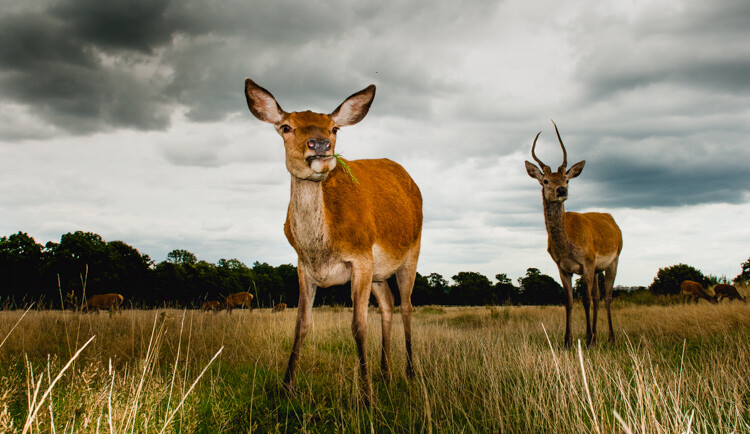
Shooting wide two deer in a field - wildlife photographer

For most wildlife photographers, the long telephoto is our safe haven. We know that when using a 300mm, 500mm or 600mm lens we can frame up our subjects and get wonderful clean portrait images. Allowing us to concentrate on our subjects and not necessarily needing to worry about the other elements in the landscape.

The thing is that, although telephotos are fantastic for filling the frame and showing close details of distant creatures, they don’t give an impression of scale. Images show with a long lens almost seem less immersive than shots taken with shorter focal lengths.

Of course, one of the biggest problems is that shooting wildlife with a wide lens is often a lot harder, (depending on the subject) than your traditional long lens wildlife photography. But this is a great learning curve. Yes, the complexities of predicting animal behavior, working out positioning for remote cameras and triggering them at the perfect time without always being able to look through the viewfinder is difficult. But the struggles will certainly push you to be a better wildlife photographer in the long run.

Try working with a wireless remote in the garden to get started. A simple bird feeder or setup for urban mammals is a great way to hone your skills, to add another string to your photographic bow.

Remote camera triggers - wildlife photographer

Remote camera setup

Remote triggered wideangle

Remote-triggered wide-angle shot.

3 – Add movement

Often, I hear wildlife photographers talking about always getting the image tack sharp. But in reality, how much in nature ever freezes dead still? Adding motion to your images is a great way to explore and develop your shooting style, adding drama to images and also helping the wildlife you’re recording to come alive in your frames.

When working in the field it can be tempting to always have that 1/1000 of a second shutter speed dialed in. Learning how and when to slow your shutter to display movement is a great skill, but it takes practice to get it right.

Often I find that for large moving creatures, such as deer, a shutter speed of 1/15th of a second allows enough movement into the frame to make great panning shots. In contrast, birds with their fast-moving nature mean that often 1/100th or 1/60th easily provides enough movement within the frame for lovely streaking effects.

a deer running - wildlife photographer

Birds in flight - wildlife photographer

Of course, in addition to panning with slow shutter speeds, keeping your camera dead steady and allowing the creatures to move is another effective technique for creating unique and captivating images of nature’s patterns and movements.

4 – Pick a theme and stick to it

Another way to challenge yourself as a nature photographer is to set yourself a theme to work on. This could be a practical theme like birds in flight, animal portraits, or in the landscape images. Another option is exploring a certain location or place with a geographical theme or even delving a little deeper to explore emotions or feelings as a base for a set of images.

The reason for shooting around a theme is to train yourself how to showcase and express your ideas through images more effectively. As a photographer, you are a visual storyteller. So being able to draw from inspirations, ideas, and emotions and express them photographically helps you to tell better and more powerful stories through your images.

Aim to develop a couple of small bodies of work, maybe three sets of three images, each with a different focus as a training exercise. It’s a great way to focus on areas where you’re less confident and give yourself a mini-assignment to develop and shoot to keep you focused on improving your work.

Shooting a set of images (3 images of deer)

5 – Shoot like you have one roll of film

A final way to challenge yourself is to go out on a shoot and pretend that you only have 36 images or a single roll of film. This is to force yourself to be more critical and picky with your images, choosing the perfect moment to get a shot rather than just taking a number to be sure one will be okay.

Shooting with a limit slows you down and makes you consider things more intently, thinking through your exposure, composition, and technique before shooting. The idea is that you only shoot one frame per subject, aiming to get it perfect on every image.

You can do this even more strictly by getting hold of an old school 1gb or 2GB memory card, the modern equivalent of a single roll of film. You can pick them up cheap on eBay and they are great training aids.

Small SD and film

Of course, if you want even more of a challenge why not try shooting an actual roll of film. With each frame literally costing you money, you will soon focus your shooting in order to make sure you nail it out on location. It’s good fun and a really great learning tool!

Conclusion

So there you have it, a quick rundown of five ways to challenge yourself as a nature or wildlife photographer to help develop your photography.

By focusing on specific challenges and setting yourself goals and tasks, you’ll certainly see your photography improve. As well, you will have more confidence going for those creative images when you’re on your next shoot.

The post 5 Ways to Challenge Yourself as a Wildlife Photographer appeared first on Digital Photography School.


Digital Photography School

 
Comments Off on 5 Ways to Challenge Yourself as a Wildlife Photographer

Posted in Photography


Dunning-Kruger Effect: Why you’re not as good a photographer as you think you are

13 Apr

Have you ever noticed that as you learn more about the world of photography, you tend to realize just how little you actually know? This phenomenon is what’s referred to as the Dunning-Kruger effect.

London-based photographer Jamie Windsor recently took to his YouTube channel to explain what it is, how it affects you and your work and even shares five things you can do to overcome thinking you know more than you actually do.

A chart from the video showing how perceived ability compares with actual ability according to the Dunning-Kruger Effect.

As explained in the video, the name of the phenomenon came from two social psychologists David Dunning and Justin Kruger. During a study, the two recognized that the less competent someone was at a given task, the better they thought they were. Put more simply, if you think you’re a great photographer, there’s a good chance you’re not nearly as amazing as you think you are.

Almost everyone falls victim to the Dunning Kruger effect at some point in their career. But the more self-aware you can become, the less likely you are to fall into the trap of being a bad photographer who thinks they’re good. To help combat this downward spiral, Windsor shares a few tips, which we’ve paraphrased and elaborated on below:

  1. Beware of feeling comfortable – If you start feeling comfortable in your abilities, try something new and expand your horizons. Don’t get complacent.
  2. Learn to let go of old work – Always try to one-up yourself and make your next shot your best shot. If you still think that shot from four years ago is your best, you probably haven’t improved much.
  3. Ask for feedback and constructive critique – It’s not always easy to hear, but an outside perspective can help you get a broader and more realistic view of your skills and ability.
  4. Always keep learning – “You have never learnt everything.” Never think you’ve finished learning something—everything is a rabbit hole of knowledge.
  5. Feeling bad about your old work is a sign of progress – Thinking your old work isn’t great means you’ve learned where you’ve fallen short and know how to improve your work.

In the end, Windsor emphasizes that no matter what you think of your work or how far you’ve come, it’s ultimately about enjoying the ride. His parting piece of advice is to ‘learn why you’re doing things, not just how to do them’.

To find more videos, head over to Windsor’s YouTube channel and subscribe.

via Reddit

Articles: Digital Photography Review (dpreview.com)

 
Comments Off on Dunning-Kruger Effect: Why you’re not as good a photographer as you think you are

Posted in Uncategorized