RSS
 

Posts Tagged ‘Photograph’

Video: How a film camera superimposes the time and date onto a photograph

15 Oct

Have you ever wondered how film cameras expose the date and time the image was captured directly onto the negative? While this little detail might seem like a straightforward process at a cursory glance, the actual implementation is far more interesting than you likely expect.

YouTube channel Applied Science has shared a 14-minute video that details the inner workings of how film cameras impose the date and time onto the film negative. For the video, presenter Ben Krasnow tears apart a seemingly unbranded camera with the model number ‘PC620D.’

While the entire video is well worth a watch for all of the interesting tidbits Krasnow finds along the way, the system works by projecting light from a small incandescent bulb through a micro LCD projector, which in turn exposes a small portion of the film negative when the shutter is pressed.

As for the orange/red coloring often associated with the ‘stamped’ time on a photograph, Krasnow concludes the coloring is due to the light being projected through the film substrate before hitting the silver halide particles, which in turn causes the otherwise white light to have its signature orange glow.

Articles: Digital Photography Review (dpreview.com)

 
Comments Off on Video: How a film camera superimposes the time and date onto a photograph

Posted in Uncategorized


Which Way? When to Photograph in Portrait or Landscape Orientation

06 Sep

The post Which Way? When to Photograph in Portrait or Landscape Orientation appeared first on Digital Photography School. It was authored by Megan Kennedy.

The standard camera sensor is rectangular in shape – a configuration that allows for both portrait and landscape orientations.

But is landscape orientation crucial to the execution of a landscape photograph? Must portraiture always be photographed in portrait orientation?

Plus, what if you’re photographing a subject that’s neither a portrait nor a landscape? What orientation works best?

In this article, we’ll have a look at how to choose between a portrait or landscape orientation in photography.

portrait and landscape orientation examples

A bit of history

Landscape orientation

Portrait and landscape designations likely stem from the orientations of canvasses used in art.

The dimensions of a horizontal rectangle best accommodate the wide vistas depicted by landscape artists. This earned the format its landscape title.

However, the landscape orientation is not restricted to landscape photos. Yes, landscape masterpieces by Vincent Van Gogh, Hokusai, and Monet have been in a landscape format. But artists like Sandro Botticelli and Wassily Kandinsky have created non-landscape art using landscape orientation. Frans Lanting, Andreas Gursky, and Gregory Crewdson all depict photographic subjects with the landscape orientation.

It’s the same for portrait photography. Photographers such as Robert Frank and Annie Lebovitz have approached portraiture in a landscape format.

horizontal orientation leaf

The landscape orientation of this image of a leaf conveys a more relaxed viewing approach

Portrait orientation

A canvas taller than it is wide has become known as portrait orientation.

Leonardo da Vinci’s Mona Lisa or Johannes Vermeer’s Girl with a Pearl Earring are famous examples of portraits depicted in the traditional format. And Dorothea Lange’s Migrant Mother and Steve McCurry’s Afghan Girl are well-known examples of portrait photography executed in a portrait format.

But portrait orientation isn’t limited to depicting people. Painters like Rachel Ruysch and Claude Monet worked in a portrait format to accommodate non-human subject matter.

And Edward Henry Weston used a portrait format to lend a formal quality to his investigations of organic materials, while the Bechers made hundreds of portrait-oriented images of urban landmarks.

vertical leaf abstract

The portrait orientation of this leaf abstract lends a more formal quality to the image.

Should you use portrait or landscape orientation?

Fitting the subject

One of the deciding factors in choosing between a portrait or landscape orientation is the dimensions of the subject itself.

In terms of framing the face and body of a human, a portrait format can be ideal. The vertical nature of the human body works well with a portrait orientation.

Vertical subjects like tall buildings, trees, and waterfalls may also require a portrait orientation to be captured in their entirety.

vertical orientation flower

Subjects made up of horizontal elements (like aircraft and landscapes) can fit better in landscape orientation.

Landscape orientation can also provide more room for incorporating additional elements into a photograph.

This is particularly useful in genres of photography like environmental portraiture, where the setting of the photograph is as important as the subject.

horizontal or vertical horizontal airplane

Because of the dimensions of aircraft, aviation photography is often carried out in a landscape orientation

Emphasis

The orientation of an image contributes significantly to visual emphasis.

A portrait orientation exaggerates the upright extension of subjects in a photograph. But a portrait orientation also speaks to our associations with tall subjects, emphasizing a sense of independence, wonder, modernity, and even superiority or unease.

In contrast, a landscape orientation places extra emphasis on space, illustrating ease and immersion.

In the simple example below you can see the different emphasis being placed on the floral silhouettes.

The portrait example emphasizes the energetic, upright quality of the flower. The landscape orientation creates a more relaxed perspective.

flower silhouette example

Cropping

Every photographic situation is different and sometimes an element in a potential image is less than ideal.

If there are elements present within a photo that you would rather omit, switching camera orientations might help achieve a more polished image, either in-camera or in post-processing.

Cropping out excess information with a portrait orientation will simplify an image and minimize distractions.

Switching from a portrait to landscape orientation will decrease image height, prioritizing the horizontal flow in a photograph instead.

abstract horizontal of water

Formality vs relaxation

Over time, our historic use of image orientation has associated specific visual qualities with both portrait and landscape formats.

Portrait orientation is associated with the formality of historic portraiture. It is also associated with being upright, which is attached to wakefulness, sociability, and energy.

A landscape format, on the other hand, can lend a more relaxed, organic impression to a photograph. So a horizontal orientation is associated with laying down, lending a more tranquil quality to an image.

woven mat

Conclusion

Choosing between a portrait or landscape orientation isn’t easy. There are many aspects to consider, and the orientation of an image depends heavily on the situation.

But if you understand the benefits and drawbacks of different orientations, you’ll be in a good position to decide which orientation to use!

Do you lean towards portrait or landscape orientation? Share with us in the comments!


portrait-or-landscape-orientation

The post Which Way? When to Photograph in Portrait or Landscape Orientation appeared first on Digital Photography School. It was authored by Megan Kennedy.


Digital Photography School

 
Comments Off on Which Way? When to Photograph in Portrait or Landscape Orientation

Posted in Photography


How to Photograph Architecture as Sculpture

24 Aug

The post How to Photograph Architecture as Sculpture appeared first on Digital Photography School. It was authored by Herb Paynter.

Architects design buildings based on form as much as functionality. Many of these creative structures serve as works of art as well as mere brick and mortar buildings. Viewing subjects for their form as well as their function, and capturing that beauty with creative eyes and a little careful planning, can deliver stunning results. In this article, you’ll learn how you can photograph architecture as sculpture.

Photograph-Architecture-as-Sculpture

A statue of Wilbur Wright stands in front of the Student Union building on the campus of Embry Riddle Aeronautical University in Daytona Beach, Florida.

Rule One: Observe before you shoot

Too often we are struck with the initial appearance of a subject and immediately start shooting. However, this knee-jerk snapshot approach rarely provides the kind of result that it could if we took our time. Take the time to walk around the subject and observe it from several different angles. Those angles will provide different vantage points, reflections, and shadows that will change and influence the framing you use for each shot.

Investigate the uniqueness that each structure presents and appreciate the visual statements the architect is making. Structures are more than a collection of connected boxes with passageways and windows. They are the physical housing of the community. We should study the features that make each structure unique. Throughout time, architects have designed structures that reflect social attitudes and serve the full spectrum of cultures from very conservative and business-like to modern and avant-garde.

Image: London’s amazing architecture along the Thames.

London’s amazing architecture along the Thames.

If you carry optional lenses in your bag, consider how each will render the scene. Don’t hesitate to stop long enough to find out. Lenses not only provide a distance variable, but they also change the dynamics of dimension. Longer lenses tend to compact the range much more than wider lenses.

Remember, backgrounds play a large role in the process. It is easy to get carried away with the subject and not see the effect that items in the foreground and background have on the final result. You can shorten major post-production chores, and even eliminate, by carefully seeing and shaping the background.

Rule Two: Think before you shoot

Digital cameras tend to override the cardinal rules of photography by allowing us to haphazardly capture dozens of shots without thinking them through. Remember, photography is a discipline and technical science as much as it is a process of documentation. Don’t allow yourself to excuse sloppy shooting.

The basic tradeoffs of exposure should run through your mental checklist as you think through each shot. Here’s where “Auto” settings can work against you as a photographer.

Briefly weigh the big three factors behind correct exposures before you click the shutter: Shutter speed, ISO, and Aperture each contribute to the shot, and each affects the result.

Photograph-Architecture-as-Sculpture

Interior of Student Union at Embry Riddle University

The most important of these three variables in architectural photography is the aperture. Aperture controls the depth of field (DOF), particularly in long lenses. Since buildings rarely move around and daytime outdoor lighting is usually ample, shutter speed is of little consequence in the final analysis. As is ISO, but your choice of framing and DOF will make all the difference.

Rule Three: Plan your shot before you shoot

Make it a point to develop specific intent for each shot and develop at least a mental shot list of the project. Without this exercise, you’ll end up with a multitude of lookalike shots that you’ll have to cull through. Ask yourself if you want to capture the entire scene or just highlight a particular aspect of the scene?

Image: The 19th century stone structure of the Chicago Water Tower stands in contrast to the gleamin...

The 19th century stone structure of the Chicago Water Tower stands in contrast to the gleaming metal surface of the Trump Tower, also in Chicago.

Rule Four: Account for Keystoning

Buildings are always taller than the camera lens and thus always distort the parallel nature of the vertical lines. The only way to avoid this is to keep the camera axis parallel to the horizon. The moment you shift the lens skyward, the vertical lines will keystone. This is both normal to the human eye and advantageous to adding drama to tall buildings, but the camera lens can exaggerate it.

If you’re fortunate, and a bit creative, you can shoot the building from the inside (or atop) another structure. This will allow you to keep the vertical surfaces parallel.

Image: Seeing this domed rooftop from an adjoining property delivered a unique view. If I’d ca...

Seeing this domed rooftop from an adjoining property delivered a unique view. If I’d captured this dome from the ground, the actual shapes and features would have been distorted.

The other option, and the one most utilized, is to adjust these angles in post-production. Almost all imaging software provides the ability to straighten the lines by either automatically or manually stretching the image using the software’s Transform function. However, be aware that every time you distort an image’s shape, you reassign pixel values which can affect the sharpness of your image.

Rule Five: Assess White Balance

The general assumption is that you should capture outside photos in Daylight mode. But this isn’t always the case. Outdoor lighting changes constantly. Images captured either in the shade or in mixed lighting (dusk with street lighting, windows illuminated with tungsten lighting, or interior shots that include sunlight coming from outside) can create problems. The best way to address this issue is to capture your images in RAW mode. Doing so, allows you the latitude to experiment with the color temperature during post-production.

Photograph-Architecture-as-Sculpture

Even after extensive damage suffered in World War II, Dresden, Germany still hosts a great number of historical and cultural buildings.

Rule Six: Carry a tripod

There are many good reasons to carry a travel tripod when shooting architecture. Exposures can vary greatly, and a tripod eliminates the possibility of camera shake during longer exposures or shooting to match precise angles of structures.

Since buildings don’t move much, a tripod allows you to lock down the focus and the steady the camera even at strange angles. Tripods also allow you to use your camera’s timer for hands-free exposures.

Image: Genoa Archway

Genoa Archway

Rule Seven: Choose the right lens for the shot

Wider-angle lenses allow you to capture larger buildings in areas of limited access. However, extreme wide-angle lenses (both zoom and non-flat field) can also introduce undesirable issues like barrel distortions that bow straight lines. Moderately wide-angle lenses and reasonable distances from the subject will most times address these issues.

Rule Eight: Pay attention to textures and geometry

The array of interesting textures, colors, fixtures, and surfaces used in building materials is quite diverse and makes for very interesting detail shots. Textures are the fabric of life and vary wildly both inside and outside modern architecture.

Architects are perfection artists who love geometry, and good geometry is the foundation of good structure.

From the earliest days of piling and arranging huge stones into pyramid shapes to today’s massive sports arenas, you can see the mathematical beauty of creative geometry everywhere. Look for geometric design in the biggest and smallest elements of architectural structures.

Photograph-Architecture-as-Sculpture

The Interior of the Frauenkirche cathedral in Dresden, Germany is graceful in structure and beautifully finished in pastel colors.

Rule Nine: Break the rules

Don’t be scared to see your subject from very strange vantage points. This includes looking both straight up from the floor and straight down from balconies. You may look a little silly to passersby, but chances are you’ll never see those people again, and they may well marvel at the photos you produce. The result of your creative vantage point will let your viewers see life from a fresh angle.

Almost everybody takes pictures from eye height (which is quite boring), and most of us are between five and six feet tall, so this means that most photos appear…average and “normal.” Get un-normal and show people life from a fresh viewpoint.

Image: Many of the European cultural and government buildings include beautiful cultural symbols and...

Many of the European cultural and government buildings include beautiful cultural symbols and statues sculpted with old-world craftsmanship.

Rule Ten: Look for contrast and balance

This applies to subjects as well as tone curves. Today’s buildings are focused on issues that reflect environmental and social issues. Pay attention to the juxtaposition of natural and human-made elements that are designed to coexist in total harmony. Colors and textures emphasize cooperation between human achievement and nature. The balance of the practical and artistic aspects of modern engineering reflect a renewed sense of respect between progress and responsibility in today’s world.

Conclusion

Most of all, take the time to appreciate the marvel and beauty of human creativity. The more you look, the more you’ll appreciate the ingenuity and genius of today’s architectural masterpieces.

Don’t rush through this process. Exercise the same level of care and skill that you observe in the design and structure of the buildings and interiors that you capture, and you’ll produce some amazing pictures. Shoot inspired.


photograph-architecture-as-sculpture

The post How to Photograph Architecture as Sculpture appeared first on Digital Photography School. It was authored by Herb Paynter.


Digital Photography School

 
Comments Off on How to Photograph Architecture as Sculpture

Posted in Photography


Woodstock photographer shares what it was like to photograph the 1969 music festival

21 Aug

Henry Diltz, an official photographer of the Woodstock music festival held in August 1969, has detailed his experience in a new six-minute video produced by Keeper and directed by Scott Hanson. Diltz captured thousands of photos during the three-day festival, which was attended by nearly half a million people.

‘It’s almost every day now, people are asking me to interviews, about Woodstock, to use my photos, and my remembrance of it,’ Diltz says in the new short film. The photographer explains how he landed the job, revealing that he was only able to attend the event thanks to lighting director Chip Monck, who sent Diltz a plane ticket and $ 500.

Unlike other photographers who attended the music festival, Diltz explains that he was allowed to shoot from a walkway built for the film crew, putting him directly in front of the concert stage. It’s from this position that Diltz was able to capture iconic photos of renowned artists, including one he says he managed to capture with all four members of The Who in the same image, something that was difficult using his widest lens.

Articles: Digital Photography Review (dpreview.com)

 
Comments Off on Woodstock photographer shares what it was like to photograph the 1969 music festival

Posted in Uncategorized


How to Photograph Wedding Receptions with Great Success

06 Aug

The post How to Photograph Wedding Receptions with Great Success appeared first on Digital Photography School. It was authored by Jackie Lamas.

Wedding receptions are often referred to as the most boring part of the day since the most exciting part are the bride and groom portraits. However, it would be wrong to treat receptions as such since receptions hold many of the meaningful details of an actual wedding celebration. So here are some tips on how to photograph wedding receptions with great success.

How-to-Photograph-Wedding-Receptions

1. Schedule the reception with a time buffer

Weddings are high paced and often begin on time, but as the day progresses, it can be easy to fall behind schedule. When you’re creating the wedding day itinerary for your clients, add in an extra 15-minute buffer to any travel or transition time before the reception.

How-to-Photograph-Wedding-Receptions

The reason for this is because you’ll want to grab a snack and hydrate before getting into the last leg of the wedding day. You’ll also want to test out your gear, change batteries, or memory cards. Some photographers take this time to do the same-day slideshow.

This extra buffer means no rushing to the reception but instead preparing your gear and yourself for the last few hours of the day so that you’re not running on empty.

How to Photograph Wedding Receptions with Great Success

It also will allow you to get to the reception early, which is my next point.

2. Photograph the reception alone

Getting to the reception area those extra few minutes early also allows you to photograph all the details without any guests in the background. This makes for really nice wide shots and closeup shots of the entire set up.

You can then create real depth to your photos and zone in on particular details like the seating chart, place cards, centerpieces, and the sweetheart table. You can capture them without drinks, purses, or other guest items.

How to Photograph Wedding Receptions with Great Success

If at all possible, have the bride and groom enter the reception area and photograph them alone in the middle of the set up as part of their wedding portraits. It can add a little more emotion and tie the narrative of the event together.

3. Make a list of all the must-have photos

How to Photograph Wedding Receptions with Great Success

Most wedding receptions are much the same in terms of what you should photograph for the bride and groom. While they can vary in time of day, location, or style, these are the main details that you should be sure to photograph:

How to Photograph Wedding Receptions with Great Success

  • Entrance details: Do they have a sign? Are there photos from their engagement session? Is there a sign-in guest book, meaningful mementos like wood blocks to sign and write notes on? All of these are important to photograph as a whole and each detail individually or a group of details.
  • Wide photo of the space as a whole. Photographing the entire space gives the reception and final wedding photos a nice transition in the narrative or album. Take a few photos from different perspectives so that you can choose the best one for the final gallery of images.
  • Centerpieces: If there is only one style, photograph it both horizontally and vertically as well as taking a close up detail photo of it. If there are different styles on each table, take photos of each style. If, for example, they have placed a different photograph on each table, you don’t have to photograph each table. Instead, find one or two that you like and photograph two or three different tables.
  • Table seating/ seating cards: Table seating and table cards are how guests know where to sit during receptions. These may present in various and creative ways. You should photograph a wide shot of the setup and then a detailed photo of the seating. Choose a name that sounds familiar to you (perhaps a family member or member of the bridal party) to focus on for the detail photo.
  • Dinnerware set up: If you notice that the dinnerware and stemware have been chosen with a little more intention, photograph the setup. Get different perspectives and angles.
  • Florals: This is most likely to be found as part of the centerpiece; however, some weddings have beautiful florals decorating different parts of the space.
  • Desert table/candy bar
  • Cake
  • Lounge or seating area
  • Any other detail that you feel the couple put lots of effort, time, or money into.

How to Photograph Wedding Receptions with Great Success

How-to-Photograph-Wedding-Receptions

3. Staging

A big mistake that many new wedding photographers make is failing to stage photos. Staging the photos will help you get the perfect photo of the detail while still keeping the main aesthetic that the bride and groom have chosen.

Image: Staging and moving things around can help the final photo.

Staging and moving things around can help the final photo.

This means, moving salt and pepper shakers out of the way, lighting the votive candles if necessary, turning a table number to face the camera, or even moving a chair so you can get the whole table in one photo.

After getting your shots, make sure to place everything back to where it belongs. That way, when the guests arrive, they see the complete look and aren’t missing their water glass or chairs.

4. Lighting

If you are photographing a reception in a salon or closed venue, the lighting may not be ideal for photos. If the ceiling is white, you can use it to bounce light from your flash back down onto the table and reception details. This will give you more even lighting and a pretty straightforward light in your photos.

Image: At left the flash is pointed to the side. At right, the flash is bouncing from the ceiling. Y...

At left the flash is pointed to the side. At right, the flash is bouncing from the ceiling. You can see the difference in both.

In addition, using an external flash attached to your camera, point the flash to the side so that you can get more side lit photos. These add more depth to your detail photos and adds shadow. For example, this type of lighting makes for great depth to cake photos and also centerpieces.

You can also use an external LED video light or small light to help you light the reception details. This also gives you a lot more flexibility in getting different lighting that is immediately obvious. As for flash, you have to take test shots first to see how the light looks.

How-to-Photograph-Wedding-Receptions

Having an external flash can help you get really nicely lit photos. Use the flash in manual mode to control the output.

If you don’t have any external lighting then you can use the ambient light for the details. Just make sure that your camera is stable enough to photograph by using a tripod. Having a fast lens can also help you capture ambient light.

How-to-Photograph-Wedding-Receptions

Be aware of the color temperature of the ambient light as well. This can change the color of florals, table linens, seating cards, etc. if you’re photographing with ambient light.

How-to-Photograph-Wedding-Receptions

As a good resource, you can also use your cell phone flashlight to help light or fill in light on the details that you’re photographing.

5. Events of the reception

How to Photograph Wedding Receptions with Great Success

During the reception there will most likely be some, if not all, of the following events:

  • Grand entrance
  • First dance
  • Mother/Son and Father/ Daughter dance
  • Toasts
  • Cake cutting
  • Bouquet toss/Garter toss
  • Money or Honeymoon dance
  • DJ-led games or trivia
  • Dancing

How to Photograph Wedding Receptions with Great Success

All of these usually get coordinated by the wedding planner, bride, or DJ himself. Look to them to know what is next after dinner has begun. Never leave your camera and always be ready to photograph anything and everything that you feel is important or fun.

Dancing is always fun. If you can make sure to photograph the key players, like the mother of the bride, bridal party, children dancing, or the best man, these all make for meaningful and fun photos later.

How to Photograph Wedding Receptions with Great Success

It’s really important to photograph the bride and groom dancing with their guests as well.

Don’t be afraid to get creative when you feel like you have photographed all of the most important events. Slow your shutter to get interesting lighting effects. Use multiple flashes to light the dance floor evenly. Even get a different perspective of the party.

How to Photograph Wedding Receptions with Great Success

The main thing is to enjoy yourself while taking photos!

6. Before you leave the wedding

Before you leave the wedding reception, make sure to thank your clients and ask this one important question: Is there anything you’d like for me to capture before I leave?

How to Photograph Wedding Receptions with Great Success

This allows them to get last-minute photos that they may have forgotten to ask for earlier in the day. They may want a quick one with their grandmother or a photograph of them with their best friends from college.

Do this about 10 minutes before you are set to leave. That way, you can have time to photograph all of those last-minute requests before you pack it up and head out.

How-to-Photograph-Wedding-Receptions

It’s also a great way to say goodbye to the couple for the night.

In Conclusion

How to Photograph Wedding Receptions with Great Success

Photographing wedding receptions can be really fun even though they usually happen at the end of a really long day.

Give yourself some time to get into the mindset and get creative during the reception.

Do you have any great tips on how to photograph wedding receptions? Feel free to share with us in the comments below.


How-to-Photograph-Wedding-Receptions

The post How to Photograph Wedding Receptions with Great Success appeared first on Digital Photography School. It was authored by Jackie Lamas.


Digital Photography School

 
Comments Off on How to Photograph Wedding Receptions with Great Success

Posted in Photography


When is the Best Time to Photograph the Moon?

10 Jun

The post When is the Best Time to Photograph the Moon? appeared first on Digital Photography School. It was authored by Peter West Carey.

Moon phases are a key to understanding when you should be out taking photos. These days it’s easy to predict where and when you will see the moon for the type of photos you want to produce.

First let’s start with some tools you might want to look into, then options for different moon phase photos.

Tools

Astronomers have known the secrets of the moon’s phases and timing for eons. Ancient civilizations built monuments and shrines in regard to locations of the sun, moon and stars long before computers were invented. Our modern tools are a little easier to access.

Newspapers and Websites

Not into learning full astronomy? My first suggestion is to Google the phase you’re looking for. It’s that simple. One of the top sites that will appear in the results is Time & Date. You can find all the phases of the moon, based on the location of your Internet connection, right here. If the location isn’t correct, simply search for your city and the site will give you all you need to get started.

Another great option (that also has an app, but it is so much better on a large computer screen) is The Photographer’s Ephemeris (TPE). I wrote about using TPE here on DPS and they have a Web App available for those who don’t use phones and their apps.

The US Navy has a simple site that allows you to print out a year’s worth of times for any location on the planet.

Don’t have an Internet connection while you travel? Newspapers still print the information for the moon and sun phases (as well as setting and rising times).

Apps

Everyone loves a good app, and there are three that I keep loaded on my phone for photography purposes. All of these apps will show you the angle of the moon at any time, its phase, and some even help you calculate the best time to photograph the moon.

Full moon over Washington’s Cascade Mountains

My choices are:

    • Photo Pills   (DPS astrophotography instructions)
    • LightTrac
    • Photographer’s Ephemeris   (DPS full moon instructions)

Catching the Full Moon

The best time to photograph the full moon is the day before or after a full moon. Why’s this?

A full moon is marked at the height of its path across the heavens and this is often after midnight. Let’s say the moon reaches the height of its fullness at 12:26 am on July 2nd. This means the full moon actually rises on the day BEFORE that which is marked on the calendar. Throw in use of Daylight Saving Time and the timing can be wonky.

Full moon rising above Washington’s Cascade Mountains and Puget Sound

Going out the day before the moon is actually marked as full means you’re catching the moon rising just about at the same time as the sun is setting. So the sun is lighting the moon and often the foreground of your scene. This gives a nice, even lighting to your scene.

The same can be said for shooting the full moon setting the day it is marked on the calendar.

Late at night, you can still capture great images of the moon. However, you have to understand that the contrast difference between the moon (a giant reflector in space) and the black sky will be immense. This means you will lose detail in the moon if you attempt to hold the shutter open long enough to exposure the foreground. Some creative light painting can come in handy in this case.

Full moon and chorten with the Himalayas in the background. Mong La, Nepal

Half/Quarter Moons – Daytime wonders

Some people call them half-moons because half of the moon is illuminated. Some call them quarter because they are at the quarter phase of a full cycle. Either way, they look the same.

Half-moons will rise or set in the middle of the day. It matters on whether the moon is waxing or waning, meaning if it is getting closer to full or further away in its cycle. This is a good time to use an app or Astro calendar to plan ahead.

You’ll be best served by catching a half moon when it is rising or setting, just like with a full moon. Having it closer to the foreground subjects will help it appear larger. Let me give you an example.

Here’s the half moon rising in Canmore, Alberta, Canada just behind the Rocky Mountains.

Half moon and the Canadian Rockies

Nice and large when using a long lens and the moon is close to the ground. It is fairly high in the sky here as I am looking way up at the mountain.

Now, here are two examples with a nearly half moon over Half Dome in Yosemite National Park, and another of it over Seattle, Washington.

See the issue? It’s still a half moon, but later in its cycle, when it is far from foreground objects, it is relatively small and loses some grandeur.

Slivers or Crescents

Slivers, or crescents, are visible just before and after a new moon. Look for them a couple of days before and after the new moon and, just like full and half, try to find a time when they are low on the horizon.

Crescent moon setting over the Himalayas

You will also notice the sliver will seemingly rotate as it crosses the heavens and this may affect your composition choices. As with the half moon, you will have even more trouble giving the moon prominence in a mid-day shoot when it is high in the sky.

Lunar Eclipses

Lunar eclipses are all the fashion these days with this or that news source touting, “This will be the last blah, blah, blah for decades!”  But don’t let them fool you; lunar eclipses happen often enough – about once a year. However, their location can be the biggest issue. Let’s go back to Time & Date’s site for more info on upcoming lunar eclipses for the next 10 years. You’ll need to click on the “Lunar” tab once on the page.

Not all of those eclipses will happen in your neck of the woods, so you’ll have to click through and see where they will happen. As with solar eclipses, when the sun is blotted out by the moon, people will often travel far and wide for lunar eclipse shots.

A full lunar eclipse, at its height, means the moon will be completely in the shadow of the Earth. Because of the distance between the Earth and moon, some light still slips past the Earth, which causes it to have all colors except red stripped away. This is why lunar eclipses are sometimes called blood moons.

Again, having a foreground subject helps because the eclipse often happens high in the sky. The whole sequence of the moon moving into and then fully out of the Earth’s shadow can take a little over an hour, and you should plan accordingly. The colorful and best ‘action’ of the eclipse will span maybe 5-10 minutes.

More tips on capturing lunar (and solar) eclipses are found in this DPS article.

New Moon or No Moon – Photograph the Stars

When the moon’s not out, it’s a great time to photograph the stars. And my, oh, my, do we have a batch of great articles to help you with that!

  • How To Plan Astrophotography With The Photopills App
  • Astrophotography Made Simple
  • How to Choose a Lens for Night Sky Photography
  • Reducing Digital Noise in Astrophotography Using Exposure Stacking
  • How to Add More Interest to Your Astrophotography With Light Painting

Conclusion

Moon photography is a fun and challenging subject because the moon is constantly changing phases and its location in the sky. Thankfully, we have plenty of tools at our disposal to track and plan for great moon photos. While full moons are alluring, try your hand at the other phases, too.

Feel free to share your photos of the moon with the dPS community in the comments below.

best time to photograph the moon


The post When is the Best Time to Photograph the Moon? appeared first on Digital Photography School. It was authored by Peter West Carey.


Digital Photography School

 
Comments Off on When is the Best Time to Photograph the Moon?

Posted in Photography


An Interesting Subject Does Not Make An Interesting Photograph

10 Jun

The post An Interesting Subject Does Not Make An Interesting Photograph appeared first on Digital Photography School. It was authored by Kevin Landwer-Johan.

Many beginner photographers, and some more experienced ones, fall into the trap of thinking a good subject will make a good photo. It’s not true. I’ve seen loads of terrible photos of fabulous subjects.

A good photographer makes good photos, no matter what the subject. I like how British photographer Martin Parr describes his work. He says his aim is to make the ordinary look extraordinary.

An Interesting Subject Does Not Make An Interesting Photograph

The late afternoon light makes this landscape more interesting. © Kevin Landwer-Johan

To make the best photo, whether or not your subject is impressive, you need to:

  • Expose it well.
  • Time it right.
  • Choose the best lighting.
  • Compose it carefully.
  • Connect on some level.

Achieving all these five aspects of interesting photographs in a single frame is challenging. It takes skill, practice, and patience.

Being mindful of these pillars of good photography will lead you away from the snapshot trap when you see something interesting. Learning to keep these things in mind, you will gradually improve and be able to make the most mundane object look great when you photograph it.

An Interesting Subject Does Not Make An Interesting Photograph

Without the interesting cloud formation, this landscape would be rather dull. © Kevin Landwer-Johan

Master your camera technique

Confidence in managing your camera is essential. Using your camera without understanding much of how it works will frustrate your creative growth. Learning what each of the main settings does on your camera is not difficult.

Control of the exposure is made using the aperture, shutter speed, and ISO settings. Focus is either automatic or manual. None of these are hard to master when you put your mind to it and spend some time practicing. Figuring out what part of your composition needs to be exposed well and where the focus point needs to be are part of your creative choice.

Mastering the basic technical aspects of using your camera will free you up to become more creative with your photography.

An Interesting Subject Does Not Make An Interesting Photograph

Careful exposure makes this winter tree more interesting. © Kevin Landwer-Johan

Press your shutter at the right time

Choose the optimum moment to take your photo. Consider the action happening in front of you. Look at the colors as they change when the sun is rising and setting. Watch a flower blooming in your garden. Each instance you take a photo, make sure it’s the optimum one.

What determines the decisive moment for when you take a photo depends on many things. Each circumstance is different, so it’s important for you to observe what’s happening carefully.

Sometimes you’ll need to respond quickly. Other times you’d best be patient and wait, or come back another time. This is so for landscape and architecture photography where the right light and weather conditions are so vital.

Anticipating when the best time is will help you nail it more often. Think about what will happen next. What is the sequence of events that will unfold? How are clouds moving in the sky? Will they cover the sun before it sets?

In situations where you have some control over your subject and the action, timing is not so difficult to predict. You can ask the model to flick her hair back on the count of three. You could ask your kids to run and jump over the sleeping dog and be ready for them.

Timing is one of the key elements which influence good photos. Each picture you take is a short moment in time. Making sure you capture the right moment can often make or break your photographs.

An Interesting Subject Does Not Make An Interesting Photograph

The day I took this photo it was raining – all day. The sun came out in the evening and it was worth waiting for. © Kevin Landwer-Johan

Craft your compositions

Relying on your subject to make your photo interesting means you may not compose it well. Don’t just plonk it central in your viewfinder, focus and click. Everyone with a camera can do that.

Move around. Look for a better background without distractions. Take a little time to think through some rules of composition. Are there strong lines you could incorporate? Will using the rule of thirds make the photo stronger? What else is in the frame and is it relevant to your photo?

Use different focal length lenses to incorporate more or less background. With a wide lens, you’ll see more background. Using a longer lens will cut more of the background and help isolate your subject. Longer lenses also give the impression of compressed distance where wide lenses do the opposite.

Lots of the best street photography looks as if it’s been made in a hurry. People rushing past, glancing at the camera. Or absorbed in what they are doing. Mostly these photos are not snapshots. The photographer has planned well and anticipated the action. Then waited.

Action is more easily caught and composed well when patience and observation are applied.

An Interesting Subject Does Not Make An Interesting Photograph

The whole dam was interesting, but it was too hard to find an interesting angle for the whole structure, so I cropped in tight. © Kevin Landwer-Johan

Lighting for feeling

Hard light or soft light will create different moods.

Strong contrast when you have hard light is more dramatic. If you want a softer, more romantic feeling, hard light is not the best. Even with an interesting subject, such as a newborn baby or a flower, harsh lighting will not provide a gentle feeling in your photograph.

Matching the lighting to the mood you wish to create in your photograph will make the photo feel right. There are no fixed rules. You must decide for yourself with each photo. This is part of your creative expression as a photographer.

Think about the direction the light’s coming from. It is hard or soft? How is it affecting your subject? Is there too much shadow or contrast for the mood you want?

An Interesting Subject Does Not Make An Interesting Photograph

© Kevin Landwer-Johan

Connect with your subject

No matter what you choose to photograph, the more you connect with your subject the better photos you will make of it.

I always thought this applied only to people, and maybe animals. I’ve changed my perspective, and now think it can apply to anything you photograph.

I love flowers. My wife loves them more and loves to grow them. She takes much better photographs of flowers than I do because she has that passion. It shows in her pictures.

If you love the location you live in, or maybe where you grew up, you will photograph it more intimately than a stranger to it probably will.

How you connect with people you’re photographing will certainly make a huge difference in your photos.

An Interesting Subject Does Not Make An Interesting Photograph

© Kevin Landwer-Johan

Conclusion

Take your time. Be more observant. When you find your next alluring subject, consider how you can make the best photo of it. Don’t rely on its interest value alone.

Travel photography is prone to snap-shooting. When you travel, you always see new and interesting things to photograph. This is part of what makes travel so interesting. I often encourage people who take our photography workshops not to be travel snapshooters.

Ansel Adams said, “The most important component of a camera is the twelve inches behind it.” Think about your subject and how you can treat it.

Remember, it’s the photographer who makes the picture interesting, not the subject.


The post An Interesting Subject Does Not Make An Interesting Photograph appeared first on Digital Photography School. It was authored by Kevin Landwer-Johan.


Digital Photography School

 
Comments Off on An Interesting Subject Does Not Make An Interesting Photograph

Posted in Photography


8 Creative Ways to Photograph Trees

16 May

The post 8 Creative Ways to Photograph Trees appeared first on Digital Photography School. It was authored by Simon Bond.

A favorite subject for many photographers is the tree. Tree’s can be found everywhere, so wherever you are in the world, you’ll have a chance to photograph them. In this article, you’ll see how adding a tree to your composition can add oxygen to your photography! So take a deep breath and learn how inspiring tree photography can be by using these seven different approaches to photograph trees.

1. The lone tree

A lone tree frames a typical landscape scene in southern England.

The lone tree alone in a field or on the brow of a hill really is a photo for the ages. It’s as strong a main subject as you’ll ever take in landscape photography. Whether you position this tree in the center of your frame or the left or right third, the photo is likely to work. The main thing is to ensure the tree is truly isolated and doesn’t have other rival trees in the frame competing for attention. The challenge, of course, is to find such a tree. In some cases, these tree’s are famous like the one at Wanaka lake in New Zealand. The chances are you’ll find a tree near where you live though.

Lens choice

The choice of lens you use may well help you isolate that tree once you’ve found it.

  • Wide angle – This type of lens works well when you want to get close to the tree, yet want to show the tree in its entirety. Through the use of this lens you might be able to create a minimalist style photo containing just the tree, the sky, and some fields where the tree is located.
  • Telephoto – When that tree is a long distance away, and is perhaps inaccessible because it’s on private land, a telephoto lens could work.Of course, make sure you’re not impinging on someone’s privacy when taking that photo. You’ll also be able to zoom in to isolate a lone tree, which is perhaps near to other trees and removing those other trees from your composition.

2. The tree tunnel

Another popular type of photo is the tunnel. These contain a strong leading line and an infinity point. They’ll also work very nicely with portrait photos, where the model acts as a foreground element in front of this tunnel. When it comes to trees, you’ll find they’re naturally good at creating tunnels. This happens when a mature tree has an arching main trunk, and branches that hand down to the side of the tree. Another place you can see a tree tunnel is a path or road that has trees on both sides, where those trees form a roof of interlocking branches. Photos of tree tunnels like this are usually more dramatic taken at longer focal lengths, where the comprehension that gives will enhance the effect of the trees creating the tunnel.

Tree lines work very well in photography.

3. The change of seasons

As with all things in nature, they’ll change with the seasons. As long as you’re not in the tropics, you’ll be able to see the change in a tree throughout the year. The most powerful way to record this is to choose one composition and photograph it for each of the four seasons. Whether that composition is a single lone tree or a path with trees along it will be up to you.

You don’t necessarily need to make your seasonal set from the same location though. You could choose to show photos of trees in the country you’re from, with clear markers that you’re in a particular country from your photos. Each scene you show can show the different seasons, and show the trees of that country.

Autumn is one of the most popular times to take photos of trees, and with good reason.

4. Applying creative techniques

There are many photography techniques out there which you can try. A lot of these techniques are adaptable to use with tree photography. Here is a selection you could try the next time you photograph a tree:

  • Silhouette – This works great with trees, especially those trees with beautiful branches that show the detail of the tree when silhouetted. Silhouettes are relatively easy to achieve. Expose for the sky, and aim towards the sky. The tree should naturally silhouette as long as you’re photographing with the sun in front of you.
  • Refraction – Another classic for tree photography involves using a lensball. Here you’ll see an inverted image of the entire tree all captured with a small glass sphere.
  • Infrared – Choose a sunny day with some clouds in the sky. You’ll want to choose the summer as well, as this technique needs green leaves on the tree. These photos can be taken with infrared filters or repurposed cameras. You’ll need to adjust the white balance in post processing. Once done, you’ll produce a beautiful dreamscape image.
  • Long exposure – The tree itself won’t benefit from long exposure. However, on days when clouds are moving across the sky, this technique looks great. The static tree juxtaposed against blurred moving clouds will work very well.

This is a slightly different take on the lone tree photo, and uses a lensball to achieve it.

5. Details photos

Having taken plenty of photos of entire trees, it’s a good idea to balance this with some detail photos. You’re really spoiled for choice when it comes to the type of photos you take here. All areas of the tree offer potential.

The following ideas can guide you:

  • Leaves – Detail photos of leaves could take different forms. You could focus on a single leaf, and produce a bokeh background behind it. You might use a macro lens and focus on all the detail the veins of the leaf give you. Photographs of leaves work very well with the sun shining through the leaf from behind.
  • Bark – The texture of bark is a natural fit for a detail photo. Look to side light the bark to get maximum texture in your photo.
  • Trunk – The trunk is not just about the bark on the tree. Focus on the root system around the trunk, and all the patterns you can find at the foot of the tree.
  • Branches – Looking up works equally well. Interlocking branches make for great pattern photos, especially when silhouetted.

One of the best places to photograph trees is the jungle. This photo show the detail at the tree trunk.

6. Portrait work

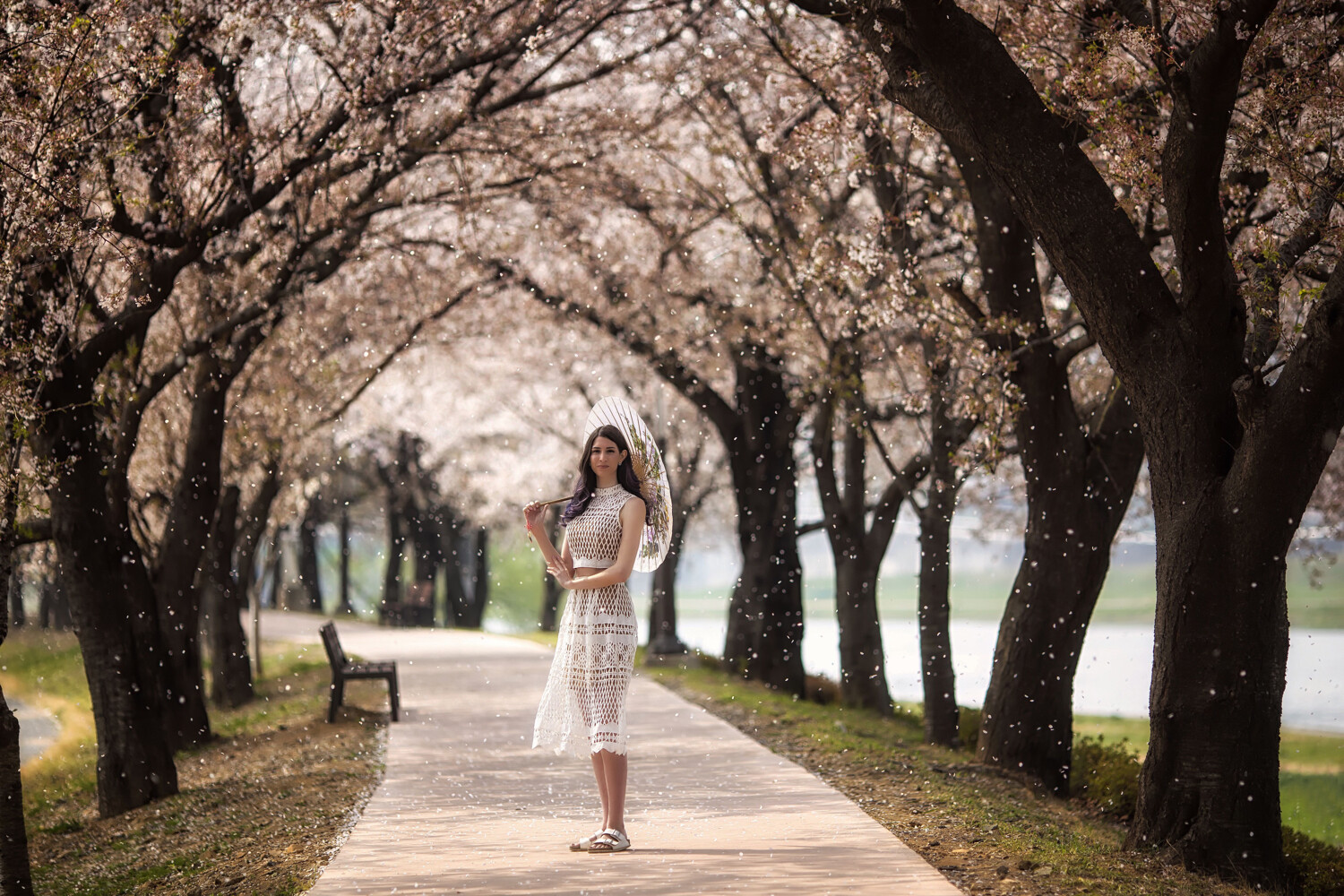
The use of trees as backgrounds for portrait photos is a popular idea. There is a good reason for that; much of which is related to the points made earlier in this article. Tree’s have the potential to form natural frames, especially where branches arch back from the trunk towards the ground. A line of trees forms a leading line, one that can draw the eye towards your model.

In the summer months, you’ll find leaves are amazing for creating a natural bokeh background for your portrait. Your model will be able to interact with the tree, perhaps mimicking the shape of the branches. There are many ways trees can add to your portrait work. So using trees for portrait work is another way to use trees creatively.

In this photo the model stands under cherry blossom trees as the petals fall down.

7. Different perspectives to photograph trees

Another way to photograph trees more creatively is to change the perspective. There are lots of angles you can use, though you’ll need to be close to the tree to utilize some of these. Take a look at the angles you could be using, and see how you can apply them to your work.

  • Low angle – Either from a distance or closer to the tree, photographing from a low angle will give you a different perspective. Foreground elements will show up a lot more in the frame, so you could place flowers in the foreground with the tree in the background.
  • Worm’s eye view – Low to the floor, but now looking up at the sky. This is a great angle when there are several trees together, and you stand in the middle between them.
  • Bird’s eye view – Should you have a way of getting an overhead photo of the tree, or a canopy of trees, this is a great angle.
  • Framing – Look for ways to frame a tree, perhaps use another tree in the foreground to frame a tree in the background.

This photo uses the branch of one tree to frame another tree in the background.

8. Wildlife photography

It goes without saying that a tree is a living ecosystem. Many living things rely on trees for life, including humans. In terms of photography, you could start small by looking for beetles in the soil, or under the bark. Leaves will also be home to a lot of smaller life such as caterpillars. So you’ll be able to get your macro lens out and explore the world of insects.

Of course, larger creatures feed on these insects, and you’ll be able to photograph them as well. You’ll find lots of species of birds, squirrels, and other animals. Photographing these is trickier, and you’ll certainly need a longer focal length. The use of camouflage gear and bird-watching huts also enhance your chance of photographing life within a tree.

In some countries the wildlife in the trees is a little bigger than a squirrel.

Conclusion

A tree is an interesting subject for a photo and has been used by photographers many times to create photography projects. In this article, you’ll have seen several methods you could use to photograph a tree.

Are there any in this list that interest you? What other approaches to tree photography have you used that aren’t discussed here?

At Digital Photography School, we’d love to see examples of your tree photography, together with your thoughts about this article.


The post 8 Creative Ways to Photograph Trees appeared first on Digital Photography School. It was authored by Simon Bond.


Digital Photography School

 
Comments Off on 8 Creative Ways to Photograph Trees

Posted in Photography


How to Photograph a Minimalist Landscape

14 May

The post How to Photograph a Minimalist Landscape appeared first on Digital Photography School. It was authored by Simon Bond.

Creating amazing photos can be much easier than you think. The simplest images can be the most striking. Keeping your image simple means minimalism. In this article, you’ll learn about creating minimalist landscape photos. The creation of these type of images requires the correct use of a lens, and often the correct selection of location. Read on and find out all you need to know to create minimalism in your landscape photos.

In this photo, the main subject is the mountain in the distance. The remainder of the frame is kept simple.

The location for a minimalist landscape

Where you take your photo will determine your success with minimalist landscape photography. You’ll have more success in remote locations, but urban environments can also be used for minimalism as well.

When photographing in a busier environment, you’ll need to use the correct lens and camera angle to maintain minimalism with your photo. More remote locations naturally have a minimalist feel, but the challenge in those locations is locating a strong main subject.

The following are locations you could use for minimalist landscape:

  • Coastal – This is a great location for minimalist photography. The great expanse of the sea invites minimalism. You can further build on this by flattening the sea through long exposure. Interesting rock formations or a lighthouse can make great main subjects.
  • Deserts – Whether you’re photographing on the sand or on the ice, deserts are the land equivalent of the sea when it comes to minimalism. Vast, uniform in their features, and without the clutter of human development.
  • Mountains – Another area that is remote are mountains. These also offer opportunities to create a minimalist landscape. With too many mountains in the one scene they can also be potentially cluttered, so choose compositions with care. A lone hut surround be the green foothills of a mountain range would make for a good subject.

Deserts make excellent locations for minimalist landscapes.

The lens

The lens you choose is equally as important as the location for a minimalist landscape. There is no absolute rule over which lens to use; it depends on the location you find yourself in. If you have chosen a location in the wilderness, the chances are you can use either a wide angle or a long telephoto lens. However, if you’re photographing in the city, the lens becomes important.

  • Wide angle – A lens that works well for minimalism, as you can use that wide angle to create the nice negative space required for a minimalist landscape. Think how you can get down to a low angle for those ripples in the sand on a sand dune. In a more cluttered environment, you need to be careful though, as the wide angle could easily cause unwanted elements to appear in the frame and make it too busy.
  • Long focal length – The longer focal lengths allow you to zoom in on a particular portion of your scene. Here, the challenge is to avoid compressing too many things into the same photo. Choose an area on the horizon that’s interesting but devoid of too many extra elements. This focal length can be a big advantage in an urban setting that’s generally too chaotic for minimalism, yet has portions of the skyline that can be zoomed in on to create a minimal image.

This photo uses a wide-angle lens. This really captures the interest in the foreground from the shapes in the sand.

Adjust your perspective

Photos that are taken at eye level work well for many situations. However, when you’re looking for minimalism, changing to a new angle works wonders.

The following are good choices when it comes to simplifying your image:

  • Bird’s eye – Things looks very different from a high angle looking down. The higher you get, the more dramatic this becomes. One of the reason’s drone photography works so well is its potential for minimalism.
  • Worm’s eye – At the other extreme is the worm’s eye view looking up. You could include a small amount of the horizon line, and make the remainder of the photo about the sky. This will give you a landscape photo with a very minimalist feel.
  • Framing – The use of a frame around the landscape portion of your photo could give you a minimalist photo. The landscape itself need not be minimalist in this case, so long as the surrounding frame provides enough negative space to tick the minimalist box.
  • Lensball – A lensball, in effect, frames a landscape inside a spherical object. That allows you to take a minimalist landscape, and keep the area surrounding the ball simple. This will give your photo a minimalist edge as well.

A lensball can be used to capture a scene that’s not normally minimalist, and capture it in a minimal way.

A good main subject

Every photo type is strengthened by having a main subject. In some cases, the inclusion of that main subject can be more of a challenge. Portrait photos, for instance, always have the main subject – the person you’re photographing. Landscape photos may not always have an obvious focal point – in some cases, it’s not needed – but for most photos, it will give you a stronger image.

In a minimalist landscape, that main subject will leap out of the photo strengthened by the minimalism across the rest of the frame. So what type of object could you use for this main subject?

  • A lone tree – The classic, a lone tree. There’s a good reason for this, of course. It’s a clear focal point in an image, looks beautiful, and works well for a number of composition types. It’s also relatively easy to isolate a lone tree.
  • A single person – A lone person silhouetted against the horizon. Someone riding their bike up the ridge of a hill. Whether you decide to stage this or it was more spontaneous, the photo will have more narrative.
  • A building – A red-walled building against green hills is a good combination for a photo. In a coastal setting, a lighthouse can make for a great subject.

The single yurt acts as the main subject in this photo.

Use other techniques

Minimalist landscapes naturally dovetail with several other well-known photography techniques. You can apply one or more of these to your photo, for a better image. Take a look at some of these techniques, and look at why they’ll improve your photo:

  • Silhouettes – In order to photograph a silhouette, you’ll be photographing towards the light, and quite likely towards a sunset sky. This means landscape features in your photo will likely also be black with a colored sky. This will give you a good chance of creating a minimalist image.
  • Long exposure – Blurred clouds moving across the sky, or flattening the sea are both potential results of long exposure photography. Use a tripod and expose for more than 5 seconds to flatten the sea, and usually longer than 30 seconds to see cloud movement.
  • Refraction – The use of a lensball for refraction photography is a good way of creating minimalism even in a busy setting. Place the more complicated scene within the lensball, and surround the ball with a blurred bokeh background for minimalism.
  • Harmony – This means keeping the same set of colors within the same photo. So try cold colors or warm colors. Even better for minimalism is keeping the same color, but in different shades. There is lots of potential for this in landscape photography, especially when the photo is taken from a bird’s eye point of view.
  • Contrast – One of the reasons black and white photography works so well is its intrinsic minimalism – especially those black and white photos with the highest contrast. Look to experiment with two main colors, and not more when creating a minimalist landscape.

In this photo, there are a number of elements in the frame. The minimalism is provided by the single tone of the image. The main subject is silhouetted against the background.

Conclusion

Landscapes and minimalist photography are two of the most popular photography genres there are, so it makes sense to combine them.

Have you experimented with this type of image? Did you use any of the approaches mentioned in this article? Having read this article, would it make you approach your landscape photography in a slightly different way? What approaches do you use for landscape photography?

As always, we’d love you to share your opinions and photos with the community. Please share in the comments section of this article.


The post How to Photograph a Minimalist Landscape appeared first on Digital Photography School. It was authored by Simon Bond.


Digital Photography School

 
Comments Off on How to Photograph a Minimalist Landscape

Posted in Photography


This is the first ever photograph of a black hole

10 Apr

Credit: Event Horizon Telescope Collaboration

Editor’s note: It appears the National Science Foundation has taken down the link to the full-resolution image, likely due to the ridiculous bandwidth required to load a 183.3MB image. We will leave the original link in its place for the time being until we can find an officially mirrored image to put in its place.


As promised a week ago, the results of the Event Horizon Telescope (EHT) project have been unveiled to the world, showing the first ever photograph of a supermassive black hole.

The picture above, which you can find a full-resolution version of on the National Science Foundation’s (NSF) website (183.3MB TIF), shows a black hole at the center of the galaxy Messier 87 (M87). The black hole, located 55 million light years from Earth, is 6 billion times more massive than our Sun and 1,500 times more massive than Sagittarius A* (Sgr A*), the black hole at the center of our own galaxy, the Milky Way.

The black disk at the center of the image is a shadow of the event horizon. Surrounding it is an orange glow made up of hot gas that’s managed to escape the strong gravitational pull of the black hole. In the words of the NSF, who helped to fund the EHT Project, the image is ‘not simulation or conjecture, but chaotic photons surrounding an unimaginable void.’

The data used to create the image was captured in a week’s time back in April 2017 with the help of eight different radio telescopes across five continents, but it’s taken until now to gather, process and review that data. As noted by The Verge, Davide Castelvecchi of Nature News wrote back in 2017 that ‘A typical night will yield about as much data as a year’s worth of experiments at the Large Hadron Collider outside Geneva, Switzerland.’

Below is a video explainer of the EHT project and its mission.

Once all of the data was captured from the eight telescopes across the globe, the data had to be physically sent to centralized locations where it was parsed through by a supercomputer for months on end to create the image we’ve been shown today.

In addition to processing the data, the final image and accompanying information was stringently peer-reviewed ahead of today’s release, ‘as a part of the standard process of peer-review required for any scientific publication.’


Update (April 10, 2019): This article has been updated to clarify that the black center of the image is not the event horizon itself, but a shadow caused by the activity at the event horizon.

Articles: Digital Photography Review (dpreview.com)

 
Comments Off on This is the first ever photograph of a black hole

Posted in Uncategorized