While wearable, mountable cameras such as the GoPro have been the choice for capturing action-oriented stills and video, some camera phone cases enable users to achieve similar results safely from their smartphone – at a fraction of the cost. With the high-megapixel cameras and HD video recording capabilities of today’s advanced mobile devices, such accessories are becoming very viable options for extreme sports and action mobile photography. We look at three such products today on connect.dpreview.com.
Video uploaded from my hTC mobile phone Video Rating: 5 / 5
Andrea Hass is board certified in opthalmology and an ophthalmic plastic and reconstructive surgeon trained at the prestigious Wills Eye Hospital in Philadelphia, Pennsylvania. Video Rating: 0 / 5
Slide projectors are great but outdated. And digital projectors cost a bundle. What’s a photographer to do when they’re looking for a bigger picture?
We’ll show you how to turn your phone into a photo projector for just $ 1.
Yep, for a buck you can have Instagram on overdrive and Flickr living large.
The project is so easy, you might even have time to sneak in a cat video or two.
Make a DIY Projector for $ 1
Why it’s Cool:
A phone based projector is a great way to show off your mobile photos and your phone hack savvy.
Just picture laying in bed browsing your feed or watching a movie on a ginormous screen.
A projector provides a new way of looking at your shots, and for $ 1, who can afford not to try this project?
The Ingredients:
Shoebox
Paperclip
Smartphone
Magnifying glass (get it for $ 1 at Dollar Tree), or a large aperture lens
X-acto knife or similar
Electrical or black duct tape
Optional:
Matte black spray paint or black paper
Step 1: Trace a Hole on the Box
A shoebox or similar will work great for your new projector.
If the inside walls of your box are a bright color, you may want to spray paint them black or tape up some black paper for best image quality.
Once your box is ready, trace the outer edge of your lens or magnifying glass onto one of the short sides of the box.
Step 2: Cut a Hole in That Box
Cut out the inside of the circle you just traced.
You don’t want light leaking around your lens so try not to cut too much.
At the back of your box, cut a small hole for your phone’s power cord.
Step 3: Attach Your Lens
Now you’ve got a porthole cut in your shoebox its time to stick on that lens.
If your magnifying glass has a handle, you may want to remove it first.
Line up your lens with the hole and apply tape around the entire edge of your lens.
Make sure your lens is held securely and there are no holes between the tape for light to escape.
Step 4: Take a Stand
We used this very helpful tutorial to make a stand for our phone out of a paper clip.
Other stand ideas include this ultra-portable Tiltpod, this hand dandy Gorillapod, or this super creative lego stand from this cool tutorial.
Step 5: Flip Your Screen
When light passes though a lens (including the lenses in your eyes), it gets flipped, which means the picture from your projector will come out upsidown.
No fear though, we have a fix!
For the iPhone go to Settings > General > Accessibility and turn on AssistiveTouch.
Once activated, a little white orb will pop that you can drag around the screen.
Click on the orb and go to Device > Rotate Screen.
This will allow you to flip applications like the Photos app which would normally rotate itself right side up.
Andriod users can download the app Ultimate Rotation Control.
Or if all else fails you can just stand on your head.
Step 6: Finding Focus
If your walls are plastered with pics you will need to clear out a little space for your projection.
For a screen you could use a white bed sheet, turn a poster around, project onto a shower or window curtain, or just use the bare wall.
Without a focus ring on your magnifying glass you’re going to have to foot focus.
Position your phone in its stand near the back of the box and walk forwards or backwards until your image starts to come into focus.
Once you’ve found a good range you can fine tune focus by moving your phone forwards or backwards in the box.
If you used a camera lens for your projector, you get the bonus of a focus ring that gives you some extra flexibility in terms of screen size and focus distance.
Step 7: Don’t Fight the Light
It’s not the power of your projector. It’s how you use it!
For best viewing, turn the screen brightness of your phone all the way up and turn the room lights down.
Set your phone’s photo app to slide show mode for a hands free experience.
Your power cord can go through the hole you cut in the back of the box and a little tape will seal the deal.
Taking it Further
Use your magnifying glass to get an up-close perspective on your phones pixels.
Try using your computer screen instead of your phone as the display in a new projector project.
Check out this crazy sophisticated DIY digital projector that can create a 120″ HD screen!
This mini film projector fits in the palm of your hand and was made from an Altoids tin!
Leave it to the Japanese to do something this awesome with a projector. Hint: Samurai swords, shadow battles.
Related posts:
DIY: Turn Phone Photos into Mural-Sized Prints! Extra photos for bloggers: 1, 2, 3 What’s on every…
How To Make Your Cell Phone Look Like Your Favorite Camera! Extra photos for bloggers: 1, 2, 3 Photographers. We’re a…
The Polaroid iPhone Decal: Turn Your Phone into a OneStep! Your iPhone4 is the Swiss army knife of the mobile…
[ By WebUrbanist in Technology & Vintage & Retro. ]
As you may recall (and please, forgive the pun), pay phones used to be ubiquitous – in many places they remain a physical presence, but without a use. As Banksy‘s work (above) points out, their primary purpose is arguably quite dead – but, on the upside, that leaves room for all kinds of radical rebirths.
Around the world, old phone booths are also becoming high-tech data hubs. Consider New York City, which has just unrolled a pilot program to turn 250 old phone booths into information centers, providing basic maps, directions and directories to tourists, but also up-to-the-minute emergency information and safety alerts in case of serious storms or other natural disasters.
Local architect John Locke has come up with another, lower-tech, even-easier reuse project for some of the 10,000+ remaining unused public phones on the streets of Manhattan – easily-fabricated micro-libraries that can be slotted into existing boxes, taking advantage of their robust framework and shelter. No fasteners needed for this efficient and inexepensive flat-pack solution.
Across the pond, iconic red-box phone booths of England may be even more well-suited to this particular kind of conversion, being closeable and thus, while not 100% weatherproof, still more completely sealed from the elements. The result is one of “the country’s smallest lending libraries – stocking 100 books. Villagers from Westbury-sub-Mendip in Somerset can use the library around the clock, selecting books, DVDs and CDs. Users simply stock it with a book they have read, swapping it for one they have not.”
Turning back toward the high-tech, Telekom Austria is tackling over ten thousand disused phone booths, turning them into recharging stations for the nation’s estimated growth toward over a half-million electric vehicles in the next decade. But enough about functional conversions – what about the artistic side? See below for homeless shelters, aquariums, even outhouses made of old phone booths.
Next Page: Retro Redial 8 Creative Phone Booth Conversion Projects
Want More? Click for Great Related Content on WebUrbanist:
7 Brilliant Building Conversion Projects: Superb Examples of Architectural Adaptive Reuse
Know of other recycled design or amazing architecture projects? Be sure to list them in the comments below!
Click Here to Read More »»
Walky Talky: 12 Concept Mobile Phone Telephone Booths
These 12 concept mobile phone telephone booths recapture the isolation old public phones provided while enhancing the experience of conversing in the city.
Click Here to Read More »»
[ By WebUrbanist in Technology & Vintage & Retro. ]
Back when Zeppelins were zipping around and petticoats were all the rage, the zoetrope was the closest you could get to catching a movie.
If you suppose this little gizmo went out with the steam engine, think again.
Our DIY tutorial gives the zoetrope a 21st century makeover by using the panorama function of a phone.
Yes, with just a few shutter clicks and scissor snips you can create your very own stop motion movie machine.
Sound fun? Well full speed ahead on the zoetrope express!
Make a Zoetrope with Your Phone!
Why it’s Cool:
The zoetrope has the distinction of being the world’s first device to create motion pictures.
It was invented by the Chinese in 180 AD, making it the great great grandfather of the GIF.
Combining this millennia old device with a touch of cutting edge technology just gives us a smile that won’t quit.
Also, the zoetrope is a great way to show off your panorama skills and makes for a fun little coffee table accessory or Christmas tree ornament.
Check out the zoetrope we made on our phone in action!
Zoetrope in Action from Photojojo loves you on Vimeo.
Ingredients:
Smartphone with panorama function
Cylindrical cardboard canister. A Quaker Oats container will do the trick.
Matte black spray paint
Scissors or an X-acto knife
Pencil
String
Ruler
A friend to pose for you
Step 1: Do the Panorama Dance
We made our image strip with an iPhone and an app called Panorama which has more manual control than the built in app. Photaf is a good app for Android users.
Panorama works differently than the built in iPhone app. To use it snap your first shot and then sweep the camera to your right.
A ghostly overlay of your last pic will show up on the left of your screen. Line up this overlayed image with the edge of your next shot, and then hit the shutter.
By standing your subject smack dab in the middle of each frame and changing their movement slightly in each section of your panorama, you can create a stop motion effect when the images are viewed in your zoetrope.
For best results, try to keep lighting consistent, movements small, and a good amount of contrast between your subject and the background.
Step 2: Transfer your Treasure
Now that you’ve done the dance, it’s time to take your panorama across the great phone/computer divide.
No sweat though, just send your full sized panorama to your computer via email, or sync it with your computer’s photo manager.
Step 3: Size and Print
My what lovely wallpaper your zoetrope has.
Open up your panorama in Photoshop or a similar editing program to resize it.
To find your zoetrope’s inside circumference, coil a piece of string around the inner wall of your cardboard cylinder and measure it with a ruler.
In Photoshop, go to Image > Image Size and under Document Size put the measurement you just took as the Width. Also, change the Resolution to 300 for printing.
You will need to cut your panorama in half to print it on an 8.5 x 11 sheet of paper.
Create a new document in photoshop with 8.5 x 11 dimensions and a resolution of 300. Paste in your panorama, select half of it, then press ctrl-x and ctrl-v. Now drag one half under the other.
Print your image strip and congratulations, you just got a yellow belt in Photoshop.
Step 4: Deep Cuts
Alright Edward Scissorhands, let’s get choppin’.
This helpful article explains the zoetrope making process in great detail and provides some handy cutting guides.
Start by printing up the template, cutting it out, and taping it to your cardboard cylinder.
Cut off the top part of your cardboard container, making sure to leave enough room for your image strip and viewing slits.
Use your scissors or an X-acto knife to cut out the vertical slits on top for viewing holes.
When you’re done, your container should look like a little castle turret.
Step 5: All Together Now
Alright, let’s put those images in motion!
Bust out your black spray paint and give the outside walls of your zoetrope a quick coat. This will make your animation much easier to see.
Once the paint is dry, cut out your image strip, tape the two pieces together and place the long strip against the lower inside wall of you zoetrope.
Gently poke a pencil through the bottom of the zoetrope and twirl like mad! You can also place your zoetrope on a turntable, or whirl it on a CD spindle or lazy susan.
Watch the action through the spinning teeth and discover why the Chinese called the zoetrope “the pipe which makes fantasies appear.”
Take it Further
Start stripping: Create a collection of photo strips to go along with your new zoetrope.
Get inspired by Peter Hudson’s 3D pedal powered zoetrope.
Keep an eye out for zoetropes in a subway near you.
Related posts:
How To Make Your Cell Phone Look Like Your Favorite Camera! Extra photos for bloggers: 1, 2, 3 Photographers. We’re a…
10 Tips to Make Your Phone Photos Amazing; Plus, Our New Phoneography Blog! Phoneography is the best. No matter where you go, you’ve…
Make Your Own Photo Pencils Extra photos for bloggers: 1, 2 This Photojojo made possible…
Smartphone photography is taking increasingly seriously as a medium, but this isn’t because the devices have reached a certain standard. In an interview from 2009, actor and photography Joel Grey discusses the work he’s done using a 1.3MP phone camera. He discusses the snobbery surrounding cameraphones (including his own), and points our that ‘pictures are pictures…the subject, light and framing is everything.’
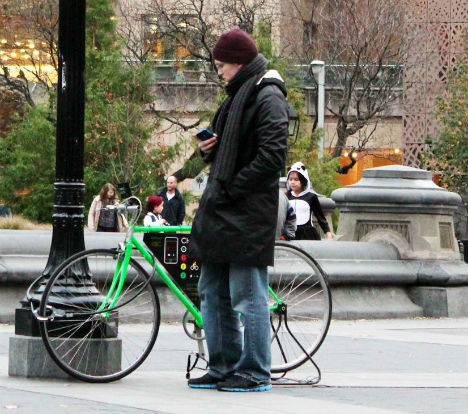
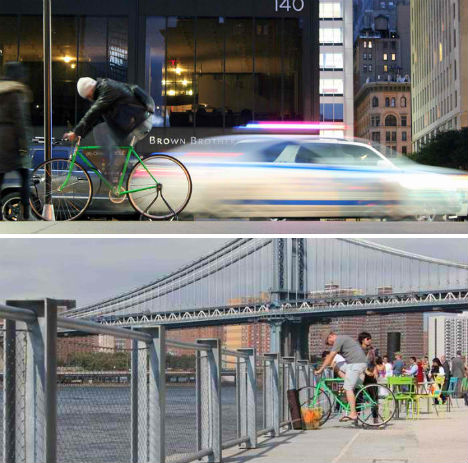
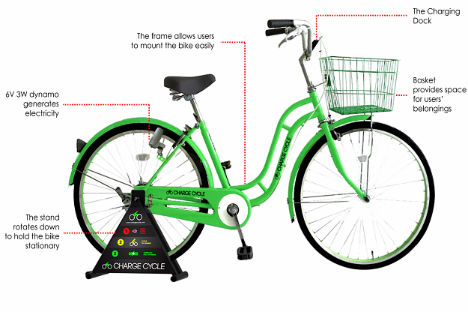
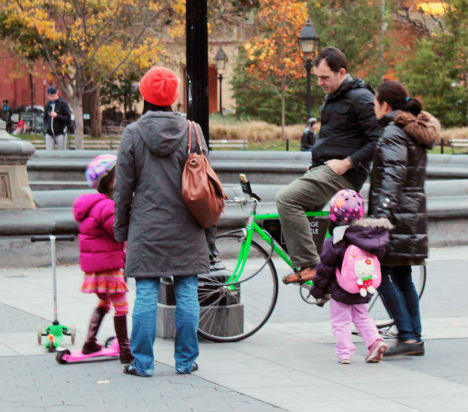
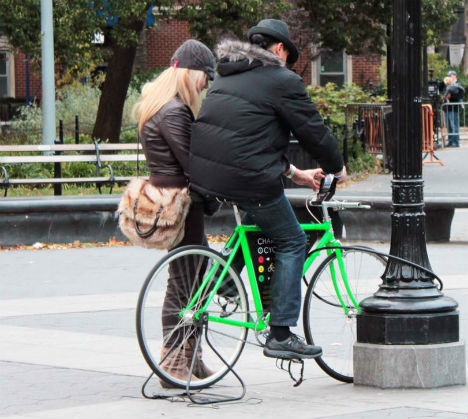
Soon, you’ll be able to charge your iPhone at strategic locations around New York City – but you’ll have to put in a little leg work. The Charge Cycle is a stationary bike equipped with an iPhone dock, so users can charge their phones with the power of their own muscles, without plugging into the grid.
The Kickstarter-based project by David Krawczyk and Navjot Kaur aims to get at least 30 of these bikes out into the city where anyone can use them by early May 2013. Prototypes have already been placed around New York in locations like Washington Square Park, Zuccotti Park and Brooklyn Bridge Park.
The bike is equipped with micro-USB, 30-pin and 8-pin adapters, so virtually anyone can charge their phones. It takes about the same amount of time cycling as it does plugging into a wall charger to charge up a phone, since most phones have built-in charge limiting functions to prevent overheating. The Charge Cycle will be free for public use.
To use it, you attach your phone to an adapter ad secure it to the bike with a silicone band. A 10-segment LED display bar tells you how much charge you’ve accumulated as you pedal. The basket in the front holds your belongings as you ‘ride’. Watch the video above to see it in action.
Want to support this project? Check out the Charge Cycle Kickstarter page.
Want More? Click for Great Related Content on WebUrbanist:
Dial4Light: Turning Street Lights On Via Mobile Phone
A groundbreaking cost-cutting, energy-saving program in Germany called Dial4Light requires pedestrians to activate street lights using their cell phones.
5 Comments – Click Here to Read More »»
Bike Campers: 12 Mini Mobile Homes for Nomadic Cyclists
Who says you can’t camp in luxury when taking a bicycle tour? These 12 bike trailers
5 Comments – Click Here to Read More »»
The Big Day. You’re outfitted, rehearsed and have a belly full of butterflies.
This isn’t your wedding day. It’s the day you’re shooting one with your phone!
So what apps are you going to use and what lenses will help you along the way? And OMG whataboutbatterylife.
Photojojo’s very own *pro* photographer Kim Thomas will tell you just what you need to shoot a wedding with your phone!
She recently shot one here in San Francisco for the lovely couple pictured, Jonathan & Brandi.
It’s a big day. Not just for them, but for you and your phoneography chops, too.
Kim’s Wedding Phoneography Guide
p.s. Way cool opportunity here! Kenneth Cole is featuring Instagrammers on its Collection Site. Enter your photos for a shot with this week’s theme “iconic”.
Why it’s cool:
There are all kinds of reasons you might want to shoot a wedding with your phone!
Maybe it’s the challenge you’ve been missing or maybe it’s just that your DSLR’s in the shop.
Maybe you just want to see if it can be done! Will your photos look much different through your phone’s lens as opposed to your DSLR’s? Will your friends be able to tell?
It’s exciting, and you’re dying to see what will happen. So try it! Kim did. Here’s her guide on how to best prep yourself for the big day.
Ingredients:
A camera bag (Kim used the Any Bag Insert)
Your camera phone
Another camera phone, as a backup (an older model or a friend’s works)
A charger
A portable backup charger (Kim used the Mophie)
Cell lenses, such as our Phone Lens Series or the Olloclip
Optional: the iPhone SLR Mount
Glif Plus tripod mount (for the iPhone) & a tripod
NOTE: This will vary from photographer to photographer, but the above is to give an idea of the kinds of tools that will help you get awesome results like Kim’s!
Lighting
If the wedding is outdoors, you’re all set with natural lighting.
Either using an outside camera app or your phone’s built-in shooting app, you can choose your exposure by touching the part of the photo or using an exposure adjustment tool to get your exposure just how you want it.
HDR mode (either built-in or via an app, like HDR Pro) will help capture a balanced exposure when you have bright skies and a shadowy subjects.
If your wedding is indoors, place the couple next to windows where you can find natural light.
If you don’t have any windows to work with, this is where the Glif Plus and your tripod will come in handy. That’s because you’ll want to stabilize your phone as much as you can when you’re shooting indoors.
You won’t be able to eliminate all noise, but it will help, and some grain is a-okay in my books. A little bit of grain and even some motion blur gives photos that old film look.
EXTRA TIDBIT: You might consider combining the powers of a tripod, an app that lets you control shutter speed (like Slow Shutter Cam for iPhone or Light Painting Camera for Android), and an external flash. With these, you can set a long exposure and pop off a flash to light your couple.
Apps & Tools
I edited all the photos with Instagram after the wedding. I also used an app called PhotoForge2 to help straighten some of the photos. PhotoForge2 also gives you control of curves and levels in your photos.
For Androiders, PicSay and Camera360 are both excellents app for making small exposure adjustments, straightening, and cropping.
When it comes to outside accessories, cell lenses are really helpful in getting a closer view when you can’t get close enough or giving you a wider angle when you need to pack more into your image than space allows you.
And if you want to get advanced, you can try something like the iPhone SLR Mount which lets you shoot photos on your iPhone with a Canon or Nikon SLR lens!
Shooting Portraits
I start photographing people from farther away so they can get used to the presence of the camera, er, phone, being there.
People like direction and trust you to make them look good, so tell them what to do and how to stand. For example, it’s as simple as telling them to “stand facing one another and hold hands.”
When posing the couple, you can still capture candid moments by telling them to have a conversation with one another. They’ll start talking and laughing, and then you can snap your photo.
Having your subjects change up their line of view can help change the mood in the photo. A photo of a couple standing there looking at the camera will look a lot different from a photo of the couple standing there looking off into the distance. It adds a little wonder to your photo.
Lastly, remember that the environment is that additional subject in your frame. Pose your couple based on what’s around you. They could be leaning against a tree, looking over a balcony or sitting on some steps.
Shooting Candids
Candids can be tricky because your iPhone doesn’t work as quickly as your DSLR will.
Since that’s the case, don’t be afraid of motion blur. You can still capture the mood, and the blur may make your photos look more like film, which is always cool.
Battery Life
If possible, have a backup phone. You might use an older model that you no longer use as a phone or borrow one from a friend.
If you are at an indoor location, I recommend leaving one of your phones plugged in a safe place, and then you can swap phones once your current one is almost out of battery.
If you don’t have an extra phone on you, keep a portable backup charger (I used the Mophie) with you for when you need to recharge your phone. Remember to start charging your phone before it’s too late as it will take a bit of time to charge back up.
If you have any downtime during the wedding (say the couple is going to freshen up and grab some drinks), use that time to charge up.
Even More Tips & Inspiration
Flip your phone to airplane mode to stave off interruptions.
Check out this team of photographers who used our iPhone SLR Mount to shoot Australia’s first iPhone wedding!
Catch our guides to the best iPhone and Android camera apps
Find even more *excellent* app recommendations at We Love Phoneography
Related posts:
Wedding Photos You’ll Love (Even if You Hate Wedding Photos) ~Have a cool photo product or site? Reach 270,000 photo…
10 Tips to Make Your Phone Photos Amazing; Plus, Our New Phoneography Blog! Phoneography is the best. No matter where you go, you’ve…
Attachable Lenses for Your Camera-Phone, Fisheye & Macro/Wide Angle Phone Lenses Extra photos for bloggers: 1, 2, 3 Camera-phones. They’re a…
A list of services you can use to attempt to reverse lookup a business or person by their phone number.
Did you write down a phone number and forget for whom it was for? Receive a phone call and don’t recognize the number on Caller ID? While typing a phone number into Google sometimes results in useful web results, the ability to directly query white and yellow page results just by typing in a phone number has been removed.
However, various Internet services still offer reverse number lookup, each with varying results. While these may work for persons and businesses that can be found in the phone book, you may not have much luck finding telemarketers. Nevertheless, a list of a few services is below:…


 A phone based projector is a great way to show off your mobile photos and your phone hack savvy.
 A shoebox or similar will work great for your new projector.
 Cut out the inside of the circle you just traced.
 Now you’ve got a porthole cut in your shoebox its time to stick on that lens.
 We used this very helpful tutorial to make a stand for our phone out of a paper clip.
 When light passes though a lens (including the lenses in your eyes), it gets flipped, which means the picture from your projector will come out upsidown.
 If your walls are plastered with pics you will need to clear out a little space for your projection.
 It’s not the power of your projector. It’s how you use it!






 The zoetrope has the distinction of being the world’s first device to create motion pictures.
 We made our image strip with an iPhone and an app called Panorama which has more manual control than the built in app. Photaf is a good app for Android users.
 Now that you’ve done the dance, it’s time to take your panorama across the great phone/computer divide.
 My what lovely wallpaper your zoetrope has.
 Alright Edward Scissorhands, let’s get choppin’.
 Alright, let’s put those images in motion!




 There are all kinds of reasons you might want to shoot a wedding with your phone!
 If the wedding is outdoors, you’re all set with natural lighting.
 I edited all the photos with Instagram after the wedding. I also used an app called PhotoForge2 to help straighten some of the photos. PhotoForge2 also gives you control of curves and levels in your photos.
 I start photographing people from farther away so they can get used to the presence of the camera, er, phone, being there.
 Candids can be tricky because your iPhone doesn’t work as quickly as your DSLR will.
 If possible, have a backup phone. You might use an older model that you no longer use as a phone or borrow one from a friend.