On-Location Product Reviews – The Cotton Carrier Camera System Vest Unit and removable Side Holster.
Video Rating: 5 / 5
On-Location Product Reviews – The Cotton Carrier Camera System Vest Unit and removable Side Holster.
Video Rating: 5 / 5
This weeks session the squad trying something new to dubstep music. United Krump Fam Krump Ireland
Video Rating: 4 / 5
blog.jaredpolin.com Here in part 2 I go into detail on using Shutter Priority for shooting sports outdoors. What is it, what are the benefits of using it and how it works. Make sure you watch the very end for a sneak peek of shooting better hockey pictures. Shot with the NIKON D3S
Music: — To Aru Kagaku no Railgun – battle area To Aru Majutsu no Index – Breakthrough (Original upload date: June 11, 2010) Third video of four featuring the TzTok-Jad before the TzHaar City update. In this video, I choose to use magic against him and it is fun back then. RuneScape is a trademark to Jagex Ltd. I do not own any of the contents used for this video, but used for the sole purpose of entertainment without profit. All music used in this video is copyrighted to the respective owners.
Video Rating: 5 / 5

An understandable description of how to use the manual mode on your DSLR or advanced point and shoot camera. This is the second of three videos in the basic manual photography series.
Video Rating: 0 / 5
In a recent post on the topic of Amateur or Professional Photography I asked an open ended question that would solicit responses. While I was not surprised by the polarization, I was disappointed by how personal the comments became.
I will state categorically that any professional who is not willing to share information must be quite insecure in their own abilities. Like any business certain facets have to remain confidential in order to remain competitive in a free market enterprise. Beyond that, I believe we do owe it to our industry to be honest with each other – no one, regardless of standing, is bigger than the industry itself – and that includes amateurs being honest with professionals.

Are you ready to open shop?
Many readers missed my point entirely in the opening post, that being if you are going to delve into the medium as a means of income then one should play by the rules. The one rule that professional photographers cannot compete against is the various taxes that they must pay as a result of their vocation and business. Each country and city has their own tax laws, and in Canada essentially all income has to be declared as taxable income. Should the professional photographer’s neighbour who photographs weddings on Saturday’s only for $ 300, not declare their income several things happen by default: 1. They are automatically at a 30% (the average income tax in Canada) price advantage due to tax evasion, 2. They have potentially broken tax statutes and that affects the economy of the community; and 3. They have devalued the industry as a whole. These are examples of ethics to which I was referring in the original post.
Believe me, your time, your equipment and your experience has value and as each increases so too should the value of your service. That is a basic business premise and has nothing to do with photographers feeling threatened. Should you really be interested in learning the profession, and haven’t had the opportunity to attend school, source a local photographer whose work you respect and ask if you can assist or apprentice with them for free for six months (I don’t agree with this approach personally, but if you are going to shoot jobs for free you would be doing the industry and your eventual clients a far greater service by learning from a well respected and established business person).
Beyond that, it is very much a wild west as far as photography as an industry is concerned. There are no trade union protections to benefit the photographer, and likewise there are no minimum standards of delivery to protect the client. Whether there should be is a whole other debate and one best not discussed on the DPS forum. It is very much a climate of client and providers beware.
Moving forward, let’s take the wedding photographer completely out of the picture and think in the bigger realm.
Let’s also set the record straight: NO, it is not necessary to go to university or college to become a photographer. NO, it is not necessary to apprentice with an established firm to become a photographer. NO, it is not necessary to become a student of business administration to become a photographer. However, should you be fortunate enough to have been able to pursue photography as a profession by travelling these paths you will inherently have a huge advantage over the amateur who aspires to turn a love of craft into a successful business venture.
In short, you can be the best photographer in the world but if you do not know how to manage and market your business the chances of success are greatly diminished. The aspiring pro should have no illusions – photography is a tough business and the more you can learn about the industry and appropriate business practises, the better the opportunity of success. The client will decide whether your skill with a camera is commensurate with your fee structure.
Regardless of how you have entered the profession it is possible to earn a successful living with a camera while satisfying an internal desire to be a photographer by following a few well laid out principles. The first golden rule that must be cemented in your business plan is to, well, have a business plan. The second golden rule is to learn to pay yourself first; you are, after all, starting a business to earn an income.
If you can’t accept the fact that you need a business plan, you will unquestionably be wandering around aimlessly and without direction. The business plan today must reflect the current market, and, as we all know the photo industry is rapidly adjusting itself without checks and balances. Therefore your business plan will have to be fluid; no longer can we work on a five year plan. Some would suggest a three year plan is risky and the proprietor should be giving serious consideration to a two year plan.
You are entering a service based industry and for the most part your skill level, locale and client base will dictate what you can charge as a fee. There are several web-based outlets that offer great advice, and are well worth reviewing. As a poster earlier shared, Mark Wallace (Adorama TV) has a great video on You Tube:
In this video Mark offer a huge bucket full of sage advice; however I would caution that you not plug his “days of work” numbers in your daily costs calculations as it is quite unlikely you will work 250 days on start up. To clarify, you will probably work more than 250 days, but what are your billable days? Another resource that makes life easier for calculating the daily cost of business is a calculator from NPPA found here: https://www.nppa.org/calculator .
From both of these resources there were several topics not itemized in the calculations. You may decide to work from your home, and there may be tax advantages to doing that. However, there are also going to be increased costs on the home budget that require consideration. Are you even legally permitted to operate a home-based business in your community? The calculators and Mark’s video –I could stand to be corrected—have not identified capital reserve requirements. You have expensive equipment that will most likely have to be replaced every three years due to technology advances. Should you be channeling funds into a capital reserve to lessen the blow when that day arrives? Are there tax advantages to renting your equipment?

Navigating the labyrinth of roads involved in any business will be a nightmare when starting out. You will be well served by educating yourself on solid business practices.
Spend some money on a lawyer and accountant. Regardless if you are working as a professional or semi-professional, or even an amateur, you will be exposing yourself and equipment to liability risks that probably will not be covered by any type of home insurance policy you currently have. Your lawyer will also advise whether you are best served by incorporating or working as a sole proprietor. Don’t forget about learning Intellectual Property laws, and learn who owns the results of your toil and under what circumstances. It is imperative you have iron-clad contracts so both you and your client completely understands the others position before you even accept the commission.
Good accountants are worth their weight in gold; the better ones will give you sage advice and don’t particularly care about hurting your feelings. If you really want a good gauge on how good your business plan has been prepared, go visit a local bank and ask for a business start-up loan. These folks will not lend money if they see any risk in your plan and their judgement should, and can, speak volumes.
If you want to turn that avocation to a vocation, start working on a business plan first. Make no mistake, it will be tough to succeed with long hard hours of non-paying administrative and business training that will siphon your cash flow quicker than a drop of water evaporating on hot asphalt in the desert sun.
If you are skilled and savvy enough there is always room for good photographers, and there probably always will be. At least I hope so – we all deserve to pursue our dreams providing we respect our neighbours in an honest and ethical way.
Postscript: By now I hope the readers following my posts will have recognized I am targeting two audiences. The first being the amateur who is just starting their journey, and the second being the advanced amateur who believes they are ready to advance into the profession. I would ask that you fire your criticisms toward me and not each other. Thank you in advance for following the posts. –Dale Wilson
Post originally from: Digital Photography Tips.
Check out our more Photography Tips at Photography Tips for Beginners, Portrait Photography Tips and Wedding Photography Tips.
Amateur or Professional, Part II
www.imageguy.com The second part of my Nikon CLS video series. In this video we shoot a toy car and make lighting adjustments using Nikon’s CLS to control the output of the flash.
Video Rating: 3 / 5
Part 2- Here: www.youtube.com Hello, Today I am going to be reviewing the Bower 650-1300mm f/8-16 Super-Telephoto Lens with a Nikon T-Mount Adapter on it. The Bower is a great lens for the price. I wouldn’t suggest this lens for your main Super-Telephoto Shooting Lens. If you want A LOT of zoom for under 0 dollars then this is that lens. The Bower 650-1300mm f/8-16 has OK quality when focused correctly and given a lot of light! The Bower is a heavy lens and I suggest either a Tripod or Monopod if you’re going to be shooting for over an-hour-and-a-half. Link to B&H Photo Video: www.bhphotovideo.com Music: Used in Part 1. and 2. Deadmau5- Alone With You; itunes.apple.com Deadmau5- Strobe; itunes.apple.com Thanks for watching, Chargerfun34
Video Rating: 3 / 5
Spread The Word on Twitter,Cheers : clicktotweet.com This is my Unboxing of the new Panasonic Camcorder th at took over the SD10’s place. After finding that i did not like the design of the SD10,I opted to take that camera back and get the SD60 instead,Which is much better. So here’s the new updated version,Of what is the best camcorder i have ahd the pleasure of useing to date. Panasonic UK : www.panasonic.co.uk Thank’s forbeing interested in my content,Enjoy the video,Thank’s for watching,Cheer’s 🙂 Follow me on Twitter : twitter.com Subscribe to my Channel : www.youtube.com Email Me @ : pimpyouriphone3g@gmail.com If you have any question’s ?, Then please don’t hesitate to get in touch,I will do my best to answer and help in what ever way i can,Cheer’s.
Video Rating: 4 / 5
So you want to be a professional photographer. Here’s my choices for lenses, cameras and gear based on APS-C choices from Pentax, Nikon and Canon. There are many possibilities, but I’d feel pretty comfortable at any paying gig with any of these systems in my bag! (Music by www.danosongs.com and all photography by Edward Thomas. Thanks!)
Video Rating: 4 / 5
It is often said that photography is a visual language. Through our photographs we tell stories, share experiences, and communicate emotions. Aside from journalism, where faithful captures are important for ethics reasons, photography is often about creatively interpreting a scene, rather than simply recording what is in front of the lens.

Tokyo street scene with creative color

Tokyo street scene with ‘normal’ color
Creative use of color can be a powerful tool for controlling the mood in your photographs. In a series of three posts I will discuss three Lightroom controls that can be used to control color and mood in your photos:
1. White Balance
2. Split Toning
3. Tone Curve
In this first article in the series I will discuss white balance, the simplest of the three tools.
Note: I shoot Raw and import my photos into Lightroom, converting to DNG on the way into Lr. Shooting Raw gives me much more flexibility to make creative color decisions in post processing. The screenshots from are from Lightroom 4, but with the exception of the Tone Curve technique that I will cover in Part 3 of the series, these techniques can be used in previous versions of Lightroom.
White balance allows you to control the overall color temperature of your image, and adjust for different light sources like tungsten, daylight, flash, etc. If you’ve never heard of white balance take a look at this post.
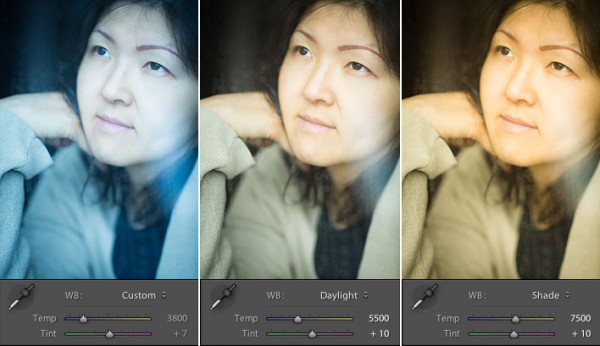
Example of different white balance settings
Most of the time you’ll read that white balance is there to help you get accurate color in your photos. This article is not about accurate color. For the next few minutes, forget about accurate color and let’s just look at how white balance can be used to change the mood in a photo. I like to think of white balance as just another tool for controlling color image my images. Thinking of white balance this way is liberating and encourages experimentation.
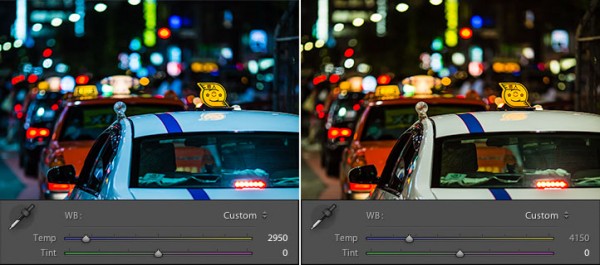
Tokyo Taxi White Balance Example
Notice how a cool white white balance creates a totally different mood than a warm white balance for the same scene? Which of the above images do you prefer? When you feel like getting creative with your images, try shifting the white balance either cooler or warmer for creative effect.
I hope this article has encouraged you to think creatively about white balance, and to experiment with shifting white balance for creative effect. I love hearing your feedback, please comment below or feel free to connect with me through Facebook or Google+.
In Part 2 of the Creative Color series I will discuss Spit Toning, and demonstrate how white balance and split toning used together for even more creative control over color.
Post originally from: Digital Photography Tips.
Check out our more Photography Tips at Photography Tips for Beginners, Portrait Photography Tips and Wedding Photography Tips.
Creative Color Processing (Part 1/3 – White Balance)
Demonstration of using the D300 built-in flash to control one off camera SB800 flash, wirelessly.
Video Rating: 4 / 5
City Photographed: Prague, Czech Republic. www.libanyusuf.com Buy photo prints! http Music: Kevin Macleod, www.incompetech.com (Royalty Free Music) Equipment: Nikon D300, Photoshop & Final Cut Pro. Thanks for watching, please rate, fav and subscribe! Liban
Video Rating: 5 / 5