RSS
 

Posts Tagged ‘Park’

Canadian Travelogue: Nova Scotia – Cape Breton Highlands National Park

21 Jul

The autumn foliage of Cape Breton Highlands National Park offers a more exciting colour palette than anywhere else in Canada, and quite possibly in North America.

The best time to visit is immediately after Thanksgiving weekend in October. The holiday weekend itself can be nightmarish, with hordes of people and endless lines of tour buses. Restaurants are filled to capacity and accommodations are hard to find unless you have made reservations well in advance. On the Monday immediately following the holiday weekend, you will pretty much have the entire Highlands region and the National Park to yourself.
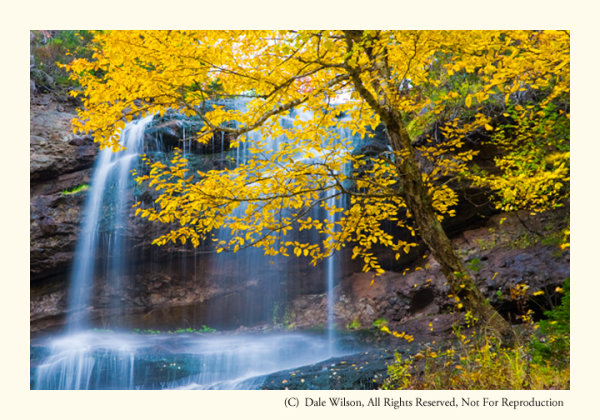
Beulach Ban Falls in the 2nd week of October.

Beulach Ban Falls in the 2nd week of October.

The park is enclosed by the northern section of the famed 300Km long Cabot Trail, a loop of highway that starts and ends at Baddeck. I prefer to enter the Park at the western terminus, near the Acadian village of Cheticamp, and tour the park in a by driving in a clockwise direction along the Cabot Trail.

For those who enjoy American history, the original residents of Cheticamp are repatriated families who had previously been extradited to the United States during the Great Expulsion (Le Grand Dérangement) of 1755.  The word Cajun, which is a common term used to identify the French residents of Louisiana, for example, is actually an anglicized mispronunciation of the French word Acadien. This is a topic for another day, but Cheticamp is a fabulous place to base a few days and listen to the residents speak a very unique and distinct dialect of French and English languages.

One cannot leave the Cape Breton without the classic Cabot Trail photo, and the opportunity comes early in the trip. Park your car at the Cap Rouge pull-off and look southwest back toward the village of Cheticamp – you will instantly recognize the view and potential for a great post card picture. This is an afternoon shot, unless you are looking for a photographic challenge. A sunset photo from this location can be breathtaking, but it can also be difficult to pull-off. The sun will be slight to the right-centre of the frame so you will most likely have to contend with lens flare, and make your images thinking of a final HDR treatment.

Two particular locations in the park that call me back each year are Mary Ann Falls and Beulach Ban Falls. Beulach Ban Falls is at the eastern base of North Mountain, near the most northerly point on the Cabot Trail. It is reached by way of a gravel laneway that passes a warden’s cabin, on the opposite side of the road from the Big Intervale Campground. About 2 kilometres on this gravel laneway will get you to a small picnic park, and to the base of the falls. You should hear the falls from the parking lot. As with any waterfall, the option to include the entire waterfall, or selective portions, is an entirely personal choice – let the muses direct your creativity.
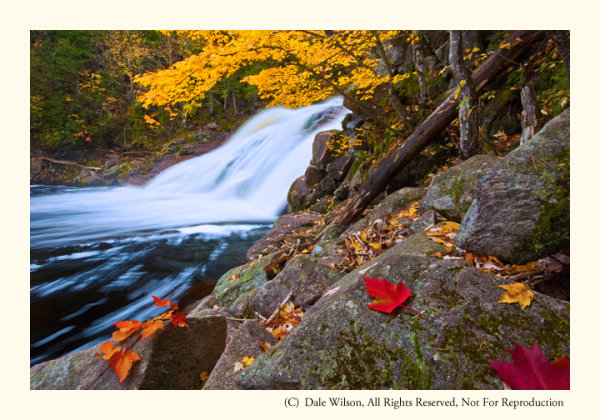
Mary Ann Falls in 2nd week of October. Yes, I placed the leaves; however, I later heard a photographer swear up and down that those leaves in his picture were exactly as he found them!

Mary Ann Falls in 2nd week of October. Yes, I placed the leaves; however, I later heard a photographer swear up and down that those leaves in his picture were exactly as he found them!

On the Park’s eastern limits, and about a 5 kilometre drive west from the town of Ingonish, you will come to a gravel road leading inland to the Marrach Group Campground. Continue along this road, following the signs to Mary Ann Falls, for about 7 kilometres until you come to a gated wooden bridge – Mary Ann Falls is immediately to your right, or downstream.

Successful images can be made at several vantage points, but the weather will often decide your ideal location along this relatively small but photogenic waterfall. Like most watercourses, the ideal time to make photographs at either Mary Ann Falls or Beulach Ban Falls is during a light drizzle or with overcast skies, thus lowering the overall contrast. Shutter speeds below 1/15th of a second should produce the often sought after “bridal veil” effect, suggesting water movement.

There are many other locations in Cape Breton Highlands National Park that deserve your attention: there is a fantastic panoramic image looking up MacKenzie River from a pull-off near the top of MacKenzie Mountain, the Coastal Trail offers some really unique Jack Pine stands (an uncommon tree in Cape Breton) as well as several vantage points for great views along the Gulf of St. Lawrence shoreline, and a really easy hike among the hardwoods of the Lone Shieling Trail.

As with most national parks, there is much to offer and explore. You simply have to allow yourself the time and flexibility to maximize your efforts in this park due to its maritime environment – if you don’t like the weather, wait an hour.

The Highlands of Cape Breton, in autumn, is a world-class destination. Plan to spend at least four days to appreciate its splendour.

Post originally from: Digital Photography Tips.

Check out our more Photography Tips at Photography Tips for Beginners, Portrait Photography Tips and Wedding Photography Tips.

Canadian Travelogue: Nova Scotia – Cape Breton Highlands National Park

Digital Photography School

 
Comments Off on Canadian Travelogue: Nova Scotia – Cape Breton Highlands National Park
Posted in Photography


Canadian Travelogue -Newfoundland- Gros Morne National Park

14 Jul

Gros Morne National Park is to Atlantic Canada what Banff is to Alberta: a treasure trove of photographic opportunities. One major difference between the two National Parks is that Gros Morne receives only about 120,000 visitors per year, while Banff gets four million.

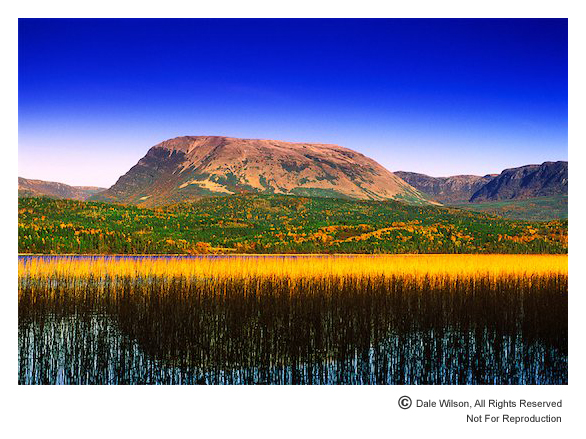
Gros Morne Mountain as seen from Rocky Harbour Pond. Filters used: Cokin 173 Blue/Yellow Colour Polarizing, Cokin 2-stop blue soft edge graduated and Singh-Ray Colour Intensifying

Gros Morne Mountain as seen from Rocky Harbour Pond. Filters used: Cokin 173 Blue/Yellow Colour Polarizing, Cokin 2-stop blue soft edge graduated and Singh-Ray Colour Intensifying


Designated a UNESCO World Heritage Site, Gros Morne is best photographed by concentrating on a given topic or subject matter, be it wildlife, flora, seascapes or landscapes. Each geographical region in the park offers its own rewards and anyone planning to explore and photograph Eastern Canada’s premium photo destination should schedule a minimum of four days.

While each month offers its own special attractions and challenges, I prefer to photograph Gros Morne in September when the air is usually clear of atmospheric haze and there are few tourists. Late in September many of the animals –moose in particular—become more active as they enter the rutting season. July is prone to a lot of atmospheric haze and August is the warmest month, averaging around 20 degrees Celsius and rarely going above 25 degrees.

Even during the summer months snow can be found at higher elevations in the cirques and shadows zones of north facing mountains, and evening can be quite cool. In addition to foul-weather gear, warm clothing and wind breakers are a must for personal comfort. Even during the summer months finger-less are invaluable for handling the cold legs of a tripod and providing some shelter against chilly winds.

Access is gained by driving along route 430 (the Viking Trail) from Deer Lake to the park’s epicentre at Rocky Harbour, about 71 kilometres. Or, turn off route 430 onto route 431 at Wiltondale to access the south side of the park, where you will drive past the Tablelands mountains and eventually arrive at the fishing hamlet of Trout River.

Often overlooked, the Tablelands mountain range is one of the most unusual geological formations in the world. The yellowish-brown rock known as peridotite was thrown heavenward by the continual bump-and-grind of plate tectonics. Exposed from the earth’s mantle, this rock is devoid of plant supporting nutrients, and consequently the Tablelands Range hosts only a few varieties of flora, with most to be found along the banks of Winterhouse Brook.

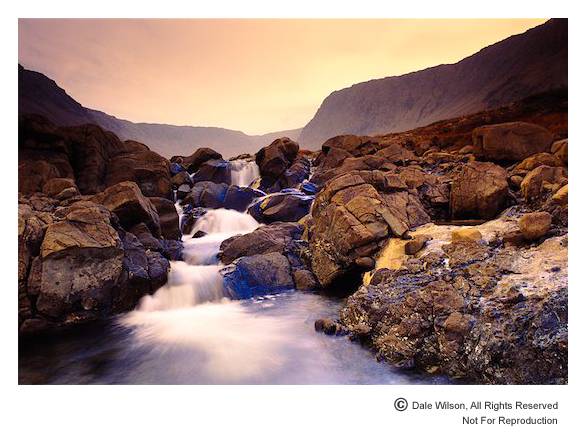
Winterhouse Brook in the Tablelands.  Filters used: Cokin 173 Blue/Yellow Colour Polarizing and Cokin 2-stop Grey soft edge graduated

Winterhouse Brook in the Tablelands. Filters used: Cokin 173 Blue/Yellow Colour Polarizing and Cokin 2-stop grey soft edge graduated


Photographically, the Tablelands is a challenge that demands the photographer’s full attention to make creative images. The light is unique due to the topography; both morning and evening is in shadow and light only makes its way into this valley during high noon. However, if you must make a choice, opt for evening when you can drive along route 431 and view the mountain range to the south. On those few occasions when the evening light bathes this unique landscape the colour of the rocks will be sublime and unparalleled in eastern Canada.

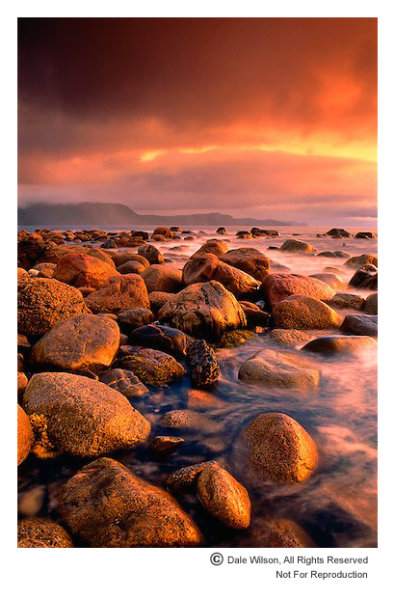
One of the most exciting areas to photograph seascapes is the north side of Bonne Bay, just a few kilometres past Lobster Cove Head lighthouse. Green Point, on the Gulf of St. Lawrence, provides an ideal vantage point as the large rocks turn a lovely shade of orange in the sweet light of sunrise and sunset – and you can photograph both from this location.  The best access is via a single lane gravel driveway on your left about 500 metres beyond the Green Point Campground. You will recognize the spot when you find fishermen’s seasonal cabins along the shoreline. As this is a working area for the fisherfolk, it is courteous to park at the top of the bank and walk over the hill to the shoreline. There are no tips with respect to how best create images from this location, simply walk along the shoreline and change lenses as your creative vision dictates.


Green Point at dusk in pending storm light. Filters used: Cokin 173 Blue/Yellow Colour Polarizing, Singh Ray Colour Intensifying and Cokin 2-stop grey soft edge graduated

Green Point at dusk in pending storm light. Filters used: Cokin 173 Blue/Yellow Colour Polarizing, Singh Ray Colour Intensifying and Cokin 2-stop grey soft edge graduated


Other attractions not to be missed in Gros Morne National Park are Western Brook Pond and the boat tour of this land-locked fiord. Secure your reservations at least a day in advance from the tour office located in the Ocean View Hotel in Rocky Harbour.  As awe-inspiring as this trip down the fiord is, it is incredibly difficult to capture creative images as you are restricted by the movement of the boat and the lack of light reaching the 675 metre high south wall. Given the choice, opt for the last run of the day for best light.
As mentioned above, bring warm clothes, sturdy footwear, lots of media cards and allow at least four days and you will be rewarded with the most exciting, photographic diversity and easily accessable region in Atlantic Canada.

Post originally from: Digital Photography Tips.

Check out our more Photography Tips at Photography Tips for Beginners, Portrait Photography Tips and Wedding Photography Tips.

Canadian Travelogue -Newfoundland- Gros Morne National Park

Digital Photography School

 
Comments Off on Canadian Travelogue -Newfoundland- Gros Morne National Park

Posted in Photography


An Entire Amusement Park Smashed Into a Four-Ton Cube

22 Jun

[ By Delana in Art & Sculpture & Craft. ]

compressed amusement park

Amusement parks are a big part of most peoples’ childhoods, with fond recollections of roller coasters and snow cones dancing in our memories. But what happens to those amusement parks after they have lived out their lives? For artist James Dive of The Glue Society, one amusement park from his past was turned into a creepily touching piece of art.

james dive compressed amusement park

The sculpture, entitled Once, contains an entire amusement park compressed into a single four-ton cube. Dive’s treatment of the park is gentle and reverent while being inherently violent. To prepare for his unusual work of art, Dive first did the exact opposite of his ultimate goal: he carefully cleaned, painted and restored every bit and piece of the park.

smashed amusement park

Over the following two weeks, a 28-ton excavator smashed and crushed the entire amusement park into a neat, gigantic cube. Parts of the park’s former life can still be glimpsed – a brightly-painted sign here, a string of lights there, some creepy dolls scattered about. The feeling Dive tries to evoke with this exceptionally odd sculpture is “the finality of a missed moment. And how brutal that can sometimes be.”

old compressed amusement park

The irony of this piece lies largely in its finality, given that the pleasures of an amusement park are so transient and fleeting. In this sculpture they become more permanent, all compressed into one strangely savage yet sentimental four-ton cube. Once was installed as part of the Sculpture By the Sea program in Aarhus, Denmark.

Share on Facebook


[ By Delana in Art & Sculpture & Craft. ]

[ WebUrbanist | Archives | Galleries | Privacy | TOS ]


WebUrbanist

 
Comments Off on An Entire Amusement Park Smashed Into a Four-Ton Cube

Posted in Creativity


Milky Way Over Half Dome, Yosemite National Park

17 Jun
Milky Way Over Half Dome, Yosemite National Park

The Milky Way rises over Half Dome as seen from Glacier Point – Yosemite National Park

One of the many things I love about Yosemite National Park is that it’s equally photogenic at night as it is during the day. During my last visit I focused on astro-landscapes, but Mother Nature had other things in mind with a lot of clouds. Fortunately for me the heaviest clouds cleared just in time for me to take this photo and several others.

My location of choice was Glacier Point as the increased altitude above the valley floor allows you to see the Milky Way rising a little earlier without obstruction. In addition you have an amazing view of Half Dome and Nevada and Vernal Falls. These of course make for amazing foreground subjects.

One interesting note about this photo is that it was taken with out a tripod. I had two other cameras running time-lapses on a tripod when this was taken and I was left with only my ingenuity to stabilize my 3rd camera. To stabilize my camera for this long exposure I lodged the camera on a rock and used the strap with a great deal of tension to lock it into place. If there is interest I’ll go over exactly how I did this.

Photo Details:
Canon 5D Mark II, Canon 15mm f/2.8 fisheye, ISO 6400, 30sec

Copyright Jim M. Goldstein, All Rights Reserved

Milky Way Over Half Dome, Yosemite National Park

The post Milky Way Over Half Dome, Yosemite National Park appeared first on JMG-Galleries – Landscape, Nature & Travel Photography.


JMG-Galleries – Landscape, Nature & Travel Photography

 
Comments Off on Milky Way Over Half Dome, Yosemite National Park

Posted in Equipment


Transformation: Sunset Rainbow over Yosemite National Park

14 Jun
Sunset Transformation and Rainbow - Yosemite National Park, California

Transformation: Sunset Rainbow over Yosemite National Park

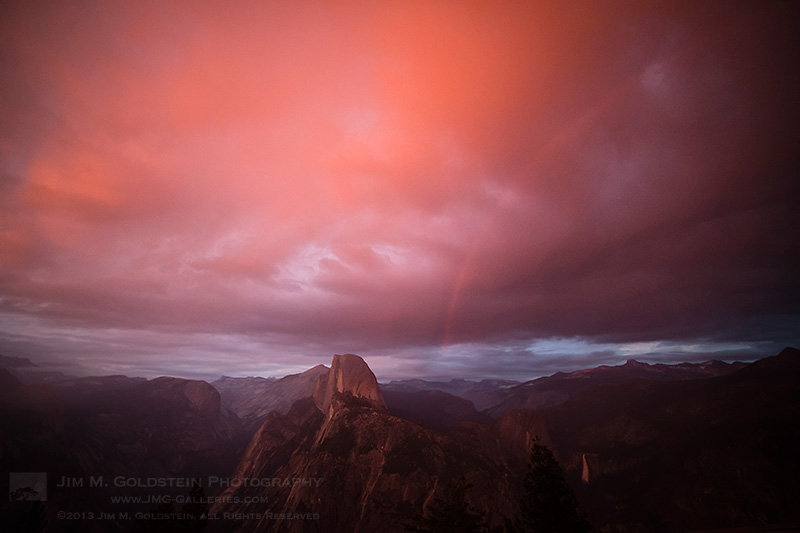
30 minutes of amazing transformation is all it took to change a drab gray stormy view of  Yosemite’s Half Dome and Nevada Falls into a dynamic fiery rainbow filled  scene. Literally in the 11th hour after a full day of foggy and overcast weather I witnessed a sunset like I’ve never seen anywhere in all my travels.

As if scripted, storm clouds rose above Yosemite Valley and were illuminated by a thin pipe of sunset light. Just as the intensity of the red light was about to peak the clouds exploded into downpour. This cloudburst in combination with the suns last gasp of light created the largest rainbow I’ve ever seen. Even with a Zeiss 15mm ultra-wide lens I was only able to photograph a third of it. This sunset was easily the most stunning I’ve yet to witness.

Photo Details:
Canon 5D Mark III, Zeiss Distagon T* f/2.8 15mm ZE lens, 1/250 sec at ISO 1600
Equipment courtesy of BorrowLenses.com

Copyright Jim M. Goldstein, All Rights Reserved

Transformation: Sunset Rainbow over Yosemite National Park

The post Transformation: Sunset Rainbow over Yosemite National Park appeared first on JMG-Galleries – Landscape, Nature & Travel Photography.


JMG-Galleries – Landscape, Nature & Travel Photography

 
Comments Off on Transformation: Sunset Rainbow over Yosemite National Park

Posted in Equipment


Sky Park: Design Idea Floats City Block Over Penn Station

13 Jun

[ By WebUrbanist in Architecture & Public & Institutional. ]

sky park penn station

Out of four recent proposals for a radical overhaul of Penn Station in New York City, this concept by Skidmore, Owings & Merrill LLP is far and away the most dramatic – and arguably the most inspiring as well.

sky park new york

Drawing on the success of The High Line, an elevated park in the same city, this project solution from SOM proposes lifting city life to new heights and integrating a new version of Madison Square Garden, boldly suspended in midair.

sky park section slice

Below, the main station itself sits as a dome over the underground transit hub. Meanwhile, the mega-block is anchored by towers at its four corners, with offices occupying the lower floors and residential stories above.

sky park from below

On the one hand, this multi-layered result consolidates central activities around a newly-refocused core. On the other, it opens up shared green park space on a series of levels, blending intentionality with optionality.

sky park som diagrams

While conceptually simple, the design is … challenging from an engineering standpoint, to put it mildly, and more idealistic than realistic at this point. Hanging so much structure over such a distance stretches the limits of the imagination, but that practical weakness is also the visionary strength of the proposal, for better and worse.

Share on Facebook


[ By WebUrbanist in Architecture & Public & Institutional. ]

[ WebUrbanist | Archives | Galleries | Privacy | TOS ]


WebUrbanist

 
Comments Off on Sky Park: Design Idea Floats City Block Over Penn Station

Posted in Creativity


Horsetail Falls Moonset Light, Yosemite National Park

23 May
Horsetail Falls Moonset Light, Yosemite National Park

Horsetail Falls Moonset Light, Yosemite National Park

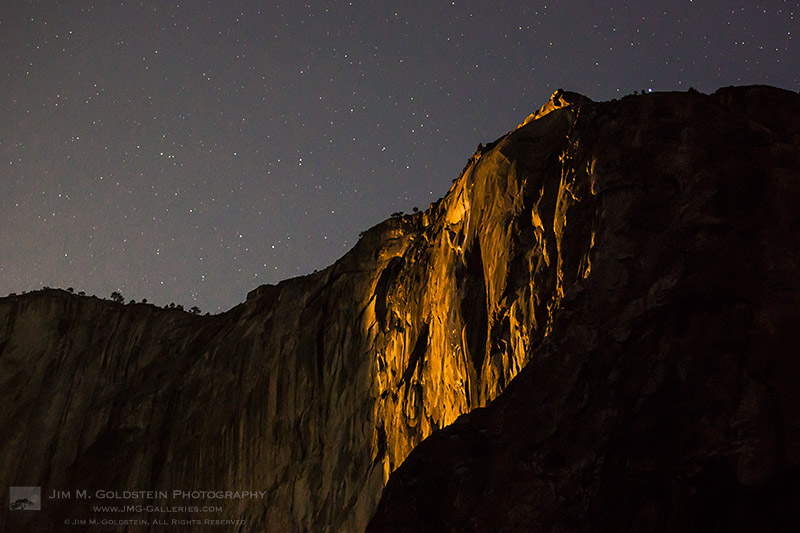
Much is said about light in landscape photography, especially golden hour, blue hour and moonlight. While most associate these lighting conditions with the end of the day it’s important to note they happen at the beginning of the day too and not just sourced from the sun. It’s a little bit rarer to see, as fewer photographers actually want to stay up or wake up to see golden moonlight. Case and point was my last visit to Yosemite National Park as I ran into 2 people photographing Horsetail Falls at 4am. I’m not complaining by any means as the view was spectacular and the golden moonlight was great. Granted the human eye can’t see the color of moonlight nearly as well due to human night vision being somewhat limited.  Something to consider the next time you’re sleeping in… what great moonlight are you missing?


Copyright Jim M. Goldstein, All Rights Reserved

Horsetail Falls Moonset Light, Yosemite National Park

The post Horsetail Falls Moonset Light, Yosemite National Park appeared first on JMG-Galleries – Landscape, Nature & Travel Photography.


JMG-Galleries – Landscape, Nature & Travel Photography

 
Comments Off on Horsetail Falls Moonset Light, Yosemite National Park

Posted in Equipment


Dogwoods Blooming in Yosemite National Park

01 May

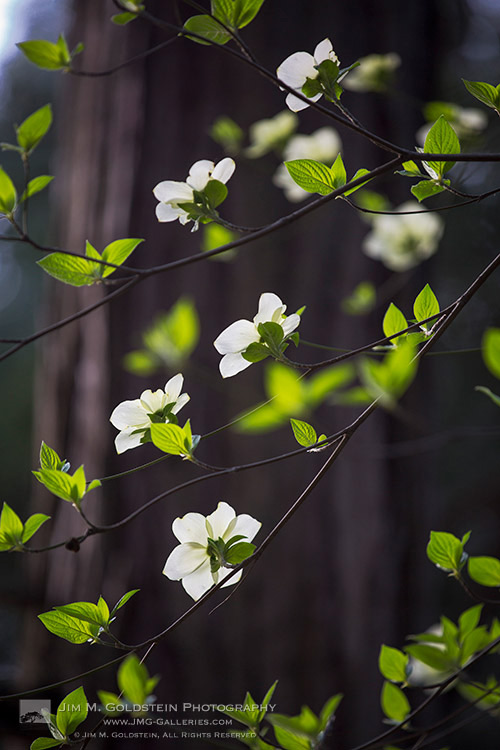
Last week I took the opportunity to photograph several amazing sights in Yosemite National Park ranging from night & astro landscapes, moonbows and blooming Dogwoods. The later is what captured my eye by day. This is the first time I’ve seen Dogwoods in optimal conditions. In the past I’ve always seen them after a storm or a little too late in the season. One thing I can say after seeing Dogwoods in peak form is that they’re a must see.

Dogwoods Blooming in Yosemite National Park

Dogwoods Blooming in Yosemite National Park

Copyright Jim M. Goldstein, All Rights Reserved

Dogwoods Blooming in Yosemite National Park

The post Dogwoods Blooming in Yosemite National Park appeared first on JMG-Galleries – Landscape, Nature & Travel Photography.


JMG-Galleries – Landscape, Nature & Travel Photography

 
Comments Off on Dogwoods Blooming in Yosemite National Park

Posted in Equipment


22 March, 2013 – Saguaro National Park

22 Apr

Our regular contributor, Miles Hecker, has a new geo-tagged travel article for us today about Saguaro National Park, home of The Roadrunner.


 "Every time I go back to a module I had already seen, I learn additional things.  I have never seen tutorials that have the excellent mix of what the features are, 
how to use them, enough of the under-the-hood information 
and concepts so that I can utilize the features creatively and efficiently, 
and just enough humor to keep the motivation level high.  Wow!"


The Luminous Landscape – What’s New

 
Comments Off on 22 March, 2013 – Saguaro National Park

Posted in News


2 March, 2013 – Great Basin National Park

02 Mar

Many photographers continue to seak out the iconic landscape locations in America’s national parks. One of the lesser known western parks is Great Basin National Park, which is described on a new location article by Don Whitebread.


Win a New 128GB iPad with Retina Display
Including all Major Luminous Landscape Videos
– Pre-Installed –

Find Out More


The Luminous Landscape – What’s New

 
Comments Off on 2 March, 2013 – Great Basin National Park

Posted in News