RSS
 

Posts Tagged ‘Network’

Desert Cities: Modular Nodal Network Idea for the Middle East

30 Jan

[ By WebUrbanist in Architecture & Cities & Urbanism. ]

desert city social organization

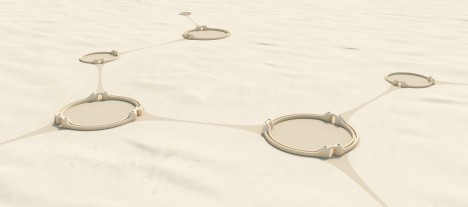
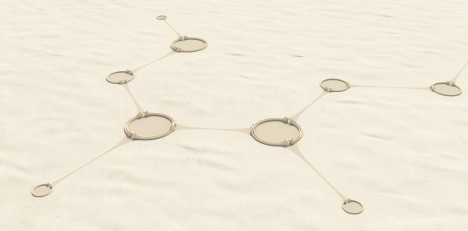
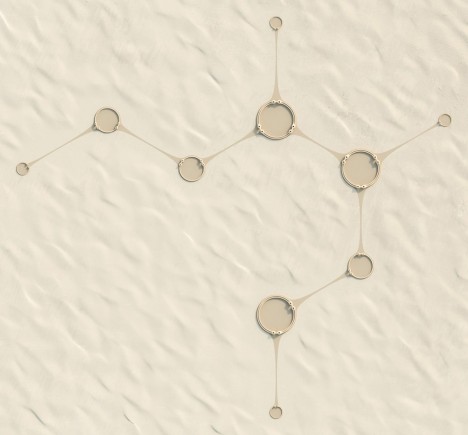
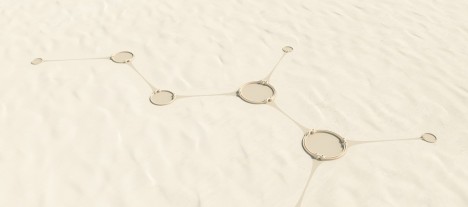
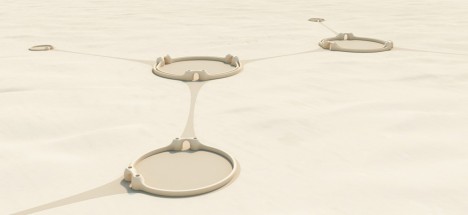
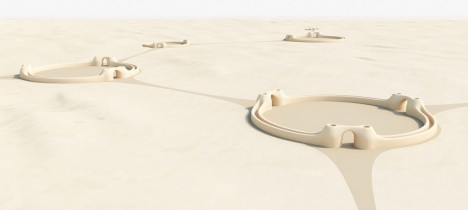
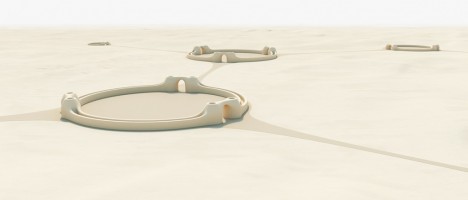
A combination of contemporary regionalism and sustainable urbanism, this design strategy proposed by an Italian architecture firm involves a series of modules for living, working and interacting at different scales. Notably different from most models of urban design is the intentional lack of density, raising the question: is the premise that good urban strategies revolve around dense centers a universally valid one?

desert city expanse

desert city different scales

desert cities node network

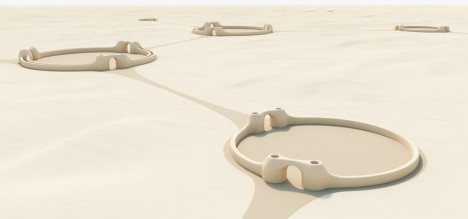
Connected by lines that serve as both dividers and connectors, the smallest modules are family-sized units, the mid-sized variants working as cultural, research and service centers and the largest operating as micro-cities with more complex communities.

desert city concept rendering

desert city individual community

By spreading these out, maximum use can be made of minimal rainfall (water capture) as well as sun exposure (solar power), rendering each unit relatively or entirely self-sufficient. Internally, composing, recycling and other sustainable strategies would be employed as well.

desert city design urban

desert city layout strategy

desert city streets connectors

desert city angled view

Luca Curci Architects describes the approach as follows: “The project-plane is made by a series of identity-places with symbiotic interconnections among them which create an organic and articulated system. The identity-places can be divided in 3 macro architectural types, different for dimension, function and inhabitants. Each identity-place is developed following residential and architectural solutions which respect the environment’s tradition, climatic condition and resources.”

Share on Facebook


[ By WebUrbanist in Architecture & Cities & Urbanism. ]

[ WebUrbanist | Archives | Galleries | Privacy | TOS ]


WebUrbanist

 
Comments Off on Desert Cities: Modular Nodal Network Idea for the Middle East

Posted in Creativity


Ello, My New Favorite Social Network

21 Nov

ello-40715fdd-0669-4999-bedd-419b07886886

I just spent $ 40 on a t-shirt.

I don’t think I’ve ever spent $ 40 on a t-shirt in my life. The t-shirt is a limited edition threadless Ello t-shirt designed by @nopattern.

I’ve been given t-shirts in the past by many social networks and sites. I have a Google+ t-shirt, I have a Facebook t-shirt, I have a Flickr t-shirt, I have a friendfeed t-shirt from back in the day. Twitter never gave me one, but that’s ok. The Ello one I bought for myself though. I like to think that this is some small way that I can help contribute towards the ad-free social experience that quickly has become my favorite of all the networks.

Over at the Atlantic Alexis Madrigal has an article out today titled “The Fall of Facebook.” In the article he describes a certain “soullessness” of Facebook and writes about the unease that people increasingly have with Facebook’s advertising network.

A few weeks ago, when the San Francisco Giants clinched the World Series, my wife took a photograph of our children and family celebrating the win. Not being particularly privacy conscious when it comes to social media, she added a name for the location, “Hawkville” without realizing that through this process she was creating a new permanent “place” on Facebook that was geotagging our home.

Friends quickly liked both the post and the new “place” and in a matter of hours we were much more public on Facebook than I wanted to be. After realizing that she’d made this mistake, my wife removed the location tag from the photo – but what she couldn’t remove was the new permanent “place” on Facebook, “Hawkville,” which geotagged our home’s exact and precise location against our wishes.

Because I’ve had issues with impersonation on Facebook in the past and I suppose because I have a larger than average social media following, previously I’d been given a link to a special sort of VIP customer service area at Facebook.

Although I was disturbed that there seemed to be no way to remove my geotagged home from Facebook, I figured it would just take reaching out to this VIP customer service group to get the geotag deleted — unfortunately this turned out not to be the case. The Facebook employee who responded to me told me that she was unable to delete the page “Hawkville” or remove the geotag of my personal and private residence.

I next made a post on Facebook about the unfairness of this. Just because my wife made a mistake and geotagged our home, why should that mistake be irreversible? Shouldn’t I have more control over my personal residence on Facebook? Does Facebook believe in doxing? Why were my wife and I locked out of this page, unable to control this personal data? Why had Facebook created a “place” of a personal residence in the first place and why wasn’t my wife warned at the time that by geotagging our home she was permanently and irrevocably adding our location data to Facebook with no way to remove it?

After several posts and further attempts to contact the Facebook VIP customer service department, about a week later I went to a group of Facebook employees who I know personally and I was able to get the geotag removed (although not the place). I really appreciate the personal help that I was given to get this done (I really do), but the fact of the matter is that I shouldn’t have had to go that route to have my personal information removed from Facebook.

I’ve been increasingly disappointed with my experience on Facebook. I find that fewer and fewer of my friends are seeing what I post and engagement is increasingly going down.

I’m seeing more and more “sponsored” posts and advertising crowding out organic content, which probably plays a part in this… or maybe my photography just sucks and is way less interesting to the people who follow me there.

Sponsored posts are the worst as far as I’m concerned. At least with an ad over in the right hand column, I can try to ignore it. A sponsored post shoves itself right into your face though. Time and again I’ve caught myself reading the first few lines of a sponsored post before realizing I’m reading one and then have that terrible feeling I get when I realize I’ve just been suckered for few seconds into an ad.

More than this though, I feel like Facebook doesn’t really care about me. I feel like I’m being targeted and manipulated and probed and studied. I don’t feel like my content there is valued. There *is* a certain soullessness to the place. I’m not sure what can be done about that, it’s just what it feels like to me.

I also feel like photography doesn’t really matter at Facebook. Photos are super small and optimized for mobile, rather than big and glorious and optimized for the web. I get that Facebook has to pay for storage for our photos, but with all of the advertising and personal data they collect to target us, don’t they have even just a few nickels or dimes to make the photos just a tiny bit larger in the feed? Yes, I know that someone can click through and see it larger, but most people don’t and won’t and so your art is presented in an unfavorable small way to the 0.1% of your followers who might actually see it in their feed.

My experience so far at Ello has been the opposite.

At Ello I’ve found an idealistic group of artists, photographers and thinkers who dare to imagine a different, better way. I’ve found some of the freshest, most creative and most interesting art that I’ve seen in years online. There are no ads. Ello is not tracking my information to try and sell it to advertisers.

The founders and operators of Ello come across as creative, innovative, accessible, enthusiastic and engaged. I feel respect for my content on Ello, which is shown large in full high res glory. This is why I put more of myself into my art and photography on Ello than any other site. The respect feels greater.

I’ve met so many new and interesting friends on Ello. I’m settling in there realizing that this will be the place that I will share and communicate online with people going forward more than anywhere else. It feels like I’m hanging out with some really interesting artists in a nice cozy little café in Marfa, Texas with amazing coffee and music — rather than being lost, wandering aimlessly around the world’s largest Walmart, being told not to take photos in the store by some security guard.

Forbes says that the number one social media marketing trend that will dominate 2015 will be the rise of Ello. Rather than rely on crappy paid advertisements on Facebook going forward, Fashionista writes about how brands will actually have to create interesting, creative content to be seen on social networks like Ello in the future.

So is this new network worth $ 40? You’d better believe it is. Plus I get an awesome new t-shirt to go with the Marfa Public Radio one I bought just last week.

Do you like art and photography and architecture and design and creative thinking? Then come hangout on ello. You’ll find me most days online over there at http://ello.co/thomashawk


Thomas Hawk Digital Connection
 
Comments Off on Ello, My New Favorite Social Network

Posted in Photography


[MODIFIED] Google Chrome – View Memory and CPU Usage, Network Activity of Each Tab

22 Apr

Display memory, CPU, network, and other Google Chrome usage details.

For those trying to diagnose computer or networking issues when visiting resource-intensive websites, or just the merely curious, Google Chrome includes a Task Manager. This displays the amount of memory and CPU used by the browser and each tab as well as network activity, process IDs, and for developers the frames per second and ports used to debug native client apps (NaCl debug port). This way, you can determine if a particular webpage is using too many system resources, possibly slowing your computer down.

If you want extra information, a “Stats for nerds” screen shows the memory broken down by private and shared, as well as virtual memory usage. This details screen can even show basic memory usage statistics for other browsers such as Internet Explorer and Mozilla Firefox….

Read more at MalekTips.
New Computer and Technology Help and Tips – MalekTips.Com

 
Comments Off on [MODIFIED] Google Chrome – View Memory and CPU Usage, Network Activity of Each Tab

Posted in Technology


Why Blocking is Important for a Social Network

14 Dec

Why Blocking is Important for a Social Network

Earlier today Twitter reversed their decision to change how user blocks are handled after a backlash reaction on their network.

From the Twitter blog:

“Earlier today, we made a change to the way the “block” function of Twitter works. We have decided to revert the change after receiving feedback from many users – we never want to introduce features at the cost of users feeling less safe. Any blocks you had previously instituted are still in effect.”

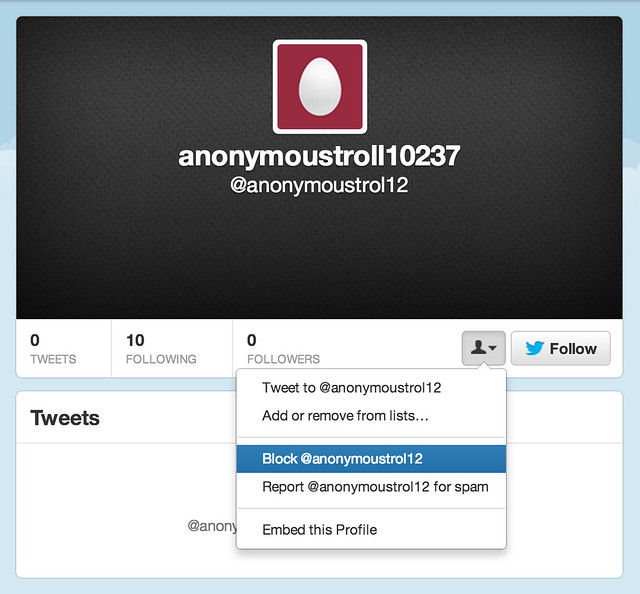
In a way, the current block at Twitter is sort of ineffective. If I block someone, the only thing it really does is prevent them from seeing my tweets when they are logged in (which also serves as notification to them that I’ve blocked them). They can still open up an unlogged-in version of Twitter (as easy as cmd-shift-N in Chrome, or cmd-shift-P in Firefox) and see everything I’ve tweeted publicly. Still, Twitter’s reversal shows that users really do care about blocking functionality and want more control and powerful blocking tools, not less.

I would argue that there are three key benefits that come from strong blocking tools on a social network.

1. Users feel empowered when they are more forcefully able to deal with harassment on a network. If someone is saying something offensive, why shouldn’t I personally be able to take control over that situation? If someone is making me uncomfortable, why shouldn’t I be empowered to deal with that for my own personal experience?

2. More effective blocking tools encourage more civil interaction. The thing that most trolls, haters, griefers, offensive jerks, etc. want on a social network is attention. By making it super easy to mute them or diminish them (especially by an intended target) it provides a disincentive for anti-social behavior in general.

3. Empowering users with blocking tools provides immediate relief for a user. Since oftentimes harassment is happening in real time, this can be more effective than waiting for customer service / community management reps at a social network to respond to reports of community violations. It is frustrating for a user to have to suffer even an additional 12 hours of harassment while a complaint works its way through to a community manager.

As far as best practices go, I’d hold up Google+ and Facebook as the networks that provide users the best blocking protection on the internet today.

Like Twitter, on Google+ and Facebook when you block someone they cannot see your public posts.

Google+ and Facebook take it one important step further though. Not only do they prevent someone you’ve blocked from seeing your public posts, they *also* filter the blocked user entirely out of your G+ or Facebook experience.

On G+ and Facebook when you block someone they become completely invisible to you everywhere on the network. It’s like they no longer exist in your social utopia.

That second block function is even more important than the first.

Flickr by contrast has some of the weakest blocking tools on the internet. When you block someone on Flickr, all it does is prevent them from private messaging you or commenting/faving your photos. Because of Flickr’s weak blocking tools, I’ve seen many of the most active, social accounts on Flickr leave due to harassment. This is bad design.

What makes harassment even worse on Flickr, is that (unlike G+ and Facebook) they allow anonymous troll accounts. So if a Troll1022 is harassing you anonymously on Flickr, and you report them, and three days later that account is deleted, all they need to do is set up Troll1023 and continue with the practice. Flickr’s weak blocking function allows virtually unlimited harassment on their network by anonymous trolls.

Protecting users and providing more control over your experience on a social network is important. It’s your most social and active users who will most likely sooner or latter run into friction. These are the users that any social network should be striving to empower.

I’m glad Twitter reversed their block policy after user reaction, and hope all networks realize how important the block feature is.


Thomas Hawk Digital Connection
 
Comments Off on Why Blocking is Important for a Social Network

Posted in Photography


First Instagrams out of North Korea after opening of 3G network

05 Mar

korea.png

Last week North Korea started to allow foreigners to use a 3G mobile network from inside its borders. This means that tourists and visiting professionals alike can now tweet and upload instagrams from Pyongyang. However, access to mobile networks is still limited for locals. Two of the most notable Instagrammers in North Korea are Associated Press journalists Jean Lee and David Guttenfelder. Since the change, the journalists have used their accounts to present life inside North Korea. Click through to see their images.

News: Digital Photography Review (dpreview.com)

 
Comments Off on First Instagrams out of North Korea after opening of 3G network

Posted in Uncategorized


Creating your first Meraki network

24 Jan

In this short video I will show you how you can quickly and easily create your first Meraki network. All demonstration screens are shot in real time with no shortening of the sequences. Shot on a Nikon D7000 with a Nikkor 50mm f/1.8G lens in my living room, this video was put together as a side project as a way of learning more about shooting DSLR video and video editing. Audio is captured on a Zoom H1 Handy Recorder with Audio Technica ATR3350 lavalier microphone. Hopefully this will be the first in a series of short videos that will highlight features of Meraki technology in a quick and easy to understand way.


Google+, The Nicer Social Network for Photographers

16 Nov

Are You on Google+ Yet?  If So Please Post a Link to Your Google+ URL Here

For the last few weeks I’ve been thinking a lot about online conversations. It feels like I’m constantly in one somewhere on some site.

More and more for me these are happening on Google+. I used to spend almost all of my social time online in Flickr group discussion threads. I stopped visiting Flickr groups for a while due to personal harassment — but you know what, it wasn’t just me who left, the velocity of quality conversations in Flickr groups have gone wayyyy down more broadly speaking in the past year.

This is not just a subjective thing — it’s easily measured ojbectively as well. Flickr Central is one of the oldest/largest/most active groups on Flickr. Over there years (as counted by threads) 11,503 conversations that have gone on there. Some are very successful, some are not.

If you look at Flickr Central today you’ll see that the time stamp for discussions on the first page goes back two weeks. This was not always the case. It used to be that the entire first page of discussions in Flickr Central were from the past 48 hours. Clearly the velocity of conversations in this Flickr group has gone way down. I suspect the same goes for other groups as well. Many of the groups recommended to me as “groups that Flickr has noticed” on the groups page haven’t had conversations in months, in some cases even years.

Meanwhile, over at Google+, in the past year I’ve been involved in some of the best conversations that I ever remember happening anywhere on the web. Interesting conversations about photography and art and meetups and hangouts and all kinds of fun things. it seems like there is always some great conversation somewhere on Google+ to jump into.

Over the course of the past few weeks I’ve jumped back into a few Flickr conversations to see what it feels like. What I’ve noticed is that the tone of conversations on Google+ feels so much more positive than it does at Flickr. There’s so much less snark and bitterness and negativity overall. I hadn’t seen the difference so dramatically before, but after having been gone awhile it felt more evident.

This made me think about what Google+ was doing right for community that Flickr is not.

When I first joined Google+ one of the things that I noticed is that some of the more hostile individuals from many of the old Flickr groups showed up. Some personal attacks took place, they aired their gripes about different things, typical BS hater stuff — but you know what? These people were quickly marginalized and moved out of the way to create a more positive environment. I blocked many of these people and so did so many other photographers on G+.

A few weeks went by and these people were just as hostile and negative but they were basically shouting to an empty room. The majority of positive forward thinking photographers on G+ had tuned them out with the tools that we were given. What we were left with was a more positive filtered G+ experience. I went back a few days ago to look at a few of the accounts of people that I blocked and you know what — they are gone. They quit G+. By empowering a mostly positive oriented community these people found no audience to bitch at and they left. Meanwhile, more constructive social photographers on G+ carry on.

Now, one worry with filtering out criticism is that it hurts meaningful conversation because all conversation is not always puppy dogs and roses, but that also hasn’t happened on Google+. Lots of criticism has gone on in tons of threads. The difference is though that the criticism feels much more respectful than some of what I’ve experienced in Flickr groups. People disagree on Google+ they just do it respectfully.

By giving users more powerful blocking tools on G+ Google has built a nicer community. A nicer community feels so much more enjoyable.

Every so often I’ll find someone new who comes along and leaves some sort of assholish comment in a thread on Google+. It’s almost delightful at how easy it is to block them and make them invisible.

In poking around Flickr Groups over the past week I did find what felt like some high quality conversations to me, I read them, I lurked — but I didn’t participate. The reason why I didn’t participate was that I noticed some of the toxic types that I’d run into previously on Flickr or G+. I’m sure I would have jumped into these conversations if I hadn’t seen them there, but what’s the point of jumping into a conversation about fine art photography when you know someone is just going to be a jerk?


Thomas Hawk Digital Connection
 
Comments Off on Google+, The Nicer Social Network for Photographers

Posted in Photography


Windows 8 – Toggle Computer, Control Panel, Files, Network, Recycle Bin on Desktop

16 Oct

Show or hide a variety of icons on the Windows 8 Desktop: Computer, Control Panel, Files, Network, and/or the Recycle Bin.

By default, the Windows 8 Desktop is fairly sparse, only showing an icon for the Recycle Bin so you can quickly view deleted files that have not been completely removed from the system.

While you can access your Computer, Control Panel, the network, and your user files via the Explorer icon in the Taskbar, you might find it more useful to have Desktop icons that you can double-click for instant access to these locations. …

Read more at MalekTips.
New Computer and Technology Help and Tips – MalekTips.Com

 
Comments Off on Windows 8 – Toggle Computer, Control Panel, Files, Network, Recycle Bin on Desktop

Posted in Technology