RSS
 

Posts Tagged ‘National’

Waters of Yosemite National Park HD

15 Jan

Waters of Yosemite – a high definition video compilation of Yosemite National Park, California. Authored by: Richard Wood, May 23-25, 2009. Music: Streamside from “In a Safe Place” by the Album Leaf. youtube homepage: www.youtube.com high definition viewing: vimeo.com


Timeless A National Park Odyssey

27 Dec

Sheer Majesty… A glorious moving gallery of photography.- Billboard Magazine “A spectacular and often breathtaking marriage of film and music.” – Napra Trade Journal Timeless must be seen to be believed. This DVD contains some of the most breathtaking cinematography ever filmed in our National Parks. By using special cameras and techniques, David Fortney has captured the beauty of these parks in ways never seen before. Fluid, masterful camera work and aerial photography gives you the sensation of soaring over and through the landscape. Complimented by an exquisite score by Patrick O’Hearn, this is a journey you will want to take again and again. Features breathtaking cinematography from the Magnificent National Parks of North America.

 
Comments Off on Timeless A National Park Odyssey

Posted in Photography Videos


A Good Gawk by Sandra McCowen: Sculpture In Context 2012 at the National Botanic Gardens

16 Dec

Some cool visual art images:

A Good Gawk by Sandra McCowen: Sculpture In Context 2012 at the National Botanic Gardens
visual art
Image by infomatique
Sculpture In Context 2012 at the National Botanic Gardens, Glasnevin, Dublin 9.
6th September to 19th October 2012

Sculpture in Context continues to build on 26 years of experience in organising successful exhibitions. It has, over the years staged highly acclaimed visual arts events at venues such as Fernhill Gardens, the Conrad Hotel, Kilmainham Gaol, the Irish Management Institute, Dublin Castle, Farmleigh House and the National Botanic Gardens.

The gardens are not only a botanical haven, and a quiet oasis on the outskirts of a modern European City, they also offer a challenging venue which gives the artist the rare opportunity of realising large scale work. It also gives the visitor an opportunity to ramble and explore, sometimes finding sculptures in the most unusual places. The sculptures are displayed throughout the gardens, ponds, Great Palm House, and Curvilinear Range, with the smaller works exhibited in the gallery above the visitors’ centre.

 
Comments Off on A Good Gawk by Sandra McCowen: Sculpture In Context 2012 at the National Botanic Gardens

Posted in Photographs


Scarecrow Fox by David Wilcoxson: Sculpture In Context 2012 at the National Botanic Gardens

15 Dec

Some cool visual art images:

Scarecrow Fox by David Wilcoxson: Sculpture In Context 2012 at the National Botanic Gardens
visual art
Image by infomatique
Sculpture In Context 2012 at the National Botanic Gardens, Glasnevin, Dublin 9.
6th September to 19th October 2012

Sculpture in Context continues to build on 26 years of experience in organising successful exhibitions. It has, over the years staged highly acclaimed visual arts events at venues such as Fernhill Gardens, the Conrad Hotel, Kilmainham Gaol, the Irish Management Institute, Dublin Castle, Farmleigh House and the National Botanic Gardens.

The gardens are not only a botanical haven, and a quiet oasis on the outskirts of a modern European City, they also offer a challenging venue which gives the artist the rare opportunity of realising large scale work. It also gives the visitor an opportunity to ramble and explore, sometimes finding sculptures in the most unusual places. The sculptures are displayed throughout the gardens, ponds, Great Palm House, and Curvilinear Range, with the smaller works exhibited in the gallery above the visitors’ centre.

Velcome by Beatrice Stewart: Sculpture In Context 2012 at the National Botanic Gardens
visual art
Image by infomatique
Sculpture In Context 2012 at the National Botanic Gardens, Glasnevin, Dublin 9.
6th September to 19th October 2012

Sculpture in Context continues to build on 26 years of experience in organising successful exhibitions. It has, over the years staged highly acclaimed visual arts events at venues such as Fernhill Gardens, the Conrad Hotel, Kilmainham Gaol, the Irish Management Institute, Dublin Castle, Farmleigh House and the National Botanic Gardens.

The gardens are not only a botanical haven, and a quiet oasis on the outskirts of a modern European City, they also offer a challenging venue which gives the artist the rare opportunity of realising large scale work. It also gives the visitor an opportunity to ramble and explore, sometimes finding sculptures in the most unusual places. The sculptures are displayed throughout the gardens, ponds, Great Palm House, and Curvilinear Range, with the smaller works exhibited in the gallery above the visitors’ centre.

 
Comments Off on Scarecrow Fox by David Wilcoxson: Sculpture In Context 2012 at the National Botanic Gardens

Posted in Photographs


Where Does a Former National Geographic Photographer and Current Yahoo Exec in Charge of Flickr Share His Photos? Yep, You Guessed it Google+

06 Nov

Late last week over at All Things Digital, Kara Swisher reported on the appointment of the latest high profile Yahoo exec, Adam Cahan. In addition to reporting directly into Marissa Mayer and overseeing mobile for Yahoo (super important!) it was also announced that Cahan would be put in charge of Flickr, the photo sharing site that so many of us love.

On the surface this is great news. The fact that the guy who is now overseeing Flickr reports directly into Mayer may mean that Flickr’s profile is moving up internally at Yahoo. After a few years of Flickr layoffs and shrinking, it looks like Yahoo once again is staffing up in photo sharing!

In addition to staffing up, over the past year Yahoo has probably improved Flickr more than any other year in its existence. They’ve added a really nice new justified page layout for your contact’s photos and favorites (hopefully coming to search, photostreams and sets soon!), they added a new meet up page where they are getting active with photowalks again (check out this shot from their Austin photowalk this past weekend), they created a new liquid photo format that expands photos to the size of your monitor (slick!), they also increased the maximum size for photos for paid accounts to 50MB! (Facebook and Google+ downsize your photos).

So my question is, why with so much excitement going on around Flickr, why don’t Yahoo employees use or care more about the service?

A lesser known thing about Adam Cahan, the new Yahoo exec in charge of Flickr, is that according to the San Jose business Journal he’s a former National Geographic wildlife photographer. So here’s the guy who is in charge of Flickr, definitely talented with a camera, and where is he choosing to share *his* photographs? Yep, you guessed it Google+! Here’s a photo he posted earlier this year there for the 75th Anniversary of the Golden Gate Bridge.

Of course, Cahan is just following by example really here, his boss Marissa Mayer chooses to post her own photos over at Instagram instead of Flickr.

Why is Flickr such a pariah that Yahoo’s own executives (even the one directly in charge of Flickr) won’t dare to use it personally?

Certainly Google and Facebook employees share their photos on Google+ and Facebook. So why aren’t Yahoo executives doing the same thing?

I believe that leadership is done by example. I also believe that every company should encourage dogfooding and should encourage their employees to use their own products. I think this sends a better message to users when you feel like people who work for the company use it too.

The message that Mayer and Cahen send when they shun Flickr and instead post their photos on competing photo sharing sites is that those sites are better than Flickr. The exact message that they should be trying to change if they really care about Flickr.

Now I’m all for Yahoo executives testing out the competition. Actually I think that’s smart. They *should* have accounts on Instagram and Google+ and Facebook and all that — but they should *also* have accounts at Flickr and they should be acting as Flickr’s biggest cheerleaders in the same way that Vic Gundotra does for Google+ over there.

There is a current conversation going on over at Flickr in their highest profile discussion group that Flickr is dying. Yahoo should care about discussions like this. Yahoo employees should actually be involved in them and trying to convince people that Flickr is not dying, that a comeback is just around the corner — but in order to be involved in conversations like this Yahoo employees need to actually, you know, have an actual Flickr account.

It’s not hard, really, you can even use your Facebook or Google+ account to sign into Flickr these days. Directly from the Flickr sign up page: “It takes less than a minute to create your free account & start sharing! Have a Google or Facebook account? You can use them to sign in!”

Flickr’s tagline is “almost certainly the best online photo management and sharing application in the world.” That’s been it’s tagline for years now. So if this is true, why don’t Yahoo execs want to use it to manage and share their photos? If that tagline isn’t true anymore maybe Yahoo execs should think about changing it to “almost certainly *was* the best online photo management and sharing application in the world.”

I was thinking yesterday back to all the excitement that was around Flickr back in the olden days. Natural disasters tend to be things that galvanize social sharing, and especially photos. Back in 2005 when Katrina hit, Flickr was the go to place for people to post photos online about the disaster. Not only were the best user generated photos flowing into Flickr, they were flowing in fast and furious. Flickr was recognized for the Katrina photos in the national press. A group was started on Flickr to do a print auction to raise funds for Katrina survivors. The very next year Time Magazine named Flickr co-Founders Stewart Butterfield and Caterina Fake as two of the 100 most influential people in the world! Butterfield and Fake both had Flickr accounts by the way.

More recently hurricane Sandy hit New York. Was Flickr the go to place this time for photos? No. Everywhere you went in the national press it was 24/7 Instagram. It’s telling that Time Magazine — the very same Time Magazine that recognized Flickr and their founders/managers after Hurricane Katrina — recruited five professional photographers this time around to cover hurricane Sandy for them on… Instagram, the same photo sharing site where Yahoo CEO Marissa Mayer shares her photos.

By the way, photos taken after Oct 15th tagged Sandy on Flickr? 36,000. Photos tagged Sandy on Instagram? Over 800,000. Now just today Instagram announced photos on the web.

On a personal level, my photos at Facebook and Google+ get far more views and engagement than they do on Flickr — not just a little more, a lot more — as in hundreds of times more. I’m still rooting for Flickr though. They were the photo sharing service that I started out with back in 2004. They still have the best photo organizational tools on the web and at $ 25 for over 70,000 full high res photos of mine they are a bargain. Competition in the photo sharing space is good for all of us. It benefits the user. I just wish I felt like Yahoo actually wanted to win more with Flickr. Maybe this will change though and some day soon I’ll be able to add Mayer and Cahan as contacts of mine on Flickr. I bet as a former National Geographic pro Cahan has got some great shots. :)

Comments on this post at Google+.


Thomas Hawk Digital Connection

 
Comments Off on Where Does a Former National Geographic Photographer and Current Yahoo Exec in Charge of Flickr Share His Photos? Yep, You Guessed it Google+

Posted in Photography


Washington DC: National Gallery of Art – Pei’s Tetrahedron skylights

04 Nov

Check out these visual art images:

Washington DC: National Gallery of Art – Pei’s Tetrahedron skylights
visual art
Image by wallyg
The National Gallery of Art, administered by the Smithsonian Institute, was established on the National in 1938 by the United States Congress with funds for construction and a substantial art collection donated by Andrew W. Mellon, major art works donated by Lessing J. Rosenwald, Italian art contributions from Samuel Henry Kress, and more than 2,000 sculptures, paintings, pieces of decorative art, and porcelains from Joseph E. Widener.

The museum comprises two building, the West Building, and the East Building, which are linked by a spacious underground concourse resting beneath a series of terahedron "crystal" skylights. The West Building, composed of pink Tennessee marble, was designed in 1937 by architect John Russell Pope. Pope’s neoclassical style features a central pavilion with a gigantic columned portico and a massive dome, flanked by large, symmetrical east and west wings. In contrast, East Building, which was designed in 1978 by I.M. Pei, is sharply geometrical and fragmented. The H-shaped façade is similarly faced in pink marble from the same quarry. To emphasize the sharp angles, though, lighter stone was used for the vertical corners. The sharp fin of the west corner cleaves the air at an angle of 19.5 degrees and rises 107 feet above ground.

The West Building has an extensive collection of paintings and sculptures by European masters from the medieval period through the late 19th century, as well as pre-20th century works by American artists. The East Building focuses on modern and contemporary art. The East Building also contains the main offices of the NGA and a large research facility, Center for the Advanced Study in the Visual Arts (CASVA). To the west of the West Building, across Seventh Street, is the 6.1 acres Sculpture Garden, centered on a large circular fountain (an ice rink in the winter) surrounded by stone seating.

The Smithsonian Institution, an educational and research institute and associated museum complex, administered and funded by the government of the United States and by funds from its endowment, contributions, and profits from its shops and its magazines, was established in 1846. Although concentrated in Washington DC, its collection of over 136 million items is spread through 19 museums, a zoo, and nine research centers from New York to Panama.

Washington DC: National Gallery of Art – Pei’s Tetrahedron skylights
visual art
Image by wallyg
The National Gallery of Art, administered by the Smithsonian Institute, was established on the National in 1938 by the United States Congress with funds for construction and a substantial art collection donated by Andrew W. Mellon, major art works donated by Lessing J. Rosenwald, Italian art contributions from Samuel Henry Kress, and more than 2,000 sculptures, paintings, pieces of decorative art, and porcelains from Joseph E. Widener.

The museum comprises two building, the West Building, and the East Building, which are linked by a spacious underground concourse resting beneath a series of terahedron "crystal" skylights. The West Building, composed of pink Tennessee marble, was designed in 1937 by architect John Russell Pope. Pope’s neoclassical style features a central pavilion with a gigantic columned portico and a massive dome, flanked by large, symmetrical east and west wings. In contrast, East Building, which was designed in 1978 by I.M. Pei, is sharply geometrical and fragmented. The H-shaped façade is similarly faced in pink marble from the same quarry. To emphasize the sharp angles, though, lighter stone was used for the vertical corners. The sharp fin of the west corner cleaves the air at an angle of 19.5 degrees and rises 107 feet above ground.

The West Building has an extensive collection of paintings and sculptures by European masters from the medieval period through the late 19th century, as well as pre-20th century works by American artists. The East Building focuses on modern and contemporary art. The East Building also contains the main offices of the NGA and a large research facility, Center for the Advanced Study in the Visual Arts (CASVA). To the west of the West Building, across Seventh Street, is the 6.1 acres Sculpture Garden, centered on a large circular fountain (an ice rink in the winter) surrounded by stone seating.

The Smithsonian Institution, an educational and research institute and associated museum complex, administered and funded by the government of the United States and by funds from its endowment, contributions, and profits from its shops and its magazines, was established in 1846. Although concentrated in Washington DC, its collection of over 136 million items is spread through 19 museums, a zoo, and nine research centers from New York to Panama.

 
Comments Off on Washington DC: National Gallery of Art – Pei’s Tetrahedron skylights

Posted in Photographs


The Reality Of Shooting In National Parks

03 Nov

You’ve seen them.

The beautiful pictures, often repeats of other beautiful pictures. Here, let me give you an example.

PeterWestCarey-Utah2012-1022-7461

This is Mesa Arch in Canyonlands National Park, Utah. You may have seen this type of shot before or one much like it. Some people wait until the sun is blocked by the arch and the underside of the arch is glowing red, as in this picture.

Calm. Serene. You can almost hear the light breeze and the whisper of time held still.

Now let me show you what is missing in this frame on that day.

PeterWestCarey-Utah2012-1022-6857

And

PeterWestCarey-Utah2012-1022-7347

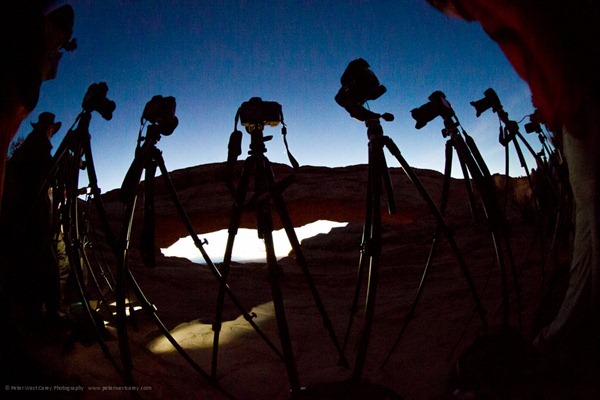
This is the reality behind the lens and something not often mentioned.

For this shoot, I was meeting up with fellow photographer Michael Riffle who has been to this location before. He said we needed to meet early….real early. “How early?” I asked. With a sunrise at 7:30, he guessed about 5:30am. That should get us to the park and in position around 6:30am.

Evidently that was not early enough.

We were bested by two workshop groups who had arrived even earlier. I took up a position to the far right while Michael managed to use his charm to gain front row access, but not as close as he had planned. In all, there were over 17 people shooting the arch that day, the crowd getting ruckus when one gentleman decided to walk on top and pose for his workshop group. This brought yells to get off and threats that his act was illegal (for reference sake, we asked a park ranger at the trailhead and were told it is not illegal to walk the arch. “It’s not a very smart thing to do, though.” Were his words).

The atmosphere is not what the illusion of the first image portrays, but that’s ok, because that’s photography. An illusion of what really was, malleable any way we, as artists, please.

Now, let’s contrast that experience with our shoot the next morning in neighboring Arches National Park. It was my idea to head to Delicate Arch for sunrise. This icon is so popular, it even adorns most license plates in Utah.

First, a shot of the classic arch.

PeterWestCarey-Utah2012-1023-7847

You may notice this is not the normal shot people take. That shot is near sunset when the face is lit up. We decided to go early for a different view of the classic and it paid off as this is the crowd we faced:

PeterWestCarey-Utah2012-1023-7852

No one. For an hour and a half we set up, tested, shot and waited. After an hour and a half, one person showed up for about 20 minutes and then left.

In my book, it doesn’t get any better than that. I’ve been to this location at sunset and so had Michael. We exchanged horror stories of tourists being tourists and exploring the arch, much to the consternation of the multiple photographers lined up (to the right in the image above) to get their copy of a classic. I didn’t want to spend half a day trying to edit out tourists (yes, I am one of them too) who, “got in my shot!”

This is a shot of such crowds by Matt Leher on Flickr.

1805543877_305a65baf9_z

The valley view just off the road in Yosemite Valley. Old Faithful. Mt. Rushmore.

The list goes on and on. Classic shots that leave behind the reality of a crowded scene to get a classic shot.

Crowds are not bad nor evil. I’m not saying you shouldn’t get those classic shots. They are beautiful and help people gain interest in our National Parks.

I want you to be aware; when you plan that ultimate shoot to capture a well worn icon for your own portfolio, realize you may have company.

On the other hand, we spoke with a local Utah photographer who visits Mesa Arch often and he pointed out winter is a great time to shoot and crowds are usually less. But he also said it can’t be predicted as he has been there in bad weather, expecting to have the place to himself, only to find a crowd. The flipside also being true.

What can you do?

  • Scout first, during the day or day before. Look for a spot when the light is harsh and there are less visitors to contend with. You can do some of this online before leaving to see what others have shot and figure out angles you might want to try.
  • Arrive super early. Not early; super early.
  • Be patient. All the others are wanting what you want and it’s not because they hate you. It’s because you all likely appreciate the same beauty.
  • Be friendly. With the crowd at Mesa Arch, I joked around with a couple of people near me who were lighthearted enough to enjoy the morning even with the crowd.
  • Bring a second camera. This will allow you to stake a claim to a spot and still take other images.
  • Enjoy what you came to enjoy.

Despite the crowds I have found at popular shooting locations, I have always enjoyed the experience. Sure, my expectations of a deserted vista were dashed, but once I dropped that expectation and the disappointment that came with it, my mood and shooting improved.

Good luck! And good shooting!

Post originally from: Digital Photography Tips.

Check out our more Photography Tips at Photography Tips for Beginners, Portrait Photography Tips and Wedding Photography Tips.

The Reality Of Shooting In National Parks


Digital Photography School

 
Comments Off on The Reality Of Shooting In National Parks

Posted in Photography


National Geographic photographer’s surprise encounter with deadly predator

19 Oct

Leopard_Seal.jpg

National Geographic photographers can find themselves in unusual, extreme and potentially dangerous situations, trying to capture the ‘never before seen’ images the magazine is famous for. However, contributing photographer Paul Nicklen’s story of his close encounter with a huge Leopard Seal (one of the top predators in the Antarctic), shows there’s still opportunity for surprises in the job.

News: Digital Photography Review (dpreview.com)

 
Comments Off on National Geographic photographer’s surprise encounter with deadly predator

Posted in Uncategorized


Hanging Rock by Moonlight – Glacier Point, Yosemite National Park

01 Aug

There are few things that pique the curiosity of night sky watchers more than the moon. Even my son at 10 months old started to point out the moon. If you see it enough it seems anything but special, but the moon is amazing. It’s an amazing sight to witness and an amazing subject to photograph. One thing that amazes photographers the most is that the full moon gives off so much light.

Overhanging Rock by Moonlight – Glacier Point, Yosemite National Park

The moon is one gigantic reflector in the sky. The moon reflects ~1/7th of the sun’s light back to Earth, so with the right exposure (~7x’s longer than normal) you can get an image that looks nearly indistinguishable from a daytime photo. If you’re walking at night under a full moon you might not think that much light is there to see, but on the contrary once your eyes adapt it can look incredibly bright. The moon is pretty cool all around so be sure to take the time to appreciate it on your next night walk or night photo shoot. The experience will more than likely awaken a primal curiosity no different in experience than our caveman relatives might have felt.

Photo Details:
Canon 5D Mark II, Canon 16-35mm f/2.8L II USM at 20mm, f/4, 6 seconds, ISO 3200

Related Post:
Overhanging Rock & Yosemite Falls

Copyright Jim M. Goldstein, All Rights Reserved

Hanging Rock by Moonlight – Glacier Point, Yosemite National Park

flattr this!


JMG-Galleries – Jim M. Goldstein Photography

 
Comments Off on Hanging Rock by Moonlight – Glacier Point, Yosemite National Park

Posted in Equipment


Milky Way Above Yosemite National Park

01 Aug

One Day in Yosemite – Milky Way Above Half Dome, Yosemite

Earlier this week I had the great fortune of being part of “One Day in Yosemite”. The goal, have 25+ photographers and videographers document everything and anything happening in Yosemite: morning hang gliders, rock climbers, hikers on well known landmarks, amazing sights, wildlife encounters, behind the scenes at hotels, campground activities, ranger programs, interviews of employees & visitors and more. Shooting was from midnight to midnight to capture a full 24 hours of everything Yosemite. I’m looking forward to seeing a sample of what was captured in an up coming episode of the Nature Notes video series released by the National Park Service and the Yosemite Conservancy. In the future the producer, the very talented Steve Bumgardner (@yosemitesteve), is working to release a longer documentary comprised of the days shoot. Based on the footage I saw from the many talented photographers/videographers taking part the end result should be amazing. Stay tuned!

Copyright Jim M. Goldstein, All Rights Reserved

Milky Way Above Yosemite National Park

flattr this!


JMG-Galleries – Jim M. Goldstein Photography

 
Comments Off on Milky Way Above Yosemite National Park

Posted in Equipment