RSS
 

Posts Tagged ‘Museum’

Human Body Museum: Undulating Design Wins Competition

03 Dec

[ By WebUrbanist in Architecture & Public & Institutional. ]

museum of the human body

Its organic form fits its function as a Cité du Corps Humain (Museum of the Human Body) like a metaphorical glove – interlocked fingers were, in fact, part of the conceptual inspiration for this new museum in France.

museum site aerial view

museum curves design detail

With a medical school more than a millennium old, Montpellier is a fitting location for a nearly 10,000 square-meter place for people to “explore the human body from an artistic, scientific and societal approach through cultural activities, interactive exhibitions, performances and workshops.”

museum night curved path

museum exterior roof renderings

Working with local firm A+ Architecture, BIG was first shortlisted then selected to complete the project. Their ability to format compelling modes of visual communication no doubt helped improve their prospects with the jury.

museum natural shape diagram

museum city park connection

Weaving together nature and the city, a series of indoor and outdoor spaces interlock to shape programmatic and public areas. “The museum’s roof functions as an ergonomic garden – a dynamic landscape of vegetal and mineral surfaces that allow the park’s visitors to explore and express their bodies in various ways – from contemplation to the performance – from relaxing to exercising – from the soothing to the challenging.”

Next Page – Click Below to Read More:
Human Body Museum Undulating Design Wins Competition

Share on Facebook


[ By WebUrbanist in Architecture & Public & Institutional. ]

[ WebUrbanist | Archives | Galleries | Privacy | TOS ]

WebUrbanist

 
Comments Off on Human Body Museum: Undulating Design Wins Competition

Posted in Creativity


Ship Shaped: Undergound Maritime Museum in Dry Dock Void

29 Nov

[ By WebUrbanist in Architecture & Public & Institutional. ]

ship nautical museum void

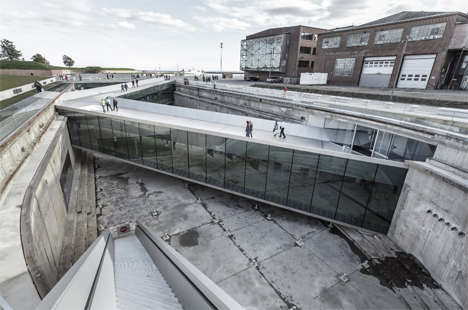
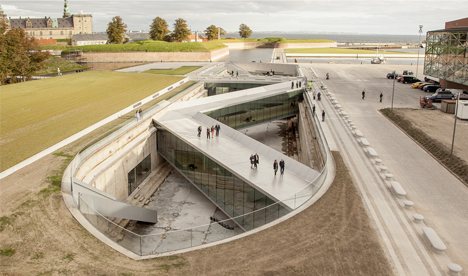
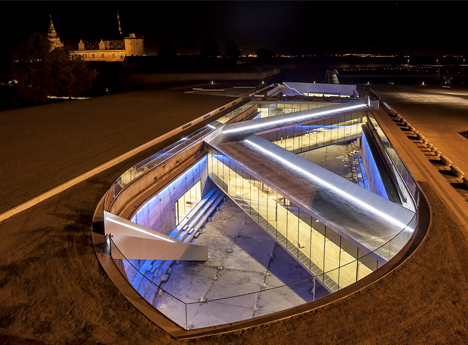
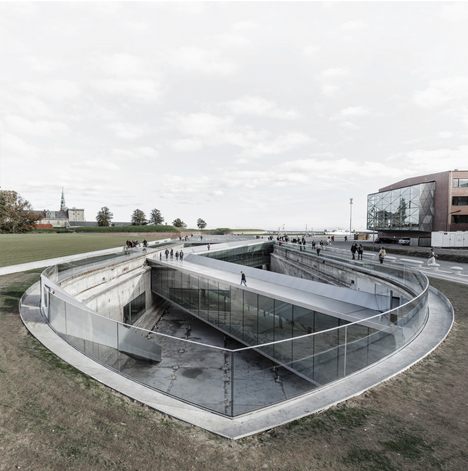
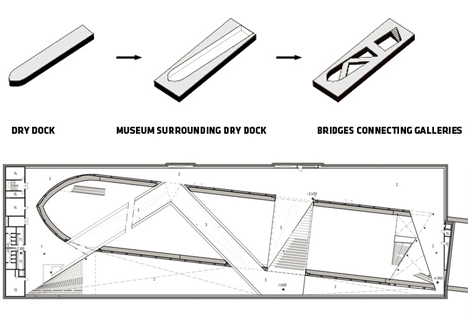
Using the existing vessel-shaped space of a six-decades-old dry dock, the Danish National Maritime Museum in Helsingor, Denmark takes visitors on a unique subterranean tour of the areas used to build, maintain and repair ships.

ship sea vessel museum

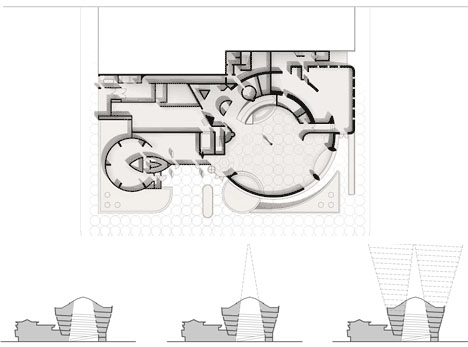
ship museum plans diagrams

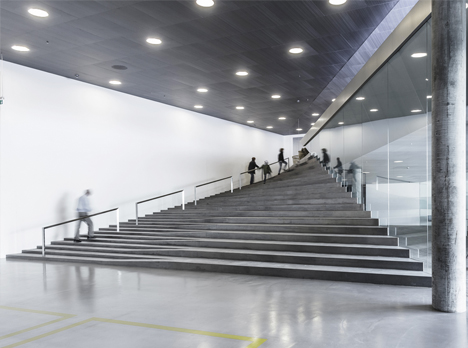
Historically, the zone would be drained to bring in or assemble vessels then flooded to send them back out into open waters. Today, thanks to BIG architects (images by Rasmus Hjortshøj and Luca Santiago Mora), people can follow a staircase directly down and enter the area at the lower levels then cross through it via interior sloping skyways.

ship auditorium presentation space

ship lower level spaces

maritime museum bridge entry

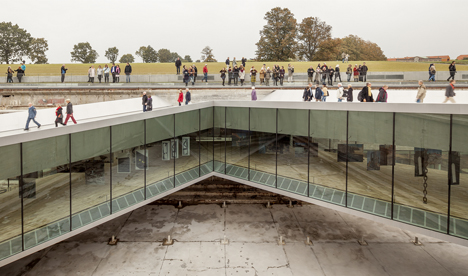
Alternatively, a grand entry path begins above via the bridge system that zigs and zags along the length of the museum to a main entry just below ground level. This route offers a gentle slope and stellar views of everything happening below and on all sides. Passers by can also enjoy a good look down when traversing a smaller connecting bridge that simply spans from one side to the other.

ship museum bridge design

ship surrounding area view

ship void site context

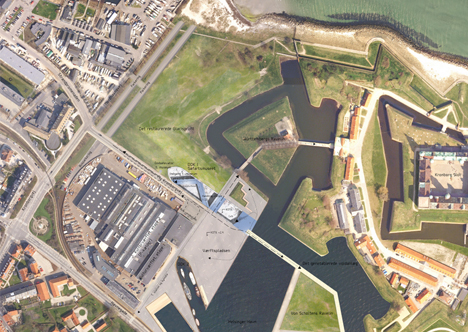
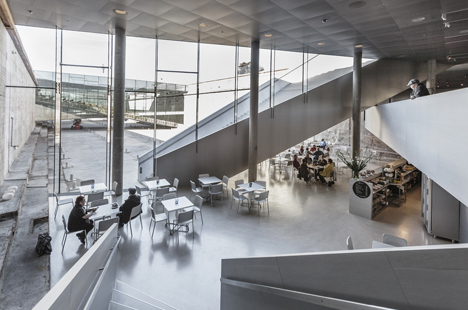
The main museum exhibition, auditorium, classroom, office and cafe areas are arrayed around the outdoor void on the levels below. Their borders are in turn defined by an off-axis rectangle the emphasizes their contrast with the curved ship shape of the center space and connect to other nearby attractions, monuments and landmarks.

Share on Facebook


[ By WebUrbanist in Architecture & Public & Institutional. ]

[ WebUrbanist | Archives | Galleries | Privacy | TOS ]

WebUrbanist

 
Comments Off on Ship Shaped: Undergound Maritime Museum in Dry Dock Void

Posted in Creativity


Mountaintop Museum: Underground Rooms Tunnel into Peak

22 Aug

[ By WebUrbanist in Architecture & Public & Institutional. ]

mountain museum overlook ledge

In a bold yet beautifully contextually move, this embedded mountaintop museum structure is part of a series of buildings set high in the mountains of Tyrol, Italy, and designed by Zaha Hadid Architects.

mountain museum spatial sequence

Visitors ascend the slope from below, enter a glazed above-ground space, then pass through subterranean exhibit rooms and come out onto an observation deck with stunning views down the steep sides of the mountain below.

mountain building underground rooms

The sixth of the set, Messner Mountain Museum is situated at the peak of Mount Kronplatz above a regional ski resort. It is designed to educate visitors on the discipline of mountaineering and celebrate the world’s greatest rock faces.

mountain section cut entrance

Aside from its sinuous aesthetic, the strength of this design relies on sequential experience – movement through the building provides an appreciation for both the site and the subject matter of the museum. It works, quite literally, on a number of levels.

mountaineering museum lower platforms

From the architects: “A composition of fluid, interconnected volumes, the 1000 sq. m. MMM Corones design is carved within the mountain and informed by the geology and topography of its context. A sharp glass canopy, like a fragment of glacial ice, rises from the rock to mark and protect the museum’s entrance”

Share on Facebook


[ By WebUrbanist in Architecture & Public & Institutional. ]

[ WebUrbanist | Archives | Galleries | Privacy | TOS ]


WebUrbanist

 
Comments Off on Mountaintop Museum: Underground Rooms Tunnel into Peak

Posted in Creativity


Secret Museum Hidden in an Abandoned Freight Elevator

23 Jul

[ By Steph in Architecture & Cities & Urbanism. ]

Abandoned Freight Car Museum 1

Unlike all of New York City’s flashy and well-known museums, this particular exhibition space is grungy, quirky and easy to miss. Located in an abandoned freight elevator on the edge of the Tribeca neighborhood in Manhattan, Museum measures just 80 square feet and is covered by a pair of unmarked, heavy iron doors when it’s closed. It contains collections of objects just as unconventional as the space itself.

Abandoned Freight Car Museum 2

Abandoned Freight Car Museum 3

As stark and unfussy as its name, Museum is intentionally hard to find. It’s only open to visitors on the weekend, but you can peer through a series of viewing windows to get a look at the contents 24 hours a day, 7 days a week. Photographer Garrett Ziegler captured these images of the space and its humorous, oddball display pieces.

Abandoned Freight Car Museum 4

The Museum exhibits consist of urban curiosities, found objects and funny vintage items in addition to art pieces. Want to know more about a particular piece? You can call a toll-free hotline (888-763-8839) and enter the item’s identification number (the exhibits change frequently, and are currently different than those pictured).

Abandoned Freight Car Museum 5

“Life exists all around us, and the proof of our existence is both beautiful and absurd. Our footprint, which is often overlooked, dismissed, or ignored, is intriguing, and always worth exploring.”

Share on Facebook


[ By Steph in Architecture & Cities & Urbanism. ]

[ WebUrbanist | Archives | Galleries | Privacy | TOS ]


WebUrbanist

 
Comments Off on Secret Museum Hidden in an Abandoned Freight Elevator

Posted in Creativity


World’s Most Powerful Man-Made Tornado in a Museum

25 Apr

[ By Steph in Architecture & Public & Institutional. ]

World's Strongest Man Made Tornado 1

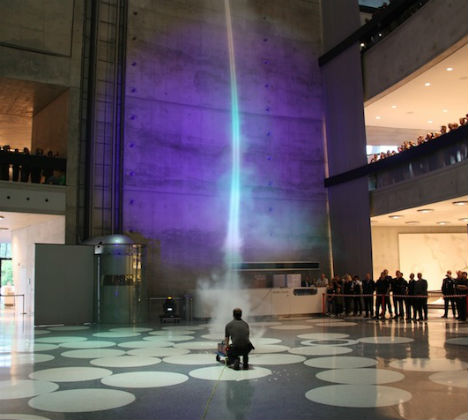
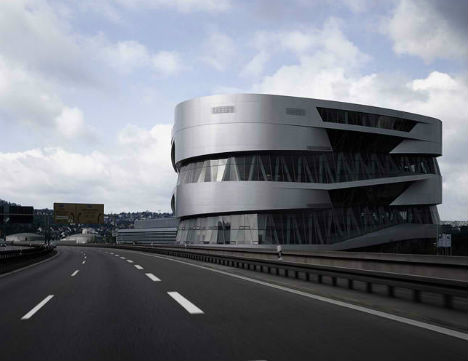
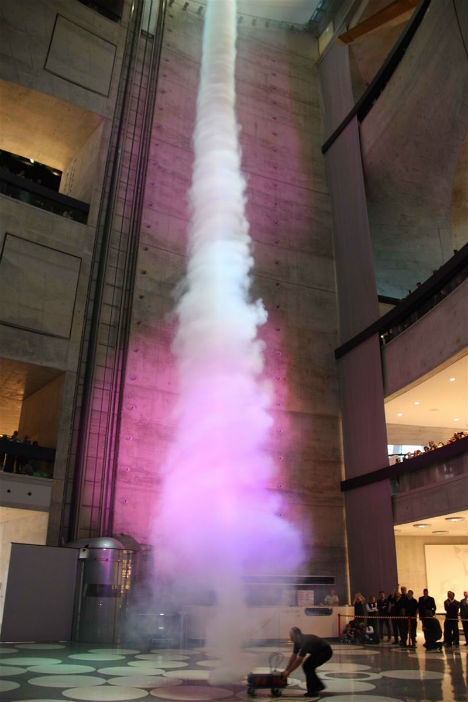
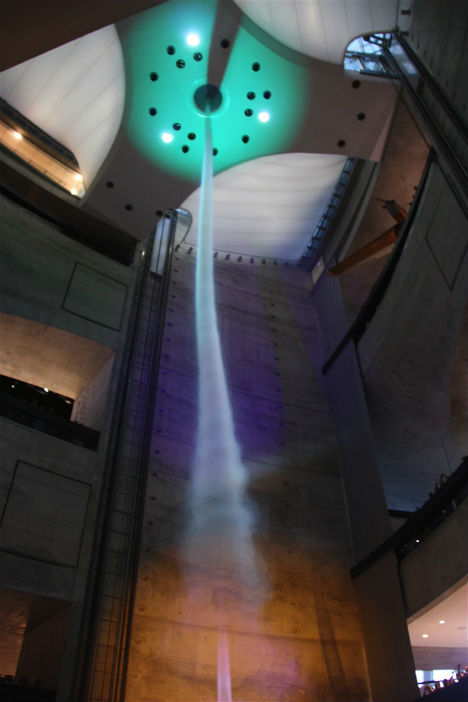
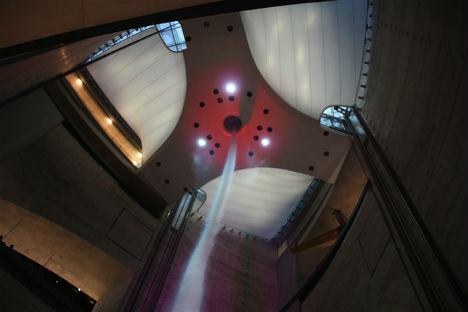
Experience the awe-inspiring power of a tornado, up-close and personal, without putting yourself in serious danger chasing a real one. The Mercedes-Benz museum in Stuttgart hosts the strongest artificially generated tornado in the world, with 144 jets spewing 28 tons of smoke in a 112-foot-high column. Why intentionally produce a tornado in a showroom full of over 150 luxury vehicles? The answer may surprise you.

World's Strongest Man-Made Tornado 5

World's Strongest Man-Made Tornado 2

The facility, designed by Dutch architecture firm UNStudio, is one of the most cutting-edge of its kind. Reminiscent of the Guggenheim, the Mercedes-Benz Museum is a steel structure based on a double-helix, featuring a massive central atrium viewable from the floors that spiral around it. All rooms are open, all walls are curved and each of the 1800 triangular window panes on the exterior walls is unique.

World's Strongest Man-Made Tornado 3

World's Strongest Man-Made Tornado 4

The 1500 exhibition areas contained within the space are connected without any fire zones – making them a bit of a hazard if a fire were ever to really break out. The solution? An artificial tornado created by injecting air into the interior courtyard of the museum from those 144 jets. The smoke is collected by the air currents and whisked outside.

Though it’s actually a safety measure, the tornado effect is so spectacular that it has become a bit of a tourist attraction, bringing even more people to check out the museum. See it in action above.


Share on Facebook


[ By Steph in Architecture & Public & Institutional. ]

[ WebUrbanist | Archives | Galleries | Privacy | TOS ]


WebUrbanist

 
Comments Off on World’s Most Powerful Man-Made Tornado in a Museum

Posted in Creativity


Spiral Out of Control: Guggenheim Museum Extension Idea

25 Feb

[ By WebUrbanist in Architecture & Public & Institutional. ]

guggenheim addition

The Guggenheim Museum in New York may be the most iconic work of American architect Frank Lloyd Wright – as such, any addition to it will invariably be the center of much debate … but this one (despite being more concept than call for change) could stir more discussion than most.

guggenheim artistic extension concept

A typical disjunctive approach to adding to or around classic architecture would involve setting the new elements apart from the old, to make the distinction clear. This conjunctive one by OIIO Architecture embraces the existing form, and builds dramatically upon it.

guggenheim floor plan addition

The design involves tripling the existing floor space by winding the outward-wrapping spiral that forms of gallery core up even higher and wider. The existing roof would be removed and re-added to the new top.

guggenheim current versus proposed

Critics will be quick to point out that though the form is maintained, the proportions are thrown for a loop, so to speak – and tapers the inner cone down to a small point. For all kinds of reasons, it is unlikely such a proposal would ever make its way into reality – still, as an experiment, it is quite beautiful.

Share on Facebook


[ By WebUrbanist in Architecture & Public & Institutional. ]

[ WebUrbanist | Archives | Galleries | Privacy | TOS ]

WebUrbanist

 
Comments Off on Spiral Out of Control: Guggenheim Museum Extension Idea

Posted in Creativity


Computer History Museum shares original Adobe Photoshop source code

16 Feb

splashscreen.png

The source code of the original version of Adobe Photoshop has been made available by The Computer History Museum, based in California. Photoshop started off in the 1980s as a program called ‘Display’ written by Thomas Knoll, before being renamed ‘Photoshop’ in 1990 – the year that the first version of the software shipped to customers. The download, which is available for non-commercial use with the permission of Adobe, consists of around 128,000 lines of code. Click through for more details (and some nostalgia-inducing screenshots of Photoshop 1).

News: Digital Photography Review (dpreview.com)

 
Comments Off on Computer History Museum shares original Adobe Photoshop source code

Posted in Uncategorized


Aerial Silks at the Museum of Glass

17 Jan

A rough sketch of the “Abandoned Bride” concept silks act, the final version of which was performed October 24-25, 2008 with Pendulum Aerial Arts in Portland, OR. Check out their website: www.pendulumaerialarts.org Sorry for the choppy video quality, it’s the fast-edit version. Music by Tosca Tango Orchestra from the soundtrack to “Waking Life” Special thanks to Julie Pisto and the Museum of Glass Leslie Raimer and Vertigo Rigging Videographer Basil Shadid Photographer Stacy Jacobsen and James Torchia
Video Rating: 4 / 5


Camille Pissarro, Ashmolean Museum Oxford

15 Jan

Check out these visual art images:

Camille Pissarro, Ashmolean Museum Oxford
visual art
Image by Martin Beek
Camille Pissarro (July 10, 1830 – November 13, 1903) was a French Impressionist painter. His importance resides not only in his visual contributions to Impressionism and Post-Impressionism, but also in his patriarchal standing among his colleagues, particularly Paul Cézanne.

Known as the "Father of Impressionism", Pissarro painted rural and urban French life, particularly landscapes in and around Pontoise, as well as scenes from Montmartre. His mature work displays an empathy for peasants and laborers, and sometimes evidences his radical political leanings. He was a mentor to Paul Cézanne and Paul Gauguin and his example inspired many younger artists, including Californian Impressionist Lucy Bacon.

Pissarro’s influence on his fellow Impressionists is probably still underestimated; not only did he offer substantial contributions to Impressionist theory, but he also managed to remain on friendly, mutually respectful terms with such difficult personalities as Edgar Degas, Cézanne and Gauguin. Pissarro exhibited at all eight of the Impressionist exhibitions. Moreover, whereas Monet was the most prolific and emblematic practitioner of the Impressionist style, Pissarro was nonetheless a primary developer of Impressionist technique.

Pissarro experimented with Neo-Impressionist ideas between 1885 and 1890. Discontented with what he referred to as "romantic Impressionism", he investigated Pointillism (as seen in this work above) which he called "scientific Impressionism" before returning to a purer Impressionism in the last decade of his life.

 
Comments Off on Camille Pissarro, Ashmolean Museum Oxford

Posted in Photographs


MUSEUM OF MODERN ART (MOMA) 2011 – 53rd Street, Manhattan NYC – 04/01/11

14 Jan

Check out these visual art images:

MUSEUM OF MODERN ART (MOMA) 2011 – 53rd Street, Manhattan NYC – 04/01/11
visual art
Image by asterix611
MUSEUM OF MODERN ART (MOMA) 2011 – 53rd Street, Manhattan NYC – 04/01/11

MUSEUM OF MODERN ART (MOMA) 2011 – 53rd Street, Manhattan NYC – 04/01/11
visual art
Image by asterix611
MUSEUM OF MODERN ART (MOMA) 2011 – 53rd Street, Manhattan NYC – 04/01/11

 
Comments Off on MUSEUM OF MODERN ART (MOMA) 2011 – 53rd Street, Manhattan NYC – 04/01/11

Posted in Photographs