www.artoftheimage.com – Reviewing the impressive new Nikon SB-700 Speedlight Flash and discussing why it’s much more than just an up-date to the SB-600.
Video Rating: 3 / 5

www.artoftheimage.com – Reviewing the impressive new Nikon SB-700 Speedlight Flash and discussing why it’s much more than just an up-date to the SB-600.
Video Rating: 3 / 5
[ By WebUrbanist in Design & Products & Packaging. ]

No shutter shades or scarf in this set, just a basic collection of essentials to get you started on the road to a life of independent fashion, aspiring artistry and political posturing.

A well-worn plaid shirt will compliment your new rounded, thick-rimmed, faux-vintage glasses. Take to the streets and share your mix tape of obscure bands, and don’t forget to shoot some Polaroids while you are at it.

Not sure what to do next? An owner’s manual is included. And what about the mustache? You probably don’t have to be male to pull it off, assuming you wear it with a sufficiently ironic affect. A great Christmas gift too – or maybe if you are feeling fashionably secular you could give it at New Year’s. Sure to be a hit this holiday season, regardless.

Stake your subcultural claim alongside beat, hippie, punk and grunge demographics with your style-defining assortment of goodies by graphic designer Mihael Mikloši. Thrift-store-worthy, organic-looking labels and hand-written fonts for things like the mix tape seal the deal.


[ By WebUrbanist in Design & Products & Packaging. ]
[ WebUrbanist | Archives | Galleries | Privacy | TOS ]
Editorial Engagement Shoot by Steven Branstetter Photography
Video Rating: 5 / 5
All photographers dream of new lenses and camera bodies, professional studio lighting, carbon tripods, and so on and so forth. But what is strange, too many of them oversee some not too expensive stuff which will infinitely enhance their workflow – making it more comfortable, safe and productive. Here are a couple of things I personally can’t live without: 1. Continue Reading
The post 4 Devices to Make Post-Processing Even More Enjoyable appeared first on Photodoto.

About this time last Friday I was in head-scratching mode, trying to figure out my light. Here was the challenge:
Teeny-tiny stage. Twenty three insane performers. No room to change shooting positions. Complex, low-level and fast-changing ambient.
I had been looking forward to it for weeks. Because I was getting to photograph MarchFourth, my absolute favorite band in the world. Lighting, pics and video, inside… Read more »
[ By Steph in Abandoned Places & Architecture. ]

While many abandoned places are ultimately demolished (and sometimes temporarily serve as settings for unexpected art installations), some get a second chance at life with restoration projects that transform them for new purposes. These 13 abandoned places, including zoos, bath houses, military compounds, railways and factories, now serve as libraries, galleries, offices, arts centers and private homes.

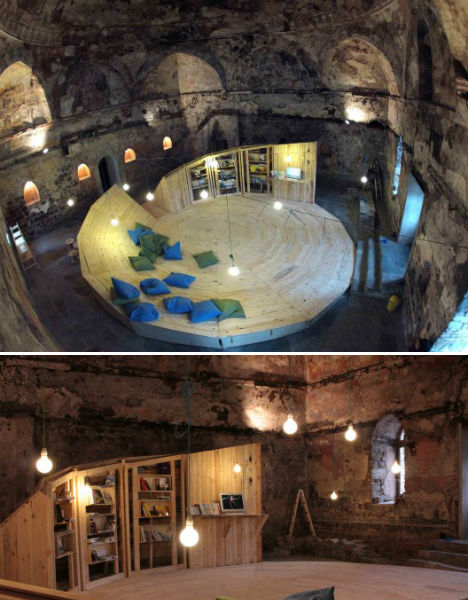
A beautiful rounded wooden library reminiscent of a seashell has been temporarily installed inside a once-abandoned Turkish bathhouse in Bulgaria. the ICONITemporary Library by Studio 8 1/2 contains nothing but books about contemporary art, with comfortable places to lounge, flip through the pages and gaze at the 16th century architecture.

Empty retail stores can be quite an eyesore, sitting vacant for months or even years. One such building has been completely transformed from a vacant Walmart in McAllen, Texas, to America’s largest library. Measuring 124,500 square feet, the single-floor library was painted in bright colors and renovated to include glass-enclosed spaces.

An old zoo in Torino, Italy has become the Street Art Museum, with the former animal enclosures painted with often-surreal scenes. It’s part of the Border Land Project, an urban regeneration initiative that helps utilize and raise awareness about neglected spaces.

The Harmony Club was built in 1909, and operated as a social club for the Jewish community in Selma, Alabama, including a restaurant, a ballroom and an exclusive men’s lounge. It was turned into headquarters for the Elks Club in the 1930s, and boarded up in the ’60s. Today, it’s a luxurious home that retains many of the historical details, making it truly one-of-a-kind. See more photos at Yatzer.

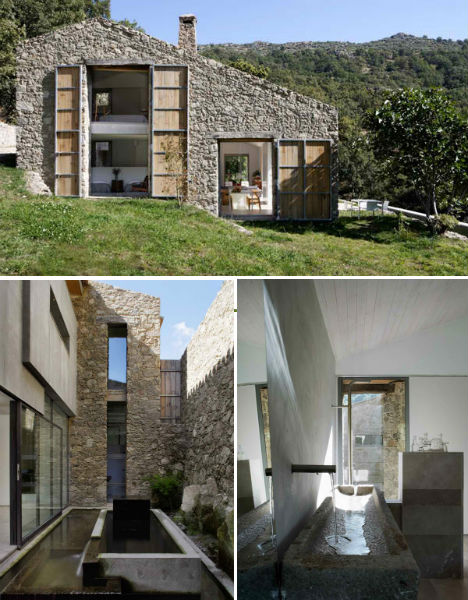
Architecture firm Abaton took a crumbling, centuries-old stone barn in the Spanish province of Caceres and rehabilitated it into a beautiful family home, with the haylofts becoming bedrooms. The large doors – two stories tall, in one case – were glassed in to create massive windows.

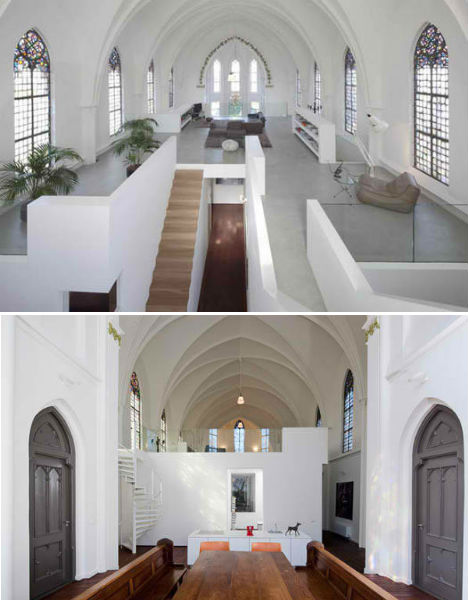
An abandoned Catholic church is now a spacious, modern residence in Utrecht, The Netherlands. Zecc Architects carefully preserved the dramatic aspects of the church’s architecture with soaring ceilings, stained glass windows and even a dining table made from the preserved pews.

The local council in Taichung, Taiwan had decided to demolish the remains of an abandoned 1940s military encampment on the outskirts of its suburban community, but an elderly resident named Huang Yunfu had another idea. He covered the entire site in colorful pairings, turning it into an outdoor gallery. It’s now called ‘Rainbow Village.’

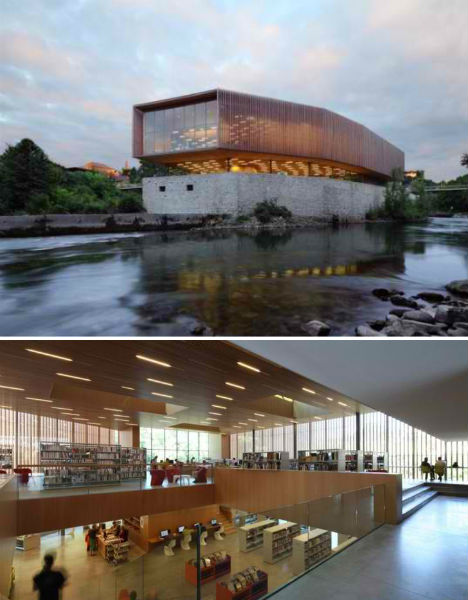
Would you guess that this incredibly modern-looking facility was once an abandoned beret factory? A riverside site that was recently little more than an industrial wasteland on the edge of the Pyrenees mountains in France is now a two-story multimedia center built on the original stone foundation with skylights and green terraces.

Madrid architects Churtichaga + Quadra + Salcedo (CH +QS) turned an abandoned garage in the center of the city into a timeshare office, preserving the industrial character of the place while adding comfortable semi-private nooks, including an informal living room made of wood crates.

After losing a competition to transform an abandoned sewage treatment silo in Amsterdam into a climbing gym, NL Architects may get a second chance. Developers in the area think that a third abandoned silo could be ideal for the project. The ‘Siloo O’ concept would create a world-class climbing and mountaineering facility that could become a major tourist attraction for climbers around the world.

Ad firm Wieden + Kennedy turned an old warehouse in Portland, Oregon into its new world headquarters, holding several hundred employees. Portland architecture firm Allied Works gave the building a new concrete interior and new stories, preserving some of the original timber.

Once the largest steel-producing facility in America, the old Bethlehem Steel building in Pennsylvania closed its doors in 1995 and remained abandoned for more than a decade. Spillman Farmer Architects converted the 68,000-square-foot space into the ArtsQuest Center, an art campus where the industrial aspects of the building are accented by the warmth of native Pennsylvania ash wood.

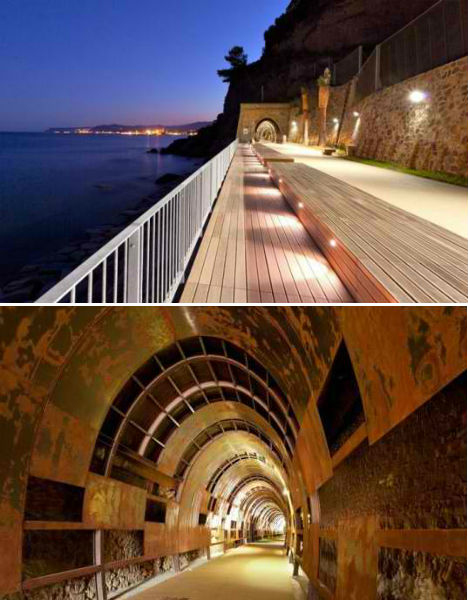
A retired railway between the towns of Albisola Superiore and Celle Ligure on the coast of Italy left a large stretch of the shoreline unused. 3S Studio and Voarino Cairo Voarino transformed the old promenade into a walking path using low-impact materials for a small environmental footprint.


[ By Steph in Abandoned Places & Architecture. ]
[ WebUrbanist | Archives | Galleries | Privacy | TOS ]
Aishwarya Rai’s wax statue gets a makeover! Anjana Sukhani talks about Ram Gopal Varma Anurag Kashyap has no time for Ranbir Kapoor’s ‘Bombay Velvet’ Chunky Pandey gets naughty on zoOm Shahrukh Khan to host IIFA awards Sonakshi Sinha turns photographer on-the-sets of ‘Rowdy Rathore’ ‘Vicky Donor’ will apparently be remade in Hollywood Will Shahrukh Khan skip the finale of the T-20 tournament? Your one stop destination for all the latest happenings,hot rumours and exclusive B-Town gossip… Subscribe NOW! www.youtube.com Follow us on twitter, facebook & Google+: www.twitter.com www.facebook.com gplus.to Also check out our website: www.zoomtv.in
Video Rating: 5 / 5
[ By Steve in Abandoned Places & Architecture. ]
Abandoned churches may symbolize to some the weakening of religion in the modern age but that’s far too simplistic an explanation – people can move, churches not so much. These 7 amazing abandoned churches stand as testaments to the power of faith and the construction skills of motivated craftsmen though their congregations have forsaken them.
(images via: Wikipedia/Alma Pater, Foje64 and Panoramio/Dainius63)
The six-story Church of Blessed Virgin Mary of Consolation in Vilnius, Lithuania, had its heyday long ago when the Polish–Lithuanian Commonwealth was one of Europe’s largest and most populous states. Tough times were in the making for Vilnius, however, and the years 1710 through 1711 when the city lost approximately half its population due to an outbreak of bubonic plague were especially trying.
(image via: Keith Ruffles)
Like most large churches and cathedrals, the Church of Blessed Virgin Mary of Consolation was built to last and last it has, through wars, plagues, communism and more. The appearance of trees and shrubs that have taken root on the roof of the lowest floor indicate that the old gal has at least some life left on her, if not in her.
(images via: Urban Ghosts, Verybadfrog.com and Waymarking)
Known as “St. Curvy” by parishioners due to the spectacular sweep of its wooden upper balcony, the Woodward Avenue Presbyterian Church in Detroit, Michigan was dedicated in June of 2011 after nearly three years of construction. The English Gothic-style church’s fortunes rose and fell along with the city of Detroit and only its addition to the National Register of Historic Places in 1982 kept it from the wrecker’s ball.
(image via: Rick Harris)
“This splendid building… stands as one of the most handsomest churches in the country,” wrote the Detroit Times on June 10th of 1911. Attendance declined in the mid-1950s and drastically accelerated following the 1967 race riots. After an unsuccessful stint as the Abyssinia Interdenominational Church, the building and its contents were sold to new owners unwilling to pay for its upkeep. A proposal in 2010 to turn the church’s cavernous carcass into a homeless shelter seems not to have gained traction and in the current grim economic climate it’s doubtful “St. Curvy” can hold out against vandals, the elements and time itself much longer.
(images via: Artificial Owl)
Located in the Mexican state of Michoacán, the remains of the Church of San Juan Parangaricutiro, rise from a still-warm lava field expressed by the Paricutin volcano in 1944. After suddenly erupting from a farmer’s cornfield the previous year, Paricutin expelled waves of molten lava that breached the church’s cemetery walls in 1944 and quickly subsumed most of San Juan Parangaricutiro’s centuries-old cathedral.
(image via: Panoramio/Panamon-Creel)
Only one tower, sections of supporting walls and the so-called “Altar de los Milagros” remain visible under solidified lava up to 40 feet thick. The church and alter are popular tourist attractions as it is said the lava’s stopping just short of the alter was a miraculous occurrence.
(images via: Bestarns and Jan Hoogendoorn)
Agnus Dei is a combination church and retirement home abandoned in 2005 after a devastating fire. The carnage was mainly restricted to the residential wing, however, leaving the liturgical areas comparatively unscathed.
(image via: Haikyo.org)
A more severe fire would have resulted in Agnus Dei’s exquisite stained glass windows being blown out, melted or both – they seem to have survived just fine. The relative isolation of the buildings has also helped keep vandals and graffiti “artists” at bay, which is why Agnus Dei’s precise location will remain unmentioned in this post.
(images via: Mr Wobble, Nathan.Horner and 28DaysLater)
Red brick Cottam Chapel (or Holy Trinity church) dates from 1890 though it looks much older than that. The crumbling structure is all that remains of a village that stood at the site for nearly 1,000 years. Services were held annually at the chapel around harvest time into the 1930s but the building has been unmanned and unmaintained since then.
(image via: Grangefirth)
The Cottam Chapel was slated to be demolished in 1990 but through the efforts of Arthur Mason of Cottam House, the Church Commissioners were persuaded to leave the structure in place, as-is. Nowadays the chapel is a popular stop for hikers in Yorkshire and it’s proved to be a boon for photographers after that quintessentially English composition combining the forces of time and the themes of pastoralism.
(images via: Not Over The Hill and KYCheng)
Dedicated on September 15th of 1882, the Methodist Church in the boomtown of Bodie was a case of too little too late: the town’s population had suffered a decline of roughly 70% over the previous year as the gold-mining boom was rapidly turning to bust. Like many of the town’s buildings, the church was made from wood which has held up remarkably well in the arid climate 8,379 feet (2,554 m) above sea level at the California-Nevada border.
(image via: Wikipedia/Thomas Fanghaenel)
Designated a National Historic Landmark in 1961 and a State Historic Park the following year, Bodie’s small but resilient Methodist Church remains in a state of “arrested decay”. Visitors are not able to enter the building but its door is open, literally, to those interested in how religion in a two-church town was able to coexist with over 60 saloons.
(images via: Britannica, Judith Lindberg and J.S. Aber)
The remnants of the Church of Hvalsey near the modern town of Qaqortoq, Greenland may look a little worse for wear but hey – how would YOU look after standing for 600-odd years in southern Greenland’s not-so-balmy weather? The most recent records concerning the church date from the year 1408 when a wedding was performed there. At that time the church was already over 400 years old, having been built shortly after Norse colonists from Iceland established the Eastern Settlement in the year 985. Skeletal remains of some of the colonists have been recovered from burial places just outside the church walls.
(image via: ArcticPhoto/Troels Jacobsen)
Qaqortoq means “the white place” in the language of the local Inuit people. Archaeologists surmise that the walls of the Church of Hvalsey were originally plastered with mortar made from crushed seashells though the plaster has completely weathered away. The church also featured windows which were small on the outside and large on the inside, a sign of advanced construction techniques employed by the “rough” Vikings.
![]()
(image via: Prima Games Author Blog)
Call ‘em creepy, spooky or just plain possessed but abandoned churches just seem to exude a certain vibe whether one is personally religious or not. Fictional representations such as the snap from Fallout 3 (above) can merely match the unsettling atmosphere of these monuments to monotheism; adding a neglected graveyard doesn’t hurt either. Take the time to visit an abandoned church sometime in your travels… you won’t be the first but you just might be the last!


[ By Steve in Abandoned Places & Architecture. ]
[ WebUrbanist | Archives | Galleries | Privacy | TOS ]
[ By Steve in Abandoned Places & Architecture. ]

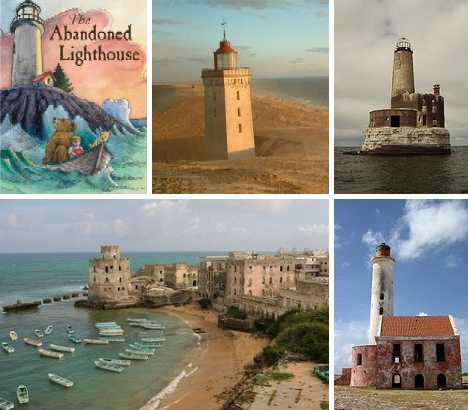
Is a lighthouse still a lighthouse when the light goes out and no one’s left to call it home? These 7 scenic sentinels slowly succumbing to the endless onslaught of wind and waves stand – barely – as solitary reminders of a time when fog-piercing lighthouse beams guided wayward mariners from the cold clutches of the devil and the deep blue sea.
(images via: Flavorwire and English Russia)
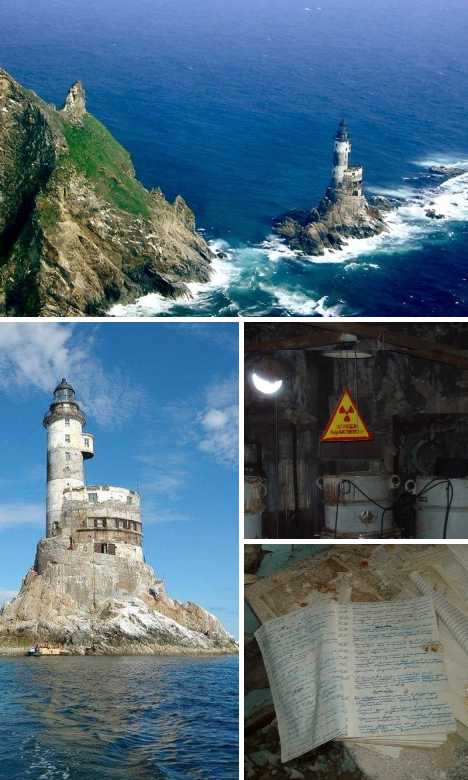
Built under extremely difficult conditions on a formerly jagged rock just off the southeastern-most cape of Sakhalin island, the Mys Aniva lighthouse has seen a lot of history over its 3/4 of a century lifespan. Japan ordered the lighthouse built in the late 1930s when Sakhalin was divided between that country and the USSR. Sometime after the Soviets seized the whole of Sakhalin at the end of World War II, they installed an RTG (Radioisotope Thermoelectric Generator) to supply electricity to the lamp – yes, this was a nuclear-powered lighthouse!

(image via: Remembering Letters and Postcards)
The fall of communism in the early 1990s led to a decade of near-chaos with funds for all purposes in short supply. The Mys Aniva lighthouse, isolated though it was and is, has been looted and ransacked for its metal fittings though luckily its RTGs were removed before the unofficial salvage crews arrived.
(images via: National Geographic, Lighthouse Friends and Robert Williams Photography)
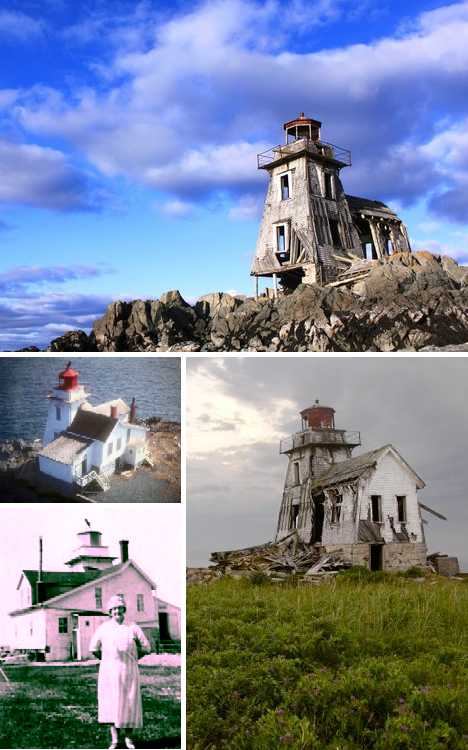
The Grand Harbour Lighthouse and attached keeper’s house at Fish Fluke Point on Ross Island, New Brunswick, Canada has been in a state of slow-motion collapse since 1963 when the station was closed. The once-picturesque lighthouse’s degeneration was accelerated by the great Groundhog Day Gale of 1976 but though it may make an excellent setting for a horror movie the lighthouse itself refuses to implode.
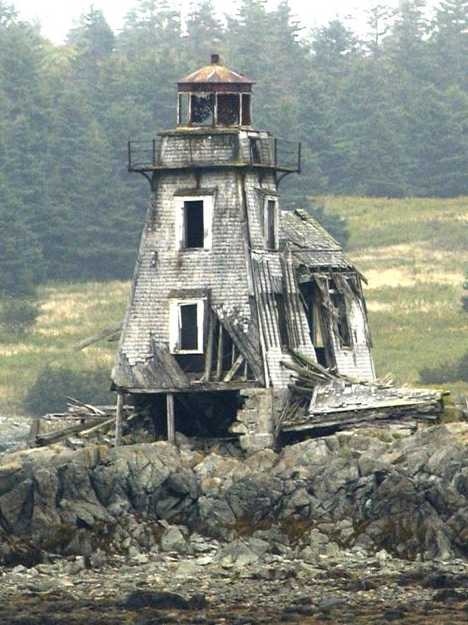
(image via: Swallowtail Keeper’s Society)
Opened in the fall of 1879, the Grand Harbour Lighthouse was a low-budget affair from the get-go: one of the early keepers was issued a hand-operated foghorn to be used as required. Cheap or not, the wood-framed complex has lasted longer than many stone structures of similar age. At this point it’ll take a superstorm of, say, Sandy-like intensity to finally knock its lights out for good.
(images via: Curacao-TravelGuide.com, Debi van Zyl and Foter)
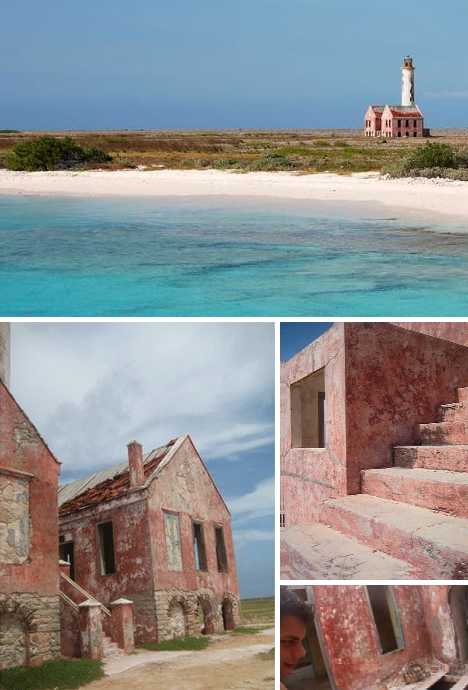
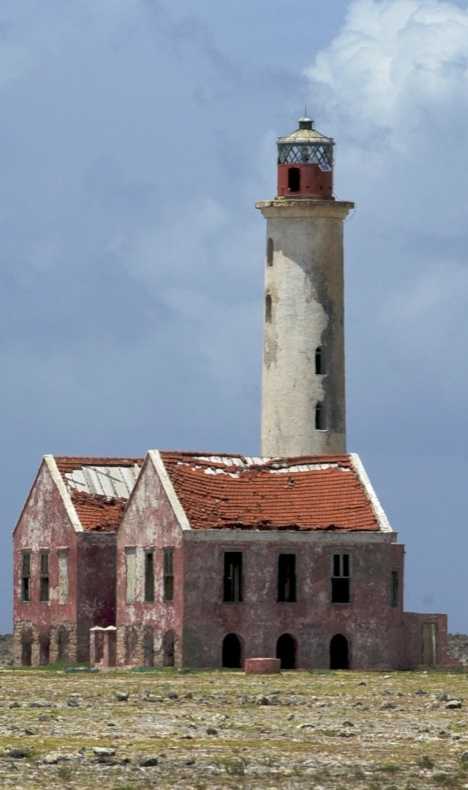
The Caribbean island of Curacao bore witness to the golden age of exploration, pirates, treasure-ships and more – and it’s got plenty of shipwrecks to prove it. In 1850 a lighthouse was constructed on the tiny, (3 km2 or 1.2 square mile) island of Klein Curacao situated 10 kilometers (6.2 miles) south-east of the mother island.
(image via: Gordon_C)
In 1877 a powerful hurricane destroyed the original lighthouse and in 1879 a stronger replacement was built. This lighthouse was subsequently storm-damaged and repaired again in 1913. Though the lighthouse had been abandoned decades ago and had been left to decay, the light itself was recently reactivated and an automatic solar-powered LED beacon was installed.
(images via: Waugoshance Lighthouse Preservation Society and Beaver Island Jewelry)
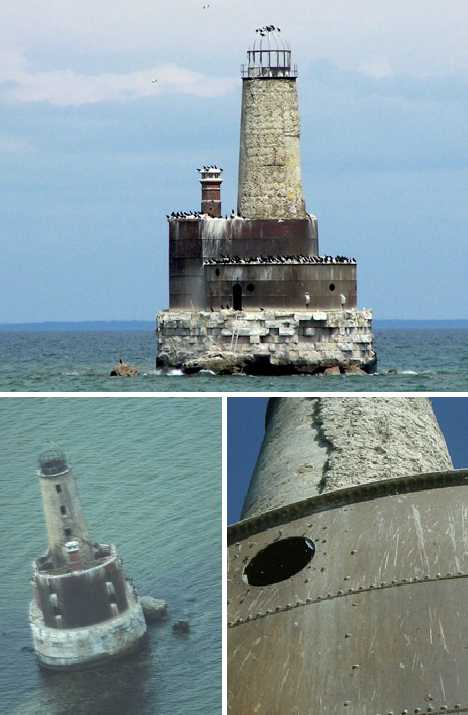
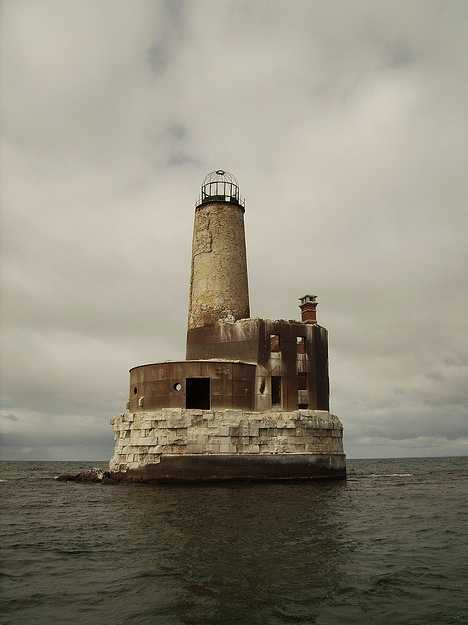
Not all lighthouses stand on the seashore; lakes need lighthouses too! Especially great lakes like, er, the Great Lakes where shipping (and shipwrecks) have been commonplace for several centuries. Take the late, great Waugoshance Light for instance. Built in 1851 to replace a lightship guiding ships through a treacherous area of the Straits of Mackinac, the Waugoshance Light was the first Great Lakes lighthouse to be surrounded on water on all sides.
(image via: Divemi)
The Waugoshance Light was built of brick and covered with iron plating – built to last, it was. Unfortunately, the creation of deeper draft ships that had to use the Gray’s Reef passage saw the building of the White Shoal Light and the Grays Reef Light. The Waugoshance Light was decommissioned in 1912 and was used as a gunnery target by the U.S. Navy during World War II. That anything still remains of this rugged feat of engineering after more than 160 years is remarkable to say the least.
(images via: Dissident Nation and National Geographic)
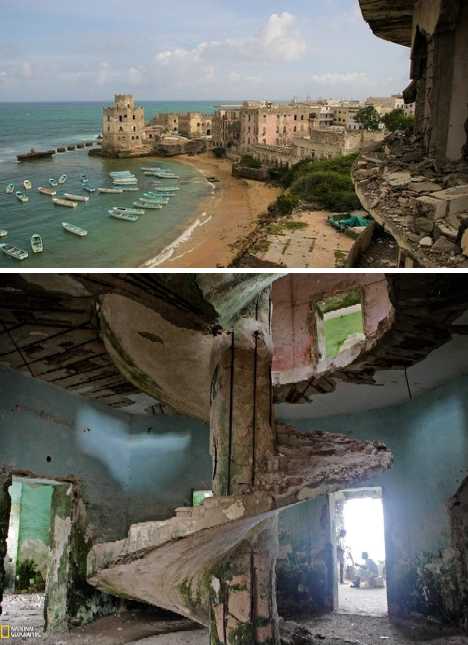
Though shattered by two decades of on & off civil war, the Somali city of Mogadishu has a long and prosperous history based on sea trading. The country’s network of ports appealed to Italian colonizers during the latter quarter of the 19th century and with the establishment of Italian Somaliland extensive infrastructure was built. One of the outstanding and surviving examples is the Mogadishu Lighthouse, or the ruins thereof.

(image via: Frankkeillor)
Its light long dimmed and its open spiral staircase on the verge of collapse, the lighthouse serves these days as a shady retreat for fishermen, gamblers and partakers of the aromatic stimulant shrub called qat.
(images via: Environmental Graffiti/Anders Hollenbo, CIB W78 and ForoCoches)
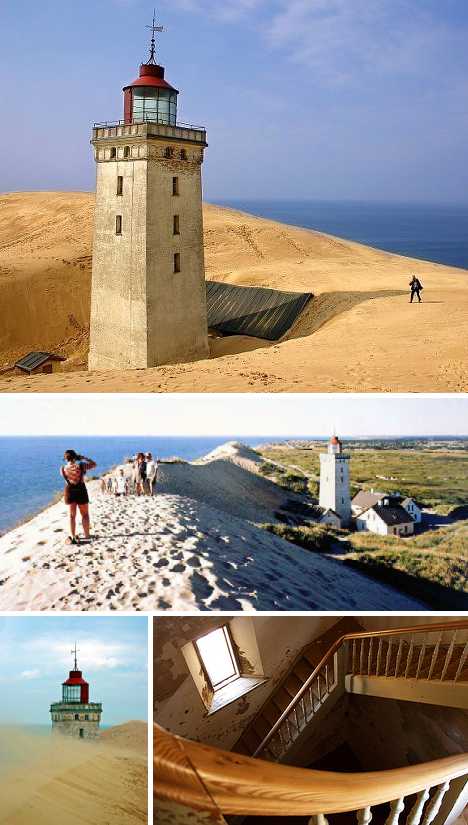
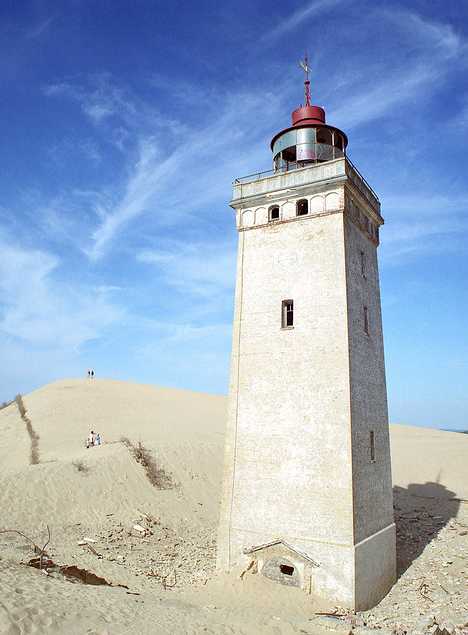
When the Rubjerg Knude Lighthouse in Jutland, Denmark first fired up its lamp on December 27th of 1900, its builders were confident its location atop Lønstrup Klint 60 meters (200ft) above sea level would keep it out of the reach of windblown sand dunes that had made any seaside construction untenable. Though in time the dunes would not be denied, it would take almost 70 years for the lighthouse to be rendered inoperable and a further 35 for all the buildings in the complex to be abandoned altogether.
(image via: Mariorei)
One might think a lighthouse nearly subsumed by sand dunes would be located in the Middle East, North Africa, basically anywhere but Denmark! Live & learn, constant readers and potential lighthouse builders. It’s somewhat ironic a lighthouse constructed to help those who sail the waves would be wrecked by windblown waves of sand.
(images via: Megali.ST, FKA, Tony Arruza Photography and Joyous!))
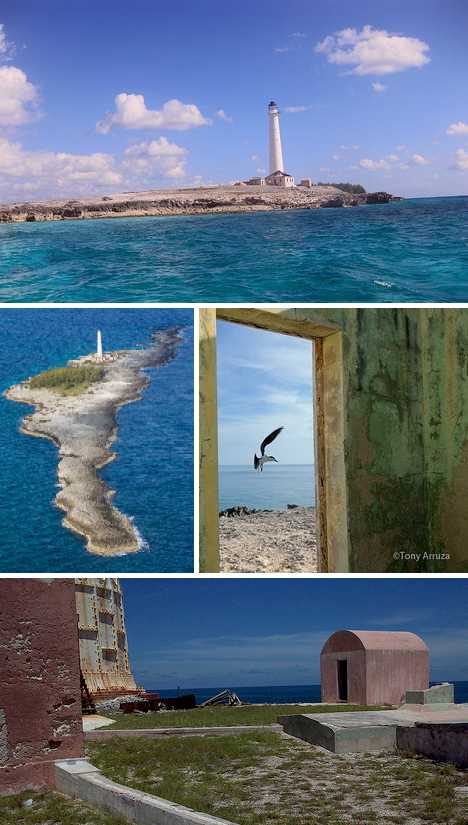
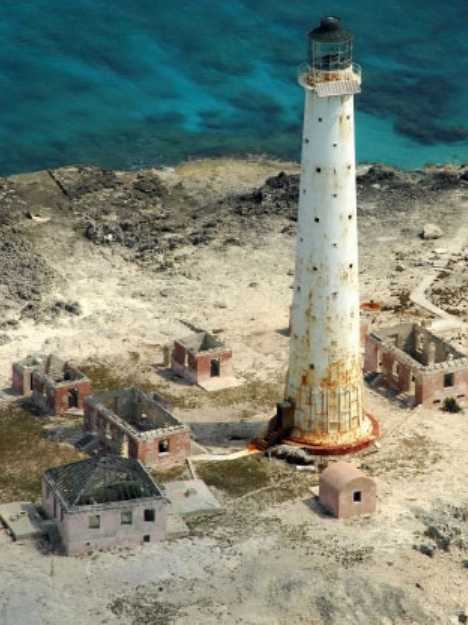
The Great Isaac Cay Lighthouse was built in 1859 on tiny Great Isaac Cay in the Bahamas. The 152ft-tall tower is surrounded by a small group of decrepit and decaying outbuildings abandoned after the lighthouse’s last two keepers mysteriously vanished in 1969.
(image via: Artificial Owl)
The lighthouse still functions using an automatic lighting mechanism as it is still needed as a navigational aid. That’s just as well – the lighthouse has acquired a reputation for being haunted by the ghosts of shipwrecked ship passengers. It’s said that when the full moon shines, the spectral shades of a mother and child shipwrecked off the island in the late 19th century can be heard bemoaning their fate.

![]()
(image via: Michael John Grist)
The first to go were the keepers, made redundant by automated power generators. Next were the lighthouses themselves, relegated to superfluousness when GPS navigation offered ship captains accurate positioning any time of day, whatever the weather. Often built in isolated locations beset by the harshest of environments, these relics of a more romantic age are gradually giving up the ghost, ravaged by the same seas they sought to make safer for sailors. Last one to leave, please shut the door and turn out the light.


[ By Steve in Abandoned Places & Architecture. ]
[ WebUrbanist | Archives | Galleries | Privacy | TOS ]
You must be logged in to post a comment.