RSS
 

Posts Tagged ‘More’

Q&A With Team Priime: Fave Styles, Cameras, And More!

24 Sep

A little while back, we asked some of our favorite IGers to tell us about their go-to photo editing apps. One that got a lot of love was Priime!

The Priime team is based right by our HQ in San Francisco, so we decided to pop by their office for a visit.

Take a look as we go behind the scenes and chat with them about how they’re taking photo styles to the next level.

(…)
Read the rest of Q&A With Team Priime: Fave Styles, Cameras, And More! (663 words)


© Taylor for Photojojo, 2015. |
Permalink |
No comment |
Add to
del.icio.us

Post tags:


Photojojo

 
Comments Off on Q&A With Team Priime: Fave Styles, Cameras, And More!

Posted in Equipment


How to take more Photography Gear through Airports

23 Sep

Have you ever wondered how you can get more gear onto a plane without paying an excess baggage fee?
We found this interesting video from photographer Peter Leong, a wedding photographer in Japan who travels regularly for overseas weddings, describing how he carries camera gear on board.

Have you worn a photography vest before? What has your experience been when traveling with photography gear and taking it through airport security?

googletag.cmd.push(function() {
tablet_slots.push( googletag.defineSlot( “/1005424/_dPSv4_tab-all-article-bottom_(300×250)”, [300, 250], “pb-ad-78623” ).addService( googletag.pubads() ) ); } );

googletag.cmd.push(function() {
mobile_slots.push( googletag.defineSlot( “/1005424/_dPSv4_mob-all-article-bottom_(300×250)”, [300, 250], “pb-ad-78158” ).addService( googletag.pubads() ) ); } );

The post How to take more Photography Gear through Airports by Darlene Hildebrandt appeared first on Digital Photography School.


Digital Photography School

 
Comments Off on How to take more Photography Gear through Airports

Posted in Photography


Exo creates housing to make GoPro operate, look more like a traditional camera

17 Sep

New Zealand-based EXO Camera Equipment has launched a Kickstarter campaign to get its camera-style casing for GoPro cameras off the ground. The company hopes to produce the EXO GP-1, a metal body into which GoPro cameras can be placed, to take on a more traditional camera form. Read more

Articles: Digital Photography Review (dpreview.com)

 
Comments Off on Exo creates housing to make GoPro operate, look more like a traditional camera

Posted in Uncategorized


6 Tips for Creating More Captivating Landscape Photographs

07 Sep

2-for-1 special

As part of Landscape Photography Week here on dPS, we’re offering TWO for the price of ONE on our best-selling Living & Loving Landscape Photography ebooks!

Click here to take advantage of this offer.


If landscape photography is your passion, you probably love to visit new places, and photograph beautiful natural scenes. But have you ever been unable to capture the beauty you saw in front of you in your camera? Do your images come out flat and boring? With these six tips, you’ll take your photography to the next level by creating more captivating landscape photographs that really stand out.

1. Time your shoot for the perfect light

Making interesting photographs is all about the light. Boring light creates boring photographs. Dramatic light creates dramatic photographs. Once you find a scene to work with, be patient and wait for the dramatic light that will enhance your image. You may even have to return on a different day to make the most of the scene.
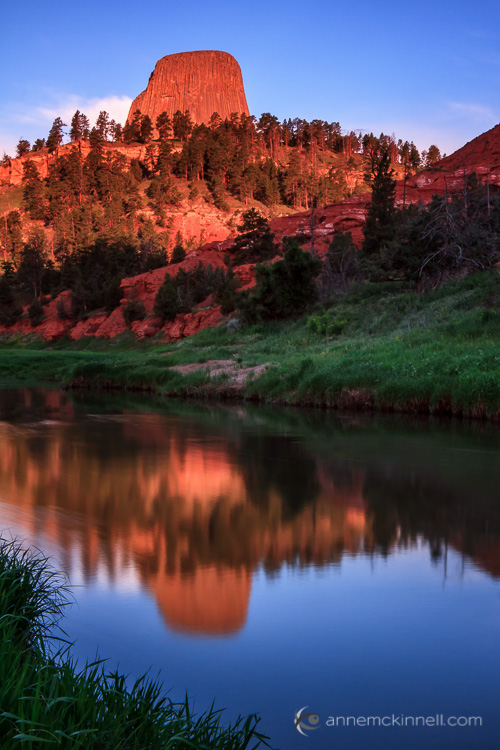
Devils Tower, Wyoming by Anne McKinnell

The quality of the light that illuminates your scene is going to change depending on the weather and the time of day.

Weather

The effect that weather has on your photo is usually obvious – a clear, blue sky gives a distinctly different feeling than dark storm clouds. Direct sunlight causes high contrast and dark, clear shadows – but the light becomes soft and even on an overcast day.

Time of Day

We know that the sun rises in the east and sets in the west, but the direction of the sun with respect to your landscape also makes a big difference. It could mean the difference between the sun being in, or out of the frame. It determines which side of a mountain is lit, and can change the way the shadows fall in a grove of trees.

When you’re scouting your location, try to figure out where the sun will be at different times of day, what effect that will have on your landscape, and when you think the light will be at its best. This can be as simple as deciding whether you are at a sunset or sunrise location, so you know the best time to return to the scene.
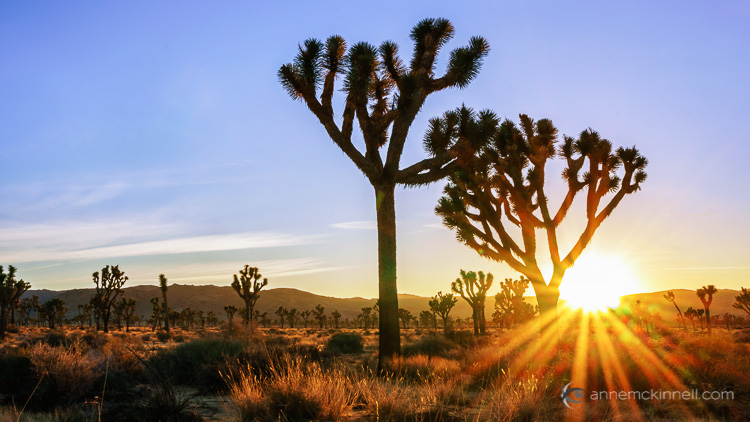
Joshua Tree National Park by Anne McKinnell

Keep in mind, as well, that the colour of the light changes throughout the day. When the sun is low in the sky (towards sunrise or sunset) the light takes on a warm golden hue, but in the middle of the day the light turns a brighter white. Just after the sun sets, and again before it rises, the blue hours give a scene a soft, cool tone.

2. Use the right equipment

Use a tripod to keep your camera steady and allow for longer exposures. A tripod will also help you be more purposeful in the way you compose the frame.

Choose your lens based on the type of photograph you want to make. A grand vista type of landscape photograph is usually made with a wide-angle lens, with a focal length below 35mm. The shorter your focal length, the larger your angle of view, and the more of the scene you can fit in the photo. However, by doing this you shrink everything within the frame.
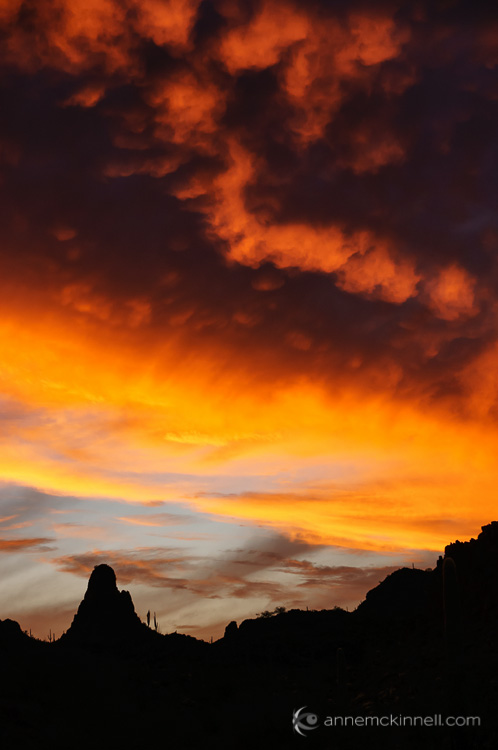
Ajo Sunset by Anne McKinnell

If there is something in your frame that you want to appear large in the scene, using a longer focal length will emphasize it. Longer focal lengths are also excellent for more intimate landscapes that do not include a massive expanse of space.

3. Use the right camera settings

Understanding the exposure triangle is critical when it comes to choosing the best camera settings. Generally, for landscape photographs where nothing is moving in the scene, you don’t need to worry about shutter speed, especially if you are using a tripod (see tip #2 above).

In landscape photography, one very important setting is aperture, since that controls the depth of field in your image. When making a grand vista type landscape, you usually want everything from foreground to background to be in sharp focus.

To get your photo sharp all the way through, use a small aperture, like f/11, to maximize your depth of field. However, smaller doesn’t always mean sharper – because of an optical phenomenon called diffraction, images tend to get softer when the aperture is too small. Therefore, the clearest images are typically made closer to the middle of a lens’ aperture range. I recommend shooting landscapes at f/11 instead of f/22 for the sharpest possible photo.
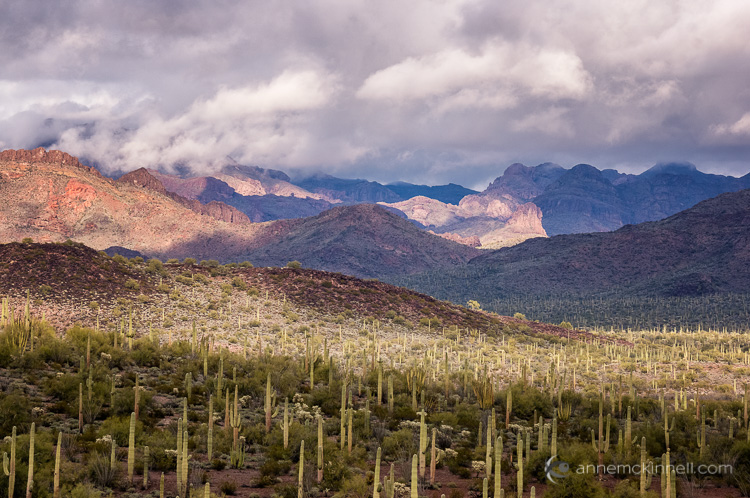
Organ Pipe Cactus National Monument Arizona by Anne McKinnell

That leaves ISO as the last factor in the exposure triangle. For the best image quality, your ISO should be set to a low value, like ISO 100.

If nothing is moving in your landscape, use aperture priority mode, set the aperture to f/11, set the ISO to 100, and then let the camera calculate the appropriate shutter speed to get a good exposure.

However, if there is something moving in the scene, you can set a higher ISO, to allow for a faster shutter speed.

4. Separate your foreground, middle ground, and background

When composing your landscape photo, try to arrange it with elements in the foreground, middle ground, and background. Make sure they are framed to be distinct, and separate from each other, in order to create a sense of depth that draws the viewer into the picture.
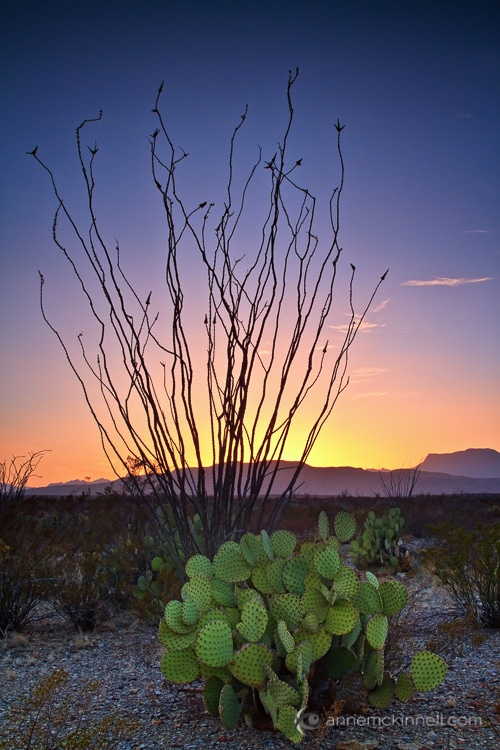
Big Bend National Park , Texas, by Anne McKinnell

Background features are common things like mountains, the horizon, and sky – while foregrounds can be nearby objects such as trees, grasses, man-made objects, and even rocks on the ground in front of the camera. The middle ground, of course, is everything in between that occupies the main part of the scene.

Not all photographs have these three distinct areas, but if you can compose your image so it does, you’ll have a photo with great depth and more impact.

5. Include a point of focus

Sunsets and forests and seashores are beautiful, but they need something small to give them a sense of scale. Almost anything can serve this purpose – a person walking through the scene, a single silhouetted tree, a boat floating in a lake, a dock, or an animal – anything to give scale to the immensity of the landscape and create something for the eye to be drawn to.
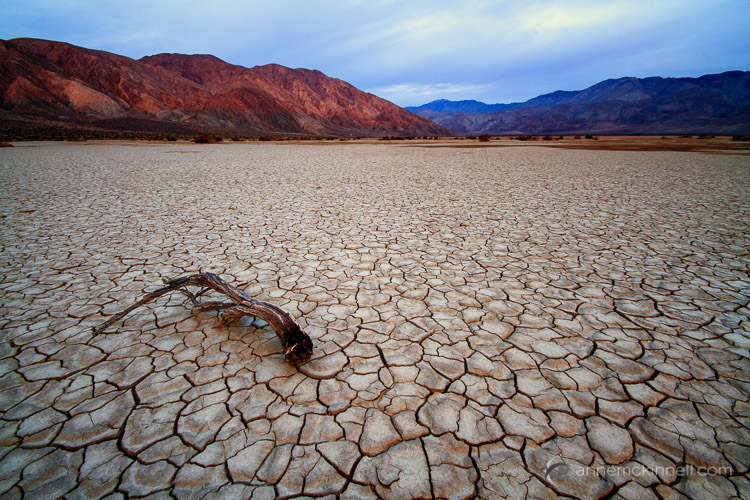
Clark Dry Lake by Anne McKinnell

6. Bracket your shots

Landscape scenes can be very high in contrast, so it’s a good idea to shoot a few different exposures to make sure you get details in both the highlights and shadows. Some cameras will have an automatic bracketing feature built-in, but if not, you can do this manually. Simply take one picture at the recommended settings, then turn your exposure compensation button (+/-) to +1 and take another. Repeat this at -1 and you’ll end up with three pictures of different brightnesses. Later, when editing them on your computer, you can decide which exposure looks best and even combine multiple images in Photoshop or Lightroom (using the new Merge to HDR feature in LR CC or LR 6) to get the most detail possible.

Good light, the right equipment, the right settings, a strong composition, and a good exposure all work hand-in-hand to ensure you’ll make captivating landscape photographs.


Here on dPS this is landscape week – here is list of what we’ve covered so far. Watch for a new article (or two) on landscape photography daily for the next couple days.

  • 6 Tips for Better Low-Light Landscape Photography
  • Landscape Photography and the Human Element
  • 5 Ways a Telephoto Lens Can Improve Your Landscape Photography
  • Landscape Photography from the Side of the Road
  • 32 Majestic Landscape Photos to Inspire Your Wanderlust
  • Weekly Photography Challenge – Landscape
  • Landscape Photography – Shooting the Same Location Through the Seasons
  • How to Solve 5 Composition Conundrums Faced by Landscape Photographers

googletag.cmd.push(function() {
tablet_slots.push( googletag.defineSlot( “/1005424/_dPSv4_tab-all-article-bottom_(300×250)”, [300, 250], “pb-ad-78623” ).addService( googletag.pubads() ) ); } );

googletag.cmd.push(function() {
mobile_slots.push( googletag.defineSlot( “/1005424/_dPSv4_mob-all-article-bottom_(300×250)”, [300, 250], “pb-ad-78158” ).addService( googletag.pubads() ) ); } );

The post 6 Tips for Creating More Captivating Landscape Photographs by Anne McKinnell appeared first on Digital Photography School.


Digital Photography School

 
Comments Off on 6 Tips for Creating More Captivating Landscape Photographs

Posted in Photography


Reflection Perception: 12 More Mirrored Art Installations

24 Aug

[ By Steph in Art & Installation & Sound. ]

mirror art main

Mirrors can disrupt our perception of our environment, especially when they’re positioned to blur the lines between land and sky, up and down, reality and reflection. These 12 (more) mirrored art installations dazzle us with glinting light, confuse us with illusions and invite us to question the difference between what we are shown and what we believe to be true.

Mirrored Ziggurat by Shirin Abedinirad

mirror art ziggurat 4

mirror ziggurat

mirror art ziggurat 3

Slivers of the sky seem to hover in mid-air if you approach this mirrored ziggurat from one of its corners, the steps reflecting the sky while the walls reflect the grass. “In this installation I have been inspired by the pyramidal structure of Ziggurat, a common form of temple in ancient Mesopotamia, attempting to connect earth and sky, so humans could be nearer to god,” says artist Shirin Abedinirad. “The Mirrored Ziggurat acts as a staircase, which seeks to connect nature with human beings and to create union of ancient history and today’s world. The installation offers a transformative view of the self.”

Dazzling Wolf by Tomoko Konoike

mirror wolf

mirror wolf 2

mirror wolf 3

mirror wolf 4

Tiny shards of mirrors reflect light all over the surrounding surfaces as they form a silvery fragmented coat for a six-legged wolf. Titled ‘Donning Animal Skins and Braided Grass,’ the sculpture by Tomoko Konoike draws inspiration from both tradition and pop culture in the form of manga and Shinto animism.

Landscapes Turned Upon Themselves
landscapes 1

landscapes 2

landscapes 3

landscapes 4

landscapes 5

Portions of a three-dimensional landscape are cut out and pasted on top of themselves in a large-scale mirror series called A Moment’s Reflection by Cody William Smith. The effect is most striking at night, when one side of the sky is dramatically different from the other. “My intention is to draw new connections between familiar forms by interdicting specular reflections to environments where none would typically exist. The mirrors serve as a focal point within a given scene and also function as a window to provide an entirely unique perspective on the same location.”

Maze of Mirrors at Hyde Park

mirror art maze

mirror art maze 2

Visitors carefully navigate a maze full of mirrors in Sydney’s Hyde Park, as it would be far too easy to just walk right into one of the reflective columns. Architecture firm Out of the Dark installed 81 mirrored posts with 423 reflective surfaces at the park as an interactive exhibit encouraging visitors to question what’s real and what’s an illusion.

Next Page – Click Below to Read More:
Reflection Perception 12 Mirrored Art Installations

Share on Facebook


[ By Steph in Art & Installation & Sound. ]

[ WebUrbanist | Archives | Galleries | Privacy | TOS ]


WebUrbanist

 
Comments Off on Reflection Perception: 12 More Mirrored Art Installations

Posted in Creativity


Less is more? Fujifilm X-T10 review

05 Aug

The Fujifilm X-T10 puts many of the X-T1’s capabilities into a smaller, less expensive body. It uses the same 16MP X-Trans CMOS sensor and EXR Processor II and, despite a more compact body, offers an additional custom function button and even squeezes in a pop-up flash. Is the X-T10 capable of holding its own against APS-C competitors? Read our full analysis. Read more

Articles: Digital Photography Review (dpreview.com)

 
Comments Off on Less is more? Fujifilm X-T10 review

Posted in Uncategorized


Putt Hurt: 12 More Abandoned Miniature Golf Courses

03 Aug

[ By Steve in Abandoned Places & Architecture. ]

abandoned-miniature-golf-course-1a
Most miniature golf courses have 9 or 18 holes per course. These dozen abandoned courses, on the other hand, have more holes than Blackburn, Lancashire.

abandoned-miniature-golf-course-1b

abandoned-miniature-golf-course-1c

abandoned-miniature-golf-course-1d

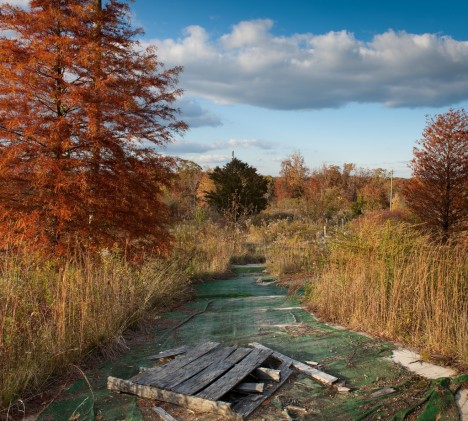
Flickr user Tom Faulkner (tom faulkner photographs) has apparently done the impossible by turning an abandoned miniature golf course into an oasis of breathtaking beauty. The course is located somewhere in Maryland and though the artificial greens and fairways still reflect hints of their former verdant glory, the true glory of Faulkner’s images comes courtesy of Mother Nature in all her autumnal glory.

Pasture-ized

abandoned-miniature-golf-course-2a

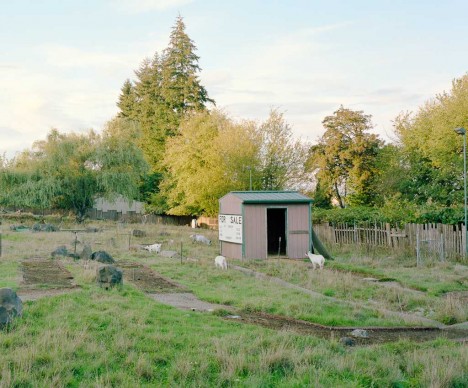
It’s so annoying when a perfectly good miniature golf course closes its doors and drifts into deterioration and decay. In fact, one might say it really… gets our goat. Kudos to Flickr user Isaac Sachs, who snapped the currently “now serving as a goat pasture” status of the former Scappoose Mini Golf in September of 2013.

Eurotrashed

abandoned-miniature-golf-course-3a

abandoned-miniature-golf-course-3b

abandoned-miniature-golf-course-3c

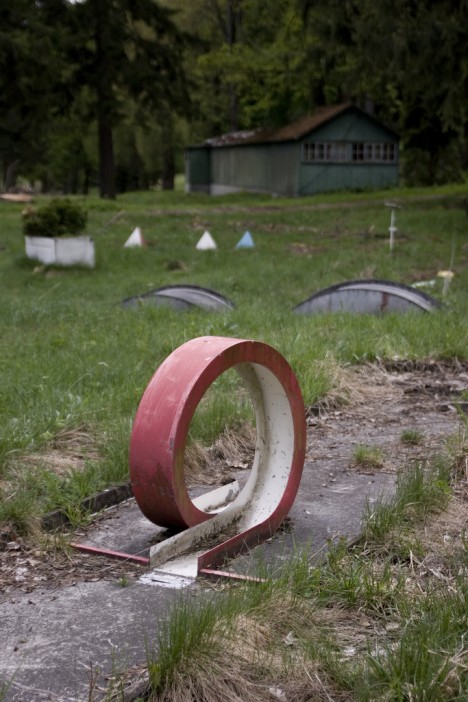
Flickr user bertolino captured this baaadly overgrown and abandoned miniature golf course on May 2nd of 2009… hey, don’t they have goats in Europe?

Not Milwaukee’s Finest

abandoned-miniature-golf-course-4

abandoned-miniature-golf-course-4b

abandoned-miniature-golf-course-4c

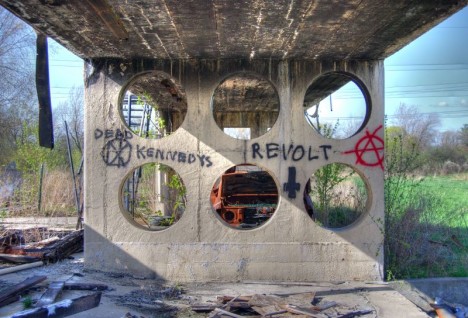
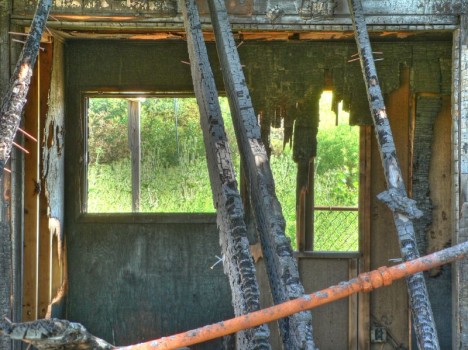
Dead Kennedys; D K; decay… coincidence? We think not! Flickr user Retinal Fetish brings us these post-apocalyptic images taken in 2006 and 2007 at Willow’s Miniature Golf in Milwaukee, Wisconsin. The graffiti’d divider wall looks a little like swiss cheese – gray and moldy swiss cheese but hey, beggers can’t be choosers. Hopefully it won’t attract giant rats.

Next Page – Click Below to Read More:
Putt Hurt 12 More Abandoned Miniature Golf Courses

Share on Facebook


[ By Steve in Abandoned Places & Architecture. ]

[ WebUrbanist | Archives | Galleries | Privacy | TOS ]


WebUrbanist

 
Comments Off on Putt Hurt: 12 More Abandoned Miniature Golf Courses

Posted in Creativity


Intel and Micron create 3D XPoint: a smaller, faster, more secure memory technology

29 Jul

Chip makers Micron and Intel have announced a new form of computer memory that promises faster, more reliable storage than current technologies, in a smaller space and at similar prices. The technology could reduce the distinction between memory and storage within computers and provide a faster, more stable way of storing large Raw and video files. Read more

Articles: Digital Photography Review (dpreview.com)

 
Comments Off on Intel and Micron create 3D XPoint: a smaller, faster, more secure memory technology

Posted in Uncategorized


Peak Design’s Everyday Messenger carries more than camera gear

25 Jul

Peak Design, maker of the Slide and Clutch and other camera gear, has launched its newest bag on Kickstarter. Called ‘The Everyday Messenger’, this bag features an adaptable design able to tote around one’s everyday gear along with photography equipment. Read more

Articles: Digital Photography Review (dpreview.com)

 
Comments Off on Peak Design’s Everyday Messenger carries more than camera gear

Posted in Uncategorized


The AP and British Movietone publish more than 1 million minutes of historic footage to YouTube

24 Jul

The Associated Press and British Movietone have announced the addition of more than 1 million minutes of digitized historic footage to YouTube. The AP says that this project represents the largest ever upload of historic news content to YouTube, and will serve as a ‘visual encyclopedia’ for witnessing some of the biggest moments in recent world history. Read more

Articles: Digital Photography Review (dpreview.com)

 
Comments Off on The AP and British Movietone publish more than 1 million minutes of historic footage to YouTube

Posted in Uncategorized