American professional camera dealer Digital Transitions has announced that it will host a preview event of a new Phase One medium format digital camera system that doesn’t use a reflex mirror system. Although Phase One has yet to comment, it appears that the A-Series will comprise three configurations which use different Phase One backs. The Phase One A250 will feature the IQ250’s 50MP CMOS sensor, while the A260 and A280 systems will use the IQ260 and IQ280 CCD sensors of 60 and 80 million pixels respectively. Read more
Tag: mirrorless
-
Think Tank launches Perception and Digital Holster bags for mirrorless systems
USA bag brand Think Tank Photo has launched a collection of daypacks and a new holster designed specifically for mirrorless camera systems. There will be three new bags in the Perception series of small backpacks, and will be available in sizes that range from the Perception Tablet that is suitable for a body, lenses and a mini tablet, to the Perception Pro which holds a tablet, a 15-inch laptop and a large mirrorless body with a collection of lenses. Read more
-
Photokina 2014: Canon interview – Mirrorless ‘in the very near future’
DPReview attended the Photokina trade show last week in Cologne Germany. As well as getting our hands on this season’s newest photo gear we also sat down with executives from several major camera manufacturers. One of them was Masaya Maeda of Canon. Our time with Mr Maeda was brief, but in our conversation he shared reactions to the 7D Mark II, and explained that Canon is very serious about mirrorless, and is also committed to making higher-resolution sensors. Click through to read more
-
Photokina 2014: Nikon interview – ‘large-sensor mirrorless could be a solution’
When we visited Photokina last week in Germany we made time to sit down with senior executives from several camera manufacturers. Among them was Toshiaki Akagi, Department Manager in Nikon’s 1st Designing Department. In our conversation we spoke about reaction to the D750, the legacy of the D600 oil problem and the potential for a large-sensor mirrorless camera from Nikon in the future. Click through to read the full interview
-
Olympus PEN E-PL7 compact mirrorless camera announced
Olympus has announced the PEN E-PL7, refreshing its entry-level mirrorless line. It offers a 16MP CMOS sensor, 3-axis image stabilization system borrowed from the OM-D E-M10, 8 fps continuous shooting and built-in Wi-Fi. Not forgetting the self-portrait-obsessed masses, the E-PL7 provides an articulated 3″ touch LCD capable of flipping downward by 180°. Along with the E-PL7, Olympus has also announced an update to its OI.Share app as well as a black version of its 12mm F2.0 prime. Read more
-
27 August, 2014 – The Mirrorless Revolution

There is no question times are a changing and in the photographic world we are witnessing these changing times with the migration to mirrorless camera systems. A recent report by CIPA and summarized by Mirrorlessrumors shows that DSLR shipments are falling and mirrorless camera shipments are steadily climbing.
Recently Michael and I sat down and made a video The Mirrorless Revolution. We discuss the move to mirrorless and why both of us have adopted it and why we enjoy it and what we think of the present offerings in this market. Plus, Michael sends a message to Nikon and Canon.
Have you wanted to travel to the bottom of the world and experience one of the most incredible photographic environments there is? Well you can this January and February with the Fly Over The Drake – Antarctica Workshop. Don’t hesitate register today
The Ultimate Iceland Workshop. See the Iceland others don’t experience.
-
Sony announces Alpha a5100 compact mirrorless camera
Sony has announce its new Alpha a5100 mirrorless camera, which takes the ‘guts’ from the a6000 and puts it into the compact body inherited from the NEX-5 line. The a5100 offers the same 24.3MP sensor with on-chip phase detection as the a6000, along with a 3″ LCD that flips up 180 degrees for taking self-portraits. The a5100 has impressive video features for its price, including support for the XAVC S codec, which allows for 1080/60p/24p recording at 50Mbps.
-
10 Reasons Why a Pro is Using a Mirrorless Camera for Personal and Paid Jobs

Everyone can take a picture, but as photographers (professional or aspiring), we have the skill set and the tools to create great images in any situation. We have the ability to turn the ordinary into extraordinary through photography. As the saying goes, the shoemaker’s kids have no shoes, and similarly, we often don’t put the same emphasis on images for ourselves and our family as we do for others and their families.
Personally I’ve always struggled with feeling like the “photographer” during personal affairs; I don’t feel right bringing a big DSLR, lens and flash to a family function, vacation or personal outing. Often this means that I either trust others to take pictures, or I take my own quick snaps with a point-and-shoot or with my iPhone.
My wife and I welcomed our first daughter Ava last March, and as a photographer, I know the importance of documenting those young, tender moments, and how impactful it can be to tell the story of childhood through photography. At the same time, I didn’t want to be “that Dad” who is always lugging around a camera bag. Quick aside: if that’s you, that’s perfectly fine, it just doesn’t work for me personally. I wanted to get great pictures of Ava on vacation, I wanted to be in the pictures myself, I wanted to capture happy moments around the house and I wanted to document her first Christmas. All the while, I wanted to leave the “big guns” in the studio.

With my mirrorless camera (I use the Fuji X-T1, X-E2 and the X100S), I can still take those great images while not standing out as a photographer. In fact, all of the images in this blog post are taken with my Fuji mirrorless cameras, and you probably didn’t know the difference
Creative Loop Versus Business Loop
Let’s back-up to 9 years ago. My story of discovering photography is not all that different from most photographers. I got into it because I loved the creative side of photography: the art, the composition, the lighting and the medium’s storytelling ability. We all start out in a “Creative Loop” that is a cycle of being creatively inspired, practicing, educating ourselves, learning and then gathering feedback.
Once you start out in business as a photographer, though, priorities often shift. As an entrepreneur, we have so many other aspects to think about outside of the creative process, such as marketing, pricing, branding, clients, workflow, customer service, and so on. We enter into the “Business Loop” that pulls our energy and attention away from the creative side.
For me, after a few years of being a professional photographer, I was becoming recognized, awarded, and known for my skills as a photographer. I became comfortable with my creative abilities and therefore much of my focus shifted to the business side of being a photographer.
Mirrorless Love
In October 2013, I attended a workshop with world-renowned photographer David Beckstead where he taught his approach to light, shadows and composition. What inspired me the most though was David’s shooting style with his Fuji X-E1, and how it forced him to be purposeful, be intentional and slow down. From the moment I looked through the electronic viewfinder (EVF) and saw the ability to shoot in Black and White and see in terms of tone and mood. I was hooked.
Fast forward to today and I am now shooting 60% of my professional work with my Fuji mirrorless camera, and 100% of my personal work with it. Here are the 10 reasons that I love shooting with a mirrorless camera.
Mirrorless Photography Love #1: Intentional and purposeful photography
I photograph mostly with my Fuji camera set to B&W mode and my Nikon full-frame camera set to colour, so when I am photographing, I am intentionally choosing to create an image in colour or B&W as I shoot. It is almost as if I am post-processing my images as I shoot. What I love most about this process is that it makes me think about these things before I press the button and it makes me photograph with greater purpose.

Mirrorless Photography Love #2: More thoughtful photography
Admittedly, the processing and usage of most mirrorless cameras aren’t as “snappy” and quick as the high-end DSLRs, but I actually like that. My Fuji mirrorless cameras makes me more thoughtful and forces me to slow down and be more methodical about my compositions and timing. This has made me a better photographer with more intentional images and less “spray and pray” sequences.
Mirrorless Photography Love #3: Seeing light, tone and mood
The electronic viewfinder (EVF) in my mirrorless cameras opens up a whole new world of possibilities. You’re looking at a processed image as it’s happening, it’s “what-you-see-is-what-you-get”. This has several benefits:
- You can see the image as you are capturing it, which means you don’t have to review and look at the screen (chimp) afterwards.
- You can see the exposure as you’re creating it, so you can more accurately fine-tune your exposure and get it right in the camera with more accuracy.
- In my case, where I shoot in B&W mode, it allows me to see that monochrome image as I’m making it so I am free from distraction of colour. It allows me to focus more on the light, tone and mood.
- When I’m shooting in colour mode, I can see the image in its “enhanced” state – with saturation, contrast, tone and sharpening adjustments applied. Sometimes I’m seeing an image better than what it looks like in real life!
Mirrorless Photography Love #4: Saves time
It’s obvious to see how shooting with a mirrorless camera, and an EVF specifically, will save you a ton of time on the back-end of your workflow. Shooting with greater purpose, while seeing mood and light more effectively and making exposure adjustments as you shoot, will result in more refined images right out of the camera, which eliminates a lot of post-processing work.
Mirrorless Photography Love #5: Low-profile presence
The physical appearance of a mirrorless camera is closer to that of a point-and-shoot instead of a DSLR. This is a good thing if you’re a photographer, like me, who wants to “blend in” with a crowd and not stand out.

Mirrorless Photography Love #6: Lighter and smaller
The smaller physical size also takes significant weight off of my shoulders and back, which I appreciate during a 12-hour wedding day. It also means that I can have a smaller camera bag. For the travelling photographer, you’ll appreciate the compactness as well.
Mirrorless Photography Love #7: Being a part of the picture-making process
This is highly subjective, but for me, the physical form factor of my mirrorless camera has a certain “feel” to it that makes me feel as though I am a part of the picture-making process. The raw, hard, mechanical and manual feel to my Fuji camera is so much more inviting and intimate. This inspires me to shoot differently and puts me in a different place creatively.

Mirrorless Photography Love #8: Improved autofocus
The benefit of not having a mirror involved in the picture-making process means that there is less to go wrong in terms of autofocus. The accuracy of autofocus in mirrorless cameras is significantly better than DSLRs because of this. Secondly, because the mirrorless camera doesn’t have to rely on a separate phase-detection AF chip to focus, the focus points aren’t limited to the center of the frame. This means that your autofocus points have great coverage and more flexibility.
Mirrorless Photography Love #9: Easier AF refinement
The EVF in mirrorless cameras means a whole new world of possibilities with regards to manual-focus. Specifically, split-image and focus-peaking are huge benefits that make manual focus and AF focus refinement much easier with a mirrorless camera.
Mirrorless Photography Love #10: More intimate subject engagement
The LCD screen on a mirrorless camera is the same as the EVF, and therefore you can use them both interchangeably without limitation. Being able to use the LCD screen has a huge benefit in that it allows me to engage and have eye-contact with my subject when it’s needed.

The Future of Photography
What does the future of photography look like? Is mirrorless a part of it? I believe so. There are three main reasons why I feel that mirrorless cameras and the mirrorless market will shape the future of photography:
Technology
The technological gap between the mirrorless line-up and the DSLR line-up is narrowing. Already there are so many reasons that mirrorless cameras are better for many photographers, as I’ve outlined above. The remaining areas where DSLRs have the leg-up on the competition are diminishing. My estimate is that within the next two to three years, the mirrorless technology will have caught up, and in six to eight years, the only real option on the market will be mirrorless cameras.
Innovation
The attention that mirrorless cameras have been getting has done wonders for the photography industry. What I love most about it is that it’s no longer a monopoly, and competition ultimately fuels innovation. Every camera manufacturer needs to be thinking forward, and this will push the industry and the technology in a positive direction.
Why Not?
Lastly I ask – why not? Why shouldn’t mirrorless technology be a part of the future? Maybe I should ask this a different way – why do we need the mirror in cameras today? It’s an old technology that is clunky, outdated and unnecessary. If we can use the same sensors, have the same kind of processing power, have the same autofocus, and ultimately achieve the same kinds of images without the mirror, wouldn’t you just say that it’s one more thing to break or to worry about?
Further Discussion
If the topic of mirrorless photography intrigues you and you’d like to further the discussion, I would love to talk! Please post your comment in the section below.
The post 10 Reasons Why a Pro is Using a Mirrorless Camera for Personal and Paid Jobs by Bryan Caporicci appeared first on Digital Photography School.
-
Fujifilm X-T1 Mirrorless Camera Review

The weather resistant Fujifilm X-T1 Mirrorless Camera
I was thrilled when Fujifilm Canada sent me their brand new X-T1 to play with just over a month ago. Along with the camera body itself they sent me three lenses including the XF 55-200mm F3.5-4.8 R LM OIS, the XF 35mm F1.4R and the XF 60mm F2.4 R macro lenses. Upon removing these items from the box I was immediately impressed with the professional fit and finish of the camera body, lenses and lens hoods. Larger companies like Canon could learn a thing about lens hood design from Fujifilm. While the camera body is weather resistant, none of the lenses currently available at the time of this review shard that characteristic.
Electronic viewfinder
Mirrorless cameras seem to be all the rage these days and for good reason. Leaving the mirror out of the light path allows for smaller, lighter, less mechanically complex cameras to be built. But, without a mirror to reflect light into the viewfinder, mirrorless cameras are dependent on providing a viewfinder image via an electronic viewfinder (think of a tiny monitor). Past attempts at electronic viewfinders by Fujifilm and other manufacturers has generally resulted in sub-standard results due to laggy (slow to respond) electronic viewfinders with hard to view results.
Fujifilm Viewfinder Layout
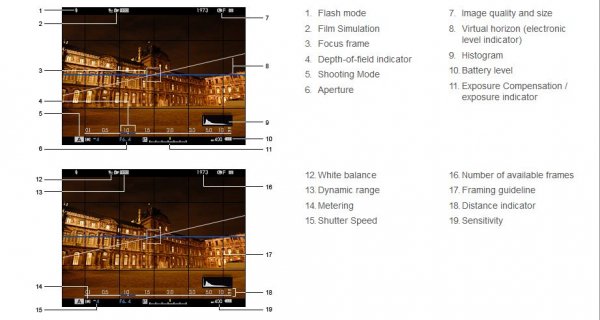
The X-T1’s viewfinder suffers from none of these problems. The viewfinder is large, bright and very responsive. I normally shoot with one of Canon’s pro cameras and the X-T1’s viewfinder was, surprisingly, a tiny bit larger. An advantage of the electronic viewfinder is that extra information can be superimposed over the image, allowing photographers to make real-time adjustments to exposures before the image is made by glancing at a histogram, instead of having to wait until after the photo is made as is the case on a standard digital SLR camera.
Autofocus
Another issue plaguing many mirrorless cameras has been their autofocus performance. Fujifilm has tackled this head-on by providing 49 focus points spread out across the entire image and those focus points are adjustable in size so that you can customize them based on the type of subject you are photographing. Where most mirrorless cameras rely on a type of autofocus system detecting contrast to determine whether the image is in focus or not, the central nine focus points on the X-T1 use the faster, more accurate phase modulation focus system for superior results.
Image quality
I found the images produced by the sensor of the X-T1 to be especially nice; low in noise and more resolution than I was expecting from a 16 megapixel APS-C sized sensor. That could be due to the fact that the X-Trans CMOS II sensor in the X-T1 uses a unique arrangement of colour filters which supposedly eliminate the need for an optical low-pass filter thereby resulting in increased resolution and perceived sharpness.
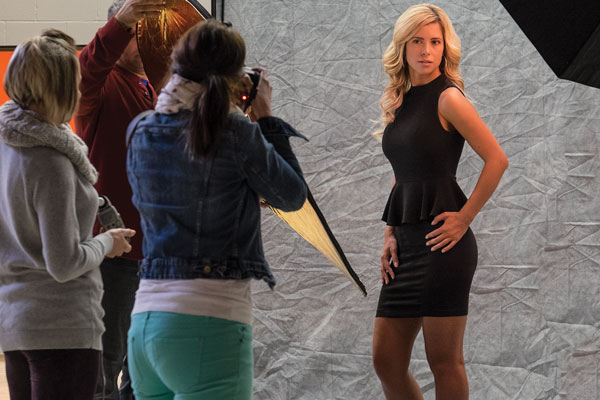
Students photographing model – ISO 3200 – XF55-200mm F3.5-4.8 R LM OIS Lens
1/25 at F6.4, ISO 3200, 95mmWiFi
The X-T1 also has built in WiFi capabilities that allow you to download a free app for your smart device. This app allows you to remotely control your camera from a distance. A nifty application that requires additional hardware on most other current cameras to achieve similar results.
Controls on top of the camera
Camera controls
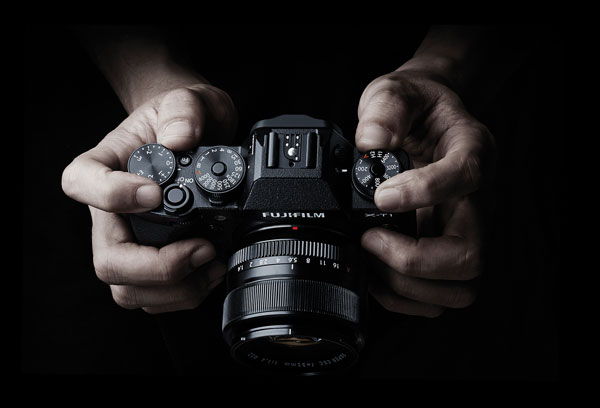
What I became especially fond of while working with the X-T1 is the controls for aperture, shutter speed, ISO and exposure compensation. Aperture is controlled by rotating a ring on the lens, just next to the body. ISO, shutter speed and exposure compensation are all controlled via dials on the top of the camera. Reminded me of some of my old-school SLR cameras, but it took me virtually no time to adapt from the Canon cameras I’ve used for the last 20 years or so.
Size and weight
The camera body itself is extremely light-weight but fit comfortably in my somewhat gigantor hands. I suspect adding the optional battery grip and/or hand grip would make it even better and of course battery grips always help with the making of vertical photographs. That said, most of the controls were easily accessible and with the body itself weighing in at just 440g (15.4 ounces), it is a camera that I could easily carry and shoot with for extended periods of time with little or no hand/shoulder/arm fatigue setting in. Even with the 55-200mm lens attached, the weight was just 1020g (36 ounces).
Customization
Another pro-camera feature I was thrilled to find on the X-T1 was a total of six different completely configurable multi-function buttons. This allowed me to fine-tune access to features like selecting focus points, depth-of-field preview, macro mode, autofocus mode and white balance so that I could program the buttons most convenient for me to the functions I use most.
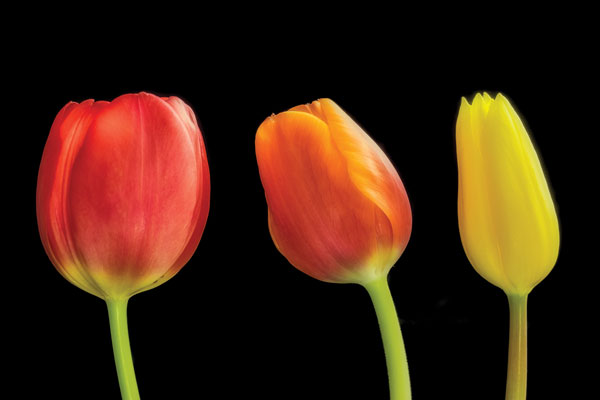
Studio Tulips – XF60mm F2.4 R Macro Lens
5.3 Seconds at F8.0, ISO 200, 60mmDislikes
If you’re wondering if there is anything I didn’t like about the camera, there is. I strongly dislike the four-way controller on the back of the camera. Where the other buttons on the camera offer tactile feedback when pressed, that feedback is absent on the four-way controller. Since I needed to use the four-way controller to select different focus points, I was constantly using (or trying to) the four-way controller. I found it virtually impossible to use without glancing towards it (thus removing my eye from the viewfinder and missing a chance at retiring via a photo of a brief appearance by Sasquatch if that circumstance had occurred) and continually frustrated by it. Living where I live in Canada and therefore in cooler temperatures, it is absolutely impossible to use with any sort of gloves in conjunction with the four-way controller, and on a mostly professional-feel camera like this, it was a bad design or manufacturing decision.
Another quality issue on the camera body is the door that slides opens to allow for the removal of the SD memory card. It feels ridiculously flimsy and I felt lucky to be able to send the camera back to Fujifilm with the door intact because it always felt like it was about to break off.

Red-breasted Nuthatch – XF55-200mm F3.5-4.8 R LM OIS Lens
1/800 at f4.8, ISO 800, 200mmOverall
Overall though, this camera is a gigantic win for Fujifilm in my opinion. I’m a wildlife photographer by nature and for the most part, that’s the type of shooting I did with the camera. I was suitably impressed with the autofocus, and was thrilled with the quality of the lenses and sort of images that the sensor produced. Regardless of the situation (high or low ISO), the images were always impressive and the camera did a great job at judging the white balance although I always shot in RAW mode just to give me that extra flexibility in case the camera got in terribly wrong.
Need for longer lenses
For a wildlife photographer though, Fujifilm’s biggest weakness is the lack of larger lenses. The biggest lens I could get my hands on was the 55-200mm (84-305mm equivalent on a full-frame camera). While that’s okay for casual wildlife photography, it stops well short of “real” telephoto focal lengths. For instance, just a couple of days ago I was out at my favourite marsh with my camera, 500mm lens with two teleconverters attached (2.0x and 1.4x) for a grand total of 1400mm of image magnification. However, Fujifilm representatives tell me they have plans for bigger glass in the future and if that comes to be, I know that it would make a tempting package for me to have in my kit.

Snowshoe Hare – XF55-200mm F3.5-4.8 R LM OIS Lens
1/200 at f 4.8, ISO 400, 200mmRoom for improvement in some areas
Another area that still needs some work is the autofocus system. While the X-T1 is a great improvement over other mirrorless systems I’ve tried, it still suffers from performance issues with moving subjects rapidly changing distances between shots. Theoretically, the X-T1 can shoot 8 frames-per-second in continuous drive and focus modes. However, if the subject you’re focused on is rapidly moving towards you, the camera’s processing slows down and I was lucky to get 2 or 3 frames per second.
An additional improvement I’d like to see is an expansion in the number of phase-detect autofocus points. Nine out of forty-nine isn’t a bad ratio, but more would be better. I love the control over the size of focus points, but having more of the high-performance phase-detect points would help a lot too for composition on moving subjects.
For accurate exposures, I love having a live histogram overlaid on my image in the viewfinder. However, it was frustrating to have that histogram disappear when I half-pressed the shutter button to focus on my subject. While in continuous focus mode, having the histogram remain visible would help me make better exposures overall.

Red-breasted Nuthatch – XF55-200mm F3.5-4.8 R LM OIS Lens
1/800 at f5.6, ISO 400, 200mmFinal word
Overall, I highly recommend this camera. I teach hundreds of photography students each year the basics of operating their interchangeable lens cameras. I can confidently state that a student with this camera system would probably find learning the basics a bit easier than with a standard digital SLR camera system if for no other reason than the live histogram available in the electronic viewfinder and the easy to access, logically laid out controls. Further, for the seasoned user, the X-T1 body and lenses make a great combination for producing high-quality professional results.
The post Fujifilm X-T1 Mirrorless Camera Review by Paul Burwell appeared first on Digital Photography School.
-
25 May, 2014 – The Ultimate Mirrorless Camera Strap?

The passion of photography for many soon turns into an addiction as we look for the latest and greatest gear. This includes camera bags and now camera straps. Kevin Raber today reviews The DSPTCH Camera Strap System. It’s a modular camera strap that works well with the small format cameras mirrorless cameras. It’s definitely a strap to have but beware it will lead to a new addiction.

Have you checked out the Kimberley Workshop next April. This is definitely one that should be on your bucket list.