RSS
 

Posts Tagged ‘mirrorless’

Nikon announces Z 24-70mm F2.8 S – a new standard zoom for mirrorless

17 Feb

$ (document).ready(function() { SampleGalleryV2({“containerId”:”embeddedSampleGallery_1500268640″,”galleryId”:”1500268640″,”isEmbeddedWidget”:true,”selectedImageIndex”:0,”isMobile”:false}) });

Nikon has taken the wraps off a new standard zoom lens for mirrorless – the Z 24-70mm F2.8 S.

The Z 24-70mm F2.8 S has been on Nikon’s Z-series roadmap since the mount was announced last August, and is being pitched by Nikon as a perfect fast standard lens for the Z6 and Z7, offering a faster maximum aperture and more robust build quality than the more compact Z 24-70mm F4 S.

Compared to the AF-S 24-70mm F2.8 for F-mount, the new lens is 25% smaller and 18% lighter, with a totally redesigned optical formula comprising 17 elements in 15 groups. Two of the elements are Extra Low Dispersion (ED) glass, and four are aspherical. As well as Nikon’s Nano Crystal coating, the 24-70mm introduces a new ‘Arneo’ coat, which is promised to further reduce flare and ghosting. Fluorine coating on the front and rear elements is designed to help make it easier to clean oil and moisture from the outer surfaces of the lens.

Initial sample images from photographer Ami Vitale

$ (document).ready(function() { SampleGalleryV2({“containerId”:”embeddedSampleGallery_0584537716″,”galleryId”:”0584537716″,”isEmbeddedWidget”:true,”selectedImageIndex”:0,”isMobile”:false}) });

An customizable ‘L-Fn’ button is joined by an OLED panel, which can display various information, including focus distance, aperture and focal length. Also new, a third customizable ‘control ring’ joins focus and zoom rings to provide direct control over various exposure parameters (if desired).

The new Z 24-70mm F2.8 S will ship later this spring, at an MSRP of $ 2299.

Press release:

NIKON UNVEILS THE NIKKOR Z 24-70MM F/2.8 S, A FAVORITE ZOOM LENS REBORN FOR THE Z SERIES

The NIKKOR Z 24-70mm f/2.8 S Implements the Latest Nikon Optical Technologies to Reinvent One of Nikon’s Most Coveted Zoom Lenses for the Full-Frame Mirrorless Z System

MELVILLE, NY (February 13, 2019 at 11:01 P.M. EST) – Today, Nikon Inc. announced the NIKKOR Z 24-70mm f/2.8 S: a much-anticipated, fast-aperture zoom lens that’s ideal for professional and advanced photographers who capture portraits, landscapes, weddings and events, as well as content creators who shoot video using Nikon’s revolutionary new Z Mount System. Designed to take full advantage of the wider, brighter and faster Z Mount, this new S-Line lens delivers stunning sharpness all the way to the corners of the frame, even when used at its maximum aperture.

The NIKKOR Z 24-70mm f/2.8 S is the first NIKKOR lens to use the all new Nikon-designed ARNEO coat, which is used in conjunction with Nikon’s Nano Crystal Coat to significantly minimize flare and ghosting. The lens also includes Nikon’s new Multi-Focus System to help ensure fast and accurate autofocus even when shooting close-up subjects. Additionally, the 24-70mm f/2.8 S is the first NIKKOR Z lens to feature a dedicated manual focus ring independent of the customizable control ring, a Function (L-Fn) button, and an Organic EL Lens Information Panel for quick reference of key settings such as focus distance, depth-of-field, aperture and focal length.

“The NIKKOR Z 24-70mm f/2.8 S is the lens that Z Series users have been waiting for, a lens that many photographers and videographers would never leave home without,” said Jay Vannatter, Executive Vice President, Nikon Inc. “Lightweight and tack sharp, the 24-70mm f/2.8 S is a great example of the outstanding performance and portability that is possible with our next-generation Z Mount System.”

NIKKOR Z 24-70mm f/2.8 S – Performance, Precision and Optical Superiority
The NIKKOR Z 24-70mm f/2.8 S builds on a century of Nikon optical heritage by harnessing the technical advantages of the Z Mount. This type of lens is known as a photographer favorite due to its versatility, useful zoom range, fast aperture and sharpness. Nikon was able to redesign this all-around zoom lens to achieve a new standard of performance, while making it both smaller and lighter—approximately 24.7% lighter and 18.4% shorter than the popular AF-S NIKKOR 24-70mm f/2.8E ED VR lens.

The NIKKOR Z 24-70mm f/2.8 S takes advantage of the latest optical technologies to ensure exceptional control of aberration, ghosting and flare. Featuring an optical construction of 17 elements in 15 groups—including two ED glass elements and four aspherical elements—the lens delivers sharp, virtually vignette-free performance from edge-to-edge across its entire zoom range, even at maximum aperture.

Additionally, the NIKKOR Z 24-70mm f/2.8 S is the first NIKKOR lens to feature Nikon’s all-new ARNEO coating: a multi-layer coating that is used in conjunction with Nano Crystal Coating for superior anti-reflective performance. While Nano Crystal Coat suppresses ghosting and flare coming from backlight at diagonal angles, the ARNEO coat compensates for light entering the lens from vertical angles. This expanded field enables the lens to capture exceptional contrast and sharpness even when the light source is visible inside the frame.

To help ensure fast, accurate and silent autofocus, the NIKKOR Z 24-70mm f/2.8 S combines a powerful stepping motor (STM) with Nikon’s new Multi-Focus System. This system uses two actuators to move two focus groups at once, enabling the lens to achieve critical focus rapidly from nearly any distance, including close-up shooting.

The 24-70mm f/2.8 S is the most customizable NIKKOR Z lens yet. The lens features an Organic EL Lens Information Panel that allows for quick confirmation of aperture and focal length or focus distance and depth-of-field without looking at the viewfinder. For enhanced versatility, the addition of a L-Fn button allows you to set over 20 custom functions when shooting stills. The lens is also the first to feature an independent focus ring in addition to the customizable control ring found on all S-Line lenses, giving professional photographers and videographers more comfortable and convenient control over their shooting experience.

Finally, the NIKKOR Z 24-70mm f/2.8 S was designed to excel at video in addition to stills capture, taking full advantage of the industry-leading video features found in the Nikon Z 6 and Z 7. Its design minimizes focus breathing, preventing the angle of view from changing when the focus is adjusted; the stepping motor and Multi-Focus System ensure fast, accurate and quiet focusing; full compatibility with the built-in 5-axis VR of the Nikon Z System ensures users can capture super-smooth video hand-held; and the customizable control ring, independent focus ring and Organic EL panel give filmmakers even more control over this exceptional lens on-set.

The NIKKOR Z 24-70mm f/2.8 S is destined to be an instant classic—a must-own lens for Nikon Z Series creators of all types.

Key Features:

  • An indispensable standard zoom lens for professionals, advanced photographers and video creators—ideal for environmental portraits, landscapes, weddings, events, studio and street photography.
  • Constant f/2.8 aperture throughout the zoom range delivers the subject separation, speed and gorgeous bokeh professionals demand.
  • Exceptional optical performance achieves edge-to-edge sharpness and minimal aberration in an incredibly lightweight and portable package, thanks to the revolutionary new Z mount.
  • All-new ARNEO coating works in conjunction with Nikon’s Nano Crystal Coat to minimize ghosting and flare when the light source is within the frame.
  • Fast, accurate and quiet autofocus throughout the zoom range, thanks to Nikon-designed Multi-Focus System and Stepping Motor.
  • Built-in Function (L-Fn) button, Organic EL Lens Information Panel and independent focus ring give creators more control over their shooting experience.
  • Fully compatible with in-camera 5-axis VR found in the Nikon Z 6 and Z 7, providing up to 5 stops1 of image stabilization without adding to the size or weight of the lens.
  • Optimized for video, with reduced focus breathing, a quiet stepping motor, customizable control ring, and the ability to take advantage of the in-camera 5-axis VR + eVR of the Nikon Z 6 and Z 7.
  • Designed with consideration to dust and drip resistance, and featuring a fluorine coat that effectively repels dust, water droplets, grease and dirt.

Price and Availability:

The NIKKOR Z 24-70mm f/2.8 S will be available in spring 2019 at a suggested retail price (SRP) of $ 2,299.952.

For more information about this lens, as well as the latest Nikon products including the full Nikon Z Mount System, please visit www.nikonusa.com.

1. Based on CIPA Standard. This value is achieved when FX-format compatible lenses are attached to a FX-format digital SLR camera and zoom lenses are set at the maximum telephoto position.
2. SRP (Suggested Retail Price) listed only as a suggestion. Actual prices are set by dealers and are subject to change at any time.

Nikon Nikkor Z 24-70mm F2.8 S specifications

Principal specifications
Lens type Zoom lens
Max Format size 35mm FF
Focal length 24–70 mm
Image stabilization No
Lens mount Nikon Z
Aperture
Maximum aperture F2.8
Minimum aperture F22
Aperture ring No
Number of diaphragm blades 9
Optics
Elements 17
Groups 15
Special elements / coatings Four ED and two aspherical elements + Arneo and Nano Crystal coatings
Focus
Minimum focus 0.38 m (14.96)
Autofocus Yes
Motor type Stepper motor
Full time manual Yes
Focus method Internal
Distance scale No
DoF scale No
Physical
Weight 805 g (1.77 lb)
Diameter 89 mm (3.5)
Length 126 mm (4.96)
Sealing Yes
Zoom method Rotary (extending)
Power zoom No
Filter thread 82 mm
Hood supplied Yes

Articles: Digital Photography Review (dpreview.com)

 
Comments Off on Nikon announces Z 24-70mm F2.8 S – a new standard zoom for mirrorless

Posted in Uncategorized


Fujifilm issues minor firmware update for its X-T3 mirrorless camera

08 Feb

Fujifilm has announced a minor firmware update for its X-T3 mirrorless camera.

Firmware version 2.10 adds the ability to record video files over 4GB in size as a single file. With the new firmware, the file is recorded as a single file so long as the memory card being used is 64GB or larger. If a 32GB card or smaller is used, the filming will continue without interruption, but the files will be separated as the X-T3 has previously done.

The firmware also addresses unspecific ‘defects’ throughout the camera.

To download firmware version 2.10 for the Fujifilm X-T3, head over to Fufjifilm’s download page. More details on how to install the firmware can be found there as well.

Articles: Digital Photography Review (dpreview.com)

 
Comments Off on Fujifilm issues minor firmware update for its X-T3 mirrorless camera

Posted in Uncategorized


Sony announces a6400 midrange APS-C mirrorless camera

16 Jan

$ (document).ready(function() { SampleGalleryV2({“containerId”:”embeddedSampleGallery_4361068136″,”galleryId”:”4361068136″,”isEmbeddedWidget”:true,”selectedImageIndex”:0,”isMobile”:false}) });

Sony has announced the a6400, an updated 24.2MP mirrorless camera with a flip-up rear touchscreen and the processor and autofocus system ‘borrowed from the a9’.

In many respects the camera resembles an a6300 with a more powerful processor, enhanced autofocus and a more extensively articulated touchscreen, but launched at a slightly lower cost. It also adds the timelapse function that was lost when Sony moved away from offering in-camera apps.

Like previous models it can shoot at up to 11 fps or 8 fps in silent shutter mode, both with full autofocus and exposure capability, but not live view.

Enhanced AF

Most of the enhancements come in the form of autofocus improvements that have been developed for the a9. These include increased speed along with the enhanced ‘real-time tracking’ and animal Eye AF promised in a firmware update for its a9 pro-level sports camera.

Like recent APS-C Sony models it has 425 phase detection points spread out across its sensor. These, combined with the more powerful processor let Sony claim World’s fastest AF (with all the footnotes such claims usually entail). The most obvious differences are that Sony now says its subject recognition and tracking algorithms now include eye and pattern detection, in addition to the distance, color and face detection information they previously worked with. This should lead to more stable, persistent tracking, the company says.

Movie AF tracking is also improved, Sony says. Like the a6300, oversampled 4K video is taken from the full width of the sensor.

The camera also offers an 8-bit version of the Hybrid Log Gamma standard for simple capture of HDR video, allowing the capture and display of a wider range of tones in a natural manner, on the latest TVs. The company only promises compatibility with its own TVs.

The body-only price will be $ 900 in the US, CAN$ 1250 in Canada and €1050 in Europe. This is noticeably less expensive (by $ 100 and €200) than the a6300, which suggests it will sit a little lower in the lineup. Only time will tell whether this will also see it replace the low-cost a6000 model.

Official sample images:

$ (document).ready(function() { SampleGalleryV2({“containerId”:”embeddedSampleGallery_6708912892″,”galleryId”:”6708912892″,”isEmbeddedWidget”:true,”selectedImageIndex”:0,”isMobile”:false}) });


Sony Announces its Next-generation ?6400 Mirrorless Camera with Real-time Eye Autofocus, Real-time Tracking and World’s Fastest Autofocus

  • World’s Fastest 0.02 seconds AF acquisition speed plus 425 phase-detection and contrast-detection AF points covering approximately 84% of image area
  • Advanced Real-time Eye AF
  • New Real-time Tracking for object tracking
  • 2MP APS-C Exmor™ CMOS image sensor and latest-generation BIONZ X™ image processor
  • 180-degree fully tiltable LCD touch screen for self-recording
  • High-speed continuous shooting at up to 11 fps mechanical shutter / 8 fps silent shooting with continuous AF/AE tracking
  • High-resolution 4K movie recording with full pixel readout and no pixel binning, plus advanced AF speed and stability
  • Interval recording for time-lapse videos

SAN DIEGO — Jan. 15, 2019 — Sony Electronics Inc. today introduced an exciting new addition to its E-mount mirrorless camera lineup – the ?6400 (model ILCE-6400).

The ?6400 brings many of Sony’s most advanced technologies from their acclaimed full-frame lineup to a compact, lightweight APS-C camera. The speedy new camera boasts the world’s fastest1 autofocus (AF) acquisition of 0.02 seconds2, while also introducing the new advanced “Real-time Eye AF” and ”Real-time Tracking” capabilities. Also included are high-speed shooting at up to 11 fps4 with AF/AE tracking, a new-generation BIONZ X image processing engine that produces excellent image quality, 4K6 video recording, a fully 180-degree tiltable LCD touch screen and much more, making it the ultimate tool for all types of creators ranging from professionals to vloggers.

“The ?6400 represents another important step in the growth of Sony’s overall interchangeable lens camera lineup,” said Neal Manowitz, vice president of Imaging Solutions at Sony Electronics. “By bringing so many of our latest and most advanced technologies from full-frame cameras to a brand new APS-C model, we are giving today’s creators more options than ever to realize their vision.”

Speedy Performance that Captures Decisive Moments

The impressive autofocus system on the new ?6400 inherits many technologies from Sony’s newest line-up of full-frame cameras including the ?9, ?7R III and ?7 III models. The new a6400 features 425 phase-detection AF points and 425 contrast-detection AF points that are placed densely over the entire image area, covering approximately 84% of the image area. This high-speed, high-performance tracking AF system is paired with a new-generation BIONZ X image processing engine that together allow the camera to acquire focus in as little as 0.02 seconds2 and maintain subject lock extremely effectively, ensuring even the fastest moving subjects can be tracked and captured with ease.

The ?6400 introduces advanced “Real-time Eye AF,” the latest version of Sony’s acclaimed Eye AF technology. This exciting new capability employs artificial intelligence based object recognition to detect and process eye data in real time, resulting in improved accuracy, speed and tracking performance of Eye AF. In all autofocus modes, the camera now automatically detects the eyes of the subject and activates Eye AF with a half press of the shutter button, and when in AF-C or AF-A mode, the preferred eye (left or right) of your subject can be selected as the focus point. Choices include Auto / Right Eye / Left Eye, and a Switch Right / Left Eye function is able to be assigned to a custom function as well. This exciting new technology completely frees the photographer to focus solely on composition with full trust that focus will be tack sharp on the subject’s eye. Eye AF support for animals will be added in summer 2019 via a system software update, ideal for wildlife photographers.

Also debuting on the ?6400 is Sony’s newly developed “Real-time Tracking.” This mode utilizes Sony’s latest algorithm including artificial intelligence (AI) based object recognition and processes color, subject distance (depth), pattern (brightness) as spatial information to ensure that all subjects can be captured with excellent accuracy. Additionally, when photographing or videographing humans or animals, face and eye position information is recognized by AI and the subject’s eye7 is monitored in real time with extremely high tracking precision. This can be activated by a simple half press of the shutter button, or can be assigned to a custom function as well.

In terms of overall shooting speeds, the new camera can shoot at up to 11 fps4 with full AF/AE tracking while utilizing the mechanical shutter, and up to 8 fps5 with full AF/AE tracking while silent shooting. It can shoot at each of these speeds for up to 116 frames JPEG Standard / 46 frames RAW compressed, greatly increasing the chances of capturing the perfect moment.

All-around Advancements in Image Quality

Sony’s new ?6400 is equipped with a 24.2 MP3 APS-C sized image sensor with that is paired with an upgraded BIONZ X processor to deliver incredible advancements in image quality and color reproduction in all types of shooting conditions. Standard ISO ranges up to ISO 32000 for both still and movie, and is expandable up to ISO 102400 for still images, with excellent noise reduction at medium and high sensitivities.

The camera also inherits many of the image processing algorithms from Sony’s newest full-frame cameras, greatly suppressing noise while preserving resolution and improving texture depiction.

Advanced High-Resolution 4K6 Movie Recording with Fast Hybrid Autofocus

The versatile ?6400 is an exceptional video camera, offering internal 4K (QFHD: 3840 x 2160) movie recording with full pixel readout and no pixel binning to collect about 2.4x the amount of data required for 4K movies, and then oversamples it to produce high quality 4K footage with exceptional detail and depth. Focusing during movie shooting is fast and stable thanks to upgraded Fast Hybrid AF technology, which keeps the subject in constant smooth focus no matter the scene, and even if an object crosses in front of the camera. This advanced AF plus touch focus functionality make it an ideal camera choice for many vloggers and video creators that are regularly creating and uploading content online.

For time-lapse movie creation, the new camera features built-in interval recording that can be set anywhere between 1 and 60 seconds, with a total number of shots from 1 to 9999. AE tracking sensitivity can be adjusted to “High”, “Mid” or “Low” during interval shooting, allowing for reduced changes in exposure over the shooting interval.

Additionally, for the first time in Sony APS-C mirrorless camera, the new model includes an HLG (Hybrid Log-Gamma) picture profile, which supports an Instant HDR workflow, allowing HDR (HLG) compatible TV’s to playback beautiful, true-to-life 4K HDR imagery. Further, both S-Log2 and S-Log3 are available for increased color grading flexibility, as well as Zebra functionality, Gamma Display assist and proxy recording. The camera can also record Full HD at 120 fps at up to 100 Mbps, allowing footage to be reviewed and eventually edited into 4x or 5x slow-motion video files in Full HD resolution with AF tracking.

Upgraded Build to Maximize Versatility

The new camera is designed to offer a high level of functionality and customization to maximize shooting freedom. New on the ?6400 is a fully 180-degree tiltable, 3.0-type LCD flip screen with 921k-dots of resolution that allows for simple and effective framing of selfie-style shooting for both still and video capture. Utilizing this capability, vloggers will be able to check and monitor composition throughout their entire creative process. The LCD screen is also equipped with touch functionality, with options for Touch Pad, Touch Focus, Touch Shutter and new Touch Tracking which quickly activates “Real-time Tracking” through the touch screen.

The camera features a high quality XGA OLED Tru-finder™ viewfinder, extensive customization with 89 functions that are assignable to 8 custom keys, the new My Dial and My Menu functionality, enhanced overall menu usability, a help screen for menus, star rating for images, and many other features that allow for a seamless shooting experience. It is also built with a tough magnesium alloy design and has an extremely durable shutter that is rated for approximately 200,000 cycles. It also is capable of seamlessly transferring files to a smartphone or tablet when connected to the brand new Imaging Edge Mobile application.

Pricing and Availability

The ?6400 will ship in February 2019 for a suggested retail price of $ 900 USD and $ 1,250 CAD. It will also be offered as a kit with the 16-50mm F3.5 – 5.6 lens for a suggested retail price of $ 1,000 USD and $ 1,350 CAD, or in a kit with the 18-135mm F3.5 – 5.6 lens for a suggested retail price of $ 1,300 USD and $ 1,750 CAD. The camera and kits will be sold at a variety of Sony authorized dealers throughout North America.

A variety of exclusive stories and exciting new content shot with the new camera and other Sony ? products can be found at www.alphauniverse.com, a site built to educate and inspire all fans and customers of the Sony ? brand.

The new content will also be posted directly at the Sony Photo Gallery and the Sony Camera Channel on YouTube. Detailed information pages within Sony.com for the new products can be found at:

(US) – LINK

(CA) – LINK

Footnotes

1 Among interchangeable-lens digital cameras equipped with an APS-C image sensor as of January 2019, based on Sony research
2 CIPA-compliant, internal measurement method with an E 18-135mm F3.5-5.6 OSS lens mounted, Pre-AF off and viewfinder in use
3 Approximate effective megapixels
4 In “Hi+” continuous shooting mode. Maximum fps will depend on camera settings
5 Maximum fps will depend on camera settings. Some distortion may occur with fast-moving subjects or if the camera is moved sideways rapidly while shooting
6 A Class 10 or higher SDHC/SDXC card is required for XAVC S format movie recording. UHS speed Class 3 or higher is required for 100Mbps recording
7 Accurate focus may not be achieved with certain subjects in certain situations
8 “Tracking” must be enabled via the menu beforehand
9 The latest version of Imaging Edge “Viewer” and PlayMemories Home desktop applications is required
10 Connect this product to an HDR (HLG) compatible Sony TV via USB cable when displaying HDR (HLG) movies
11 S-Log2 and S-Log3 are premised on processing pictures
12 Pixels to be read are limited to the sensor area that is required for Full HD movies
13 Sony internal tests with electronic front curtain shutter
14 Availability of transfer / playback depends on the performance of the smartphone and tablet

Sony a6400 specifications

Price
MSRP $ 900 (body only), $ 1000 (w/16-50mm lens), $ 1300 (w/18-135 lens)
Body type
Body type Rangefinder-style mirrorless
Body material Magnesium alloy
Sensor
Max resolution 6000 x 4000
Image ratio w:h 1:1, 3:2, 16:9
Effective pixels 24 megapixels
Sensor photo detectors 25 megapixels
Sensor size APS-C (23.5 x 15.6 mm)
Sensor type CMOS
Color space sRGB, Adobe RGB
Color filter array Primary color filter
Image
ISO Auto, 100-32000 (expands to 102800)
Boosted ISO (maximum) 102800
White balance presets 10
Custom white balance Yes
Image stabilization No
File format
  • JPEG (Exif v2.31)
  • Raw (Sony ARW)
Optics & Focus
Autofocus
  • Contrast Detect (sensor)
  • Phase Detect
  • Multi-area
  • Center
  • Selective single-point
  • Tracking
  • Single
  • Continuous
  • Touch
  • Face Detection
  • Live View
Autofocus assist lamp Yes
Manual focus Yes
Number of focus points 425
Photography features
Minimum shutter speed 30 sec
Maximum shutter speed 1/4000 sec
Built-in flash Yes
Flash range 6.00 m (at ISO 100)
External flash Yes (via hot shoe)
Flash modes Off, auto, on, slow sync, rear sync, redeye reduction, wireless, hi-speed sync
Flash X sync speed 1/160 sec
Exposure compensation ±5 (at 1/3 EV, 1/2 EV steps)
AE Bracketing ±5 (3, 5 frames at 1/3 EV, 1/2 EV, 2/3 EV, 1 EV, 2 EV steps)
WB Bracketing Yes

Articles: Digital Photography Review (dpreview.com)

 
Comments Off on Sony announces a6400 midrange APS-C mirrorless camera

Posted in Uncategorized


Fujifilm X-T3 versus Fujifilm X-H1: The Best Mirrorless Camera for You?

14 Jan

The post Fujifilm X-T3 versus Fujifilm X-H1: The Best Mirrorless Camera for You? appeared first on Digital Photography School. It was authored by Suzi Pratt.

Fujifilm was on a roll this year releasing a slew of gear including two very popular mirrorless cameras: the Fujifilm X-H1 and Fujifilm X-T3. Released a mere 7 months apart, these two cameras have amateurs and professionals alike wondering which is better suited for their needs.

Key Specs

Fujifilm X-H1 vs X-T3

Fujifilm X-T3

One of Fujifilm’s most popular cameras to date has been the X-T2, so it’s no surprise that many loyalists to the X-T line were awaiting the third generation. The Fujifilm X-T3 is the newest Fuji camera to date, using a brand new sensor and processor. As a result, it has quite a few advantages over all other Fujifilm cameras, including boosted battery life. It continues to enhance photography features with its larger sensor resolution (8% more pixels), 100 more focus points, faster continuous shooting (6 fps faster), and the inclusion of a flash sync port. Fujifilm also added a slew of video features such as 4K60p, higher bit rate (400mbps), and a headphone port. All in all, the X-T3 is made to entice today’s hybrid photo and video shooters.

  • Announced: September 2018
  • Fujifilm X-Mount
  • Comes in black or silver
  • 26MP – APS-C BSI-CMOS Sensor
  • No Anti-aliasing (AA) filter
  • ISO 160 – 12800
  • 3.2 Tilting Screen
  • 3690k dot Electronic viewfinder
  • 20.0 fps continuous shooting
  • 4096 x 2160 video resolution
  • Built-in Wireless
  • 539g. 133 x 93 x 59 mm
  • Weather Sealed Body

Fujifilm X-H1 vs X-T3

Fujifilm X-H1

Brand new to the Fujifilm X-Series lineup is the X-H1. It is the first X-Series camera to have in-body image stabilization (IBIS), which is essential for shooting more stable handheld video and lowlight photos. This is the main advantage that the X-H1 has over the X-T3.

  • Announced in February 2018
  • Fujifilm X-Mount
  • 24MP – APS-C CMOS Sensor
  • No Anti-aliasing (AA) filter
  • ISO 200 – 12800
  • Sensor-shift Image Stabilization
  • 3 Tilting Screen
  • 3690k dot Electronic viewfinder
  • 14.0 fps continuous shooting
  • 4096 x 2160 video resolution
  • Built-in Wireless
  • 673g. 140 x 97 x 86 mm
  • Weather Sealed Body

3 reasons to pick the X-H1 over the X-T3

1. Built-In Image Stabilization (IBIS)

As mentioned above, the X-H1 is the only Fujifilm camera to offer in-body stabilization. This means that even your lenses without Optical Image Stabilization (OIS) will be stabilized by the camera. With that said, if you use an OIS lens on the X-T3, you can still get a degree of stabilization even without IBIS.

2. Top LCD

The X-H1 physically resembles DSLRs in several ways, namely via its top LCD. This can be helpful for viewing and changing settings in the dark, and also for seeing your battery levels without turning the camera on.

Fujifilm X-H1 vs X-T3

3. Larger overall footprint.

Overall, the X-H1 is physically larger than the X-T3 and is closer in looks to the Fujifilm GFX camera line. The X-H1 is about 134 grams heavier and has a noticeably larger right-hand grip. While many people purchase mirrorless cameras with the idea of having a smaller, more compact camera, you may prefer the X-H1’s larger size if you have big hands or tend to use Fujifilm’s large red badge lenses.

4 reasons to pick the X-T3 over the X-H1

1. Enhanced Autofocus

Fujifilm made significant autofocus improvements to the X-T3, now offering 425 hybrid autofocus points. That’s 100 more autofocus points than both the X-T2 and the X-H1. Additionally, both face and eye detect have been enhanced and they are much more responsive and accurate on the X-T3 than on previous Fujifilm cameras. I will say, however, that Sony still leads the pack in terms of face and eye detect in particular.

Fujifilm X-H1 vs X-T3

2. Faster continuous shooting

The X-T3 also ups the ante in continuous shooting. Now able to shoot 11 frames-per-second (fps) with the mechanical shutter, 20 fps with the electronic shutter, and 30 fps in 1.25x crop mode with the electronic shutter. In comparison, the X-H1 also shoots 11 fps mechanical, but only 14 fps with electronic. If frames per second and continuous shooting are of importance to you, the X-T3 is your best bet.

3. Higher quality video settings

Despite the X-H1 being intended as Fujifilm’s video-oriented mirrorless camera, the X-T3 doesn’t skimp on video features. In fact, the X-T3 outperforms the X-H1 when it comes to bitrate (400mbps vs 200mbps), and its ability to shoot at 4K60p (compared to the X-H1’s 4K30p). Also, the X-T3 has a headphone jack to monitor audio–this is a feature you can only get on the X-H1 if you use the accompanying battery grip.

4. Lower price point

In addition to a new processor and sensor, the Fujifilm X-T3 also boasts a lower price point of $ 1499 versus $ 1899 for the camera body only. That’s a $ 400 difference that could be put towards a new lens or camera accessory.

Fujifilm X-H1 vs X-T3

Common ground – X-H1 and X-T3

Both the Fujifilm X-H1 and X-T3 have many features to make them viable competitors in today’s hot mirrorless camera market. Here’s what they have in common:

  • Wireless and Bluetooth connection
  • Smartphone camera control via an app
  • Articulating rear touchscreen LCD screens (but no selfie flip out screen)
  • Timelapse recording
  • 2 SD card slots
  • Ability to shoot in RAW and JPG (for stills) and f-log (for video)
  • Fujifilm’s famous film simulations, including the newest Eterna
  • Firmware updates that are actually helpful — Fujifilm is known for listening to its customer base and releasing significant firmware updates for cameras and lenses.

In Conclusion

As a newer camera with more photography and video features AND a lower price point, the Fujifilm X-T3 will probably be the camera of choice for most people. Even Fujifilm seems to have realized this as the X-H1 has dropped in price to be very competitive with the X-T3. However, if you’re a serious videographer who isn’t in a hurry to get a new camera, it is probably worth waiting to see what Fujifilm does with the next generation of the X-H1: the X-H2. Although nothing official about the X-H2 has been announced yet, Fujifilm is famous for taking customer feedback seriously and many Fuji enthusiasts believe the X-H2 will be the ultimate video camera. We’ll wait and see!

Video with sample images and footage

Most comparisons were done in video form, so please check out the video below to see X-H1 and X-T3 sample video and photos.

?

The post Fujifilm X-T3 versus Fujifilm X-H1: The Best Mirrorless Camera for You? appeared first on Digital Photography School. It was authored by Suzi Pratt.


Digital Photography School

 
Comments Off on Fujifilm X-T3 versus Fujifilm X-H1: The Best Mirrorless Camera for You?

Posted in Photography


Canon exec says an 8K mirrorless camera is on the ‘EOS R-series roadmap’

11 Jan

In an exclusive interview with Dave Etchells of Imaging Resource Canon’s top product-planning executive, Yoshiyuki Mizoguchi, shared a number of interesting details regarding the future of the Canon R series.

Considering his position in the company, Mizoguchi-san is the foremost expert in terms of understanding where Canon is currently at and where it anticipates on going with the EOS R lineup in the future.

The interview is full of smaller tid-bits regarding the Canon EOS R series, but the stand-out detail from the lengthy interview is the mention of an upcoming EOS R camera that’s capable of recording 8K video.

When inquired by Etchells as to how video plays a roll in the EOS R series — both in terms of lenses and cameras — and how important it will be within the product lineup, Mizoguchi-san had the following to say:

Video will play a huge role in the EOS R System for sure. For example, an 8K video capable camera is already in our EOS R-series roadmap. And we are not just looking at video from a camera perspective, we are also working on how to make RF lenses better for video capture as well. [Emphasis provided by Imaging Resource]

The answer continues on with Mizoguchi-san saying the RF 24-105mm F4L was designed, in part, with Nano USM technology due to its ‘silent and smooth autofocus while shooting video.’

Mizoguchi-san wraps up the answer saying ‘Paired with Dual Pixel CMOS AF, a wide range of Nano USM equipped RF lenses will promise video creators great image quality as well as impressive autofocus together in the R-series.’

As Imaging Resource pointed out in an editorial note underneath this specific question and response, the phrase ‘on the roadmap’ could mean later this year or within the next decade. However, the fact Mizoguchi-san even mentioned it shows it’s very likely a sooner-rather-than-later sort of deal considering how conservative and quiet Canon tends to be when talking about future technologies.

There is plenty to dig into within the full interview, but a few other notable mentions include Mizoguchi-san saying 4K without crop factor, faster frame rates, and in-body image stabilization (IBIS) are all features Canon ‘[is] aware of and are working on.’ Mizoguchi-san also confirms that Canon is very much focused on ‘satisfying’ both the DSLR and mirrorless market, at least for the time being.

To read the full interview, head on over to Imaging Resource. It’s a fantastic dive into the EOS R system and its future with the man who would know best.

Articles: Digital Photography Review (dpreview.com)

 
Comments Off on Canon exec says an 8K mirrorless camera is on the ‘EOS R-series roadmap’

Posted in Uncategorized


Olympus teases new enthusiast mirrorless camera due in January

03 Jan

Olympus has posted a teaser video for a high-end mirrorless camera that the company plans to launch on January 24th. The video is short – under 20 seconds – and highlights the camera being used at sporting events. It also features everyone’s favorite: a shadowy camera silhouette. Wouldn’t be a teaser video without one, would it?

Scenes in the video suggest that the camera will be rugged enough to stand up to some tricky conditions like a sand volleyball match, a point that’s driven home as the clip closes on the OM-D logo. Take a look for yourself at the video above and let the speculation begin.

Articles: Digital Photography Review (dpreview.com)

 
Comments Off on Olympus teases new enthusiast mirrorless camera due in January

Posted in Uncategorized


DPReview TV: Full frame mirrorless camera party

30 Dec

It’s time to ring in the New Year, and we invite you to join us at the Full Frame Mirrorless camera party, where we’ll meet old friends and maybe some new ones as well. Happy New Year from DPReview TV!

Articles: Digital Photography Review (dpreview.com)

 
Comments Off on DPReview TV: Full frame mirrorless camera party

Posted in Uncategorized


Gear Review: Canon EOS M50 Mirrorless Camera Kit

19 Dec

The post Gear Review: Canon EOS M50 Mirrorless Camera Kit appeared first on Digital Photography School. It was authored by Anabel DFlux.

1 - Gear Review Canon EOS M50 Mirrorless Camera Kit

The Canon EOS M50 is a compact interchangeable lens camera for aspiring photographers looking for an easy way to boost the quality of their photos and videos. Sporting 4k video capabilities to capture your favorite memories, 24-megapixel vibrant photographs, and Dual Pixel Autofocus system, the Canon EOS M50 is a masterful piece of technology.

Social media mavens can benefit from the camera’s Wifi function that allows users to connect to the Canon Camera Connect app to transfer images to their smart device. From there, you can share and upload from your device directly to various social media sites.

Canon’s newest addition is an excellent introduction to mirrorless cameras. Complete with a lens, its ready to go right out of the box – making it a fantastic holiday season gift for any photography enthusiast. Following is why this camera is so spectacular!

What is a Mirrorless Camera?

Before we get into it, let’s have a quick look at what a mirrorless camera is and how this new technology compares to digital Single Lens Reflex cameras (DSLRs).

2 - Gear Review Canon EOS M50 Mirrorless Camera Kit

The way that a digital SLR camera works is that a mirror inside the camera reflects the light up to the optical viewfinder (which is also how you see the image before you take it). When you release the shutter, the mirror lifts, allowing the light to hit the sensor and capture the image.

In a mirrorless camera, there is no mirror or optical viewfinder. Instead, the imaging sensor gets exposed to light at all times. This method gives you a digital preview of your image either on the rear LCD screen or an electronic viewfinder (EVF).  As such, a mirrorless camera is one that doesn’t require a reflex mirror – a key component of DSLR cameras.

Due to the lack of mirror, the camera is significantly smaller and lighter weight than a DSLR, a very distinct difference between the two. However, DSLRs are well-trusted because of their true-to-life through-the-lens optical viewfinder system, which uses a series of mirrors to reflect light to your eye.

Mirrorless cameras, on the other hand, require an electronic viewfinder or LCD screen for image monitoring. Both are equally spectacular. Each model has their own pros and cons and it comes down to personal choice.

Canon EOS M50 features and specifications

3 - Gear Review Canon EOS M50 Mirrorless Camera Kit

Features

The Canon EOS M50 mirrorless camera sports some very impressive features that would make even the smuggest photographer blush. The EOS M50 delivers improved Dual Pixel CMOS AF for fast, accurate autofocus that helps you get the photo you want right at the moment it happens.

The 24.1 Megapixel (APS-C) sensor is capable of capturing high-resolution image and video. The files grant the user images suitable for enlargements with sufficient resolution for significant cropping. The video capability of this hardy little camera is even more impressive. It has the ability to record in 4K UHD at 24 frames per second. The high-speed 120p mode is possible in HD.

According to the manufacturer, the built-in high-resolution electronic viewfinder features approximately 2,360,000 dots. So, you can see high amounts of detail in whatever you’re capturing.

The vari-angle Touchscreen LCD, which has a flexible tilt range. The tilt range is ideal for high-angle and low-angle shooting so you can get the composition you want without breaking your back. The Canon EOS M50 camera features the new DIGIC 8 Image Processor, which helps improve autofocus performance, enables you to shoot 4K UHD 24p video and aids with many other advanced features.

4 - Gear Review Canon EOS M50 Mirrorless Camera Kit

Specifications

  • Improved Dual Pixel CMOS AF and Eye Detection AF.
  • 24.1 Megapixel (APS-C) CMOS Sensor with ISO 100-25600 (H: 51200).
  • 4K UHD* 24p and HD 120p** for Slow Motion.
  • Built-in OLED EVF*** with Touch and Drag AF.
  • Vari-angle Touchscreen LCD.
  • Built-in Wi-Fi, NFC, and Bluetooth Technology.
  • Automatic Image Transfer to Compatible Devices while Shooting.
  • New DIGIC 8 Image Processor with Improved Auto Lighting Optimizer.
  • Silent Mode for Quiet Operation.

This is only the second EOS M model to have a built-in Electronic View Finder (with the first being the EOS M5). It is also the first EOS M model to offer 4k video, which puts it one step ahead of the EOS M5. The camera also uses a DIGIC 8 processor, rather than the older DIGIC 7 processor.

Physical build

5 - Gear Review Canon EOS M50 Mirrorless Camera Kit

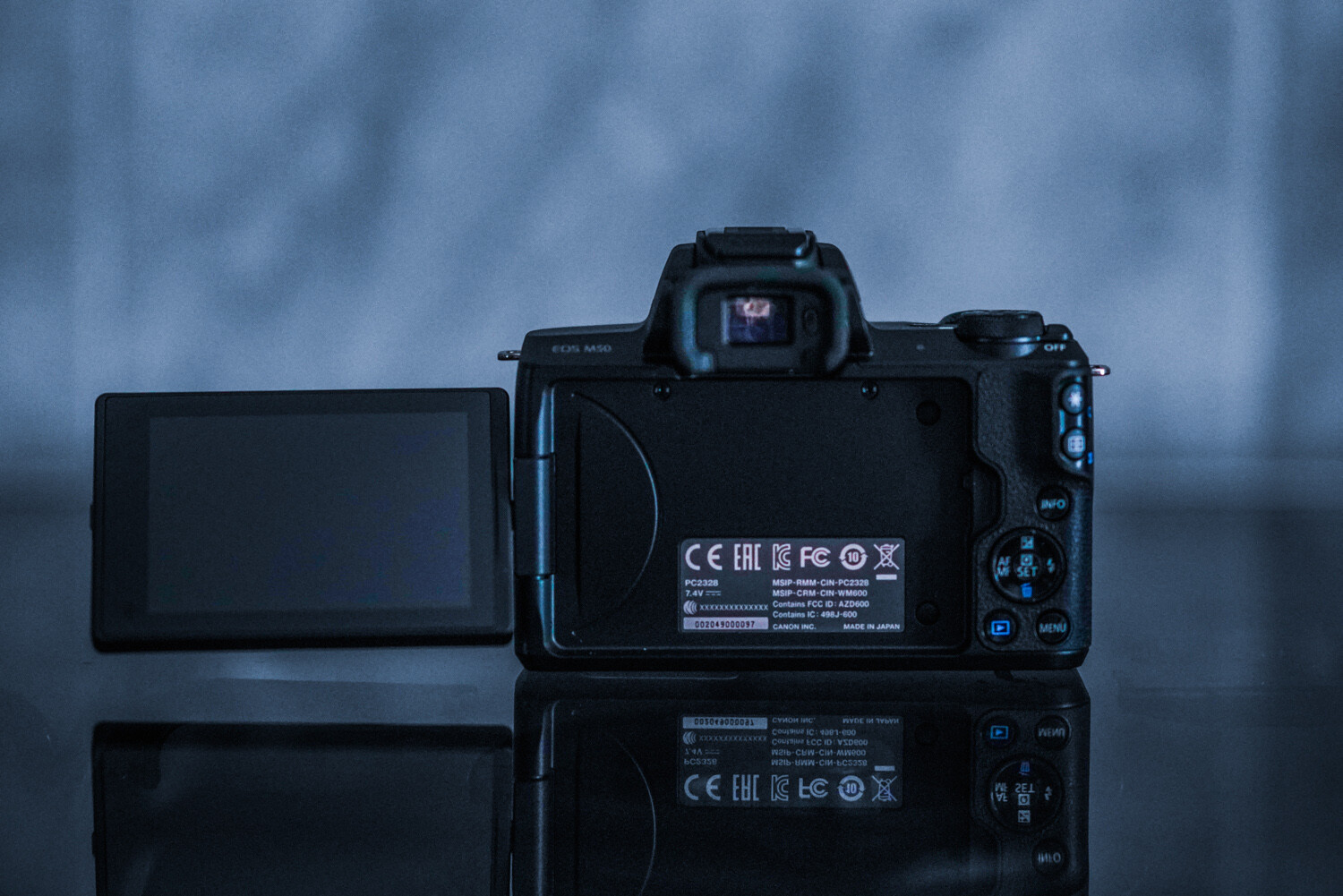
This camera’s size is brilliant! It is smaller than my cell phone (Google Pixel). Easy to throw into any bag, purse, or pocket. The body construction consists of polycarbonate rather than a metal body shell, but it still feels robust enough in your hand. The camera features a very comfortable and well-designed grip containing  ‘hooks’ for your second finger and thumb. As a result, the M50 feels surprisingly secure, even when used with one hand.

Much like Canon’s pro-level DSLRs, the controls are well laid-out. The buttons are a decent size and easily located by touch while using the viewfinder. However, the size may be an issue for those with larger hands. My hands are petite, and I find the controls just fine (haha)!

6 - Gear Review Canon EOS M50 Mirrorless Camera Kit

The tilt, vari-angle touch screen is brilliant. This nifty feature has infinite uses. Additionally, the screen can be stowed backward against the camera body to avoid any potential scratches (for those that don’t purchase screen protectors). The built-in viewfinder is very helpful when shooting during the noon sun or other bright conditions. There’s an auto activation when your eye approaches the viewfinder, ensuring that the LCD doesn’t blind you.

Canon has a knack for making its small models handle well and feel professional. The M50 is proof of this.

Autofocus

Canon’s autofocus is what has kept me loyal to the brand for over ten years now. Canon’s Dual Pixel CMOS sensor that the M50 sports mean every sensor pixel is capable of being used for phase detection. Allowing fast autofocus almost wherever the subject gets situated within the frame. The AF system is sensitive down to -2 EV, which means the camera continues to focus in extremely low light.

7 - Gear Review Canon EOS M50 Mirrorless Camera Kit

A new autofocus feature of this model is the eye-detection autofocus. The camera can find eyes on your subject and lock focus on them with the push of a button. It is photographic witchcraft, and I love it. This feature is activated when face detection is turned on, to focus specifically on your subject’s eye.

Do make note that this fun feature is only available in single-AF mode, which means you can’t use it track focus during burst shooting. As can be seen above, the eyes of my dog are nicely in focus (and this was easy to achieve, even when she moved a bit).

I have always preferred the AI Servo | Continuous Focus mode due to the majority of my subjects moving around a lot. Thanks to the ability to use phase-detection anywhere in the frame, this feature is fast and reliable.

Low light capability

8 - Gear Review Canon EOS M50 Mirrorless Camera Kit

As the years’ progress, so does low-light capability. In higher ISO levels, image quality stands up very well at ISO 800. It’s only at ISO 3200 noise, and noise reduction starts to blur away detail. However, the color gets retained well. The higher numbers are passable for smaller reproductions, but you’ll generally find yourself not wanting to move beyond 12,500 max! The autofocus continues to shine even at low-light levels.

9 - Gear Review Canon EOS M50 Mirrorless Camera Kit

Battery life

I have always been a tremendous fan of Canon’s batteries. They always continue to impress me with their longevity. This camera is no exception, despite having an always-on LCD screen! As always, I do suggest purchasing more than one battery, but you can remain confident in this camera lasting you through your entire photo session and photography adventures.

10 - Gear Review Canon EOS M50 Mirrorless Camera Kit

The lens: EF-M 15-45mm f/3.5-6.3 IS STM

The M50 kit comes complete with the EF-M 15-45mm f/3.5-6.3 IS STM, a compact and stylized zoom lens for the mirrorless camera. The lens is very compact and features a side switch to flatten the lens when stored. This feature makes traveling with the M50 kit an absolute breeze.

11 - Gear Review Canon EOS M50 Mirrorless Camera Kit

With the 15-45mm kit lens with its STM focus motor, autofocus is great. It is super-fast, silent, accurate, and excellent for any photography style. The 35mm-equivalent 24-72mm range combines a wide-angle for landscapes and big group photos, with a telephoto zoom for close-ups and detailed headshots.

12 - Gear Review Canon EOS M50 Mirrorless Camera Kit

I found the lens to be reliable, fast, and sharp – no complaints whatsoever!

Final thoughts

13 - Gear Review Canon EOS M50 Mirrorless Camera Kit

The Canon EOS M50 is an excellent entry-level camera for aspiring, beginner, and hobbyist photographers alike. From its variety of features to its portable size and ease-of-use, unraveling this camera under the Christmas tree would excite even the most controlled picture-takers. Plus, having a kit that comes with a lens is just a brilliant bonus!

The post Gear Review: Canon EOS M50 Mirrorless Camera Kit appeared first on Digital Photography School. It was authored by Anabel DFlux.


Digital Photography School

 
Comments Off on Gear Review: Canon EOS M50 Mirrorless Camera Kit

Posted in Photography


Video: Nigel Danson on his switch to mirrorless and the Nikon Z7

16 Dec

Renowned UK-based landscape photographer Nigel Danson has been using DSLRs for years. In this video, created exclusively for DPReview, Nigel discusses his experience using the Nikon Z7 and why he’s excited about mirrorless cameras. (Spoiler… beautiful scenery ahead.)

If you enjoy this video, visit Nigel’s YouTube channel where you’ll find dozens more, including topics such as Master your telephoto lens photography and improve fast and Why you don’t need perfect light to shoot the best photo.

Visit Nigel Danson’s YouTube channel

  • Opening
  • Introduction
  • Size and Weight
  • Electronic Viewfinder
  • In-Body Image Stabilization
  • Video
  • Ergonomics
  • Stopping for a Quick Shot
  • Sensor and Image Quality
  • Opportunities for Improvement
  • Conclusion

Articles: Digital Photography Review (dpreview.com)

 
Comments Off on Video: Nigel Danson on his switch to mirrorless and the Nikon Z7

Posted in Uncategorized


Gear Review: The Lumix G9 Mirrorless Camera

29 Nov

The post Gear Review: The Lumix G9 Mirrorless Camera appeared first on Digital Photography School. It was authored by David Shaw.

1 - Gear Review - Lumix G9 Mirrorless Camera

The Lumix G9 – a 20.3mp, micro 4/3rds, mirrorless camera.

When I bought my first full-frame DSLR many years ago (an original Canon 5D), I thought I’d discovered the pinnacle of camera technology. Because a bigger sensor is better right?

Well, not necessarily.

Sensor sizes are like film sizes- they are different formats, not different quality. Each has advantages and disadvantages, and some will fit your needs while some won’t.

2 - Gear Review - Lumix G9 Mirrorless Camera

Flying in small planes is how I reach many of my photo locations. A light camera system is vital.

The Lumix G9 Mirrorless Camera

Bigger sensors, for all their benefits, also mean bulkier and heavier lenses. A smaller sensor, such as the micro 4/3rds system, is compact, and light. That’s why, as an outdoor pro who specializes in shooting in remote areas, I’ve recently begun shooting the Lumix m4/3rds system. Specifically, my primary camera is now the Lumix G9 mirrorless camera, the flagship of Lumix still cameras.

Body Quality

3 - Gear Review - Lumix G9 Mirrorless Camera

The Lumix G9 Mirrorless Camera from the top.

The Lumix G9 Mirrorless Camera is of a similar size to other pro-level mirrorless camera bodies. For me, this is the appropriate size. If the body were much smaller the controls would become too small and cumbersome for rapid use in the field, and impossible while wearing gloves. The G9, in my opinion, is a good compromise between size and functionality.

The build is sturdy with a die-cast magnesium chassis and is environmentally sealed. A textured rubber coating covers most of the body providing a confident grip, even when wet. The body weighs in 658g, more or less typical of this size mirrorless camera. I’ve used mine in temperatures varying from -25F, to +100F in the snow, rain, and salt spray. I’ve banged it around inside bush planes, safari vehicles, rafts, and canoes, and have yet to have an issue with durability.

4 - Gear Review - Lumix G9 Mirrorless Camera

Bush planes. I’ve gotten used to flying in them, but I never get tired of photographing them. (De Havilland Otter reflected in an Alaskan lake).

Sensor

The 20.3mp micro four-thirds sensor has an excellent dynamic range for a sensor of this size and extremely low noise below about 1600 ISO. At higher ISOs, the noise does increase noticeably, which is a drawback for night photography. However, the files can handle substantial pushes in post-processing. Adding two or even three stops of light seems to have little impact on image quality.

Stabilization

5 - Gear Review - Lumix G9 Mirrorless Camera

Handheld, at 1/15th second. Easy.

Lumix advertises a whopping 6.5 stops of stabilization built into the camera; a system that works seamlessly with lens-integrated stabilization. This impressive number isn’t just marketing hyperbole. I’ve found I can handhold images, even while using a long lens, to speeds as low as 1/8th of a second. Blurred water shots no longer require a tripod and video capture is smooth and almost vibration free. This is unquestionably the best camera I’ve ever used when it comes to image stabilization.

6 - Gear Review - Lumix G9 Mirrorless Camera

Still Photography Performance

Frame Rate

Mirrorless cameras are not subject to the same limitations of shutter speeds as their DSLR counterparts. The electronic shutter of the Lumix G9 reaches a whopping 20 frames per second, far more than is needed except in all but the most extreme, fast-paced shooting situations. Even when using the standard frame rate, it still manages 9 frames per second, which is competitive with just about any camera on the market.

7 - Gear Review - Lumix G9 Mirrorless Camera

At 20fps in the high burst mode, or 9fps in regular, the G9 makes quick work of moving subjects.

Autofocus

The autofocus is perhaps the one point, where the G9 does fall a bit short of high-end DSLRs. Lumix has applied a contrast detection system combined with Panasonic’s Depth from Defocus technology (DFD). In bright conditions with few obstacles, I found the autofocus to be exceptionally fast with a high hit rate. However, in tangled environments, or in low light, it occasionally struggles to grab my subject.

8 - Gear Review - Lumix G9 Mirrorless Camera

The DFD system is an active autofocus that perpetually pushes and pulls the focus just a hair back and forth as it determines the focus point. It’s fast, but slightly distracting and often lead me to think that the camera hadn’t settled on my subject. It had, and the resulting images show a high hit rate, but the constant push-pull is a bit distracting.

Image Quality

9 - Gear Review - Lumix G9 Mirrorless Camera

While overall image quality is excellent, night photography is the one place where the G9 falls short. This image, captured at ISO 3200, required substantial noise reduction.

In most lighting situations, the 20.3mp images are excellent. RAW format files have a competitive dynamic range which allows substantial pushing of exposure in post-processing. If you are jpeg shooter, the camera exports colorful, but not unnatural files ready for sharing on social media. I like the jpeg outputs so much that I’ve set the camera to write both small jpegs and RAW files which allows for quick shares without post-processing.

10 - Gear Review - Lumix G9 Mirrorless Camera

Contrasting the previous image, this image captured at 800 ISO is nearly clean and required no noise reduction, despite the dim conditions. There seems to be a big reduction in image quality between ISO1600 and ISO 3200.

11 - Gear Review - Lumix G9 Mirrorless Camera

High contrast scenes like this, the G9 handles admirably well.

High-Resolution Images

One of my favorite features of the Lumix G9 Mirrorless Camera is the high-resolution setting. The 20.3mp sensor is plenty for general use, however, as a landscape photographer, I often desire files that can be printed very large. The high-resolution image setting on the G9 takes 8 images in a row, each offset by 1/2 pixel. This produces a final file that is over 80 megapixels! For best results, a tripod is required, but for landscape work, I’m almost always using one anyway. The quality of the final image is, quite frankly, amazing.

12 - Gear Review - Lumix G9 Mirrorless Camera

This image was captured using the high-resolution setting on the Lumix G9. The original file is a whopping 10368x7776px.

13 - Gear Review - Lumix G9 Mirrorless Camera

The above image, cropped nearly in half, is still enormous by almost any standard.

Features

WIFI

Wifi connectivity when combined with Lumix’s intuitive app for phone or tablet, allows quick exporting of files for sharing from the field. Additionally, the app allows full remote operation of the camera. Once your image is composed, you can use the app to adjust exposure, aperture, shutter speed or ISO, then click the shutter from a 100m away.

Customization

14 - Gear Review - Lumix G9 Mirrorless Camera

With a wide variety of lenses in the Lumix (and Olympus) lines. There is no shortage of options for all kinds of photography from wildlife to portraits and landscapes.

Advanced shooters will appreciate the extensive customization options on the G9. You can program in multiple preset modes, accessible from the main function dial atop the camera. But I’ve come to like even more, a separate switch on the front of the camera at the lower left, which allows you to switch between two types of shooting modes. I have one set for my standard landscape settings, and one to my favorites for wildlife. With a quick flick of a finger, I can move back and forth between the two as my shooting situation changes. Nifty.

Video

Lumix has always been associated with video capture, even more than still photography. And while the G9 was definitely designed with still images in mind, it has inherited many video features of the other Lumix cameras. 4k video capture up to 60fps is possible with the G9, something few other still cameras can achieve. With the excellent integrated stabilization, high-quality video is a breeze. As many of my clients are now requesting video clips in addition to stills, the excellent moving image capture of the G9 means I no longer have to carry a second, video-specific camera when I’m shooting on assignment. For a still shooter who likes to capture some video or a film-maker who also wants high-quality stills, the G9 may be the perfect compromise.

15 - Gear Review - Lumix G9 Mirrorless Camera

From the back, the camera’s controls are straight forward.

But What’s it Like to Use?

All the tech specs in the world won’t tell you what it actually feels like to use the camera. And in that case, I think the Lumix has really won the race. The controls are intuitive, with buttons conveniently located and ergonomics that allow you to determine buttons easily by feel, and without searching around. I moved from Canon to Lumix and found it didn’t take long to feel at home from the new system. I also shoot a Sony mirrorless, and moving back and forth between the two is not challenging.

16 - Gear Review - Lumix G9 Mirrorless Camera

It was intermittently snowing hard and blowing cold wind when I made this image in Alaska’s western Arctic. The G9 handled the conditions without issue.

But it’s in the field that I really love the Lumix G9. The m4/3rd system means that not only the sensor is smaller, but the lenses too. Everything is much smaller and compact, even with fast, high-end lenses. My kit has shrunk substantially with my switch to Lumix. While full-frame mirrorless cameras are smaller and lighter than pro-level DSLRs, the lenses are not, which puts a limiter on how much weight and space you can really save by switching to full-frame mirrorless. With micro 4/3rds however, everything is smaller.

17 - Gear Review - Lumix G9 Mirrorless Camera

As a wilderness photographer, this is a HUGE advantage for me. I can carry a body and multiple lenses for the same weight and size as a single DSLR and mid-range zoom lens. I can’t tell you how much this has meant to me on the many occasions I’ve had to weigh out every ounce to make my kit fit in a bush plane. Size matters to a backcountry photographer, and when it comes to cameras, smaller is better.

A Note on Lenses

While this isn’t a review of the Lumix lenses, I do want to offer a quick hat-tip to the Lumix-Leica lens systems. The glass is compact, light, and extremely sharp. The Leica glass elements are impeccable, and while not cheap, the sharpness is in every way comparable to the best Nikon, Canon, and Sony lenses. Secondarily, the m4/3rds lenses are compatible across brands meaning that Olympus equipment works seamlessly on Lumix bodies. (My current long lens is the Olympus 300mm f4 PRO, and it works perfectly on the G9).

18 - Gear Review - Lumix G9 Mirrorless Camera

Final Thoughts

Lumix has been a go-to manufacturer for videographers and film-makers looking for a compact, high-quality system for many years, while Olympus has led the m4/3rds still photography market. That has all changed with the Lumix G9. While I look forward to a few improvements in the next generation, the G9 has almost everything a serious photographer could want: great image quality, excellent choices in lenses, ability to shoot 4k video, abundant customization options, and intuitive controls.

It looks like the Lumix system has found a permanent place in my camera bag.

Have you used the Lumix G9 Mirrorless Camera? Please share your thoughts and experiences in the comments below.

The post Gear Review: The Lumix G9 Mirrorless Camera appeared first on Digital Photography School. It was authored by David Shaw.


Digital Photography School

 
Comments Off on Gear Review: The Lumix G9 Mirrorless Camera

Posted in Photography