[ By WebUrbanist in Conceptual & Futuristic & Technology. ]

Using the magnetic levitation technologies employed in high-speed trees, the MULTI elevator system conveys people horizontally as well as vertically at record speeds and without ropes, all while allowing multiple elevators to traverse the same shafts.

Allowing fast vertical interior transportation, the elevator has already revolutionized the shape of cities once – this breakthrough may enable them to do it again, not only cutting down on wait and travel times but also by enabling versatile sideways travel through structures. As illustrated above, a single car can go both up or down and then left or right, moving in a three-dimensional fashion within a building.
The creator of the MULTI, ThyssenKrupp AG, expects to have a fully-functional prototype by the end of 2016 with cars capable of moving at speeds of up to 16 feet per second when unoccupied. The various advantages of this system will increase elevator capacity in a given building by as much as 50% and help reduce the amount of space required (as much as 40% of a building’s footprint with traditional elevator arrangements).

Whether through looping systems (like the one proposed above by Hitachi) or maglev technologies or, most likely, a combination of the two, the “days of one cabin, in one shaft on one rope traveling up and down” which “hasn’t changed for 160 years” are soon to be over. Imagine the possibilities for architects and engineers no longer constrained to simply building up but now free to build out in fresh new ways as well. Of course, there are always some potential dark sides to new technology, but here’s hoping no one decides to build The Cube (or Cabin in the Woods) in real life.
Want More? Click for Great Related Content on WebUrbanist:
SkyTran: 2-Person Maglev Monorail Could Replace Cars
Two-person monorail pods zoom down from the sky at a command from your smart phone in a futuristic commercial transit system set to be installed in Israel. The …
Click Here to Read More »»
Aerial Urbanism: Hyper-Dense ‘Cloud City’ Redefines Skylines
A complex spanning in seemingly all directions, this sky-oriented, cloud-shaped, forward-thinking design has just won the Shenzhen Super City Competition in …
Click Here to Read More »»
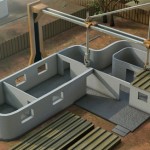
20-Hour House: How to 3D-Print 2,500 Square Feet in 1 Day
Combining ancient earthen-architecture approaches and cutting-edge robotic technologies, this contour crafting process promises a revolution in how we address …
Click Here to Read More »»


[ By WebUrbanist in Conceptual & Futuristic & Technology. ]
[ WebUrbanist | Archives | Galleries | Privacy | TOS ]