
RSS
 

Posts Tagged ‘Losing’

Flickr increases Pro subscription price after warning the company is losing money

23 Jan

Flickr has notified its Pro subscribers about a price increase that brings the current annual rate to $ 60, a ten dollar increase over the previous $ 50 annual fee. Customers are also offered other plan options, such as a monthly subscription for $ 7, a three-month subscription for $ 19 and a two-year subscription for $ 118.

The price increase is not surprising in light of CEO Don MacAskill’s impassioned plea for more Flickr Pro subscribers published in mid-December. In it, MacAskill explained that parent company SmugMug didn’t acquire Flickr because it is a wealthy company — in fact, MacAskill says, ‘Flickr was losing tens of millions of dollars a year.’

Despite the work that SmugMug put into Flickr, MacAskill had explained that the company was still losing money and that it needed more of its users to sign up for the Pro subscription. This subscription offers a number of benefits for users, including unlimited storage, ad-free browsing, discounts from partners, access to advanced account states, priority exposure in the service’s Explore section and more.

The price increase went into effect yesterday, on Tuesday, January 21. Existing Pro customers are given the option of immediately renewing their plan at the lower price using a link in the notification email sent to users. In explaining why it decided to increase the price, Flickr points toward MacAskill’s December letter and states that the company ‘cannot continue to operate at a loss.’

Articles: Digital Photography Review (dpreview.com)

 
Comments Off on Flickr increases Pro subscription price after warning the company is losing money

Posted in Uncategorized


California tourist fined $20,000 for losing control of drone that landed at airport

22 Nov

If you want to fly your drone on the Las Vegas strip, you need to secure approval from the Federal Aviation Administration (FAA) first. Since the popular tourist destination is in controlled airspace, and its airport, McCarran International does not participate in Low Altitude Authorization and Notification Capability (LAANC), acquiring a waiver from the FAA, as a Part 107-certified commercial pilot, is mandatory.

In June 2018, California tourist Reuben Burciaga learned this the hard way. He was attempting to capture an aerial perspective of the High Roller Observation Wheel at the LINQ with his drone. That’s when things went horribly wrong. ‘I went up to the parking structure at Caesars Palace and had no problem with GPS,’ Burciaga tells FOX 5 KVVU News. ‘It started acting weird and just took off.’

Burciaga’s drone flew two miles away from its takeoff point, at an altitude of slightly above 450 feet, and landed a few feet away from an active runway at McCarran. Employees discovered the drone and handed it over to the local police. After the FAA conducted an extensive investigation, due to an inaccurate registration number, they were able to identify Burciaga as the drone’s owner. The government agency followed up with a letter outlining his numerous violations, including flying in controlled airspace without authorization and fined him $ 14,700.

Flying a drone in congested areas poses serious risks. Signal loss caused by magnetic interference is the top cause of fly-aways. It’s pretty clear that Burciaga didn’t properly calibrate the drone’s compass before taking off in a parking structure. If he did calibrate it where he took off, the significant amount of rebar in the parking structure would certainly cause a compass error. If Burciaga already conducted hundreds of flights, like he claims in the video above, he should have known this would happen.

‘I don’t have the money to fight it, and I wouldn’t even have an idea how to fight it,’ Burciaga said. ‘That’s half of my year’s paycheck for trying to take a picture.’

Besides taking the time to perform basic pre-flight safety measures, he also avoided multiple letters from the FAA along with his chance to appeal. As a result, his fine has been bumped up to nearly $ 20,000. ‘I don’t have the money to fight it, and I wouldn’t even have an idea how to fight it,’ Burciaga said. ‘That’s half of my year’s paycheck for trying to take a picture.’ Appealing the charges is something he could have done for free.

The new amount owed has been turned over to the U.S. Treasury Department. They will deduct the amount from his future tax returns. Burciaga believes the fine is far too harsh, stating an amount between $ 1,000 – $ 3,000 would have been more appropriate. The FAA doesn’t seem to agree. ‘This was really a very serious incident, which is why we imposed such a large fine,’ said spokesperson Ian Gregor. ‘In this situation, the pilot committed a litany of serious violations and really flew the drone carelessly and recklessly.’

Articles: Digital Photography Review (dpreview.com)

 
Comments Off on California tourist fined $20,000 for losing control of drone that landed at airport

Posted in Uncategorized


Photographer finds fully-functional Fujifilm lens 4 months after losing it in the desert

20 Oct

Modern camera lenses are durable, but a little anecdote from Steve Boykin, writing for 35mmc, shows just how far weather-sealing has come in the past few years.

Four months ago, in June of this year, Boykin managed to lose his Fujifilm XF 23mm F2 R WR lens while on a hike in the wilderness. This week, he managed to stumble across the lens while out on another trek and after a bit of cleaning up, he says the lens is in seemingly perfect condition, even after withstanding the summer heat, countless thunderstorms and freezing temperatures.

The location where Boykin found the lens

Boykin says he was walking along a path he’s walked ’30 or 40 times over the last few months’ when he looked down and noticed the lens ‘sitting on the ground a few inches from my foot.’ Naturally, Boykin assumed the lens wouldn’t work, due to the harsh conditions it incurred, but after getting home and removing the front B+W filter and rear lens cap, Boykin mounted the lens to his Fujifilm X-Pro1 and ‘it came to life like nothing had happened.’

Despite there being some ‘slight discoloration’ on one side of the lens barrel (likely the side that was laying in the dirt) Boykin says the autofocus works ‘like nothing ever happened’ and both the aperture and focus rings rotate smoothly. Boykin credits much of the survival to the fact the front filter and rear lens cap were still attached, but even then it’s an impressive feat for the lens to survive a third of a year in the desert with essentially zero protection.

To read the full story, which includes a pair of photos captured with the lost lens, head on over to 35mmc (and check out their other coverage on all things film photography related).


Image credits: Photos by Steve Boykin, used with kind permission from 35mmc

Update (October 16, 2019): Updated the first sentence of the article as to better explain the current state of lens weather-sealing.

Articles: Digital Photography Review (dpreview.com)

 
Comments Off on Photographer finds fully-functional Fujifilm lens 4 months after losing it in the desert

Posted in Uncategorized


German publisher Steidl ordered to pay $77k after losing photographer’s prints

22 Dec

German publisher Steidl has been ordered to pay photographer Lawrence Schwartzwald €65,000 / $ 77,000 after losing his portfolio prints. According to Artnet News, Schwartzwald sent the prints to Steidl in September of 2014 for inclusion in a book project. The photographer was reportedly told in June of 2015 that the project wouldn’t proceed, and that he’d get his photos back… but that never happened.

Despite repeated requests, Schwartzwald never did receive his portfolio. And so, after a year of waiting, he filed a lawsuit in a German court against Steidl for the return of his prints, which he valued at $ 1,200 each. That lawsuit has now culminated in a ruling that Steidl must pay Schwartzwald €65,000 in compensation for the lost prints, plus legal fees.

Gerhard Steidl, the company’s founder, gave Artnet News a different version of events, claiming that Schwartzwald’s photos had been selected for print publication, but the photographer grew impatient with the duration of the process and requested that his prints be returned.

Regardless of which version of events is true, however, the outcome is the same: Schwartzwald’s portfolio went missing.

Steidl acknowledged this in his statement to Artnet, explaining that it was an accident and that the portfolio couldn’t be located. “Someone probably packed it incorrectly and it ended up somewhere else, but it’s not there anymore,” said Steidl. “It just happened, in my opinion I don’t deserve the death penalty.”

Articles: Digital Photography Review (dpreview.com)

 
Comments Off on German publisher Steidl ordered to pay $77k after losing photographer’s prints

Posted in Uncategorized


3 Tips for Photographing Children Without Losing Your Mind

27 Apr

photographing-children-9

Photographing children is one of my favorite things to do, but at times it can also be one of the most difficult. Sometimes with kiddos, there is a very thin line between capturing memories that will last a lifetime, and capturing tears, tantrums, and meltdowns. After years of photographing nieces, nephews, friends, and my own girls, I’ve made a whole lot of mistakes. But, I’ve also picked up a few tips and tricks that help things go a little more smoothly when it comes to photographing children, that will hopefully make your life a little easier as well.

1. Choose your location thoughtfully

photographing-children-8

When photographing children, heading to a park is a no-brainer, right? Well, maybe. Parks can be really great, free resources for photographers, but it’s important to think about them through the eyes of a child as well. As a photographer, if you take a young child to a park with a playground and then attempt to have them sit still on the grass directly across from the playground for a portrait, chances are that you’re creating an scenario that may not end well. If there’s a playground in view, you’d better be prepared that the kids will want to play on it.

photographing-children-7

Sometimes, letting kids play on the playground is a great way to capture some more candid moments, and other times it is a big distraction. More and more, I find myself scheduling sessions at hiking trail heads, covered bridges, and open fields, which still allow for plenty of room to run and play, but in a location that provides fewer distractions. In addition, I find these sorts of locations to be more aesthetically pleasing for capturing those candid moments, than playgrounds often are.

2. Find ways to make them laugh
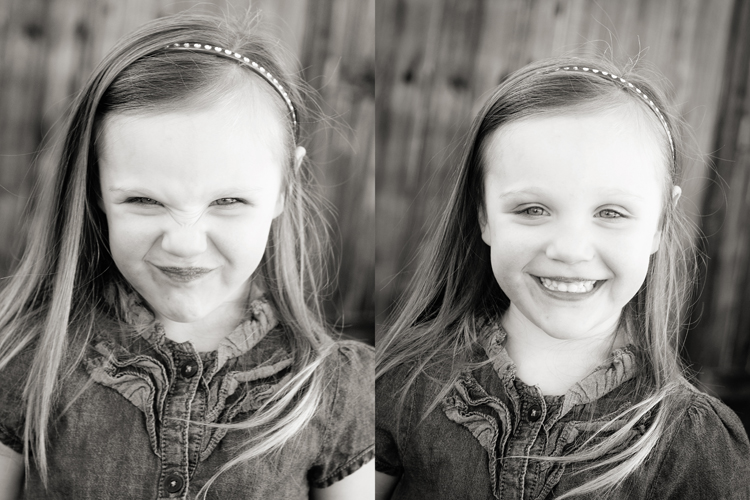
photographing-children-6

Anyone who has photographed kids knows that most kids have a fake smile, that makes an appearance any time someone asks them to smile. That fake smile is fine, and may be unavoidable to some extent, but it is always better to get a real smile or laugh whenever possible. There are so many ways to do this, but I’ll share just a couple that I’ve found to be effective with lots of different children.

The first is simply to ask them to show you a variety of different faces. It’s fun to capture the silly faces that they make, but the point is really to capture their genuine smiles and laughs at your reaction to their silly faces. In the photo above, I asked my daughter if she would show me her angry face (left), and while I absolutely love that photo, and think it actually captures her slightly mischievous personality very well, my goal was really the more natural smile (right) that came after my laughter and exclamations that her angry face was absolutely terrifying.

In my experience, most kids think it’s hilarious to run through a whole string of different faces: angry, silly, dinosaur face, prince/princess face, hungry face, tired face, surprised face, and happy face all tend to be fun, and often result in lots of genuine smiles and laughs.
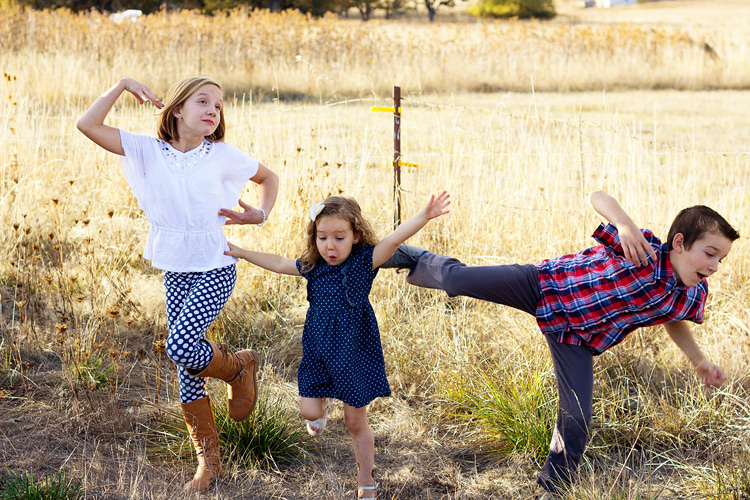
photographing-children-3

Another thing that seems to work well for most kids is to simply ask them to give you a funny pose. Be ready, because you may get anything from a stuck out tongue, to much more hysterical shenanigans. I truly never know what to expect, but always be ready to capture whatever it is. I often include a few of the most silly photos in the final images, because even if they aren’t 100% perfect or they don’t fit my normal aesthetic, they just plain make everyone happy, and I think there’s value in that. There’s also a practical value during the session as well, in that once again, being silly results in genuine smiles and laughs. Time and time again, my favorite images in a session are often the ones that come directly after the silliest images.

photographing-children-4

3. Be sensitive, and keep a sense of humor

My oldest daughter once cried for a half an hour because I made blackberry cobbler for breakfast, and she wanted toast instead. My youngest daughter laid on the floor, cried real tears, and screamed that I was ruining her whole life because I asked her to put on her shoes this morning. Moments like those are rarely funny at the time, but sometimes an hour or a day later, you find yourself laughing at the absurdity of the situation.

photographing-children-2

When it comes to kids, the reality is that even if you’ve been thoughtful about the timing and location of a session, sometimes meltdowns happen for no identifiable reason, and come from out of nowhere (sometimes they even happen mid-photo, as above). Photo sessions can be kind of stressful, and feel really high pressure for both kids and their parents. Sometimes with a little humor, distraction, or quick change of plans, everyone can get through a tantrum or minor meltdown just fine, and you’ll all laugh about it years later.  Sometimes, it’s more than that, and a child may be having a meltdown because of sensory issues that you are unaware of, or because they’ve been battling a cold or they’re teething and they just don’t feel good.

Regardless of the reason, sometimes it’s clear that the kiddo is genuinely upset, and isn’t going to calm down any time soon. If a child is genuinely upset, don’t force things. If it’s possible, offering to try again on a different day can be a really meaningful good-will gesture. After all, a parent saying, “Stop crying and smile” rarely (if ever) results in those genuine smiles that we so desperately try to achieve as photographers. It’s a fine line to walk sometimes, between being sensitive to the really legitimate feelings that kids may be having, and to also recognize that sometimes kids cry and get hysterical about really silly things, and then get over them equally as fast.  If things go south, just do your best to be sensitive, while also keeping a sense of humor about things. Life is messy sometimes.

photographing-children-5

Do you have any other tips that make photographing children just a little bit easier? Please share in the comments below, and I’d love to see your kid photos too.

People photography week

This week on dPS we’re featuring articles all about different kinds of people photography including portrait, event and travel photography. See all the previous ones below, and watch for more people photography articles over the next few days.

  • How to Take Low Key Head-shots
  • How to Do a One Light Portrait Setup and Use it as Your Back-up Plan
  • Travel People Photography – Tips and Pitfalls
  • 8 Tips for Photographing Men
  • 24 Diverse Images That Showcase People Photography
  • Weekly Photography Challenge – People Photography
  • Tips for Getting Yourself to Relax as a Photographer and Have More Successful Portrait Sessions
  • 5 Good Reasons to Add People into Your Landscape Photography
  • 6 Must-Have People Shots to Capture When Photographing Corporate Events
  • 4 Tips to Help You Get Started Doing Lifestyle Photography

googletag.cmd.push(function() {
tablet_slots.push( googletag.defineSlot( “/1005424/_dPSv4_tab-all-article-bottom_(300×250)”, [300, 250], “pb-ad-78623” ).addService( googletag.pubads() ) ); } );

googletag.cmd.push(function() {
mobile_slots.push( googletag.defineSlot( “/1005424/_dPSv4_mob-all-article-bottom_(300×250)”, [300, 250], “pb-ad-78158” ).addService( googletag.pubads() ) ); } );

The post 3 Tips for Photographing Children Without Losing Your Mind by Meredith Clark appeared first on Digital Photography School.


Digital Photography School

 
Comments Off on 3 Tips for Photographing Children Without Losing Your Mind

Posted in Photography


Photography Magazines: Why Print Is Losing To The Internet

28 Jul

Fashion Photography Magazines: Why Print Will Lose To The Internet

Hey there FashionPhotographyBlog.com readers. Recently, I received a request from a student fashion journalist on our FPBlog Facebook page asking me to offer opinions to help her out with her latest assignment. The question she posed was “Why online is overtaking print as the medium for hobby and trade magazines?” and more specifically those around the photography field. 


I was really glad to have been asked this question, because, not many people are aware that I have been involved in the digital space for almost a decade and have observed communication trends evolve over this time. I’ve made predictions over the years that have since came true, funnily enough. What this means is that I’m able to share my insights in regards to why the internet is steamrolling print and other traditional forms of media and what this means for photography as an industry.    


What we tend to forget as photographers is that photography as a craft, has always evolved with the technology at the time. It came into this world when painting was the respected art form, but gained its popularity after. From black and white film to photographs in color; from film to digital; from handheld cameras to smart phone photography. As you can see, the medium of photography is a product of human evolution.


The print industry, that includes book, magazine and newspaper publishing, are also susceptible to technological changes. Look how we read text these days; it’s through Kindles, smart phones, tablets, laptops and desktops. It’s how you are viewing this website :). This is why there are at least 3 reasons why I see photography trade and hobby magazines, jumping ship over the online threshold and providing their circulation on the web. These include being reachable, affordable and measurable.


Reachable:


– People can purchase and view hobby magazines online from the comfort of their homes anywhere in the world. Online publications are portable and accessible with the growth of smartphone usage.


– Nowadays anyone can access the internet in the palm their hands wherever they are.


– Online has a significant advantage in terms of reach, compared to products that are bound to physical locations, because consumers do not need to be in a specific location to purchase and interact with the product.  


Affordable:


– The cost of production and distribution is significantly less in creating digital products than it is with physical products.


– Overheads such as warehousing and transportation logistics, are no longer expense factors and replaced with the price of portable hard drives and cloud hosting.


– The price tag on technology-based services continue to trend down making it even more possible for consumers to have access to household internet, and digital product creators can create virtual products, such as online magazines, at much lower costs than manufacturing these products in physical form.    


Measurable:


– Interactions consumers make with online magazines or any virtual product, can be tracked. This means that data is more easily collected and decisions about the product can be made based on statistics rather than guess work.


– By analyzing the behavior of their customers, online magazine creators can evaluate what actually worked and what didn’t worked and make improvements based this feedback in time for the next issue, therefore continually improving and making changes in real time.


– With physical magazines, customer interaction and engagement is a lot harder to track.


The purpose of this article is not to discredit print mediums like photography hobby and trade magazines, or film. To this day I still love the smell of books and the feel of a glossy magazine in my hand, however as technology continues to evolve new doors open. Technology will make advancements whether we like it or not, so we should embrace it rather than trying to resist it and remember that, as photographers, we are participating in an art form that was born out of new technologies and innovation.


So what do you think of this discussion? Do you have an opinion on the future of printed photography hobby and trade magazines? Where do you see technology taking photography as a craft? Make your predictions the comment section below.


Fashion Photography Blog

 
Comments Off on Photography Magazines: Why Print Is Losing To The Internet

Posted in Uncategorized


Easy Portrait Retouching Tutorial without Losing Skin Texture

18 Jun

When it comes to skin retouching, less is more. Retouching skin is tricky. You want to enhance it, not beat it to death, make it fresh and glow-y, while still keeping the integrity of the skin. You want to soften wrinkles, not obliterate them. And to bring out their eyes and natural beauty while keeping them looking like themselves. Even Continue Reading

The post Easy Portrait Retouching Tutorial without Losing Skin Texture appeared first on Photodoto.


Photodoto

 
Comments Off on Easy Portrait Retouching Tutorial without Losing Skin Texture

Posted in Photography


Posing Guide: How to Pose Groups without Losing Your Mind

09 Mar

The other day I had mom bring her daughter in for fine art dance pictures. “Oh, just snap away while she’s doing her competition routine… she doesn’t like to be interrupted,“ the mom said as the daughter grand jeted halfway off my roll paper half in the storage room, facing completely away from me. Shooting that would be crazy, right? Continue Reading

The post Posing Guide: How to Pose Groups without Losing Your Mind appeared first on Photodoto.


Photodoto

 
Comments Off on Posing Guide: How to Pose Groups without Losing Your Mind

Posted in Photography


How Your Pricing Structure Could be Losing you Money

12 Mar

Jackie is the creator of the Portrait Photography Pricing Workbook – on sale now, for a limited time at SnapnDeals.

Are you 100% confident you are making a profit with each and every client?

As artists, photographers may not be as business-minded as they should be. This can get many of us into trouble, both legally and financially. In order to call your photography business successful, it should first and foremost be profitable. If you are not making money from your photography business, you need to call it what it is: a hobby.

How do you make sure you are not losing money, but rather making money and running a profitable photography business? Despite what you may think, it has little to do with the number of clients your business is attracting, or how high or low your prices are. It has everything to do with your pricing structure.

Paper and pen

Here are some questions you need to ask yourself if you think your photography business is losing your money:

What expenses does my business have? Whether it is a reoccurring expense or a variable one, a business expense is a vital factor to consider when pricing your business. An expense for your photography business can include any or all of the following:

  • Studio rental
  • Insurance (liability, equipment, health, and/or disability)
  • Accountant fees
  • Retirement accounts
  • Advertising
  • Loan Payments
  • Equipment purchases
  • Office Supplies
  • Workshops
  • Intern or Assistant
  • Props

These are just some examples of expenses for a photography business. Obviously there are many others that may be specific to yours. Once you total your fixed expenses (expenses that don’t change from month to month or on a yearly basis) and your variable expenses, you can have an idea of how much money you should be making per year in order to at least cover those expenses.

What is my cost of goods sold?

Cost of goods sold is separate from expenses, even though it acts like an expense. The definition of “cost of goods sold” is the cost of materials used to create the product. Basically, it is how much a product costs your business before you turn around and sell it to your client.

In the photography industry, the cost of goods sold can include any of the following:

  • Printing costs
  • Cost to ship the product to you
  • DVDs
  • USB drives
  • Print packaging

Before you set the price of any of your products, you must determine the cost of goods sold of each product. Otherwise, you risk losing money on each sale. Once you figure the cost of goods sold, you can set a break-even price for each product and mark the product up from there.

Calculator

How big are my package discounts?

Along the same lines, you need to make certain your packages are not priced too low. While there should be a discount to the client, you obviously do not want to discount the package to the point where your business is losing money with each sale.

Do I accept credit cards and what is the processing fee?

Even though the credit card processing fee is probably small, it can add up over time or with larger transactions. Think about what percentage of your clients pay with a credit card and integrate that into your pricing structure.

What taxes do I have to pay and what are the rates?

There are several different kinds of taxes you will have to pay as a business owner.  The 4 most common ones for your photography business would be:

  • Federal Income Tax
  • State Income Tax
  • Sales Tax
  • Use Tax

Check out the IRS Small Business and Self-Employed Tax Center to find more tax information (if you are US based). Since each state’s (or your country’s) income, sales, and use tax laws vary, you will have to check with your state’s Secretary of State’s office to get all of the applicable tax information for your photography business.

Finally, I’ll explain a little more about use tax, because it is very commonly overlooked. Use Tax is a tax you are responsible for paying to the state for items your business purchased, but did not pay sales tax on at the time of purchase. Some examples would be a portfolio album for your studio or a lens purchased online. It is typically paid at the same time as your sales tax.

How much time do you want to spend on your business?

This question is crucial. With the rise of digital cameras taking over film, the perception is that running a photography business does not cost much money. While you might be saving money on film and developing, it still is costing you the same amount of time, if not more of your time! However, since the perception is there is no monetary cost with each shoot, it seems easy to charge less for your services and product.

Don’t make this mistake, or you and your business will be headed down a dangerous path. If you are working too much, for too little money, you risk burning out. So, how do you calculate your time into your prices? Everyone’s personal situation is different, so it is difficult to put an exact number on your “time”. What it comes down to is:

  • How many sessions and/or weddings do you want to shoot each year?
  • How much money does your business need to bring in each year?

If you want a low workload, your prices should be higher, if you need to bring in more money. If you can handle a high workload, your prices could be set lower. But, don’t forget to include the factors above, so you aren’t under-pricing yourself and losing money.

Running a photography business encompasses so much more than just the photo shoot! You need to consider all of your time spent on your business, not just the time spent shooting. For instance, managing emails, editing photos, packaging and sending orders, meeting with clients, and holding in-person ordering sessions are all examples of tasks to run your photography business. Make sure you are compensating yourself appropriately for all that time!

Pricing workbook

These hold true for ALL businesses! I assure you that if you ask yourself these questions and calculate it all out, your photography business will be profitable and not lose you money.

Here are some summary points for you to remember:

  • Total up all your expenses
  • Figure in all taxes and credit card fees
  • Consider the total cost of goods sold
  • Factor in your time, workload, and financial situation!

What if you don’t want to do these calculations manually?

You might want to check out my Portrait Photography Pricing Workbook! You just plug in the numbers and watch the magic happen before your eyes. It will automatically calculate suggested retail prices and what you should be charging based on the points above. On sale now for a limited time only on SnapnDeals.com.

The post How Your Pricing Structure Could be Losing you Money by Jackie Boldt appeared first on Digital Photography School.


Digital Photography School

 
Comments Off on How Your Pricing Structure Could be Losing you Money

Posted in Photography


Losing Stuff

08 Dec

One minute you have it, one minute you don’t. Losing stuff is as annoying as it is funny because it’s usually the result of day dreaming or brain farting. BART”S SHIRT: justkiddingfilms.bigcartel.com BLOOPERS: www.youtube.com GAMER CHANNEL: www.youtube.com NEWS CHANNEL: www.youtube.com WEBSITE: www.justkiddingfilms.net MERCHANDISE www.justkiddingfilms.bigcartel.com TWITTER twitter.com FACEBOOK: www.facebook.com TUMBLR: justkiddingfilms.tumblr.com Credits: Creative Minds- Joe Jo (@joverdose) & Bart Kwan (@bartkwan) Director- Casey Chan (@chanmanprod) Director of Photography- Casey Chan (@chanmanprod) Editor- Casey Chan (@chanmanprod) Assistant Director- Tommy Trinh (@TomTTrinh) Producer- Geo Antoinette (@Geo_Antoinette) Sound- Shena & Bruce Kwan (@brucekwan15) Grip- Tommy Trinh (@TomTTrinh) and Bruce Kwan (@brucekwan15) Behind-The-Scenes- Tommy Trinh (@TomTTrinh) Casey Chan (@chanmanprod) & Brian Huynh losing stuff, shit, sex change, circumcise , butcher, stealing, theft, water dispenser, GTA, stolen car, unicycle, reunion, virgin, virginity, lost phone, lunch time, jkfilms, justkiddingfilms, just kidding films, geo Antoinette, bart kwan, joe jo
Video Rating: 4 / 5

SOUNDS OF THE NIGHT FLIPBOOK | Tiësto x Melanie Iglesias Dance music has never sounded and looked so good! This unique video combines the fashion of dance music and the energy of the live experience. This unique video follows the lovely Melanie Iglesias as she parties at a mind blowing pool party and dance music festival dancing away to the sounds of the king himself – Tiësto! Along the way, she wears some of the freshest outfits out there and the best headphones around – the AKG by Tiësto range. For more information visit: tiesto.akg.com MADE WITH LOVE, BY RECREATION WORLDWIDE EXECUTIVE PRODUCER JOSH NEUMAN EXECUTIVE CREATIVE DIRECTOR SEAN MIYASHIRO PHOTOGRAPHY MICHAEL CREAGH VIDEOGRAPHY GALEN OAKES NELSEN BRAZILL FILM BY GARY GARY GARDNER EDITING NELSEN BRAZILL POST PRODUCTION, MOTION GRAPHICS STABLISHED – RATHA NOU MAKEUP LOLA SON YUKO TAKAHASHI HAIR STYLIST TAKASHI ASHIZAWA STYLIST CHRIS KIM PRODUCTION ASSISTANTS EUNICE PARK CHRISTINA KIM ASHIMA AIYER

 
Comments Off on Losing Stuff

Posted in Photography Videos