RSS
 

Posts Tagged ‘Lomography’

Lomography plans convertible lens system with three focal lengths

07 May

Alternative photography brand Lomography has set out plans to produce a system that allows users to achieve three different focal lengths by switching the elements in the front half of a lens. The Neptune Convertible Art Lens System comprises a four-element barrel unit that remains attached to the camera, and three interchangeable front sections that can be switched to deliver 35mm, 50mm or 80mm focal lengths.

A click-less aperture is positioned in the rear section of the Neptune that provides a maximum F-stop setting of F2.8 when used with the 50mm front end. The same iris offers a maximum F number of F3.5 with the 35mm section and F4 with the 80mm section, according to Lomography. Each of the four-element front sections has been given a name – the 35mm F3.5 is called Thalassa, the 50mm F2.8 is called Despina and Proteus is the 80mm F4.

In addition to interchangeable front element groups the system has a collection of six shaped stops that can be inserted to interrupt the passage of light through the lens. The idea is that the shapes cut into the stops, or Special Aperture Plates, influence the characteristic of out-of-focus highlights in the image.

Lomography is using a Kickstarter campaign to fund the project, and at the time of writing had already succeeded in raising three times its target figure for production to go ahead. The manual-focus Neptune system will be available in black or silver and in Nikon F, Canon EF and Pentax K mounts. The system will also work with most compact system models via an adapter.

The company says it intends to begin shipping a limited number of Neptune systems in November this year, with the main production being available from February 2018. The full retail price is expected to be around $ 980, but early bird offers are in place from $ 690. The kit comprises a base lens unit, the three converters and the six aperture plates.

For more information see the Lomography website and the company’s Neptune Kickstarter page.

Manufacturer information

The Neptune Convertible Art Lens System

The Neptune Convertible Art Lens System is everything you need on any photography venture. A reimagination of the world’s first convertible lens system created by Charles Chevalier in the late 1830s, this unique system opens up a world of possibilities for beginners and professionals alike.

The Neptune Convertible Art Lens System consists of a lens base that’s mounted to your camera and several convertible lens components. By interchanging the front components, you can shoot photos or videos at three different fixed focal lengths — 35mm, 50mm and 80mm. An Art Lens System unlike any other; it offers you all the freedom of a zoom lens without compromising on prime lens quality, and it’s the only convertible Art Lens out there to work with a range of modern-day analogue and digital cameras. Each component is assembled by using the finest multi-coated glass and crafted to produce exceptionally sharp focus and strong, saturated colors for stunning high-definition images — even when you’re shooting close-ups at 0.25m/9.8” with Thalassa (35mm), 0.4/15.7” with Despina (50mm) or 0.8m/31.5” with Proteus (80mm). This is an Art Lens System that lets you take beautifully intimate shots, allowing you to get near enough to capture every last detail of your subject. And because it’s so small and lightweight design, you can take it with you everywhere.

And that’s not all — the Neptune Convertible Art Lens System also features two aperture mechanisms to give you all the creative freedom you need. The stopless iris diaphragm aperture mechanism in the lens base features a wide range of optimal Fstops for each focal length, but with the 35mm and 80mm lenses you’ve got the freedom to go beyond that range and experiment. You can also soften your style by inserting the special aperture plates in front of the iris diaphragm to edge your frame with delicate bokeh.

By reviving and reinventing Chevalier’s convertible lens design for modern-day cameras, we’ve created an Art Lens System that will revolutionize the way you approach photography and videography. There’s no limit to the amount of new front lenses we can produce, and we’re already designing new lens components with unique effects and possible focal lengths ranging from an ultra-wide-angle 15mm to a 400mm monocular.

Each new front lens will be just like the ones you can see on this page — small, handcrafted and compatible with the same lens base, meaning that you won’t have to break the bank by buying a whole new system every time you want to shoot with a new prime lens.

Photographers and videographers all over the world have tested the Neptune Convertible Art Lens System to make sure that we’ve created a system that performs exceptionally in any and every shooting situation. Lightweight and compact, it’s everything you need in your bag — no matter where your adventures take you.

Thalassa: 3.5/35
When attached to the base, the Thalassa lens shoots at a wide-angle fixed focal length of 35mm, making it perfect for architecture, street photography and reportage. As this is a focal length very close to that of the human eye, you can approach your subjects intimately, fill the frame, and immerse yourself in the shot. And as Thalassa has a closest focusing distance of 0.25m/9.8” and delivers exceptional sharpness, you’ll be able to capture all the gritty details that make this beautiful planet we live on so captivating. Sleek and compact, the Neptune Convertible Art Lens System is discreet enough to capture bustling street scenes off guard. Combine Thalassa with the special aperture plates to turn busy urban backgrounds into colorful bokeh frames for stunning environmental portraits, and try bypassing the optimal maximum aperture of F3.5 to add unique effects to your imagery.

Despina: 2.8/50
To shoot at a versatile fixed focal length of 50mm, attach Despina to the base. Nicknamed the Nifty Fifty for good reason, 50mm is one of the pillars of photography — a great focal length for learning, but also for constantly improving your craft. Ideal for everyday, fashion and studio photography, it comfortably captures everything from full-length portraits to editorial spreads in stunning high definition. 50mm also produces delicate bokeh — particularly when fired at the largest aperture of F2.8 and especially when paired with the special aperture plates. With a closest focusing distance of 0.4m/15.7”, Despina captures stand-out features of couture, and allows you to experiment with framing and composition.

Proteus: 4.0/80
Proteus is perfect for portraits, sports and action photography. It has a closest focusing distance of 0.8m/31.5”, and when attached to the base it shoots at a fixed focal length of 80mm. This means that the depth of field is very shallow, and as such Proteus produces beautiful, soft bokeh perfect for framing a subject and guiding your viewer to the focus of your shot. Not only is this ideal for placing your subject against a busy background to create a mesmerising headshot, but it’s also great for isolating the background to make subjects in the foreground appear closer, which makes it a popular focal length for capturing sports stars in action. And because the bokeh also turns crisp foliage into textured backdrops for snapshots of fauna, Proteus is a fantastic lens for nature photography. Add delicate effects to your background using the special aperture plates, and bypass the optimal largest aperture of F4.0 to experiment with the blurred areas in your shot even more.

Articles: Digital Photography Review (dpreview.com)

 
Comments Off on Lomography plans convertible lens system with three focal lengths

Posted in Uncategorized


Lomography launches Simple Use Film Camera

18 Apr

If you thought the market for single-use cameras was dead, think again. Lomography today launched its Simple Use Film Camera that comes in three variations: color negative film, black & white film or the Lomography-exclusive color-shifting film LomoChrome Purple.

The cameras come with a built-in flash and Lomography says they are perfect for parties, road trips, weddings and similar occasions. Three different color gel flash filters let you tint your color or LomoChrome Purple shots and if you are feeling adventurous you can even try replacing the pre-loaded film when the roll is finished. Lomography says the camera is designed for single-use only and film replacement can be tricky, but still gives detailed replacement instructions on its website. 

The film sensitivity is ISO 400 for all three types and finished rolls can be developed in any lab. The camera is powered by an AA battery, and shutter speed and aperture are both fixed at 1/120s and F9 respectively. A three camera bundle is available to order on the Lomography website now for $ 52.92. You can also buy individually, in which case the color and black & white cameras will set you back $ 16.30 each, the LomoChrome Purple is $ 21.90. 

Articles: Digital Photography Review (dpreview.com)

 
Comments Off on Lomography launches Simple Use Film Camera

Posted in Uncategorized


Lomography Daguerreotype Achromat 2.9/64 Art Lens launches on Kickstarter

07 Apr

$ (document).ready(function() { SampleGalleryV2({“containerId”:”embeddedSampleGallery_6775714931″,”galleryId”:”6775714931″,”isEmbeddedWidget”:true,”standalone”:false,”selectedImageIndex”:0,”startInCommentsView”:false,”isMobile”:false}) });

Lomography is seeking funds in its latest Kickstarter campaign to bring into production a Daguerreotype Achromat F2.9 to F16 65mm Art Lens, a recreation of the first photographic optic lens from 1839. The lens is designed to work with modern analog and digital cameras, and will be available in Canon EF and Nikon F mounts with support for ‘multitudes of other cameras using adapter mounts.’

The 64mm Daguerreotype Achromat Art Lens will be available with black and brass finishes, and will support Micro Four Thirds cameras, the Fujifilm X-Pro1, Sony Alpha cameras and others using adapter mounts. An array of special effects are produced via Waterhouse Aperture plates; they range from what is described as an ‘ethereal soft focus’ at apertures below F4 to sharper effects with deep contrasts at aperture F5.6 and greater.

The special effects are created by inserting Waterhouse Aperture plates into a slot in the lens, positioning the plate in front of the lens elements. Three sets of plates are supported: Standard, Lumière, and Aquarelle. The latter two sets, Lumière and Aquarelle, were created by Lomography for this particular lens to create different effects in out-of-focus highlights.

By pledging to Lommography’s Kickstarter, supporters can reserve an early copy of the Daguerreotype Achromat Art Lens, though certain backing options have been sold out, such as the brass ‘super early bird’ launch deal. Remaining pledge options include $ 400 for a brass or black-finish lens, $ 500 for a low serial number Nikon mount brass lens and $ 550 for an earlier September 2016 shipment rather than the later December shipment, among others.

Articles: Digital Photography Review (dpreview.com)

 
Comments Off on Lomography Daguerreotype Achromat 2.9/64 Art Lens launches on Kickstarter

Posted in Uncategorized


Otherworldly? Lomography introduces Jupiter 3+ lens

21 Jan

$ (document).ready(function() { SampleGalleryV2({“containerId”:”embeddedSampleGallery_6385885616″,”galleryId”:”6385885616″,”isEmbeddedWidget”:true,”selectedImageIndex”:0,”startInCommentsView”:false,”isMobile”:false}) });

Lomography has resurrected another classic Russian lens to sit next to its Petzval 85mm and 58mm lenses. This time, the company has revived one of the Jupiter designs that are so popular in our Adapted Lens Talk forum. The 50mm F1.7 lens is offered in L39 mount with an included M-mount adapter. See the press release below for all of the details.

Press Release:

NEW JUPITER 3+ LENS (1.5/50 L39/M)

A BOLD, BEAUTIFUL & BRIMMING-WITH-BOKEH RESURRECTION FROM
THE ZENITH OF RUSSIAN OPTICAL DESIGN

  • A Resurrection of Planetary Proportions from the glory days of rangefinder photography
  • Unsurpassed Character with super-fast performance and incredible low light ability
  • Handcrafted Construction of solid chrome-plated brass and Russian glass optics
  • Rich Russian Heritage based on the iconic Jupiter lens

A RESURRECTION OF PLANETARY PROPORTIONS

Designed by the highly experienced Lomography team and manufactured by the expert technicians at the exact same Zenit factory in Russia as the original lens, the New Jupiter 3+ Art Lens retains the strong character and Soviet spirit of its forbearer — crisp sharpness, smooth, natural colors and lush, dreamy bokeh — while transcending it in many ways. With substantial improvements on design and compatibility, Lomography is extremely proud to introduce the New Jupiter 3+ Art Lens to their line of exquisitely handcrafted Lomography Art Lenses over half a century since the original Jupiter 3 lens was released.

UNSURPASSED CHARACTER

Equipped with a versatile 50mm focal length and fast f/1.5 maximum aperture, the New Jupiter 3+ Art Lens allows you to effortlessly capture every moment from portraits to everyday life. It has an outstandingly shallow depth of field at large apertures and yields stunning results in all kinds of settings, whether you’re shooting in low light or bright sunshine. Subjects will pop out from the frame while the defocused areas will be drenched in beautiful bokeh, resulting in an extremely unique image quality that makes this lens incredibly special and gives a character entirely its own!

HANDCRAFTED CONSTRUCTION

With years of knowledge and experience, the skilled and dedicated team of technicians at the Zenit Factory in Russia has produced the lens to the highest quality. In addition to having a modified 0.7m closest focusing distance (an improvement from 1m on the original lens), the New Jupiter 3+ Art Lens is directly compatible with L39 and M mount rangefinder and mirrorless digital cameras, as well as many more using adapter mounts.

Constructed from chrome-plated solid brass, the New Jupiter 3+ Art Lens is much more durable than the original Jupiter 3 lens, which was made out of aluminum, so it will last for many, many years to come.

RICH RUSSIAN HERITAGE

First developed in Soviet Russia in the late 1940’s, the original Jupiter lens was crafted by the optical pioneers at the Zenit factory in the suburbs of Moscow and came to be loved for the incredible character it gave to
the images captured with it. Since then, it’s been used to capture millions of photographs around the world. But
production of the Jupiter 3 was halted in 1988 and the option to find one has become more difficult as time goes on. Lomography is proud to bring this lens back into the spotlight and make it available once again to
a new generation of photographers. The New Jupiter 3+ Art Lens is being produced in small batches and thus will be available on a very limited first-come, first-
served basis in the Lomography Online Shop.

TECHNICAL INFORMATION

  • Focal Length: 50mm
  • Aperture: f/1.5 – 1/22
  • Lens Mount: L39, includes Leica M-mount adapter
  • M-mount Adapter Frame Line 
  • Triggering: 50mm frame line
  • Rangefinder Coupling: Yes
  • Minimum image circle: 44mm
  • Field of view : 46 degrees
  • Flange distance: 28.8mm (L39 mount) 27.8mm (M mount)
  • Closest Focusing Distance: 0.7m
  • Filter Thread Requirement: 40.5mm
  • Lens Construction: 7 elements in 3 groups

Order the New Jupiter 3+ Art Lens

http://shop.lomography.com/jupiter-3-plus

Visit the New Jupiter 3+ Art Lens Microsite

http://www.lomography.com/jupiter

Articles: Digital Photography Review (dpreview.com)

 
Comments Off on Otherworldly? Lomography introduces Jupiter 3+ lens

Posted in Uncategorized


Lomography launches Lomo’instant Wide camera

14 Oct

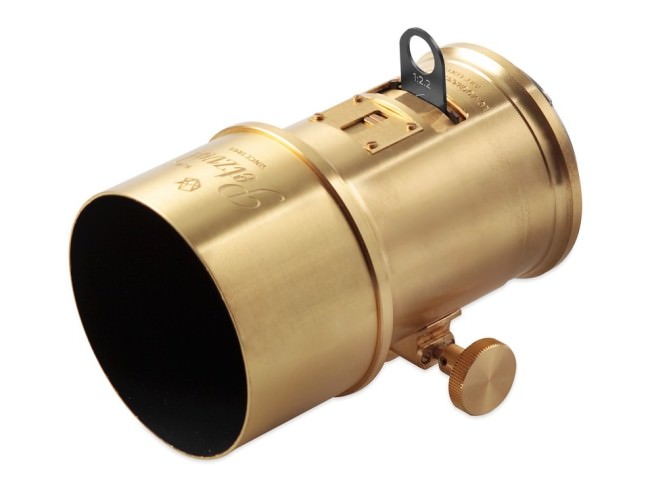
Lomography has introduced the Lomo’instant Wide camera. Using Fujifilm Instax Wide film, the camera offers a 35mm equivalent lens and Auto, Bulb, and 1/30sec Fixed Shutter Speed modes. Features cater to those who want to take a little more control over their instant prints, including a multi-exposure button and a lens cap that functions as a shutter remote control. Read more

Articles: Digital Photography Review (dpreview.com)
 
Comments Off on Lomography launches Lomo’instant Wide camera

Posted in Uncategorized


11. Türchen: Lomography

11 Dec

Lomo'Instant

11. Türchen

Unser heutiges Türchen verspricht jede Menge Spaß. In ihm liegt die neue Sofortbildkamera Lomo’Instant von Lomography, mit der Ihr Eure Erinnerungen festhalten und direkt in Händen halten könnt. Mit viel Zubehör lädt sie zudem zu kreativen Experimenten ein.

Die Kamera ist klein und leicht und so perfekt zum Mitnehmen, bietet aber jede Menge Möglichkeiten. Sie enthält einen Blitz mit Farbfiltern und ein eingebautes Weitwinkelobjektiv. Drei weitere Objektive lassen sich zur Kamera dazukaufen: Ein Portrait-, ein Makro- und ein Fisheye-Objektiv.

Weitere Funktionen gibt es, um Langzeit- und Mehrfachbelichtungen zu machen. Ein kleiner Spiegel an der Kamera hilft bei Selbstportraits. Die Kamera nutzt die Fuji-Instax-Mini-Filme, die eine Außenabmessung von 54 x 86 mm und einem Bildfeld von 46 x 62 mm haben.

Lomo'Instant

Die Lomo’Instant gibt es in schwarz, weiß und in der Sanremo Edition mit braunem Leder. Wir verlosen im Türchen die schwarze Ausgabe inklusive den drei Zusatz-Objektiven. Das Set ist 129 € wert. Der Preis der Kamera ohne weitere Objektive liegt bei 99 €.

Um die Kamera zu gewinnen, schreibe einen Kommentar unter bürgerlichem Namen und gültiger E-Mail-Adresse bis heute um 24 Uhr. Danach verlosen wir sie per Zufallsgenerator unter allen Kommentatoren. Die genauen Gewinnspielregeln findest Du hier. Viel Glück!


kwerfeldein – Fotografie Magazin | Fotocommunity

 
Comments Off on 11. Türchen: Lomography

Posted in Equipment


Lomography adds Lomochrome Turquoise film to lineup

27 Oct

Back in January 2013, Lomography announced that it would be releasing a color negative film called Lomochrome Purple, which was based on Kodak’s Aerochrome. With that film, photographers could capture images with shifted colors skewed towards the presence of purple. Today the company has made a follow-up announcement, introducing the Lomochrome Turquoise XR 100-400. Read more

Articles: Digital Photography Review (dpreview.com)

 
Comments Off on Lomography adds Lomochrome Turquoise film to lineup

Posted in Uncategorized


Testbericht: Lomography x Zenit Petzval Lens

31 Aug

Ein Beitrag von: Tamara Skudies

Lomography startete im Juli 2013 auf Kickstarter das Petzval-Projekt. Mit Hilfe von über 3.000 Unterstützern und mit Zenit konnten sie die Petzval produzieren! Die Linse ist eine Neuauflage des legendären Petzval-Objektivs aus dem Jahr 1840, das in Wien entworfen wurde.

Das Petzval-Objektiv war die erste Portraitoptik in der Fotogeschichte und wurde von Josef Maximilian Petzval konstruiert. Die Linse hatte damals zwei Verbesserungen gegenüber den schon vorhandenen Objektiven. Zum einen war es mit einer Blende von 3.6 etwa 22 Mal lichtstärker und zum anderen wurde die Zusammensetzung der Linsen zum ersten Mal berechnet anstatt nur geschätzt.

Das von Voigtländer produzierte Objektiv wurde bis 1862 60.000 Mal hergestellt. Ein Nachteil der Konstruktion war ein starker Schärfeabfall an den Rändern, der heutzutage aber zugleich den Charme des ganzen Objektives ausmacht.

Das neue Petzval-Objektiv wird aus Messing gefertigt und verfügt über eine Glasoptik von Zenit. Der „Nachteil“ der alten Konstruktion wurde natürlich beibehalten, denn ein modernes Objektiv, das die Feldkrümmung minimiert, sollte es ja nicht werden. Das verleiht den Bildern den besonderen Look.

Petzval-Objektiv

Möchte man weiche Bilder, nimmt man eine offene Blende und will man mehr Schärfe, nutzt man eine der kleineren. Mit einer Brennweite von 85 mm ist sie perfekt für Portraits geeignet. Zudem passt die Linse je nach vorliegendem Anschluss auf (analoge und digitale) Canon-EF- und Nikon-F-Kameras. Man bekommt zu der Linse ein Paket verschiedener Steckblenden von f/2.2 bis f/16 und kann vier weitere experimentelle Steckblenden zusätzlich erwerben.

Technische Details

Fokuslänge: 85 mm
Maximale Blende: f/2.2
Blenden: Waterhouse Blendenset, bis zu f/16
Bildkreis: 44 mm
Bildfeld: 30°
Linsenaufsätze: Canon EF und Nikon F
Elektronische Kontakte: Nein
Geringste Fokusdistanz: 1 m
Fokus Mechanismus: Gear Rack Focusing
Filtergewinde: 58 mm
Bildkreis: 44 mm

Portrait einer Frau mit Sonnenbrille.

Bunte Blätter.Grashalme.

Das Auspacken der Linse war schon toll, denn wenn man sie in die Hand nimmt, gibt sie einem das Gefühl einer besonderen Wertigkeit. Die Verarbeitung war bei meinem Modell gut und die Aufmachung war sowieso atemberaubend schön.

Ich hatte die messingfarbene Variante und wurde glatt gefragt, ob das eine Leica sei, obwohl hinten ein hässlicher schwarzer Canonklotz dran hing. Das ist eigentlich der einzige Nachteil, denn ich hätte die Optik viel lieber für M42 oder meine Pentacon Six, denn Adapter auf Canon- oder Nikonmodelle sind ja heutzutage kein Problem. Mit dem Wunsch bin ich, glaube ich, auch nicht die einzige.

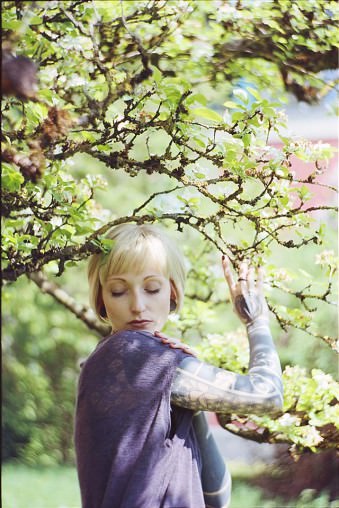
Blonde Frau in einem Magnolienbaum.Frau in Unterwäsche.

Äste mit Blüten vor blauem Himmel.

Ich testete die Linse mit meinen analogen Canons (EOS 1000 oder EOS 500) und mit meiner digitalen Canon 5D Mark II. Für Portraits machte ich ein paar Termine aus, um zu sehen, wie die Bilder damit werden. Am meisten machte ich jedoch mit ihr Naturaufnahmen. Für beides ist die Linse geeignet.

Bei Portraits würde ich aber zu einer geschlosseneren Blende raten. Meine meisten Bilder sind mit f/2.2, f/2.8 oder f/4 gemacht. Die Blende 6 hatte ich nicht und 8 war mir zu klein, da ich ein Freund von geringer Schärfentiefe bin. Somit hatte ich ein paar unscharfe Ergebnisse, mit denen ich aber gut leben konnte.

Mit der Zeit bekommt man aber ein Gefühl dafür, mit der Linse und ihrem besonderem Einstellrad links unten am Objektiv scharf zu stellen. Mich hat diese Art des Scharfstellens begeistert und ich finde es sogar praktischer als die übliche Variante. Etwas umständlich ist eher die Blendeneinstellung, da man für jede Blendenöffnung eine Stecklinse besitzt, die man oben in das Objektiv stecken muss.

Auch daran gewöhnt man sich mit der Zeit und meistens habe ich auch nicht oft gewechselt. Die Steckblenden haben an den Seiten zwei schmale Stücke, die man an seine Optik anpassen kann, damit sie nicht herausfallen können. Ich konnte dies beim Testgerät natürlich nicht machen und habe die Optik immer auf unendlich oder ganz nah gestellt, damit ich die Stecklinsen nicht verliere.

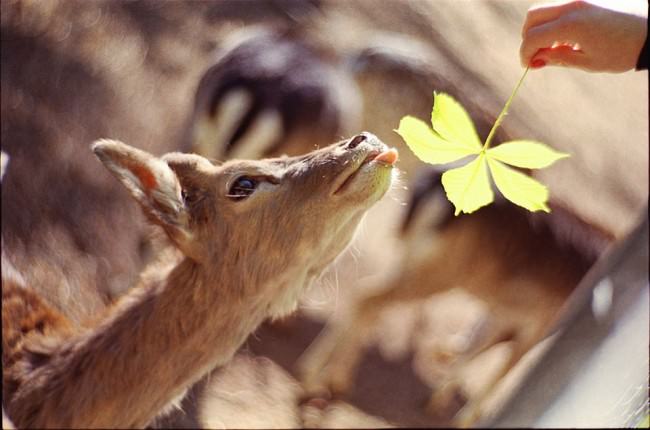
Reh wird ein Kastanienblatt hingehalten.

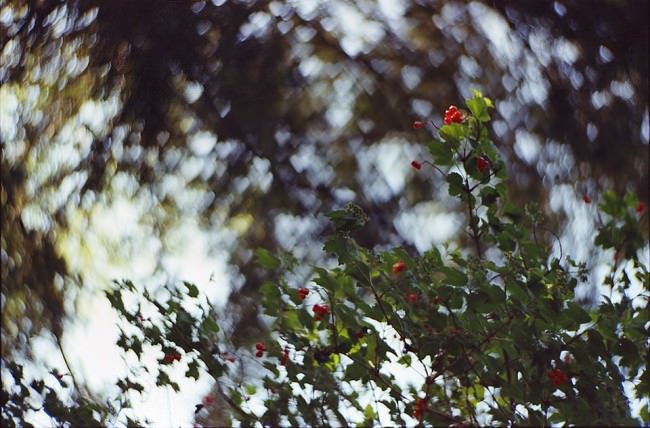
Ast mit grünen Blättern und roten Beeren.

Leider habe ich keine Tests mit Blende 8 oder aufwärts gemacht, was mich wirklich ärgert. Dafür baute ich mir aus einem festen schwarzen Papier meine eigene experimentelle Steckblende mit Herzform, die mir sehr viel Spaß bereitet hat.

Zudem nutzte ich die Optik im botanischen Garten mit einer +2-Nahlinse, die es mir ermöglichte, näher an meine Motive ran zu gehen. Der „Swirl“-Effekt ist zum Glück nicht bei jedem Hintergrund möglich, was auch das Fotografieren mit einem schönen weichen Bokeh ohne die runde Unruhe ermöglicht.

Beachten sollte man auch die Unschärfe im Randbereich, die das Scharfstellen erschwert oder sogar unmöglich macht. Der Schärfepunkt sollte also eher zentral liegen. Wer absolute Schärfe wünscht, sollte sich eine andere Linse kaufen. Für mehr Schärfe ist es wohl besser, mit geschlossener Blende zu fotografieren, aber ich wollte ja den Charme der Linse unbedingt haben mit der ganzen Unschärfe. Im offenen Blendenbereich sind die Ergebnisse eher weich und haben einen geringen Schärfebereich.

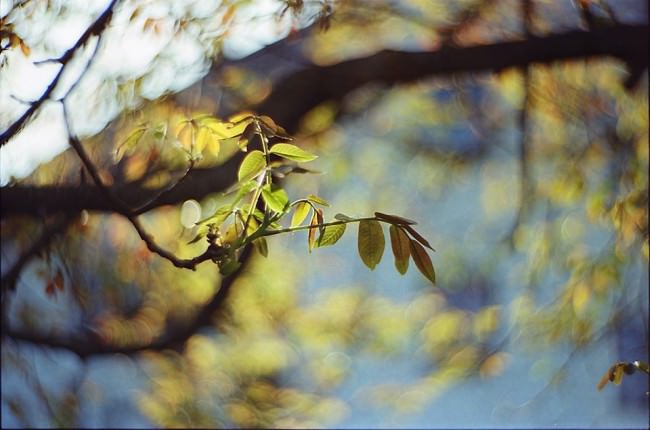
Ein Ast

Bunte Äste im Gegenlicht.

Die Optik ist eher was für Fotos mit Charme als für technisch perfekte Bilder. Aber gerade deshalb habe ich mich in sie verliebt. Wäre der Preis nicht 549 €, würde ich mir sicher auch eine kaufen. Der Andwendungsbereich der Optik liegt meines erachtens hauptsächlich bei Portraits und Naturaufnahmen. Dafür finde ich den Preis etwas zu hoch, aber sie lässt mir nach wie vor keine Ruhe. Im großen und ganzen ist der Preis okay für die Optik, sie ist nun einmal etwas ganz Besonderes und mit keiner anderen Linse zu vergleichen.

Als die Linse vorgestellt wurde, hätte ich sie schon am liebsten gehabt. Dann bekam ich die Möglicheit, sie zu testen und hatte die Angst, dass wenn ich sie erst einmal hätte, ich sie auch wirklich unbedingt brauche. So ist es nun auch und mein Verstand kämpft mit meinem Herzen.

Moosbewachsene Äste.

Ich hatte nicht wirklich irgendwelche Erwartungen an die Linse, außer daß ich sie wohl noch schöner als mein Helios 58 mm ist, das ja auch einen leichten Swirl-Effekt hat. Viele fragen ja, warum man sich ein teures Petzval kaufen sollte, wenn es das Helios günstig gibt. Ich konnte jetzt beides vergleichen und muss sagen, dass das Petzval noch mal einen stärkeren Charme auf Fotos bannt als das wirklich tolle Helios.

Falls sich ein edler Spender findet oder jemand sein Petzval günstig verkaufen will – ich nehm’s gern! Jetzt gibt es ja bald die Möglichkeit, die Optiken in den Geschäften zu begutachten und sicher auch mal an seiner Kamera zu testen. Macht dies aber nur, wenn Ihr den passenden Geldbeutel dafür habt!


kwerfeldein – Fotografie Magazin | Fotocommunity

 
Comments Off on Testbericht: Lomography x Zenit Petzval Lens

Posted in Equipment


A look at the Lomography Petzval 85mm F2.2 lens

02 Jul

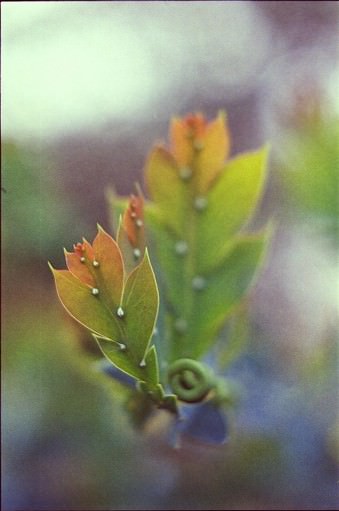
Lomography isn’t a company we’ve historically talked about much on DPReview; with its emphasis on low-fi, ‘shoot from the hip’ photography using plastic film cameras, it’s a long way from the typical interests of our readers. But last year the company came up with an interesting idea: to recreate a classic 19th century portrait lens for modern SLRs. The result is the Petzval 85mm F2.2, which is available now to fit Canon or Nikon SLRs. So what’s it like?

related news: Digital Photography Review (dpreview.com)
 
Comments Off on A look at the Lomography Petzval 85mm F2.2 lens

Posted in Uncategorized


Lomography seeks crowdfunding for Lomo’Instant Camera

28 May

lomo_instant.jpg

Lomography has announced a new Kickstarter campaign, looking to fund the production of the Lomo’Instant camera. This is the company’s first fully instant camera, featuring a 27mm equivalent lens with 0.4m close focusing distance, a built-in flash, tripod mount, fisheye and portrait lens attachments and included color gels. It accepts Fujifilm Instax Mini film, and is estimated to become available in late 2014. Learn more

News: Digital Photography Review (dpreview.com)
 
Comments Off on Lomography seeks crowdfunding for Lomo’Instant Camera

Posted in Uncategorized