RSS
 

Posts Tagged ‘like’

Sharon Montrose Answers What It’s Like to Photograph Lions and Other Incredible Animals

15 Aug

When was the last time you got to snuggle a wolf puppy at work?

Never? Us neither. Sharon Montrose, on the other hand, can raise her hand to that one (and we’re green with jelly).

Sharon’s the photographer behind The Animal Print Shop. You might’ve spotted her portraits of wide-eyed baby giraffes, raccoons looking smug, and baby bears being baby bears.

We asked about how she discovered her awesome talent for photographing animal personality and what working commercially is all about.

While wolf pups might not be next up on your model list, you’ll get inspired to sit your pet down for a session!

Sharon Montrose on Animal Photography

p.s. We’re hiring for an amazing opening at Photojojo. We’re looking to re-invent what/how/where we publish online, and we’re seeking one amazing somebody to lead the charge as Editorial & Community Lead.

Who is Sharon?

The first time we heard about Sharon, she was snapping a baby giraffe in this Etsy interview. That’s when we knew that she probably had the best job in the world.

Sharon’s an acclaimed animal photographer who happened upon her talent for capturing portraits of animals when she was inspired to photograph her own dog one day (read more about that in the interview).

While she shoots dogs and cats commercially (you’ve probably seen her photos on billboards), Sharon has had the opportunity to work with less common animals like bear cubs, ostriches, and flamingos in her personal photography. This project is what became her Animal Print Shop series. Read about where the animals come from here.

Looking through Sharon’s portfolio is a roller coaster ride of awwww and is that real! and dang, she’s inspiring. Read on to learn more about how Sharon got started and what gets her inspired.

Is photographing large animals intimidating?

Q: You’ve photographed buffalo, cows, giraffes, lions even! Is it intimidating to stand in front of an animal that large with your camera?

A: No. I’m naturally a somewhat fearful person, but I when I get behind the lens, my fear is goes away–I think I’m too distracted getting my shot to be afraid. 

How do you get great photos of wiggly subjects?

beforeQ: So, kittens and puppies aren’t known for their sitting-still-in-one-spot skills. How do you manage to get great photos of them regardless?

A: Patience and timing. With animals that move around a lot, you have to be ready and focused to hit the shutter in that split second when they stop.

How many shots does it take to get that one photo?

beforeQ: When you’re shooting for your Animal Print Shop series, how many shots does it take to get that one incredible photo?

A: It really depends on the animal–if it’s a calm animal (like a cow) who will just stand there and look around, I can get my shot in a couple frames. Others though, like little lion cubs, are running all over the place and take some serious time and patience.

How did you get into animal photography? before

Q: Did you know you wanted to get into animal photography off the bat? If not, what was getting there like?

A: At first I had a very tough time turning what I loved doing into a way to earn a living. I floundered before I became established as a working photographer. I was shooting headshots and weddings and doing okay at it, but I wasn’t happy doing either and had lost the love I had for photography.

Around the same time, I adopted my first dog (several members of my family also had dogs), so I started taking photos of all the dogs in my life to see if it reignited the love I once had for photography. It did, and I learned an important lesson as a result: I had to have an authentic connection with my subjects.

Shortly afterwards I began work on my first book Dogtionary (Viking Press 2001). The book came after many failed attempts at marketing myself as a private party pet photographer. Back in 1998 people didn’t spend money on their dogs like they do today.

The book (and subsequent books) established me in my niche because the internet was still new, so being published was more productive in those days and there were very few published photographers with dog books in the United States. There were only a handful of us in the shadows of the great William Wegman, Elliot Erwitt, Henry Horenstein, and Keith Carter. I think it was me, Jim Dratfield, Kim Levin, Valerie Shaff, Sharon Beals, Deborah Samuel, Jeff Selis, and Debra Marlin. If I forgot someone, I’m human, please don’t send me hate mail.

Can you describe a shoot in 5 steps?

beforeQ: Can you describe a shoot (let’s say one from your Animal Print Shop series) in 5 steps? Give us an idea of what happens start to finish!

A:
1. Phone calls: Reaching out to my contacts to see if there’s anything out there for me to photograph.
2. Production: Coordinating the logistics and equipment for the shoot.
3. Shoot day: The best day!
4. Editing, post production, and test printing.
5. Producing Materials for New Release: Producing product shots, printing inventory, and adding the new release to the site, plus marketing efforts.

What is having a professional team like?

Q: What is having a professional team like? Are you ever like, “I wish it was just me?” 

A:never wish it was just me. I literally couldn’t do what I do without my team–I’m very lucky to have them.

What didn’t you realize you would be doing?

beforeQ: You’re pretty much running your own business as a photographer. What do you do a lot of now that you didn’t realize you would be doing when you started?

A: Answering questions about myself in interviews. I take my work seriously, but I don’t take myself seriously–so it’s a weird challenge.

How much creative free-reign do you typically get?

beforeQ: In commercial photography how much creative free-reign do you typically get? We’re guessing you’re working with clients’ marketing teams and maybe stylists — how collaborative is it?

A: It’s always a collaborative effort to get the shot, sometimes with many different creatives coming together: creative director, set decorator/prop stylist, production, and my crew.

If I have been selected for a job by a creative team, it’s because they like what I do and believe I can nail their comp, so it’s inherently collaborative.

Usually after we’ve been successful at getting their comp and the client is happy, I’ll shoot variations and freestyle a little to get extra options and make sure they have everything they need — that’s where I get free-reign. And sometimes they end up using those shots instead or in addition to the original concept.

Who are your top 3 favorite photographers?

Sally Mann, Robert Mapplethorpe, Edward Weston.

Where or who is your favorite inspiration? 

beforeQ: When you want to photograph your own stuff, where or who is your favorite inspiration? 

A: Honestly, it’s hard to shoot my own stuff now since I’m so busy running The Animal Print Shop. Inspiration does strike though, and I usually just pull out my iPhone to take a few snaps. It’s usually of my dogs or my crew messing around at the shop to post on Instagram.

Unless I’m in my most favorite place on earth: Yosemite. There you will find me somewhere along the Merced River in all my photo glory looking like a total Ansel Adams wannabe, photo-geek. True story.

Do you have any favorite phone photo apps or tips?

beforeQ: We see you’re on Instagram. (OMG wolf puppy!) Do you have any favorite apps or tips?

A: I like VSCOcam and Squareready. But don’t ask me, I’m old.


Related posts:

  1. How to Photograph the Holidays — From Around the Web Points of Interest Got ideas for great New Year’s Photo…
  2. Photograph Your Friends From Five States Away! Relationships, fragile packages, our feet. Long distance is hard on…
  3. How to Photograph the Galaxy…in 3D! The minute Richard Branson’s Virgin Galactic takes off, you’ll be…


Photojojo

 
Comments Off on Sharon Montrose Answers What It’s Like to Photograph Lions and Other Incredible Animals

Posted in Equipment


Flat-Pack Emergency Shelters Slot Together Like Puzzles

05 Jun

[ By Delana in Architecture & Houses & Residential. ]

emergency shelters flatpack plywood

Times of emergency call for quick action to get victims into safe shelters. Plenty of easily-assembled emergency structures have been designed over the years, but Australian architecture firm BVN Donovan Hill has presented an interesting take on the topic. Their idea goes together like a 3D puzzle, each piece of plywood slotting together as easily as a flat-pack furniture kit.

flatpack emergency shelter

The shelter consists of pre-cut plywood boards that would be delivered to a disaster site flat-packed. Each piece has notches that fit into the next piece; assembling one of the shelters requires no tools other than the hands of one or two people. Once the wooden skeleton has been assembled, a waterproof skin is put on the outside to keep out the elements. The goal is for the structure to be able to be assembled in just one day.

easily assembled flat pack emergency shelter

The inside of the structure features contours that jut out to create shapes that could be used for sitting or sleeping. That’s according to the designers – to us, the thin plywood shapes don’t look comfortable enough to support a person without an extreme amount of padding between them and the human body.

modular pre-cut easy assemble emergency shelters

According to the designers, one of their main goals in this design was to create a space that is not simply utilitarian, but one that creates happiness in times of tragedy. The shelters are small – around 100 square feet – but very heavy at about half a ton each. This makes each one quite substantial and perhaps usable for long periods if necessary.

temporary emergency shelter flat pack

The structures can be grouped together to create a temporary community, with some buildings serving as meeting places instead of grouping all of the victims together in one very large space. The concept will require a significant amount of fleshing out before it becomes a viable option for disaster relief, but the idea of an easily (and quickly) assembled, private temporary home is one that will appeal to just about anyone who has ever been displaced by a natural disaster.

(images via: Inhabitat)

Share on Facebook


[ By Delana in Architecture & Houses & Residential. ]

[ WebUrbanist | Archives | Galleries | Privacy | TOS ]


WebUrbanist

 
Comments Off on Flat-Pack Emergency Shelters Slot Together Like Puzzles

Posted in Creativity


The Stunning Instrument That Sounds Like an Orchestra

04 May

[ By Delana in Gadgets & Geekery & Technology. ]

wheelharp

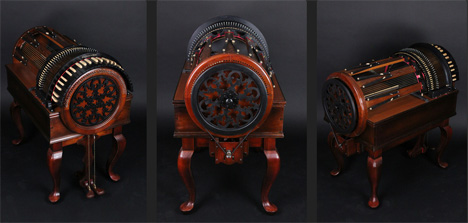
Stringed instruments have been played since time immemorial, and naturally as technology improves plenty of people are trying to recreate that kind of sound digitally. Of course, nothing compares to the rich, warm, sensual sound of an actual stringed instrument, and this is something that artist and artisan Jon Jones understands better than most people. That is why he created the Wheelharp, an incredible stringed instrument that manages to sound like the entire string section of an orchestra all on its own.

radial wheelharp

The beautiful instrument was inspired in 2001 by Jones’ hurdy-gurdy, an ancient stringed instrument that produces tones via a hand-cranked rosined wheel rubbing against strings. As much as Jones enjoyed the hurdy-gurdy, he wanted to know if he could create a full-scale chromatic instrument in which each string could produce a different sound when individually bowed on the rosined wheel. He set out to produce the first Wheelharp.

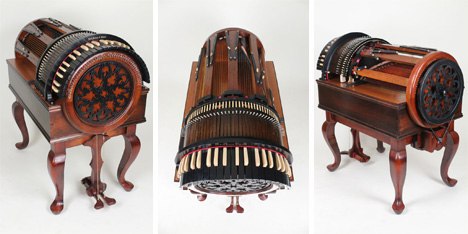
The result was an instrument of incomparable beauty and charm. Pressing on any of the Wheelharp’s keys moves a string toward the rosined wheel. Of the instrument’s two pedals, the right controls the speed of the motor which turns the wheel. The left pedal controls a damper system that extends across the strings. Although the instrument looks old-timey and low-tech, it also includes an electromagnetic pickup and a piezoelectric pickup, both of which allow the player to control the instrument’s amplification.

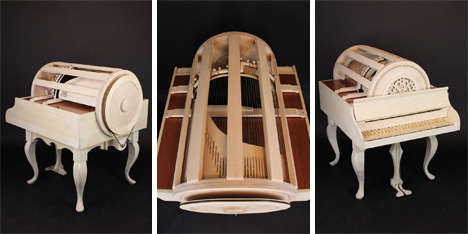
linear wheelharp

It would be impossible to describe the immense beauty and complexity of the music produced by the Wheelharp. It is truly an instrument like no other in the world. It is produced in two versions: a radial version (with the curved keyboard) and a linear model with a more familiar, traditional straight keyboard. Both models produce some of the most breathtaking music ever produced by a single instrument. It certainly doesn’t hurt that the Wheelharp is an object of beauty to look at, either. But if you want to give this incredible invention a try, be ready to pay for it: the least expensive version from Antiquity Music runs nearly $ 10,000.

Share on Facebook


[ By Delana in Gadgets & Geekery & Technology. ]

[ WebUrbanist | Archives | Galleries | Privacy | TOS ]


WebUrbanist

 
Comments Off on The Stunning Instrument That Sounds Like an Orchestra

Posted in Creativity


Tentsile: Extreme Travel Tree Tents Hang Like Hammocks

15 Mar

[ By WebUrbanist in Global & Travel & Places. ]

tentsile hanging hammock tent

Hikers and campers have long been used to hanging food packs out of reach of bears and scavengers, but these tensile treehouse shelters take things a few steps further, allowing you to loft your entire portable residence amid any forest.

tentsile three legged tent

No more worrying about the weather or extreme landscapes like muddy swamps and desert sands. “Due to the unique design, the tent provides a level trampoline style floor in any terrain or inclination. It’s elevated position does away with the need to clear the site of foliage and provides separation from flood, sand storms, earth tremors, cold and lumpy ground as well as offering increased protection from wildlife, including insects, snakes and other predators.”

tentsile deployment models options

In theory, you could suspend these off the sides of cliffs or hover them above lands and streams since (setup, entry and exit excepted) the ground conditions are irrelevant. Tentsile describes their product line as being “the world’s most versatile tents. Whether you are looking for an all terrain camping solution, a safari safe house, a mountain or beach retreat, or a portable treehouse that avoids all planning restrictions, with Tentsile the sky really is the only limit.”

tentsile night setup detail

The various models have side and bottom entries in various configurations, with sleeping sections along the spokes and a central communal area familiar from many typical tents. Like a three-legged stool, the frame is held in tension from three points and is thus essentially self-balancing within the right tolerances. “The structure comprises a collapsible frame of webbing straps with fire retardant, UV PU and water resistant polyester fabric infill panels.” 

Share on Facebook


[ By WebUrbanist in Global & Travel & Places. ]

[ WebUrbanist | Archives | Galleries | Privacy | TOS ]


WebUrbanist

 
Comments Off on Tentsile: Extreme Travel Tree Tents Hang Like Hammocks

Posted in Creativity


Shoot Like Henri Cartier-Bresson: A Quick Guide To Becoming An Amazing Photojournalist

07 Feb

“Most of my pictures are grounded in people. I look for the unguarded moment, the essential soul peeking out, experience etched on a person’s face. I try to convey what it is like to be that person, a person caught in a broader landscape that I guess you’d call the human condition.” It’s by Steve McCurry, whom I didn’t know Continue Reading

The post Shoot Like Henri Cartier-Bresson: A Quick Guide To Becoming An Amazing Photojournalist appeared first on Photodoto.


Photodoto

 
Comments Off on Shoot Like Henri Cartier-Bresson: A Quick Guide To Becoming An Amazing Photojournalist

Posted in Photography


10 Ways to Direct a Portrait Shoot like a Pro

30 Jan

In this post Gina Milicia – author of our brand new eBook “Portraits: Making the Shot” shares 10 tips on directing a portrait shoot like a Pro.

Mallory Janson New York: photo by Gina Milicia

1. Check your Mood

Have you ever been served by a rude shop assistant or waiter that was in a bad mood? How did it make you feel?

Your mood on the day of your shoot is going to have a huge impact on the people around you. If you want the people you photograph to look and feel relaxed then you should look and feel relaxed too.

2. Try to be interested rather than Interesting

A great portrait photographer knows how to speak to their models and make them feel comfortable, confident and relaxed.

A persons name is the sweetest sound to their ears so remember it and use it often.

Most people’s favorite topic of conversation is themselves. Ask questions, be interested and really listen to their answers

3. “Be yourself, everyone else is already taken.” Oscar Wilde

Ditch the boring clichés, saying stuff like “make love to my camera” just sounds really creepy

Work with a language you are totally comfortable with. If you are softly spoken then this is how you should give direction. Trying to be someone else will just make directing awkward for you and your model.

Daniel Macpherson: photo by Gina Milicia

4. “By failing to prepare, you are preparing to fail.” Benjamin Franklin

As the photographer you should always be the first to arrive and the last to leave.

Always have your lighting, poses and location worked out in advance. Your model will already be feeling nervous and vulnerable. Subjecting them to lighting tests and your uncertainty is only going to make them feel worse.

5. YOU need to know how to Pose

Practice posing to learn which positions will flatter a body and which shapes looks good from different angles. Or be a model for another photographer and experience what it’s like to be directed by someone else.

Then explain the pose in different ways.

  1. Get in there and do the pose for them. Show them what you want.
  2. Explain it to them at the same time.
  3. Then get your model to do the pose before you start shooting.

This is not only the quickest and most effective way to get your sitter into the pose, it helps you develop a rapport. Once your model knows how nice the pose looks on you (and realizes they won’t look foolish), they will be much happier to do what you’re asking.

Lachy Hulme: photo by Gina Milicia

6. Use Visual rather than Verbal Cues

I hear and I forget. I see and I remember. I do and I understand.” – Confucius

The quickest and most effective way to direct a person is by giving them visual rather than verbal cues.

Telling my clients how to stand with verbal cues would sound something like this

Stand with your feet adjacent to each other, weight on your back foot, hips side on, front toe to camera, right arm on hip, left arm in pocket, chest ¾ to camera , head slightly right…. No sorry my right. Now move your head left… sorry, I mean right. Now step left… sorry I mean right

Verbal cues become incredibly confusing and can really diminish rapport with your client. You become frustrated because your client keeps moving the wrong way and your client is confused, uptight and lacking in confidence.

I have found that visual cues are by far the best way to pose your clients.

I simply swap places with my client walk onto the set and go into the pose so they can see exactly what I’d like them to do.

Once your client is in the correct position continue to use visual cues to direct them.

Some examples of this would be;

Turn your face towards that tree” instead of “turn your face to the left

Move your face towards the window and move your eyes back to look into my camera” instead of “turn your face to the right and look at me

7. Praise and Encourage

Give positive feedback when your model is doing the right thing. It’s classic positive reinforcement but it works. Ignore the bad and praise the good.

Talking to your model will keep them relaxed so they don’t worry about what you’re thinking behind the camera (because that’s exactly what they’re worrying about).

Shaun Micaleff: Photo by Gina Milicia

8. One Size does not Fit All

A photograph is just a tiny slice of a subject. A piece of them in a moment. It seems presumptuous to think you can get more than that.” – Annie Leibovitz

It’s really important to choose poses that fit your model.

Trying to foist a particular style and attitude onto the shoot is a short cut to your model looking and feeling uncomfortable. Most great portrait photographers are masters at letting their model’s personality come through in their shots.?

9. Eye, eye, eye

You can’t hide your lying eyes” – The Eagles

Everything you think about is mirrored in your eyes. I actually notice this in the eyes of women more than men.

Even if you’ve nailed the pose, the lighting, and the location, an insincere smile or eyes that lack emotion can ruin your shot.

How do you get your sitter to switch off?

While you can’t actually stop your sitter from thinking, you can direct them to a better headspace to reduce any negative thought patterns.

Here are a few visualization techniques I use

  1. Favorite holiday destination
  2. Dream job scenario
  3. Meeting one of their idols

Ask your sitter to look away from the camera, and then back again after each frame. This is especially useful on a long shoot as it distracts your sitter long enough to give them fresh, thoughtful eyes for each shot.

Make small variations on the pose to make it a little more interesting, such as asking your sitter to make their smile bigger or smaller.

Just keep talking

10. The quiet moments in between frames

Some of my best portraits have been captured in those moments between frames when the model thought I wasn’t shooting and relaxed their “pose face” or glanced/laughed off camera. Watch for these moments. They are gold.

Enjoy this post? Check out more of Gina’s advice in her new eBook – Portraits: Making the Shot (and get a bonus one free for the next week only).

Post originally from: Digital Photography Tips.

Check out our more Photography Tips at Photography Tips for Beginners, Portrait Photography Tips and Wedding Photography Tips.

10 Ways to Direct a Portrait Shoot like a Pro


Digital Photography School

 
Comments Off on 10 Ways to Direct a Portrait Shoot like a Pro

Posted in Photography


Adele Someone Like You Acoustic Guitar Cover Duet Version by Celia & GJ

19 Jan

shot in my living room with a friend’s Nikon D3100, hope you guys enjoys it! www.facebook.com special thx to Elin for her equipments!

Presented by: Neumann Films Sponsored by 3 Studios, Citadel Church and Bucer’s Coffee House Label: Dream Records www.dreamrecords.org Buy Jonathan’s Album “The Anatomy of a Heartflow” here itunes.apple.com Song mixed and mastered by Luke Fredrickson Drums, guitar and bass by Luke Fredrickson Piano by Jonathan Thulin Violin by Kai-Li Cheng Violin 2 by Hsaan-Wen Lin Viola by Benjamin Davis Cello by Cory Grossman Backgorund vocals by Whitney Thulin and Lori Sabin Directed by: Luke Neumann and Jonathan Thulin Filmed by: Luke Neumann, Pete Dryden and Marika Neumann Filmed on the Canon T2i / Canon 550D / Kiss X4 Canon 50mm f 1.8 Nikon 28mm f 2.8 Glidetrack SD Shooter Glidecam HD1000 Edited in Sony Vegas Pro 10.0 Color Corrected in After Effects CS5.5 using Magic Bullet Looks Filmed at: Cordelia Chapel – Genesee, Idaho, Bucer’s Coffee House – Moscow, Idaho, Apartment – Moscow, Idaho Crew: Luke Neumann, Pete Dryden, Marika Neumann, Jonathan Thulin, Dane Wilson, David Kong, Katie Smith Lighting provided by David Kong Story line: Jonathan Thulin Movement Director: Katie Saunders Make up: Cristina Plaza Casting by: Jonathan Thulin, Katie Saunders, Natalie Greenfield, Tina McClure, Jeremiah Grauke, Cristina Plaza Costumes provided by Hope Center Moscow, Idaho Language Coach Katie Saunders Transportation provided by The Crossing, Moscow, Idaho CAST Boy – Levi Wintz Girl – Ruth Saunders Babylon the Great (Violin Player) – Abigail Smith Door Keeper – Chantelle Courtney Babylon the
Video Rating: 4 / 5


John Deere ATU installation in Macdon like Swathers

01 Jan

John Deere ATU installation in Macdon like Swathers. Premier, Westward etc.

The Dead 60s – Too Much TV – (Dub Vesion)
Video Rating: 0 / 5


My Visit With DigitalRev, or, What’s Kai Wong Really Like?

01 Jan

Earlier this month as many of you know, I traveled to Hong Kong to be a guest on DigitalRev's Pro Tog, Cheap Camera series. (Full video and final pic edits below.)

Which meant I also got to hang out with the DR team, including Lok, Alamby, Theo—and of course show frontman/international sex symbol/Man of Mystery Kai Wong.

And you are probably wondering right now: what's Kai really like? Read more »
Strobist

 
Comments Off on My Visit With DigitalRev, or, What’s Kai Wong Really Like?

Posted in Photography


Scorpions’ “No One Like You”

29 Dec

Finally the first video with my new baby 😀 Great Scorpions song of their 1982 album “Blackout”. I made the backing track using Toontrack Ezdrummer and Spectrasonics Trilian. Guitars: Jackson Soloist Custom Shop Gibson Les Paul Custom Amp: Vox AD50VT XL Audio-Recording: Shure Sm57 Lexicon Omega Software: Cubase LE4 Ezdrummer Spectrasonics Trilian Sony Vegas 8.0 Video-Recording: Nikon D90
Video Rating: 4 / 5