RSS
 

Posts Tagged ‘latest’

Fujifilm unveils the Instax Mini Link, its latest compact instant photo printer

02 Oct

Fujifilm has launched the Instax Mini Link, its latest photo printer designed to turn digital photos into analog Instax prints.

The handheld device works hand-in-hand with Fujifilm’s new Instax Mini Link app to share and print images wirelessly. Fujifilm says the device can transfer prints in ‘about 12 seconds’ and can print up to 100 Instax prints per charge.

The Instax Mini Link has special printing modes including called ‘Video Print’ and ‘Party Print.’ ‘Video Print’ lets you scrub through a video to capture a still to print with the devices, while ‘Party Print’ allows up to five different smartphones to pair together to create a collage of images in a single print. An additional ‘Surprise Mode’ within the ‘Party Print’ option will randomly scramble the images, ensuring the final print remains a mystery until it’s revealed.

Basic edits can be made to photos within the Instax Mini Link app and a collection of border options are available to for further customization. Fujifilm’s X Series and GFX System cameras can also be paired with the Instax Mini Link via the Fujifilm Camera Remote app—because who doesn’t want an instant print from a $ 4,499 51.4-megapixel camera body?

The Instax Mini Link printer will be available in blue, pink and white versions and is expected to retail for $ 99.95 when it becomes available to purchase on October 4, 2019. For more information, check out the Instax Mini Link website.

Articles: Digital Photography Review (dpreview.com)

 
Comments Off on Fujifilm unveils the Instax Mini Link, its latest compact instant photo printer

Posted in Uncategorized


Apple’s ‘MultiCam’ recording will be available on iPhone XS, XR and the latest iPads

17 Sep

During its iPhone 11 event last week, Apple showcased an as-yet-unreleased version of the Filmic Pro app running on the new iPhone 11 Pro. The app was capable of recording footage from multiple cameras simultaneously, for example, front and rear camera or wide-angle and primary shooter. According to Filmic Pro, the updated version of its app will be available in the App Store sometime later this year.

The multi-cam recording function uses a new API that comes with iOS 13 and, according to Apple, required a redesign of the camera pipeline on their devices. The good news is that the changes have already been made on the iPhones XS and XR, as well as the latest iPad Pro models, as explained in this WWDC session keynote.

A screenshot from the WWDC session that shows the supported MultiCam Formats on the iPhone XS.

However, having multiple cameras active and recording at the same time puts a lot of stress on the hardware, which is why multi-camera recording on the 2018 devices has some limitations. Only certain combinations of cameras can be activated simultaneously (see table below) and, depending on the hardware requirements of their app, developers might have to revert to lower-quality video streams to make the feature work.

A screenshot from the WWDC session showing what combination of camera modules can be used with the MultiCam API in iOS 13 on an iPhone XS.

It has not been clarified yet which camera combinations will be usable on the iPhone 11 generation but during the Filmic demo, the footage appeared to be recorded from all four of the iPhone 11 Pro’s cameras simultaneously.

Nevertheless, this is good news for owners of 2018 Apple flagship devices who will be able to use the new feature at least partly. The multi-cam API should launch with iOS 13 on September 19. We’d expect a bunch of third-party apps implementing the functionality soon after.

Articles: Digital Photography Review (dpreview.com)

 
Comments Off on Apple’s ‘MultiCam’ recording will be available on iPhone XS, XR and the latest iPads

Posted in Uncategorized


TurtleRig launches latest versions of its Bulb Extensions for Flashpoint/Godox strobes

28 Jun

Lighting accessory manufacturer TurtleRig has announced the launch of its latest Bulb Extensions for Flashpoint and Godox strobes.

As explained in the three-minute promotional video above, the third-generation Bulb Extension units move the flashbulb forward 32mm (1.25in) so less light is wasted when used with certain speed-rings and light modifiers. The result is not only more light per flash (TurtlRig claims between 1/3rd to one stop of additional light) but also more even light, since modifiers like beauty dishes and parabolics benefit from having the light project more evenly than would be possible with the standard flashbulb position.

At the time, TurtleRig offers its Bulb Extensions for four different Flashpoint/Godox units, including the AD200, AD400, AD600 and AD600 Pro. Prices start at $ 20.95 and go up to $ 22.95 depending on the model.

Articles: Digital Photography Review (dpreview.com)

 
Comments Off on TurtleRig launches latest versions of its Bulb Extensions for Flashpoint/Godox strobes

Posted in Uncategorized


Leica’s latest special edition is an ‘urban camouflage’ Leica CL with a matching strap

20 Jun

Leica has teamed up with French-Italian photographer and art collector, Jean Pigozzi to release a special-edition version of its Leica CL camera system.

The camera, officially named the Leica CL ‘Urban Jungle by Jean Pigozzi,’ features the same internals as the standard Leica CL, including the 24.2-megapixel APS-C CMOS sensor and Maestro II image processor. The outside, however, features an urban camouflage print on its black leather wrap, a custom grey rope camera strap, and the words ‘URBAN JUNGLE’ etched alongside Pigozzi’s signature on the rear of the camera underneath the LCD display.

The special edition kit also comes paired with the Leica Elmarit-TL 18mm F2.8 ASPH lens, which is neatly tucked alongside the camera body and custom strap in ‘an elegant presentation box.’ This is Leica’s second collaboration with Pigozzi, the first being the Leica Sofort ‘Limoland’ camera released in 2017.

Only 150 Leica CL ‘Urban Jungle by Jean Pigozzi’ will be made and shipping will start June 25, 2019. You can get your hands on a kit at Leica Stores and Boutiques for $ 3,950. Alternatively, you can buy the standard black Leica CL kit, get yourself a silver Sharpie, scribble a little bit on the leather wrapping and save yourself approximately $ 750.

Press release:

Leica Releases Limited Edition Camera Inspired by the Aesthetic of the Concrete Jungle

The LEICA CL “URBAN JUNGLE by JEAN PIGOZZI” pairs unparalleled imaging quality with a unique camouflage design

June 19, 2019 – The visually-captivating LEICA CL “URBAN JUNGLE by JEAN PIGOZZI” is the newest special edition release of the Leica CL compact system camera presented by Leica Camera. Created in collaboration with French-Italian photographer, entrepreneur and art collector Jean Pigozzi, this eye-catching camera features a striking urban camouflage pattern on its leather covering, with an accompanying gray rope strap. Just as the Leica CL strikes a balance between traditional controls and contemporary design, Pigozzi’s thoughtful design language takes the functional pattern of camouflage and elevates it with a high-fashion and ultramodern aesthetic.

“With this design,” Pigozzi shares, “I wanted to do something completely different and create something is unique from all the other cameras around. To bring the urban aesthetic to life, I tried to visualize the structures of a big city like New York to replicate what I define as an ‘Urban Jungle.”

The LEICA CL “URBAN JUNGLE by JEAN PIGOZZI” sports the same top-level performance, intuitive handling and exceptional image quality as the standard production Leica CL. A few highlights include the built-in EyeRes® electronic viewfinder that enables users to preview the final image before the picture is taken, high-resolution image quality that performs exceptionally well in low light, and a supremely fast and accurate autofocus; all of which are packaged efficiently into a compact system camera that travels effortlessly to any urban jungle the world over. The special edition set is complete with a Leica Elmarit-TL 18 mm f/2.8 ASPH. lens, lovingly packaged together with the camera in an elegant presentation box. With a focal length ideal for everyday travel and street photography, the Elmarit-TL lens helps this set bring the urban spirit to life.

Pigozzi’s latest design is his sophomore collaboration with Leica Camera, following the Leica Sofort “Limoland” by Jean Pigozzi in 2017, which sported vibrant, colorful graphics of “Mr Limo,” the logo of Pigozzi’s LimoLand fashion label.

The LEICA CL “URBAN JUNGLE by JEAN PIGOZZI” is limited to 150 sets worldwide and will be on sale for $ 3,950 beginning June 25, exclusively available at Leica Stores and Boutiques.

Articles: Digital Photography Review (dpreview.com)

 
Comments Off on Leica’s latest special edition is an ‘urban camouflage’ Leica CL with a matching strap

Posted in Uncategorized


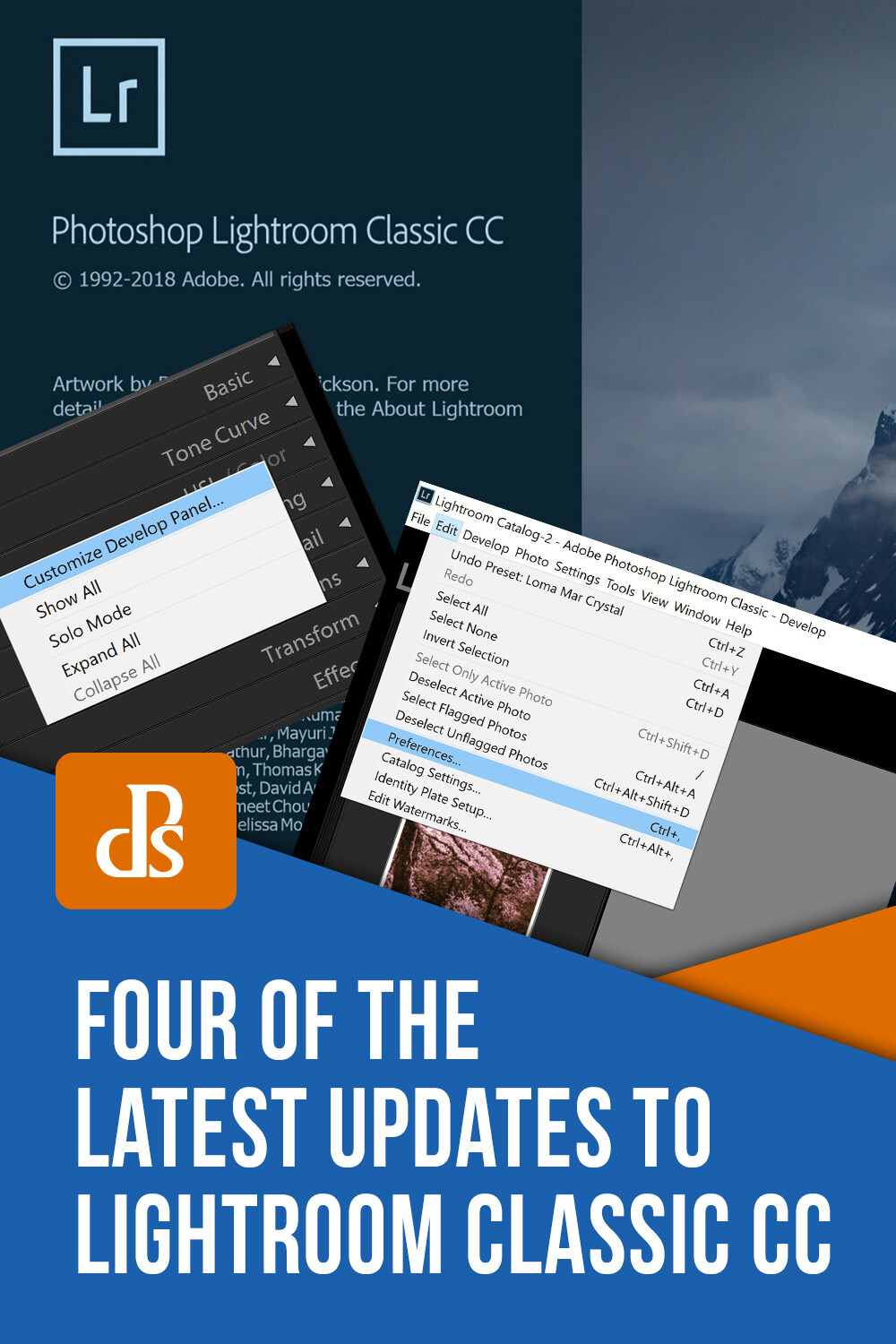
Four of the Latest Updates to Lightroom Classic CC

08 May

The post Four of the Latest Updates to Lightroom Classic CC appeared first on Digital Photography School. It was authored by Adam Welch.

When it comes to the world of photography it seems as if change is an everyday occurrence. New cameras, new lenses and new ways to make your photographs better, give the feeling that we are never quite standing still. One of the biggest testaments to this fluidity comes from the recent changes made to Adobe Lightroom Classic CC. It seems as if Adobe has been extremely busy over the past year by introducing new features and settings to Lightroom.

F:\DPS Images\Four Updates for LR Article\Lightroom-updates-adobe-adam-welch-digital-photography-school-3-3.png

It’s impossible to list all of the changes here, so I’ve picked four of the biggest and freshest new features to be introduced into Lightroom Classic CC. These range from somewhat complex to some very simple tweaks that might leave you thinking “hey, why didn’t I think of that?!”

Here’s a short list of the new features which are currently available in Lightroom Classic CC v8.2 which was the most current build at the time this article was written.

Customize Develop Panels

To kick things off, we’ll take a look at a very simple yet interesting new feature introduced to Lightroom in December of 2018. Until now the only choice of customization for our Develop panels was to switch to “Solo” (highly recommended) mode. With the release of Lightroom Classic CC v8.1, we can now choose the order we want the Develop panels to appear and even decide which panels we want to have listed at all.

Lightroom-updates-adobe-adam-welch-digital-photography-school-3

I know, right? Looks a little odd to see all the panels in a different order and a few missing! To customize your Develop panels all you need to do is right-click on the title bar of any panel.

Lightroom-updates-adobe-adam-welch-digital-photography-school-3

This opens up the customizer dialog box.

Lightroom-updates-adobe-adam-welch-digital-photography-school-3

From here it’s just a matter of checking or unchecking the panels and/or dragging and dropping them into the order you like.

Show/Hide Develop Presets

Moving over from the far right to the far left side of Lightroom Classic CC, we’ll find another new feature added to the v7.4 (seems so long ago) update which dropped in June of 2018. Beginning with this build, we can now control which Develop Preset groups appear in our Preset panel. This feature is called “Manage Presets,” and it is accessed by right clicking on any Develop Preset group or by clicking the dropdown icon at the top right of the panel.

Lightroom-updates-adobe-adam-welch-digital-photography-school-3

We are then met with this preset management window.

Lightroom-updates-adobe-adam-welch-digital-photography-school-3

This is where you can check or uncheck the preset groups you want to appear in the Develop presets panel. Remember, you can always select “Reset Hidden Presets” should you ever decide you want to restore everything to the default configuration.

Preset Compatibility

While we’re on the topic of Develop presets, it’s worth mentioning another brand new aspect to grace the halls of Lightroom Classic CC in 2018. Starting with the v8.1 update, we have the option to determine which presets appear in our Develop Preset folders even more judiciously than before with the ability to hide or show partially compatible presets.

Now, you might be wondering what a partially compatible preset is? Simply put, any Develop Preset that contains a setting not compatible with your current version of Lightroom will now be italicized or hidden depending on your preferences.

Here, let me show you.

First, let’s say this preset was made with a creative profile which you don’t have installed. You’ll notice that its name appears in italics. This means that the preset is still usable, however, it only offers limited functionality.

Lightroom-updates-adobe-adam-welch-digital-photography-school-3-3

Alternatively, we can choose to not have that preset appear at all. To do this, we first select ‘Edit’ and then ‘Preferences’

Lightroom-updates-adobe-adam-welch-digital-photography-school-3-3

Next, click on the ‘Presets’ tab and then set the preset visibility checkbox to your desired preference. If left unchecked ANY of your presets that feature settings not fully compatible with your version of Lightroom will no longer appear in your presets folder.

Lightroom-updates-adobe-adam-welch-digital-photography-school-3-3

This of course can be undone at any time by simply checking the presets visibility box once again.

Single-step HDR Panorama Photo Merge

Don’t worry, just because the title is lengthy doesn’t mean this next feature is overly complicated. For years we’ve been able to tell Lightroom to stitch together our panoramic and HDR images for us. Now, the folks at Adobe have given us an incredibly easy way to combine the best of both worlds with the release of Lightroom Classic CC v8.0 back in October of 2018. We can now merger multiple bracketed photos into a high dynamic range (HDR) panorama in, you guessed it, just a single step. Well, maybe a little more than that – but it is still incredibly easy.

Lightroom-updates-adobe-adam-welch-digital-photography-school-3-3

The majority of the work involved in making use of this new feature happens before you ever import your images into Lightroom.

Namely, your photos need to be correctly bracketed and meet a few other criteria. It will be helpful to read the full release notes from Adobe to learn more about how to make sure your images are compatible with Single-step HDR Pano Merge.

In any case, once you have selected the bracketed images for your HDR pano, the actual process is remarkably straightforward. So go ahead and select them first.

Lightroom-updates-adobe-adam-welch-digital-photography-school-3-3

Then right-click on any image and select ‘Photo Merge,’ and then ‘HDR Panorama’.

Lightroom-updates-adobe-adam-welch-digital-photography-school-3-3

From here, Lightroom will create a smart preview of your HDR Panorama.

Lightroom-updates-adobe-adam-welch-digital-photography-school-3-3

You then have options to control the way the final photograph gets cropped as well as how the images combine. This new “single-step” approach to creating high dynamic range panoramas is light years ahead of previous methods. Instead of first needing to merge individually bracketed image sets into separate HDR photos, only then to require further stitching into the final panorama, we can now eliminate virtually half of the effort involved. If you’re an avid landscape photographer, you will absolutely fall in love with single-step HDR Panorama Photomerge.

And that’s not all…

Of course, this is just a taste of the new flavors Adobe has added to Lightroom in the last year or so. It’s nearly impossible to include all of the new features constantly added – and that’s a good thing. There are many more fresh features to be found in Lightroom Classic CC.

Do you have any favorites? Feel free to let us know in the comments!


The post Four of the Latest Updates to Lightroom Classic CC appeared first on Digital Photography School. It was authored by Adam Welch.


Digital Photography School

 
Comments Off on Four of the Latest Updates to Lightroom Classic CC

Posted in Photography


Adobe After Effects gets Content-Aware Fill, more in latest Creative Cloud updates

04 Apr

With the annual NAB media show coming up, Adobe has rolled out its spring update for the Creative Cloud video and audio apps, including Premiere Pro, After Effects, Audition, and Character Animator.

After Effects now comes with a new Content-Aware Fill function for video which works pretty much in the same away as the still image version in Photoshop. Users can select an object in the footage that they want removed and Content-Aware Fill does the job automatically, filling in the background.

Premiere Pro now features a new Freeform Project panel that lets you organize clips into select shots, making it easier to build and visualize project ideas. In addition text and graphics alignment is made easier through rulers and guides as well as guide templates that can be shared between After Effects and Premiere Pro. Adobe has also managed to speed up mark tracking. The company says this will make color and effects workflows more efficient. H.264 and HEVC encoding has been optimized for smoother playback in Premiere Pro and After Effects.

In After Effects users have now a an Expressions Editor at their disposal. It was designed with advanced users in mind, for examining code visually and comes with features such as syntax highlighting, line numbers, matching brace highlighting, and code folding.

In Character Animator puppet rigging has been improved to give more personality to characters and new Twitch live-streaming triggers allow for enhanced livestream performances, allowing viewers to engage with characters using real-time costume changes, dance moves, gestures, and poses.

As usual, there are also a range of general bug fixes and performance improvements. All improvements and new features are described in more detail on the Adobe blog. The updates are available now.

Articles: Digital Photography Review (dpreview.com)

 
Comments Off on Adobe After Effects gets Content-Aware Fill, more in latest Creative Cloud updates

Posted in Uncategorized


Interview: Understanding RF, DS and DO – we talk to Canon about its latest lenses

03 Apr
Left to right: Yoichi Sato, Manabu Kato and Shogo Yamaguchi

At the launch of the Canon EOS RP in February we had the chance to sit down with a selection of senior engineers and planners to discuss the R series and its lenses. They talked to us about the RP and the six lenses whose development was announced alongside it, but also gave some insight into where the R series is heading.

  • Manabu Kato – Head of EF + RF mount R&D
  • Yoichi Sato – EOS camera electronics R&D
  • Shogo Yamaguchi – Optical planning specialist

What’s the biggest challenge for Canon over the coming years?

One of the challenges from the lens side is that, obviously we switched mount: we added the RF mount. We’ve kept the same mount for over 30 years, that was really big, and we kept lens compatibility for a long time. But when we started the new mount had to start from scratch and prepare a lot of new lenses, so that’s been a big challenge for us. Of course, it’s very exciting that the new mount opens up whole new possibilities in lens design and expand the boundary of image capture.

How do you prioritize which lenses to develop?

So the idea for the initial four lenses was we wanted to deliver the surprise factor, so we decided to deliver the 28-70mm, as well as the 50mm F1.2, with stunning resolution. That was the concept behind these two lenses.

With 24-105mm we thought it would be the best match as a standard zoom lens to the EOS R camera, and the 35mm F1.8 was supposed to be an affordable and compact travel companion. Those were the concepts behind the four initial lenses.

With the six additional lenses that we introduced as development announcements this time, we believe we will be able to deliver more surprise factors, for some models compactness. These two concepts with the addition of these models.

How have you made the 70-200mm so small?

Canon’s RF 70-200mm F2.8 L mockup, alongside the EF version. Although it’s not clear from this mockup, we expect the RF version to extend on zooming.

We were actually surprised as we started developing this particular product. The idea is that, with the introduction of the large diameter mount with the shorter back-focus distance, we were expecting it to be more suitable for designing wider-angle lenses, but it turned out to be very effective for designing this telephoto lens.

So this is largely due to the fact we have this new mount: it has become a really big contribution to designing this really compact telephoto zoom lens. So we hope we were able to give more of a ‘wow’ factor with the introduction of this telephoto zoom lens.

I apologize that this is all we can talk about, as of now, but we hope to talk more about it as we make an official announcement of this product.

It doesn’t use a Diffractive Optics design, then?

We decided not to use Diffractive Optics with this lens, this time, but we are working on this particular technology and we are experimenting with different designs and so forth, to see how we can use this DO technology in future.

Can you give any insight into the DS technology?

With lens such as the 85mm F1.2 bokeh is a really important factor, because it’s a portrait lens. We really wanted to deliver something that was not possible with the conventional lenses, so we decided to develop this technology of defocus smoothing.

There will be two versions of the RF 85mm F1.2L USM: a ‘DS’ variant will feature ‘defocus smoothing’ technology.

The fact with our DS technology is that it’s a coating technology, so it’s relatively easy to apply this technology to a range of different lenses. This is all we can say at this moment.

There are going to be two versions, does this imply the DS technology is quite expensive?

There’s a price factor but, with the DS element it’s not the case that it’s superior in every way. There’s some differences: some challenge in maintaining the illuminance. With transmittance, we lose some light as it goes through the DS element, so that is one difference of having the DS technology. So it’s not like one version is obviously better than the other.

That sounds like an apodization effect.

Yes

Some lenses designed to match the EOS R and others designed to impress and surprise, what lenses do you imagine EOS RP users buying?

At this moment, the best match would be the 35mm F1.8 and we believe the 24-240mm lens that we announced will be a good companion to the EOS RP body.

We were able to mount the 24-240mm mockup on an EOS RP body, to give some idea of the size.

One thing that’s important about our system is that you can adapt a lot of lenses. Truly a variety of lenses: you can adapt some of the really compact EF lenses, that’s an option too.

Obviously we’re working on a lot of really compact lenses in the future, so I hope you’ll stay tuned to hearing from us.

The pro-level ‘L’ series lineup looking impressive: how far into the future are you planning?

I’m sorry, the roadmap is all we can say for now. We have a full lineup of what there should be: a full lineup of the RF lenses. And what we do among those lenses we choose which to prioritize, that’s the concept of how we decide what to work on next.

With this many professional lenses being announced in 2019, does that mean a body isn’t far behind?

All we can say is that we’re working on a lot of different types of cameras. I can’t pinpoint when a specific camera will come. We understand that expectations are really high.

What are the advantages of the faster communication between lens and body that the RF mount allows?

A good example is that we are working on a combination of optical and body stabilization, working together to give enhanced IS. That would be a good example of being high speed communication system in RF.

We are working on a combination of optical and body stabilization, working together to give enhanced IS

There are numerous things that we will be able to deliver, through the introduction of the new communication system. The combination of RF lens and body, the Dynamic Lens Optimizer (DLO) data can be transferred automatically to the body. So users will be able to use in-camera DLO for new lenses without needing to download an update from their computer.

We’ve previously talked about how we’re looking another 30 years into the future. We have to think about what might be possible with another 30 year in mind, we have to think that far into the future. So at first glance this communication system might be too much for what’s been made possible, as of now. But we have to look so far into the future that this system has to have a lot of potential.

I think most people now understand how forward-thinking the EF mount was for 1987

Looking back after 30 years of EF lens and mount, we can’t help but thank our predecessors for being so forward-thinking: delivering a fully electronic mount at that time in history. We hope we were able to deliver the type of communication system that our future generations of designers, thirty years down the road will be thankful us for being so forward-thinking.

Is there anything else you’d like to tell our readers?

So in terms of the six lenses, once we’ve launched these we’ll have ten RF lens models. I hope we can convince our users we’re serious about this mount, serious about this system.

We hope your readers will understand each of these designs are unique, and are impressive in every way, in terms of the specifications, in terms of the size. I hope your readers understand the potential of the system.

Please don’t forget the pro-level camera that you’re expecting is on the way

We hope that with the introduction of the RP, the main purpose is we hope we’re making full frame more accessible to more people. That’s what we’re trying to do with this camera. We hope that a lot of beginners in photography will be able to enjoy what is possible with the full frame sensor and we hope to expand the market of full-frame camera, overall.

Please don’t forget the pro-level camera that you’re expecting is on the way.

Also important, we see people speculating that we’re terminating the DSLR or the M-series development. What we can say is that we’re developing, simultaneously, multiple DSLR, M-series and R-series models. Our approach is to leverage our lineup strategy but at the same time, we’d like to listen to our customers’ feedback and make decisions based on this.

Should we expect to see more lenses like the EF-M 32mm then?

The Canon EF-M 32mm F1.4 is one of the few photographically ambitious lenses available for the EOS-M system.

The reason we launched the 32mm for EF-M came from closely listening to users and what the market was asking for. So we were really happy that we were able to deliver something that a lot of users will be able to enjoy and we’re really confident about the performance of this lens.

One of the goals of the EOS RP was meant to be a good step-up for current APS-C users. We hope it’s possible for APS-C users to step up to the FF camera market.


Editor’s note: Richard Butler

We conducted this interview a few hours after Canon revealed the six RF-mount lenses it plans to launch in 2019 and, although they wouldn’t be drawn on specifics, we did uncover a few interesting details.

The confirmation that the 70-200mm F2.8 won’t use diffractive optics was interesting (a Canon patent for an extending 70-200 has subsequently come to light), as was the confirmation that the 85mm DS will use an apodization filter effect to smooth the edges of its bokeh.

Canon has only released a mid-level and entry-level R-series camera so far, but its lineup is awash with pro-focused ‘L’ lenses.

On the cameras side of things, the interview confirmed what we believed about the RP: that it’s a concerted attempt to expand the market to reach a new type of user that wouldn’t have previously considered a full-frame camera (and, as a result, a different type of user than the one Sony has already been targeting with its a7 models).

It was interesting to hear Canon confirm that there will be a pro-level camera: something that can be easily deduced from the company’s lens lineup, but still good to have confirmed. But it was the statement that Canon is working on a combined in-body and in-lens image stabilization system that most stood out.

Many of these are themes that we took up with Canon when we met them at CP+ in Yokohama. There’ll be further insights coming in that interview, tomorrow.

Articles: Digital Photography Review (dpreview.com)

 
Comments Off on Interview: Understanding RF, DS and DO – we talk to Canon about its latest lenses

Posted in Uncategorized


NBC’s Tonight Show filmed its latest episode entirely on the Galaxy S10+ smartphone

26 Mar

There have been iPad commercials shot with iPads and feature-length films made on smartphones, so why not add a late night television show to the list of jobs smartphones are taking over.

Tonight’s episode (March 25, 2019) of NBC’s Tonight Show will be shot entirely on a Galaxy S10+ smartphone and its wide-angle camera, a bold move to turn not just 30 seconds into a commercial, but the entire episode.

As you might expect, the show won’t be taking its normal format though. Rather than sitting at his desk throughout the evening, Fallon, his accompanying band, The Roots, and a few guests will be taking a tour around his favorite locations around New York City, from The Django jazz club to singing with Conor McGregor at a New York Irish pub, it’s very much an on-location shoot designed to showcase the photo and video capabilities of Samsung’s latest flagship smartphone.

In an interview with Variety, Samsung’s vice president of marketing, Patricio Paucar, unabashedly says the move was done to combat traditional advertising avenues:

‘We know consumer attention is being pulled in so many different directions today. It’s really hard to break through the noise and get people to engage in a way that best communicates the benefits of your products.’

In addition to the Tonight Show, Samsung will be showcasing a high volume of commercials for the S10+ across various networks and television shows, including NBC’s Today, Bravo’s Watch What Happens Live with Andy Cohen, Telemundo’s La Vox and E!’s Snapchat show The Rundown.

From the sample video above, the footage looks promising. It’d be interesting to see what’s going on behind the camera though and see what sort of rig the camera is arranged on.

Articles: Digital Photography Review (dpreview.com)

 
Comments Off on NBC’s Tonight Show filmed its latest episode entirely on the Galaxy S10+ smartphone

Posted in Uncategorized


Unreal Engine’s latest demo videos show just how photorealistic the digital world has become

23 Mar

At this year’s Game Developers Conference (GDC), Epic Games showed off a new pair of demo videos that show just how capable its Unreal Engine has become thanks to advanced ray tracing technologies.

$ (document).ready(function() { SampleGalleryV2({“containerId”:”embeddedSampleGallery_4654967374″,”galleryId”:”4654967374″,”isEmbeddedWidget”:true,”selectedImageIndex”:0,”isMobile”:false}) });

The first video, seen above, is titled Rebirth and showcases just how photorealistic scenes can be when developed with the gaming engine’s technology. The demo, designed by the studio Quixel, highlights how realistic the lighting technology inside Unreal Engine 4 has become.

The demo was created by just three artists who developed it all using a standard version of Unreal and real-world scans from Quixel’s Megascans Icelandic collection. The result is a stunning showcase of textures and details that rival reality, as seen in the gallery of screenshots above, captured from the 4K stream.

The second demo is a teaser for an upcoming movie titled Troll. Still in the works, the movie is a collaboration between Deep Forest Films and Goodbye Kansas Studios. The short glimpse we get of it once again highlights just how realistic the animated lighting is in the scene, with the face of a woman being dynamically illuminated by little fire fairies of sorts.

As for what this means in the world of photography, the possibilities are seemingly endless. Aside from the inevitable point in time when we can no longer tell a rendering from an actual image — if it’s not already here — the ability to replicate precise lighting situations could open up the door to new software and technology that could not only help to simulate lighting setups in the digital world before testing them out in the real world, but also open up the door to adding realistic lighting to scenes and portraits in post-production.

Keep in mind that unless you’re viewing the videos in Google Chrome on a 4K monitor, you won’t be able to see them in their 4K glory. Even in 1080 though, the videos look incredible.

Articles: Digital Photography Review (dpreview.com)

 
Comments Off on Unreal Engine’s latest demo videos show just how photorealistic the digital world has become

Posted in Uncategorized


Fujifilm announces the FinePix XP140, its latest ruggedized point-and-shoot

16 Feb

Fujifilm has announced the impending release of the FinePix XP140, its latest rugged point-and-shoot that adds new automated features and improved durability against the elements.

The compact camera is waterproof to 25m / 82ft, shockproof up to 1.75m / 5.9ft, freeze-proof to -10°C / 14ºF and dustproof. Compared to its predecessor, the XP130, this is an improved waterproof depth of 5m / 17ft, with all of the other stats staying more or less the same. The XP140 also includes a more pronounced grip for better handling in rough environments.

At the heart of the XP140 is the 16.4 megapixel 1/2.3-inch backside illuminated (BSI) CMOS sensor with a maximum sensitivity of ISO 12800, a stop higher than the XP130. In front of the sensor is an optically stabilized Fujinon 5x optical zoom lens that starts at 28mm (35mm equivalent). With Fujifilm’s Digital Zoom technology, the camera reaches 10x zoom.

An example of a scene using Fujifilm’s Eye Detection mode.

New to the XP140 is Fujifilm’s evolved Scene Recognition Auto mode, which ‘can detect a main subject within a scene and automatically optimize the camera setting[s].’ Also included is an ‘Eye Detection’ feature that focuses on subjects’ eyes and other auto-intelligent modes including a timer mode that automatically triggers the shutter when the camera detects a smile.

Fujifilm has also included 17 of its ‘Advanced Filters’ including its Rich & Fine and Monochrome (NIR) presets.

On the connectivity front, Fujifilm has included Bluetooth for easy connection to smartphones via its Fujifilm Camera Remote app and Instax printers.

$ (document).ready(function() { SampleGalleryV2({“containerId”:”embeddedSampleGallery_3323670054″,”galleryId”:”3323670054″,”isEmbeddedWidget”:true,”selectedImageIndex”:0,”isMobile”:false}) });

The FinePix XP140 will be available at authorized Fujifilm retailers in yellow, blue in the United States and yellow, blue, lime, white and dark silver in Canada. It’s expected to be released in March 2018 for $ 229.95 USD / $ 239.99 CAD.

FUJIFILM EVOLVES ITS RUGGED XP SERIES FURTHER WITH THE LAUNCH OF THE NEW FINEPIX XP140

Developed for adventure, the latest camera in the XP series boasts a variety of updated automatic shooting functions in a compact and lightweight design, with added protections to combat the elements.

Valhalla, New York, February 14, 2019 – FUJIFILM North America Corporation today announced the launch of the FUJIFILM FinePix XP140 (XP140), the latest rugged camera in the XP series. The newest addition includes upgrades to the construction of former models in the XP series, making it waterproof to 82 feet, shockproof from up to 5.9ft1, freeze-proof to 14°F and dustproof– the ideal accessory to capture any adventure.

The compact camera weighing in at only 7.3oz2 (207g) also features powerful image quality made possible with its FUJINON lens, which incorporates Fujifilm’s renowned color reproduction technology and 16.4 megapixel back-illuminated CMOS sensor. The XP140 also comes with variety of automatic functions such as main subject recognition and an easy-to-use interface, making it an ideal choice for a wide variety of shooting situations with ease-of-use for photographers of all levels

Four Rugged Features: Waterproof, Shockproof, Freeze-proof and Dustproof The XP140 complies with waterproof and dustproof protection standards of products, stipulated by IEC (International Electrotechnical Commission). The XP140 is waterproof to 82 feet, which is 25% improvement from its predecessor XP model. With its stylish design enhanced, the XP140 is easy-to-use during outdoor activities with features including a grip and a double-locking mechanism for the battery compartment. With the XP140, users are able to enjoy capturing their adventures without worrying about water, sand or dropping the camera — making it the perfect camera for users looking for their first, serious camera experience as well.

High-Performance Sensor and Lens for Premium Image Quality Equipped with a CMOS sensor and FUJINON’s 5x optical zoom lens with the zoom range starting from 28mm (35 format equivalent) on the wide-angle side, the XP140’s optical zoom range will reach up to 10x with Fujifilm’s Intelligent Digital Zoom technology. The camera also has an optical image stabilization mechanism and output sensitivity as high as ISO12800 (one stop higher than the XP130 model) to produce sharp images free of noise even in low light conditions. Fujifilm’s years of experience are reflected within its color reproduction technology, which ensures beautiful colors in any condition.

Versatile Automatic Shooting Functions to Support Your Photography Experience With evolved ‘Scene Recognition Auto’ mode, the XP140 can detect a main subject within a scene and automatically optimize the camera setting. The ‘Eye Detection’ feature helps to capture portraits easily by automatically focusing on the eyes of the subject. A variety of other auto-intelligent features such as the self-timer mode – which automatically releases the shutter when detecting a smiling face– helps capture instant moments. The camera also features 17 variations of ‘Advanced Filters’ including the new “Rich & Fine” and “Monochrome (NIR)”. These selections are fully assisted with an implemented unique live-view interface.

Bluetooth® Pairing and Wireless Connectivity for Automatic Photo Transfer and INSTAX® Printing Bluetooth® compatibility allows automatic and instant image transfer to smartphones and tablet devices by easy paring registration. The technology also syncs the time and location information from your device and attaches it to images, as well as enables remote shooting function via application. To utilize this feature, users can download the free “FUJIFILM Camera Remote” app to their smartphone or tablet device and easily transfer photos and videos in the camera to the device and download directly. For INSTAX SHARE SP printer users, images can be transferred from the camera directly to the INSTAX SHARE SP printer for quick printout.

Availability and Pricing The FinePix XP140 will available in yellow or sky-blue in the U.S and available in sky blue, lime, yellow, white and dark silver in Canada. It is anticipated to be released in March 2019 for USD $ 229.95 and CAD $ 239.99.

Articles: Digital Photography Review (dpreview.com)

 
Comments Off on Fujifilm announces the FinePix XP140, its latest ruggedized point-and-shoot

Posted in Uncategorized