RSS
 

Posts Tagged ‘Later’

Throwback Thursday: the Samsung NX1 is still impressive three years later

20 Oct

We usually dig a bit further into the past for Throwback Thursday, but decided to make an exception for the Samsung NX1. Announced just three years ago, the NX1 is the camera that still leaves us wondering what might have been had Samsung decided to remain in the camera market. Alas, we’ll never know.

On paper, the NX1 had impressive specifications; the camera that landed in our laps still felt rough around the edges and a bit, well… unfinished when it arrived. Samsung diligently improved the camera through a series of firmware updates over the following months, and the NX1 ultimately became a much more refined, responsive machine.

On paper, the NX1 had impressive specifications; the camera that landed in our laps still felt rough around the edges and a bit, well… unfinished when it arrived.

The ‘post-multiple-firmware-updates’ version of the camera delivered technical innovation, pro-level performance, and a fantastic user experience all in a single package, earning it one of the highest scores we had ever awarded to a camera at the time, and winning the 2015 DPReview Innovation Award.

In addition to impressive performance, the NX1 held up well in extreme conditions. When shooting in 0ºF (-18ºC) conditions the camera kept going as long as I did.

We highlighted this innovation in our review of the NX1, writing “One can almost imagine a group of Samsung engineers sitting in a conference room and having the spec sheets of every leading APS-C and four thirds camera dropped in front of them, along with a directive to outperform the whole lot. And here’s the crazy thing – to a certain extent they seem to have pulled it off.”

The NX1 was a mirrorless camera that looked and performed like a high-end DSLR. It included a hybrid AF system with 205 phase detect autofocus points covering 90% of the frame, and in burst mode could shoot up to 15fps. Impressively, in our testing the AF system was able to keep up.

1 2 3 4 5 6 7 8 9 10 11 12 13 14 15

The AF system on the NX1 was very quick to keep up, even when shooting fast moving subjects at close range at 15fps in burst mode. In this example, the camera tracked Richard with a cloud of AF points that covered his body and the bike and kept him in focus, though there are minor differences in terms of where the camera focused on him between frames. Manually selecting an single AF point would have given us more precision. (Samsung 50-150mm F2.8 S at F2.8)

It also delivered the goods when it came to image quality. Built around a 28MP BSI sensor, it held its own against the best APS-C cameras of its day. The ISO-invariant sensor also made it possible to push shadows 5EV in post without paying any additional noise cost (when shooting at base ISO).

Even the ergonomics and shooting experience were excellent. It was comfortable in the hand, with most dials and buttons in easy to reach places. The bright and crisp OLED EVF had no perceptible lag (a common challenge back then), and was the first electronic viewfinder I really fell in love with. In our review I commented, “Once I started shooting with NX1 it was easy to forget that I was using an EVF and I just got on with taking photos.”

The NX1’s OLED electronic viewfinder impressed us with its bright, crisp image and fast performance. Its layout was also well-designed and easy to use.

The NX1 also excelled at video. Unlike many cameras – even some the ones we encounter today – there was no sense that video was wedged in to fulfill a spec sheet requirement. On the contrary, the NX1 was clearly designed with video in mind. The interface was excellent, included tools such as peaking and zebras, and the oversampled footage exceeded the quality of the Panasonic GH4, our reference camera for video at the time.

Ironically, the only major complaint we had about the NX1’s video was that it was a bit too forward looking.

Ironically, the only major complaint we had about the NX1’s video was that it was a bit too forward looking: it relied on the advanced H.265 codec, something that many computers and editing systems are just now beginning to handle well.

Samsung also gets a nod for having the first (and still one of the best) Wi-Fi + Bluetooth implementations we’ve seen.

Video on the NX1 was outstanding, exceeding the quality of the Panasonic GH4, our reference camera for video at the time. The user interface for shooting video was also good, taking advantage of touchscreen controls for many functions.

There seemed to be a lot of commitment from Samsung to getting the NX1 right, including numerous firmware updates that improved performance and added functionality over time. (A bit ironic when you consider the fate of the camera.) Let me share one behind-the-scenes anecdote about how all those updates impacted our review of the camera.

I actually wrote two entire reviews of the NX1. The first review was less than a week from publication when Samsung released a big firmware update; it included so many performance improvements and feature updates that I had to scrap the entire review, go back and re-test the camera, then write another one. The review you read on the site was actually the second one I wrote.

Despite its age, the NX1 is still remarkably competitive with today’s top APS-C cameras, and Samsung seemed to be investing a lot to develop a strong line of pro quality lenses as well. It’s interesting to think of what the camera market might look like today had Samsung not exited the business.

Samsung NX1 Sample Gallery

$ (document).ready(function() { SampleGalleryV2({“containerId”:”embeddedSampleGallery_8415181188″,”galleryId”:”8415181188″,”isEmbeddedWidget”:true,”standalone”:false,”selectedImageIndex”:0,”startInCommentsView”:false,”isMobile”:false}) });
Articles: Digital Photography Review (dpreview.com)


 
Comments Off on Throwback Thursday: the Samsung NX1 is still impressive three years later

Posted in Uncategorized


New arrival: Tamron SP 85mm F1.8 launches later this week

23 Mar

Tamron has announced pricing and availability for its recently released SP 85mm F1.8 Di VC USD. According to the company, the lens will launch this Thursday, March 24 in Canon and Nikon mounts for $ 749. Tamron also plans to launch a Sony mount lens later this year, but has not provided a launch date at this time.

The 85mm F1.8 lens features an Ultrasonic Silent Drive and full-time manual focus override, and produces, among other things, a ‘balanced bokeh’ for emphasizing a photo’s foreground subject. The SP 85mm model uses both low dispersion and ultra low dispersion glass elements to produce sharp and clear high-fidelity color photos with minimal color fringing, while eBAND and BBAR lens coating technologies reduce ghosting and lens flares to what Tamron says is ‘imperceptible levels.’

Other features include a moisture-resistant body, a water and oil-repellant fluorine coating on the front element and support for the Tamron TAP-in Console. Notably, the Nikon mount version features the electromagnetic diaphragm system that has been a Canon mount standard feature.

Articles: Digital Photography Review (dpreview.com)
 
Comments Off on New arrival: Tamron SP 85mm F1.8 launches later this week

Posted in Uncategorized


Exposure: Get it Right in Camera or Fix it Later?

16 Mar

Recently, I received a very interesting question from a dPS reader about exposure. The question was, “How much does it matter about getting the exposure right when the photo is taken, as opposed to fixing it later in Lightroom?” It is a really interesting question, and it became even more interesting to me the more I thought about it.

Toledo-Overlook

Options for achieving the best exposure

Let’s start off by looking at the possibilities here. There a few different ways you can approach this, and they each have their advantages:

#1 Get it right in camera:

The first way is to make absolutely sure you get it right in camera, without resorting to post-processing software, unless you absolutely have to. Historically, this is the way it was done, largely because changing exposure levels was much more difficult than it is today with digital photography. Any professional photographer worth their weight in salt, would tell you to get it right in camera.

Even today, however, there is still a lot to recommend this strategy. If you don’t use post-processing software, then obviously this is the only answer for you. Further, if you are someone that takes a lot of pictures, and do not want to spend all your time editing them, then this approach still has merit as well. There is just something that feels right about getting it correct in camera. It also avoids surprises later.

#2 Rely on Lightroom:

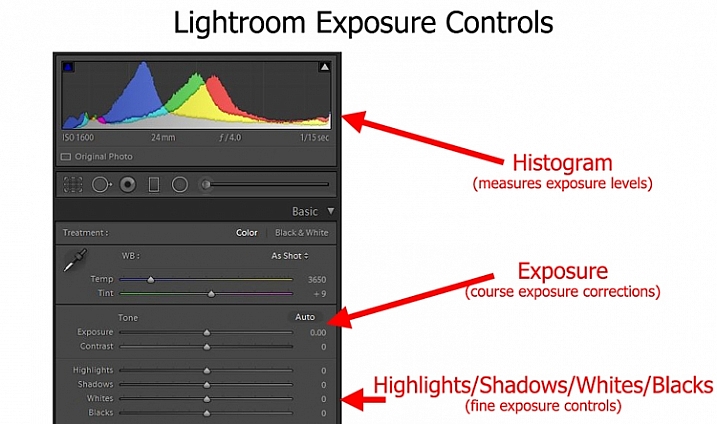
At the opposite end of the spectrum, is the idea that you should not worry about exposure so much while shooting, and instead get it right in Lightroom. When I say “not worry about it so much,” of course I do not mean you should just haphazardly twist dials to any exposure setting and blast away. Obviously, you need to get the exposure somewhat close to what you want. In addition, you cannot let your highlights get blown out, or your shadows turn pure black. But programs like Lightroom and Photoshop give you a lot of flexibility to deal with exposure settings later. As long as you get it close when you are shooting, you can take your time in front of a computer and get it exactly right.

#3 Do both:

Then, of course, there is a median way.  You can try very hard to get the exposure exactly right in camera, and then tweak it later in Lightroom, when you are in front of your computer. In this approach, basically you are just always trying to get it right. You are taking advantage of all your tools. You may get it right in camera, which avoids time in front of the computer later, and avoids any surprises. If not, you can take your time and tweak it later.

LR-controls-Graphic

To me, as I thought about it, the median way seemed like the right answer, I expect it did to you too. Except the more I thought about it, the more I realized I don’t really do that.

My approach to exposure

Instead, I tend more toward the “don’t worry about exposure so much” end of the spectrum. I tend to just get it close, knowing that I am going to fix it later in Lightroom. Am I just being lazy in the field? Maybe, but I don’t think so.

It is just that when I am out shooting, I am usually trying to focus all my attention on composition. I think that is ultimately what matters in creating great photos. For me at least, that topic requires virtually all my mental energy. You have everything from your choice of subject, to how you will be placing things within the frame, to the perspective you want to use, to making everything balance, etc. That’s not to mention shape, leading lines, and other compositional elements. There is just so much to think about. Therefore, the more I can eliminate distractions from anything but composition, the better. I try to keep exposure from intruding on that process too much when I am out shooting.

Further, this approach toward exposure just lends itself to my way of shooting. I’m not someone that sets up on a tripod and stays in one place for a long time. It seems like I’m always on the move, chasing the next shot. My time spent on each shot is pretty limited. Further, while I take a lot of pictures, I edit very few of them, so I don’t mind spending whatever time is necessary, tweaking exposures in Lightroom. I often bracket my pictures as well, which gives me a little leeway for my exposure settings, and means I won’t have an unpleasant surprise later.

Sometimes you are set up on a tripod facing a static scene with unchanging light - which means you can spend all the time you want making sure you have the exposure the way you want it.

Sometimes you are set up on a tripod facing a static scene with unchanging light – which means you can spend all the time you want making sure you have the exposure the way you want it.

Anyway, thinking about how my approach toward photography as a whole affected how I approach exposure, made me realize that your particular method or style of photography probably has a lot to do with your approach to exposure.

Which should you do?

So, how should you approach exposure – by getting it right in camera, or relying more on Lightroom? There is no right answer here, as far as I can tell. As mentioned above, I believe it depends a lot on how you approach photography.

For example, a street shooter who is always on the move, trying to capture fleeting emotions, might not have time to devote toward getting the exposure exactly right. On the other hand, someone who spends a lot of time in one place may have the time. There are a lot of other factors as well.

. . . and other times you have only a second to get a shot before conditions change or your subject walks away - in which case you might spend very little time thinking about exposure and just tweak it in Lightroom.

Other times you have only a second to get a shot before conditions change or your subject walks away – in which case you might spend very little time thinking about exposure and can tweak it in Lightroom later.

Therefore, I’ve started a little list of factors that would tend to put you in one camp or the other. Check it out and see which apply to you:

Factors that lean toward getting it right in camera:

  • You often stay in one place, and have sufficient time in the field to tweak exposure settings.
  • Your subject is fairly static.
  • You do not have post-processing software or just do not like to use it.
  • You shoot in high volume and the time needed to tweak exposure settings would be too much.

Factors that lean toward increased reliance on Lightroom

  • You are a consistent user of post-processing software to enhance your pictures.
  • You bracket your pictures.
  • Your subject is moving or the moment fleeting.
  • You do not edit large volumes of pictures.

Did I miss some factors? Do you have a different take? If so, let me know in the comments below, and tell me – which camp are you in?

googletag.cmd.push(function() {
tablet_slots.push( googletag.defineSlot( “/1005424/_dPSv4_tab-all-article-bottom_(300×250)”, [300, 250], “pb-ad-78623” ).addService( googletag.pubads() ) ); } );

googletag.cmd.push(function() {
mobile_slots.push( googletag.defineSlot( “/1005424/_dPSv4_mob-all-article-bottom_(300×250)”, [300, 250], “pb-ad-78158” ).addService( googletag.pubads() ) ); } );

The post Exposure: Get it Right in Camera or Fix it Later? by Jim Hamel appeared first on Digital Photography School.


Digital Photography School

 
Comments Off on Exposure: Get it Right in Camera or Fix it Later?

Posted in Photography


Smell Ya Later! 12 Abandoned Fish & Seafood Canneries

25 May

[ By Steve in Abandoned Places & Architecture. ]

abandoned fish cannery 1a
The advent of refrigerated ships radically changed the fish and seafood processing industry, leaving dozens of isolated and uneconomical canneries behind.

abandoned fish cannery 1b

abandoned fish cannery 1c

The former Canadian Fishing Company salmon cannery at Butedale on Princess Royal Island, British Columbia, is typical of the genre. Located in the midst of the region’s rich salmon fishing grounds for convenience and expediency, the mossy-roofed cannery and the associated 400-population town of Butedale prospered from about 1911 through the mid-1950s.

abandoned fish cannery 1d

abandoned fish cannery 1e

When the cannery closed, there was no reason to stay in Butedale – it’s become a steadily deteriorating ghost town. Kudos to Panoramio users Denis Dwyer and Jack Borno for capturing these enduring images of the abandoned CFC cannery for posterity.

Bayside The Point

abandoned fish cannery 2a

abandoned fish cannery 2b

abandoned fish cannery 2c

Flickr user Jonathan Khoo (jonjk) brings us the remarkable Bayside Canning Company building in Alviso, California, which last canned fish back in 1931. The firm mainly employed Chinese immigrants; a tribute to whom can be seen in some of the delightful murals added to the factory’s outer walls at a much later date.

Uzbekis-Can

abandoned fish cannery 3a

abandoned fish cannery 3b

abandoned fish cannery 3c

A fish cannery without fish is like a sea without water, which pretty much describes both the above abandoned fish cannery in Muynak, Uzbekistan, and the once-wet Aral Sea which once supplied the cannery with fish. Over 80 miles (130 km) of toxic desert sand now separate Muynak’s abandoned fish canneries from the still-receding seashore, and few if any fish now live in the concentrated toxic soup which comprises the much-diminished Aral Sea.

Oregon Fail

abandoned fish cannery 4

What’s better than building a cannery on the waterfront? Building one on the water, of course! Brilliant concept aside, it takes more than location, location and location to keep a cannery’s books in the black and this abandoned cannery on the Columbia River near Astoria, Oregon is a case in point. Credit Flickr user Eli & Anne-Marie with the above ethereal scene captured on September 10th, 2011.

Next Page – Click Below to Read More:
Smell Ya Later 12 Abandoned Fish Seafood Canneries

Share on Facebook


[ By Steve in Abandoned Places & Architecture. ]

[ WebUrbanist | Archives | Galleries | Privacy | TOS ]


WebUrbanist

 
Comments Off on Smell Ya Later! 12 Abandoned Fish & Seafood Canneries

Posted in Creativity


Lost & Found: Underwater Ghost Town Resurfaces 30 Years Later

23 Jan

[ By WebUrbanist in Abandoned Places & Architecture. ]

abandoned village from above

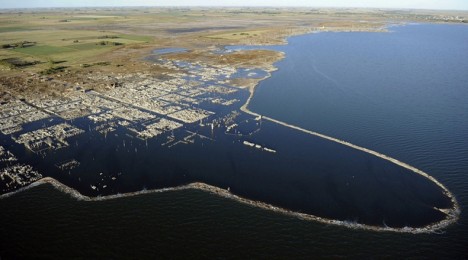
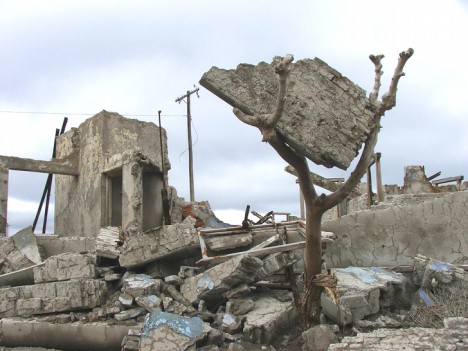
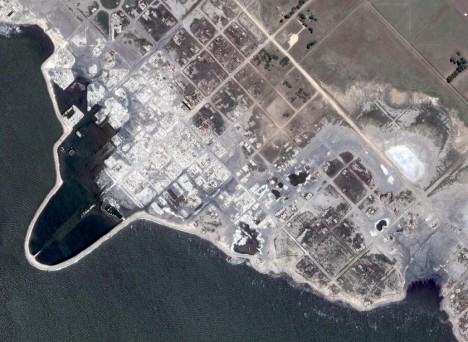
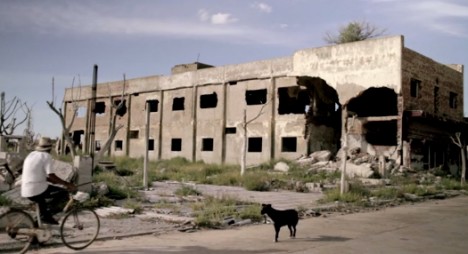
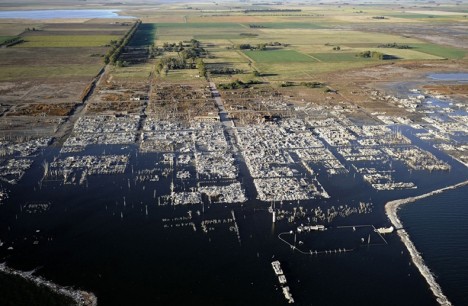
Like a corroded time capsule, this submerged village has risen from the depths after being flooded decades ago when the local lake broke its banks and left Epecuen under dozens of feet of water. In 1985, a rare weather pattern broke a nearby dam first, then the dike protecting the town, quickly making most of it uninhabitable. Today, long-term changes in the regional climate have brought down the overall level of the lake, resurfacing the town.

sunken village resurfaced underwater

Giving a tour of his devastated hometown, the man in the award-winning video above , Pablo Novak, claims his father predicted the return of water to the areas of land on which people were building back in the 1980s – at its peak, the place drew in over 25,000 tourists a year. Today, Pablo is the only remaining resident, slowly exploring the remnants now revealed as waters around the lake have lowered.

villa epecun from above

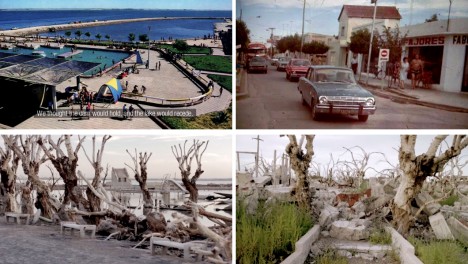
underwater village before after

Located near Buenos Aires, it is hard to imagine that this place – with a permanent population of 5,000  at one point – was once a busy destination from tourists around the country and even the world, renowned for its high-salinity lake in which people came to bathe. This salt content is largely responsible for the high levels of damage done to the town’s buildings and infrastructure during its years underwater.

underwater deserted abandoned buildings

underwater village ruins

slaughterhouse abandoned town

First, the fields began to flood, driving our narrator’s cows, horses, pigs sheep and goats back further onto land and forcing Pablo to buy a family home in a neighboring village. Now 85 years old, he always assumed the town would be rebuilt, but that has never come to pass.

sunken town ruins

sunken village washed roots

abandoned underwater town resufraced

Since the waters have receded, Pablo now tries to appreciate the solitude left in its wake and gives tours to those who come these days not to soak but to see the once-sunken village now risen once again to the surface. Images by Sam Verhaert, Jonathan Evans and Pablo Gonzales via Inhabitat.

Share on Facebook


[ By WebUrbanist in Abandoned Places & Architecture. ]

[ WebUrbanist | Archives | Galleries | Privacy | TOS ]


WebUrbanist

 
Comments Off on Lost & Found: Underwater Ghost Town Resurfaces 30 Years Later

Posted in Creativity


Ricoh announces it will launch Pentax DSLR in spring and lenses later

06 Jan

Pentax owner Ricoh has released very limited details of a DSLR and a collection of three lenses that it says it will launch in the future. Reference images that accompany the announcement appear to show a mid-range APS-C DSLR that the company says will feature a CMOS sensor. This may arrive in stores in spring this year. The camera is shown with a new 18-50mm f/4-5.6 collapsible zoom lens attached – which will be available at about the same time. Read more

Articles: Digital Photography Review (dpreview.com)
 
Comments Off on Ricoh announces it will launch Pentax DSLR in spring and lenses later

Posted in Uncategorized


Mount St. Helens images found decades later

13 Jan

772191_Reids_lost_roll_18a_r770x495.jpg

New images of Washington’s Mount St. Helens have been recently discovered. Reid Blackburn, a staff photographer for the The Columbian newspaper, took photographs in a flight over the volcano in April 1980. When he got back to the paper’s studio his roll was set aside and never developed. Until now. Learn more

News: Digital Photography Review (dpreview.com)
 
Comments Off on Mount St. Helens images found decades later

Posted in Uncategorized


Alligator steals DSLR, kindly returns it eight months later

25 Aug

photo-2-1024x755.jpg

During a holiday party at the Everglades Alligator Farm last year, employee and budding wildlife photographer Mario Aldecoa was setting up his camera to capture the glowing eyes of the local residents. It wasn’t long after he mounted his Canon DSLR to a tripod when, in a flash, one of the gators grabbed the whole thing as if it was lunch. After a fruitless search the next morning, Aldecoa had all but given up on finding his camera. Eight months later, he was in for a surprise.

News: Digital Photography Review (dpreview.com)

 
Comments Off on Alligator steals DSLR, kindly returns it eight months later

Posted in Uncategorized


WebUrbanist Update: 5 Years & 50 Million Visitors Later

16 Oct

[ By WebUrbanist in Gaming & Computing & Technology. ]

Five years ago, who would have thought that what started as an offbeat visual culture weblog would turn into a full-fledged (but still and always free) cosmopolitan online magazine? After just half of a decade, WebUrbanist now has over five hundred thousand feed and email subscribers, not to mention over a million monthly visitors.
The constant curiosity of authors (including Delana, Marc, Stephanie and Steve,, with Kurt as executive editor) and ongoing diligence of developers (Jeff and Mike) has been crucial, of course. Still, at the end of the day, it would all come to nothing without you, the readers, RSS subscribers, Twitter followers, Facebook fans and Pinterest friends supporting these efforts. Your ongoing help sharing our stories with friends via email, blog posts, StumbleUpon and Reddit has been essential in building WebUrbanist’s audience and is much appreciated.

Much has happened over this long-yet-short period of time, including multiple major redesigns of the publication, from the underlying code to numerous iterations its layout and logo. We hope this ongoing evolution seems fitting, though, since the core topics we cover – architecture, art, design, travel and technology – all revolve around creative exploration, iteration and (re)invention.

For anyone new to the site – or at least its latest redesign – we recently re-categorized every single article in the archives. Each individual past post can now be found under exactly one of five main sections (per the paragraph above) as well as one of twenty-five subcategories , linked in various ways on every page, including via a new drop-down menu on the sidebar. We hope this helps make the ever-larger annals more accessible to new and existing readers alike. Thanks again for your patronage – now onto the next five years!


Want More? Click for Great Related Content on WebUrbanist:

WebUrbanist Turns One Year Old: From Past Favorites to Future Developments

Has it really been that long? It is hard to believe how much the site has changed and evolved in just one year.
12 Comments – Click Here to Read More »»


WebUrbanist Update: The Past, Present and Future of Your Favorite Urban Weblog


More extreme urban sports, skateboardable signage c/o Christof Damian
Regular readers know by now that there isn’t much self-conscious metablogging on WebUrbanist. The site is mostly about pro…

12 Comments – Click Here to Read More »»


Share on Facebook


[ By WebUrbanist in Gaming & Computing & Technology. ]

[ WebUrbanist | Archives | Galleries | Privacy | TOS ]


WebUrbanist

 
Comments Off on WebUrbanist Update: 5 Years & 50 Million Visitors Later

Posted in Creativity


FGZ- Joe Hodges, Ten Years Later

01 Aug

For the 10th anniversary of 9/11, photographer Joe McNally has embarked on an update of his original giant polaroid project known as “Faces Of Ground Zero”. The update includes both still imagery, as well as video interviews, shot entirely on Nikon’s D3x and D7000 cameras. For more information, please visit: www.facesofgroundzero.com OR www.joemcnally.com/blog
Video Rating: 0 / 5