RSS
 

Posts Tagged ‘invest’

Gimbal Tips And Advice – Why you Need to Invest in One

03 Sep

A gimbal is a device that enables you to keep your camera stable while shooting video. It can also be useful when it comes to capturing high-quality still images. A combination of three gimbals will enable you to obtain a smooth movement of your handheld camera in three different directions, thanks to the three rotation axes. In this article I Continue Reading

The post Gimbal Tips And Advice – Why you Need to Invest in One appeared first on Photodoto.


Photodoto

 
Comments Off on Gimbal Tips And Advice – Why you Need to Invest in One

Posted in Photography


5 Ways to Invest in Your Photography Over the Next 365 Days

02 Jan

Happy 2018! Can you believe it is already 2018? Seems like just a little while ago we were all celebrating ushering in the Y2K era and now to think that 2020 is just two years away seems unreal. I love the new year. It brings forth hope, aspirations, and positivity.

Metaphorically, it is like the slate has been wiped clean and you have a chance to chase some of your most amazing and lofty goals. So why not use this new year to invest in something that you really love as well – your photography. Here are some simple easy ways to invest in bettering your creativity and your craft over the next 365 days.

Sunset golden hour photo - How to Invest in Your Photography Over the Next 365 Days

#1 – Create smart goals for your photography

Let’s drop the myth that only professional photographers who are in business are allowed to have photography goals. I don’t care if you are just beginning to learn photography or have been doing this for years, one of the best ways to improve at anything is to have realistic goals for what you aspire to and want to achieve.

Goals can be things like learning to photograph in manual mode, selling stock images or booking your first wedding client. No matter what your goals are, I encourage you to take it a step further and create SMART goals. A SMART goal is defined as one that is;

  • Specific
  • Measurable
  • Achievable
  • Results-focused
  • Time-sensitive

So for each of your goals, add additional parameters to convert them to SMART goals by figuring out how to measure them, how to achieve and execute them, and what specific timeframe you want them to be completed by.

Jaipur Lake Palace Photo - 5 Ways to Invest in Your Photography Over the Next 365 Days

A SMART goal to travel and explore my home country has lead to some amazing opportunities. All because I really thought through what I wanted to do, how I wanted to execute it, and what outcomes I wanted from those opportunities and really working towards those goals!

#2 – Plan to do at least 4 personal photography projects

I really believe that personal projects are the cornerstone to helping you improve your photography. Once you take the pressures of working with clients out of the equation, you are free to explore, get creative, and challenge yourself. This creative freedom is bound to reflect positively on your work.

Personal projects can be short exercises directed to help you improve in some area of your photography or extended self-assigned projects that really take you completely out of your comfort zone to try something different. You can choose to space out your personal projects throughout the year – perhaps even commit to doing one per quarter.

No matter what you choose, have SMART goals on what, when, and how you are going to execute your personal projects. You can see more details on the importance of personal projects in this previous article.

Ocean views from the caribbean - 5 Ways to Invest in Your Photography Over the Next 365 Days

One of my ongoing personal projects to learn and master film photography because it provides so much more room for learning and improving my photography in general. I even went so far as only taking a 35mm film camera on vacation to the Caribbean.

#3 – Practice photography every day

One of the easiest ways to practice photography every day is by signing up for a 365 series. Quite simply put, a 365 series is a commitment to creating one photo every day for 365 days. You can use a DSLR, a point and shoot camera, or even a smartphone to work on this series.

You can even take this a step further by joining one of the many online groups available. They are created solely for the purpose of encouraging you to photograph and post a single photo every day for 365 days straight. They even provide photo prompts to help you stay on track so you are constantly thinking of what to photograph every day.

Small waterfall photo - 5 Ways to Invest in Your Photography Over the Next 365 Days

A picture a day is literally just that – a photo a day. Get as creative as you want with this exercise. Use it as a way to get out of the house, meet fellow photographers, or just as some quiet time to reflect on who you are as a photographer and what motivates you.

#4 – Share your work online and offline

Join online groups or even local camera clubs to meet and socialize with other photographers. Many clubs have critique nights where members submit photos and comment on each other’s work. This is a great way to not only have your work be seen by others but also to get unbiased feedback on your work, which can be used for improvement and growth.

Many times we are our own worst critic and downplay our talents and skills because we are afraid or maybe lack the confidence in our photography. And you know what’s the best part? Having a group of like-minded people that you can talk photography about with all day long without them tuning you out within the first five minutes of any conversation (Can you tell this is how my family is when I start to talk photography!?).

Photo of the Taj Hotel in Mumbai at sunrise - 5 Ways to Invest in Your Photography Over the Next 365 Days

I have made some amazing friends via online communities – we have collaborated together, referred work to each other and bounced life and business challenges off one another. But most importantly, I have made some incredible friends who I know have my best interests at heart.

#5 – Attend a photography workshop, conference or take an online course

Like most other professions, the photography industry is continually evolving and changing. New products, techniques, and styles are constantly being introduced. So attending a photography workshop or conference is a great idea.

Plus you never know who you might meet there in terms of future friends, potential clients, or even referral opportunities. There are numerous workshops, seminars, and even free online events and tutorials to keep you busy learning new things.

Keeping abreast of the latest in any business is a good thing. It shows your clients, both present, and future, that you value your business and skill, enough to invest in it.

 Mirror reflection of an alpine lake in Oregon - 5 Ways to Invest in Your Photography Over the Next 365 Days

Workshops, and conferences are another great way to expand your professional circle, make industry friends and learn new skills/techniques. Make sure you do your research prior to committing funds to attend an event/workshop or conference.

What will you do with the next 365 days?

I hope these tips were helpful to you as you plan out 2018. Remember, getting your photography to a level that you are proud of takes time and a lot of hard work. Make this your year to shine with your photography.

The post 5 Ways to Invest in Your Photography Over the Next 365 Days by Karthika Gupta appeared first on Digital Photography School.


Digital Photography School

 
Comments Off on 5 Ways to Invest in Your Photography Over the Next 365 Days

Posted in Photography


Before you invest in LED lights, make sure you understand CRI

30 May

LED lighting technology is all the rage, and there are great reasons to invest in LED lights. (Beyond using them as a lightsaber.) However, photographers are keenly aware that it’s not just the light that’s important, but also the quality of light you have.

One tool we can use to assess the color accuracy of a light is the color rendering index, or CRI, which provides some information about how accurately a light can reveal color compared to an ‘ideal’ light. A light which perfectly emulates the color accuracy of natural daylight would have a CRI score of 100.

Companies love to state CRI numbers on their products, leading you to believe that they can provide the color accuracy you’re looking for. However, while a higher CRI number is generally better, it’s important to understand how that number is generated, and why it’s not as definitive as manufacturers like to make it sound.

Learn more at premiumbeat.com

Articles: Digital Photography Review (dpreview.com)

 
Comments Off on Before you invest in LED lights, make sure you understand CRI

Posted in Uncategorized


Ready to Upgrade Your Kit Lens? Tips for Which Lens to Invest in Next

01 Oct

Most cameras come with a kit lens that generally works well as a decent all-around workhorse. A common focal range for these lenses is 18-55mm, which means they are capable of wide-angle shots as well as medium-telephoto pictures, and everything in between. The tradeoff for this zoom range, however, is a limited maximum aperture range of roughly f/3.5 when zoomed out (18mm), and f/5.6 when zoomed in to 55mm.

Of course some kit lenses cover a longer focal range and have different maximum apertures, but overall most kit lenses are designed for the types of all-around shooting conditions in which you may often find yourself. While this is not necessarily a bad thing, it does mean that the kit lens is more of a jack of all trades while being the master of none, and after a while you might start wondering what other options are available to you and how they will affect your photography. This all begs the question: which lens should you buy when you want to upgrade from the one that came with your camera?

Child bear

A 35mm or 50mm lens can work well for shooting portraits

Lenses are like apps

Think of lenses like different apps for your camera, and just as apps on your smartphone or tablet have specific functions, each lens is designed to meet a specific set of photographic needs. Next, think of the kit lens as a basic set of apps you might find on a device. It does many things well, but doesn’t really unlock the true potential of your camera. For some people, that’s fine: they don’t feel the need to install new apps (i.e. buy new lenses) and instead only use the ones that come with their device.

But when you start exploring the myriad of apps available for phones and tablets you might wonder how you ever lived with your device’s basic apps at all! The same holds true for lenses, but there is one key area where the analogy breaks down – price. When you start looking around for lenses, you might find that your vision quickly outstrips your budget! The choice, then, is this – which lens should you buy after exhausting the possibilities of the kit lens that came with your camera?

Montana

Wide-angle lenses are great for capturing photos of natural landscapes and other outdoor scenery.

Know what you need for the photography you do

The answer, unfortunately, is not as black and white as it might seem. While there are hundreds of options available, what you buy ultimately comes down to your unique needs and style as a photographer. After using your kit lens for a while, you will hopefully have an idea of what type of photography you enjoy most: landscapes, architecture, portraits, nighttime long exposures, pets, sports, weddings, etc. Or maybe you do a combination of everything! Before spending hundreds of dollars on another lens it’s important to know what will suit your needs – much in the same way that purchasing a vehicle is a matter of finding one that works for you, as opposed to simply buying the same car that all your friends have.

Grapes

A lens with a wider aperture will enable you to shoot get nice blurry backgrounds that are not always possible with a kit lens.

Prime lenses pros and cons

My first bit of advice, though, is to find a prime (non-zooming) lens that can accommodate your shooting style. If you take a lot of landscape and outdoor shots, you will likely want a wide-angle lens with a focal length of around 10-20mm (for cropped sensors, 15-35mm if you have full frame). For portraits, anything between 50-100mm is a good choice. Sports and wildlife shooters tend to use lenses that are on the telephoto end, such as 100-300mm. Remember the tradeoff between zooming and aperture I mentioned in the first paragraph? If you eliminate the zoom functionality you will find plenty of lenses with much larger apertures, which will let in much more light and allow you to use faster shutter speeds, as well as capture pictures in low-light situations that might not otherwise be possible without the use of a flash.

Church

Prime lenses can’t zoom, but you gain the ability to shoot in dimly-lit situations without the need for a flash because they often have large apertures.

It admit it can be a bit nerve-wracking to use a lens that can’t zoom in and out, but once you try it you may find a whole new world of photographic possibilities that you never knew existed, thanks to the larger aperture. Remember that you haven’t lost the ability to zoom, you can still move yourself around physically, which is another fantastic way to explore and stretch yourself as a photographer. You can often find prime lenses for a couple hundred dollars that will suit your needs exceedingly well, though even prime lenses with longer focal lengths could easily push the limits of your budget.
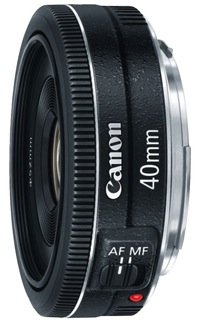
40mmPancake

It might be small, but Canon’s 40mm f/2.8 pancake lens packs a big punch.

If you would like to upgrade from your kit lens but are not entirely sure exactly what your individual needs are, I would recommend one of the following. All are fairly inexpensive as far as lenses go, and will suit a variety of photographic situations, though they are not the best for sports and wildlife due to their somewhat short focal lengths:

  • Canon 24mm f/2.8 – and the newly released pancake version at only $ 149 US
  • Canon 40mm f/2.8 (pictured on the right)
  • Canon 50mm f/1.8
  • Nikon 35mm 1.8G – get the DX if you have an APS-C or cropped sensor, get the ED if you have full frame.
  • Nikon 50mm 1.8G

Zoom lens options

You can buy prime lenses with longer focal lengths, but they can easily cost many times that of their cheaper counterparts. If you decide you absolutely cannot live without the zoom functionality, I would recommend going with a lens that covers one end of a focal range (i.e. wide-angle to medium telephoto) rather than one that covers both ultra-wide and ultra-telephoto. Of course this is all subjective, and there are as many opinions on this topic as there are photographers. In my experience lenses that try to cover as many focal lengths as possible are generally not as sharp as their more limited counterparts, unless you are willing to spend hundreds or even thousands of dollars. Lenses I would recommend include:
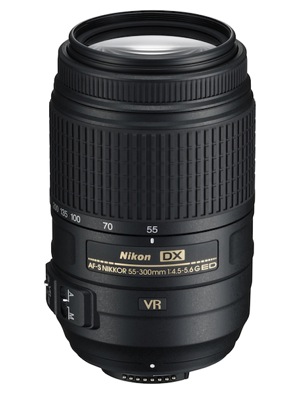
55 300mm

[caption: Nikon’s 55-300mm picks up where most kit lenses leave off and is a great option if you are interested in shooting sports and wildlife.

  • Canon 75-300mm f/4-5.6
  • Canon 28-135mm f/3.6-5.6
  • Canon 24-105mm f/4
  • Nikon 18-105mm f/3.5-5.6
  • Nikon 55-300mm f/4.5-5.6G

There are also many other really good third party options available. The options are almost endless so I’ve stayed with the two big brands here, but you can also look at Sigma and Tamron who both make some really good lenses also.

Deciding

The more you are willing to spend on a lens, particularly a zoom lens, the more features it will have like: image stabilization, higher-quality glass elements, weather sealing, and larger maximum apertures. These lenses are just the beginning. The sky’s the limit when it comes to upgrading your lens, and it’s important to not overlook options like simply borrowing one from a friend, buying older gear, renting, or even looking online for used equipment. Whatever you decide, it’s important that the lens is right for you and your photography goals, but chances are if the kit lens is too limiting there is a fantastic one out there with your name on it, waiting for you to come and explore what it can do for you.

The post Ready to Upgrade Your Kit Lens? Tips for Which Lens to Invest in Next by Simon Ringsmuth appeared first on Digital Photography School.


Digital Photography School

 
Comments Off on Ready to Upgrade Your Kit Lens? Tips for Which Lens to Invest in Next

Posted in Photography


Sony to invest $1.2 billion in CMOS production

27 Dec

Sony has announced it is investing .2 billion in production of CMOS sensors. The announcement includes the purchase and refurbishment of a a production facility it previously operated as a joint venture with Toshiba. With this move and other recent investments, the company aims to double its total monthly production from approximately 25,000 wafers to approximately 50,000 wafers per month by the end of March 2012.
News: Digital Photography Review (dpreview.com)

 
Comments Off on Sony to invest $1.2 billion in CMOS production

Posted in Uncategorized