Animated flipbooks have been around for nearly 145 years. With just a slide of your thumb, these books allowed you to view a few seconds worth of animation. Now, a new concept camera known as the GIFTY allows you to record video and print a flipbook instantly. The only problem: you can’t buy one yet. (via Yanko Design)
[ By WebUrbanist in Architecture & Public & Institutional. ]
Take a structure, strip away all of the non-essentials, and squeeze out every last unused bit of air space, and what do you get? Something a lot like a folded sheet of paper.
This folding shelter designed by Doowon Suh is as elementary as it gets – a series of sheets that unfold like origami to form a robust but basic building.
Like nesting paper cranes, in its most compact form, each module can be stacked on its siblings, making it easy to pack and ship in containers or store until deployed.
The modules are bare bones for maximum adaptive capability – they can emergency homes or hospital pods, temporary stores or community rooms.
[ By WebUrbanist in Architecture & Public & Institutional. ]
[ By WebUrbanist in Architecture & Cities & Urbanism. ]
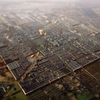
Normally, urban design is done with death and destruction in mind – but prevention, rather than facilitation, is the focus. This unique mini-city was made to be destroyed, pummeled into the dust by repeated drills by armed forces.
Built by the United States military in the remote Nevada desert, the Urban Target Complex (R-2301-West aka “Yodaville”) is the target of strafing, sniping, rocketing and bombing (above image by Lance Cpl. Zac Scanlon).
The terrain has a realistic layout patterned after settlements in the Middle East, and the structures themselves – mainly constructed from shipping containers – are stacked up to four stories high.
As Ed Darack writes for Air & Space Magazine, from his experience following troops into the faux action, ”The artillery and mortars started firing, troops advanced toward the target complex, and aircraft of all types—carefully controlled by students on the mountain top—mounted one attack run after another. At one point so much smoke and dust filled the air above the “enemy” that nothing could be seen of the target—just one of the real-world problems the students had to learn to cope with that day.”
BldgBlog asks what we should make of mysterious military architecture, often hidden from public view and thus veiled from scrutiny or critique. “So what, for instance, might something like a Yodaville National Park, or Urban Target Complex National Monument, look like? How would it be managed, touristed, explored, mapped, and understood? What sorts of trails and interpretive centers might it host?”
Want More? Click for Great Related Content on WebUrbanist:
Starting at the End: 12 New Cities Built From Scratch
Cities take centuries to evolve – or do they? Here are 12 urban centres that offer a radical alternative to tradition – they are cities from the first day they open for business.
Click Here to Read More »»
Ever wonder how your phone’s signal stays so clear even when you’re not within sight of a tower? Cellular towers are really hiding in plain sight all around us.
Click Here to Read More »»
[ By WebUrbanist in Architecture & Cities & Urbanism. ]
LA based fine art photographer, Jim McHugh, shares his unique photographic gear used to create his highly sought after pieces, With Speed Graphics and instant film, the gear is a throwback but his work is currently very hot. In this segment we get into the bag(s). next up- the process. Visit photoinduced.com for more photo-ness
I've been a fan of instant photography ever since I was a little kid when an instant camera was simply called "the Polaroid."
That's because no one else manufactured similar cameras and Polaroid had the field all to themselves. But things soon changed.
Polaroid continued changing and improving their products, Kodak took a shot at the instant camera business, and Fuji came out with some cameras and film of their own, but the technology was still clumsy and limited.