RSS
 

Posts Tagged ‘History’

Abandoned America: Photographing a forgotten history

02 Oct

$ (document).ready(function() { SampleGalleryV2({“containerId”:”embeddedSampleGallery_0949592309″,”galleryId”:”0949592309″,”isEmbeddedWidget”:true,”standalone”:false,”selectedImageIndex”:0,”startInCommentsView”:false,”isMobile”:false}) });

Photographing abandoned spaces has gained a reputation to some as a voyeuristic act, with little respect paid to the subject or its history. But for Matthew Christopher, it’s much more than ‘ruin porn.’ He runs Abandoned America, and his interest in photographing abandoned structures started a decade ago with an asylum in Philadelphia. Working at mental health facilities, he calls exploring Philadelphia State Hospital a life-changing experience. He picked up photography and started keeping a record of the places he visited at Abandoned America.

He tells Resource Travel ‘If there was one thing I’d hope to achieve, I suppose it would be encouraging people to see abandoned spaces not as eyesores but as the treasures they sometimes are.’ He’s also aware of the often sad stories behind the buildings he enters, and encourages those looking to follow in his footsteps to do two things: ‘be careful and be respectful… just because these places are abandoned, doesn’t mean that nobody cares about them or that it’s OK to loot or vandalize them. Leave them as you found them.’ 

You can read the full interview with Christopher over at Resource Travel and see more of his images.

Articles: Digital Photography Review (dpreview.com)

 
Comments Off on Abandoned America: Photographing a forgotten history

Posted in Uncategorized


Twisted History: Archival Photos Augmented with Surreal Animations

30 Aug

[ By SA Rogers in Art & Drawing & Digital. ]

archival gif main

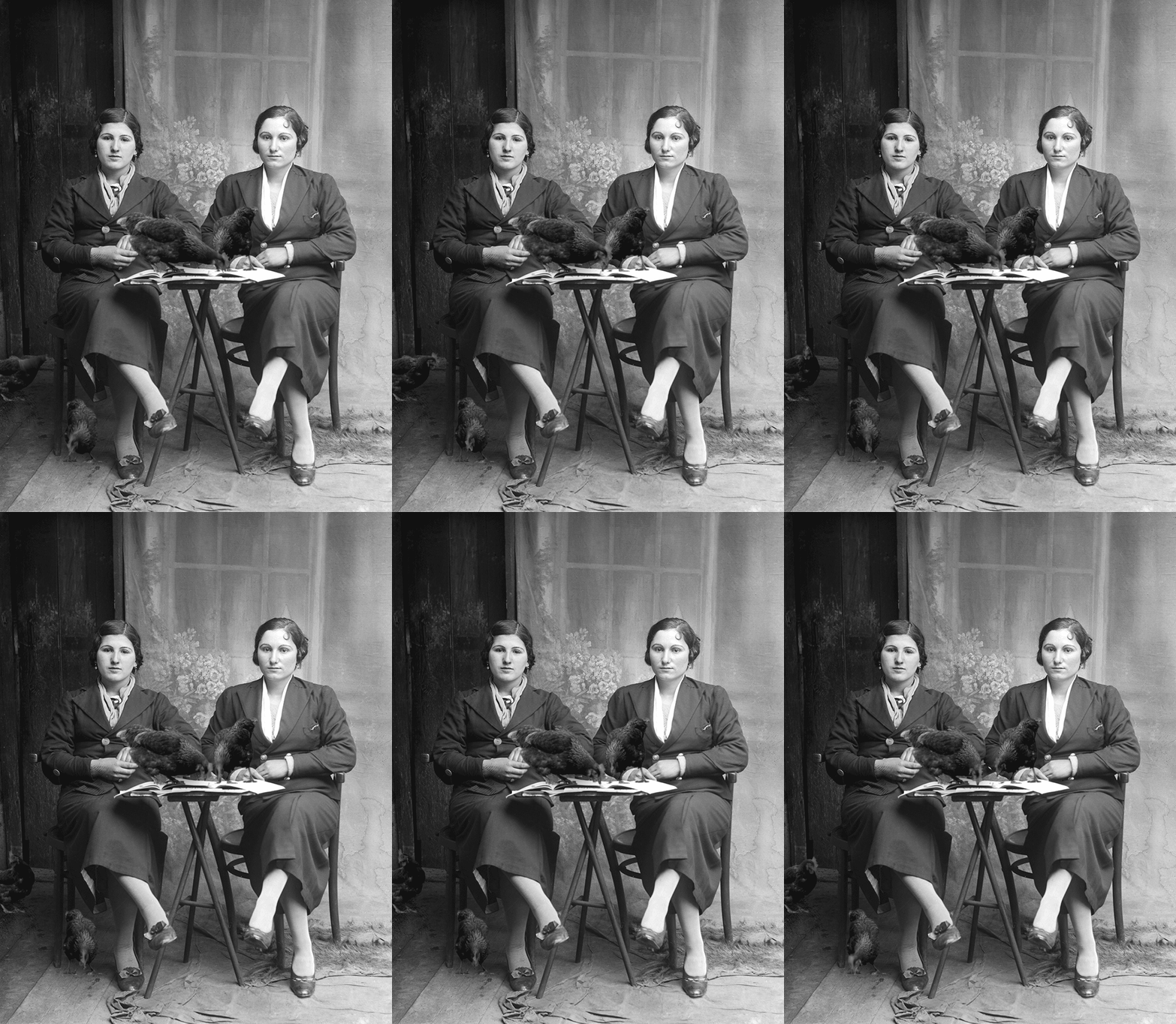
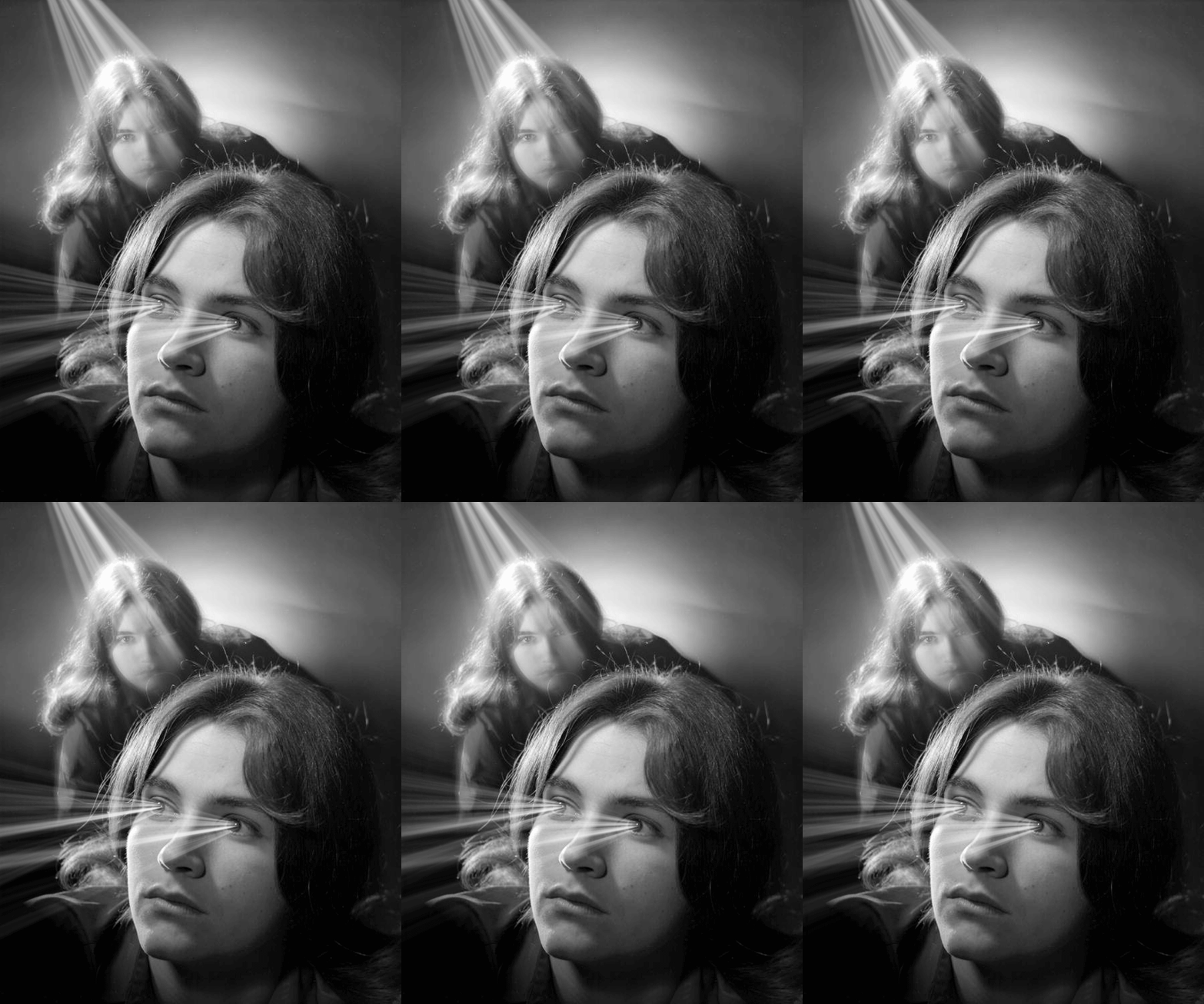
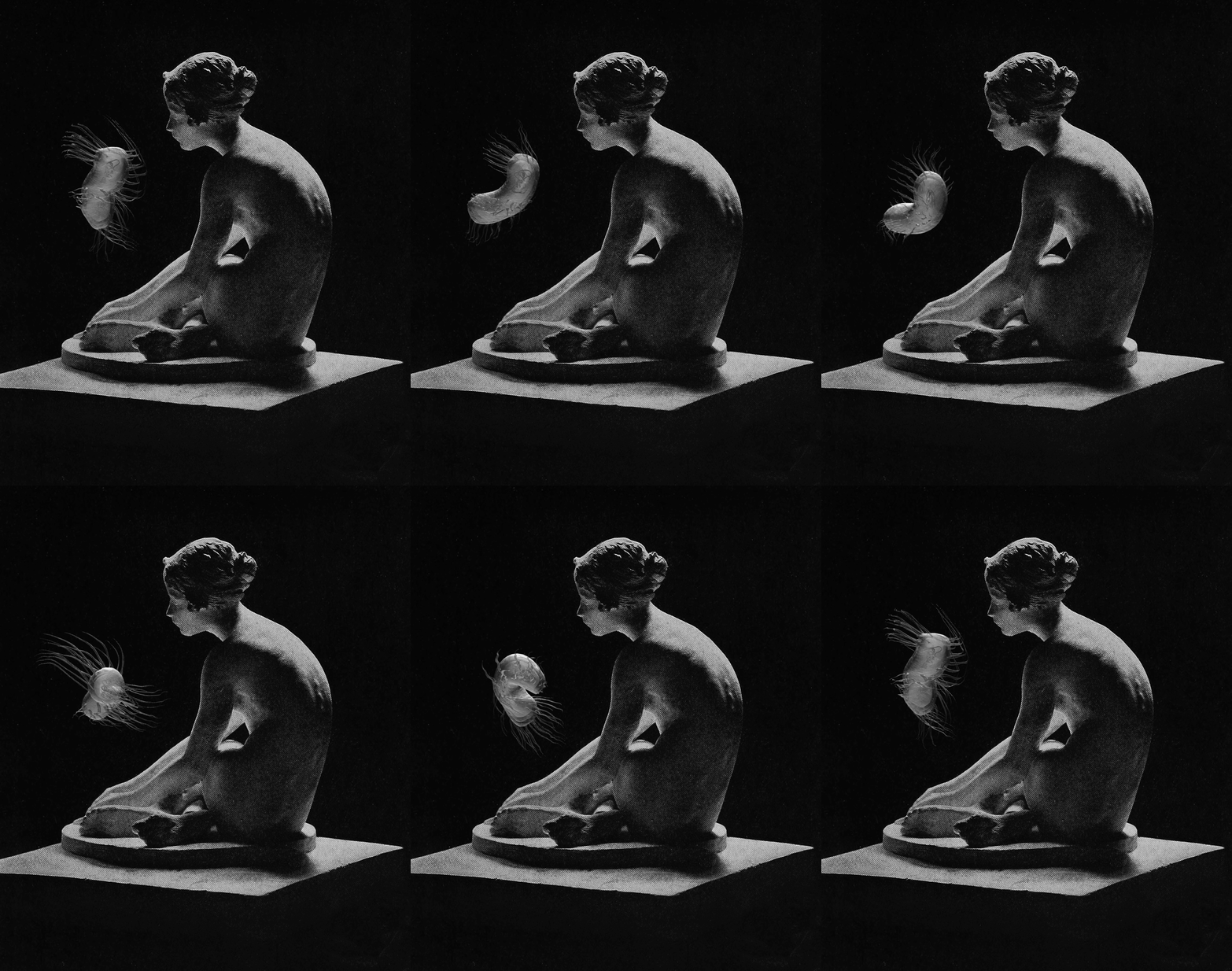
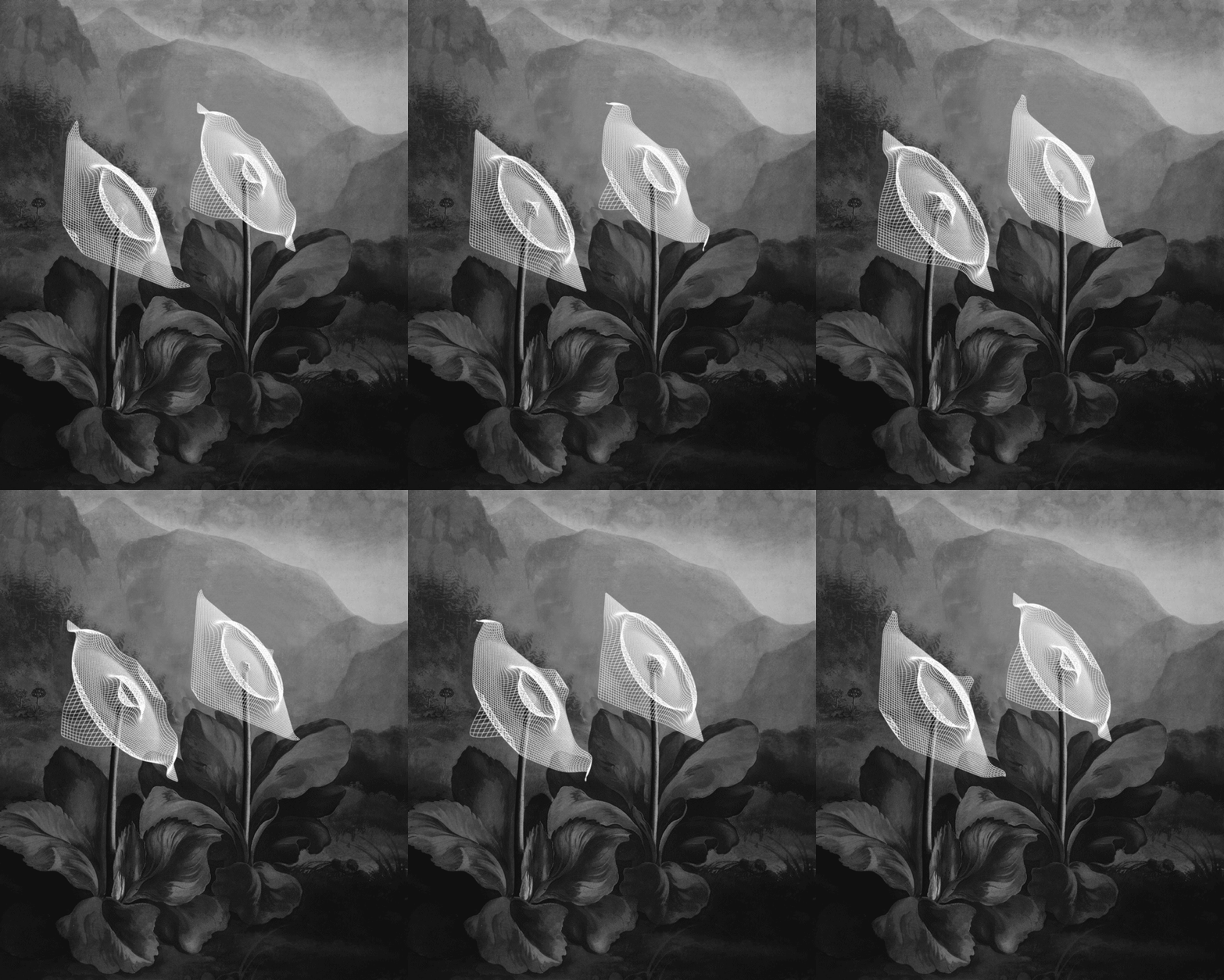
Black-and-white images and footage from the past, plucked from public domain collections, become absurd animations as moving elements are transposed on top of them in this series of images by artist Bill Domonkos. UFOs spin around a a curly-haired woman captured on film in the early 20th century, a running skeleton struggles to keep up with the camera on a blurry set of train tracks and television sets hover in Victorian living rooms. A fancy hairstyle becomes a journey into a forest, human eyes project beams of light and armless statues get prosthetics.

archival gifs 2


archival gifs 1

archival gifs 4

The fact that the moving additions are so suitably tailored to the original images is what makes the results so magical, not to mention their 3D appearance. Simultaneously funny and dark, the animations – which he presents in both GIF and video form – are each strange and unlikely in their own particular way, yet somehow still believable. Maybe that’s not too surprising, coming from a man who shot his own version of Valley of the Dolls as a child with a Super 8 camera.

archival gif 10

archival gif 11

archival gif 12

“I view my work as a collision and recombination of ideas,” says Domonkos. “My process unfolds gradually and spontaneously – using found materials such as archive film footage, photographs, and the internet. I experiment by combining, altering, editing and reassembling using digital technology, special effects and animation to create a new kind of experience. I am interested in the poetics of time and space – to renew and transform materials, experiences and ideas. The extraordinary thing about cinema is its ability to suggest the ineffable – it is this elusive, dreamlike quality that informs my work.”

archival gif 9

archival gif 14

archival gifs 5

The filmmaker and computer animator is also the creator of an app called Stereopsis, collection of 40 3D stereo images and GIF animations that combine altered archive stereographs and 3D computer graphics. You can get a contraption called ‘Google Cardboard’ to enhance the effect. See more on his website and tumblr.

Share on Facebook


[ By SA Rogers in Art & Drawing & Digital. ]

[ WebUrbanist | Archives | Galleries | Privacy | TOS ]


WebUrbanist

 
Comments Off on Twisted History: Archival Photos Augmented with Surreal Animations

Posted in Creativity


TIME names Kodak and Polaroid cameras two of the ‘most influential gadgets’ in history

07 May

TIME Magazine has published its list of ‘the 50 most influential gadgets of all time,’ and included among them is the Kodak Brownie Camera (#8) and the Polaroid Camera (#27). According to the publication, the list is ordered by each gadget’s influence on subsequent technologies and devices, such as the Brownie camera that helped bring photography ‘into everyday use.’

The Kodak Brownie Camera, launched in February 1900, was priced at $ 1 and used inexpensive film, making it possible for anyone to capture snapshots of daily life. The low price and subsequent ease by which anyone could get into photography boosted film sales for Kodak, but that was only a small part of the Brownie’s role in our history and its influence on our future. Says TIME, the Brownie camera ‘helped capture countless moments and shape civilization’s relationship to images.’

Arriving later on (and further down the list) is Polaroid and its OneStep Land instant camera launched in 1977. This model holds the distinction of having been the first affordable and easy to use camera of its kind, says TIME, going on to become so popular that the influence of its ‘square-framed, often off-color snaps’ lives on today in apps like Instagram.

Are the Brownie and Polaroid cameras deserving of their spots on the list? Let us know what you think in the comments.

Via: TIME Magazine

Articles: Digital Photography Review (dpreview.com)

 
Comments Off on TIME names Kodak and Polaroid cameras two of the ‘most influential gadgets’ in history

Posted in Uncategorized


History Repeating: Olympus PEN-F Review

25 Feb

The original Olympus PEN-F first hit the streets in 1963. Built around the half-frame film format, it quickly gained a following thanks to its beautiful, yet simple design and small size. Getting 70 images to a roll of film probably didn’t hurt, either. Now, 53 years later the PEN-F is back.

The digital reincarnation of the 35mm film Olympus PEN-F does not replace the current digital PEN flagship E-P5, rather it slides in next to it as the ‘premium’ option in the PEN family. The reason being that unlike digital PENs before it, the F has something much more OM-D-like: a built-in 2.36 million dot OLED electronic viewfinder. The F also boasts the highest output resolution of any Olympus body to date, boasting a 20MP Four Thirds sensor (probably the same one we’ve seen in the Panasonic Lumix DMC-GX8).

Released specifically to appeal to street shooters and the design conscious looking for a capable camera with retro-styling and rangefinder-like controls, the PEN-F has a lot going for it.

Olympus PEN-F features:

  • 20MP Live MOS Four Thirds format sensor
  • 5-axis image stabilization with automatic panning detection
  • 2.36 million dot OLED electronic viewfinder
  • Up to 10 fps continuous shooting (20 fps with electronic shutter)
  • Highly customizable interface, twin controls
  • Fully articulating 1.04 million dot, 3″ LCD touchscreen
  • 50MP High-res Shot mode
  • 1/8000 sec top mechanical shutter speed (1/16,000 with e-shutter)
  • 1080/60p video recording

All of the above come packaged in a machined aluminum and magnesium body, with no visible screws anywhere. A faux-leather wrap encircles the PEN-F and the body itself is both well-weighted and has a very solid feel to it. 

With many of the same guts as the OM-D EM-5 II and sleek rangefinder-style looks (reminiscent of Fujifilm’s X100 series cameras), the most direct Micro Four Thirds competitor to the PEN F is the Panasonic GX8, which also uses a 20MP chip. Other close competitors include the Sony a6000, a6300 and the Fujifilm X-E2S – all of which are APS-C format cameras. Of course, the PEN-F also has to compete against alternatives within the OM-D series as well.

To help us to better understand how the PEN-F fits into the market place as a whole, we chatted with Eric Gensel, a technical specialist with Olympus. He breaks down exactly how the PEN-F fits in Olympus’ lineup, who the target-audience of the camera is and what went into the design process:

Compared to its siblings

Many of the highlight features of the PEN-F aren’t new. In fact a lot of the key spec is shared with other recent Olympus releases. However, some functions have been improved upon. For instance, thanks to its 20MP sensor, the Pen F is capable of higher resolution in multi-shot mode compared to the OM-D E-M5 II, up to 80MP in Raw mode (50MP in JPEG). It also features a dedicated creative control knob on the front, as well as four customizable shooting modes, accessed via the locking exposure mode dial.

It’s hard to see the PEN-F as a large step forward given how many of its core features are inherited from other models, but it offers a handling experience that is unique in Olympus’s lineup. Is the PEN-F more than just a pretty face? Let’s dig in.

 
Olympus PEN-F
Olympus OM-D
E-M5 II
Olympus PEN E-P5
Pixel count 20MP 16MP 16MP
Image stabilization 5-axis 5-axis 5-axis
Stabilization (CIPA) 5 stops 5 stops 4 stops
Max shutter speed

1/8000
(1/16000 electronic)

1/8000
(1/16000 electronic)
1/8000
On-sensor PDAF No No No
Continuous shooting
(without /with AF)
10 fps / 5 fps 10 fps / 5 fps 9 fps / 5 fps
Flash Clip-on
Tilt/bounce/rotate
Clip-on
Tilt/bounce/rotate
Pop-up flash
Viewfinder Built-in 2.36M-dot LCD
1.23x mag
Built-in 2.36M-dot LCD
1.48x mag
Optional VF-4 accessory EVF w/ 2.36M-dot LCD and 1.48x mag
Max video res/rate 1080/60p 1080/60p 1080/30p
Max bitrate 77Mbps 77Mbps 20Mbps
Mic socket No Yes No
Rear screen

Fully articulating 3″ touchscreen
1.04M-dots

Fully-articulated
3.0″ touchscreen
1.04M-dots
Flip up/down
3.0″ touchscreen
1.04M-dots
Wi-Fi Yes Yes Yes
Environmental sealing? No Yes No
Battery life (CIPA) 330 310 330
Weight 427 g 469 g 420 g
Dimensions 125 x 72 x 37mm 124 x 85 x 45mm 122 x 69 x 37mm

Pricing and availability

The Olympus PEN-F will be available at end of February – early March 2016, and will hit the streets at a body-only price of $ 1199. It ships with the FL-LM3 flashgun seen in the image at the top.

If you're new to digital photography you may wish to read the Digital Photography Glossary before diving into this article (it may help you understand some of the terms used).

Conclusion / Recommendation / Ratings are based on the opinion of the reviewer, you should read the ENTIRE review before coming to your own conclusions.

We recommend to make the most of this review you should be able to see the difference (at least) between X, Y, and Z and ideally A, B, and C.

This article is Copyright 1998 – 2016 and may NOT in part or in whole be reproduced in any electronic or printed medium without prior permission from the author.

Articles: Digital Photography Review (dpreview.com)

 
Comments Off on History Repeating: Olympus PEN-F Review

Posted in Uncategorized


Week in Review: One for the history books

21 Feb

Week in Review: One for the history books

It was a Wednesday like any other Wednesday. The sun rose in the East. The DPReview staff made their morning coffee run. They sat down at their desks. And then they wrote. They wrote. For unlike another Wednesday, this Wednesday would see the introduction of a historic camera: the Pentax K-1. Memories of Pentax’s first promise of a full-frame DSLR were all but a distant memory, but Pentax would finally step into the world of full-frame digital photography. 

To say it was a busy week is an understatement. The world didn’t only get full-frame Pentax this week, it got so many more things: a Canon EOS 80D! A kit lens with a strange detachable power zoom accessory! A Panasonic GF-series update made just for selfies! 

Just to be sure you didn’t miss anything, you better take a look back with us.

It’s all gonna be O-K

After years of promises and months of teasing, this week Ricoh finally unveiled the Pentax K-1, a 36.4MP full-frame DSLR built around the K lens mount. At a very enticing body-only MSRP of $ 1800, the K-1 offers 5-axis IS, built-in Wi-Fi and 4.4 fps burst shooting. We took a look back at the long and winding road Pentax has taken to full-frame, and while the K-1 shows a lot of promise, we think Ricoh still has a tough road ahead.

Subtle video upgrades

Just hours after the K-1 announcement, Canon swooped in and dropped the EOS 80D, G7 X Mark II, an updated 18-135mm F3.5-5.6 and a couple of interesting accessories (more on that in a second).

The 80D is a fairly incremental update to the 70D, but it does offer updated Dual Pixel AF with continuous focus as well as an upgraded 45-point all cross-type AF system. Subtle enhancements in the video department, like the addition of 1080/60p recording and a headphone socket, nudge the camera 80D toward video enthusiasts, but don’t hoist it into the ranks of video-centric cameras like the Sony A7S and Panasonic GH4. Still, it should offer plenty to help a non-pro get good results.

In this week’s unusual innovations we saw Canon introduce the PZ-EI Power Zoom adapter, the first OEM-branded accessory of its kind, specifically built for its new 18-135mm. For just an extra $ 150, prospective 80D owners who are interested in shooting video with their new kit can pick up a PZ-E1 and gain control over zoom speed by way of physical controls or Canon’s Smart Utility app. It’s a neat solution and relatively inexpensive solution for video shooters, rather than building power zoom functionality into the lens and raising the cost (and weight of the lens) for everybody.

Know thy selfie

Speaking of long and winding roads, the introduction of the selfie-tastic Panasonic Lumix DMC-GF8 this week underscored just how far that series has wandered from where it started. The GF8’s brightly colored accents (or ‘unisex’ silver and brown, if you prefer), beauty re-touch features and 180-degree articulated selfie-friendly LCD are all a far cry from the pioneering little GF1. That camera’s enthusiast features long ago drifted and evolved into the GX-series, while Panasonic seems to be making a Casio-esque play with its entry-level GF-series to capitalize on shoppers interested in selfie-centric features in some Asian countries. To each his own, right?

Two good?

It’s easy to get excited about the Sony RX1R II‘s potential. A compact 42MP full-frame camera with updated AF and a Zeiss 35mm F2 lens has that effect. But it’s also easy to suffer a case of sticker shock when you realize it’s $ 3300. Our full review, published this week, digs into the camera’s performance to see if the problems that plagued the RX1R persist, and whether it’s a $ 3300 well spent. There’s just one way to find out…

Go wide

Yeah, we’ve heard it before: a 75-100mm focal length is more flattering for portraits than wide-angle lenses. But what if we all stepped away from our 85mm portrait primes for a minute and embraced a different perspective? Tech Editor Rishi Sanyal does just that in our lens technique video. Using the Sigma 24-35mm F2 Art to make his case, he captured some environmental portraits at sunset in Seattle’s gorgeous Discovery Park (the nice part, not the bit by the sewage treatment plant). 

Rumors of new lenses are coming fast and furious, including this rumored Sigma 50-100mm F1.8 Art for APS-C. It would seem that the timing is right, too, what with CP+ starting next week. We’ll be in Yokohama covering the show, so tune in next week as we separate rumors, fact and fiction. 

Articles: Digital Photography Review (dpreview.com)

 
Comments Off on Week in Review: One for the history books

Posted in Uncategorized


History Repeating: Olympus PEN-F First Impressions Review

27 Jan

The original Olympus PEN-F first hit the streets in 1963. Built around the half-frame film format, it quickly gained a following thanks to its beautiful, yet simple design and small size. Getting 70 images to a roll of film probably didn’t hurt, either. Now, 53 years later the PEN-F is back.

The digital reincarnation of the 35mm film Olympus PEN-F does not replace the current digital PEN flagship E-P5, rather it slides in next to it as the ‘premium’ option in the PEN family. The reason being that unlike digital PENs before it, the F has something much more OM-D-like: a built-in 2.36 million dot OLED electronic viewfinder. The F also boasts the highest output resolution of any Olympus body to date, boasting a 20MP Four Thirds sensor (probably the same one we’ve seen in the Panasonic Lumix DMC-GX8).

Released specifically to appeal to street shooters and the design conscious looking for a capable camera with retro-styling and rangefinder-like controls, the PEN-F has a lot going for it.

Olympus PEN-F features:

  • 20MP Live MOS Four Thirds format sensor
  • 5-axis image stabilization with automatic panning detection
  • 2.36 million dot OLED electronic viewfinder
  • Up to 10 fps continuous shooting (20 fps with electronic shutter)
  • Highly customizable interface, twin controls
  • Fully articulating 1.04 million dot, 3″ LCD touchscreen
  • 50MP High-res Shot mode
  • 1/8000 sec top mechanical shutter speed (1/16,000 with e-shutter)
  • 1080/60p video recording

All of the above come packaged in a machined aluminum and magnesium body, with no visible screws anywhere. A faux-leather wrap encircles the PEN-F and the body itself is both well-weighted and has a very solid feel to it. 

With many of the same guts as the OM-D EM-5 II and sleek rangefinder-style looks (reminiscent of Fujifilm’s X100 series cameras), the most direct competitors for the PEN-F are probably Sony’s a6000 and Fujifilm’s just-announced X-E2S – both of which are APS-C format cameras. Of course, the PEN-F also has to compete against alternatives within the OM-D series as well.

To help us to better understand how the PEN-F fits into the market place as a whole, we chatted with Eric Gensel, a technical specialist with Olympus. He breaks down exactly how the PEN-F fits in Olympus’ lineup, who the target-audience of the camera is and what went into the design process:

Compared to its siblings

Many of the highlight features of the PEN-F aren’t new. In fact a lot of the key spec is shared with other recent Olympus releases. However, some functions have been improved upon. For instance, thanks to its 20MP sensor, the Pen F is capable of higher resolution in multi-shot mode compared to the OM-D E-M5 II, up to 80MP in Raw mode (50MP in JPEG). It also features a dedicated creative control knob on the front, as well as four customizable shooting modes, accessed via the locking exposure mode dial.

It’s hard to see the PEN-F as a large step forward given how many of its core features are inherited from other models, but it offers a handling experience that is unique in Olympus’s lineup. Is the PEN-F more than just a pretty face? Let’s dig in.

 
Olympus PEN-F
Olympus OM-D
E-M5 II
Olympus PEN E-P5
Pixel count 20MP 16MP 16MP
Image stabilization 5-axis 5-axis 5-axis
Stabilization (CIPA) 5 stops 5 stops 4 stops
Max shutter speed

1/8000
(1/16000 electronic)

1/8000
(1/16000 electronic)
1/8000
On-sensor PDAF No No No
Continuous shooting
(without /with AF)
10 fps / 5 fps 10 fps / 5 fps 9 fps / 5 fps
Flash Clip-on
Tilt/bounce/rotate
Clip-on
Tilt/bounce/rotate
Pop-up flash
Viewfinder Built-in 2.36M-dot LCD
1.23x mag
Built-in 2.36M-dot LCD
1.48x mag
Optional VF-4 accessory EVF w/ 2.36M-dot LCD and 1.48x mag
Max video res/rate 1080/60p 1080/60p 1080/30p
Max bitrate 77Mbps 77Mbps 20Mbps
Mic socket No Yes No
Rear screen

Fully articulating 3″ touchscreen
1.04M-dots

Fully-articulated
3.0″ touchscreen
1.04M-dots
Flip up/down
3.0″ touchscreen
1.04M-dots
Wi-Fi Yes Yes Yes
Environmental sealing? No Yes No
Battery life (CIPA) 330 310 330
Weight 427 g 469 g 420 g
Dimensions 125 x 72 x 37mm 124 x 85 x 45mm 130 x 94 x 63mm

Pricing and availability

The Olympus PEN-F will be available at end of February – early March 2016, and will hit the streets at a body-only price of $ 1199. It ships with the FL-LM3 flashgun seen in the image at the top.

If you're new to digital photography you may wish to read the Digital Photography Glossary before diving into this article (it may help you understand some of the terms used).

Conclusion / Recommendation / Ratings are based on the opinion of the reviewer, you should read the ENTIRE review before coming to your own conclusions.

We recommend to make the most of this review you should be able to see the difference (at least) between X, Y, and Z and ideally A, B, and C.

This article is Copyright 1998 – 2016 and may NOT in part or in whole be reproduced in any electronic or printed medium without prior permission from the author.

Articles: Digital Photography Review (dpreview.com)

 
Comments Off on History Repeating: Olympus PEN-F First Impressions Review

Posted in Uncategorized


Neolithic Modernism: History Museum Appears Carved from Stone

30 Oct

[ By WebUrbanist in Architecture & Public & Institutional. ]

cave museum

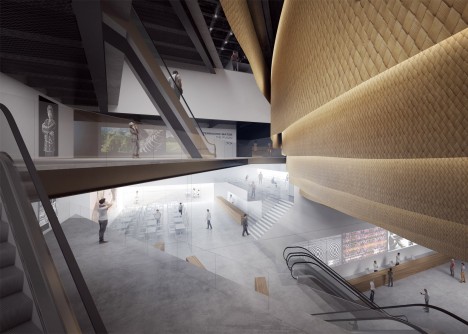
A bold break from traditional closed-box museums, this gorgeous open Museum of Indigenous Knowledge design is as much an interactive rock-hewn landscape as a work of contemporary architecture.

cavernous neolithic history museum

Kengo Kuma & Associates of Japan are the team behind this stoney structure slated for construction in Manila and designed to showcase Philippine history starting in the Neolithic period, known for its huge stoneworks.

ave museum contrast

Populated with tropical plants, waterfalls and pools, the carved-out center of the structure is made to feel both organic and inviting, encouraging visitors to climb up, wander and explore their environs.

cave museum interior spaces

The building is meant to stand out in contrast not only to more minimalist and austere museums but the surrounding urban environment as well, providing relief from the relentless urban cityscape on all sites.

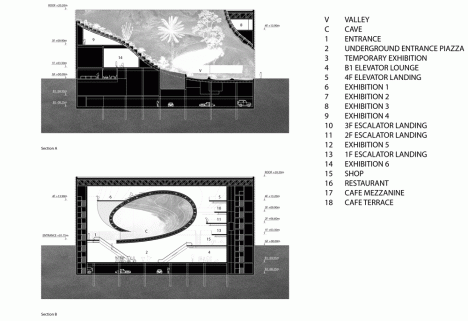
cave museum sections

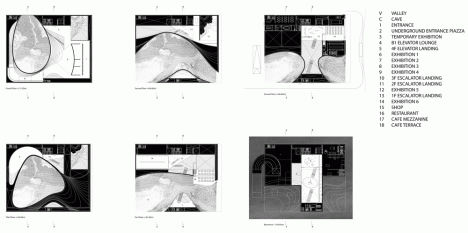
cave museum floor plates

Restaurants and shops are located along the artificial ravine toward the base of the building, meant to be accessible independently but also a gateway to the galleries and exhibition spaces on the floors above.

Share on Facebook


[ By WebUrbanist in Architecture & Public & Institutional. ]

[ WebUrbanist | Archives | Galleries | Privacy | TOS ]


WebUrbanist

 
Comments Off on Neolithic Modernism: History Museum Appears Carved from Stone

Posted in Creativity


Twisting History: 40+ Surreal Altered Vintage Photographs

20 Aug

[ By Steph in Art & Drawing & Digital. ]

vintage photos long 3

Many of us have picked up old black and white photographs and wondered what their backstories are, but these artists take history into their own hands, altering the images to produce new narratives. In the following 40+ revised photographic histories, new elements are combined with the mysterious original images, giving them a sense of surreality that could then serve as the basis of an entire book if the creative chain were to continue.

Black-and-White to Colorfully Surreal by Jane Long

vintagephotos long 5

vintage photos long 4

vintage photos long 2

vintage photos long 1

A figure in a found black-and-white photograph catches artist Jane Long’s eye and she begins to envision them in a new setting, giving them a story, making them somehow less anonymous. She digitally restores and colorizes each image and combines them with other photographs to create entirely new, surreal compositions. “I wanted people to see these figures as real people, more than just an old photograph. Adding color completely changes our perception of images.”

Library of Congress Images Get Horror Makeover by Jim Kazanjian

vintage photos kazanjian 1

vintage photos kazanjian 2

vintage photos kazanjian 3

vintage photos kazanjian 4

Historical photographs archived by the Library of Congress are a lot more interesting in the hands of digital artist Jim Kazanjian, who combines them in unexpected ways to create terrifying architectural creations straight out of a horror movie. “I’ve chosen photography as a medium because of the cultural misunderstanding that it has a sort of built-in objectivity. This allows me to set up a visual tension within the work, to make it resonate and lure the viewer further inside. My current series is inspired by the classic horror literature of H.P. Lovecraft, Algernon Blackwood and similar authors.”

Crazy Hyper-Colored Collages by Eugenia Loli

vintage photos lolli 4

vintage photos lolli 1

vintage photos lolli 3

These smash-ups of vividly colored vintage photographs juxtapose entirely unexpected elements, like gigantic children riding tortoises through a city park or a war plane dropping candy instead of bombs. “I start by finding a ‘base’ image, and then I sort of build around it. Sometimes I have a concrete idea of what I want to do, and sometimes I leave the images to fit together by themselves,” says artist Eugenia Loli. “Sometimes, after a lot of juxtaposing, the ‘base’ image might not even be a part of the final collage. Most of the time I try to ‘say’ something important via my art, but other times it’s just about doodling.”

Bizarre Details Painted Onto Photos by Colin Batty

vintage photos batty 1

vintage photos batty 2

vintage photos batty 3

vintage photos batty 4

vintage photos batty 5

Can you imagine what the original subjects of these photos would think if they saw artist Colin Batty’s alterations? They might be a tad disturbed to see their own heads on fire or replaced by gigantic eyeballs. The artist paints with acrylics directly onto cabinet cards from the early 1900s.

Next Page – Click Below to Read More:
Twisting History 40 Surreal Altered Vintage Photographs

Share on Facebook


[ By Steph in Art & Drawing & Digital. ]

[ WebUrbanist | Archives | Galleries | Privacy | TOS ]


WebUrbanist

 
Comments Off on Twisting History: 40+ Surreal Altered Vintage Photographs

Posted in Creativity


Photo History Club: Pop Art Photography

29 Jul

I believe one could argue that the general population as a whole has historically had a messy, sometimes turbulent, relationship with art. As artists throughout time have sought to interpret their different realities and experiences as a human being, the end results we call “art” have, at times, ventured into increasingly esoteric realms. That is to say, difficult to understand Continue Reading

The post Photo History Club: Pop Art Photography appeared first on Photodoto.


Photodoto

 
Comments Off on Photo History Club: Pop Art Photography

Posted in Photography


Exploring Abstract Photography: History, Philosophy, Inspiration

07 May

How do you as an artist express an emotion, an idea or a concept without referring back to something already loaded with meaning? How can you explore new visual territory hidden within old subjects you know well? Or what can you do to find some new inspiration and break out of your photographic rut? Abstract photography has the potential to be Continue Reading

The post Exploring Abstract Photography: History, Philosophy, Inspiration appeared first on Photodoto.


Photodoto

 
Comments Off on Exploring Abstract Photography: History, Philosophy, Inspiration

Posted in Photography