RSS
 

Posts Tagged ‘Hinder’

Astronomers warn SpaceX Starlink satellites may hinder scientific observation and discovery

28 Aug

SpaceX plans to launch thousands of satellites into space for the firm’s Starlink high-speed satellite internet network. While the Starlink service aims to bring high-speed internet to locations where it is otherwise unavailable or prohibitively expensive, Independent is reporting that hundreds of astronomers have expressed concerns that Starlink’s satellite array will have an impact on astronomy and slow down scientific discoveries.

A report by the Satellite Constellations 1 (SATCON1) workshop stated that constellations of satellites in the night sky are problematic for ground-based observations, including those utilizing optical and infrared technologies. The research underpinning the workshop’s report included input from ‘more than 250 astronomers, satellite operators and dark-sky advocates.’

SATCON1 co-chair Connie Walker from the National Science Foundation’s (NSF) NOIRLab said of the report, ‘Recent technology developments for astronomical research – especially cameras with wide fields of view on large optical-infrared telescopes – are happening at the same time as the rapid deployment of many thousands of low-Earth-orbiting satellites (LEOsats) by companies rolling out new space-based communication technologies.’

Not to scale. Illustration courtesy of NOIRLab / NSF / AURA / P. Marenfeld

The report concludes that large satellite constellations will impact astronomical research and the general human experience of the night sky, although they find that the impact will range from ‘negligible’ to ‘extreme.’ When Starlink’s first 60 communication satellites launched in May 2019, the impact was felt immediately by astronomers and the satellites were ‘brighter than anyone expected.’ It is not fiscally or scientifically feasible to stop utilizing ground-based astronomy.

While the impact of LEOsats may be negative for astronomers, the introduction of communication services to underserved areas is undoubtedly positive for potential users. The SATCON1 workshop is trying to work with satellite operators to find a solution. In the report, there are two main findings. One is that LEOsats ‘disproportionately affect science programs that require twilight observations, such as searches for Earth-threatening asteroids and comets, outer solar system objects, and visible-light counterparts of fleeting gravitational-wave sources.’ The second finding is that there are at least a half dozen ways to reduce the harm caused to astronomy by large satellite constellations.

From the SATCON1 workshop report: ‘A wide-field image (2.3 degrees across) from the Dark Energy Camera on the Víctor M. Blanco 4-m telescope at the Cerro Tololo InterAmerican Observatory, on 18 November 2019. Several Starlink satellites crossed the field of view. Image credit DECam DELVE Survey/CTIO/AURA/NSF.’ For many more visual examples of the impact of Starlink satellites on astronomical observations, read the full SATCON1 technical report.

One of these six ways is to launch fewer or no LEOsats, which is of course an impractical and unlikely solution. More realistically, the workshop found that the impact of LEOsats can be reduced if they are deployed at orbital altitudes no higher than 600 km, satellites are darkened or include sunshades, or are carefully oriented in space to reduce reflections. There may also be ways to reduce the impact of satellite trails with improvements to processing techniques for astronomical images. Further, if satellite owners provide astronomers with accurate orbital information, observers may be able to avoid satellites with their telescopes.

NOIRLab director Patrick McCarthy says of the report’s findings and recommendations that he hopes that they ‘will serve as guidelines for observatories and satellite operators alike as we work towards a more detailed understanding of the impacts and mitigations and we learn to share the sky, one of nature’s priceless treasures.’

The next workshop, SATCON2, will aim to tackle the issues of policy and regulation when it meets in early to mid-2021.

Image credit: SpaceX / Starlink

SpaceX plans to launch more than 30,000 Starlink satellites. This represents approximately a doubling of space-based moving objects visible to the naked eye during twilight, according to the SATCON1 report.

Despite there being only about 500 Starlink satellites currently in orbit, the program’s impact has already been felt during significant astronomical events. For example, the comet Neowise made an appearance this summer, something possible only once every 6,800 years, and Starlink satellites disrupted observation for many.

Image credit: SpaceX / Starlink

Thus far, SpaceX has taken steps to reduce the impact of its satellites. The space exploration firm has utilized a twisting technique to make the solar panels on the satellites less reflective. It has also explored painting reflective surfaces black and using sunshades. SpaceX has worked with the American Astronomical Society (AAS), National Radio Astronomy Observatory (NORAF) and the Green Bank Observatory (GBO) in pursuit of a solution to the issue of LEOsat visibility.

SpaceX stated ‘We’ve taken an experimental and iterative approach to reduce the brightness of the Starlink satellites. Orbital brightness is an extremely difficult problem to tackle analytically.’

For astronomers, the SATCON2 workshop cannot come soon enough. Professor Tony Tyson of the University of California, Davis, says that ‘…no combination of mitigations can completely avoid the impacts of satellite trails on the science programs of the coming generation of optical astronomy facilities.’

Articles: Digital Photography Review (dpreview.com)

 
Comments Off on Astronomers warn SpaceX Starlink satellites may hinder scientific observation and discovery

Posted in Uncategorized


How To Avoid 4 Photography Mistakes That Will Hinder Your Development

21 Aug

Teaching photography workshops has made me aware of four mistakes people make which hinder their development as photographers. If you can learn to avoid doing these four photography mistakes you will become a much more creative photographer and find more enjoyment in using your camera.

4 photography mistakes 01

Mistake #1 – Always thinking your camera is not good enough

Most people who join our workshops come with DSLR or mirrorless cameras and have made a reasonable financial investment in this equipment. They have researched what to buy, carefully chosen and purchased a camera they decided will be right for them.

But many people still are stuck on the idea that if they upgrade their equipment their photography will improve dramatically. This can be true in some cases, but generally, it’s a mistake to be easily avoided. It’s most often a mistake to think like this because you are telling yourself you cannot improve unless you get new gear.

4 photography mistakes 02

Changing your thinking about wanting new camera equipment is the best way to avoid getting stuck in a photographic rut. Sticking with the camera you have, getting to know it and love it will enable you to become a far better and more creative photographer. I’ve had my main camera now, (a Nikon D800,) for over five years – a long time for any digital hardware, and I am more than satisfied with it. I have come to know it well and therefore, use it easily. I’ve been using Nikon cameras for over 30 years so am pretty familiar with the way they work.

Sticking with the camera you have, and getting to know it well will enable you to concentrate more on composition, lighting, and timing. You will not be distracted trying to figure out which dials and buttons to use to set the camera the way you want. Making these settings will become second nature once you are intimate with your camera. By upgrading your camera too often you are not as likely to get to become truly familiar with it.

4 photography mistakes 03

Mistake #2 – Not studying how to use your camera

Another mistake I find people often make is not learning how to use their camera. We had a customer recently who had studied photography in high school and also taken courses in photography at university, but they did not really know much about using their camera. I was shocked!

One of the easiest ways to avoid frustration and undoubtedly help improve your photography is to study your camera before you study anything else about photography. Learning how your camera functions and how to control it should be the first step you take in your photographic journey. Unless you are confident with your camera and can use it with ease, you will be distracted from the more creative aspects of photography.

4 photography mistakes 04

Picking up most camera manuals it’s not difficult to understand why people so often do little more than skim a few pages before putting it down again, as they are notoriously challenging to make much sense of. There are other ways to learn about your camera settings.

Getting online and using Google and Youtube will typically result in an incredible amount of good information about most camera models. Many top brands have authors who write independently about their cameras and the information in those books is often far easier to digest.

By deciding to enjoy the camera you have and learning how to use it, you will be avoiding two of the biggest mistakes I find people make that hinder their growth as photographers.

Mistake #3 – Using your camera infrequently

Hopefully, if you are committed to avoiding the first two mistakes you will naturally avoid this third one I find many people make – not using your camera frequently enough.

4 photography mistakes 06

If you only use your camera when you go on vacation, or for family gatherings or to photograph your kid’s soccer game, you are not using it enough to become a really proficient photographer. This is an easy mistake to avoid if you build a healthy habit of taking your camera everywhere, (and you don’t just leave it in your camera bag).

Using your camera frequently, every day preferably is the best way to integrate what you have learned about your camera into practical experience. Taking up what’s known as the 365-day challenge is a great way to help form a creative habit which will do more for your development as a photographer than any other method I know. Choosing to pick up your camera and take at least one photo a day, every day of the year, is a commitment destined to shape and speed your development as a photographer.

4 photography mistakes 07

Mistake #4 – Relying on auto exposure

Most people who join our photography workshops have their camera’s set to one of the auto modes, typically aperture priority, at the start of the day. Before we are through the first hour, most have their cameras set to manual mode. I am very good at convincing people to make the switch to manual because I passionately believe it is a big mistake to allow your camera to make the creative choice of setting the exposure. Your camera is smart, the artificial intelligence in modern cameras is incredible, but your camera is not creative.

4 photography mistakes 05

By taking control of your exposure using manual mode you are avoiding one of the biggest mistakes people make. Knowing how to use manual mode on your camera will empower you to become so much more creative, but you must first overcome the mindset that tells you it’s too difficult. It really isn’t, especially if you are avoiding the first three mistakes I’ve written about in this article.

Camera manufacturers love to promote all the new technology in their cameras and you never see much encouragement from them to use manual mode. I believe learning to use your camera in manual mode is a lot less complicated than learning all the auto settings. Learning to set your exposure manually you have control over the way your photographs will look and you will truly be able to develop your own unique photographic style.

4 photography mistakes 08

Take creative control

By making the mistake of relying on the camera’s AI and using your camera on auto you are relinquishing creative control to a piece of equipment manufactured to return standardized results. If you want to avoid all your photos looking like most other people’s I would encourage you to switch to manual mode and take creative control of your photography.

This is a big step for many people and does require practice to learn the principles of exposure. We have had so many people leave us lovely reviews and thank us for encouraging them to make the switch to manual mode.

Conclusion

4 photography mistakes 09 4 photography mistakes 10

Even if you can avoid making one or two of these mistakes you will notice an improvement in your photography. Managing to avoid all of these photography mistakes will take some time and commitment, but to excel in any creative expression does not happen easily for most people.

The post How To Avoid 4 Photography Mistakes That Will Hinder Your Development by Kevin Landwer-Johan appeared first on Digital Photography School.


Digital Photography School

 
Comments Off on How To Avoid 4 Photography Mistakes That Will Hinder Your Development

Posted in Photography


How Auto White Balance Can Hinder Your Photography

01 Feb

You’ve likely heard that auto settings like auto exposure and autofocus aren’t fail-proof. They’re strong features, no doubt, and most photographers take advantage of them at least some, if not all, of the time. But the key to success with auto-anything is to make it work for you; that is, to understand its limitations, and know when it’s not going to give you the best results.

If you’ve been a photographer for very long, you’ve likely run into the situation in which a very bright scene, a snowy landscape, for example, caused your camera’s auto exposure to significantly underexpose the shot, giving you murky gray snow instead of brilliant white. Likewise, a shot that was naturally dark, like a portrait of a black dog, might have been recorded too light, also resulting in unwanted gray or brown.

In both of these cases, the auto exposure was tricked by the scene’s overall light or dark tone, and attempted to compensate for this problem by doing exactly what it’s designed to do: choose an exposure that will average out the tones in the scene. For many photographs, auto exposure does a fine job of selecting a correct exposure, for scenes when average is correct. The trouble is when a situation is not average. In those cases, it’s up to you, the photographer, to make the necessary adjustments.

DJ ATM7 40 2

DJ ATM7 40

The exact same thing happens with your camera’s Auto White Balance, only in this case, the issue is not with light intensity, but with color.

The Color of Light

Not all light is the same; different types of light have different colors built-in to them. Daylight is basically white, while light from a sunrise or sunset has a red, orange, or pink cast to it (caused by the light being bent through deeper layers of atmosphere). Shade is usually a bit blue, as is snow, as both of these situations are receiving reflected blue light from the sky. Standard incandescent (tungsten) lightbulbs give off a strong yellow cast, while fluorescent lights, long the bane of photographers, can be anywhere from blue, to purple, to green.

Your camera needs to know the color of the light so that it can accurately record the rest of the colors in the scene. With film, this White Balance” is built into the product (i.e., Daylight film and Tungsten film), but with digital cameras, we have the ability to change the White Balance on the fly. If you shoot a room illuminated only by tungsten light with your camera’s Daylight White Balance setting, the resulting photo will show incorrect colors that are skewed towards yellow (try it and see for yourself). You could also shoot an outdoor natural-light photo with the tungsten setting and get some simply awful blue images. But when these situations are shot with the correct White Balance selected, the colors in the photos should be spot-on accurate.

The Auto White Balance Blues

Your camera likely offers a handful of White Balance choices, settings like: Daylight, Cloudy, Shade, Flash, Tungsten, and Fluorescent. There is also, surprise, an Auto choice.

Many beginning photographers tend to set their White Balance selection to Auto and leave it there. This mistake can be the cause of quite a few photographic problems. Like your auto exposure, Auto White Balance is pretty good. Especially when dealing with artificial light sources, the results of Auto can be very satisfactory. The trouble arises when a color cast is desirable, or when shooting a subject that is mostly one color.

DJ CWG 3 11 E 2

DJ CWG 3 11 E

A great example is a classic sunrise or sunset scene. In this case, there can be quite a lot of red or orange light illuminating the scene. If you choose Auto White Balance for this shot, the camera will evaluate the scene and think, “Hey, something’s wrong! There’s a lot of red here! Better back off on the reds.” The problem is, you do NOT want your camera to correct for those colors. In this case, having a lot of red in the scene is correct according to the subject and your intention. Auto White Balance will probably deliver a sunset that has a much more bluish feel, not as dramatic, and not what the scene actually looked like.

Another way Auto White Balance can be fooled is with objects that are mostly one color. A good example is flower photography. Suppose you’re photographing a large pink flower that fills the frame almost entirely. Auto White Balance will look at this shot and think, “Whoa, too much pink! Gotta back off on that.” Auto White Balance has no way of knowing if subject is truly that color, or if it’s the lighting. The only thing it can do is try to deliver what it perceives to be an average color balance for the image. In this case, the flower in the photo won’t appear the correct, vibrant pink that it was.

DJ 776 9 2

DJ 776 9

Auto White Balance can even cause slight inaccuracies to everyday outdoor photos, often resulting in shots with just a bit too much purple than they should have (the result of Auto trying to over-compensate for green vegetation).

Use Presets!

So what’s the solution? Use those White Balance presets! Many photographers, including me, use the Daylight setting a great deal of the time, to help ensure accurate colors during all times of the day and in many weather conditions. The Shade and Flash presets can also be quite useful. If you’re shooting JPEG files, selecting the correct White Balance at the time of shooting is critical. But even if you shoot RAW files and have the (very useful) ability to adjust your White Balance in post-production, choosing the correct White Balance preset at the time of shooting can start your images off right, and save you plenty of time, and who doesn’t like that?

Do you have any other stories or examples where Auto White Balance did you wrong? Please share in the comment below.

googletag.cmd.push(function() {
tablet_slots.push( googletag.defineSlot( “/1005424/_dPSv4_tab-all-article-bottom_(300×250)”, [300, 250], “pb-ad-78623” ).addService( googletag.pubads() ) ); } );

googletag.cmd.push(function() {
mobile_slots.push( googletag.defineSlot( “/1005424/_dPSv4_mob-all-article-bottom_(300×250)”, [300, 250], “pb-ad-78158” ).addService( googletag.pubads() ) ); } );

The post How Auto White Balance Can Hinder Your Photography by Daniel Johnson appeared first on Digital Photography School.


Digital Photography School

 
Comments Off on How Auto White Balance Can Hinder Your Photography

Posted in Photography


The Rule of Thirds – How it Can Help or Hinder Your Composition

27 Oct

How compositional rules can help or hinder your composition

Creating good photographs, and becoming a good photographer, is in general, not just about learning about your camera and all the rules of composition. These help, but while you should know your camera and have a good knowledge of technique, the biggest challenge you need to give yourself is learning to expand your perception, of the world and learn to see the world as it really is. Our minds are basically full of distractions – endless thoughts about our needs, wants, and to do lists. It’s a bit like living in a bubble which you need to break out of, so that you are fully able to see what’s happening around you, and not be distracted by your mind.

ROTAnthonyEpes 02

“It takes a lot of imagination to be a good photographer. You need less imagination to be a painter because you can invent things. But in photography everything is so ordinary; it takes a lot of looking before you learn to see the extraordinary.” – David Bailey

I think the rules of composition, and in particular the Rule of Thirds, are a great way to develop your perception. It’s not a rule you should learn and then overlay on all of your images, or your view of the world.

For me rules are a way to train your eye, so that eventually you can unleash its wild creativity. The creativity that is totally unique to you and exists in no other person.

Rules of composition:

  • Do work and help you create excellent compositions – but don’t use them all the time (don’t use anything all of the time)
  • Help you develop your perception and train your eye to see the wonders of the world
  • Create harmony between your subject and its setting

My philosophy with rules is always, “Learn the rules like a pro, so you can break them like an artist.” (Picasso said that by the way, not me).

20130116_tomi_188

Use them like a tool box

I like to think of the rules of composition as a little tool box that you can draw from in different ways, and in different variations. They aren’t always necessary, but they are super useful for helping your mind be both disciplined and focused, as well as creative, free, and wild.

So – what is the Rule of Thirds?

I love the rule of thirds because it’s a very simple, and easy concept to understand. It’s one of the key compositional rules (others include: leading lines and natural framing) that many photographers use to enhance their compositions. Although it can be tricky initially to bring it into your photos, once you start composing using the Rule of Thirds, it will immediately give your photographs a feeling of flow and depth; as well as helping them look balanced, creating an easy path for the eye of the viewer.

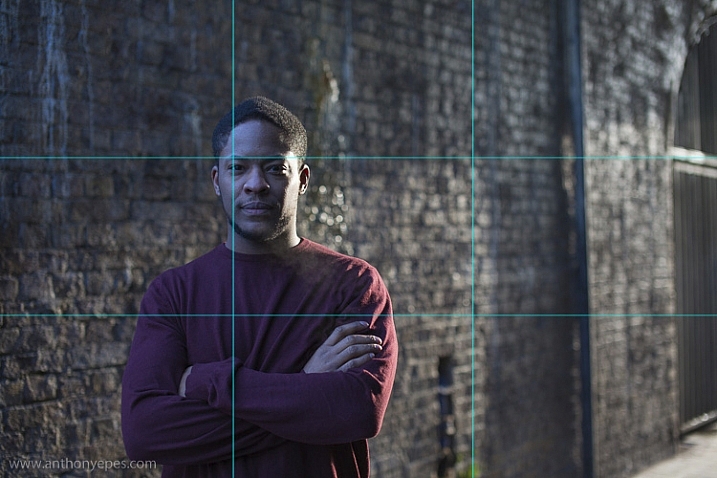
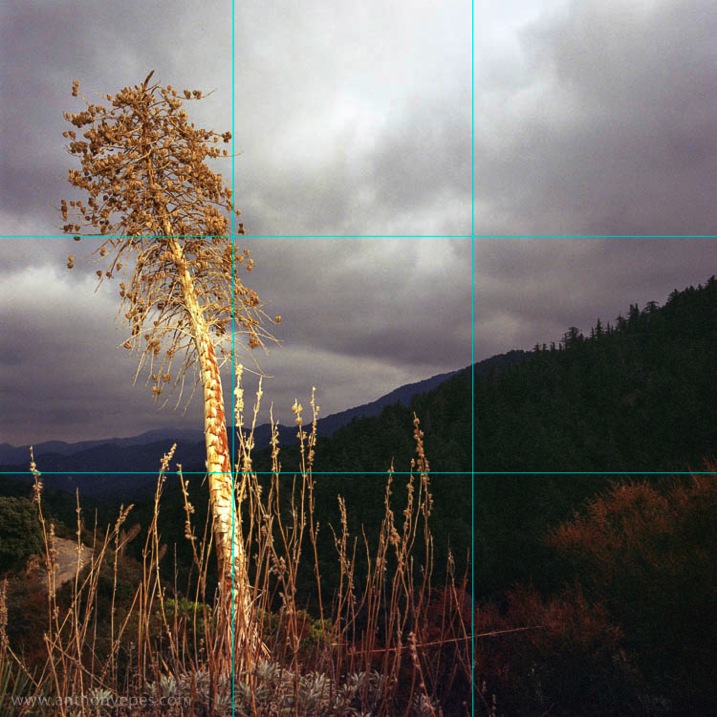
The rule of thirds breaks the image up into nine equal squares. Where the lines intersect we call these Points of Interest. The rule works by placing your subject, and other elements, along the lines and at the points of interest. Most cameras will have the option to overlay this grid on the viewing screen, so turn it on if that helps.

ROTAnthonyEpes 01

The human eye is naturally drawn to the these points of interest. It won’t generally look in the centre of an image first, unless there is a particularly arresting subject drawing the eye there.

Why use the rule of thirds?

Generally placing your subject off-balance, then using one, two or several other elements within the frame, placed at the points of interest, creates a much more visually appealing photo than having your subject dead centre. It:

  • Creates balance
  • Adds more complexity to an image than just placing your subject in the centre
  • Creates energy
  • Gives your photo a sense of depth, rather than just being a flat image

20151008_istanbul_001

What’s very important also, is that you have one or two other elements within the frame that balance or create energy, tension or harmony with your subject. It’s not enough to just have your subject off-centre. Let’s look at some examples.

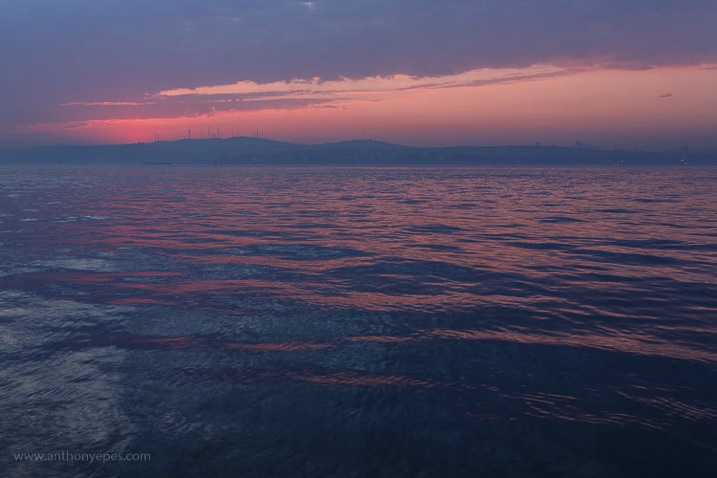
Let’s start simply. Rule of thirds can be applied to your horizon line. Don’t put it in the middle, use it to run along the top or bottom third of the image:

This is more unusual to do than you imagine. Of the thousands of photos I have with a horizon line only a handful are not running along the centre of the image.

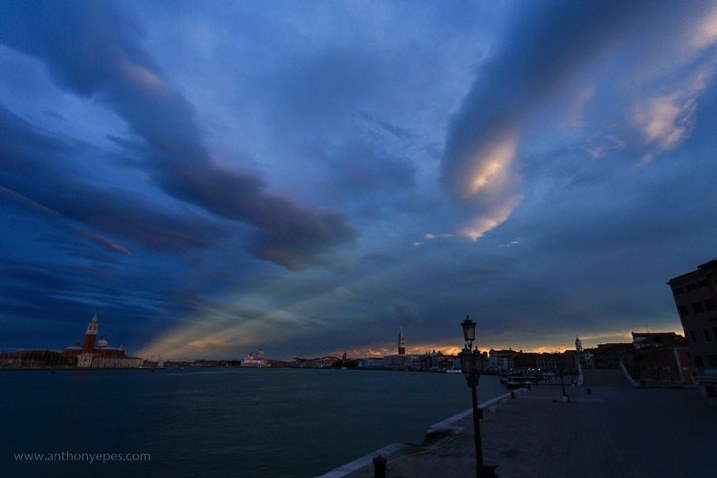
With every technique you use, there has got to be a reason for doing it. Otherwise you just see technique. I used it in the photo above (at the top of the article) because the clouds and sky were so much more interesting than the foreground, and below, because the light on the water was beautiful.

ROTAnthonyEpes 03

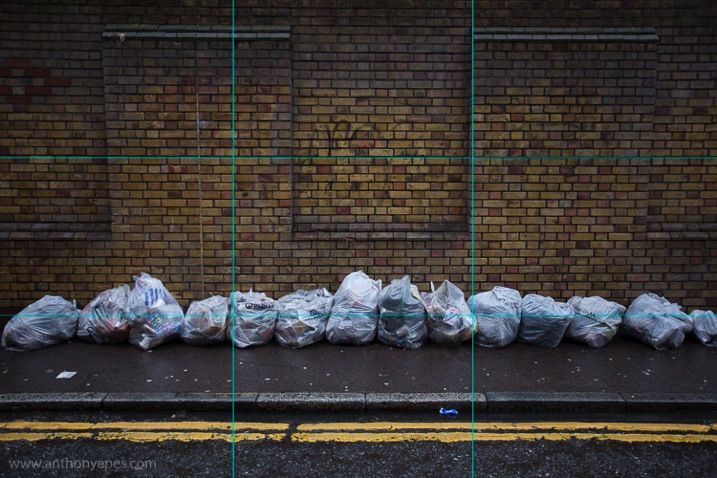
You can also apply the idea of having lines run along the upper or lower third of your image to things other than the horizon. Here I’ve applied it to some well organized rubbish bags. Notice that the line of bags follows the bottom horizontal line, but that it’s also emphasized by the line of the pavement and double yellow line at the bottom? These elements create energy – giving it perhaps a sense of movement and flow. Then you have the vertical lines and brickwork patterns as a contrast. All of this order of lines and patterns are very pleasing to the eye. The mind is always looking for order within the chaos of the world!

ROTAnthonyEpes 04

It’s important to say that I am not walking around looking for pictures that fit into the rule of thirds, or any of the other composition rules. But when I find a subject I’m interested in (I believe passion for your subject is the most important thing in your photography) and I am composing, looking for elements etc., then that’s when the rules are really helpful. Once you really get familiar with the rules, then you can start to adapt them to your own creative vision.

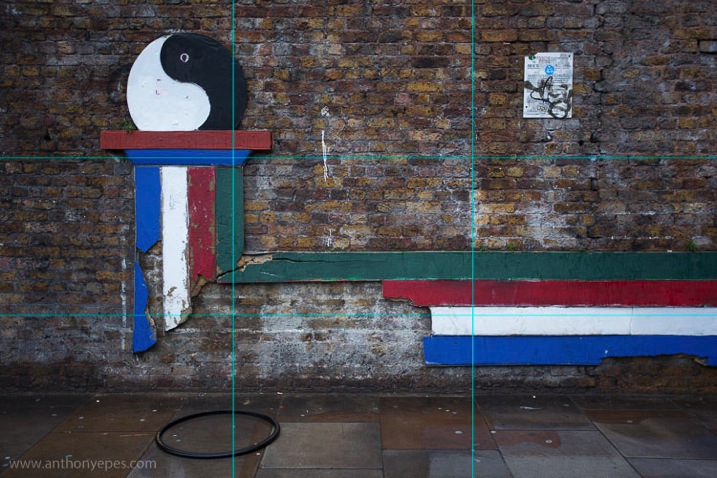
I have a passion for urban decay, you might call it. In the image below, instead of placing the ball and the column dead centre, I placed it in the left third of the frame. The other elements that are balancing it out are the ring on the floor, the lines going horizontally along the image, connecting with the points of interest lines, and then in the top third of the photo we have the notice on the wall. Take away the notice and the ring, and you’d have a much plainer, less interesting image.

ROTAnthonyEpes 05

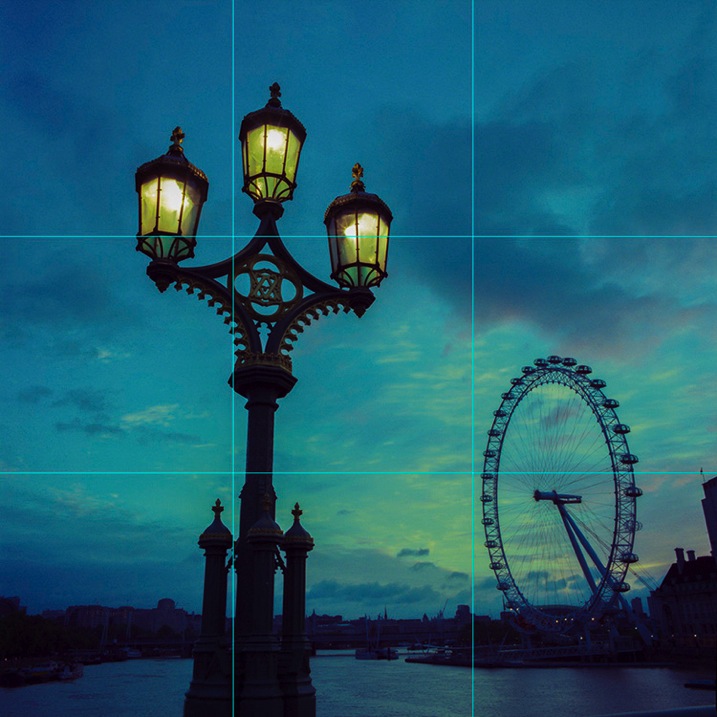
Below is one of my favourite photos of London. Here you have the old street lamp hitting the two left hand points of interest, and the wheel of the London Eye in the bottom right corner. You could say that there are only two elements in this photo – a primary and a supporting secondary in juxtaposition. The street lamp being the primary element is placed on the first third and is without a doubt the main subject. But by adding the London Eye as the secondary element we now have a sense of place, and the relationship is complete. It says, “This is London!”

ROTAnthonyEpes 06

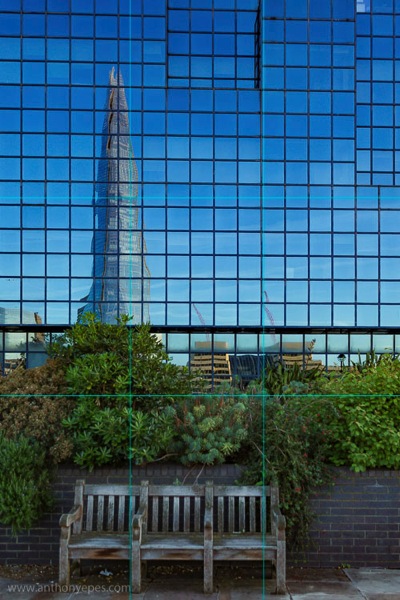
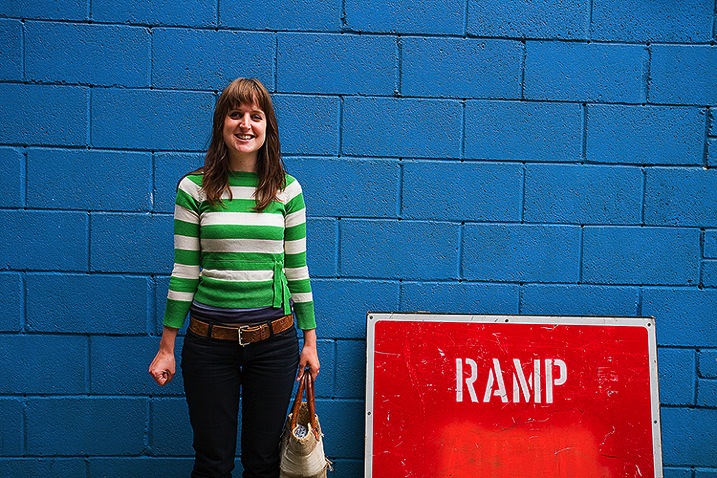
I like that the third element in the image below is the blue background, which helps the image feel clean. But because of the balancing elements of the woman and the sign, it’s not overly simple.

ROTAnthonyEpes 07

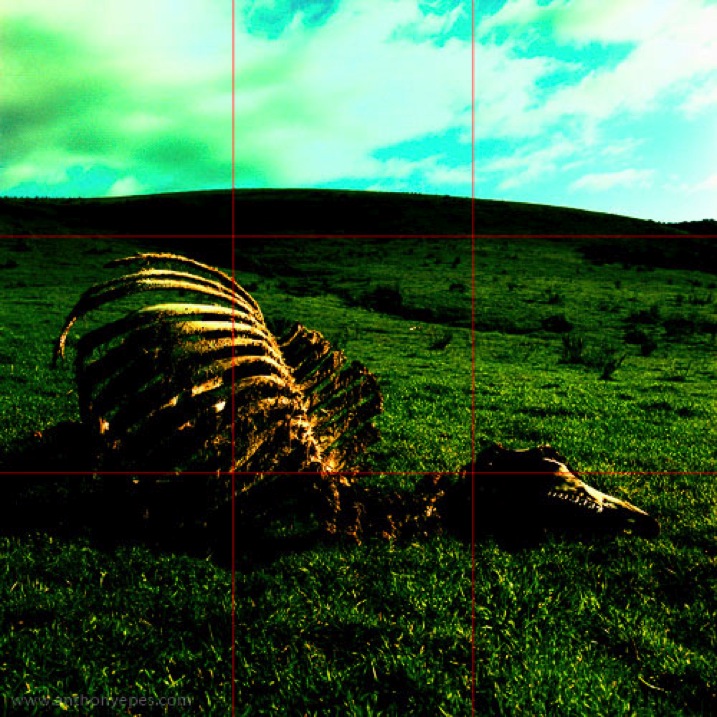
In the photo below is a rough adherence to the Rule of Thirds. Can you see where I placed the elements and why? Do you think this was the best way to compose the image? What’s important for me is that it’s not just a photo of a skeleton – it’s a photo of a skeleton in a very beautiful place. I find that lots of photographers will get absolutely mesmerized by their subject and start taking photos before absorbing the whole scene (you know that time when you get your images up on the computer and wonder why they don’t look as great as you thought they were going to, this is often due to not taking in the whole scene).

ROTAnthonyEpes 08

A very interesting skeleton it is, and unusual to come across. But there is also the element of perspective and the upper third being an almost ethereal sky. If you take away the sky the photo wouldn’t pop, would it? By placing the subject nearer the lower third I’ve created space for it to rest in.

Rule of thirds will help you capture beauty

Most people are able to appreciate, and see, the beauty and harmony of nature on a large scale – that epic view of a sunset over a beach, the vast meadow of beautiful flowers. But when you put a camera up to your eye, and reduce an image to a much smaller scale, I think most people lose that ability to see the harmony of the world, and thereby its beauty. The rule of thirds will help you see how to create harmony and balance within your photo, by helping you when you are placing your elements within your frame.

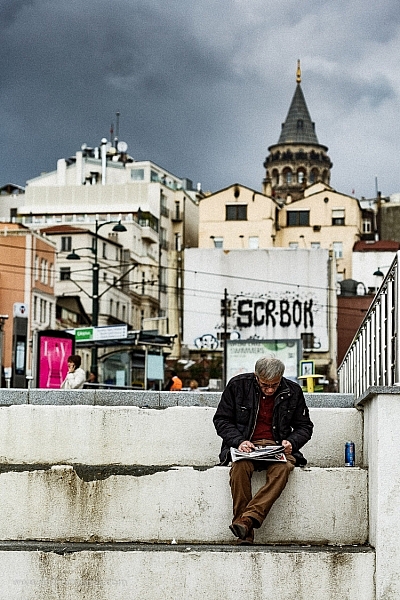
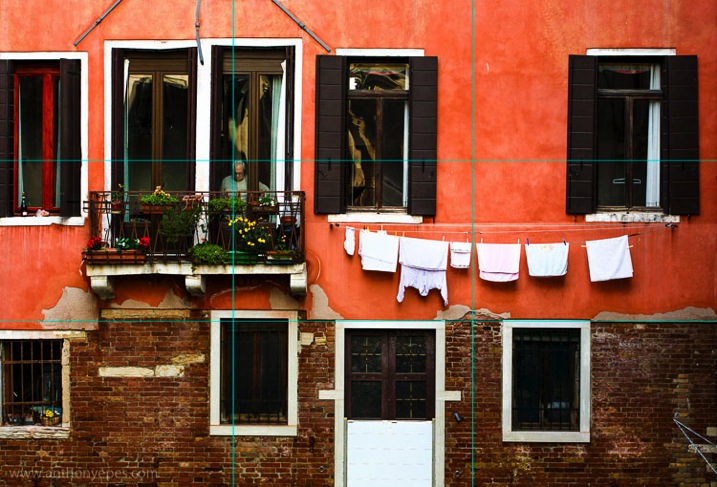
And now to Venice. This photo below is a bit more complicated, but let’s look at what elements are the most important. The man, definitely. He is bang on one of the points of interest. Now notice how the change of colour and texture of the building runs along one of the lines.

There is some of the structure of the rule of thirds but that’s not the whole story here. So you can use elements of the rule of thirds and then add in your own ideas and elements. It’s all flexible. Play with it.

ROTAnthonyEpes 09

Let the rules help you be excellent

You can sometimes use the rule of thirds to almost repair your image, by cropping. All processing programs will have the grid available, and I know that some photographers will overlay the grid and crop their image to fit these rules. I am not a fan of any kind of regular cropping. Why? Because I think in general it makes you a lazy photographer. Don’t rely on anything after the fact to make your photo better, when you can capture something in-frame now. By all means use things to enhance an already good photo, but no bad photo can be saved in post-production.

But – if you love post production, and you want that to be what defines your images, that’s fine. But become awesome at that, be excellent. What unifies all photographers who are taking consistently excellent photos is they are committed to excellence in their own way. That I can get behind.

ROTAnthonyEpes 10

We all come to rules differently. I’ve noticed in my workshops that not everyone has an affinity for absorbing rules, and putting them into practise. Maybe the idea of a more technical basis for your photography makes you squirm. But I would really encourage you to stick with it. Even if it takes a while for you to absorb this, the technical aspects of photography really give you a good grounding, so that you have the ability to take the photographs that you see in your mind’s eye.

If you are more of a technical rules-based person, my advice is to try and propel yourself away from the rules. I’ve noticed that people who get too involved in rules of composition, and their camera buttons, often find it difficult to really see what’s going on around them. So learn the rules, but then really push yourself to see beyond them.

So go explore and take the rules with you. Learn them, play with them and have fun.

googletag.cmd.push(function() {
tablet_slots.push( googletag.defineSlot( “/1005424/_dPSv4_tab-all-article-bottom_(300×250)”, [300, 250], “pb-ad-78623” ).addService( googletag.pubads() ) ); } );

googletag.cmd.push(function() {
mobile_slots.push( googletag.defineSlot( “/1005424/_dPSv4_mob-all-article-bottom_(300×250)”, [300, 250], “pb-ad-78158” ).addService( googletag.pubads() ) ); } );

The post The Rule of Thirds – How it Can Help or Hinder Your Composition by Anthony Epes appeared first on Digital Photography School.


Digital Photography School

 
Comments Off on The Rule of Thirds – How it Can Help or Hinder Your Composition

Posted in Photography