RSS
 

Posts Tagged ‘Heist’

Behind the scenes of Joe McNally’s ‘High Fashion Heist’

18 Dec
Joe McNally created this shot in the Museum of Ethnography in Budapest, Hungary using the Nikon D850, a 14-24mm F2.8 zoom lens, and strobes. A lot of strobes.

Nikon D850 | AF-S Nikkor 14-24mm F2.8 @ 14mm | ISO 160 | 1/20 sec | F5.6

Joe McNally is one of the most recognizable names in photography. As one of the foremost fashion and portrait photographers in the world, his work has been published internationally in books, magazines and newspapers for decades.

In his role as a Nikon Ambassador, McNally had early access to the new Nikon D850. We spoke to him recently to talk through the process of creating one of the most arresting images of Nikon’s D850 launch campaign.


How did the idea for this image come together?

I think the bottom line here is that I’ve seen way too many James Bond movies! I wrote up three separate potential treatments, and this one I titled ‘The High Fashion Heist’. So imagine an elegant lady sweeping down a grand staircase, gown flowing behind her, clutching stolen gems, racing past the sleeping security guard. And the wrinkle is her gown inadvertently is toppling a priceless statue. It’s a heist gone wrong, that type of thing. I also wanted to include the feeling of motion or speed.

The museum was willing to work with us, it was affordable, and it’s Budapest, which is an amazing place

Did the concept evolve during the process of putting the shoot together?

The original treatment did not include the toppling statue. I was driving the sense of motion from the flowing gown, and we wanted to emphasize a little more tension, so when I re-wrote the concept I threw in the idea that she’s knocking over a statue.

Where did you shoot?

We had to work outside the U.S., and we came up with a number of locations – one of which was in Edinburgh, Scotland, and one was in the Hermitage in St. Petersburg. And one was the Museum of Ethnography in Budapest, Hungary. They sent me scouting photographs of it, and it had that feel. The old elegance. The big staircase.

The museum was willing to work with us, it was affordable, and it’s Budapest, which is just an amazing place. So after the idea was approved, we moved forward on the location pretty quickly.

$ (document).ready(function() { SampleGalleryV2({“containerId”:”embeddedSampleGallery_2777146075″,”galleryId”:”2777146075″,”isEmbeddedWidget”:true,”selectedImageIndex”:0,”isMobile”:false}) });

The bust tipping over in the foreground – was that manipulated in post?

The column and the head are supported by metal braces. We couldn’t buy a bunch of busts and have them smash on the floor, so we took the column and put a brace against it, and the head, and then touched out the braces in post.

I’d say there were probably about 20 large power packs and heads, and about 10-15 Speedlights

How did you light this shot? Was it all strobes?

It’s virtually all strobes. We were allowed to come into the museum at around 6 o’clock at night when it was closed, and we worked until 6 o’clock in the morning. So there was no natural light. So if you look at the windows up top, camera left, those are strobes on a crane truck outside. I’d say there were probably about 20 large power packs and heads, and about 10-15 SB-5000 Speedlights.

Were you shooting in TTL mode, or was it all manual flash exposure?

I shot all manual for this. The D850’s touchscreen is fantastic, because now, if I’m doing something complex with six groups of Speedlights for example, I can just tap on the screen and alter their values.

How did the D850’s particular feature set help you in putting this shoot together?

First off, there’s the resolution. When you shoot in an ornate place like this, you really want to be able to capture all of the detail, and the camera handled that really well. The D850’s sensor has great dynamic range, so I didn’t have to over-light. In the cavernous spaces, I could hint at lighting, and I knew that the shadow detail would be alright. The autofocus is hyper-accurate, which is essential, because you don’t want to get THE expression and THE particular arrangement of the gown absolutely perfect and have any sort of focus issues afterwards.

I was able to effectively control two fields of flash, with the Speedlights being controlled from the camera

I was shooting the flashes in manual exposure mode, but I was controlling all of the Speedlights using the WR-10 radio trigger from the camera. So I had a big strobe system on a different radio system, but I also had the Nikon Speedlight system. I was able to effectively control two fields of flash, with the Speedlights being controlled from the camera.

We had a big crew, plus a video crew, the clients were there, we had a props person, hair, makeup, fashion, styling, and a very elegant wonderful model. I had a crew of five assistants! So the convenience of the new technology really helped.

Are there other features of the camera that you’re excited to try out?

So far, I’ve used the D850 strictly as a stills camera. I’ve been using it a lot just for simple portraiture and for beauty portraiture, but I’m very much looking forward to going into video mode with this camera. Again, the detail is really pretty luscious and pretty wonderful. I have a small stills and video project I’m going to be shooting in February, and I’m looking forward to it.

I shot the Rio Olympics with my D5, because it’s tough and it’s fast, and I’ve always used my D810’s when I needed resolution. But the D810 doesn’t have the radio controls that I’ve come to be so fond of with the SB-5000 flashes. And the D810 didn’t have things like the tilting LCD from the D500, which I’ve found to be very convenient. With the D850, I can have all of that in one camera. Speed, resolution and convenience.


This is sponsored content, supported by Nikon. What does this mean?
Articles: Digital Photography Review (dpreview.com)

 
Comments Off on Behind the scenes of Joe McNally’s ‘High Fashion Heist’

Posted in Uncategorized


Virtual Heist: 2 Artists Secretly 3D-Scan an Ancient Artifact

04 Mar

[ By WebUrbanist in Culture & History & Travel. ]

3d art figure scan

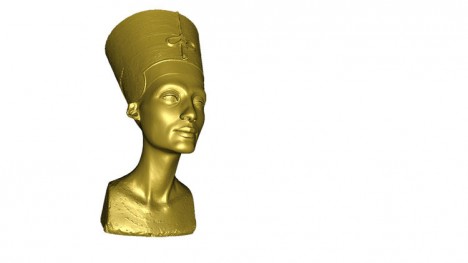
An usually high-tech form of pseudo-theft, executed by a pair of artists, has resulted in a high-resolution scan of the famous Queen Nefertiti statue at the heart of a dispute between Germany and Egypt. Avoiding the watchful gaze of four guards at the Neues Museum in Berlin, Nora Al-Badri and Jan Nikolai Nelles painstakingly scanned the 3,500-year-old bust over the course of three hours using a Kinect.

3d nefriti statue scan

Technically, nothing was taken, but the exact contours of the bust are now publicly available, open-sourced by the artists in question.

3d rendered egyptian artifact

Their work, itself a sort of art project, is in part a commentary on the question of art ownership and accessibility. The statue in question has been in Germany for over 100 years, but the Egyptian government has been lobbying to get it back.

3d figure copy

Since the release of their data dump, thousands of people have downloaded a virtual copy of the statue either to examine or 3D-print a copy. While this is not the same as preservation, it does add layers of redundancy for future researchers should something ever happen to the original figure. Many galleries are already making high-resolution images of famous paintings and drawings available on the web, and there is no reason a similar tactic could not be taken with three-dimensional works as well.

Share on Facebook


[ By WebUrbanist in Culture & History & Travel. ]

[ WebUrbanist | Archives | Galleries | Privacy | TOS ]


WebUrbanist

 
Comments Off on Virtual Heist: 2 Artists Secretly 3D-Scan an Ancient Artifact

Posted in Creativity


Love At First Heist – A Short Film

16 Oct

Love At First Heist is a short film made of still images by director Elizabeth Anweis (Hung, Southland) and shot by Bryan Koss (Discovery Channel, Director of Photography)

The interview below was submitted by Guy Birtwhistle, producer of the film.

We tracked down actress, Elizabeth Anweis in Los Angeles to ask her about her new short film, ‘Love At First Heist’, which uses a blend of still photography and live footage.

You’re a working actress in Hollywood, where the heck did you learn how to edit?

A book. Books are amazing.

For our techie reeaders what did you shoot and edit on?

I think Bryan [Bryan Koss, Director of Photography] used the 5d and 7d. The video footage of the stabbing being shot on the 5d. Post consisted of PS 5 and FCP 7.

We associate LA with sunshine and palm trees, yet you chose to show us rain and downtown, can you talk about your reasoning behind this?

Downtown LA was written into the script almost as it’s own character. As for the rain, we were lucky with it.

Still from Love At First Heist

Still from Love At First Heist

How many photos did you shoot?

Roughly 2600 photos. We were attempting to capture a lot in one day and moving quickly. It was incredible of Bryan to get all the coverage we needed in addition to the stylized experiments I wanted, most of which didn’t make the cut in the end.

What was the shooting photo count to editing photo count ratio?

2600 photos were shot of which 500 were then processed. I’m not sure how many ended up in the film as there were two different edits. The final one being scaled back and more simple.

Please talk about the process of editing all those photos, what was your criteria for selecting the photos in the video?

Pretty basic. The first pass involved separating out my favorites which were then edited in Photoshop to inspire the look and feel. Next came forming the skeleton of the story and then it was a matter of filling it in with the music in mind.

There is minimal sound design, no voiceover, can you talk about your decisions with respect to sound?

It’s good to hear that it sounds minimal as it’s not meant to stand out much and there’s actually quite a bit going on. I think the music acted as more powerful an agent than any true dialogue or voiceover could have in 3 min. It also, I think, allows a more individualized experience for a viewer to fill in who the characters are.

Still from Love At First Heist

Still from Love At First Heist

Why did you chose black and white?

It’s less distracting and offers more control over the focus of an image. I didn’t want the difference between all the lighting situations to stand out and detract from the short story. Within the three minute time frame I think the black and white images provided a stronger and faster emotional impact.

Can you talk about the challenges of shooting on the street, were you hampered by weather, light, police?

We weren’t stopped or questioned at any point which was surprising to me. Security guards watched us but never said anything. At one point we were even standing in front of a jewelry store as I was pulling a knife from my bag while masked, and nothing. The weather was the biggest challenge for me. On the one hand it was great for lighting because it was overcast all day but on the other it was freezing with the added rain. Some burly men (ahem, Bryan and Guy [Guy Birtwhistle, actor/ writer/ producer]) might disagree but as the day progressed my limbs and hair froze with icicles, I was shaking uncontrollably and by the end I could barely communicate. The words were stumbling off my tongue and tripping over my lips. Thank god Guy and Bryan are both proficient mind readers.

Learn more about the film at Guy Birtwhistle‘s website


dslrBlog

 
Comments Off on Love At First Heist – A Short Film

Posted in Photography