RSS
 

Posts Tagged ‘Guide’

2017 Buying Guide: Best cameras under $1500

03 Dec

If you’re getting serious about photography and don’t mind spending a bit more money, you’ll find some amazing cameras in the $ 1000-1500 price range. In this buying guide, we’ve rounded up our recommendations for the category.

Articles: Digital Photography Review (dpreview.com)

 
Comments Off on 2017 Buying Guide: Best cameras under $1500

Posted in Uncategorized


2017 Buying Guide: Best cameras under $1000

02 Dec

More direct controls, better autofocus, and in many cases 4K video capture – they’re a step above ‘budget,’ but cameras in this category provide a whole lot of bang for your buck. Here are our top picks in the range.

Articles: Digital Photography Review (dpreview.com)

 
Comments Off on 2017 Buying Guide: Best cameras under $1000

Posted in Uncategorized


2017 Buying Guide: Best cameras under $500

01 Dec

Whether you’re looking for a compact camera with image quality exceeding that of your smartphone or just want an inexpensive second camera, there are some impressive options that won’t bust your wallet.

Articles: Digital Photography Review (dpreview.com)

 
Comments Off on 2017 Buying Guide: Best cameras under $500

Posted in Uncategorized


2017 Buying Guide: Best cameras for people and events

30 Nov

Those shooting portraits and weddings need a camera with a decent autofocus system that won’t give up in low light, good image quality at medium/high ISO and great colors straight out of the camera. Read on to see which cameras are best suited to those tasks.

Articles: Digital Photography Review (dpreview.com)

 
Comments Off on 2017 Buying Guide: Best cameras for people and events

Posted in Uncategorized


The dPS Ultimate Guide to Fine Art Photography

30 Nov

Daring to be Different

One of the contentious topics in the world of photography these days seems to be what exactly is fine art photography. Ultimately it is what the photographer deems it to be, but in the world of art, there is a lot more to it. If you want to get recognition as an artist that uses the medium of photography, then there are certain expectations of what your body of work should be like and how you go about executing it.

Galleries and collectors are not going to collect work or invest in art when there isn’t a lot of consistency within that body of work. One fine art image is not enough to make you a fine art photographer. The work needs to be done with intention, with a direction, and have a consistency over all the images. A style is developed that is recognizable in all the images.

It is important to look at other famous artists, not just photographers, but painters and sculptures, to see how their work has evolved. See how you can do something similar with your photography. Photography is no different to those other mediums and the same definitions that apply to them are also applicable to fine art photography.

Who can be a fine art photographer?

01 leannecole fine art photography

A long exposure that was taken during the day, but the light in the image has been manipulated to make it look like it was taken at a different time.

Anyone can be a fine art photographer; there are no hard and fast rules about it. Though it does demand a fair amount of dedication. There are no rules or special qualifications that a person needs to follow or have before they call themselves a fine art photographer.

Some of the things that help define a fine art photographer

Perhaps the best way to describe how you can be a fine art photographer is to look at how they work. There is a lot more to it than simply creating beautiful images. We can all do that, but an artist works towards something. Their work is done with intention, and they have a direction they are following. Finally, there is a consistency to their work. Let’s take a look at each of these points individually.

Intention

Often when you go out to take photos, you pick a place because you think you might get nice images at that location. That is most likely never going to be a problem for you. But if you want to be considered more of a fine art photographer then you need to go to places that you know will help you create images that will further your work, and build your portfolio. There has to be some intention behind why you photograph things.

2420 leannecole fine art photography

The cityscape that has some differences, but it is quite effective and if I was short of images for an exhibition this one would be included.

For example, a fine art portrait photographer who does images of people in certain scenes, like dark moody beach scenes, is not going to go and take photos of a baby in a park. Well, they might for a friend, but they wouldn’t include that work in their portfolio.

Artists are always trying to take photos that work with what they already have. They go out with the intention of photographing subjects that follow the direction of their work.

Direction

This is a lot like intention, but it means the photographer has direction. If they are taking photos somewhere, they are being directed by their previous work. This helps them to get images that will continue to follow that style.

06 leannecole fine art photography

Before processing.

07 leannecole fine art photography

After processing to give it my signature style.

Consistency

For the same reasons as intention, that same portrait photographer is not going to photograph a baby because it won’t give their workflow any consistency. For a fine art photographer, you need to have work that is fairly consistent and looks like it all belongs together.

That doesn’t mean it has to be the same subject all the time, it can also be a similar processing style. All the images are processed in a similar way so they look consistent when a gallery or investor is looking at the portfolio.

The more consistent you are the more galleries and investors will be interested in your work.

Consistency is important and making sure the images all have the same feel and look is important in creating a body of work.

This is definitely the case. I asked the curator for Stills Gallery in Sydney, Josephine Skinner, about how important it is that there be consistency in a body of work. This is what she had to say:

It’s very important. If an artist were contacting us, I would hope to view a resolved body of work, both conceptually and materially. Of course, we’re used to working with artists as they develop new work for an exhibition, but a cold submission won’t pique my interest unless you establish your capacity to deliver.

What is a body of work and how do you create it?

A body of work is where you have several pieces that show the consistency and intention that was spoken about earlier. When you have a body of work it should have a similar style and look as though one person created it all.

The subject matter should be all the same or very similar. There needs to be a number of images in the body of work so you can have an exhibition. The actual amount will depend on where you are exhibiting and how many are needed.

This is a selection of my work, notice the similar processing style, subject matter, and mood across all the images.

Contact sheet 02

Contact sheet 01

Artist Statement

Whether you want to believe it or not, an artist statement is very important. It doesn’t have to be an essay, but putting what you are trying to achieve with your photography down on paper is a great way to help with those areas that we just discussed; intention, direction, and consistency.

When writing one you want to be clear about why you are doing what you are doing. What is important about it and why you have chosen the medium of photography?

Here is what Josephine had to say about artist statements:

An artist statement is helpful: be brief, clear and use accessible language.

Some statements can waffle on and not make much sense. It is good to sound professional, but it should be concise and leave the audience of your work with a very clear understanding of what you are trying to achieve.

This image was taken with the intention of being able to change the mood and make it look different.

03 leannecole fine art photography

The final image. Many aspects were changed so this image would look like it was taken at night with just one light shining.

Look at some fine art photographers that are practicing now

Have you ever been told that if you want to be a good writer that you should study and read the writing of those in the same field? The same can be said for fine art.

If you want to be an artist then you should study and look at the work of other great artists, in this case, fine art photographers. Though, you should include a wide range of artists as photographers can also learn a lot from painters, drawers, printmakers, and sculptors.

08 leannecole fine art photography

This image of the 12 Apostles doesn’t really belong with most of the work, but it still has the same. The light has been manipulated, so it almost belongs. But, the different subject matter would make mean it would probably not be included in an exhibition.

You really need to look at what your work is and find similar photographers. There is such a large number of photographers working at the moment, that it’s hard for me to tell you who to study. But here is a list of a few fine art photographers to give you a starting point.

  • Julia Anna Gospordarou
  • Bill Henson
  • Tracey Moffat
  • Cindy Sherman
  • Brook Shaden – artist statement and gallery of work.
  • Andreas Gursky
  • Joel Grimes
  • Art Wolfe
  • Annie Leibovitz

What is an Artist CV?

15 leannecole fine art photography

A cityscape image before processing.

16 leannecole fine art photography

The final image showing how the light has been changed to create this look.

This is very similar to a work CV (curriculum vitae) or resume. But instead of listing all the jobs you have had, you list everything that galleries and other people in the art world might want to know about you.

They usually start with your education, where you have studied and when. Then you list what solo exhibitions you have had if you have had any. The goal is to end up with a massive list of those. Then you follow those with the group exhibitions in which you have been involved. Then you might add what prizes you have won.

Finally, comes a list of places where your work has been published. For example, if you have had work published in a magazine. You can also include collections and in this section, you will mention if you have sold work to important places like a major public gallery, for instance.

09 leannecole fine art photography

Another image that has the same look and processing, but doesn’t belong. It does belong more than the image of the 12 Apostles though.

Every time you approach a gallery you will be asked for your Artist’s CV. If you don’t have one, it is time to start working on it. They are usually one page.

Here is a link to my CV as an example.

Do you need to study Fine Art at a Tertiary Level?

The simple answer to this is no, you don’t have to study at a tertiary level to be a fine art photographer. But the long answer is that if you do, you will gain a greater understanding of the many aspects of being an artist. The really good places also give you studio space and impose the need to work in that space like a professional artist would.

10 leannecole fine art photography

Another one of the power stations, that could work, but wouldn’t be included in an exhibition.

There are so many other things you learn as well, for example, how to develop your style or your body of work. Or, how to create the consistency we talked about earlier. You begin to understand how the gallery system operates and how to approach them. Often you are given opportunities to exhibit your work so you can get an idea of what it is like. These can help you to get a start on your artist’s CV.

The lecturers are usually artists themselves, so they can guide and mentor you. They understand what you are going through and their advice can be invaluable.

Getting a Bachelor of Fine Art is never a bad thing. Many other artists and galleries will take you more seriously because you have shown a commitment to your practice.

12 leannecole fine art photography

This one is a little different, but it still fits the artist statement.

Where to study it if you so choose

There are places all around the world and where you study will depend on where you live, the cost, and if you are accepted. Look at other artists and see where they studied. Do your research to find out what is available near you. Find out how many graduates of that institution have had successful careers when they finished.

Not all art schools are equal. Some have very good reputations, while others will get you the degree, but not necessarily the prestige. For example, in Melbourne, you can get a Fine Arts Degree from many places, but two are more sought after, University of Melbourne, Faculty VCA, and RMIT University. People take more notice if you have attended and graduated from those schools.

14 leannecole fine art photography

This image appears as though it would work, but since the rest of the images are more cityscapes and not close-ups of anything, it would not be included. If more similar images were made, I may have to reconsider that decision.

Keep in mind that this type of degree will not lead to a paying job, and you are being trained to be an artist. It is expected that you will work at it full-time when you finish. Of course, most artists end up doing other jobs to supplement their income until they are making enough from their art. Though this appears to only happen for a few. Nearly all teach or have other jobs to pay the bills.

I had a lecturer once that told us if we were still doing art and exhibiting our work 10 years after graduation we would make money from it. Unknown if this is true, but it is a nice sentiment.

Visit galleries and see what others exhibit

2220 leannecole fine art photography

This was taken near a marina, but it is too different and I couldn’t make it look like the other images, so it would never be included in an exhibition.

To get a great understanding of what fine art photography is one of the best things you can do is visit art galleries, both public and commercial. You can see how the artist works, look at the consistency and also how the work all looks when it’s put together in an exhibition.

Look for commercial galleries that are exhibiting photography works, or better still find ones that specialize in fine art photography. If you can’t visit them in person, then look on the internet. They all have websites and usually show the works of the artists they represent.

Study the work and the artist. If you find some whose work you really like, pay a lot more attention to them. Find out what motivates the artist, look at their artist CV, and see if you can find an artist statement. That will really help you to understand their intention, direction, and the consistency.

Public galleries often have some of their collection online, but you are usually required to go and look. Don’t be disappointed if the photography section if very small, other artworks often get more wall space. You can look for galleries that specialize in photography, for example in Victoria, Australia there is a place called Centre for Contemporary Photography and that is all they show. It’s a great way to see what other photographers are doing.

18 leannecole fine art photography

Like the ocean image, this has the same look and feel, but the subject matter doesn’t match.

Here are a few others:

  • International Center of Photography in New York City
  • A Gallery for Fine Photography in New Orleans – they carry prints by many famous and iconic photographers including Ansel Adams, Julia Margaret Cameron, Henri Cartier-Bresson, W. Eugene Smith, Edward Steichen, Elliott Erwitt, and many others.
  • Center for Creative Photography in Tucson, Arizona. They house a large collection of photography archives including many of Ansel Adams original negatives.
  • Maison Européenne de la Photographie in Paris dedicated entirely to photography.
  • Torch Gallery in Amsterdam
  • Galleria Carla Sozzani in Milan
  • Magnum Photos and Gallery – they represent several iconic photographers’ work and have a gallery in Paris, as well as events in many cities worldwide and a great online gallery for viewing.
  • The Photographers’ Gallery in London, England.
  • Camera Work in Berlin.

Study about all art, its history and what is happening now

Part of being an artist is keeping yourself informed. As previously stated, you should be going to galleries and seeing other exhibitions. It is so important to read and study other artists. It can help you understand what their lives were like and what drove them to create their art.

It is also good to keep up to date with what is happening in the world of art. Who is winning awards, what work is really popular right now, and how you could fit in. Look at who is being exhibited and which galleries are showing their work.

Look at painters, sculptures, and other mediums

Don’t limit your photography study to just photographers. You should also look at painters, sculptures, printmakers, and drawers. You can learn a lot from them as well.

Rembrandt lighting is a type of lighting pattern that portrait photographers strive to create. It involves a triangular spot of light on the cheek of the portrait subject. Photographers have been trying to replicate that style for years, but it came from a painter – Rembrandt.

13 leannecole fine art photography

The image is similar, but it probably wouldn’t be included in an exhibition. It doesn’t quite fit.

In some ways, painters were our earliest photographers as they tried to paint what they saw. Looking at their work is very important. You can learn a lot about subject-matter and more importantly, about composition. For those artists, the composition was key and they would have spent a great deal of time working on that element of their craft. Study how they put their paintings together and learn.

Sculptors create compositions and often work conceptually. If you are interested in conceptual photography then looking at how these artists work can help you find direction. See what lengths they go to in creating their sculptures.

Living an artist’s life and what that means

There is a myth that many creatives were “suffering artists”. That to be an artist you had to be in some kind of struggle. The other myth is about being the “starving artist”, so if you are going to be an artist you have to also be very poor.

An image that would be part of the body of work. It follows the theme of the rest of the images.

The first is a myth, you don’t have to be on some internal struggle to be an artist. It has been said that you have to go through disasters in your own life in order to help you create masterpieces. It isn’t true, of course. Very normal people create the most amazing artworks. There is a lot more to it than some emotional suffering.

In the past, many artists were starving. Even in today’s world, making money as an artist is incredibly hard. There are more people wanting to be artists than there are people wanting to buy the work. The reference to starving was more to do with making no money and not having enough to buy food.

The reality is that most artists live very normal lives. They often work part-time jobs to survive and live in ordinary houses. They are often very normal people. There are some eccentric artists, but they are more the exception to the rule. Many have studios and workspaces, and every free moment they get, they work in their art practice.

11 leannecole fine art photography

A cityscape that would work in an exhibition, it has the same feeling as the others.

Exhibiting your work

There are various different kinds of galleries and if you want to exhibit your work then you need to start studying them. Find out which ones are the best for you to approach first of the several different types (large public and private).
First, you need to find out what the galleries are looking for. Once again, Josephine has some advice for those wanting to approach galleries:

The first piece of advice I would have is to do proper research into which galleries you approach and be selective with those you do. We get submissions from painters, for instance, who haven’t even looked on our website to find out we exhibit photomedia and video. In the process of narrowing it down, bear in mind that if a gallery has an emphasis on photomedia that doesn’t mean that all forms of photography will fit with their broader aesthetic and focus. Also, be conscious that each artist brings something unique to a gallery so diversity is desired – they probably won’t want someone whose practice mirrors an existing represented artist. Lastly, each gallery has a different policy for receiving submissions, so a good idea is to call and ask what they prefer. Don’t just show up and expect to sit down with the Director!

17 leannecole fine art photography

A cityscape taken from an observation deck. While it is a cityscape it also would not be included. It really does not have the same look at the others.

That is great advice and a good idea for all artists. Do your research and study the galleries you are interested in to see if they are a good fit for you. You can also ask questions to see what they have to say. They will often be more than happy to talk to you about what type of work they are looking for, and how to submit your work.

Josephine has provided some information on how they find new artists:

Our focus is contemporary photomedia and video, so we tend to look at art prizes that are often interdisciplinary, such as the Hatched Graduate exhibition at PICA, and keep an eye on what’s happening in ARI (Artist Run Initiatives) spaces. These platforms provide an initial filter because the work has already undergone a process of competitive selection. Galleries with a more traditional or commercial aesthetic would probably look elsewhere.

Most galleries will have information and guidelines about how to send in proposals for exhibitions; you need to follow those closely. They get a lot of submissions and if you don’t do what they ask then you could be eliminated straight away. Do everything you can to get them to look at your artwork.

Preparing your work to exhibit

2320 leannecole fine art photography

The subject matter fits with much of what the fine art work is about, but it’s the wrong colors and sends a different message than the others.

Having an exhibition of their work is the ultimate goal for most artists. It is where they develop a name and reputation. If you want that too, then you have to make sure your work is good enough to show.

There are so many decisions to be made before you do a show. You have to decide who will print your work and how it will be printed. Part of the reason for exhibiting is to sell your work and if it doesn’t look good then people won’t buy it.

Before the work is sent to be printed you need to make sure that there aren’t any defects in the images. When they are blown up, sensor spots or other unwanted items in your scenes will be enlarged as well. They could end up standing out so much that they take over the image. Magnify the image on your computer (view at 100% or 1:1 size) and look very closely for any mistakes or faults.

20 leannecole fine art photography

Work in an exhibition.

19 leannecole fine art photography

Work that is packaged and ready to be sent to an exhibition.

Find a professional printer who will work with you. Look for one that you can rely on, and who knows their business. They should be able to help you figure out the best way to present your work. There are so many options for photographs these days. You can do canvas prints, put images on fine art paper, and even have them on metal, which is very popular right now.
Then you are faced with the option of framing or not. Most galleries will answer that question for you.

Read my article: How to Prepare a Photography Exhibit of Your Work for more on this topic.

Editioning your work

This is not compulsory, but one thing that many photographers do is edition their work. This means they will only sell a certain number of that image or a limited edition. The artist sets the edition to what they think they might sell.

2520 leannecole fine art photography

A cityscape that is very similar to many I do, but I wouldn’t include this image as it doesn’t have the impact that many of the others do.

For many artists starting out, the number of editions is usually small, around 10 or 20. The more successful an artist becomes, the more expensive the images get, and often the edition number increases as. Some will do editions of up to 200 photos.

For most of us though, especially starting out, it isn’t necessary to do editions. You may only sell one or two copies of an image. As sales pick up and you begin to make a name for yourself it is good to consider putting out editions of your work.

If you die your work will double in price

This is probably the biggest myth out there about fine art photography and art in general. While it is true that when some artists die their work becomes a lot more valuable, it isn’t the same for everyone. If the artist had a successful career and was being collected by a lot of people then there is some truth in this.

2120 leannecole fine art photography

Image with similar colors and a long exposure, but it is not an image I would include in an exhibition.

When they die their work gains in value because it becomes rare. As no new work will be produced, all of their previous work becomes more valuable. That’s all there is, a finite amount, so it will increase in value.

For most artists, our death will only matter to those around us and our artwork will only increase in sentimental value. It’s sad, but you dying likely isn’t going to cause an increase in the value of your work.

Being a fine art photographer

There are many steps you can take that will make you a fine art photographer. There are many different paths and it is up to you to decide which ones you will take. In the end, being an artist is about doing work with intention, having a direction and working consistently.

2620 leannecole fine art photography

This would very definitely be included. The light has been changed and it works with the artist statement.

Artists usually exhibit their work with the idea of gaining a reputation so collectors will purchase it. This, in turn, leads to their work increasing in value and they can sell more. Being an artist is a noble profession and one that dates back hundreds of years, who doesn’t want to belong to that group?

The post The dPS Ultimate Guide to Fine Art Photography by Leanne Cole appeared first on Digital Photography School.


Digital Photography School

 
Comments Off on The dPS Ultimate Guide to Fine Art Photography

Posted in Photography


2017 Buying Guide: Best pocketable enthusiast cameras

29 Nov

If you want a compact camera that produces great quality photos without the hassle of changing lenses, there are plenty of choices available for every budget. Read on to find out which portable enthusiast compacts are our favorites.

Articles: Digital Photography Review (dpreview.com)

 
Comments Off on 2017 Buying Guide: Best pocketable enthusiast cameras

Posted in Uncategorized


Beginner’s Guide to Metering Modes on Your Camera

26 Nov

Should you bother to learn about metering modes? I’m confident I can sell you on it. Your camera’s automatic metering will only carry you so far. As your digital photography ability grows, you’ll start to feel frustrated in scenes with mixed light. Learning metering modes is the key to making tricky light conditions seem much less intimidating.

Let’s jump right into this beginner’s guide to metering modes.

Beginner's Guide to Metering Modes on Your Camera

Giant dragon lantern in honor of the Mid-Summer Ghost Festival – Keelung, Taiwan. Metering mode: Spot.

What is metering?

This is vital to understand before you learn about your camera’s individual metering modes. “Metering” means taking a light reading. A properly exposed image is made up of three tones of light: the shadows, mid-tones, and highlights.

The image below demonstrates these three tones well. The forested hills in the foreground and dark cloud represent the shadows, the temple roof and figure represent the mid-tones, and the bright clouds represent the highlights.

Beginner's Guide to Metering Modes on Your Camera

A figure on the roof of a temple looks out across forested hills – Jiufen, Taiwan. Through the use of my camera’s light meter, I had more creative control to slightly underexpose the image giving viewers the same sense of foreboding that I felt from those dark, rumbling clouds overhead.

Your camera has an ingenious tool called a light meter that enables it to determine a correct exposure with a balance of shadows, mid-tones, and highlights. You’ll see it at the bottom of the frame when you put your eye to the viewfinder.

Taking light readings from the scene

Your camera’s metering modes control which part (s) of the scene your light meter uses to take a reading. Consider the example below. If you were to meter only off the dragon and take the photo, the dragon would be correctly exposed. However, the sky would probably be too bright.

Alternatively, if I was to meter only off the sky, the sky would be correctly exposed but the dragon would be a bit too dark. However, if I metered from a wider section of the scene, I would get a more balanced exposure.

Beginner's Guide to Metering Modes on Your Camera

Detail from the Land God Temple at Badouzi Harbor – Taiwan. Metered off the dragon the exposure is a bit too light.

The four main metering modes

Now, let’s get down to the crux of the article. Here, I’m going to explain what each of your camera’s four metering modes does and how this affects your images.

But before we begin, a note about how your camera meter works. Very bright and dark tones can trick your light meter. Why? Because it is designed to bring every tone to something called “18% gray.” Imagine a snow-covered mountain or a jet black car. Would you want your camera to correct these tones to appear 18% gray? Or would you want their tones to be rendered as truly as your eye sees them? The answer is obvious, but not to your light meter.

So it is your job to review your image on the histogram and decide if it is correct for your scene or not. If it’s not you can use Exposure Compensation to adjust it (when shooting in Aperture or Shutter Priority modes).

Evaluative (or Matrix) Metering Mode

Evaluative metering is the natural mode to explain first because it’s the one your camera uses as standard or default. Your light meter takes a reading from across the whole scene. With that information, your camera’s onboard computer makes multiple calculations to determine a correct exposure with balanced highlights, mid-tones, and shadows.

Beginner's Guide to Metering Modes on Your Camera

A scene from Mother’s Market in Imphal – Manipur, India. I wanted to read the light from across the whole scene here and so used Evaluative Metering Mode.

Beginner's Guide to Metering Modes on Your Camera

On Asahidake, Hokkaido’s highest mountain – Japan. Shot in the Evaluative Metering mode the camera attempts to make an exposure that is an average of all the light tones of the scene. This is particularly useful when you’re learning to shoot landscapes.

Center-Weighted Metering Mode

Imagine that you’re now zooming into the frame slightly. Whereas Evaluative Metering mode reads the light from across the entire scene, Center-Weighted Metering mode reads light with a preference towards the middle. It still reads from a large proportion of the frame, just not the whole thing. This varies between camera manufacturers, but it’s usually between 60 % and 80 % of the frame.

Beginner's Guide to Metering Modes on Your Camera

An accordion player in Central Vienna – Austria. Center-Weighted mode would have been a solid choice for this portrait because there is nothing much of interest in the four corners or along the edges; it’s all within the central 60 %–80 % of the frame.

The area inside the red circle is roughly what will be metered with Center-Weighted mode.

Beginner's Guide to Metering Modes on Your Camera

Fuyou Temple in Tamsui, a riverside town in New Taipei – Taiwan. I would not have used Evaluative Metering mode for this scene because my camera would have tried to brighten the image – seeing it is mostly dark. Whereas, I intentionally wanted more of a silhouette-like feel.

The area inside the circle is roughly the percentage of the frame that will be metered when using Center-Weighted mode.

Partial Metering Mode

If Center-Weighted metering meant zooming in a little, Partial Metering is a huge jump inwards again. This time, your light meter will read the light from an area the size of 6-15 % of the center of the scene, depending on your camera manufacturer.

Beginner's Guide to Metering Modes on Your Camera

Boatman on the Ganges – Varanasi, India. Partial Metering mode is where things start to get really interesting. You begin taking more control than ever before of where you meter from in the scene. As you can see, this man’s face is just on the limits of a central point of approximately 10 % of the frame. It’s exposed exactly the way I wanted, but I didn’t just get lucky.

With the Varanasi boatman above, I was shooting in Aperture Priority mode. I aimed my center focus point at his face before composing the shot. This allowed my camera to read the light from 10 % of the frame around his head.

Then, I used the exposure lock button (read that article if it’s the first time you’ve heard about it). Note that this is for use mainly with Aperture or Shutter Priority mode. With this button held down, you lock in the exposure and can recompose the shot without the settings changing.

Beginner's Guide to Metering Modes on Your Camera

On the same boat ride, the sun sets over the ghats – Varanasi, India. Again, I aimed my center focus point at the flowers to meter. Because there was just a pinprick of sunlight still peeking over the tops of the buildings, the sky wasn’t overpoweringly bright in the final image; however, I did dim the highlights slightly in Lightroom later.

Spot Metering Mode

The final push inward; Spot Metering mode reads light from between 1-5 % of your scene. I personally use Spot Metering mode more than any other, but it may be more challenging for you if you are just learning about your camera and metering.

It is particularly useful to use spot metering in conjunction with the exposure lock button and the center AF point selected. Aim the center point of your viewfinder at the subject or light source to meter from it. Lock in the exposure and recompose, then focus and shoot.

I find that spot metering mode is goodfor portraits and getting the correct skin tones. Also, I use it for specific light sources, such as a beam of light through a window, but only when I’m also happy for other regions of the photo to be underexposed. I do not recommend using it for landscapes unless you are looking to experiment with silhouettes.

Spot metered off the sky to get a silhouette sunset and deeper tones in the sky.

Beginner's Guide to Metering Modes on Your Camera

Silhouetted figure toasting marshmallows at a community bonfire – Matsumoto, Japan. Of all its many versatile uses, Spot Metering is the mode you should select if you want to create silhouettes. Meter off the brightest part of the scene and select your settings. Lock in the exposure and then compose the shot. The brightest part of the scene will be well exposed and your subject will be cast in dramatic black shadows.

Inside a 500-year-old tomb at Lodi Gardens – New Delhi, India. Spot Metering mode is gloriously precise. You can meter off a light source as specific as a single sunbeam coming through a window. In this image, I crouched down so that the artificial light source was directly behind the sign and spot metered off the bright area of the floor.

Conclusion

The next step on from here is full manual mode, in which the exposure lock button is not required. But first, master metering modes using Shutter and Aperture priority modes.

Now that you’ve learned about each metering mode, get out your camera and go practice. Don’t forget to share your thoughts and images in the comments.

The post Beginner’s Guide to Metering Modes on Your Camera by Ben McKechnie appeared first on Digital Photography School.


Digital Photography School

 
Comments Off on Beginner’s Guide to Metering Modes on Your Camera

Posted in Photography


Treat yourself 2017: the ultimate holiday gift guide for that special person (you)

20 Nov

2017 Treat Yourself Buying Guide

The holidays are all about giving, so why not give back to the most important photographer in your life? That’s right, I’m talking about you.

At this time of year there are plenty of gift guides out there geared toward buying for others, but at the end of the day, your own photographic spirit needs nurturing. Also, camera gear can be pretty pricey and no matter how much they love you, your significant other/siblings/parents/friends might not be able to spring for that $ 1600 item on your wish list.

In this guide, we’ve rounded up a list of gear designed to pamper you and your creative spirit. From the ultimate pocket compacts, to nicer ways of carrying your camera, to the perfect rugged, portable hard drive – we’ve got you covered.

Peak Design Everyday backpack, 20L black

Peak Design Everyday backpack, 20L | $ 260 | PeakDesign.com

Treat yourself to one of the most technical and well-thought-out camera backpacks on the market: the Peak Design Everyday backpack. It comes in both a 20L and 30L capacity.

Weather-proof with plenty of ways to expand its carrying capacity including luggage straps, this bag is also real slick-looking. We’re big fans of the origami-style Flex-Fold dividers used to organize the bag’s interior, and we also appreciate the many interior pockets.

DJI Mavic Pro Fly More Combo

DJI Mavic Pro more combo | $ 1300| DJI.com

There are smaller, cheaper drones than the DJI Mavic Pro out there, (like the DJI Spark) but we recommend treating yourself to the Pro because it offers a great balance of portability, features and image/video quality. The Mavic Pro can shoot 12MP Raw files and 4K video and offers 27 minutes of flight time, 3-axis gimbal stabilization and can fly at up to 40 mph. It’s also pretty easy to pick up and start using, especially in beginner mode, though there is a slight learning curve.

In a sense, it’s the perfect drone for the first-time-flyer, long-time-photographer who wants to shoot more than HD video or JPEGs with their drone. We recommend you spend the extra cash on the controller – using your cellphone alone provides a very limit flight range and mediocre flight experience. But there are few things better for changing up your photographic perspective than owning a flying camera.

Affinity Photo for desktop

Affinity Photo for desktop | $ 50 | Affinity.Serif.com

Affinity Photo for desktop is a nifty piece of editing software that rivals Photoshop, all for a one time payment of $ 50.

In our review of Affinity Photo, we found the software more than capable at handling the majority of our re-touching tasks. Editing is mostly non-destructive and there are tools for batch processing, Raw processing, tone mapping, creating panoramas and focus stacking. Plus, if you’re coming from Photoshop, the learning curve is pretty shallow.

Affinity Photo for desktop is available for both Mac and PC.

Polaroid OneStep 2

Polaroid OneStep2 + i-Type film pack | $ 146 | PolaroidOriginals.com

The ultimate treat yourself: Take a step back from the technical nitty-gritty of this modern digital world and try shooting just for composition – it can do wonders for your creative spirit. To get into this mindset may we suggest one of the coolest instant cameras on the market, the Polaroid OneStep2?

The OneStep2 is a modern rebirth of the classic Polaroid OneStep. The controls on this camera are purposely limited: there’s a shutter button, a flash on button and a self-timer. It shoots Polaroid i-Type film which is similar to the original Polaroid 600 film and substantially larger than the Instax film offered by Fujifilm.

The camera itself is pretty affordable ($ 100), but it’s the film cost that’ll get you – at ~$ 2 a shot it’ll definitely have you shooting decisively. Nothing wrong with that!

Sandisk Extreme 500 portable SSD 500 GB

Sandisk Extreme 500 portable SSD 500 GB | $ 170 | ShopSandisk.com

This tiny portable SSD drive is both drop-proof and weather-proof and it weighs less than 80g. For the traveling photographer with limited space, it’s an invaluable piece of gear – one that won’t fail if dropped or knocked around. It also offers super fast transfer speeds and runs cool and quiet.

So treat yourself and your data to peace of mind and pick up what we consider to be the most sensible rugged hard drive currently on the market.

Ricoh Theta V

Ricoh Theta V | $ 430 | us.Rioch-Imaging.com

360-degree photos and videos are pretty darn cool and the technology required to make decent looking 360/VR content is finally coming down in price. Why not get in on the fun and treat yourself to one of the nicest stand-alone 360-cameras on the market in the form of the Ricoh Theta V?

We’ve found found the Theta V to be both easy-to-use and capable of impressive quality stills and video. It offers 4K video capture and shoots 14MP stills. Connectivity and audio capture have both been improved over the previous model, and the camera itself has a slick, Apple-like design.

Olympus Tough TG-5

Olympus Tough TG-5 | $ 450 | Get.Olympus.com

The budget compact may be dead but the rugged compact is still very much alive. And the Olympus Tough TG-5 is a DPReview favorite. We already recommended it as a great gift option for others, but if you’re into outdoor activities it’ll make a great compact option alongside your main camera. In fact, DPR’s Carey Rose deemed it the ‘best rugged compact you can buy right now,’ based on his shooting experience.

The camera offers a 25-100mm equiv zoom lens and the body is completely sealed, making it waterproof down to 50ft, drop proof from 7ft, crush proof up to 220lb and freezeproof to 14F. It also shoots Raw and is capable of surprisingly good image quality. Other features include 4K video capture and 20 fps burst shooting.

There’s something to be said for a go-everywhere-camera that you don’t have to worry about dropping, breaking or soaking. And there’s none we’d recommend over the Olympus Tough TG-5. Treat yourself!

Sony RX100 V

Sony Cyber-shot RX100 V | $ 950 | Sony.com

Speaking of compacts, the Sony Cyber-shot RX100 V is arguably the most advanced high-end pocket camera to ever exist, jam packed with a dizzying array of technology and features. The creme de la creme of small cameras, for many it is a want-to-have, not a need-to-have. To that we say… treat yourself!

It’s got a useful and sharp 24-70mm equiv. F1.8-2.8 zoom lens and can shoot at up to 24 fps with AF and auto exposure. Plus, it uses an impressive 315-point phase detect AF system. But that’s not all: it’s capable of outstanding 4K video and class-leading stills. The RX100 V also offers built-in Wi-Fi, a pop-up electronic viewfinder and a pop-up flash (read our full review).

The RX100 V has come down a tiny bit in price since launch, but if it’s still too expensive, you should consider some of the other also excellent, but more affordable RX100-series cameras.

Fujifilm X100F

Fujfilm X100F | $ 1300 | Fujifilm.com

We’ve enjoyed using every camera in the Fujifilm X100-series, and the X100F is the latest and greatest iteration. A beautifully-designed, retro-looking camera, the X100F offers a fixed 35mm F2 equiv. lens and tons of direct controls.

The X100F gains a higher-resolution 24MP sensor, an AF joystick and improved AF performance. We especially like the hybrid optical/electronic viewfinder. And unsurprisingly, we gave the X100F a gold award in our review.

In short, we think it’s among the nicest-designed compact cameras around and a great companion for travel, or documenting friends and family. So treat yourself to retro-elegance in this fixed-lens beauty.

Canon 85mm F1.4L IS USM

Canon 85mm F1.4L IS USM | Canon.USA.com | $ 1600

If you’re going to buy a portrait lens, you might as well buy one of the nicest primes released this year. We’re talking of course about Canon’s new 85mm F1.4L IS (see our sample gallery shot with it). Sharp, fast and stabilized, this lens is capably of seriously excellent image quality. It’s also dust and weather-sealed and features a 9-blade aperture.

At $ 1600, it’s priced pretty competitively, but Sigma’s stabilized 85mm F1.4 is also excellent, and somewhat cheaper at $ 1200.

Nikon D850

Nikon D850 | $ 3300 | NikonUSA.com

Perhaps you already shoot Nikon, but maybe you are invested in another DSLR system, or you shoot mirrorless. Regardless of the camera your are currently shooting with, we’d urge you to take a look at the best DSLR currently on the market: the Nikon D850. As we stated in its gold award winning review…

‘Offering an impressive 45.7MP of resolution, 7fps burst shooting, full-width 4K video and a focusing system derived from the flagship D5, it looks as though Nikon’s thrown just about everything they’ve got into the D850, and priced it well to boot. Competitors with similarly specced megapixel counts such as the Sony a7R II and Canon EOS 5Ds R may be cheaper at this point in their lifetimes, but they also fall short of the D850 in a number of ways that may make a difference in the way you shoot.’

If that doesn’t have you convinced the Nikon D850 is the ultimate treat yourself purchase, maybe our sample gallery will.


That’s all the self-gifting advice we have for you this year. We certainly don’t expect you to pick up everything on our list, but hopefully there is something here that’ll make you, or a special someone smile.

Articles: Digital Photography Review (dpreview.com)

 
Comments Off on Treat yourself 2017: the ultimate holiday gift guide for that special person (you)

Posted in Uncategorized


dPS Ultimate Guide to Nature and Outdoor Photography

08 Nov

Introduction

High on a ridge in the Brooks Range of Northern Alaska, I had an epiphany. It had to do with photography, sort of. Really, it had to do with the world in which we live. You see, I was climbing this steep slope on a little-forgotten drainage in the western portion Gates of the Arctic National Park. There was no sign that anyone had been this way before, and really, there was no reason that anyone would have.

When I eventually topped out on the ridge, late on an August evening, the sun still shining from the northern sky, I found a pillar of stone.
Ultimate guide outdoor nature photography 01

The rock stood 15 or 20 feet high, a narrow obelisk that looked as though it had been planted, or perhaps grown from the earth itself. It hadn’t of course. The stone had been pushed into its delicate position by the constant slow shift of the thawing and freezing ground below.

It struck me, in that moment next to the standing stone, that I was about to be the first person to photograph these rocks. Ever.

In one fell swoop; I realized exactly what it is about photography that I love. It’s seeing things in a way that others have not. Seeing things for the first time. Not just stones on a wild mountaintop, but viewing frequently photographed scenes in a new way. The most photographed landscapes still hold potential for novelty. And creating that novelty in images is one of the great pleasures of the art of outdoor photography.

Ultimate guide outdoor nature photography 02

And here is the rub; good outdoor photography is about creating new images, not just copying what has already been done. If there is one message in this article to remember, that’s it.

A Note on Ethics

Below, you’ll find many of the tips I’ve learned over the years as an outdoor pro; landscape techniques, macro tips, and an introduction to wildlife photography. From exposure to composition, I’ll cover a lot. But one thing I want to note first, and it’s probably the most important thing I’ll mention is this:

Do No Harm!

Ultimate guide outdoor nature photography 03

Outdoor photography is extremely popular. We landscape and wildlife photographers travel across the planet to make images, and our presence is having an impact on the places we visit. It’s our job to ensure that our actions do not damage the resources we photograph.

Here are some guidelines:

Respect other users: What we are doing is no more important than the activities of others. Be respectful of other photographers and non-photographers alike. In some parts of the world, photographers are becoming disliked because of our actions. We cannot allow this to happen. Be kind to others. Your long lens does not give you the right to be a jerk.

Don’t harass wildlife: I once watched a pair of photographers, quite literally, chase a herd of caribou around the edge of a lake in the Alaska Range. The best images of wildlife are natural images, not shots of caribou fleeing across the landscape. If your presence or actions are impacting the behavior of the animals, it’s time to back off.

Note: it may also be dangerous! Animals like elk and moose may look harmless but can do a lot of damage. Likewise, too many tourists have gotten too close to bears (with no barrier) and then if the bear attacks a human it could be put down. Don’t endanger yourself or the animals – keep a safe distance.

Ultimate guide outdoor nature photography 04

Follow the rules: Most of the refuges, parks, and other lands we photograph have rules in place for a reason. As photographers break those for the sake of an image, it hurts the reputation and possible future access for all of us. Know the regulations and follow them.

Leave no trace: The next visitor to your location should have no idea you were they before them.
Landscape Photography

Above, I related the story of finding the bizarre standing stone in Alaska’s Brooks Range. Those kinds of photography opportunities are by far my favorite. I love shooting someplace where few if any others have been or photographed.

But mostly, I like the way a piece of dramatic topography under beautiful light looks. I like how it appears to my eye, and I like how it looks through the viewfinder of a camera. When I manage to make an image that brings back all those feelings of the experience, and when I can relive those moments of outdoor beauty over and over again, then I feel very successful indeed.

Ultimate guide outdoor nature photography 05

Equipment

Landscape photography does not need to be equipment heavy. On many excursions, I may carry only a single camera equipped with a wide-angle zoom lens. But when I really want to work a scene, or my sole mission is to make images, then I’ll carry a few more things. Here is my camera equipment list, and some notes on each item:

  • Full frame DSLR: Though not vital, the full frame sensor is useful for taking advantage of wide-angle opportunities.
  • Wide-Angle Zoom: The 17-40mm f/4 and 16-35mm f/2.8 are probably my most-used lenses for landscape photography.
  • Mid-Range Telephoto Zoom: Like the 70-200mm f/2.8. I like the way this lens and those of similar focal length can isolate parts of the landscape.
  • A Compact or Mirrorless Camera: In my case, this is a Panasonic Lumix GX85. This is a great second camera and when I’m traveling light, it’s my only camera.
  • Wide-Angle, and Mid-Range Zoom Lenses for the Mirrorless Camera: To cover similar focal lengths as my full-frame DSLR (minus the extremely wide, sadly).
  • Tripod: Rarely do I leave this behind.
  • Polarizing Filter: Great for removing glare and reflections.
  • Variable Neutral Density Filter: For long exposure work, a neutral density filter is great. The variable filters allow you to adjust the amount of light coming through into the camera.

Throw in a bag or backpack to carry it all, and this kit will cover about every landscape opportunity you might encounter. While I’m sure each landscape photographer has their own suggestions, additions, or subtractions, these are my necessities.

See an article I wrote recently for another approach to taking less: How to Find More Creativity Through Using Less Gear. Also read: How to Decide What Gear to Pack for a Wilderness Trip.

Composition and Exposure

I always have a difficult time writing about composition and exposure because this is where art becomes a part of the photographic process. Sure, there is a “proper” exposure, in which the highlights aren’t blown out and the shadows retain detail, but a world in which every image was “properly” exposed would be a very boring place.

Ultimate guide outdoor nature photography 06

Instead of what is right, it’s better to understand how your settings will impact your image. Then you can decide for yourself what is best for your situation.

Shutter Speed

The speed of your shutter indicates how long your sensor is exposed to the light coming from your scene. A fast shutter speed will halt motion, while a long one will blur moving objects.

In landscape photography, you may want to freeze the motion of a splashing river or leaves blowing in the wind. Or you may prefer them to blur, providing a sense of that motion. The important thing is to understand how your shutter speed choice will either blur or freeze the subject, so you don’t end up in that dreaded (but all too frequent) in-between.

Ultimate guide outdoor nature photography 07

Aperture

Your aperture plays two roles. It controls how much light is allowed into the camera, and it controls the depth of field.

At a wide aperture, say f/2.8, your lens will allow a lot of light to enter the camera, meaning you can use a faster shutter speed (see above), but it also means you have less depth of field (DOF). Which is to say, that only a narrow portion of your image, from front to back, will be in focus.

A small aperture like f/16 will mean that a longer shutter speed is required to attain the exposure you want, but more of your image will be in focus.

Ultimate guide outdoor nature photography 08

If you want to isolate your subject from your background or foreground then a wide aperture will help you achieve that. However, if you want your image sharp from the foreground to the background, then you need to select a narrow aperture.

Ultimate guide outdoor nature photography 09

Most lenses are sharpest a stop or two down from wide open, so for maximum overall sharpness, consider an aperture around f/8 to f/11.

ISO

The ISO controls the apparent sensitivity of your sensor to light (I say “apparent” because for a bunch of technical reasons that I really don’t care about, raising the ISO doesn’t actually increase the actual sensitivity, just how the camera’s algorithms report the light in the final image – blah, blah, blah). So, in practice, increasing your ISO will allow you to use shorter shutter speeds at higher apertures. Got that?

Ultimate guide outdoor nature photography 10

The drawback is that using a high ISO also tends to create digital noise. However, cameras are getting exceedingly good at controlling noise. With my current equipment, I regularly shoot at ISO 3200, 6400, and occasionally higher without a second thought.

Coming Together – The Exposure Triangle

Those three factors (shutter speed, aperture, and ISO) control the brightness, depth of field, and sharpness of your image. They interact with one another, and you can’t change one without adjusting at least one of the others. If you aren’t familiar with how each of these settings impacts the final shot, then go out and spend a few hours experimenting so you understand the exposure triangle.

Exercise:

Spend an hour shooting in Manual Mode. Adjust the ISO, aperture, and shutter speed. Assess how each change impacts the final image. Did it get brighter? Darker? Sharper? Did moving subjects blur or freeze?

Composition

Ultimate guide outdoor nature photography 14

The Classic

The classic landscape shot entails an interesting foreground object that leads your eye back to a dramatic background. It’s classic because it works. But it’s also a formula that is very easy to get wrong.

Ultimate guide outdoor nature photography 12

In a simplistic form, a landscape image is composed of a combination of lines, layers, and planes. A line can be a visual element, like the trunk of a tree or a winding stream, or it can be implied, in a way that two interrelated elements cause your eye to move back and forth. Either way, lines are the viewer’s path through the frame.

Ultimate guide outdoor nature photography 13

Layers are elements that occur through the depth of the image. These can be any element in the image, grass stems, trees, rocks, rivers, mountains, etc. But they stand alone in successive layers, each a bit further back in the image.

Ultimate guide outdoor nature photography 15

Finally, planes are elements that provide a clear sense of depth. Say, a road disappearing into the horizon, or a river winding away up a mountain valley.

Ultimate guide outdoor nature photography 16

The ways these things interact are what cause an image to be pleasing to the eye, or to fail. In a classic composition, the foreground element and the dramatic background are tied together through these elements and interact in some way. Perhaps this is color, form, juxtaposition, or some other aspect of interest to the viewer.

All these aspects of an image become a pleasurable maze for photographers. With practice, you will begin to understand how to make them relate to one another in a pleasing way.

Landscape Details

Any natural view will have a number of interesting elements held within such as; a flower, a stone, a shadow, splashing water, or distant peaks. A long lens will allow you isolate those details from the surrounding clutter.

I use this technique often with mid-range telephoto lenses. Think of this technique as simplifying an image down to its most fascinating component.

Ultimate guide outdoor nature photography 17

Ultimate guide outdoor nature photography 18

A Note on Focal Length

The focal length of your lens will impact the depth of field of your image. The longer your lens, the shallower your depth of field will be. This makes it very difficult, if not impossible to keep an image sharp from foreground through the background when using a long lens.

That’s why isolating distant details is a great use of a telephoto lens. Compositions with no foreground generally won’t suffer from the compressed depth of field.

Ultimate guide outdoor nature photography 19

With the use of a wide-angle lens, on the other hand, it is much easier to attain a deep depth of field. An aperture that is a stop or two lower will often bring an entire image from foreground to background into focus.

Ultimate guide outdoor nature photography 20

Exercise:

Starting with a mid-range telephoto like a 70-200mm or similar lens, focus on the details of a landscape. Make some photos of these details, moving around to see how the light changes with your angle. Experiment with each.

Once you are comfortable with the details before you, change to a wide-angle and see if you can find pleasing compositions that incorporate the details you just photographed, but also include the surroundings. As you back up to a wide-angle view, think about the lines, planes, and layers within the image and how they interact. Is the result pleasing or chaotic? What can you do to improve it?

Macro Photography: The World Up Close

Through the 100mm f/2.8 macro lens this bright green beetle looked monstrous and surprisingly beautiful. The iridescent carapace practically glittered in the soft light of the overcast day, while the purple highlights of the antennae and around the eyes stood out from the leaf background.

Ultimate guide outdoor nature photography 21

It was a rainy day in the rainforest of southeast Mexico, and my fieldwork had been called off due to the weather. I spent my rare morning off gathering some of the many insects that had congregated overnight on the porch, and a menagerie of beetles, spiders, and katydids now sat beneath upturned jars on the windowsill next to me. One by one, I placed them on a clean green background of a Heliconia leaf and made images.

Ultimate guide outdoor nature photography 22

Ultimate guide outdoor nature photography 23

Equipment

Close-up and macro photography is a specialized discipline, requiring a suite of its own equipment including lenses, flashes, tripod heads, and more. For photographers that specialize in this type of photography, it is a serious investment.
Fortunately, there are a few shortcuts, which can save you from investing hundreds or thousands in macro-specific equipment.

Lenses

Macro lenses allow for a very close focusing distance and are usually equipped with some moderate magnification. 50mm, 100mm, 150mm, and even 200mm are common focal lengths of macro lenses. They tend to be fast, usually around f/2.8 and are pricey pieces of glass.

If you have the budget for it, by all means, invest in a high-end macro lens, but for those of us with more limited funds here are two alternatives:

Extension Tubes

These are exactly what they sound like, simple tubes that go between your camera and the lens. Extension tubes increase the distance between the lens and your sensor allowing a closer minimum focus (but preventing the lens from focusing on distant objects). When applied to a good quality lens, some amazing images are possible.

Lens Reversal

Have you ever turned a pair of binoculars around backward and used them as a magnifying glass? If so, this is the exact same principle.

You take an old, manual lens (focus and aperture), standard or wide-angle lens (never a telephoto), buy a cheap adapter that allows you to attach the front of the lens to your camera, and you get an instant macro. For fifty bucks at a used camera store you can often find a suitable lens, and for another $ 10 or $ 15, you can buy an adapter from Amazon that fits the filter threads on the front of the lens and allows you to click it into your camera. Bingo! Reverse-lens macro created!

Ultimate guide outdoor nature photography 24

Lights

Embrace natural light if you are just starting out in macro photography. Find a place with bright, diffused light, and start there. Once you have a strong grasp on working up close, you may choose to add artificial light.

From ring lights to external flashes, many macro photographers will use artificial light to cleanly illuminate their tiny subjects with studio-like lighting. If you have a flash, and either a remote cable or wireless triggers, you probably have what you need to get started.

Start off by attaching your flash near, or directly onto your lens, so the light falls just a few inches in front of the glass. Shadows are emphasized up close, so you want to minimize the distance between the flash and your lens.

Tripod Heads

A very useful accessory is the macro tripod head. These allow you to move your camera forward and backward very smoothly and precisely without having to adjust the tripod. With a simple twist of a knob, you can slide your camera forward or backward a couple of inches (or millimeters).

In the narrow depth of field world of macro photography, this allows you to focus by changing the camera position rather than the focus on the lens. If you get serious about this kind of photography, it is probably a worthwhile investment.

Read Equipment for Macro Photography – Video Tips.

Beginning Macro Field Techniques

Ultimate guide outdoor nature photography 25

The easiest place to begin with macro photography is a subject that doesn’t move around much, like flowers. Starting with fast-moving insects will be a very frustrating way to learn the process.

Start out in soft, natural daylight, and forget the flashes for now. Choose a cloudy day, or pick a subject you can easily move into a shady spot. Direct sunlight, just as in human portraiture, is often too harsh and contrasty, resulting in burnt-out highlights or blacked out shadows. Once you’ve figured out the process under steady, natural light, you can integrate flash.

Composition

Macro lenses, reversed lenses, and extension tubes all share one common feature: an extremely narrow depth of field. Even with the aperture stopped down, the amount of the image in focus will be measured in millimeters. Because of this limitation, you need to choose your focal point very carefully, it will, after all, be the only thing in focus on your image.

Ultimate guide outdoor nature photography 26

Many times I’ve made images of small subjects only to find out later find later that my focal point was off. By all means, compose creatively, but make sure the important part of your image is in focus. For insects or other small creatures, that almost always means the eye. For flowers, you’ll likely want to focus on the stamens and pistils. Be aware, and focus carefully.

Note on Post-Processing Macro Images

While a full post-processing tutorial of macro photography is outside the scope of this article, be aware there are focus-stacking techniques. Think of this like HDR for depth of field.

In essence, you create a series of images in which you steadily move the focus point through the scene so you end up with a series of photos, each with a different slice in focus. Focus stacking then brings those all together into a single image providing otherwise unattainable depth of field. There are more resources available online about this technique if you’d like to learn more.

Read A Beginner’s Guide to Focus Stacking.

Wildlife Photography

More than any other discipline of outdoor photography, wildlife is the place where we as photographers need to be responsible, cautious, and respectful. Earlier, I related the story of watching a group of photographers chase a herd of caribou.

I dearly wish that had been the only occasion I’ve had to see wildlife photographers acting stupidly, but sadly, my list goes on: a photographer purposely flushing flocks of Sandhill cranes at a wildlife refuge to get flight shots, the abuse of call-back recordings of song-birds which results in nest failures, dangerously close approaches to bears and moose, and on and on.

Ultimate guide outdoor nature photography 27

I just can’t write about wildlife photography without saying this: Good wildlife photography is a game of patience. You cannot make shortcuts by chasing, flushing, baiting, or otherwise harassing your subject and expect to get decent images. So please, please, three times, please! Take the time required to make the image, it will be easier on the wildlife, and I promise your results will be far, far superior.

Equipment

Though lovely images of animals can, and have been, made with every focal length (some of my favorite images are wide-angles), most wildlife photography involves long lenses. My most frequently used lenses for wildlife photography are Canon’s 500mm f4L (often with a 1.4x teleconverter), 100-400mm zoom, and the 70-200mm f/2.8. None of those are cheap, though.

Fortunately, there are a growing number of alternatives on the market. Brands like Tamron and Sigma have introduced big telephotos that, although still pricey, come in way under the prices offered by Canon and Nikon. A year or two ago, out of curiosity, I rented Sigma’s 150-600mm Sport lens and was extremely impressed.

Ultimate guide outdoor nature photography 28

Come to think of it, I strongly recommend you try lenses out before you buy them. Renting is a great, and reasonably priced, option to try out a variety of lenses. Or, if you don’t shoot wildlife often, you can rent a high-end piece of glass for a single trip, without having to dole out thousands on your own lens.

Anyway, back to equipment, here is my wildlife kit:

  • DSLR (or 2)
  • 500mm f/4 lens
  • 100-400mm lens
  • 70-200mm lens
  • 1.4x teleconverter
  • A sturdy carbon-fiber tripod with a gimbal head

Ultimate guide outdoor nature photography 29

Techniques

There is a saying in photography: “If your image isn’t good enough, you aren’t close enough.” This is nonsense. However, getting close to animals, either physically, or by using a long lens, is often the easiest way to create a compelling image. There are many exceptions (see composition below), but proximity does help.

Ultimate guide outdoor nature photography 30

Getting close requires patience. If you approach an animal on foot, your subject will almost always feel threatened and move away. Humans, after all, are predators, and for most species, nothing good happens from getting close to a predator. That leaves a few options.

Go where the animals are accustomed to people

At many wildlife refuges, back gardens, national parks, etc., the animals are used to seeing people or vehicles and will allow you to get much closer (you still need to be cautious particularly around large, or dangerous animals). In such areas, cars can make a great mobile photography blind.

Animals are also often familiar with people around popular trail systems and will pay little attention to passing walkers. You can use these areas to your advantage.

Ultimate guide outdoor nature photography 31

Ultimate guide outdoor nature photography 32

Use a blind

Many wildlife refuges are equipped with photography blinds where you are hidden from view of the wildlife. These are great, pre-established places to shoot. You may even consider building your own backyard blind for photographing your local birds and other wildlife.

Camouflage

I have a sheet of camo fabric that I’ve cut holes into for my camera lens. I sit on the ground, or a low stool, and throw this over my head and tripod. This portable blind serves well, as long as I have the patience to stay still for extended periods of time. It keeps my form obscured, and animals more willing to approach.

Patience

Most of the above techniques also require patience, but simply waiting for the right opportunity is the most straightforward approach to wildlife photography. Find a promising location with good light, and simply wait to see what happens. I bet most of my best images of wild animals have been made this way.

Ultimate guide outdoor nature photography 33

Exposure

I strive for the “proper” exposure in the field. Which, means (if I’m honest) that I leave it up to the camera. Capturing the action, the expression, posture, and the setting are the most important parts of wildlife photography.

I can fiddle with brightness later in the post-processing, but not if I didn’t capture the image from the start. So I recommend, particularly as a beginner, that you do what I do and let your camera do most of the work.

Ultimate guide outdoor nature photography 34

My settings under most conditions with a long lens are something like this: Shutter priority (see below for more on this), ISO 800 (or so), and auto everything else. If for some reason the images aren’t coming out how I want them, I’ll adjust things around, but this is my standard starting point.

Shutter Speed

As with any moving subject, you may opt to strive for sharpness, freezing the motion of the animal, or you may be aiming for a more creative motion blur. I often mix it up, shifting from sharp to blur in just a few seconds. This is why I shoot wildlife primarily in Shutter Priority mode, so I can make that change easily on the fly.

During a recent shoot of a migrating caribou herd, my workshop participants and I had a couple of thousand animals pass by in a single file line. I was constantly changing the shutter speed to get different effects as the caribou trotted past 25 yards away.

I ended up with a huge variety of shots, from crazy blurs to tack-sharp detail. Variety is important.

Ultimate guide outdoor nature photography 35

Ultimate guide outdoor nature photography 36

Composition

Get low! Next time you see a wildlife image that you like, take a look at the position from which it was made. I’ll bet you that the perspective is low, probably at eye level of the subject or below. When I’m photographing birds or small mammals, I’ll often lay flat out on my stomach.

Ultimate guide outdoor nature photography 37

Humans see the world most often from a standing position; it’s how we are accustomed to viewing things. Photos from that perspective, looking down on our subject, aren’t any different than how we normally see the world. In other words, boring.

When you drop down, however, you are now seeing the world in an atypical, and therefore far more interesting way. So get low!

Ultimate guide outdoor nature photography 38

Portraits

The simplest of images is the portrait, with a clean background and a sharp subject. Often these will be under flattering front-light. Many wildlife photographers strive for this type of image, and this type of image alone.

The secret to success in wildlife portraiture is getting close to your subject, and having a setting where the animal can be cleanly separated from its background. A large aperture, like f/4, will help blur the background cleanly. Overcast, soft light or front light is ideal.

Ultimate guide outdoor nature photography 39

Action and Motion

No doubt, a good, clean portrait of a wild animal is a lovely thing and a pleasure to make, but after a time, I find the formulaic view of wildlife rather boring. I like to see behavior, action, and motion in images. These tell a better story, and to me at least, are far more compelling. These kinds of images also require a lot more time in the field.

Let’s face it; wild animals spend a lot of time just chilling out. Birds perch for extended periods bears sleep or graze, and big cats climb trees and lounge. Action is uncommon, which means you have to spend a lot of time waiting for it.

Ultimate guide outdoor nature photography 40

I was photographing at a famous bear-watching spot in Alaska a number of years ago. It was early in the season and the salmon had not yet arrived, but there were bears about, waiting for the fish. I was standing on a viewing platform, watching a single, young Brown Bear standing below a waterfall. There were no fish, and I got the impression he was as bored as I was.

Tourists and other photographers arrived around me, watched for a few moments, took a photo, and then ambled off after a few minutes with nothing happening. I waited.

After more than an hour, another bear appeared down the river and waded up toward the falls. It was of similar age, and size, they might have even been siblings that had been separated for a time. But when the second bear appeared, the bored demeanor of the first changed completely. He grew alert, staring at the intruding bear. Then, almost without warning, the first bear charged the second, throwing sprays of river water into the air as it splashed. The second stood its ground and for a few brief seconds, the two fought. They swatted each other with powerful blows and snapped jaws down on shoulders. It was over in 20 seconds, but I was breathless. No damage had been done to either bear and afterward, the two actually stood side by side, rather companionably, for a long while as they waited for salmon to arrive.

Ultimate guide outdoor nature photography 41

In those 20 seconds, I captured a series of images missed by dozens of photographers who had come and gone, unwilling to be patient.

Wide Angles

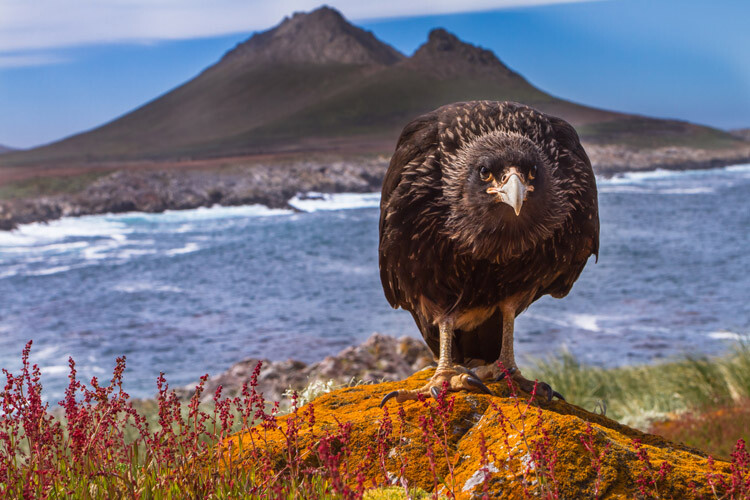
When you have a cooperative or curious subject, few techniques will yield a more compelling result than getting close, and low, with a wide-angle lens. A few years ago, when I was guiding on an expedition cruise through the Southern Ocean and Antarctica, I had several such opportunities.

In the Falkland Islands, a curious Striated Caracara hopped up to have a look at me, while on South Georgia I had a great encounter with a South Polar Skua. The images I made of these two birds are some of my favorites of that journey and perhaps some of my favorite wildlife images.

Ultimate guide outdoor nature photography 42

Wide angles show off not only your subject but also the surroundings and can be extremely effective story-telling images.

The drawback, of course, is that such opportunities are rare indeed. You’ve got to have your subject very close, and that takes time and effort while being prepared when the right opportunity arrives.
Ultimate guide outdoor nature photography 43

To maximize your chances, keep a second camera with a wide-angle lens (heck, even your phone will work) available while out shooting. That way, when a critter draws close and the opportunity for these unique images arrives, you won’t have to fumble with swapping lenses.

Conclusion

As I wrote this lengthy piece on outdoor photography, I felt I could have gone on and on about every single aspect of this discipline. There is just so much to know, and to learn; so many subjects to study, understand, and practice.

Ultimate guide outdoor nature photography 44

It is daunting, but outdoor photography is as much about the journey as anything else. I love making images that work, don’t get me wrong, but I love even more the process of being outside. I love the way a camera makes me more aware of the play of light, and the movement of animals across a landscape.

Photography can be a tool toward a better understanding of the world, but we have to use our cameras with respect and caution. Be mindful of your actions, be careful of our impact, and make beautiful photos. Along the way, you may find your experiences, rather than the final images, to be the most rewarding part. Now go explore.

The post dPS Ultimate Guide to Nature and Outdoor Photography by David Shaw appeared first on Digital Photography School.


Digital Photography School

 
Comments Off on dPS Ultimate Guide to Nature and Outdoor Photography

Posted in Photography


Getting Your Priorities Straight – A Guide to Selecting Your Shot Priority

11 Oct

A major goal when starting out in photography is to get off Auto mode and onto the semi-automatic Aperture and Shutter Priority modes. Is it daunting at first? It can be, but I promise that wrestling creative control away from your camera and into your hands is one of the first and greatest joys of digital photography.

I teach people that a deeper reason exists for the name priority mode. The obvious one is you’re prioritizing control of shutter speed or aperture and surrendering control of the other. But also, you can teach yourself to base this decision on your shot priority.

Getting Your Priorities Straight – A Guide to Selecting Your Shot Priority

Flag dancers in Liberty Square – Taipei, Taiwan. Shot priority: Freeze motion. Shutter speed: 1/500th.

This article identifies four major shot priorities: to freeze motion, to imply motion, to create a shallow depth of field, and to create a deep depth of field. The goal is to get you to ask which of these is your priority for your next shot and then to select the appropriate mode and settings to achieve that.

Shutter Priority Mode

Shutter priority mode is marked with an “S” on Nikon and Sony cameras and “Tv” on Canon mode dials. Like your eyelid, the shutter opens and closes to expose the camera sensor to light. Through selecting this mode, you can choose how long it opens.

With Shutter Priority mode, you’re prioritizing shutter speed as the crucial element for the image you want to take. Your camera will then select a corresponding aperture to create a correct exposure. It is the mode to use when your priority is either freezing motion or implying motion.

Getting Your Priorities Straight – A Guide to Selecting Your Shot Priority

Traditional dance performance at Haemi Fortress, South Korea. Priority: Freeze motion. Shutter speed: 1/1000.

Priority #1 – To freeze motion

Much of the time when shooting, you require sharp images in crisp focus. Shutter speed is the most critical factor affecting image sharpness; however, requiring image sharpness isn’t a fully-fledged shot priority. Here, we’re talking about freezing fast motion.

Select this mode to freeze action in sports fast-moving water in landscapes, and other fast motion. For example, a runner could be frozen with a shutter speed of 1/500th of a second, whereas motorsports might require 1/2000th or faster.

Getting Your Priorities Straight – A Guide to Selecting Your Shot Priority

For this image of flag dancers in Taipei’s Liberty Square, I selected a shutter speed of 1/800th to freeze the motion. As well as freezing the dancer, the fast shutter speed also froze the flag and ensured the writing was crisp and legible.

Getting Your Priorities Straight – A Guide to Selecting Your Shot Priority

At the ghats by the River Ganges in Varanasi, India’s holiest city, I saw a procession of ladies heading downstairs and a cow heading up towards them. The animal looked ready to charge at them! I had just been shooting a game of cricket so my camera was already set to 1/1000th in Shutter Priority mode. I began shooting as the cow charged at the last two women before veering away. The cow and the women’s facial expressions were frozen, preserving a fleeting moment.

Priority #2 – To imply motion

Using Shutter Priority mode, implying motion is a beautiful effect that you can easily apply to your images. Everything from slight motion blurs to light trails to dreamy water effects are possible with a variety of moving subjects.

Imagine that you’re shooting handheld street photography and you chance upon a pair of dancing street performers. You decide you want people viewing your images later to be able to get a sense of the action, so choose to imply motion as your shot priority. Because a shutter speed of 1/500th would freeze the performers, you could try 1/250th and work down from there until the desired motion blur is achieved.

Getting Your Priorities Straight – A Guide to Selecting Your Shot Priority

While working as a tour photographer in South Korea, I was tasked with capturing tourists prepare green tea leaves. To imply motion, I took a sample shot at 1/50th and then worked down until I achieved this blur. This image was 0.4 seconds – admittedly pushing the acceptable limits of handheld photography – but thanks to my lens’s image stabilization and steady hands, I ended up with this interesting shot.

Now imagine you’re on the rooftop of a tall building at nighttime and you have a tripod. Because of the added stability a tripod allows, you can open up your shutter for significantly longer. Through selecting the right settings, you can achieve crisp backgrounds, blurred subjects, and light trails that build on top of each other.

Getting Your Priorities Straight – A Guide to Selecting Your Shot Priority

A nighttime cityscape of Seoul’s Han River and Namsan Tower featuring blurred white and red light trails. I used a shutter speed of 15 seconds to allow the light from numerous cars to reach my sensor, accumulating into long streaks of light in the final image. No golden rule exists for the number of seconds, so just enjoy experimenting.

Aperture Priority Mode

Aperture Priority mode is marked with an “A” on Nikon and Sony cameras and “Av” on Canon dials. Like an iris in a human eye, aperture represents the hole that opens to expose the camera sensor to light. Through selecting this mode, you can choose how wide or narrow to open the aperture. The lower the f-number, the wider the hole. Controlling aperture is mainly used to affect what is known as depth of field.

You’ve seen portraits where the subject is in crisp focus but the background is beautifully blurry; this is called a shallow depth of field. Also, you’ve seen fantastic landscapes that are in sharp focus throughout the image from front to back; this is a deep depth of field.

Through selecting Aperture Priority mode, you’re marking aperture as the crucial element for the image you want to take. Your camera will then select a corresponding shutter speed to create a correct exposure. It is the mode to use when your priorities are creating either a deep or shallow depth of field.

Getting Your Priorities Straight – A Guide to Selecting Your Shot Priority

Stall owner at the Mother’s Market in Imphal – Manipur, India. Priority: Shallow depth of field. Aperture selected: f/2.0.

Priority #3 – To create a shallow depth of field

As a travel photographer specializing in portraits, creating a shallow depth of field is often my priority. This allows me to have my photo subject (i.e., a person’s face, and more specifically their eyes) in crisp focus, while the background melts away in a dreamlike blur. To achieve this effect, you want to select a low aperture value.

If you’re shooting with a kit lens, the lowest value available to you might be f/3.5. However, with a fixed focal length lens (prime), this will be lower, making this type of lens perfect for portrait photography. Let’s take a look at the two example images below.

Getting Your Priorities Straight – A Guide to Selecting Your Shot Priority

A Hindu lady showing her devotion during the Ganga Aarti ceremony – Varansi, India. When I’m out meeting people and taking portraits, I make sure my Sigma 35mm 1.4 Art lens is on my camera body. The aperture selected for this shot was f/1.4, ensuring a beautifully blurry background.

Getting Your Priorities Straight – A Guide to Selecting Your Shot Priority

A resident of Houtong Cat Village – Northern Taiwan. Aperture selected: f/2.8. This is a great example of shallow depth of field. The front of the cat’s paws are blurred and so is the back of its body. There is just a thin focal plane in sharp focus. The lower the aperture value selected, the thinner this slice of the focal plane becomes. For this shot, I spot focused on the cat’s left eye, ensuring that this was the sharpest spot of the image.

Priority #4 – To create a deep depth of field

By contrast, a deep depth of field enables front to back sharpness throughout an image, making it the shot priority to select for landscape photos. If the lowest aperture values provide the thinnest focal planes and the blurriest backgrounds, then surely the highest aperture values provide the best landscape settings, right? Wrong. Your lens may be capable of f/22 but please don’t select it.

The highest aperture values can create image distortion. I recommend not going above f/16 for landscape photography with a tripod, and not going above f/11 handheld. A solid choice for handheld landscapes is actually f/8 because it provides a mid to deep depth of field while enabling a lower ISO and faster shutter speed for a sharper image.

Getting Your Priorities Straight – A Guide to Selecting Your Shot Priority

Beautiful Itsukushima Shrine at Miyajima, one of “The Three Views of Japan” – Hiroshima Prefecture. A higher aperture value creates a narrower hole through which light reaches your sensor. A deep depth of field is one of the main effects, which in landscape photos creates front to back sharpness. For this image, I selected an aperture of f/7.1 and spot focused on the pool of water in the foreground.

Getting Your Priorities Straight – A Guide to Selecting Your Shot Priority

On the road to “Zero Point”, the end of the road heading north in the Sikkimese Himalayas, and looking back toward Yumthang Valley – Sikkim, India. This is a simple handheld landscape shot, for which I selected f/8 because my shot priority was a deep depth of field.

Conclusion

Remember these four major shot priorities and put them into practice using the Aperture and Shutter priority modes. Don’t forget to share your work and comments below.

The post Getting Your Priorities Straight – A Guide to Selecting Your Shot Priority by Ben McKechnie appeared first on Digital Photography School.


Digital Photography School

 
Comments Off on Getting Your Priorities Straight – A Guide to Selecting Your Shot Priority

Posted in Photography