RSS
 

Posts Tagged ‘Grads’

Lee announces very hard neutral density grads for seascapes

08 Apr
Before and after with the Lee Filters Very Hard ND graduated filter

Lee Filters has announced a new range of neutral density graduated filters that have an extra hard transition from dark to clear, making them suitable for shooting seascapes and scenes in which the horizon is very flat. Along with these new ‘very hard’ graduates, the company has launched another range that has a ‘medium’ strength transition that sits between the traditional ‘hard’ and ‘soft’ grades.

Both of the new grades are available in half-stop incremental strengths from one to four stops, and in sizes compatible with the Seven5, 100mm and SW150 systems.
For more information visit the Lee Filters website.

Pricing

Seven5 medium grad (single filter 0.3ND to 0.9ND) RRP £51.88 (excl VAT)
Seven5 medium grad (single filter 1.2 ND) RRP £77.82 (excl VAT)
Seven5 medium grad set (0.3ND, 0.6ND & 0.9ND) RRP £138.35 (excl VAT)
100mm very hard & medium grad (single filter 0.3ND to 0.9ND) RRP £71.86 (excl VAT)
100mm very hard & medium grad (single filter 1.2 ND) RRP £108.86 (excl VAT)
100mm very hard and medium grad sets (0.3ND, 0.6ND & 0.9ND) RRP £179.66 (excl VAT)
SW150 very hard & medium grad (single filter 0.3ND to 0.9ND) RRP £79.70 (excl VAT)
SW150 very hard & medium grad (single filter 1.2 ND) RRP £119.55 (excl VAT)
SW150 very hard & medium grad sets (0.3ND, 0.6ND & 0.9ND) RRP £215.00 (excl VAT)


Press release:

LEE Filters introduces very hard and medium neutral-density graduated filters to its systems

Traditionally, neutral-density graduated filters have been available exclusively in hard and soft versions. However, because all neutral-density grads in the LEE Filters range are made by hand, it is possible to be extremely precise with the depth of the transition between the coated and clear sections of the filter. As a result, LEE Filters has the capabilities to manufacture ND grads in medium and very hard versions. In the past, these were available exclusively as custom-made filters for professional photographers. Now, however, they have been made available to all those who use the Seven5, 100mm and SW150 systems.

The medium and very hard grads not only expand a photographer’s creative options, they also allow for even more exact control when balancing lighter and darker areas of the frame. The very hard grad (available for the 100mm & SW150 systems) is perfect for seascapes that feature a completely flat horizon line, while the medium grad (available for the Seven5, 100mm and SW150 systems) is that perfect ‘in-between’ strength that is ideal for any scene in which an element of the composition – a mountain or a building, for example – protrudes into the sky.

Both ND grads are available in 0.3ND (1 stop), 0.45ND (1½ stops), 0.6ND (2 stops), 0.75ND (2½ stops), 0.9ND (3 stops) and 1.2ND (4 stops) strengths.

For further information, contact LEE Filters on 01264 366245; sales@leefilters.com; www.leefilters.com

Articles: Digital Photography Review (dpreview.com)

 
Comments Off on Lee announces very hard neutral density grads for seascapes

Posted in Uncategorized


Kipon to produce Canon EF to Sony E-mount adapter with AF and slot-in ND grads

12 Feb

Chinese lens adapter manufacturer Kipon has said it is producing a new model that will allow Canon EF lenses to fit on Sony E-mount mirrorless bodies while maintaining their AF functionality. The Kipon EF-S/E AF ND lens adapter also comes provided with a slot-in four-stop graduated neutral density filter that can be fitted into the body of the ring. Sitting between the optics and the camera, the filter will be protected from stray light and in theory will remain clean, so it should deliver better image quality than had the same filter been fitted over the front of the lens.

The company has not released very much detail about the forthcoming adapter, but it does promise that the phase detection AF system will operate at ‘high speed’. Perhaps significantly, the company is showing a picture of the adapter alongside a pair of slot-in filters, so we might hope that other filters will become available at a later date.

The Kipon EF-S/E AF ND adapter will go on sale from 15th March 2016, and will cost $ 428.

For more information visit the Kipon website.

Articles: Digital Photography Review (dpreview.com)

 
Comments Off on Kipon to produce Canon EF to Sony E-mount adapter with AF and slot-in ND grads

Posted in Uncategorized


The Basics of Using ND Grads to Improve Your Landscapes

02 Jul
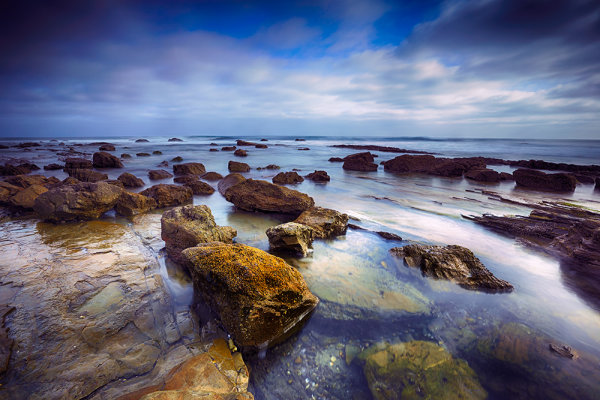
For this image, I used a 4-stop hard-edged ND grad to hold back the sky.  I also used a 5-stop ND filter to slow the exposure enough to get the water silky smooth. 6 seconds, f/16, ISO 100. EOS 5D Mark III with EF 16-35mm f/2.8L II.

For this image, I used a 4-stop hard-edged ND grad to hold back the sky. I also used a 5-stop ND filter to slow the exposure enough to get the water silky smooth. 6 seconds, f/16, ISO 100. EOS 5D Mark III with EF 16-35mm f/2.8L II.

As I’ve written before, the hardest part of landscape photography is retaining detail in a bright sky with a darker foreground.  There are several ways to deal with this issue. The newest ways involve various post-processing techniques in Photoshop or Lightroom, or using High Dynamic Range photography to blend several exposures together, retaining both shadow and highlight detail from these exposures.  There is nothing wrong with these techniques, and in fact there are times where these may be the best method for keeping detail in the sky. There are issues with both blending and HDR.  HDR tends to have a very processed look to it when not done well, and blending takes time to do well. I am not one who likes to spend much time in Photoshop with my images.  In addition, you still need to be sure that you somehow capture enough information in the sky that you are not simply darkening down white pixels.

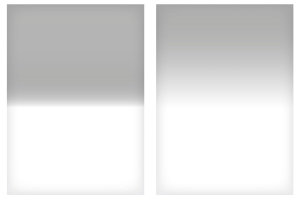
On the left is a 2-stop, hard-edged ND grad.  On the right is a soft-edged 2-stop ND grad.

On the left is a 2-stop, hard-edged ND grad. On the right is a soft-edged 2-stop ND grad.

To ensure you’re capturing enough detail, the use of graduated neutral density filters is needed. Graduated Neutral Density Filters (ND grads, for short), are pieces of glass or photographic resin that are half clear, and gradually gets darker as it moves to the other end.  This darkening begins in the middle of the piece of glass.  First of all, these filters come in two forms.  The first of which is a typical screw-on filter that screws onto the front of the lens. While this style is fine for polarizers or skylight filters, it’s problematic for ND grads, because the horizon can’t be repositioned.  The other way these filters come is in 4×5 or 4×6 inch glass or resin.  These pieces of glass are then placed in holders, and the horizon can be repositioned as needed. The biggest advantage these filters have over the screw-in kind is the fact that they allow you freedom of composition to put the horizon where you want.   The most popular holders and systems for this type of filter are the Cokin systems, which come in various sizes, and the Lee system, which typically accepts a 4″ wide filter.  The Cokin systems tend to be a bit cheaper both in terms of cost of the holder and cost of the filters.  The Lee system is a bit more expensive on both fronts.

Once you’ve decided on which system to use, there is then the choice of which ND grads to choose. There are several companies that manufacture these filters, from  Cokin for their systems, to Lee, to to Formatt Hi Tech, to Schneider Optics, among others.  The prices vary, depending on whether you’re buying photographic resin or glass.  Resin filters tend to be cheaper while glass is most expensive. Resin doesn’t break when dropped but can scratch more easily than glass does. ND grads are available in various densities, including  2 stops, 3 stops, and 4 stops.

The selection doesn’t stop there, however. In addition to choosing which density you need, you also must choose how gradual the density is. Graduated neutral density filters come in both hard-edge and soft-edge graduations.   You would use hard-edge filters when you have a clear horizon and no object in the foreground intersects it.  You would use soft-edged filters when there is an object that intersects the horizon.  Soft-edge filters have a much smoother gradation, which allows it to look more natural when used in a photo.  A hard-edged filter will create a more definitive line between light and dark in the image.

These filters have become some of the most important tools in my bag when creating landscape photos. If you’re just starting out, get an inexpensive set of filters- there is no “one size fits all” to ND grads.   However, if you can only start with one, I’d suggest a soft-edged three stop ND grad. The hard-edged can be limiting at times, and two stops never seems to be enough on its own.  I often stack ND grads to get the effect I’m looking for.

Happy shooting!

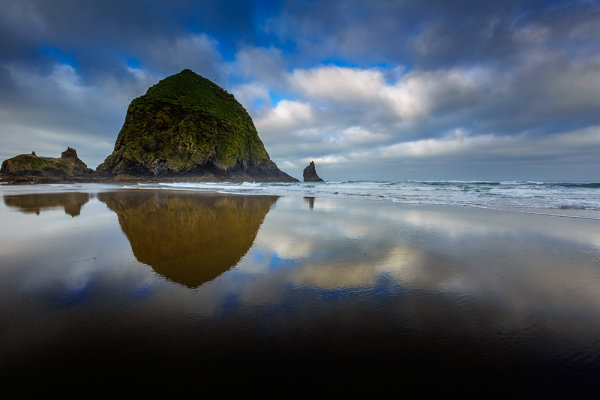
Because Haystack Rock stood above the horizon line, and was quite a bit darker than the sky behind it, I had to use a 3-stop, soft-edged ND grad filter here. 1/20, f/16, ISO 100. EOS 5D Mark III with EF 16-35mm f/2.8L II.

Because Haystack Rock stood above the horizon line, and was quite a bit darker than the sky behind it, I had to use a 3-stop, soft-edged ND grad filter here. 1/20, f/16, ISO 100. EOS 5D Mark III with EF 16-35mm f/2.8L II.

Post originally from: Digital Photography Tips.

Check out our more Photography Tips at Photography Tips for Beginners, Portrait Photography Tips and Wedding Photography Tips.

The Basics of Using ND Grads to Improve Your Landscapes


Digital Photography School

 
Comments Off on The Basics of Using ND Grads to Improve Your Landscapes

Posted in Photography