RSS
 

Posts Tagged ‘Glass’

DIY: Make a Stained Glass Window out of Instagrams

04 Mar

Extra photos for bloggers: 1, 2, 3

Ever wish your Instagram feed were more tangible? Like, hanging-from-your-window-tangible?

Well, you’ve come to the right place.

This DIY turns your windows into giant, photo-filled lightboxes that showcase your Instagram masterpieces.

Make colorful stained glass inspired windows to brighten up any space.

Gather up those digital files, or pull out that old box of 35mm slides from your grandparent’s attic.

Finally, a digital-analog way to drape your windows with Kodak moments!

Turn Your Windows into Giant Lightboxes

p.s. Attention Android party people – we’re ready for ya! You can *Enroll in Phoneography 101* – our guide to taking primo pics on your phone.

Why it’s cool:

ingred-smShiny colorful reflections that change throughout the day? Yes, please.

This funky slide curtain adds interest to any room.

Channel harsh sunlight through all the Kodachrome colors and Instagram filters, and even keep passers-by at bay.

Although, you may actually find a crowd hovering outside your door to look at your photographic treasures.

But hey, can you blame them? They are pretty awesome.

Oh, did we mention these are completely removable and damage-free? Sweet!

Ingredients:

paint-sm

  • For a digital option: Instagrams printed onto transparencies
  • For an analog option: 35mm slides, lots of them. See step one for amount.
  • Archival Slide Sleeves
  • Scissors
  • Super Glue
  • Scotch Tape
  • Small, removable plastic hooks. We used these 3M Hooks

STEP 1: Measure:

paint-smFirst, measure the space you want to cover with your curtain. For both the digital and analog version of this project, you’ll be working with 8.5″x11″ transparency pages or sleeves.

Each sheet, whether digital or analog, will hold 20 2″x2″ images.

To figure out how many slides/images we were going to need, we did a little math. You can also physically layout the sheets to visualize what this will look like.

The door we covered was 22″ wide, and 62″ high.

We measured that 2 sheets wide would cover the width. It needed 7 sheets down to cover the length. That made 14 sleeves we would need to fill with images. Since each sleeve holds 20 images, our final count was 280 images.

We’re starting with the digital version. If you are working with slides, skip to step 5.

Step 2: Digital Layout:

paint-smUse an editing software like Photoshop or Gimp to create a digital layout for your images.

Size your images to 2″ by 2″.

Copy and paste your photos into a new document that is 8.5 x 11″.

Space them out to create a grid that fits 4 images across by 5 images down.

Here’s a video that will help you figure out how to make a grid.

Repeat this step until you have the desired number of pages to cover your window.

Step 3: Digital Prints:

paint-smOnce your grids are finished, print them out on transparency pages.

You can pick these up at any office supply or art store. Just make sure they are compatible with your printer.

You could also take your files to a local copy shop and have them print on transparency for you.

Either way is fine, just print those bad boys out!

Step 4: Digital Trim:

paint-sm Sometimes the transparency will have a larger edge on the top and bottom.

If so, trim your pages to have even borders, around a half an inch wide.

Lay them out in the order you want them to be hung.

Now, skip down to step 8.

Step 5: Analog Layout:

paint-sm Now, layout your sheets on a table.

Make sure the opening where you’ll place your slides in each sheet are either at the top or side of the curtain. If they’re at the bottom, your slides could fall out.

Line them up so that they are all facing the same direction. This will help you keep track of how to glue them together in later steps.

Step 6: Analog Trim:

paint-sm In this step, you’re going to remove the white label and three hole punch from all of the sheets except the top row.

Take your scissors, and carefully trim as close to the white label as possible.

After you’ve cut one sheet, put it back in its place in the layout and move on to the next one.

TIP: You want to remove the label and holes from each sheet, but leave enough plastic to glue the sheets together.

Step 7: Analog Align:

paint-sm Again, double check that you are putting your sheets back together in a consistent manner.

You want all the openings to be facing the same direction.

Also make sure the openings are all on the same side of each sheet.

Step 8: Glue:

paint-smStart gluing the sheets of one column together.

Take the very top piece, the one with the holes and white label still attached, and place a thin line of glue along the bottom edge.

Carefully line up the sides of the next piece, and glue them together.

Press and hold for 30 seconds.

Repeat this step for the rest of the sheets.

Let the glue fully dry for 10 minutes.

TIP: We found it easiest to glue on column at a time. Start with the left side, and work top to bottom. Then do the same with the right side.

Step 9: Join:

paint-sm Once the glue has dried, it’s time to join the columns.

Line them up next to each other.

Place a line of glue on the edge of one column, and press the other column in place.

Let it dry for another 10 minutes.

TIP: It may help to temporarily tape them together to make sure they stay aligned while you’re gluing.

Step 10: Fill:

paint-smNow the fun part!

Fill up your curtain with all of your amazing slides.

You can make patterns of color, place images chronologically, or make any funky design you want.

You digital creators won’t need this step. Go ahead and skip this step.

Step 11: Place Hooks:

paint-sm Because we wanted to cover a metal door, we used these clear, removable 3M hooks on the glass.

But you can use any hanging system you wish.

Depending on your space, a curtain rod with rings might work well, or you might decide to tack it in place.

Either way, measure where to place your hooks, and affix them to your wall or window.

Step 12: Hang:

paint-smNow you see why we left the holes on the top row, eh?

Place the holes of the top row over your hooks.

Ta-da! Time to kick back and enjoy!

Take it further

  • Make a small cluster of framed slides for smaller spaces.
  • These vertical blinds add colored light and move with the breeze.
  • Make a slide light for a colorful display day or night.

Thanks to Design Sponge for the inspiration!

Related posts:

  1. How To Make Instagrams, Hand-made Exposures on Instant Film! Extra photos for bloggers: 1, 2, 3 Did you know…
  2. Turn Your Photos into Beautiful Glass Etchings! Extra photos for bloggers: 1, 2, 3 Before printers spewed…
  3. Glass Jar Frames Extra photos for bloggers: 1, 2 ~Have a cool photo…


Photojojo

 
Comments Off on DIY: Make a Stained Glass Window out of Instagrams

Posted in Equipment


Google demonstrates view behind the Glass wearable camera

21 Feb

R0~TS520x0~cms_posts_8520361839_Screen_Shot_2013-02-20_at_10.22.50_AM.png

Google has announced that its ‘Glass’ interactive head-mounted camera is now available for beta testing. Users who want to get their hands on an early version of the augmented eyewear can apply on social media channels, Google+ or Twitter. The company released a video today to promote the technology, showing what the world looks like through its camera. Read more about the Google Glass and instructions to sign up for beta testing on connect.dpreview.com

News: Digital Photography Review (dpreview.com)

 
Comments Off on Google demonstrates view behind the Glass wearable camera

Posted in Uncategorized


Brick Farmhouse Facade Illusion via Photo-Printed Glass

24 Jan

[ By WebUrbanist in Architecture & Public & Institutional. ]

glass facade

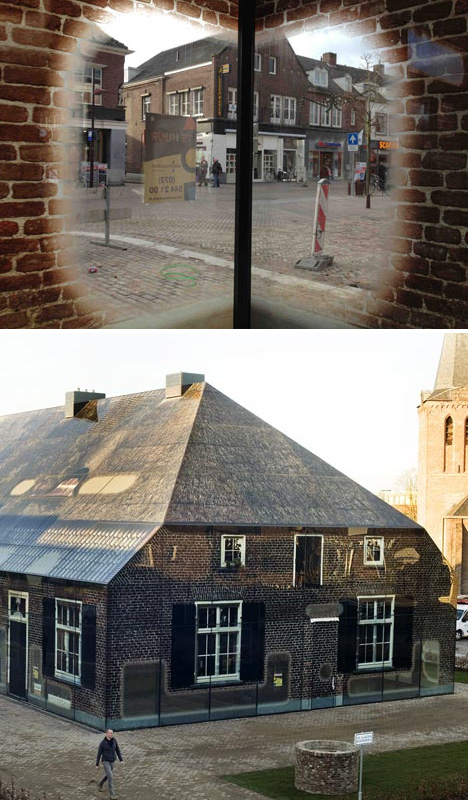
For decades, no one could quite agree on what should go in this critical location between the town hall and central church in war-damaged Schijndel, Holland … until MVDRV showed up with a radical proposal remixing old and new. Their solution: printing local historical-building photographs right onto glass.

glass brick farmhouse illusion

It was agreed that the new structure should respect the original building envelope and regional vernacular without a kitschy attempt at reproducing a false past. Hence, this glazed facade made to look like a traditional thatch-roof brick farmhouse via images provided by photographer Frank van der Salm.

glass town square secret

Window and door openings are given curious treatment, shown as semi-erased visual voids that do not conform to the structure depicted on the printed-glass surfaces. Close up, they provide useful cues to pedestrians – at a distance, they simply blend into the building or hide among reflected architecture.

glass mvrdv architecture project

Inside this so-called Glass Farm envelope, shops, restaurants and offices look back out on the mirror-image translucent farmhouse, providing fascinating interactions both within and without.  Whether or not you love this solution, it raises compelling questions – instead of masquerading as a faux-historical structure, MRVDV’s smoke-and-mirrors approach invites interactions with history via an overlapping combination of illusion, photography, reflection and reality.

Share on Facebook


[ By WebUrbanist in Architecture & Public & Institutional. ]

[ WebUrbanist | Archives | Galleries | Privacy | TOS ]


WebUrbanist

 
Comments Off on Brick Farmhouse Facade Illusion via Photo-Printed Glass

Posted in Creativity


Glass : EVOLUTION : See : FEEL : Beyond : OBVIOUS! Enjoy : the TEXTURE : the lines! :)

18 Jan

Some cool visual art images:

Glass : EVOLUTION : See : FEEL : Beyond : OBVIOUS! Enjoy : the TEXTURE : the lines! 🙂
visual art
Image by || UggBoy?UggGirl || PHOTO || WORLD || TRAVEL ||
Abstract art

Abstract art uses a visual language of form, color and line to create a composition which may exist with a degree of independence from visual references in the world. Western art had been, from the Renaissance up to the middle of the 19th century, underpinned by the logic of perspective and an attempt to reproduce an illusion of visible reality. The arts of cultures other than the European had become accessible and showed alternative ways of describing visual experience to the artist. By the end of the 19th century many artists felt a need to create a new kind of art which would encompass the fundamental changes taking place in technology, science and philosophy. The sources from which individual artists drew their theoretical arguments were diverse, and reflected the social and intellectual preoccupations in all areas of Western culture at that time.

Abstract art, nonfigurative art, nonobjective art, and nonrepresentational art are loosely related terms. They are similar, although perhaps not of identical meaning.

Abstraction indicates a departure from reality in depiction of imagery in art. This departure from accurate representation can be only slight, or it can be partial, or it can be complete. Abstraction exists along a continuum. Even art that aims for verisimilitude of the highest degree can be said to be abstract, at least theoretically, since perfect representation is likely to be exceedingly elusive. Artwork which takes liberties, altering for instance color and form in ways that are conspicuous, can be said to be partially abstract. Total abstraction bears no trace of any reference to anything recognizable. In geometric abstraction, for instance, one is unlikely to find references to naturalistic entities. Figurative art and total abstraction are almost mutually exclusive. But figurative and representational (or realistic) art often contains partial abstraction.

Both Geometric abstraction and Lyrical Abstraction are often totally abstract. Among the very numerous art movements that embody partial abstraction would be for instance fauvism in which color is conspicuously and deliberately altered vis-a-vis reality, and cubism, which blatantly alters the forms of the real life entities depicted.
EXPLORE MORE AND SOAR:
WIKIPEDIA = ABSTRACT = TO THE WORLD

Thoughts about abstract…….forms…….

As you see, I do not treat the creation of fiction, that to say the invention and development of fantasies, as a form of abstract thought. I dont wish to deny the uses of the intellect, but sometimes one has the intuition that the intellect by itself will lead one nowhere.
—J. M. Coetzee

Some more……..

Delight at having understood a very abstract and obscure system leads most people to believe in the truth of what it demonstrates.
—Georg C. Lichtenberg

Please MORE EXPLORE……..

Evil is the product of the ability of humans to make abstract that which is concrete.
—Jean-Paul Sartre

Flower : EVOLUTION : See : FEEL : Beyond : OBVIOUS! Enjoy : the TEXTURE : the lines! 🙂
visual art
Image by || UggBoy?UggGirl || PHOTO || WORLD || TRAVEL ||
Abstract art

Abstract art uses a visual language of form, color and line to create a composition which may exist with a degree of independence from visual references in the world. Western art had been, from the Renaissance up to the middle of the 19th century, underpinned by the logic of perspective and an attempt to reproduce an illusion of visible reality. The arts of cultures other than the European had become accessible and showed alternative ways of describing visual experience to the artist. By the end of the 19th century many artists felt a need to create a new kind of art which would encompass the fundamental changes taking place in technology, science and philosophy. The sources from which individual artists drew their theoretical arguments were diverse, and reflected the social and intellectual preoccupations in all areas of Western culture at that time.

Abstract art, nonfigurative art, nonobjective art, and nonrepresentational art are loosely related terms. They are similar, although perhaps not of identical meaning.

Abstraction indicates a departure from reality in depiction of imagery in art. This departure from accurate representation can be only slight, or it can be partial, or it can be complete. Abstraction exists along a continuum. Even art that aims for verisimilitude of the highest degree can be said to be abstract, at least theoretically, since perfect representation is likely to be exceedingly elusive. Artwork which takes liberties, altering for instance color and form in ways that are conspicuous, can be said to be partially abstract. Total abstraction bears no trace of any reference to anything recognizable. In geometric abstraction, for instance, one is unlikely to find references to naturalistic entities. Figurative art and total abstraction are almost mutually exclusive. But figurative and representational (or realistic) art often contains partial abstraction.

Both Geometric abstraction and Lyrical Abstraction are often totally abstract. Among the very numerous art movements that embody partial abstraction would be for instance fauvism in which color is conspicuously and deliberately altered vis-a-vis reality, and cubism, which blatantly alters the forms of the real life entities depicted.
EXPLORE MORE AND SOAR:
WIKIPEDIA = ABSTRACT = TO THE WORLD

Thoughts about abstract…….forms…….

As you see, I do not treat the creation of fiction, that to say the invention and development of fantasies, as a form of abstract thought. I dont wish to deny the uses of the intellect, but sometimes one has the intuition that the intellect by itself will lead one nowhere.
—J. M. Coetzee

Some more……..

Delight at having understood a very abstract and obscure system leads most people to believe in the truth of what it demonstrates.
—Georg C. Lichtenberg

Please MORE EXPLORE……..

Evil is the product of the ability of humans to make abstract that which is concrete.
—Jean-Paul Sartre

 
Comments Off on Glass : EVOLUTION : See : FEEL : Beyond : OBVIOUS! Enjoy : the TEXTURE : the lines! :)

Posted in Photographs


Aerial Silks at the Museum of Glass

17 Jan

A rough sketch of the “Abandoned Bride” concept silks act, the final version of which was performed October 24-25, 2008 with Pendulum Aerial Arts in Portland, OR. Check out their website: www.pendulumaerialarts.org Sorry for the choppy video quality, it’s the fast-edit version. Music by Tosca Tango Orchestra from the soundtrack to “Waking Life” Special thanks to Julie Pisto and the Museum of Glass Leslie Raimer and Vertigo Rigging Videographer Basil Shadid Photographer Stacy Jacobsen and James Torchia
Video Rating: 4 / 5


Matt Glass – Spurious Cultist – photo shoot 1

05 Jan

A behind the scenes video of an art project I’m working on. It will consist of photographs, videos and more. www.SpuriousCultist.com filmed by Cynthia Loveland and Matt Glass(me). music by The Bees (Band of Bees) and The Beach Boys.
Video Rating: 5 / 5


Corey Taylor (Through Glass)

25 Dec

Song: Through Glass Filmed: 11/15/11 at the Crescent Ballroom in Phoenix, AZ by Derrell Stanfield (I Sight Videography and Photography)
Video Rating: 4 / 5


How To Remove Infinity Focus Glass From Canon FD To Nikon Adapter

20 Nov

annnd heres the vid on how to remove the infinity focus glass from this canon fd to nikon adapter. like i said, it should work with other adapters that have a similar design ^_^
Video Rating: 5 / 5

 
Comments Off on How To Remove Infinity Focus Glass From Canon FD To Nikon Adapter

Posted in Nikon Videos


Hoopoe – 3D (red & blue/cyan glass needed)

04 Nov

Start your 3D movie in style with our free universal 3D Film Leader in sepia. 3D Movie Countdown – Free Download – Old Black & White Film Style Download it free now from www.enhanced-dimensions.com +++++++++++++++++++++++++++++++++++ Enhanced Dimensions is a blog dedicated to all things stereoscopic 3D. +++++++++++++++++++++++++++++++++++ FREE – 3D VIDEOS & IMAGES Get FREE 3D Videos, 3D Birthday Cards, 3d Desktops and much more from enhanced-dimensions.com/wordpress FREE -LEARN HOW TO MAKE 3D VIDEOS FOR YouTube & YT3D Learn to create stereoscopic images, Stereo 3-d videos, or to convert 2d to 3d movies at enhanced-dimensions.com/wordpress for comprehensive free stereoscopic tutorials. Adobe After Effects 3D – Adobe Photoshop 3D – Adobe Premiere 3D — For more info on Enhanced Dimensions: Contact us on 3d@enhanced-dimensions.com — +++++++++++++++++++++++++++++++++++ The Stereoscopic 3D Video Channel is an online 3D TV channel dedicated to showing the best in creative stereoscopic 3D videos and 3d animations. +++++++++++++++++++++++++++++++++++ The Stereoscopic 3D Video Channel on YouTube www.youtube.com The Stereoscopic 3D Channel on Vimeo vimeo.com/channels/stereoscopic3d The Stereoscopic 3D Channel TESTBED on Vimeo vimeo.com/groups/steroscopic3dchanneltestbed +++++++++++++++++++++++++++++++++++ This video was built and tested using Cyan Red 3D Glasses in Adobe After Effects. A 3D Stereoscopic Production for Enhanced Dimensions by Andrew Murchie.
Video Rating: 4 / 5

 
Comments Off on Hoopoe – 3D (red & blue/cyan glass needed)

Posted in 3D Videos


3d video glass needed

25 Oct

More 3D goo.gl This is a 3d video i made with two high definition video cameras.i put the cameras about 3 inches apart.then i used a edit software to make the video 3d.the see the effect put on a pair of red and cyan 3d glasses.cyan is a light blue color.dont use real d 3d glasses or red and green or yellow and blue glasses only red and cyan will work. about this video this 3d video i took a hand cake mixer and stick it out of your pc monitor and turn it on.wile its spinning i move it around in front of your nose.so dont flinch or your nose will get cut off.then at the end i accedently rip off your t shirt with the cake mixer lol. Never before seen 3D www.3dtv.com FREE 3D Glasses: www.3dn3d.com 3D SHOP: www.the3dshop.net 3D Facebook: www.facebook.com View cool 3D Photos: www.3dn3d.com LIKE ME: www.facebook.com Follow ME: twitter.com
Video Rating: 3 / 5

 
Comments Off on 3d video glass needed

Posted in 3D Videos