RSS
 

Posts Tagged ‘gear’

Gear of the Year 2018 – Allison’s choice: Google Photos

28 Dec

At some point in elementary school my sister was required to study San Francisco, which – if you’ve only ever lived in the Midwest – is a far-off, exotic city. She took an interest in the place, and over the dinner table she’d rattle off facts about the city, like how many hills there are (seven) and how many mosquitos there are (none). In contrast to our part of the country, an extremely flat, mosquito-riddled hellscape, San Fransisco seemed like almost a mythical place.

Jumping ahead a few years, my sister was on the verge of turning thirty, and we decided to celebrate with a trip to the destination of her choice. Naturally, San Francisco was at the top of the list. At last, she’d finally get to experience the seven mosquito-free hills for herself.

In four days we covered most of the standard stuff – the bridge, the prison, the endless souvenir gift shop that is the Fisherman’s Wharf. We drank Irish coffees at the cafe that claims to have invented them (but probably didn’t), ate avocado toast at the place that claims to have invented it (and probably did), and took a lot of selfies in front of iconic things.

Our technique on this kind of shot needs work, but you get the idea.

During the course of the trip, we documented our adventure the way most older millennials do: on our phones. When we returned to our respective homes, she requested that I add my photos to a shared Google Photos album so she could show our mother over dinner. I already backup my iPhone photos to the Google Photos app, so that was easy enough to do.

I also wanted to show the Alcatraz photos to my boyfriend (disused prisons are his thing) but flipping through them on my phone clearly wasn’t going to do them justice. Then I remembered the Chromecast plugged into the back of our TV, and within a few minutes I had a good old fashioned “How I Spent my Summer Vacation at a Former Federal Penitentiary” slideshow going.

To commemorate the whole trip, it occurred to me that a photo book might make a nice birthday present for my kid sister. And at this point, the whole thing starts to sound like a commercial for Google Photos: I selected images, added a title and text, paid for and shipped the whole thing from my phone while commuting to work on the bus. I didn’t even need to get out my wallet, because Google remembers my credit card number.

Here’s the thing: having the device I use to capture the images integrated into an ecosystem designed for sharing actually is really useful. My photos from that trip didn’t die on a hard drive – they came to life. And sure, my iPhone SE takes some pretty lousy photos in low light. But you know what? They’re fine. Nobody I showed them to complained about detail retention. And I wasn’t looking to blow them up and put them on my wall, I just wanted to remember a trip that was about hanging out with my sister.

There’s still room for improvement – the Assistant feature continues to be a mixed bag of sometimes nice, sometimes ridiculous AI-generated albums, videos and “stylized” photos. At least it does a good job of auto-suggesting items to archive, like screengrabs and pictures of packaged dinner re-heating instructions. But really, it’s fine because it’s not a core feature – anything useful the Assistant does is basically a bonus.

An automatically generated “stylized” photo courtesy of Google Photos Assistant. Just… no.

I think what impresses me most is that I didn’t at any point decide “Alright, I’m going to go all in on the Google ecosystem.” It just happened organically. I didn’t think I was the kind of person who would want to play a summer vacation slideshow on her TV – until I was. When the technology is seamless and available at your fingertips, it turns out you’re more likely to use it. And if that means more people doing more to share their photos, then that’s enough for me to call Google Photos my gear of the year.

Articles: Digital Photography Review (dpreview.com)

 
Comments Off on Gear of the Year 2018 – Allison’s choice: Google Photos

Posted in Uncategorized


Gear of the year – Carey’s choice: Panasonic GX9

27 Dec

The Panasonic Lumix DC-GX9 is one of those rare cameras that seems to be more than the sum of its parts. It’s not a market leader in any specific area, it’s not particularly inexpensive, and I’ve used and reviewed cameras that offer objectively better results than the GX9 is capable of. And yet, there’s something about its combination of features, build, form factor, image quality and controls that make it a camera I really enjoy using and want to carry around with me wherever.

Maybe most importantly, I think this is the first Panasonic camera I’ve truly felt this way about.

‘They’ve got a great personality’

Out-of-camera JPEG.
ISO 200 | 1/1250 sec | F2.8 | Lumix G Vario 35-100mm F2.8

That’s a phrase that isn’t exactly positive in the dating world, but bear with me – we’re talking about cameras, after all. There are subtleties and intangibles – ‘personalities’ – cameras have about them that can impact how they make a photographer feel. And while Panasonic has made some mighty fine cameras over the past few years, I’ve never really felt that emotional pull to pick them up and go out shooting just for fun.

Back when the Panasonic GX85 came out, I thought that was the one. That was the Panasonic camera that I’d want to pick up and take with me, even if I’m just going out for a bite to eat. But there were some issues with that camera – one issue specifically – that really turned me off, but Panasonic has addressed them in the GX9, and then some.

Enough already, what’s so good about it?

Out-of-camera JPEG.
ISO 200 | 1/500 sec | F5 | Panasonic Leica 15mm F1.7

First of all, my hat is off to the folks at Panasonic for their work on the JPEG engine. When I started at DPReview, I hadn’t been fond of Panasonic colors, particularly the skin tones, and while the noise reduction did a so-so job of reducing noise, it did a tremendous job at smearing away detail. This was the single biggest issue I had with the GX85, honestly.

I’m happy to say that’s no longer the case. Even just previewing images on the rear of the camera, I can see that the color out of the standard picture profile is rich, warm and doesn’t render my friends as green-skinned zombies. Plus, the shadowy regions of my images no longer look like mush.

This all means I’m likely to transfer images to my phone without needing to process Raws (though the GX9 can do that in-camera), and then post straight away to social media or send them to a friend. And the less processing I need to do, the more images I’m going to take.

Beyond that, I’m really happy to see the return of the addictive tilting viewfinder, though it’s a tad small. The controls aren’t quite as customizable as some competitors’, but the highly customizable touchscreen makes up for this somewhat. And personally, I prefer the tilting screen mechanism on the GX9 to fully articulating screens on other models. And when the screen is tilted out, the eye sensor disables so you don’t accidentally trip it when shooting from the waist. Why this still isn’t standard practice, I have no idea.

But it only got a silver award!

Obligatory angry cat photo. Out-of-camera JPEG.
ISO 1600 | 1/60 sec | F1.7 | Panasonic Leica 15mm F1.7

I know, I know. I was the lead reviewer for the GX9, and after all this gushing, I still only gave it a silver. But remember at the top, how I said it wasn’t a market leader in any particular way, and wasn’t particularly inexpensive? Then, consider that cheaper competition can often give you better outright image quality.

And even though the awards are weighted more toward subjective rather than objective criteria – that was all just too much for me to ignore. Bam, silver award.

But there are a few other considerations I’d like to see addressed in the GX9’s successor. First of all, enough with the field sequential electronic viewfinder. Second, this camera launched at $ 999 with a kit lens – for that price, I expect a dedicated battery charger in the box, particularly with battery life this limited (though USB charging is handy for topping up on the go).

Lastly, if you’re one of those folks that love Panasonic for their video chops, the GX9 is not the camera for you. It’s not really geared for hardcore videophiles, but even for casual shooters, it’s disappointing to see the newer model step backward in video capability with a 1.2x crop compared to the GX85.

The wrap

Out-of-camera JPEG.
ISO 200 | 1/80 sec | F2.8 | Lumix G 20mm F1.7 II

In the end, the GX9 is very capable camera. It’s not necessarily the sort of camera I’d be eyeing for high-end, paid professional gigs – though I’m sure the GX9 could handle them in a pinch – but it is the sort of camera that I enjoy for personal, casual photography. It’s also something I would absolutely recommend as a second body for more established shooters wanting a smaller package.

More to the point, I also think the GX9 is a good sign for Panasonic going forward. They tried splitting the GX lineup in two with the high-end GX8 and midrange GX85, but then decided that wasn’t working, and quickly iterated to come up with a fantastic middle-ground in the GX9. I personally appreciate that level of responsiveness, and in my opinion, the GX9 really is the best of both worlds for those cameras. Well, almost.

For the last time – let’s ditch the field sequential viewfinder.

Sample gallery

$ (document).ready(function() { SampleGalleryV2({“containerId”:”embeddedSampleGallery_5058069396″,”galleryId”:”5058069396″,”isEmbeddedWidget”:true,”selectedImageIndex”:0,”isMobile”:false}) });
Articles: Digital Photography Review (dpreview.com)

 
Comments Off on Gear of the year – Carey’s choice: Panasonic GX9

Posted in Uncategorized


Gear of the year 2018 – Jeff’s choice: Nikon Coolpix P1000

26 Dec

The evolution of the super zoom camera that resulted in the Nikon Coolpix P1000 reminds me of the development of rollercoasters over the last twenty years. Every year, amusement parks would try to out-do the competition. Bigger drops. More inversions. Faster speeds. Sitting, standing, flying. At some point you just can’t go any further without putting riders in danger.

The Coolpix P1000 won’t put anyone in danger (I hope!), but it does symbolize the culmination of manufacturers trying to make their cameras harder, bigger, faster, stronger (with apologies to Daft Punk). I’ve been in the digital camera business since the beginning and recall when breaking the 10X zoom barrier was a big deal.

Out of camera JPEG | ISO 110 | 1/400 sec | F6.3 | 1700mm equiv.
Photo by Jeff Keller

After manufacturers seemed to pause at 50X zooms, Nikon went for broke with its Coolpix P900, which had an 83X lens that topped out at 2000mm equivalent. When Nikon first told us about the Coolpix P1000, with its 125X, 24-3000mm equiv. lens, I didn’t know how to respond. I do, however, recall thinking “wow… but why?”.

After getting my hands on a P1000, my initial feelings were unchanged: it’s cool, but why does one need so much zoom? The P1000’s lens is so prominent that the camera got attention everywhere it went, whether at a wildlife refuge, the zoo or a random tourist attraction in Vancouver, where a man walked up to me and asked, “is that a P1000?”. (Turns out he was a DPReview fan and knew his stuff.)

The people to whom I showed the camera weren’t asking about sensor size, viewfinder resolution or video. They wanted to see that lens could do. So, I’d have them point it toward an object in the distance or, in the case of the zoo, at a monkey that could barely be seen with the naked eye, to see for themselves. It’s a great party trick.

Out of camera JPEG | ISO 560 | 1/400 sec | F7.1 | 2600mm equiv.
Photo by Jeff Keller

I spent over a month shooting with the Coolpix P1000 while writing its review and grew to really enjoy using it for the same reason as those who asked me about it: the lens, and what it could do. During those weeks I took photos of zoo animals, birds, cruise ships and, of course, the moon. It felt a bit awkward crossing paths with other photographers at a nearby bird refuges who were each carrying two high-end DSLR bodies, with huge telephoto lens attached, while I was holding a ‘Coolpix’ that had a much longer focal range. What I’m getting at here is that the P1000 inspired me to take photos that I never would (or could).

While shooting around with the P1000 was a blast, I usually had to make a decision about whether I wanted to haul it around with me. The camera weighs over 1.4 kg (3 lbs), so if I didn’t think that I needed a lot of zoom (which was most of the time,) the P1000 stayed home. The P1000 also taught me that, despite owning what I thought was a good tripod, I needed something much more robust, since the camera is so front-heavy that my tripod head would slowly tilt downward. My first attempt at moon photos were essentially timed for the moment when the moon entered the frame as the tripod sagged.

Out of camera JPEG, cropped to taste | ISO 180 | 1/500 sec | F6.3 | 1800mm equiv.
Photo by Jeff Keller

One downside of a lens as long as the P1000’s is that atmospheric distortion is a problem. You could easily see ‘waves of haze’ in my long telephoto shots, but I reminded myself that even the most expensive telephoto lens would see the same. The camera’s noise reduction system exacerbates the problem, turning distant subjects into an impressionist painting. And, despite having Raw support, the P1000’s small sensor didn’t give me a lot of detail to work with.

Out-of-camera JPEG | ISO 100 | 1/500 sec | F5.6 | 1300mm equiv.
Photo by Jeff Keller

Ultimately, none of that mattered. I wasn’t shooting for National Geographic, I was shooting for me. And these days, that means social media rather than 11″ x 17″ prints on my wall. Would I take it on a trip to Southeast Asia or a night out on the town? Certainly not. But would I go somewhere in the Pacific Northwest to photograph things that I normally wouldn’t? You bet.

Articles: Digital Photography Review (dpreview.com)

 
Comments Off on Gear of the year 2018 – Jeff’s choice: Nikon Coolpix P1000

Posted in Uncategorized


The dPS Top Photography Gear Tips of 2018

26 Dec

The post The dPS Top Photography Gear Tips of 2018 appeared first on Digital Photography School. It was authored by Caz Nowaczyk.

This week on dPS we’re featuring some of the top articles in different categories that were published on the site over 2018.

Yesterday, we gave you The dPS Top All-Round Photography Tips of 2018.

This one is all about the best Camera Gear Tips of the year.

Here are the top Camera Gear tips articles of 2018:

1. Photography Equipment Comparisons – Entry-Level Versus High-End Gear Does it Matter?

Photography Equipment Comparisons – Entry-Level Versus High-End Gear Does it Matter?

2. 8 Amazing Photography Tricks You Can Do With a High-Speed Camera Trigger

8 Amazing Photography Tricks You Can Do With a High-Speed Camera Trigger

3. 5 Reasons to Use Prime Lenses For Better Photos

5 Reasons to Use Prime Lenses For Better Photos

4. Why Your Camera Gear Doesn’t Matter

Why Your Camera Gear Doesn’t Matter

5. Which Size Lensball is Best for Crystal Ball Photography?

Which Size Lensball is Best for Crystal Ball Photography?

6. 4 Great Pieces of Camera Equipment to Help You Get Creative

4 Great Pieces of Camera Equipment to Help You Get Creative

7. 4 of the Best Lenses for Creative Dog Photography

4 of the Best Lenses for Creative Dog Photography

8. How to Use ND Filters Creatively to Make the Most of a Scene

How to Use ND Filters Creatively to Make the Most of a Scene

9. Review of the Nikon D850 DSLR

Review of the Nikon D850 DSLR

10. The First 10 Things You Need to Buy After Your Camera for Travel Photography

The First 10 Things You Need to Buy After Your Camera for Travel Photography

11. Five Budget Portrait Photography Hacks to Save You Money

Five Budget Portrait Photography Hacks to Save You Money

12. Why I Always Use an L-Plate Bracket for Landscape Photography

Why I Always Use an L-Plate Bracket for Landscape Photography

13. How to Choose the Best Portrait Lens According to Three Professional Photographers

How to Choose the Best Portrait Lens According to Three Professional Photographers

14. Camera Comparison of 3 Popular Nikon Models: D750 – D7100 – D5100

Camera Comparison of 3 Popular Nikon Models: D750 – D7100 – D5100

15. Wide-Angle Versus Telephoto Lenses for Landscape Photography

Wide-Angle Versus Telephoto Lenses for Landscape Photography

Next up, we’ll show you The dPS Top Post-Processing Photography Tips of 2018.

The post The dPS Top Photography Gear Tips of 2018 appeared first on Digital Photography School. It was authored by Caz Nowaczyk.


Digital Photography School

 
Comments Off on The dPS Top Photography Gear Tips of 2018

Posted in Photography


Gear of the Year 2018 – Dan’s choice: Tamron 28-75mm F2.8 Di III RXD

24 Dec

My past Gear of the Year choices – the Nikon D750, DJI Mavic Pro and Sony a9 – were based on the strong emotional connection I made with each, as a photographer and videographer during the given year. This year I’ve picked the Tamron 28-75mm F2.8, a lens I’ve recommended more than any other in 2018 and one Sony desperately needed for its system.

It’s the first third-party zoom for Sony E-mount to offer autofocus and it plays nice with all AF modes; even Eye-AF. It’s also the piece of gear in the DPReview cupboard I’m most excited to get out and shoot with once Seattle’s weather turns.

The Tamron 28-75mm F2.8 is a lens I’ve recommended more than any other in 2018

Last year’s pick, the a9, was an admission that I’ve finally come around to enjoying Sony’s cameras. But for me as a reviewer, a camera brand is only as good as its best budget lens options. In my opinion, Sony (in common with quite a few other brands) has done a poor job ensuring budding photographers on a tight budget have access to affordable, fast zooms.

ISO 200 | 1/60 sec | F8 | 28mm
Photo by Carey Rose

At $ 800, the 28-75mm F2.8 isn’t exactly cheap, but it does offer a-single-lens-solution to new E-mount customers and is a great companion to the a7 III – for about $ 2800 total, you’ve got a killer combo. It also makes Sony’s own 24-70mm F4, which costs about the same, seem irrelevant.

But the price is not the only thing Tamron got right: it nailed the size and weight, too. Sony’s F2.8 zooms tend to be large and heavy: the $ 2200 24-70mm F2.8, for instance, weighs 886g, compared to 550g in the Tamron. Size-wise, the Tamron is also much smaller, about the same size as a can of soda pop (until you zoom, that is).

It offers good center sharpness throughout its zoom range and for most photographers, that’s what counts

And just because it’s priced a lot lower than comparable native glass doesn’t mean it’s built with a ‘budget’ mindset. Sure, the body is made of polycarbonate, but it feels and handles like a high-quality piece of gear. It also well-suited to take on the elements: a fluorine coating on the front repels grime and a moisture-resistant construction, including gaskets around the barrel and at the mount, keeps water out.

It can also handle both stills and video capture as well as Sony’s modern full-frame cameras. A ‘Rapid eXtra-silent stepping Drive’ – the RXD at the end of its name – is virtually silent, ensuring accurate focus with no unwanted focus motor sounds in your videos.

It’s the most sensible zoom currently available for E-mount

Now some will argue Sony’s heavier, pricier lenses offer sharper results, nicer bokeh, etc., and honestly, this might be true. But who cares? The Tamron offers good central sharpness throughout its zoom range and for most photographers, that’s what counts. Those who want to spend 3x the cash on Sony’s version can go right ahead, while the rest of us use the Tamron.

ISO 1250 | 1/160 sec | F2.8 | 35mm
Photo by Carey Rose

The Tamron 28-75mm F2.8 my choice for 2018 Gear of the Year because it is a wonderful solution to a problem Sony has long had: the lack of a fast, affordable zoom full-frame zoom. For years, Tamron has concentrated on producing lenses that fill gaps in the market and this might be its most successful to date – there’s a reason it was back-ordered months after its launch.

Ultimately, it’s a lens for the many, not the few and in this writer’s opinion, the most sensible zoom currently available for E-mount.

Articles: Digital Photography Review (dpreview.com)

 
Comments Off on Gear of the Year 2018 – Dan’s choice: Tamron 28-75mm F2.8 Di III RXD

Posted in Uncategorized


Gear of the Year 2018 – Barney’s choice: Nikon Z7

24 Dec

This year seems like it went by in a flash (although thinking back to some of the news headlines I’m still tempted to say ‘good riddance’). In the photo industry, 2018 has definitely felt like a year of transitions: not least because this was the year that Canon and Nikon finally entered the full-frame mirrorless market, and in so doing began the slow process of moving beyond their respective legacy EF and F mounts.

Appropriately, perhaps, I sold a lot of camera equipment this year too, including my long-serving/suffering DSLR and several lenses. It’s always hard to say goodbye to gear, but there’s no point keeping expensive cameras and lenses around if they’re not getting used. The end result is that without a ‘main’ camera to reach for I’ve been feeling a little transitional myself. Of course I’m lucky that I can raid the DPReview gear cupboards when I need to, but more often than not I’ve been grabbing one of my old film cameras when I want to go out shooting. Sometimes I’ll even remember to grab a roll of film, too.

But enough about me – let’s talk about me!

My pick for Gear of the Year is the Nikon Z7, which is actually one of the few digital cameras released in the past 12 months that I’ve enjoyed spending any significant amount of time shooting with. That doesn’t mean I’m writing about it by default, just because I can’t think of anything else – far from it. For the kind of photography that I do, it’s close to being the perfect camera.

When the light gets low, the Z7’s autofocus system can start to struggle. Usually, though, if you can point it at a contrasty line or point of light (like the frames of the windows reflecting the sunset in this shot) it’ll lock on just fine.

My preferred style of photography (“interesting boring” to quote a friend whose opinion I don’t remember asking) rarely stresses any camera’s continuous autofocus system. I actually shoot manual focus lenses much of the time, and I almost never need to fire off images faster than 1-2 frames per second. As such, two of the major shortcomings of the Z7 are pretty much irrelevant to me. I’d love a taller handgrip, but I’ll take the Z7’s rather short, stubby one for the sake of a smaller and lighter body. Ditto a single card slot.

Speaking as someone who lugged a D850 (my favorite camera of last year) up and down four mountains in a day in 90+ degree heat in Japan this August,* I can tell you that the Z7 is a very pleasant traveling companion by comparison. And shooting the production of a music video back in August, coming from a D810/D850 I was very impressed by how easy the Z7 was to get to grips with, too, even without an instruction manual (the camera was still strictly embargoed at the time and the manuals were still being translated).

It’s only been very recently that electronic finders have started to compete with the best DSLRs in terms of sharpness and responsiveness

Jumping back to earlier in the summer, when Nikon first briefed us on its then-unnamed camera, it was clear that the company’s engineers had set some pretty tough internal benchmarks for what became the Z7. One of those was image quality, and another was the viewfinder experience – both of which had to be comparable to the D850. I’ve never been particularly nostalgic about the optical viewfinders in DSLRs – the sooner they’re replaced by good EVFs the better in my opinion. But note my use of the crucial word ‘good’ in that last sentence. It’s only been very recently that electronic finders have started to compete with the best DSLRs. The Z7’s EVF is one of the sharpest and most detailed out there. So sharp and detailed, in fact, that I often find myself forgetting that its electronic at all, except in really high-contrast situations.

Ruby Beach, on the Olympic Peninsular, a few hours’ drive west from Seattle. Shot with the compact Z 24-70mm F4, this shot demonstrates the lens’s high contrast and almost clinical sharpness.

Where I tend to run into the Z7’s limitations, though, is with low-contrast subjects in subdued light when, even in AF-S mode, its autofocus system becomes… let’s say… unpredictable. If you’ve ever used first-generation Nikon AF systems such as those found in the likes of the F/N90X and F4, you’ll be familiar with the need to find a bright point of light or a contrasty line or something around the desired plane of focus for the AF system to lock onto. If you can’t find one, good luck and happy hunting. Literally.

Fortunately, the Z7’s EVF remains sharp and contrasty even in poor light, so if autofocus gives up completely I just pop it into magnified manual focus mode and do things the old fashioned way. The effort is usually worth it, especially with the 35mm F1.8, which – while it might not have the nicest bokeh around – is sharp enough for landscape work at F1.8.

Another shot taken with the 24-70mm, in Japan. At F13 (for the sunstar) diffraction is taking a bite out of critical sharpness.

In fact, Nikon appears to have designed all three of the new ‘S’ lenses for optimal sharpness, with admirable success. The result is images which are phenomenally detailed across the frame, but lack the pleasant bokeh of certain Nikon and third-party F-mount lenses. Of course, if you have a favorite F-mount lens that you want to use instead, there’s an adapter for that.

Thanks to the built-in stabilization and wide, shallow dimensions of the Z mount, the Z7 has a lot of potential as a 46MP digital back

What I’m most looking forward to, though, is trying out the Z7 with my collection of older third-party primes. High quality adapters from the likes of Novoflex are slowly starting to become available, and thanks to the built-in stabilization and wide, shallow dimensions of the Z mount, the Z7 has a lot of potential as a 46MP digital back. I have a Leica M to Nikon Z adapter on order, and I can’t wait to try out: there’s an uncoated 1936 Leica 50mm Summar on my shelf just crying out for some love…

The Z7 pictured next to one of my personal cameras, a much-used mid-60s F. As you can see, the new Z mount is significantly larger than the old F mount, despite covering the same imaging area. This gives Nikon’s optical engineers a lot more flexibility when designing certain kinds of lenses for the new mount.

Nikon could have played it safe with the Z7, but its engineers decided to aim for high-end and professional photographers and launch the Z7 with their best sensor. It was a risky decision, and I can completely understand why some of the photojournalists I’ve spoken to haven’t taken to the Z7. Without a doubt, its autofocus isn’t on a par with the D850 or D5, particularly in dull, low-contrast conditions. Speaking to wildfire photographer Stuart Palley recently, it’s obvious that Nikon has some work to do before he’ll feel comfortable leaving his DSLRs at home. But while the Z7 isn’t quite the ‘mirrorless D850’ that we had hoped for, it’s close enough for me. I think I might buy Stuart’s.

Nikon Z7 Sample Gallery

$ (document).ready(function() { SampleGalleryV2({“containerId”:”embeddedSampleGallery_4819511289″,”galleryId”:”4819511289″,”isEmbeddedWidget”:true,”selectedImageIndex”:0,”isMobile”:false}) });

* Impressed? I think I was trying to prove a point about how much of a pain DSLR photography is, with the intention eventually of writing an article about it. I suppose this is that article. [Return to text]

Articles: Digital Photography Review (dpreview.com)

 
Comments Off on Gear of the Year 2018 – Barney’s choice: Nikon Z7

Posted in Uncategorized


Gear Review: Fujifilm 50-140mm vs 55-200mm

23 Dec

The post Gear Review: Fujifilm 50-140mm vs 55-200mm appeared first on Digital Photography School. It was authored by Suzi Pratt.

One of the biggest questions all Fujifilm X-Series users have to contend with is, “which telephoto zoom lens should I buy?” Luckily, there are three great Fujifilm X telephoto lenses to choose from:

  • Fujinon XF 18-135mm f/3.5-5.6 OIS WR
  • Fujinon XF 55-200mm f/3.5-4.8 R LM OIS
  • Fujinon 50-140mm f/2.8 OIS

Fujifilm Telephoto Lenses: 50-140mm vs 55-200mm

All three lenses are fantastic in their own rights, but which one is best for you? In this article, we’ll take a look at two telephoto lenses in particular: the 55-200mm and 50-140mm. Why these two? Because they’re intended to fill the role of the standard 70-200mm zoom lens, an important tool in every professional photographer’s gear kit. If you’re unfamiliar with Fujifilm, note that all X-Series cameras are crop sensors, so these lenses have a 35mm equivalent.

Specifications

Fujinon XF 55-200mm f/3.5-4.8R LM OIS

  • Released in June 2013
  • Price (MSRP): $ 699 USD
  • 35mm Equivalent: 83.6-304mm
  • Aperture Range: f/3.5-4.8
  • Dimensions: 75mm (diameter) x 118mm-177mm (length)
  • Weight: 633 grams (with hood and caps)
  • Image Stabilization (OIS): Yes
  • Weather Sealed: No

Fujinon 50-140mm f/2.8 OIS

  • Released in November 2014
  • Price (MSRP): $ 1599 USD
  • 35mm Equivalent: 76-212.8mm
  • Aperture Range: f/2.8
  • Dimensions: 82.9mm (diameter) x 175.9mm (length)
  • Weight: 1,184 grams (with hood and caps)
  • Image Stabilization (OIS): Yes
  • Weather Sealed: Yes

1 - Gear Review - Fujifilm 50-140mm vs 55-200mm

Specs Summary

Based on specs alone, there are big differences between these two lenses. The 50-140mm is much larger, heavier, and more expensive. Although, it doesn’t even cover nearly as much range as the 55-200mm. What gives? For starters, the 50-140mm is one of few Fujifilm lenses to receive the Red XF Zoom Badge. It’s similar in concept to Canon’s L-lens designation, indicating that red badge lenses are more premium and geared toward professionals.

There are two qualities in particular that make the 50-140mm more premium: weather sealing, and the constant f/2.8 aperture. Both features make this lens more flexible in terms of shooting in bad weather and in low lighting conditions. Both important features for professional photographers. Unfortunately, that also means the price is much higher with the 50-140mm costing more than double the 55-200mm.

2- Gear Review - Fujifilm 50-140mm vs 55-200mm

Build quality

Specs aside, let’s talk about how these two lenses compare in terms of handling and physical construction.

Buttons and rings

Both telephoto lenses are made of a combination of metal and rubber. There’s a rubber ring to control the zoom and another rubber ring for manual focus. The lenses also have Fujifilm’s signature aperture ring that allows the user to twist to select the aperture. There’s a key difference in that the 50-140mm has a marked Auto Aperture ring, whereas this takes the form of a switch on the 55-200mm. Both lenses also have a switch to turn OIS on or off.

3- Gear Review - Fujifilm 50-140mm vs 55-200mm

Zoom

Another big difference between these lenses is how they zoom. The 55-200mm has an external zoom, which means it extends as the zoom ring is turned. When fully extended, the 55-200mm is nearly the same length as the 50-140mm. This can be positive in that the lens ends up being quite compact when not fully extended. However, when fully extended, there’s an added risk of damaging the lens. On the other hand, the 50-140mm lens zooms internally, meaning it physically remains the same length even as you zoom in and out.

Lens Hoods

Both the 50-140mm and 55-200mm come with plastic lens hoods. The 50-140mm’s lens hood is scalloped and has an opening allowing easy access to lens filters (ie. circular polarizers).

4- Gear Review - Fujifilm 50-140mm vs 55-200mm

Tripod collar

Likely due to its size and weight, the 50-140mm comes with a metal tripod collar. This allows for the lens to be mounted to a tripod, rather than the camera body, resulting in better overall balance. The tripod collar has several knobs that allow it to easily be turned in any position, or removed altogether. Compared to other telephoto zooms such as the Canon 70-200mm f/2.8, Fujifilm’s tripod collar is much lighter and easier to remove. Overall, the tripod collar seems to be one of the best and most surprising features of this lens.

The 55-200mm lens does come with a tripod collar.

Lens performance

Let’s start with the 55-200mm f/3.5-4.8 lens as its price point and size makes it the easiest to add to your kit. Overall, the lens performs extremely well. Images are sharp and in focus. Even when shooting at 200mm f/4.8, image bokeh is smooth and there’s a good separation between the photo subject and background. However, it’s still a variable aperture lens. When shooting in low lighting or needing to isolate your subject with creamy bokeh background, this lens is blown out of the water by the 50-140mm.

5- Gear Review - Fujifilm 50-140mm vs 55-200mm

The 50-140mm at f/2.8 performs incredibly well in low lighting.

Moving on to the 50-140mm f/2.8 lens. This lens is definitely much beefier and you’ll need more room in your bag to lug it around. Its size can make it an awkward match for some of Fujifilm’s more compact cameras such as the X-E bodies. If your camera comes with an optional battery grip, using it can help the lens and camera feel more balanced. Personally, I had a hard time turning the aperture ring with the tripod collar attached, although the collar did help hold the lens steady.

In terms of image quality, the 50-140mm offers sharp, crisp images at all focal lengths and apertures. It has an obvious upper hand when it comes to low light shooting and bokeh with that f/2.8. However, if you’ve gotten used to shooting with the 55-200mm, you might miss that extra zoom range that you can’t get with the 50-140mm.

7- Gear Review - Fujifilm 50-140mm vs 55-200mm

55-200mm at 55mm f/3.5

8- Gear Review - Fujifilm 50-140mm vs 55-200mm

50-140mm lens at 140mm f/2.8

Conclusion

So which of these two Fujifilm telephoto lenses is best for you? It’s hard to say. If you’re on a budget, don’t want a bulky lens, or don’t shoot in a lot of low lighting scenarios, the 55-200mm is a great deal that will still give you sharp, clear images. However, if your budget can stretch a bit and you really value having a constant f/2.8 aperture, splurge on the 50-140mm. Despite being larger, pricier, and offering less range, the 50-140mm is a sturdy, reliable lens that will last you a long time.

Video

?


9- Gear Review - Fujifilm 50-140mm vs 55-200mm

50-140mm lens at 140mm f/11

10- Gear Review - Fujifilm 50-140mm vs 55-200mm

55-200mm at 200mm f/11

11- Gear Review - Fujifilm 50-140mm vs 55-200mm

55-200mm

12- Gear Review - Fujifilm 50-140mm vs 55-200mm

50-140mm

Have you used either of these lenses? We’d love to hear your thoughts in the comments below.

The post Gear Review: Fujifilm 50-140mm vs 55-200mm appeared first on Digital Photography School. It was authored by Suzi Pratt.


Digital Photography School

 
Comments Off on Gear Review: Fujifilm 50-140mm vs 55-200mm

Posted in Photography


Gear of the Year 2018 – Richard’s Choice: Fujifilm’s 4K video cameras

21 Dec

My Gear of the Year pick relates to the photos I’ve most enjoyed taking and the ones I’m most proud of. I’ve chosen the kit I used to shoot my favorite images of the year: all 17,100 of them. Specifically two series of 8MP images. Shot at a rate of 23.97 frames per second.

Because, while I’ve been rather enjoying thinking in 1:1 terms for Instagram this year and have had a chance to engage with and shoot some experienced models in pre-lit setups, the thing I’ve enjoyed most of all this year has been shooting and editing 4K video from the Fujifilm X-H1 and X-T3.

The great outdoors

The first opportunity came in April, when I took some time off work to walk Hadrian’s Wall: the path of a Roman fortification that ran across the North of England. I had to choose a camera that I could carry on my back for five consecutive days, along with a week’s clothes and full wet-weather gear. This ruled out the GFX 50S because, while I thought it would be funny to haul a massive great medium format lump out of my bag every time I wanted to take a picture, it also struck me as the kind of joke that would wear thin pretty quickly.

When planning for my trip, I wasn’t sure what sorts of things I’d be shooting.

My next thought was the Sony a7 III. It’s a terrific camera for both stills and video, but the more I thought about which lenses to take, the more it started to creep towards GFX proportions (the Sony 35mm F1.4 is optically very good but it’s neither small, nor especially light).

The compromise ended up being the Fujifilm X-H1 paired with a 23mm F2 and 18mm F1.8. This little kit, plus a vari-ND filter, filter adapter so it would fit both lenses and a USB battery pack to keep both the camera and my phone alive during the trip, ended up being pretty convenient. Two card slots meant I could have a big, fast card dedicated to video and stills going to the other slot (perhaps the first time I’ve found this feature useful).

The X-H1 and a pair of lenses was light enough that I didn’t mind carrying it for five days.

The video I captured is somewhat shambolic: I’d not really decided whether I was going to shoot video or stick mainly to stills until the second day of the walk, by which stage I was a Transatlantic flight away from any of the audio equipment from the office and a day’s walk from anywhere I could buy some. The result is an audio track that’s primarily WHSSHHHSSSSSWUHWUHWUHHHHHHHHHind noise.

There were certainly times I wished for something wider than the 34mm equiv of an 18mm lens.

But the footage itself is better than I could have hoped for. Highlight warnings gave me enough information to exposure correctly and the camera’s stabilization meant I could shoot hand-held, so long as I didn’t try to pan (which the IS would try to fight against). But the levels of detail are stunning, even when downscaled for playback on a lower-res device.

It’s hard to argue with this level of detail (shot hand-held into a significant headwind).

The final result is too long, too rough and too personal to be shared here, but it’s ended up being an excellent memento of something I hope to remember for the rest of my life. Which presumably isn’t why the color mode is called Eterna, but still.

Back in Seattle

The video I shot with the X-T3 has things in common with my X-H1 project in that both depict events with an inherent narrative: The X-H1 video follows a path from Carlisle to Wallsend, and the X-T3 follows the creation of a sculpture from a roughly-shaped lump of clay through to being a finished, painted object. But beyond that, they couldn’t be more different. The X-T3 project was much more planned, in the sense that I went into it with a much clearer picture of what I wanted to shoot. I even remembered to think about audio for most of the shoot.

Without any in-body stabilization I had to teach myself how to use a handheld gimbal if I wasn’t going to be limited to tripod shots (itself an enjoyable process). But, unlike the X-H1, I was able to use the full width of the sensor. (I’d ended up using the 18mm lens for almost all of my UK video, since the X-H1’s 4K crop gives it a wide-ish 34mm equivalent field of view, leaving me without the wide and wide-ish combination I thought I’d packed). Moreover I felt much more able to trust the camera’s autofocus than I had with the older camera.

Again, I shot primarily in Eterna, but the T3 also gave me the option to shoot 10-bit Log, for the times I needed to capture more dynamic range, with the knowledge that Fujifilm provides an F-Log to Eterna LUT to make sure it matched the rest of my footage.

The final video is one of the best things I’ve done in any medium for quite some time, in part thanks to the lessons I’d learned on my UK trip.

To end the video I had the idea of a matched transition: lining-up the two shots I wanted to fade between.

Both are really good stills cameras, of course and I’ve had a number of positive experiences of shooting with them both. But it’s been the process of shooting and editing these two videos I’ve really enjoyed. For instance, I knew I wanted to start and finish the X-T3 video in a natural setting. I’d worked out the transition at the beginning, but I couldn’t work out how to get back again at the end. Having the idea of a matched transition (even if I’ve not edited it perfectly) was one of the single most satisfying creative moments I’ve had in a very long time.

I remain primarily a keen stills photographer, and both the X-H1 and X-T3 are superb stills cameras, as well as really capable video tools.

I still think of myself primarily as a keen amateur photographer. But after my experience along Hadrian’s Wall, my favorite cameras are increasingly the ones that make it easy for me to shoot some stills, grab some video, then go back to shooting stills. All the brands are getting better at this, but with the X-H1 and X-T3, Fujifilm got closest, first.

Articles: Digital Photography Review (dpreview.com)

 
Comments Off on Gear of the Year 2018 – Richard’s Choice: Fujifilm’s 4K video cameras

Posted in Uncategorized


Gear Review: Canon EOS M50 Mirrorless Camera Kit

19 Dec

The post Gear Review: Canon EOS M50 Mirrorless Camera Kit appeared first on Digital Photography School. It was authored by Anabel DFlux.

1 - Gear Review Canon EOS M50 Mirrorless Camera Kit

The Canon EOS M50 is a compact interchangeable lens camera for aspiring photographers looking for an easy way to boost the quality of their photos and videos. Sporting 4k video capabilities to capture your favorite memories, 24-megapixel vibrant photographs, and Dual Pixel Autofocus system, the Canon EOS M50 is a masterful piece of technology.

Social media mavens can benefit from the camera’s Wifi function that allows users to connect to the Canon Camera Connect app to transfer images to their smart device. From there, you can share and upload from your device directly to various social media sites.

Canon’s newest addition is an excellent introduction to mirrorless cameras. Complete with a lens, its ready to go right out of the box – making it a fantastic holiday season gift for any photography enthusiast. Following is why this camera is so spectacular!

What is a Mirrorless Camera?

Before we get into it, let’s have a quick look at what a mirrorless camera is and how this new technology compares to digital Single Lens Reflex cameras (DSLRs).

2 - Gear Review Canon EOS M50 Mirrorless Camera Kit

The way that a digital SLR camera works is that a mirror inside the camera reflects the light up to the optical viewfinder (which is also how you see the image before you take it). When you release the shutter, the mirror lifts, allowing the light to hit the sensor and capture the image.

In a mirrorless camera, there is no mirror or optical viewfinder. Instead, the imaging sensor gets exposed to light at all times. This method gives you a digital preview of your image either on the rear LCD screen or an electronic viewfinder (EVF).  As such, a mirrorless camera is one that doesn’t require a reflex mirror – a key component of DSLR cameras.

Due to the lack of mirror, the camera is significantly smaller and lighter weight than a DSLR, a very distinct difference between the two. However, DSLRs are well-trusted because of their true-to-life through-the-lens optical viewfinder system, which uses a series of mirrors to reflect light to your eye.

Mirrorless cameras, on the other hand, require an electronic viewfinder or LCD screen for image monitoring. Both are equally spectacular. Each model has their own pros and cons and it comes down to personal choice.

Canon EOS M50 features and specifications
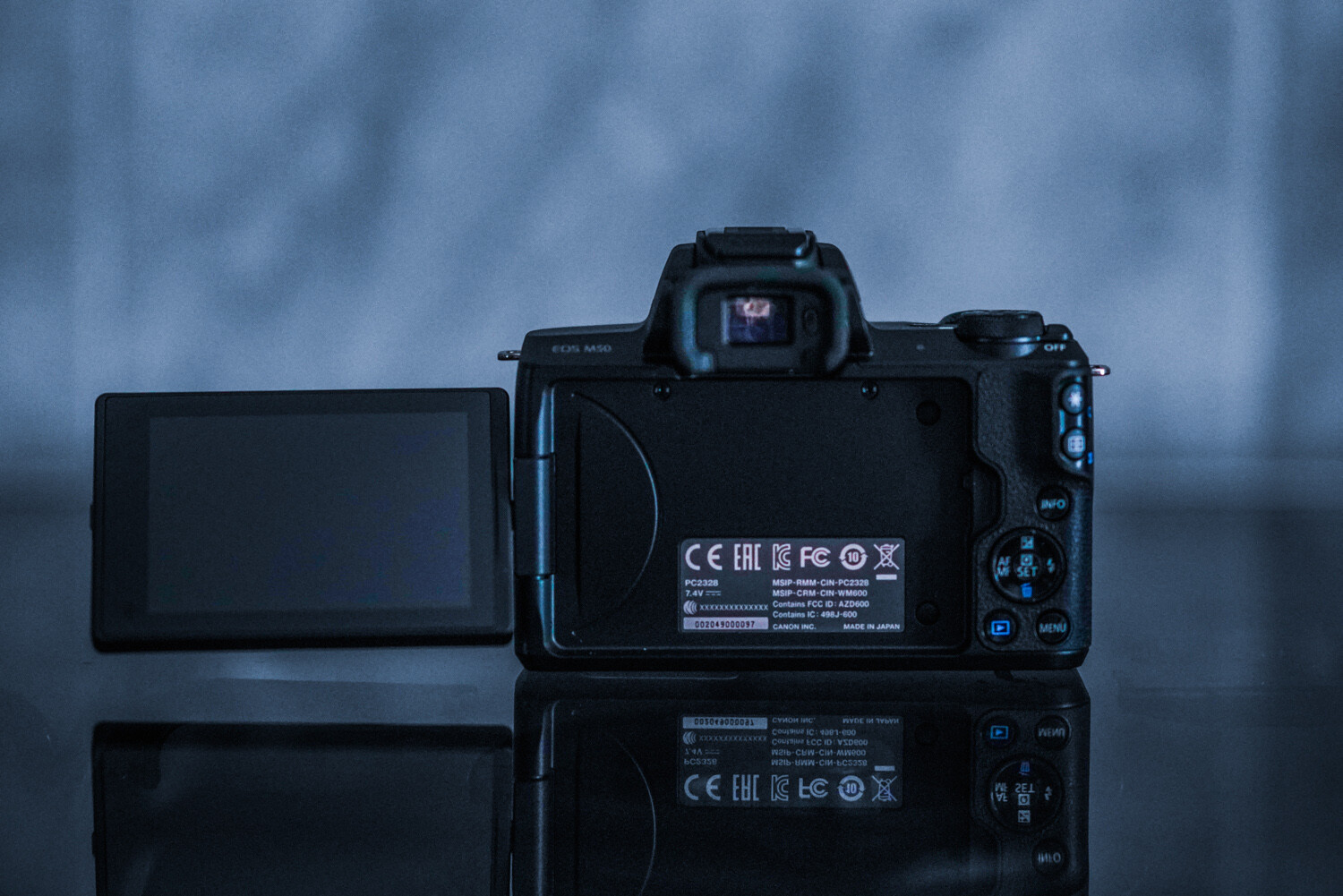
3 - Gear Review Canon EOS M50 Mirrorless Camera Kit

Features

The Canon EOS M50 mirrorless camera sports some very impressive features that would make even the smuggest photographer blush. The EOS M50 delivers improved Dual Pixel CMOS AF for fast, accurate autofocus that helps you get the photo you want right at the moment it happens.

The 24.1 Megapixel (APS-C) sensor is capable of capturing high-resolution image and video. The files grant the user images suitable for enlargements with sufficient resolution for significant cropping. The video capability of this hardy little camera is even more impressive. It has the ability to record in 4K UHD at 24 frames per second. The high-speed 120p mode is possible in HD.

According to the manufacturer, the built-in high-resolution electronic viewfinder features approximately 2,360,000 dots. So, you can see high amounts of detail in whatever you’re capturing.

The vari-angle Touchscreen LCD, which has a flexible tilt range. The tilt range is ideal for high-angle and low-angle shooting so you can get the composition you want without breaking your back. The Canon EOS M50 camera features the new DIGIC 8 Image Processor, which helps improve autofocus performance, enables you to shoot 4K UHD 24p video and aids with many other advanced features.

4 - Gear Review Canon EOS M50 Mirrorless Camera Kit

Specifications

  • Improved Dual Pixel CMOS AF and Eye Detection AF.
  • 24.1 Megapixel (APS-C) CMOS Sensor with ISO 100-25600 (H: 51200).
  • 4K UHD* 24p and HD 120p** for Slow Motion.
  • Built-in OLED EVF*** with Touch and Drag AF.
  • Vari-angle Touchscreen LCD.
  • Built-in Wi-Fi, NFC, and Bluetooth Technology.
  • Automatic Image Transfer to Compatible Devices while Shooting.
  • New DIGIC 8 Image Processor with Improved Auto Lighting Optimizer.
  • Silent Mode for Quiet Operation.

This is only the second EOS M model to have a built-in Electronic View Finder (with the first being the EOS M5). It is also the first EOS M model to offer 4k video, which puts it one step ahead of the EOS M5. The camera also uses a DIGIC 8 processor, rather than the older DIGIC 7 processor.

Physical build

5 - Gear Review Canon EOS M50 Mirrorless Camera Kit

This camera’s size is brilliant! It is smaller than my cell phone (Google Pixel). Easy to throw into any bag, purse, or pocket. The body construction consists of polycarbonate rather than a metal body shell, but it still feels robust enough in your hand. The camera features a very comfortable and well-designed grip containing  ‘hooks’ for your second finger and thumb. As a result, the M50 feels surprisingly secure, even when used with one hand.

Much like Canon’s pro-level DSLRs, the controls are well laid-out. The buttons are a decent size and easily located by touch while using the viewfinder. However, the size may be an issue for those with larger hands. My hands are petite, and I find the controls just fine (haha)!

6 - Gear Review Canon EOS M50 Mirrorless Camera Kit

The tilt, vari-angle touch screen is brilliant. This nifty feature has infinite uses. Additionally, the screen can be stowed backward against the camera body to avoid any potential scratches (for those that don’t purchase screen protectors). The built-in viewfinder is very helpful when shooting during the noon sun or other bright conditions. There’s an auto activation when your eye approaches the viewfinder, ensuring that the LCD doesn’t blind you.

Canon has a knack for making its small models handle well and feel professional. The M50 is proof of this.

Autofocus

Canon’s autofocus is what has kept me loyal to the brand for over ten years now. Canon’s Dual Pixel CMOS sensor that the M50 sports mean every sensor pixel is capable of being used for phase detection. Allowing fast autofocus almost wherever the subject gets situated within the frame. The AF system is sensitive down to -2 EV, which means the camera continues to focus in extremely low light.

7 - Gear Review Canon EOS M50 Mirrorless Camera Kit

A new autofocus feature of this model is the eye-detection autofocus. The camera can find eyes on your subject and lock focus on them with the push of a button. It is photographic witchcraft, and I love it. This feature is activated when face detection is turned on, to focus specifically on your subject’s eye.

Do make note that this fun feature is only available in single-AF mode, which means you can’t use it track focus during burst shooting. As can be seen above, the eyes of my dog are nicely in focus (and this was easy to achieve, even when she moved a bit).

I have always preferred the AI Servo | Continuous Focus mode due to the majority of my subjects moving around a lot. Thanks to the ability to use phase-detection anywhere in the frame, this feature is fast and reliable.

Low light capability

8 - Gear Review Canon EOS M50 Mirrorless Camera Kit

As the years’ progress, so does low-light capability. In higher ISO levels, image quality stands up very well at ISO 800. It’s only at ISO 3200 noise, and noise reduction starts to blur away detail. However, the color gets retained well. The higher numbers are passable for smaller reproductions, but you’ll generally find yourself not wanting to move beyond 12,500 max! The autofocus continues to shine even at low-light levels.

9 - Gear Review Canon EOS M50 Mirrorless Camera Kit

Battery life

I have always been a tremendous fan of Canon’s batteries. They always continue to impress me with their longevity. This camera is no exception, despite having an always-on LCD screen! As always, I do suggest purchasing more than one battery, but you can remain confident in this camera lasting you through your entire photo session and photography adventures.

10 - Gear Review Canon EOS M50 Mirrorless Camera Kit

The lens: EF-M 15-45mm f/3.5-6.3 IS STM

The M50 kit comes complete with the EF-M 15-45mm f/3.5-6.3 IS STM, a compact and stylized zoom lens for the mirrorless camera. The lens is very compact and features a side switch to flatten the lens when stored. This feature makes traveling with the M50 kit an absolute breeze.

11 - Gear Review Canon EOS M50 Mirrorless Camera Kit

With the 15-45mm kit lens with its STM focus motor, autofocus is great. It is super-fast, silent, accurate, and excellent for any photography style. The 35mm-equivalent 24-72mm range combines a wide-angle for landscapes and big group photos, with a telephoto zoom for close-ups and detailed headshots.

12 - Gear Review Canon EOS M50 Mirrorless Camera Kit

I found the lens to be reliable, fast, and sharp – no complaints whatsoever!

Final thoughts

13 - Gear Review Canon EOS M50 Mirrorless Camera Kit

The Canon EOS M50 is an excellent entry-level camera for aspiring, beginner, and hobbyist photographers alike. From its variety of features to its portable size and ease-of-use, unraveling this camera under the Christmas tree would excite even the most controlled picture-takers. Plus, having a kit that comes with a lens is just a brilliant bonus!

The post Gear Review: Canon EOS M50 Mirrorless Camera Kit appeared first on Digital Photography School. It was authored by Anabel DFlux.


Digital Photography School

 
Comments Off on Gear Review: Canon EOS M50 Mirrorless Camera Kit

Posted in Photography


Have your say: Best gear of 2018

19 Dec

Have your say: Best gear of 2018

For the past few weeks, our readers have been voting on their favorite photographic gear released in the past year in a wide range of categories. Now that the first round of voting is over, it’s time to reveal the winners.

Remember, it isn’t over just yet! It’s time now to pick an overall winner. Don’t miss your chance to cast your ballot – this one’s for all the marbles.

Best prime lens – Runner-up: Canon RF 50mm F1.2L USM

The 50mm F1.2 is a lovely, sharp lens for Canon’s fledgeling full-frame mirrorless lineup. It’s the lens we were most excited to get our hands on when the system made its debut, and it did not disappoint. Clearly, our readers agree that it’s a standout.

Best prime lens – Winner: Sony FE 24mm F1.4 GM

As impressive as the RF 50mm F1.2L is, Sony ultimately came up with the prime lens that our readers liked the best this year. The FE 24mm F1.4 GM is truly worthy of its ‘G Master’ designation, and best of all – it’s lighter than Canon and Nikon’s equivalent offerings. Lighter in weight and big on optical performance turns out to be a real winning combination.

Best zoom lens – Runner-up: Canon RF 28-70mm F2L USM

The RF 28-70mm F2L is an ambitious lens – and likely a hint of things to come for Canon’s full-frame mirrorless system. In use the 28-70mm F2 has impressed us with excellent image quality throughout its range, and our readers were clearly impressed too.

Best zoom lens – Winner: Tamron 28-75mm F2.8 Di III RXD

Sure, the appeal of a massive, fast zoom like the RF 28-70mm F2L is hard to deny. But there’s a special place in our readers’ hearts (ours too) for a lens that’s versatile as well as small and lightweight. It’s not quite as fast as this category’s runner-up, but its combination of size and optical performance put it ahead of the competition.

Best compact / fixed-lens camera – Runner-up: Panasonic LX100 II

We’re putting the finishing touches on our full Panasonic LX100 II review, but we’ve seen enough already to know that its image quality is solid. We think the Mark II version builds on what we already liked about its predecessor, and it seems that plenty of our readers agree that it’s more of a good thing.

Best compact / fixed-lens camera – Winner: Sony Cyber-shot RX100 VI

While there was plenty of love for the LX100 II in our poll, the Sony RX100 VI just couldn’t be caught. It’s our pick for the best fixed-lens camera of the year too – the RX100 series’ strong feature set pairs nicely with a longer zoom lens, making it the first true ‘travel zoom’ compact in the lineup.

Best entry-level ILC – Runner-up: Canon EOS M50

The Canon M50 offers an appealing combination of size and capabilities, and though its heavily-cropped 4K video leaves something to be desired, it’s one of our top picks of the year and it’s a favorite among our readership too.

Best entry-level ILC – Winner: Fujifilm X-T100

Our readers’ top pick in the category is another camera with a strong still photography pedigree: the X-T100. It combines a built-in EVF, tilting touch-sensitive LCD and the Fujifilm JPEG image quality we know and love so well. It’s a total package with a lot of appeal for those inclined toward street shooting.

Best mid-range ILC – Runner-up: Fujifilm X-T3

This was one of the closest races in our 2018 polls, and really, we had no doubt it would be. Coming in just shy of the winning camera is the X-T3 – a fantastic stills camera that happens to record excellent video as well. We think it’s one of the best all-around performers in its crop frame class, and our readership seems to agree.

Best mid-range ILC – Winner: Sony a7 III

The Sony a7 III just edged out the X-T3 to take the category, winning by under 3% of the vote. But even in a category of high-quality, versatile cameras, the a7 III stands out. That’s because it represents Sony at its best – bringing several generations’ worth of features and improvements together in a highly impressive package. It wins a competitive category and is sure to be a front-runner for Product of the Year.

Best high-end ILC – Runner-up: Nikon Z7

Nikon’s first step into the high-end, full-frame mirrorless market was a solid one. The Z7 is well-rounded and capable of seriously impressive image quality. In some ways it feels like a first-generation camera, but ultimately it’s a highly capable tool and one of the highlights of the year in our readers’ eyes.

Best high-end ILC – Winner: Fujifilm GFX 50R

The allure of medium-format, the ergonomics of a rangefinder-style camera and Fujifilm’s irresistible film simulation modes likely helped put the GFX 50R at the top of this category. It’s smaller and less expensive than the existing GFX 50S, making it one of the most approachable entry points yet to the world of digital medium-format shooting.

Have your say

You helped determine the winners in these individual categories, so now’s the time to cast your vote in one last poll! Choose up to three favorites from this list of winners and runners-up between now and January 4th, 2019 at midnight PT when the final poll closes. Watch for an announcement of the winners soon after.

As always, thanks for casting your votes and being a part of our community throughout the year.

.


Have your say

$ (document).ready(function() { Poll({“pollId”:”5001986557″,”openForVoting”:true,”mainElementId”:”poll0″,”slot”:null,”isSingleChoicePoll”:false,”minNumberOfChoices”:1,”maxNumberOfChoices”:3}); })

Have your say: Best product of 2018
Your answers
1. Required
2. Optional
3. Optional
You need to login to vote

Canon RF 50mm F1.2L

Sony FE 24mm F1.4 GM

Canon RF 28-70mm F2L USM

Tamron 28-75mm F2.8 Di III RXD

Panasonic LX100 II

Sony Cyber-shot RX100 VI

Canon EOS M50

Fujifilm X-T100

Fujifilm X-T3

Sony a7 III

Nikon Z7

Fujifilm GFX 50R

Voting is easy – you pick your favorite products by dragging and dropping. You can pick up to three, and rank them in order of priority.

Poll Rules:

This poll is meant to be a bit of fun. It’s not sponsored, promoted or paid for in any way and DPReview doesn’t care how you vote, so please don’t start a flame-war in the comments. Our readers’ polls are run on the basis of trust. As such, we ask that you only vote once, from a single account, and don’t vote purely just to sandbag another product or brand. Don’t be that guy.

Articles: Digital Photography Review (dpreview.com)

 
Comments Off on Have your say: Best gear of 2018

Posted in Uncategorized