RSS
 

Posts Tagged ‘FutureProof’

Future-Proof Parking Garages: Autonomous Vehicles Drive Reusable Designs

03 May

[ By WebUrbanist in Architecture & Cities & Urbanism. ]
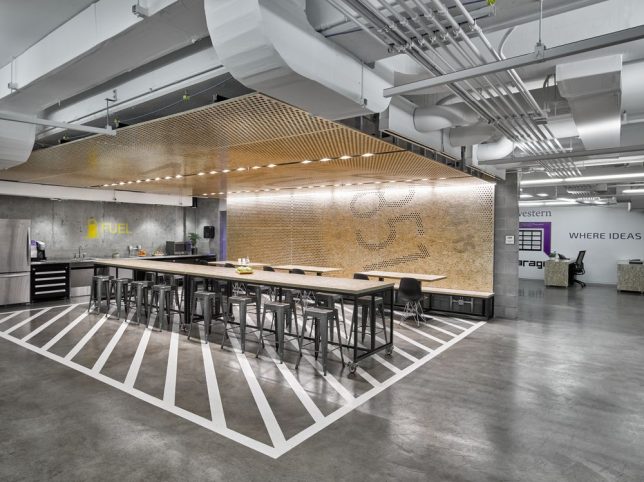
As driverless vehicles hit the streets and shared car usage grows, forward-thinking architects, developers and urban planners are working on adaptable designs to future-proof parking garage structures and give them second lives.
Big firms like Gensler see the writing on the wall, predicting car usage will peak by the end of the decade and ride-sharing may dominate by 2025. The effect of this on cities and real estate will be massive, freeing up home garages, street parking and dedicated parking structures — nation-wide there are over 500,000 parking spots and spaces inside buildings and outdoors covering an estimated 3,500+ square miles.
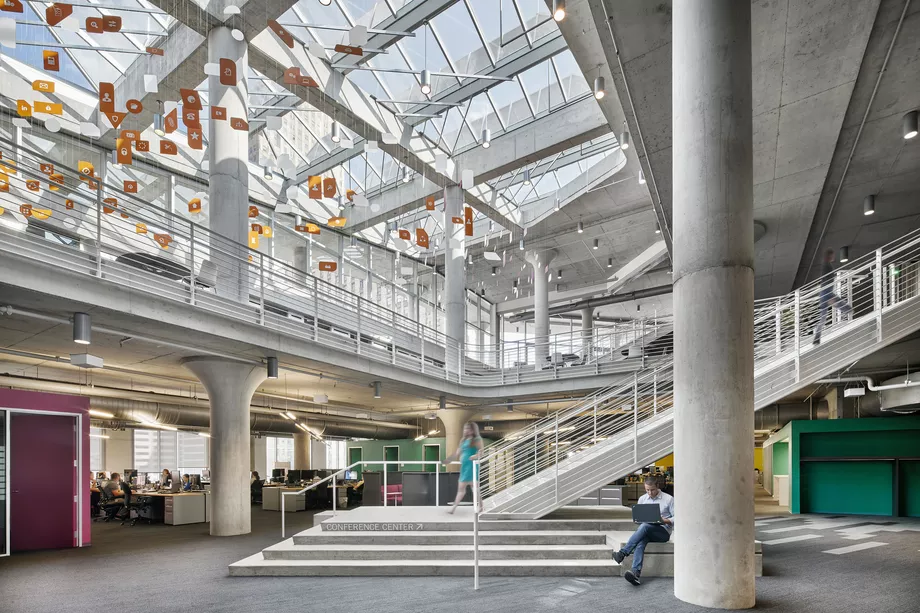
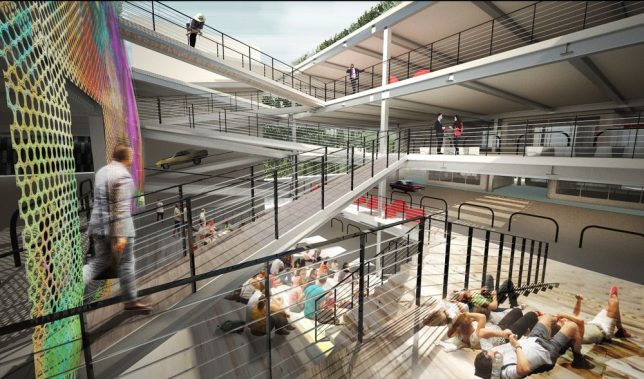
 

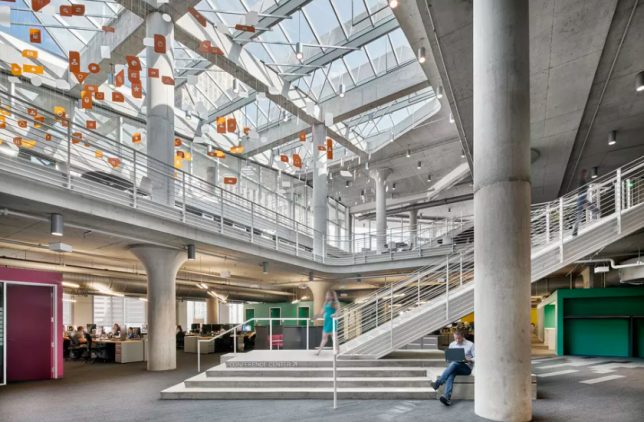
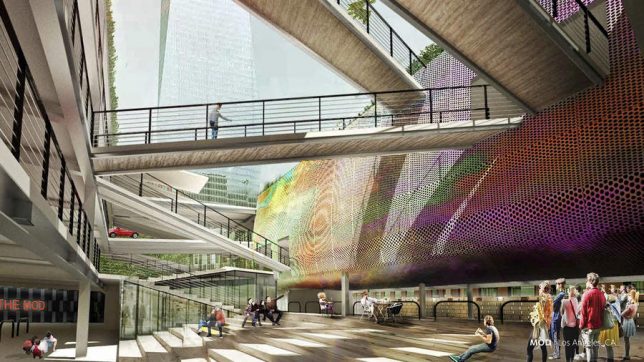
Gensler’s The Mod concept plays to new possibilities in light of their predictions, featuring garage floor heights that will work for new uses. Its modular sections can be easily moved or removed to let in light and facilitate circulation. Built-in utility hookups also help make conversion easier. The firm has also designed a building in Ohio with three parking levels made to be changed into offices over time with easily-added facades and details similar to ones found on other floors (below).

Another such project — a 1,000-car garage for building residents in the Arts District of Los Angeles by Avalon Bay — is to be completed in four years, a long time in this age of fast-evolving technology. Accordingly, their plans include tricks to make converting this area back to other residential uses easy and efficient. This includes flat floors (rather than inclined ones found in many garages) so they can be turned effectively into usable spaces, like shops or community areas.
Converting garages will be a huge project of the coming decades, but so will rethinking the way new architecture is designed in the age of autonomous vehicles. Without people at the wheel, cars can park themselves in smaller spaces. Loading/unloading zones will be reduced and the way people enter buildings (from the street rather than a garage) could change dramatically as well.

Then, of course, there are streets — with less street-side parking, space is opened up for things like parklets, walking and biking paths (not to mention all of the changes to how roads will work). Accordingly, many designers, developers and planners are wisely anticipating these changes — still, their ultimate effect on the built environment remains to be seen as the future continues to take shape.

Share on Facebook


[ By WebUrbanist in Architecture & Cities & Urbanism. ]

[ WebUrbanist | Archives | Galleries | Privacy | TOS ]


WebUrbanist

 
Comments Off on Future-Proof Parking Garages: Autonomous Vehicles Drive Reusable Designs

Posted in Creativity


Long Now: Future-Proof 10,000 Year Clock Built into Mountain

26 Dec

[ By WebUrbanist in Gadgets & Geekery & Technology. ]

longnow clock face

Founded by futurists to engage in truly long-term thinking, the Long Now Foundation is best known to many for Long Bets or its recent placement of a Rosetta Disk on a comet, but the organization has an array of amazing projects designed to last hundreds of generations, including a 10,000 Year Clock. Something to consider before we go any further: civilization as we know it is arguably only around 5,000 years old – we are talking here about an technologically sophisticated endeavor aiming to span (and keep track of) twice that period of time.

longnow clock top

longnow clock tunnel

Designers and builders are used to thinking in terms of decades, perhaps even centuries, but are rarely called upon to consider millennia in their plans and calculations. In the case of the 10,000 Year Clock, environment is critical – in addition to robust materials and geological stability, predictable temperatures and relative isolation are key ingredients in siting the mechanism. Towering 500 feet vertically and with gears weighing up to 1,000 pounds each, the first clock is being built high and dry inside a West Texas mountain on property owned by Amazon CEO Jeff Bezos. Another is planned for Nevada – both are sited to avoid excessive rain or freeze-and-thaw cycles that could damage it over time.

longnow clock design sketch

longnow clock path

In the conceptual design stage of the project, polymath inventor Danny Hillis said of his aspirations: “I want to build a clock that ticks once a year. The century hand advances once every 100 years, and the cuckoo comes out on the millennium. I want the cuckoo to come out every millennium for the next 10,000 years.” Indeed, the experience of the clock has even more unique twists than initially envisioned: each time it chimes the sound is unique – with 3.5 million melodies in store, it will not repeat itself for the next ten thousand years.

10000 year clock face

piece of long now clock

Located in a separate space from the clock’s inner workings, the face of the clock “displays the natural cycles of astronomical time, the pace of the stars and the planets, and the galactic time of the Earth’s procession.” Prototype parts of the clock are on display in some places, like the Long Now’s bar and event space in San Francisco known as The Interval, where this author recently saw Kevin Kelly, board member of Long Now and founding editor of Wired, speak about his book and history with the organization.

Perhaps most impressive of all: the clock can keep itself going for the entirety of is planned existence. While it will not display the time unless wound it will continue to keep track, using the sun and stars for guidance and temperature differentials for power. “Thermal power has been used for small mantel clocks before, but it has not been done before at this scale. The differential power is transmitted to the interior of the Clock by long metal rods. As long as the sun shines and night comes, the Clock can keep time itself, without human help. But it can’t ring its chimes for long by itself, or show the time it knows, so it needs human visitors.”

longnow clock prototype design

While this kind of working technology over such a long time period has almost no precedent, there are many examples of things surviving for such long periods – human-made ceramics have lasted up to 17,000 years along with other artifacts. The biggest worries? Some moving parts will not shift for generations, so making them able to work after a millennium without motion may be tricky. And then there are human visitors, well known for vandalizing and stealing from historical sites over time – we may, once again, be our own worst enemies.

As shown in the video above, “This system will be suspended 400ft down in the 500ft deep shaft that was carved using a raise bore drill last year. The large structural elements and gears are made from marine grade 316 stainless steel, most smaller pins and rollers are titanium, and the bearings are all made from an industrial ceramic. The entire system uses no lubrication, but the first tests have shown that over 93% of the energy put into the system, comes back out to go to the Clock.”

Share on Facebook


[ By WebUrbanist in Gadgets & Geekery & Technology. ]

[ WebUrbanist | Archives | Galleries | Privacy | TOS ]


WebUrbanist

 
Comments Off on Long Now: Future-Proof 10,000 Year Clock Built into Mountain

Posted in Creativity