Fujfilm has introduced its X30 enthusiast compact, which offers a 2/3″ X-Trans II CMOS sensor and a 28-112mm equivalent F2.0-2.8 lens – both of which are retained from the X20 that precedes it. New features include a larger, tilting 3″ LCD, an XGA OLED electronic viewfinder, a control wheel around the lens, and greatly improved battery life. A new ‘Classic Chrome’ film simulation mode has also been added, as has Wi-Fi. Read more
Tag: Fujifilm
-
X-Trans excellence? Fujifilm X30 First Impressions Review
Fujifilm’s new X30 premium compact is an intriguing piece of kit, with a larger-than-average sensor and reasonably fast lens. While not a revolutionary upgrade to the X20, it still provides some nice improvements. After some play time, we’ve put together a First Impressions Review that spells out what’s new and what’s not.
-
Fujifilm XF 18-135mm F3.5-5.6 R LM OIS WR samples gallery
The Fujifilm XF 18-135mm F3.5-5.6 is a weather-resistant lens designed as a companion to the weather-resistant Fujifilm X-T1. Covering a 27-200mm equivalent range, it claims to offer the world’s most advanced image stabilization system, using gyro sensors for a gain of up to five stops. Is it the ideal pair for the X-T1? We took it out for a spin. See gallery
-
Fujifilm updates X-mount lens roadmap through end of 2015
Fujifilm has updated the roadmap for its X-mount lenses up to the end of 2015. One extra lens has been added, while a second lens previously included has been formally named. The release order of three others has changed. The new models are the XF 90mm F2 R and XF 16mm F1.4 R, both of which are due by mid-2015. Read on to see the full roadmap and see the new release dates for the other upcoming lenses.
-
Fujifilm issues firmware update for X-series and fixed lens cameras
Fujifilm has announced firmware updates for a number of X-series and FinePix cameras. Full details of the firmware updates were announced on the company’s blog, and the new firmware versions are now available for download from the global Fujifilm site. Included in this round of updates are the X-T1, X-Pro 1, X-E1, X-E2, X-M1, X-A1, XQ1, FinePix S1, FinePix XP70 and FinePix XP200. Read more
-
New Fujifilm X-series firmware adds direct instax printing

Fujifilm has announced a firmware update for three of its X-Series camera, allowing them to print images instantly from the instax Share SP-1 printer. The Fujifilm XQ1, X-M1 and X-A1 cameras updated with the new firmware will be able to send photos directly to the compact instax printer, rather than by way of mobile device as is currently the case. The firmware should be available in late June, and Fujifilm plans to add the feature to more cameras. Learn more
-
Fujifilm launches weather-resistant XF 18-135mm F3.5-5.6 R LM OIS WR

Fujifilm has announced its first weather-resistant lens, the Fujinon XF 18-135mm F3.5-5.6 R LM OIS WR, which is designed to match the high-end X-T1 mirrorless camera. Offering a versatile 27-200mm equivalent zoom range, the lens claims to have the world’s most advanced image stabilisation system, which uses high precision gyro sensors to give a claimed 5 stop benefit. It also has an air ventilation system to help prevent dust being sucked into the lens by the zoom operation. It’ll be available in July for £749.99 / $ 899.95.
-
Fujifilm X-T1 Mirrorless Camera Review

The weather resistant Fujifilm X-T1 Mirrorless Camera
I was thrilled when Fujifilm Canada sent me their brand new X-T1 to play with just over a month ago. Along with the camera body itself they sent me three lenses including the XF 55-200mm F3.5-4.8 R LM OIS, the XF 35mm F1.4R and the XF 60mm F2.4 R macro lenses. Upon removing these items from the box I was immediately impressed with the professional fit and finish of the camera body, lenses and lens hoods. Larger companies like Canon could learn a thing about lens hood design from Fujifilm. While the camera body is weather resistant, none of the lenses currently available at the time of this review shard that characteristic.
Electronic viewfinder
Mirrorless cameras seem to be all the rage these days and for good reason. Leaving the mirror out of the light path allows for smaller, lighter, less mechanically complex cameras to be built. But, without a mirror to reflect light into the viewfinder, mirrorless cameras are dependent on providing a viewfinder image via an electronic viewfinder (think of a tiny monitor). Past attempts at electronic viewfinders by Fujifilm and other manufacturers has generally resulted in sub-standard results due to laggy (slow to respond) electronic viewfinders with hard to view results.
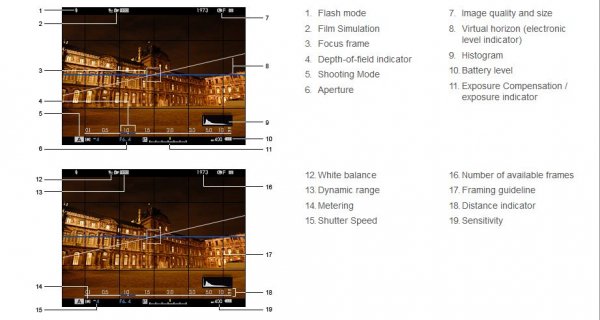
Fujifilm Viewfinder Layout
The X-T1’s viewfinder suffers from none of these problems. The viewfinder is large, bright and very responsive. I normally shoot with one of Canon’s pro cameras and the X-T1’s viewfinder was, surprisingly, a tiny bit larger. An advantage of the electronic viewfinder is that extra information can be superimposed over the image, allowing photographers to make real-time adjustments to exposures before the image is made by glancing at a histogram, instead of having to wait until after the photo is made as is the case on a standard digital SLR camera.
Autofocus
Another issue plaguing many mirrorless cameras has been their autofocus performance. Fujifilm has tackled this head-on by providing 49 focus points spread out across the entire image and those focus points are adjustable in size so that you can customize them based on the type of subject you are photographing. Where most mirrorless cameras rely on a type of autofocus system detecting contrast to determine whether the image is in focus or not, the central nine focus points on the X-T1 use the faster, more accurate phase modulation focus system for superior results.
Image quality
I found the images produced by the sensor of the X-T1 to be especially nice; low in noise and more resolution than I was expecting from a 16 megapixel APS-C sized sensor. That could be due to the fact that the X-Trans CMOS II sensor in the X-T1 uses a unique arrangement of colour filters which supposedly eliminate the need for an optical low-pass filter thereby resulting in increased resolution and perceived sharpness.

Students photographing model – ISO 3200 – XF55-200mm F3.5-4.8 R LM OIS Lens
1/25 at F6.4, ISO 3200, 95mmWiFi
The X-T1 also has built in WiFi capabilities that allow you to download a free app for your smart device. This app allows you to remotely control your camera from a distance. A nifty application that requires additional hardware on most other current cameras to achieve similar results.
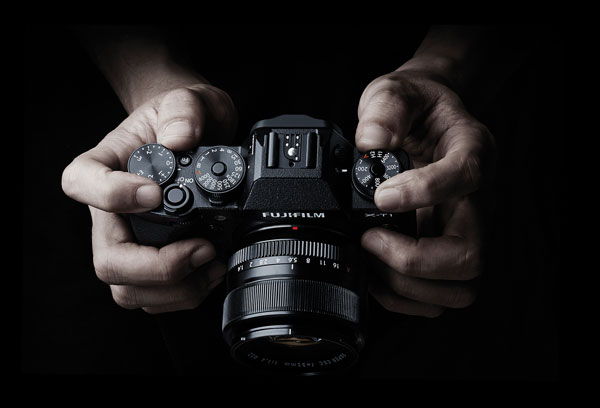
Controls on top of the camera
Camera controls
What I became especially fond of while working with the X-T1 is the controls for aperture, shutter speed, ISO and exposure compensation. Aperture is controlled by rotating a ring on the lens, just next to the body. ISO, shutter speed and exposure compensation are all controlled via dials on the top of the camera. Reminded me of some of my old-school SLR cameras, but it took me virtually no time to adapt from the Canon cameras I’ve used for the last 20 years or so.
Size and weight
The camera body itself is extremely light-weight but fit comfortably in my somewhat gigantor hands. I suspect adding the optional battery grip and/or hand grip would make it even better and of course battery grips always help with the making of vertical photographs. That said, most of the controls were easily accessible and with the body itself weighing in at just 440g (15.4 ounces), it is a camera that I could easily carry and shoot with for extended periods of time with little or no hand/shoulder/arm fatigue setting in. Even with the 55-200mm lens attached, the weight was just 1020g (36 ounces).
Customization
Another pro-camera feature I was thrilled to find on the X-T1 was a total of six different completely configurable multi-function buttons. This allowed me to fine-tune access to features like selecting focus points, depth-of-field preview, macro mode, autofocus mode and white balance so that I could program the buttons most convenient for me to the functions I use most.

Studio Tulips – XF60mm F2.4 R Macro Lens
5.3 Seconds at F8.0, ISO 200, 60mmDislikes
If you’re wondering if there is anything I didn’t like about the camera, there is. I strongly dislike the four-way controller on the back of the camera. Where the other buttons on the camera offer tactile feedback when pressed, that feedback is absent on the four-way controller. Since I needed to use the four-way controller to select different focus points, I was constantly using (or trying to) the four-way controller. I found it virtually impossible to use without glancing towards it (thus removing my eye from the viewfinder and missing a chance at retiring via a photo of a brief appearance by Sasquatch if that circumstance had occurred) and continually frustrated by it. Living where I live in Canada and therefore in cooler temperatures, it is absolutely impossible to use with any sort of gloves in conjunction with the four-way controller, and on a mostly professional-feel camera like this, it was a bad design or manufacturing decision.
Another quality issue on the camera body is the door that slides opens to allow for the removal of the SD memory card. It feels ridiculously flimsy and I felt lucky to be able to send the camera back to Fujifilm with the door intact because it always felt like it was about to break off.
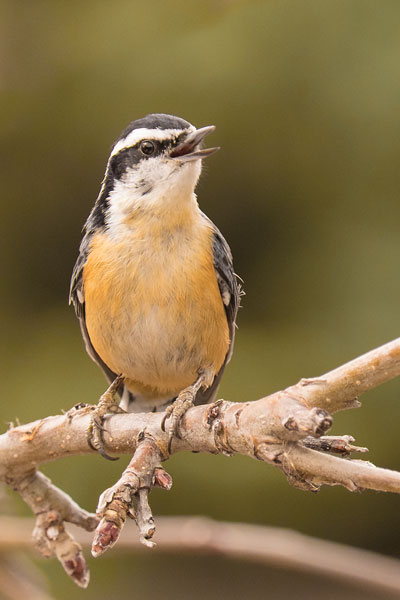
Red-breasted Nuthatch – XF55-200mm F3.5-4.8 R LM OIS Lens
1/800 at f4.8, ISO 800, 200mmOverall
Overall though, this camera is a gigantic win for Fujifilm in my opinion. I’m a wildlife photographer by nature and for the most part, that’s the type of shooting I did with the camera. I was suitably impressed with the autofocus, and was thrilled with the quality of the lenses and sort of images that the sensor produced. Regardless of the situation (high or low ISO), the images were always impressive and the camera did a great job at judging the white balance although I always shot in RAW mode just to give me that extra flexibility in case the camera got in terribly wrong.
Need for longer lenses
For a wildlife photographer though, Fujifilm’s biggest weakness is the lack of larger lenses. The biggest lens I could get my hands on was the 55-200mm (84-305mm equivalent on a full-frame camera). While that’s okay for casual wildlife photography, it stops well short of “real” telephoto focal lengths. For instance, just a couple of days ago I was out at my favourite marsh with my camera, 500mm lens with two teleconverters attached (2.0x and 1.4x) for a grand total of 1400mm of image magnification. However, Fujifilm representatives tell me they have plans for bigger glass in the future and if that comes to be, I know that it would make a tempting package for me to have in my kit.
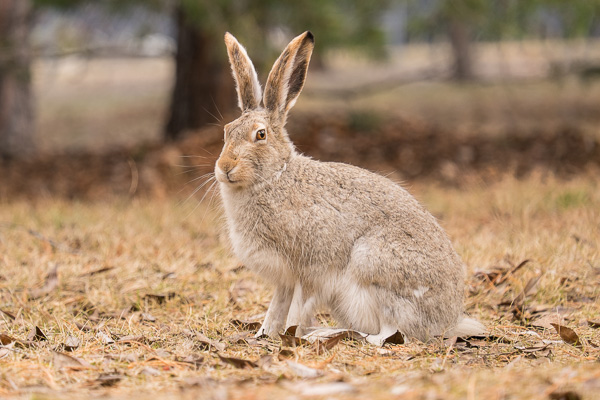
Snowshoe Hare – XF55-200mm F3.5-4.8 R LM OIS Lens
1/200 at f 4.8, ISO 400, 200mmRoom for improvement in some areas
Another area that still needs some work is the autofocus system. While the X-T1 is a great improvement over other mirrorless systems I’ve tried, it still suffers from performance issues with moving subjects rapidly changing distances between shots. Theoretically, the X-T1 can shoot 8 frames-per-second in continuous drive and focus modes. However, if the subject you’re focused on is rapidly moving towards you, the camera’s processing slows down and I was lucky to get 2 or 3 frames per second.
An additional improvement I’d like to see is an expansion in the number of phase-detect autofocus points. Nine out of forty-nine isn’t a bad ratio, but more would be better. I love the control over the size of focus points, but having more of the high-performance phase-detect points would help a lot too for composition on moving subjects.
For accurate exposures, I love having a live histogram overlaid on my image in the viewfinder. However, it was frustrating to have that histogram disappear when I half-pressed the shutter button to focus on my subject. While in continuous focus mode, having the histogram remain visible would help me make better exposures overall.
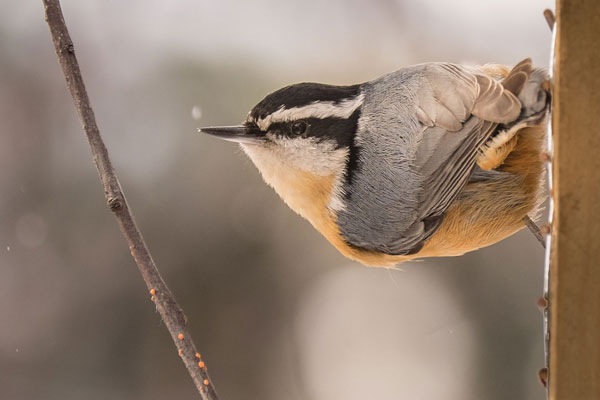
Red-breasted Nuthatch – XF55-200mm F3.5-4.8 R LM OIS Lens
1/800 at f5.6, ISO 400, 200mmFinal word
Overall, I highly recommend this camera. I teach hundreds of photography students each year the basics of operating their interchangeable lens cameras. I can confidently state that a student with this camera system would probably find learning the basics a bit easier than with a standard digital SLR camera system if for no other reason than the live histogram available in the electronic viewfinder and the easy to access, logically laid out controls. Further, for the seasoned user, the X-T1 body and lenses make a great combination for producing high-quality professional results.
The post Fujifilm X-T1 Mirrorless Camera Review by Paul Burwell appeared first on Digital Photography School.
-
Fujifilm TCL-X100 teleconverter for X100/S samples gallery

The Fujifilm TCL-X100 is a screw-in teleconverter for the X100 and X100S which increases the effective focal length of their 23mm F2 lens to 50mm. We’ve been shooting with the TCL-X100 for a few days now, in a range of different situations and light levels to see how it performs in everyday use. Click through to read our first impressions, and see our sample images.
-
Fujifilm firmware brings swifter viewfinder and sundry features to X-E2

Fujifilm has released a firmware update for its X-E2 mirrorless camera, bringing its viewfinder performance up to the standard set by the X-T1. Firmware 2.0 also adds a choice over the color of focus peaking and the ability to apply Face Detection and EVF/LCD Setting to one of the customizable buttons. A ‘Suppressed Flash’ option has also been added. The viewfinder now operates at 200Hz, meaning a lag of just 0.005 seconds. The firmware is available for download from the company’s website.