RSS
 

Posts Tagged ‘Four’

Tiniest Interchangable Lens Micro Four Thirds Cameras for Travel with Amazing Quality

21 Jun

The post Tiniest Interchangable Lens Micro Four Thirds Cameras for Travel with Amazing Quality appeared first on Digital Photography School. It was authored by Caz Nowaczyk.

In this video by MarkusPix, he looks at some of the tiniest ILC micro-four-thirds cameras and shows how well they hold up on his travels when taking some portraits.

In the video, he specifically looks at the Panasonic Lumix GX1 (2012), GX850 (2017), GM1 (2013), GM5 (2014) and uses the M Zuiko 45mm f/1.8 lens (which he describes as a great portrait lens).

He also uses the Godox Ad200 with the world’s smallest flash trigger – the FlashQ.

?

Panasonic Lumix GM1 (2013)

He states that the GM1 is one of the smallest and lightest ILC M4/3 cameras in the world. It has no viewfinder, hot shoe or image stabilization. However, the GM1 has a 16mp CMOS sensor, with a shutter speed of up to 1/16,000th, face detection, built-in wireless, built-in flash, video, and time-lapse recording.

Panasonic Lumix GM5 (2014)

Mark also states that the GM5 is one of the smallest and lightest ILC M4/3 cameras in the world. It has similar features to the GM1 but the GM5 has an electronic viewfinder and a flash shoe.

Panasonic Lumix GX1 Black (2012)

The GX! has a hotshot and can take an optional EVF (you can’t use a flash while using the optional EVF as it connects to the flash hotshoe). It has some similar features as the above cameras, but it also has optical image stabilization and built-in flash. The battery door opens all the time and the menu is confusing.

Panasonic Lumix GX850 (2017)

The GX850 (also known as the GX800 and GF9) has no EVF or hotshoe, but has a tilting screen, better LCD resolution, focus stacking and face detection. The images are very sharp. It also has a built-in flash.

So check out his experiments and see if you think these cameras would make a great (lightweight) travel companion.

Have you used these cameras? Do you agree? What are your thoughts?

Or do you have any cameras you’d add to the list?

Share with us in the comments below.

You may also find the following helpful:

  • Full Frame VS Crop Sensor VS Micro Four Thirds: Camera Sensors Explained
  • Some of the Pros of Using Micro Four-Thirds Cameras for Wildlife Photography
  • My experience with a micro-4/3rds camera – (Panasonic GF1 Review)
  • Panasonic Lumix DMC-GX7 Review
  • Panasonic Lumix DMC-G6 Review
  • Panasonic Lumix DMC-GF6 Review


The post Tiniest Interchangable Lens Micro Four Thirds Cameras for Travel with Amazing Quality appeared first on Digital Photography School. It was authored by Caz Nowaczyk.


Digital Photography School

 
Comments Off on Tiniest Interchangable Lens Micro Four Thirds Cameras for Travel with Amazing Quality

Posted in Photography


Vazen launches “world’s first” anamorphic lenses for Micro Four Thirds

04 Jun

Vazen, a Chinese optics manufacturer, is set to launch a trio of anamorphic lenses for Micro Four Thirds cameras. Showing at the Cine Gear Expo and spotted by Newsshooter, the company will be offering 28mm, 40mm and 65mm focal lengths with a 1.8x anamorphic effect.

The lens on show at Cine Gear is a 40mm T2 that will be shipping at the end of this month. When used on Micro Four Thirds cameras, such as the Lumix GH5/s, Blackmagic Pocket Cinema Camera or Z-cam E2, it will produce 2.39:1 aspect ratio images. Vazen claims the lenses will provide ‘buttery smooth oval bokeh, signature blue horizontal flare and the widescreen cinematic look’ as well as a minimum focus distance of 0.82m (2.7ft) for the 40mm example. The focus and aperture rings are fitted with gears and the front filter thread measures 110mm.

Below is sample footage captured with the 40mm T2 lens:

The 40mm version weighs 1.8kg (3.97lbs), is 110mm x 175mm (4.33in x 6.89in), and will cost $ 3,250. Users will have to wait until much later in the year for the 28mm and 65mm models. For more information see the Vazen website.

Articles: Digital Photography Review (dpreview.com)

 
Comments Off on Vazen launches “world’s first” anamorphic lenses for Micro Four Thirds

Posted in Uncategorized


Hands-on with Panasonic’s 10-25mm F1.7 Micro Four Thirds lens

01 Jun

Panasonic Leica DG Vario-Summilux 10-25mm F1.7 ASPH

The Panasonic Leica DG Vario-Summilux 10-25mm F1.7 ASPH is a fast zoom lens that covers several popular focal lengths. When mounted on a Micro Four Thirds body, where it’s equivalent to 20-50mm, you can hit 20mm, 24mm, 28mm, 35mm or 50mm with a single lens (and a fast one, at that). It will ship in July for $ 1799/£1799.

The lens was originally announced last year at Photokina, and saw a mockup under glass at CP+ back in March.

We were able to get our hands on a preproduction lens, so click through to learn more about this beast of a lens.

Big, but not that big

Make no mistake, the 10-25mm F1.7 is a hefty lens, but it’s not nearly as large or heavy as one would expect given its ambitious spec. The lens is 128mm (5″) long, has a max diameter of 88mm (3.5″) and weighs in at 690g (1.5lb). By comparison, Sigma’s 18-35mm F1.8 Art lens is a bit shorter, but almost 20% heavier, despite covering a narrower range of focal lengths.

The 10-25mm is a pricey lens, and it feels like it in the hand. It’s virtually all metal and is dust and splash-resistant. The lens can function down to -10°C/+14°F.

Seventeen elements

It shouldn’t come as a huge surprise that this ambitious lens requires a lot of glass. The 10-25mm F1.7 has 17 elements in 12 groups and includes aspherical, ED and UHR elements. The lens is threaded for 77mm filters, which serves as an example as how compact (relatively speaking) the 10-25 is.

The lens uses a stepping motor that focuses quickly and quietly.

Grabbing control over focus

The 10-25 is the first Panasonic Micro Four Thirds lens to have a focus clutch, making it easy to quickly switch between auto and manual focus. As you can see from the photo above, the lens can focus down to 28cm (11″).

With the clutch pulled back, the manual focus response is linear. This will be especially useful for video shooters, since it means you can be certain of how much the focus will change in response to you turning the lens. There’s a feedback stop at either end of the focus range but they’re not hard stops: the focus ring will continue to rotate beyond the close and far points, so it’s not great for use with a follow-focus.

Stills shooters are likely to appreciate that it gives an experience much more like an old, mechanically-driven lens,

Put a ring on it

The aperture ring, which travels from F1.7 to F16, is click-less, another feature the video crowd will appreciate. Something we like about the dial, at least on the prototype we used, is that there’s a detent to prevent you from accidentally switching the ring out of Auto mode.

Just as importantly for videographers, the aperture/iris is driven smoothly, without steps. This allows subtle adjustments in exposure (either manually or in auto mode), without the brightness of the video visibly jumping.

No going to great lengths

The lens extends when you adjust the zoom, but not by much: here it’s shown at full-extension.

Its comparably low weight should make it easy for a gimbal to stabilize, and the limited change in length should also mean its center of gravity doesn’t move very much. This should make it possible to get away without having to re-balance for different focal lengths, which is a clear benefit over using a series of prime lenses.

L-mount teleconverters

Panasonic released a pair of teleconverters for its S-series full-frame bodies alongside the 10-25mm F1.7. These 1.4x and 2x converters are compatible with Panasonic’s S Pro 70-200mm lenses: the currently available F4 version as well as the F2.8 model coming later this year.

Both teleconverters feature UHR (ultra-high refractive index lens) elements, and Panasonic claims that there’s virtually no reduction in resolution when using them.

The 1.4x and 2x teleconverters are priced at $ 499/£489 and $ 599/£579, respectively.

Articles: Digital Photography Review (dpreview.com)

 
Comments Off on Hands-on with Panasonic’s 10-25mm F1.7 Micro Four Thirds lens

Posted in Uncategorized


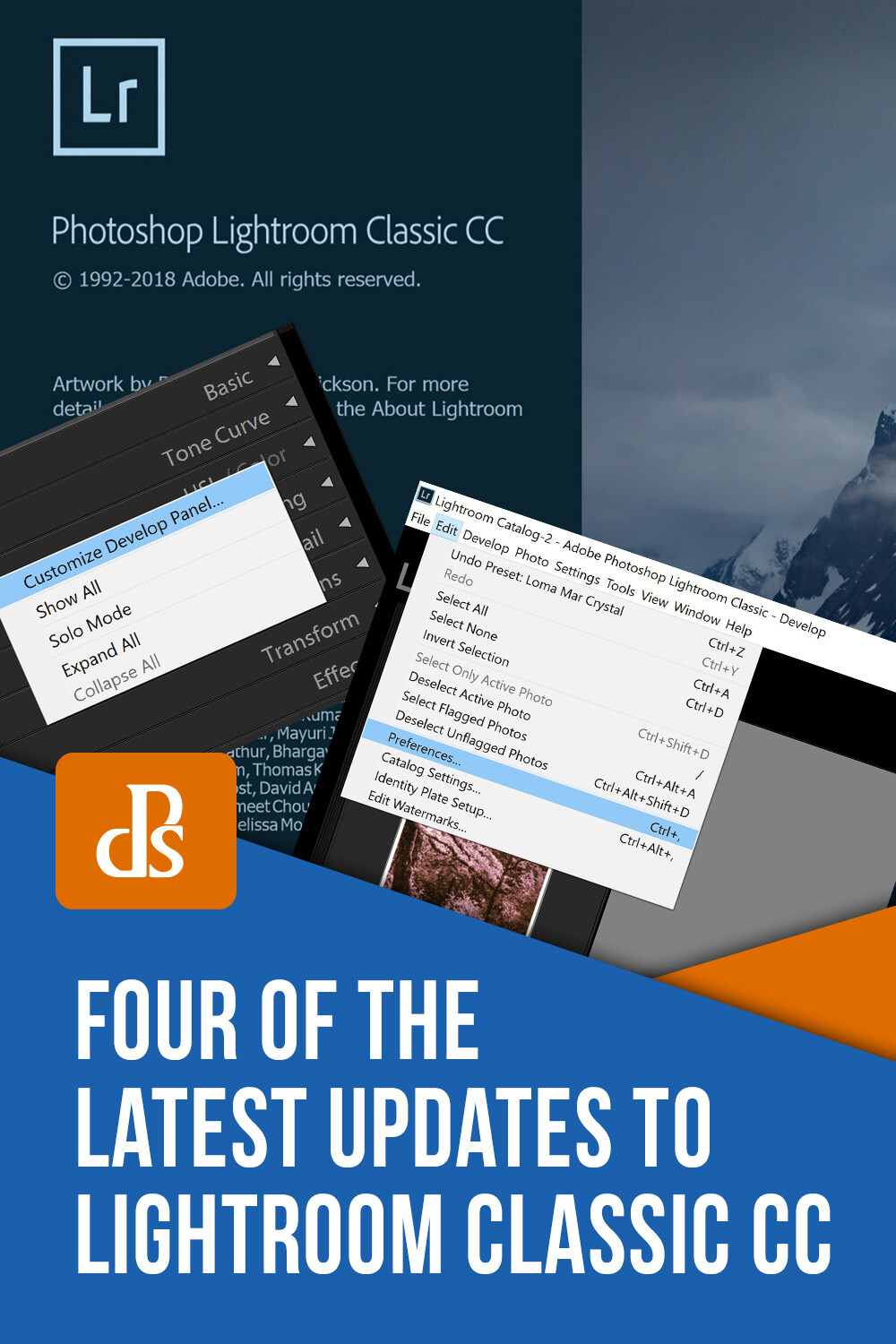
Four of the Latest Updates to Lightroom Classic CC

08 May

The post Four of the Latest Updates to Lightroom Classic CC appeared first on Digital Photography School. It was authored by Adam Welch.

When it comes to the world of photography it seems as if change is an everyday occurrence. New cameras, new lenses and new ways to make your photographs better, give the feeling that we are never quite standing still. One of the biggest testaments to this fluidity comes from the recent changes made to Adobe Lightroom Classic CC. It seems as if Adobe has been extremely busy over the past year by introducing new features and settings to Lightroom.

F:\DPS Images\Four Updates for LR Article\Lightroom-updates-adobe-adam-welch-digital-photography-school-3-3.png

It’s impossible to list all of the changes here, so I’ve picked four of the biggest and freshest new features to be introduced into Lightroom Classic CC. These range from somewhat complex to some very simple tweaks that might leave you thinking “hey, why didn’t I think of that?!”

Here’s a short list of the new features which are currently available in Lightroom Classic CC v8.2 which was the most current build at the time this article was written.

Customize Develop Panels

To kick things off, we’ll take a look at a very simple yet interesting new feature introduced to Lightroom in December of 2018. Until now the only choice of customization for our Develop panels was to switch to “Solo” (highly recommended) mode. With the release of Lightroom Classic CC v8.1, we can now choose the order we want the Develop panels to appear and even decide which panels we want to have listed at all.

Lightroom-updates-adobe-adam-welch-digital-photography-school-3

I know, right? Looks a little odd to see all the panels in a different order and a few missing! To customize your Develop panels all you need to do is right-click on the title bar of any panel.

Lightroom-updates-adobe-adam-welch-digital-photography-school-3

This opens up the customizer dialog box.

Lightroom-updates-adobe-adam-welch-digital-photography-school-3

From here it’s just a matter of checking or unchecking the panels and/or dragging and dropping them into the order you like.

Show/Hide Develop Presets

Moving over from the far right to the far left side of Lightroom Classic CC, we’ll find another new feature added to the v7.4 (seems so long ago) update which dropped in June of 2018. Beginning with this build, we can now control which Develop Preset groups appear in our Preset panel. This feature is called “Manage Presets,” and it is accessed by right clicking on any Develop Preset group or by clicking the dropdown icon at the top right of the panel.

Lightroom-updates-adobe-adam-welch-digital-photography-school-3

We are then met with this preset management window.

Lightroom-updates-adobe-adam-welch-digital-photography-school-3

This is where you can check or uncheck the preset groups you want to appear in the Develop presets panel. Remember, you can always select “Reset Hidden Presets” should you ever decide you want to restore everything to the default configuration.

Preset Compatibility

While we’re on the topic of Develop presets, it’s worth mentioning another brand new aspect to grace the halls of Lightroom Classic CC in 2018. Starting with the v8.1 update, we have the option to determine which presets appear in our Develop Preset folders even more judiciously than before with the ability to hide or show partially compatible presets.

Now, you might be wondering what a partially compatible preset is? Simply put, any Develop Preset that contains a setting not compatible with your current version of Lightroom will now be italicized or hidden depending on your preferences.

Here, let me show you.

First, let’s say this preset was made with a creative profile which you don’t have installed. You’ll notice that its name appears in italics. This means that the preset is still usable, however, it only offers limited functionality.

Lightroom-updates-adobe-adam-welch-digital-photography-school-3-3

Alternatively, we can choose to not have that preset appear at all. To do this, we first select ‘Edit’ and then ‘Preferences’

Lightroom-updates-adobe-adam-welch-digital-photography-school-3-3

Next, click on the ‘Presets’ tab and then set the preset visibility checkbox to your desired preference. If left unchecked ANY of your presets that feature settings not fully compatible with your version of Lightroom will no longer appear in your presets folder.

Lightroom-updates-adobe-adam-welch-digital-photography-school-3-3

This of course can be undone at any time by simply checking the presets visibility box once again.

Single-step HDR Panorama Photo Merge

Don’t worry, just because the title is lengthy doesn’t mean this next feature is overly complicated. For years we’ve been able to tell Lightroom to stitch together our panoramic and HDR images for us. Now, the folks at Adobe have given us an incredibly easy way to combine the best of both worlds with the release of Lightroom Classic CC v8.0 back in October of 2018. We can now merger multiple bracketed photos into a high dynamic range (HDR) panorama in, you guessed it, just a single step. Well, maybe a little more than that – but it is still incredibly easy.

Lightroom-updates-adobe-adam-welch-digital-photography-school-3-3

The majority of the work involved in making use of this new feature happens before you ever import your images into Lightroom.

Namely, your photos need to be correctly bracketed and meet a few other criteria. It will be helpful to read the full release notes from Adobe to learn more about how to make sure your images are compatible with Single-step HDR Pano Merge.

In any case, once you have selected the bracketed images for your HDR pano, the actual process is remarkably straightforward. So go ahead and select them first.

Lightroom-updates-adobe-adam-welch-digital-photography-school-3-3

Then right-click on any image and select ‘Photo Merge,’ and then ‘HDR Panorama’.

Lightroom-updates-adobe-adam-welch-digital-photography-school-3-3

From here, Lightroom will create a smart preview of your HDR Panorama.

Lightroom-updates-adobe-adam-welch-digital-photography-school-3-3

You then have options to control the way the final photograph gets cropped as well as how the images combine. This new “single-step” approach to creating high dynamic range panoramas is light years ahead of previous methods. Instead of first needing to merge individually bracketed image sets into separate HDR photos, only then to require further stitching into the final panorama, we can now eliminate virtually half of the effort involved. If you’re an avid landscape photographer, you will absolutely fall in love with single-step HDR Panorama Photomerge.

And that’s not all…

Of course, this is just a taste of the new flavors Adobe has added to Lightroom in the last year or so. It’s nearly impossible to include all of the new features constantly added – and that’s a good thing. There are many more fresh features to be found in Lightroom Classic CC.

Do you have any favorites? Feel free to let us know in the comments!


The post Four of the Latest Updates to Lightroom Classic CC appeared first on Digital Photography School. It was authored by Adam Welch.


Digital Photography School

 
Comments Off on Four of the Latest Updates to Lightroom Classic CC

Posted in Photography


CP+ 2019 Olympus Interview: Micro Four Thirds can be appreciated in almost all photographic fields

15 Apr
[L-R] Toshi Terada and Shigemi Sugimoto, pictured at the CP+ 2019 show in Yokohama

We spoke to Olympus at the CP+ trade show in Yokohama, Japan, shortly after the announcement of the OM-D E-M1X. We spoke to Shigemi Sugimoto: Executive Officer, Head of Imaging Business Unit and our old friend Toshi Terada: General Manager, Global Marketing Department, Imaging Business Unit.

We discussed a range of topics, from the company’s new camera to its overall ambitions for Micro Four Thirds.

Please note that this interview was conducted partly via an interpreter, and has been edited for clarity and flow.


What’s the response to E-M1X been like?

We’ve been holding touch-and-try events in many places and have received a lot of very positive feedback from customers. Pre-sales orders are at expected levels and we have had a good start worldwide.

The E-M1X is a model that requires a lot of consideration before users make a purchase, so we believe the users will read many reviews and learn about benefits of E-M1X before buying.

I’ve attended some touch and try events and I was very pleased to see so many customers at these events. We’re also been getting positive feedback from professional photographers.

Some people may feel that the E-M1X is big for a Micro Four Thirds system. However, the feedback we’re getting from customers that have actually tried the product is that it has changed their view. So we hope people will pick up our product and try it.

Who is the E-M1X it aimed at?

It’s a part of our professional line, along with E-M1 Mark II. One of the user groups we’re targeting is professional photographers, but also the high-level amateur, the enthusiast: they make up much of our target audience, along with the professionals.

Do you think there is significant demand for sub full-frame professional cameras?

Having received feedback from professional photographers, we feel that Micro Four Thirds’ benefits of being compact and lightweight can be appreciated in almost all photographic fields.

We feel that Micro Four Thirds’ benefits of being compact and lightweight can be appreciated in almost all photographic fields

Actually, we are seeing that there are many photographers who started using the Micro Four Thirds as their second camera, are going on to use it as their main camera.

How would you like the ‘X’ line to evolve? (and how will it need to evolve?)

As a part of the professional series with E-M1 Mark II, we will evolve the basic performance and continue to offer innovative features. Also the E-M1X line-up will further improve the level of operability and reliability.

The OM-D E-M1 II continues alongside the E-M1X as part of Olympus’s products for professional and enthusiast photographers.

How did you choose the subject-types for the subject detection/recognition AF?

Initially, we’ve chosen those three subjects that are really difficult to track by yourself, without any help, just using the single point or even using the group target area. They’re really hard to chase, with a fast-moving subject.

We also chose subjects where you need pinpoint focus – the kind of moving subject where it’s really hard to focus precisely on one specific point, for example to focus on the rider’s helmet rather than just to detect a motor bike. That’s the kind of subject where it’s most helpful to have subject detection.

If you get feedback from users, how difficult is it to train the system to recognize a new subject?

At the moment we have three specific subjects that can be detected automatically and we’re also looking to enhance the range of subjects, the types of subject. That is, if we can manage it using the current hardware, of course: at some point there is a limitation to the hardware. Also, subject detection maybe not be effective for every subject.

We have prioritized the other subjects we could look at: I cannot tell you specific subject names but, as I said, the benefit of subject detection is pinpoint autofocus, [in situations] where we should focus on a specific point. And the kind of subject that’s not easy to chase – that’s the kind of subject we should select in future.

In a lot of other brands’ systems, the machine learning efforts have mainly concentrated on human subjects. Do you feel your system is already good enough at this?

Humans are the most important subject for many photographers. We have face and eye detection already, of course. We know it’s possible to improve those kinds of detection, though, so we feel we should somehow improve [our cameras’ performance] in the future.

Could you imagine a time where we might see different subject recognition modes in different models?

This is one possibility: to choose which type of product should have what kind of subject tracking.

We are just launching that kind of new technology, so we should listen to the market to find out how they are using it, or what kind of demand they are looking for. Depending on feedback from market we can consider how to implement this kind of function in a future model.

The Micro Four Thirds system is fairly comprehensive, where are the gaps in your lens lineup right now?

Our lens roadmap has been well received by customers. We have more plans for the future, and we will continue to listen to our customers’ requirements.

What kinds of lenses are your professional customers asking for?

The high resolution of our lenses continues to satisfy professional customers, therefore we will continue building compact, high resolution lenses.

The 150-400mm F4.5 TC 1.25x IS PRO is going to launched in 2020: providing a level of reach that’s difficult to match in such a compact form.

We plan to launch several lenses every year and, of course, there will be releases of lenses before the 150-400mm PRO launch in 2020. So, please look out for a more information about our forthcoming product releases.

How much demand are you seeing for video features in your cameras?

As you may recognize, the demand of video capability is increasing. We are, of course, trying to catch up that kind of technology. Videographers are seeing our potential in terms of superb image stabilization performance in a compact and lightweight package.

Our stance for video is not changed: our products are stills-based cameras that also can capture video. We’re not a pioneer in video technology but we know it’s become a necessary technology for photographers, and we have heard from videographers saying they see the benefits of our powerful image stabilization and lightweight system for their video recording. So we’re working to offer a unique video capability for these videographers as well as for photographers who record video.

What effect, if any, do you see HDR displays having on photography?

If that kind of display is getting popular in the market, then maybe we should consider our output take advantage of that display character.

If performance of current displays makes it worthwhile, to have some other kind of the gamma, perhaps Log character, then why not? It’s just a different kind of Raw development, effectively. We can process images to suit the current display technology or for printing or we can process for a wider DR display: it’s really flexible.

In the case of video footage the data file becomes larger to accommodate the dynamic range, but in stills it’s easier. In still photography the dynamic range is defined by the image sensor [so the information is already in the Raw file]. It’s a kind Raw development challenge, we’d just need to optimize the algorithm.

We are a very R&D-orientated company: we focus on the technology which is necessary for photographers

We will keep looking at the standards and the level of performance of these displays: if we find we need to optimize for the display, why not? It all depends on whether there’s a market for this kind of display, whether it’s worth developing.

We have our own perspective because we’re a camera and lens maker. For consumer electronics manufacturers, who are also making monitors, there might also be an element of marketing strategy.

As you know, we are a very R&D-orientated company: we focus on the technology which is necessary. We’re not from the marketing world, so we can look at these technologies solely from the perspective of whether they’re valuable for photographers.

How will you reassure fans of smaller, lighter cameras? Is there still interest?

As you know, the E-M1X is a new product line for offering the benefit of a compact and lightweight system for users that require an integrated battery grip for telephoto shooting such as wildlife.

The E-M5 line is important: we can reassure users we are planning a successor model.

We can’t give you the details of future models today, but we can say that we will continue with current lineup strategy and successor models will be coming. We’d like to mention that the E-M5 line is an important product category for middle users: we can reassure users we are planning to introduce a successor model.

What advantages can you offer by using a smaller sensor (compared with those who’ve rushed to full frame)? Small/fast readout/easier to stabilize?

The Olympus ILC system has been defined by the benefits of being compact and lightweight, right back to the time of the film camera. We will continue to offer the same benefit while focusing on Micro Four Thirds, this means our brand offers a single mount system for all customers, which makes it to easily understand and can be used for a long time with confidence.

The OM-D E-M5 II demonstrates the company’s ability to make small, capable cameras with excellent handling

A single Interchangeable lens camera system offering high image quality, will continue to evolve as a system, to provide the significant values of compact and lightweight, high resolving power and image stabilization that full-frame cameras cannot offer.

We consider our strengths to be that our cameras are compact and lightweight. High resolution power (means resolution lens) and also image stabilization as you know. Across our entire product lineup we are always looking to enhance these core technologies.

What are the benefits to offering everything from entry-level to pro-level in a single system?

It means to upgrade the customer doesn’t need to change everything. You can keep using the lenses, of course. Also, if we change the [sensor] format size all sorts of things change. The aspect ratio might change, the depth-of-field changes, the effect of focal length changes: the angle-of-view is different – it’s complicated.

A single format system means don’t worry about that kind of thing. Your existing experience can be carried over to the next model.

Which types of photographer/photography benefit most from balance of size/Image Quality that Micro Four Thirds offers?

We believe that all types of photographers will benefit from shooting with Micro Four Thirds. The value of compact and lightweight system offers photographers greater freedom in shooting across many fields.

For example in landscape or bird shooting, users traditionally have to shoot from a fixed point, using a tripod. However, our system offers new shooting styles such as handheld telephoto shooting thanks to its compact and lightweight system together with strong IS. In this way our system is expanding the photography shooting range for cameras.

Will the Digital Imaging division always be a small part of Olympus’s overall business, or do you hope it might one day rival the medical division?

Olympus has three business domains: Medical, Scientific Solutions and Imaging. Through these, Olympus is contributing to the society by ‘Making people’s lives healthier, safer and more fulfilling’. The role of the Imaging business is to make people’s lives more fulfilling through our products, mainly cameras and lenses including related services. We would like to deliver the joy of capturing and expressing special moments through photography to as many people as possible.

Also, the imaging business is contributing as a technology driver regardless of its business size, in terms of the advanced digital technologies, Low-cost production and design technologies, and Mobile technologies.


Editor’s note:

Olympus is one of the few companies not currently expanding into a new mirrorless format. Given how expensive it is to develop a wholly new system and how much competition there now is (in a market segment whose potential size is still unknown) this is understandable.

The decision leaves Olympus in a position where it needs to clearly communicate the appeal of its system: cameras that can’t necessarily match the image quality of larger systems but that can be smaller and lighter, as a trade-off, and this was a recurring feature of our conversation. The use of a smaller sensor is also part of how Olympus is able to offer the ridiculously good image stabilization in the E-M1X and, potentially, more video-capable models in future.

Mr Sugimoto is right to say that the E-M1X makes a lot more sense once you’ve held it

The thing I was surprised wasn’t mentioned more was how extensive the Micro Four Thirds lens lineup is. As the originator of the modern mirrorless system, Olympus has comfortably the most extensive lens lineup for this style of camera. Of course the quandary is: once you have a lens lineup that stretched from consumer zooms to a trio of F1.2 primes, what else do you do, if the message of small and light isn’t reaching a wide enough audience?

Mr Sugimoto is right to say that the E-M1X makes a lot more sense once you’ve held it: it may look like a massive pro-sports DSLR but is well judged so that it’s big enough to feel comfortable with a large lens on it, but small enough to offer something distinct from the likes of the big twin-grip Canons and Nikons.

Personally, though, the thing that stood out was the confirmation that the company is working on a third-generation of E-M5. I consider the original version to have been the first genuinely great mirrorless camera and think it’s the perfect type of camera to take advantage of the Micro Four Thirds lens range.

Articles: Digital Photography Review (dpreview.com)

 
Comments Off on CP+ 2019 Olympus Interview: Micro Four Thirds can be appreciated in almost all photographic fields

Posted in Uncategorized


Venus Optics adds Micro Four Thirds version of its 9mm F2.8 Zero-D lens

05 Apr

Venus Optics has announced the release of a new Micro Four Thirds variant of its Laowa 9mm F2.8 Zero-D lens, adding yet another mount to the Fuji X, Sony E, Canon EF-M and DJI DL versions.

The 9mm F2.8 Zero-D lens features nearly identical specifications and optical performance as the existing versions, with a few notable differences. Its optical construction remains the same with 15 elements in 10 groups, including two aspherical elements and three extra-low dispersion elements, and it features the same seven-blade aperture diaphragm.

Despite the same optical design, the lens features a 100-degree angle of view, differing 13 degrees from the 113-degree angle of view on the aforementioned APS-C mounts. The Micro Four Thirds version is also slimmed down a bit, measuring in at 6cm / 2.36in long, 5.3cm / 2.09in in diameter and just 210g / 0.46lbs.

Below are three sample photos provided by Venus Optics:

$ (document).ready(function() { SampleGalleryV2({“containerId”:”embeddedSampleGallery_5012305621″,”galleryId”:”5012305621″,”isEmbeddedWidget”:true,”selectedImageIndex”:0,”isMobile”:false}) });

The Laowa 9mm F2.8 Zero-D MFT mount lens available for pre-order at B&H for $ 499.

Articles: Digital Photography Review (dpreview.com)

 
Comments Off on Venus Optics adds Micro Four Thirds version of its 9mm F2.8 Zero-D lens

Posted in Uncategorized


Sharp announces it’s officially joining Micro Four Thirds system

04 Apr

Electronics giant Sharp has officially joined the Micro Four Thirds system according to a press release on the Olympus global website. In the statement Sharp is identified as a ‘driving force’ behind 8K imaging, suggesting that the company will use the MFT system for its future camera systems.

Sharp has already shown a Micro Four Thirds prototype 8K camera at this year’s CES show back in January, so this announcement just confirms the company’s direction for the future, saying ‘Sharp will add Micro Four Thirds products to their line-up.’

For more information see the Micro Four Thirds organisation and the Sharp websites.

Press release:

Sharp Joins in the Micro Four Thirds System Standard Group

Olympus Corporation and Panasonic Corporation jointly announced the Micro Four Thirds System standard in 2008 and have since been working together to promote the standard. We are pleased to announce that Sharp Corporation has recently declared their support for the Micro Four Thirds System standard and will be introducing products compliant with the standard.

As the driving force behind 8K imaging technology and a product developer, Sharp Corporation now supports the Micro Four Thirds standard. In the future, Sharp will add Micro Four Thirds products to their line-up. The possibilities unique to a joint standard will expand the enjoyment of imaging further.

As the company responsible for initiating both the Four Thirds System and the Micro Four Thirds System standards, Olympus will continue to develop and enhance the product line-up to meet the diverse needs of our customers.

Articles: Digital Photography Review (dpreview.com)

 
Comments Off on Sharp announces it’s officially joining Micro Four Thirds system

Posted in Uncategorized


Canon launches four new 4K / 30p professional camcorders in XA range

03 Apr
Canon XA55

Canon has added four new models to its XA range of professional camcorders updating the series to include its first models capable of 4K / 30p recording: the XA55, XA50, XA45 and XA40.

All four of the cameras are aimed at professional news, broadcast and corporate videographers. They providing 5-axis OIS support for their wide ranging zoom lenses and feature dual XLR sockets built-in to the handle for linear PCM audio recording.

The XA55 and XA50 are essentially the same camera just with the addition of an HD-SDI (3G-SDI in Europe) terminal in the XA55. Both use 1″-type sensors and use Canon’s Dual Pixel AF system. They have a 15x zoom that covers the angle of view we’d expect from a 25.5-382.5mm lens on a full frame system, and both offer a Wide Dynamic Range Gamma mode that Canon says increases the DR by 800% to improve detail in highlight areas and to produce more accurate color.

The XA45 and XA40 use smaller 1/2.84-inch sensors and have 20x zoom lenses (29.3-601mm). As well as offering 4K / 30p recording each of the new models provides an over-sampled HD footage mode.

A fifth model launched at the same time has many of the features of the XA55 according to Canon, but is aimed at the budget/student market and doesn’t feature an overhead handle. The Canon VIXIA/LEGRIA HF G60 4K UHD uses a 1″-type sensor, has Dual Pixel AF and a 15x zoom with a variable maximum aperture.

$ (document).ready(function() { SampleGalleryV2({“containerId”:”embeddedSampleGallery_4798790855″,”galleryId”:”4798790855″,”isEmbeddedWidget”:true,”selectedImageIndex”:0,”isMobile”:false}) });

Some existing Canon camcorders will also benefit from new firmware:

  • XF705: Firmware Version 1.0.1.1 now features improved zoom response when using the zoom ring or zoom rocker, improved focus following speed during zooming, and improved image quality of interlaced recording.
  • XF405/XF400: Firmware Version 1.0.3.0 now features IP streaming, the ability to set custom white balance, support for the reset function that resets the clip number when the reel number is set and improved image quality of interlaced recording.
  • XF405 only: Firmware Version 1.0.3.0 now features 3G-SDI mapping at level A and level B.
  • VIXIA GX10: Firmware Version 1.0.3.0 now features the ability to set custom white balance.

The new XA55 and XA50 models are due to ship in June this year and will cost $ 2699 and $ 2199. The budget VIXIA/LEGRIA HF G60 will arrive at the same time and will cost $ 1699. Those interested in the XA45 and XA40 should see their cameras later this month, at a cost of $ 2199 and $ 1699.

For more information see the Canon website.

Press release:

Four New Canon XA Professional Camcorders Feature 4K 30p High-Quality Recording
XA55, XA50, XA45 and XA40 Camcorders Deliver Crisp 4K Imagery in Compact Bodies at Affordable Price Points

Meeting videographer needs for a variety of applications, Canon U.S.A. Inc., a leader in digital imaging solutions, today announced four new additions to the lineup of XA Series professional camcorders, the XA55, XA50, XA45 and XA40. These four camcorders are the first in the series to feature 4K 30p recording. They also include a detachable XLR handle and the XA55 and XA45 each feature an HD-SDI terminal. In addition, the company has announced the Canon VIXIA HF G60 4K UHD camcorder, a budget-friendly, compact-and-lightweight camcorder.

“Often spending their days and nights working in fast-paced environments, videographers need a camcorder that is affordable, reliable, and delivers great images,” said Kazuto Ogawa, president and COO, Canon U.S.A., Inc. “These new camcorders meet the needs of a variety of users, including those capturing news, shooting influential documentaries, educating young filmmakers or developing content for their companies.”

All of the camcorders feature Canon’s five-axis Intelligent Optical Image Stabilization system, providing users with powerful image stabilization via a Dynamic mode, which helps reduce image distortion, even when shooting while moving. The ergonomically designed and highly portable camcorders have a three-inch LCD touch panel screen and user-friendly, tilting, high-resolution Electronic View Finder (EVF).

The XA55 and XA45 are excellent options for news reporting and documentary shooting, while the XA50 and XA40 are geared more towards broadcasting schools, government agencies and corporate-video production companies. The affordable VIXIA HF G60 caters to advanced amateur videographers who need a 4K UHD camcorder to shoot a wedding or a student film project.

The XA55 and XA50 camcorders both feature a 1.0-inch sensor, nine-bladed circular aperture and Dual-Pixel CMOS AF with a 15x (25.5-382.5mm) genuine wide-angle Canon optical zoom lens. For natural and realistic life-like imagery the XA55 and XA50 camcorders feature a Wide Dynamic Range (DR) Gamma mode. This lowers the barrier for focusing, especially when shooting in 4K, which requires strict focus accuracy. By suppressing overexposure in high- brightness areas of the composition, this mode helps achieve a wide dynamic range of 800 percent to help produce seamless tone gradations, resulting in smooth detail, accurate color and virtually no blown-out highlights. The camera’s Dual Pixel Focus Guide takes advantage of Dual Pixel CMOS AF data to display focus-assist information on the screen. The camcorders also record 4K UHD/30p (4:2:0 8 bit) and 1080p Full HD (4:2:2 10 bit) via SDI/HDMI Output in XF-AVC and MP4 format to dual-card SD card slots with dual and relay recording.

The XA45 and XA40 camcorders both feature an eight-bladed circular aperture with the ability to record 4K UHD/30p (4:2:0 8 bit) and 1080p Full HD (4:2:2 10 bit) via SDI/HDMI Output) in MP4 or XF-AVC format to dual-card SD card slots with dual and relay recording. To help provide enhanced image quality over its predecessor, over sample HD processing can be utilized with information obtained from the 4K 1/2.84-inch sensor and the DIGIC DV 6 image processor. Both camcorders boast a 20x (29.3-601mm) genuine wide-angle Canon optical zoom lens.

The Canon VIXIA HF G60 4K UHD camcorder is packed with many of the same great features found in the XA55 and XA50, like a nine-bladed circular aperture, Dual Pixel Focus Guide and Wide DR, but with the budget- conscious user in mind. The affordable camcorder is an ideal tool for young videographers taking their first steps in the craft and will be sure to please due to its compact-and-lightweight form factor in addition to ease of use.

Additionally, Canon today announced firmware updates for the XF705, XF405/XF400 and VIXIA GX10 camcorders. New features by model include:

  • XF705: Firmware Version 1.0.1.1 now features improved zoom response when using the zoom ring or zoom rocker, improved focus following speed during zooming, and improved image quality of interlaced recording.
  • XF405/XF400: Firmware Version 1.0.3.0 now features IP streaming, the ability to set custom white balance, support for the reset function that resets the clip number when the reel number is set and improved image quality of interlaced recording.
  • XF405 only: Firmware Version 1.0.3.0 now features 3G-SDI mapping at level A and level B.
  • VIXIA GX10: Firmware Version 1.0.3.0 now features the ability to set custom white balance.

Pricing and Availability
The Canon XA55, XA50 and VIXIA HF G60 are scheduled to be available in June 2019 for estimated retail prices of $ 2699.00, $ 2199.00 and $ 1699.00, respectively. The XA45 and XA40 4K UHD video camcorders are all scheduled to be available in April 2019 for estimated retails prices of $ 2199.00 and $ 1699.00, respectively*. For more information, please visit, usa.canon.com.

Articles: Digital Photography Review (dpreview.com)

 
Comments Off on Canon launches four new 4K / 30p professional camcorders in XA range

Posted in Uncategorized


Manfrotto adds four new carry-on trolley bags to its Pro Light Reloader collection

11 Mar

Manfrotto has introduced four new carry-on trolleys to its Pro Light Reloader collection: the Pro Light Reloader Air-55, Air-50, Pro Light Reloader Switch-55 and Pro Light Reloader Spin-55. The Air-55 and Air-50 are fairly straightforward trolley cases, but both the Switch and Spin have a little more to offer, albeit with a higher price tag.

Pro Light Reloader Air-55

The Pro Light Reloader Air-55 can fit up to two pro-style DSLR, five lenses and a 17″ laptop. It features various zippered pockets on the front and side of the bags, as well as a handful of internal pockets for storing accessories. Gear organization is done with the help of large supportive dividers and 19 additional shock-absorbing dividers that can be maneuvered around to fit your needs.

The side of the bag has a dedicated strap system for holding tripods and there’s an integrated TSA combination zipper lock. Manfrotto notes the ripstop nylon fabric is water-repellent, but the bag also comes with a rain protector.

The Pro Light Reloader Air-55 is currently available at B&H for $ 379.99.

Pro Light Reloader Air-50

The Pro Light Reloader Air-50 is identical in design to its Air-55 contemporary, but slightly smaller with fewer zippered pockets and internal dividers. It can hold up to two pro-style DSLRs, four lenses and a 15″ laptop.

It too features various zippered pockets inside and out for organizing accessories and comes with two supportive dividers and 12 additional shock-absorbing dividers for making the most of the internal storage space. Manfrotto also includes the integrated TSA lock and accompanying rain protector with the Air-50.

The Pro Light Reloader Air-55 is currently available at B&H for $ 329.99.

Pro Light Reloader Switch-55

The Pro Light Reloader Switch-55 is similar to the Air-55, but has a little trick up its sleeve. In addition to working as a rolling carry-on case, it can also be turned into a backpack by taking a set of integrated shoulder straps out of its front pocket.

Like the Air-55, the Switch-55 can fit up to two pro-style DSLR, five lenses and a 17″ laptop. There are multiple internal and external zippered pockets as well as a side strap for attaching a tripod.

The Switch 55 comes with large supportive dividers and 14 additional shock-absorbing dividers for securing and structuring gear inside the bag. Manfrotto has included the TSA compliant three-digit lock and an accompanying rain cover.

The Pro Light Reloader Switch-55 is currently available at B&H for $ 389.99.

Pro Light Reloader Spin-55

Last up is the Pro Light Reloader Spin-55. As the name suggests, the Spin-55 features four wheels — instead of the two on the other Pro Light Reloader cases — that give it the ability to spin freely on the ground, whether you’re running through the airport or on-location at a shot.

The bag features a polycarbonate shell and a nylon insert that can be removed if needed. It features a front access compartment on the outside of the bag as well as multiple internal zippered pockets for additional accessories.

The Pro Light Reloader Spin-55 can hold two pro-style DSLRs, five lenses and a 15″ laptop. It features side and top handles as well as an attachment point for a tripod. An integrated TSA-approved lock is included as is a rain protector for those times when the weather gets a little rough.

The Pro Light Reloader Spin-55 is currently available at B&H for $ 399.99.

Articles: Digital Photography Review (dpreview.com)

 
Comments Off on Manfrotto adds four new carry-on trolley bags to its Pro Light Reloader collection

Posted in Uncategorized


Kamlan announces new 7.5mm F3.2 fisheye lens for Micro Four Thirds systems

12 Feb

Chinese optical manufacturer Kamlan Optical has announced its next lens will be a 7.5mm F3.2 fisheye for the Micro Four Thirds system. The lens joins an existing line-up of manual focus primes for APS-C and MFT systems, and will be shown at the CP+ show later this month.

The FS 7.5mm f/3.2 will provide an angle of view of 160° with a construction that consists of seven elements in six groups. It will focus as close as 10cm and will have a minimum aperture of F16. The manufacturer says the lens will measure 48x58mm, will weigh 250g and it will be impossible to mount a filter in the conventional way because of the shape of the built-in hood.

According to DC Watch, the price in Japan will be about 25,000 yen, which is approximately $ 230. For more information see the Kalman website

Articles: Digital Photography Review (dpreview.com)

 
Comments Off on Kamlan announces new 7.5mm F3.2 fisheye lens for Micro Four Thirds systems

Posted in Uncategorized