RSS
 

Posts Tagged ‘Four’

Freewheeling: Shooting roller derby with Micro Four Thirds

31 May

P2150779-2.jpg

Roller derby is a bit of an unconventional sport, so it’s fitting that James McDaniel uses a somewhat unconventional system to photograph the action. He’s been shooting roller derby with Micro Four Thirds cameras and lenses for the past couple of years. With no formal training in sports photography, he found himself with some exciting new equipment and an opportunity to photograph a fast-paced sport up close. He hasn’t looked back since – see his work and read our Q&A. Read more

News: Digital Photography Review (dpreview.com)

 
Comments Off on Freewheeling: Shooting roller derby with Micro Four Thirds

Posted in Uncategorized


JVC Kenwood joins Micro Four Thirds with 4K Super 35 prototypes

08 Apr

6325180910.jpg

Update: Consumer electronics maker JVC Kenwood has joined the Micro Four Thirds standard and said it will develop products for the system. The company is showing two prototype 4K-capable cameras, including a compact, handheld model at NAB in Las Vegas. We stopped by the JVC Kenwood booth and got a first glimpse of the cameras on display. Interestingly, the company says both cameras will have Super 35 sensors (around 21 x 12mm), which is wider than the original Four Thirds sensor format which the standard was designed around. Learn more

News: Digital Photography Review (dpreview.com)

 
Comments Off on JVC Kenwood joins Micro Four Thirds with 4K Super 35 prototypes

Posted in Uncategorized


Four Ways to Improve Your Photos With the Clarity Slider in Lightroom

05 Apr

Using the Clarity slider in Lightroom

Andrew S. Gibson is the author of Mastering Lightroom: Book 2 – The Develop Module. There’s a special deal on now at Snapndeals, get 40% off for a limited time only.

The Clarity slider is one of the most useful in Lightroom when it comes to giving your images extra punch and impact. Today I’m going to show you several ways you can use it to improve your photos. But first, let’s take a look at exactly what the Clarity slider does, and how it differs from its cousin the Contrast slider.

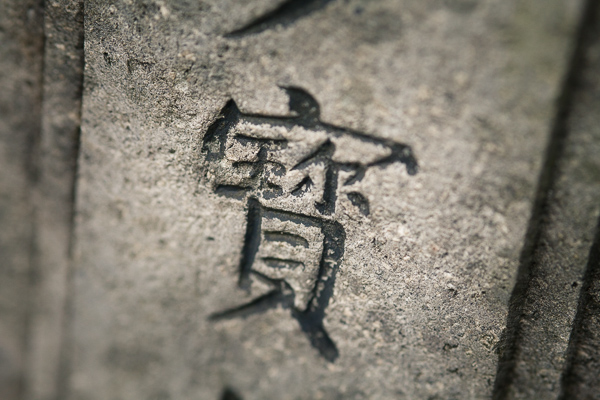
This photo is ideal to demonstrate the difference:
Using the Clarity slider in Lightroom

Using the Clarity slider in Lightroom

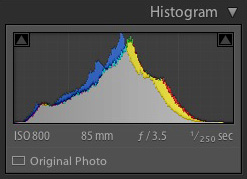
It was taken on an overcast day and the light was very flat. This is confirmed by the histogram, which has gaps on both the left and right-hand sides (screen capture image to the right).

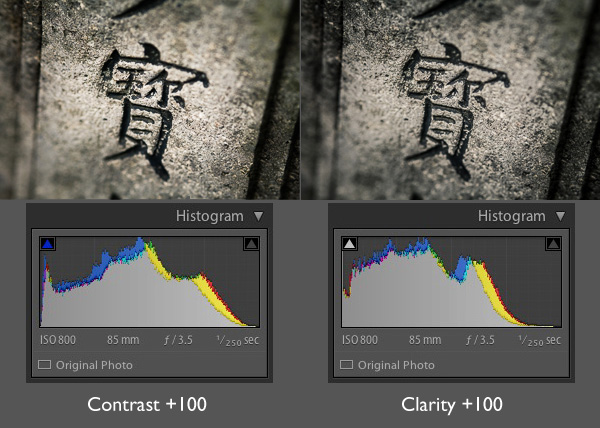
Now let’s see what happens when we set the Contrast slider, and then the Clarity slider, to their maximum settings of +100:
Using the Clarity slider in Lightroom

The most obvious difference at this scale is that the Contrast slider has a more far reaching effect. It makes both the shadows darker and the highlights brighter, stretching the histogram in the process.

The Clarity slider works differently. It increases contrast, but in the mid-tones only. The highlights aren’t affected, and if anything the photo becomes darker as the Clarity slider has a greater effect on dark tones than the Contrast slider.

Here’s a close-up of both images so you can see the effect in more detail. Look closely and you’ll see that the Clarity slider brings out more texture than increasing Contrast.
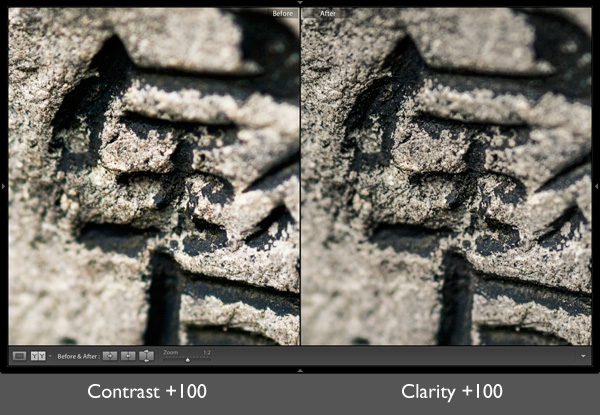
Using the Clarity slider in Lightroom

That’s the key to using this slider successfully. Increasing mid-tone contrast brings out texture and detail, increasing the tactility and apparent sharpness of the image. That’s what the Clarity slider is designed to do. Now I’m going to show you some practical applications.

1. Emphasizing texture

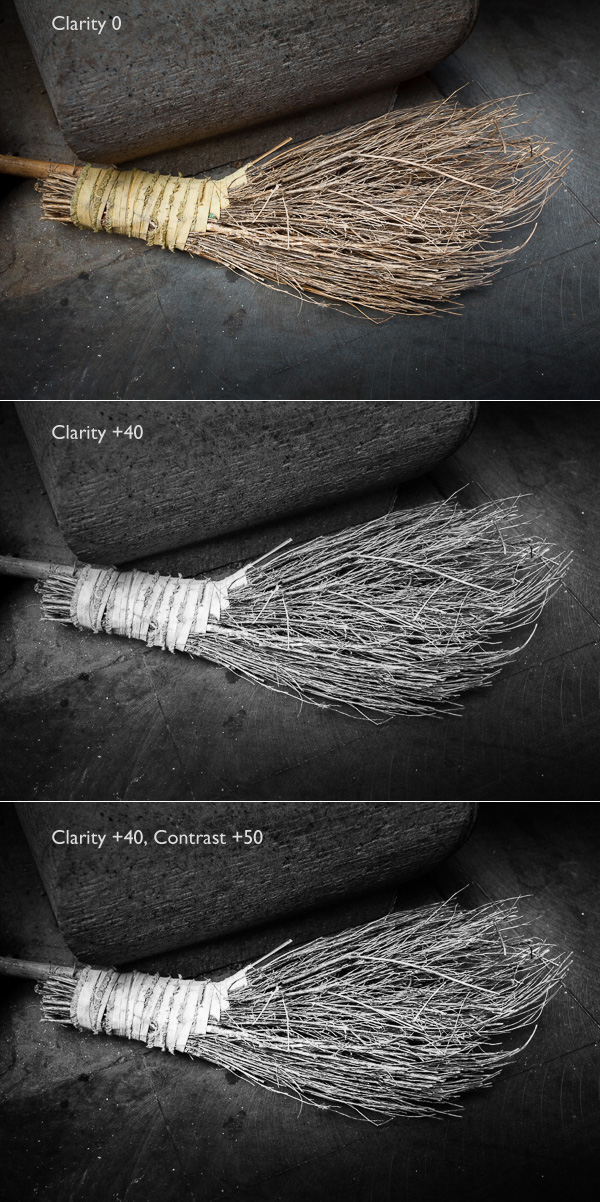
The Clarity slider in the Basic panel is a  global adjustment – meaning that, moving this slider affects the entire image. A small but subtle boost to Clarity can lift just about any image. Photos with more texture, such as the one below, may benefit from a larger increase in Clarity to bring out the texture and detail. This technique is especially effective in black and white. Plus, there’s nothing to stop you increasing contrast as well, especially in black and white, which usually benefits from higher contrast than colour images.
Using the Clarity slider in Lightroom

2. Emphasising texture locally

There is a theory in photography called visual mass that states that certain elements pull the viewer’s eye more than others (you read more about it in my article Composition, Balance and Visual Mass). One of these elements is sharpness. The eye goes to sharp parts of the image before it goes to unsharp, or out of focus areas.

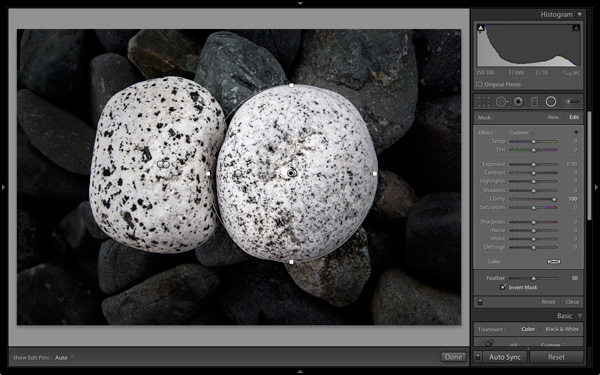
You can use this to your advantage by making local adjustments to Clarity rather than global ones. In the example below, I wanted the white stones to be the centre of attention. The principle of tonal contrast ensures that they are, and I emphasixed it here by placing Radial filters over the stones and setting Contrast to +100 in each one.
Using the Clarity slider in Lightroom

Note: The Radial filter is new to Lightroom 5. If you have an older version of Lightroom you can use the Adjustment Brush tool instead.

3. Emphasize the eyes in a portrait

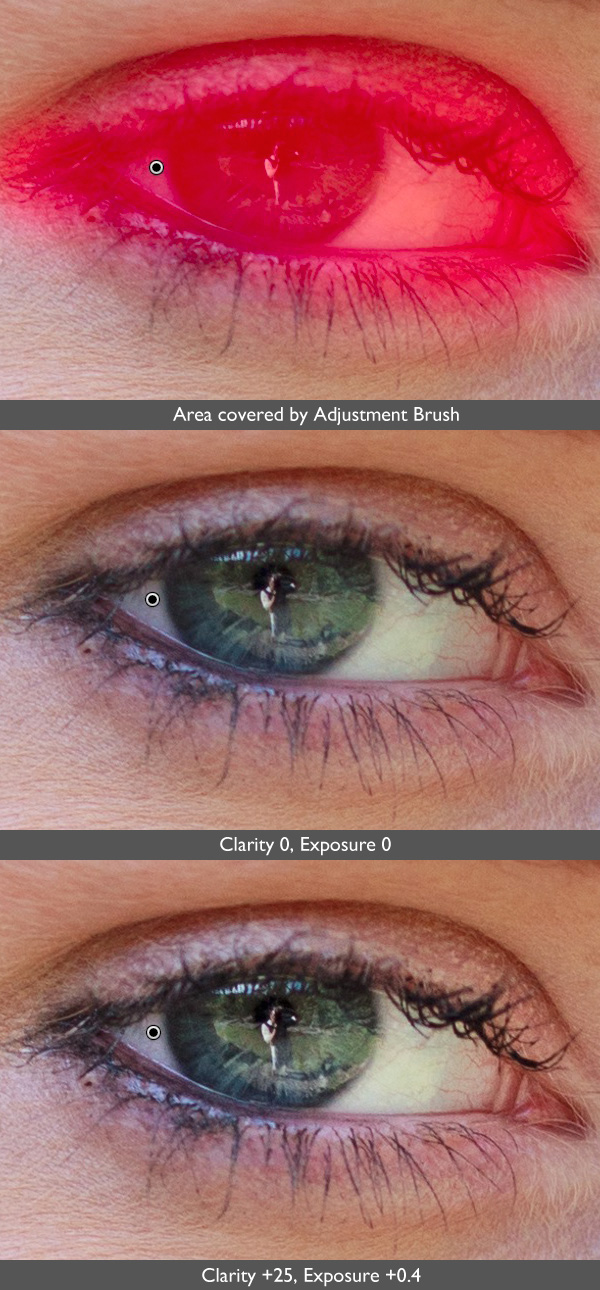
There’s another area where increasing Clarity locally can make a huge difference and that’s in portraiture. Use either the Radial filter or Adjustment Brush to increase the Clarity of your model’s eyes. Again, it’s a subtle, but often effective change. You can also do the same with your model’s mouth to emphasize the lips. Remember that as Clarity tends to make things darker, you’ll probably need to increase Exposure a little as well.
Using the Clarity slider in Lightroom

4. Soften skin

So far we’ve just looked at what happens when you increase Clarity, but you can also go the opposite way and decrease it in order to obscure detail, or soften part of the photo. You do have to be careful with this as the result can look a little false. A light touch is essential.

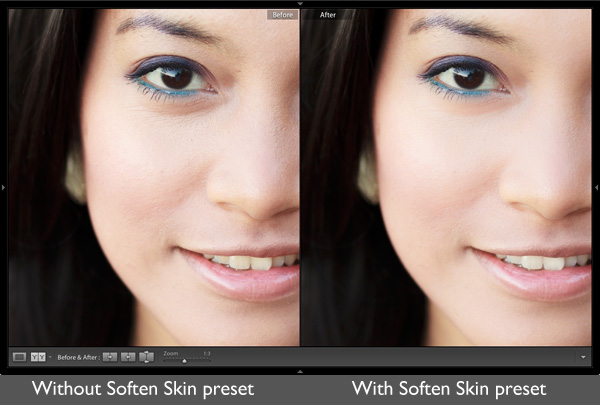
You can use negative Clarity as a kind soft focus effect in portraits. The most effective way is to increase Sharpness at the same time that you decrease Clarity. This helps retain realistic looking texture in the skin and avoids the false effect I spoke of earlier.

Lightroom has a built-in Adjustment Brush preset called Soften Skin which does exactly that. You can see the effect here. It’s subtle, look at the area under the model’s eyes if you’re not sure what the difference is:
Using the Clarity slider in Lightroom

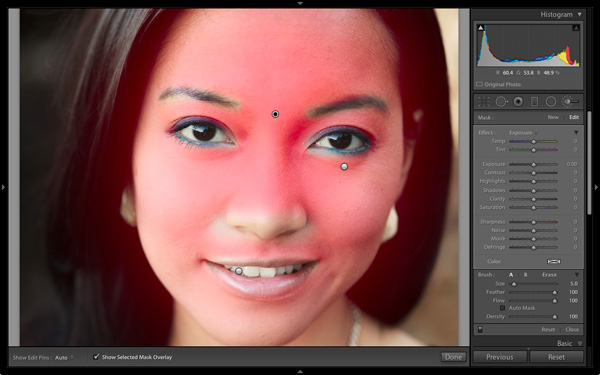
To use the Soften Skin preset, start by activating the Adjustment Brush and paint in the area you want to apply the preset to (shown in red below). Leave the eyes, eyebrows, mouth and tip of the nose alone as you don’t want to soften those areas.
Using the Clarity slider in Lightroom

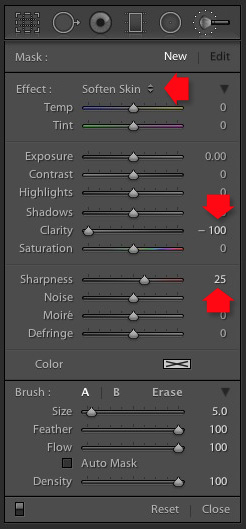
Select Soften Skin from the Effects menu. Lightroom sets Clarity to -100 and Sharpness to +25.
Using the Clarity slider in Lightroom

Using the Clarity slider in Lightroom

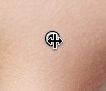
This is the strongest Soften Skin preset. If it’s too strong, you can reduce it by hovering the mouse over the Adjustment Brush pin until the double arrow icon (left) appears. When you see it, hold the left mouse button down and move the mouse left. Lightroom reduces the Clarity and Sharpness settings proportionally. Moving the mouse left, reduces the settings, moving it right increases them. Let go when it looks good to your eye. (You can also adjust the sliders manually)

Your turn

How do you use the Clarity slider? I’m curious to see what applications you have come up with for it.

Let us know in the comments, and feel free to share your photos so we can see what you have done.


Mastering Lightroom: Book Two
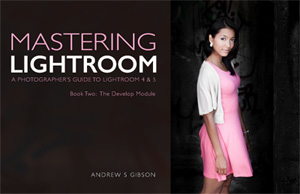
Mastering Lightroom: Book Two – The Develop Module ebookMy new ebook Mastering Lightroom: Book Two – The Develop Module teaches you how to process your Raw files in Lightroom for spectacular results. Written for Lightroom 4 & 5 it takes you through every panel in the Develop module and shows you how to creatively edit your photos. It’s now 40% off at Snapndeals for a limited time only.

The post Four Ways to Improve Your Photos With the Clarity Slider in Lightroom by Andrew S. Gibson appeared first on Digital Photography School.


Digital Photography School

 
Comments Off on Four Ways to Improve Your Photos With the Clarity Slider in Lightroom

Posted in Photography


DxO Optics Pro 9.1.4 supports Nikon D4s and four other cameras

20 Mar

opticspro8logo_large.png

DxO Labs has released version 9.1.4 of its DxO Optics Pro software. Both the Elite and Standard versions gain support for the Sony A5000, Leica X Vario and GoPro Hero 3+ Black edition. The Elite version also gives support for the Nikon D4s. The update also adds 170 lens and cameras combinations to its library, with a list of over 18,000 combinations now available. Click through for the download link.

News: Digital Photography Review (dpreview.com)

 
Comments Off on DxO Optics Pro 9.1.4 supports Nikon D4s and four other cameras

Posted in Uncategorized


Kowa to make three manual focus lenses for Micro Four Thirds

17 Feb

kowa2.png

Japanese optical company Kowa – best known for its spotting scopes and binoculars – has revealed that it plans to make three lenses for Micro Four Thirds cameras. The Kowa Prominar 8.5mm F2.8 MFT, 12mm F1.8 MFT and 25mm F1.8 MFT will all feature manual focus and aperture control, and use low-dispersion XD glass and aspheric elements to minimise distortion and aberrations. They’re due to be released in summer 2014.

News: Digital Photography Review (dpreview.com)

 
Comments Off on Kowa to make three manual focus lenses for Micro Four Thirds

Posted in Uncategorized


Back Up Your Photos Four Ways!(Or Choose One And Go With It)

13 Feb

If your phone takes a plunge into a puddle, you’re going to wish you’d backed up your irreplaceable photos…

The video from the time you met Oprah. Photos from the top of Mt. Everest. A timelapse of your first place win at the donut eating contest.

Don’t wait until you wish you would have backed up your photos.

We’ve compiled our four favorite backup solutions, their pros, their cons and their how-to’s. Turns out it’s easy and it doesn’t have to be expensive.

Do not wait until your computer is actually on fire. That is entirely too late.

Find A Way That Suits You, Back Up Your Photos Today

(…)
Read the rest of Back Up Your Photos Four Ways!
(Or Choose One And Go With It) (589 words)


© laurel for Photojojo, 2014. |
Permalink |
No comment |
Add to
(Or Choose One And Go With It)”>del.icio.us

Post tags:


Photojojo

 
Comments Off on Back Up Your Photos Four Ways!(Or Choose One And Go With It)

Posted in Equipment


SLR Magic announces 17mm T1.6 lens for Micro Four Thirds

14 Dec

17mmT16-2.png

Hong Kong-based lens maker SLR Magic has announced an addition to its family of video-oriented manual focus fast primes for Micro Four Thirds. The 17mm T1.6 offers an angle of view equivalent to 34mm on full frame, and has geared focus and aperture rings. It will be available at the end of December 2013.

News: Digital Photography Review (dpreview.com)

 
Comments Off on SLR Magic announces 17mm T1.6 lens for Micro Four Thirds

Posted in Uncategorized


Lomography announces ‘Experimental Lens Kit’ for Micro Four Thirds

21 Oct

fisheye.png

Forget the Zeiss Otus 55mm F1.4, Sony Alpha 7R and RX10, Nikon 58mm F1.4 or the tiny Panasonic GM1 – last week’s real news was Lomography’s introduction of an ‘Experimental Lens Kit’ for Micro Four Thirds. Comprising a 24mm F8 standard lens, a 12mm F8 wideangle and a 160° F8 fisheye, the kit costs £79 / €89. Each of the lenses even has a built-in shutter with speeds of 1/100sec and Bulb, allowing in-camera multiple exposures, plus a T mode to hold the shutter open for normal live view. In addition all three have a slot for colour gel filters. Click through for full details.

News: Digital Photography Review (dpreview.com)

 
Comments Off on Lomography announces ‘Experimental Lens Kit’ for Micro Four Thirds

Posted in Uncategorized


Panasonic adds Leica 15mm F1.7 lens to Micro Four Thirds stable

18 Oct

15mm.png

Panasonic quietly announced the development of a Leica DG SUMMILUX 15mm F1.7 lens, which the company says will be an ideal companion to the DMC-GM1 also released today. Details are scarce at this point, but the lens (equivalent to 30mm on a Micro Four Thirds body) will have a manual aperture ring and will ship sometime next year. Also coming in 2014 are a Leica DG NOCTICRON 42.5mm F1.2 lens, as well as a budget-friendly Lumix G 35-100mm.

News: Digital Photography Review (dpreview.com)

 
Comments Off on Panasonic adds Leica 15mm F1.7 lens to Micro Four Thirds stable

Posted in Uncategorized


Four Techniques For AddingCinematic Polish to Your Videos

07 Oct

Extra photos for bloggers: 1, 2, 3

We’ve found the secret to making your video footage downright moving! The (not so) secret, is moving your camera as you shoot.

The Mobislyder makes it easy to add dimension to your videos with pro level pans and epically smooth pulls.

This gizmo is a shrunken down version of the big ‘ol sliders used on movie sets.

It’s made of precision cut aluminum and fitted with an adjustable clamp to hold tight to any camera phone.

We’ve been having a ball with this gadget and are here to share our four fave techniques for adding professional polish to your next videographic masterpiece.

Check Out The Mobislyder
$ 95 at the Photojojo Store

Why It’s Cool

Moving your camera while you shoot gives your videos a more movie-like quality simply because that’s what the pros do when they’re making movies!

Use any (or all) of the following techniques to give your vids that Hollywood look, no matter where you’re filming.

Track the Action

With a simple left to right (or right to left) push, follow your subject across a scene.

The effect is subtle and feels very natural because a smooth pan is precisely how humans take in a scene when they’re watching through their eyeballs, not a camera.

PRO-TIP: To give your viewers the feeling of scanning the scene at eye level, mount your Mobislyder to a tripod like we did for this vid.

Surprise! Master the Reveal

When your camera is on the move, you get to control what part of the scene your viewers are privy to.

Just wait till you see what’s around this corner, over this fence, behind this pole…

The possibilities are endless.

PRO-TIP: Use your slide behind an obstruction to change up the scene. When you slide back to the action, you’ll give your viewers a surprise!

Movin’ on Up (or Down)

The tide does it, pogo sitcks do it, even see-saws do it. Let’s do it. Let’s go up and down!

A vertical slide lets you smoothly scan an object that’s too tall to fit in a single frame or follow action that’s changing in elevation.

PRO-TIP: Meld together tracking the action and the art of the reveal, like we did in this video!

Zoom to Focus

Lock the focus on a specific object then pull away or move in close to throw it out of focus.

With an iPhone you can lock the focus by tap-and-holding on your subject until the focus box pulses.

Locking the focus on Android phones varies from model to model. Google your phone model and “focus lock” to find out how it’s done.

PRO-TIP: The Mobislyder lets you move your phone very smoothly, more quickly than your auto focus can handle. Leave your phone in auto focus mode to see your subject lose focus, then snap back into focus as your AF catches up.

Taking It Further

  • Mount a Photojojo Cell Lens onto your phone to shoot video with a fisheye, telephoto, wide angle or even macro view.
  • Slide your camera diagonally for a fun if somewhat wonky look. Wonky can be good!
  • Tie a string to your Mobislyder to slide your phone during filming, while you’re in the shot! Our pal Margo did that in this video here.
  • Head over to the Photojojo Shop and learn everything you’ve ever wanted to know about the Mobislyder and more!

Related posts:

  1. Pro-Tips for Shooting Better Instagram Videos Extra vids for bloggers: 1, 2, 3 “Well that’s weird,”…
  2. 10 Editing Tips for Making Killer Instagram Videos Extra vids for bloggers: 1, 2, 3 When it comes…
  3. Bubble Photography: 3 Insanely Cool Techniques Frolicking about the garden chasing butterflies and bubbles with camera…


Photojojo

 
Comments Off on Four Techniques For AddingCinematic Polish to Your Videos

Posted in Equipment