RSS
 

Posts Tagged ‘flagship’

Sony announces new flagship guide number 60 HVL-F60RM wireless flash

23 Feb

$ (document).ready(function() { SampleGalleryV2({“containerId”:”embeddedSampleGallery_0972431050″,”galleryId”:”0972431050″,”isEmbeddedWidget”:true,”selectedImageIndex”:0,”isMobile”:false}) });

Sony just released a new flagship radio-triggered wireless flash for its full-frame E-Mount cameras. The HVL-F60RM has a built in radio receiver, which means it can be triggered simply via a FA-WRC1M Wireless Radio Commander attached to your E-mount body. It’s a powerful unit with a guide number 60m at 200mm, ISO 100. The flash covers a zoom range of 20-200mm and promises to provide “uniform wide-range zoom coverage without shading with continuous shooting up to 220 flashes.”

The HVL-F60RM does not replace the HVL-F60M flash, which remains in Sony’s lineup for A-mount cameras. The RM version is designed specifically for E-mount (though it will work with A-mount, but without AF Assist), but even for A-mount it has the added benefit of not requiring a separate radio receiver mounted to the flash to be triggered wirelessly.

Several improvements have been made to make the RM version worth your money. First, you don’t need a separate radio receiver attached to your flash. Also, heat resistance has been increased by “as much as” 4x, recycle time has been reduced to 1.7 seconds, and a new External Battery Adaptor (the FA-EBA1 seen in the gallery above) can drop that recycle time even further to just 0.6 seconds.

Additional features include non-directional wireless radio communication from up to 30 meters away, support for up to 15 flash units (assigned to up to 5 groups) when the flash is mounted to a compatible camera and used as a transmitter, an LED Light and AF Illuminator, and a dust and moisture resistant design that “allows flash shooting even in challenging environments.” But there’s one important thing to keep in mind…

No truly usable AF Assist

Sony removed the AF assist beam from the original HVL-F60M that projects a red grid upon your subject to quickly help the AF system achieve focus on subject in total darkness, say, on the dance floor at a wedding. This is a huge omission and sad oversight. We have yet to see if any light is triggered – Sony’s claim that there’s an AF illuminator indicates that at least some AF assist light is triggered. But a blinding LED is not what subjects at events in the dark want thrown in their faces. Instead, Sony should’ve built in a an AF assist grid that’s projected onto nearby subjects for quick AF in low light. Since Sony’s AF pixels on most modern a7/a9 bodies actually use blue color filters, a blue AF assist grid would be ideal, and wouldn’t even bother subjects you’re focusing on significant.

We hope Sony develops a radio transmitter that projects a blue grid for AF-assist in the future, for fast AF in total darkness

Sadly, all Sony E-mount cameras will do with this flash is project a bright LED on your subject for focus, making it difficult to shoot professional events in low light. That’s a huge shame, and our last remaining hope is that Sony develops a radio transmitter to be mounted on-camera that projects this AF grid to help achieve focus quickly.

Here’s a quick video intro to this new flash:

To learn more, head over to the Sony product page for either the HVL-F60RM flash or the FA-EBA1 external battery. The HVL-F60RM costs $ 600 USD (€700), while the FA-EBA1 External Battery Adaptor will run you $ 250 USD (€300). Both products will begin shipping in April.

Press Release

Sony Launches New Flagship Guide Number 60 Flash

New HVL-F60RM Combines Overwhelming Continuous Flash Performance with Advanced Operability and Wireless Control

SAN DIEGO, Feb. 22, 2018 – Sony Electronics, a worldwide leader in digital imaging and the world’s largest image sensor manufacturer, has today announced a new flagship addition to its digital imaging range with the launch of the HVL-F60RM Flash.

Addressing the needs of the increasing numbers of professional photographers adopting the Sony ? system, the HVL-F60RM offers high-power flash output, reliable continuous performance and advanced control features with integrated radio control options.

The HVL-F60RM has a guide number of 60[i] and covers illumination angles from 20mm[ii] to 200mm[iii] providing uniform wide-range zoom coverage without shading with continuous shooting up to 220[v] flashes. The use of heat resistant materials and the deployment of new advanced algorithms means that heat resistance has been increased by as much as 4x[iv] compared to the previous model, HVL-F60M.

Further improvements have been made to the recycle time which has been reduced to 1.7 seconds[v] or just 0.6 seconds[v] with the new External Battery Adaptor, product code FA-EBA1. A unique benefit of previous Sony flashes, Quick Shift Bounce is included, allowing the photographers to quickly shift from horizontal to vertical orientation, 90 degrees left or right, upward by up to 150 degrees, and downward by 8 degrees for flexible positioning and optimum lighting for a wide range of scenes.

Independent light output level (LEVEL -/+) buttons allow direct control of output or compensation, supporting an efficient workflow. A comprehensive display facilitates adjustments and flash output level confirmation, and also provides intuitive access to flash output settings for paired wireless flashes.

Functions can be freely assigned to the unit’s four-way controller, center button, and control wheel for easy access when required. Furthermore, TTL flash output can be memorized and recalled in manual mode when needed for immediate use or use after minor adjustment. This is another feature that can simplify manual workflow and save time.

The dust and moisture resistant design[vi] of the HVL-F60RM allows flash shooting even in challenging environments and a new optional Rain Guard[vii], product code FA-RG1, provides added protection to the connection between the flash and camera[viii]. Another example of the complete attention to detail that has gone into the design of the HVL-F60RM, is the metal foot of the Multi Interface Shoe™ connection which has been re-designed for increased rigidity and reliability.

A pre-requisite for leading-edge studio set-ups, the wireless radio communication is non-directional so receiver flash units can be positioned anywhere up to approximately 30 meters[iii] away from the camera, even in situations where reflectors or other obstacles would interfere with optical communication. A HVL-F60RM mounted on a compatible camera[ix] functioning as transmitter can be paired with off-camera units functioning as receivers. Multiple flashes are supported with the user able to use up to 15 flash units, assigned in to up to 5 groups[x] or wireless flash control and the use of a pairing system effectively prevents interference from other electronic devices.

Pricing and Availability

The new HVL-F60RM will be available in North America in April, 2018 priced at approximately $ 600 US or $ 730 CA.

The new FA-EBA1 will be available in North America in April, 2018 priced at approximately $ 250 US or $ 330 CA.

The new FA-RG1 will be available in North America in April, 2018 priced at approximately $ 25 US or $ 30 CA.


[i] 200mm at ISO100 in metres

[ii] 14mm with wide panel

[iii] 35mm full-frame equivalent

[iv] Sony test conditions

[v] With Ni-MH batteries, Sony test conditions

[vi] Not guaranteed to be 100% dust and moisture proof

[vii] Not to completely protect against water ingress. When the camera is held in the portrait orientation or at a tilt for photographing, in particular, it may fail to protect water ingress

[viii] With this unit attached, the camera may fail to record audio during video shooting, depending on the model. For the camera models to which this precaution applies, visit http://www.sony.net/acc/rg1/.

[ix] Refer to the Sony support page for camera compatibility information. http://www.sony.net/flash/f60rm/

[x] In the Group flash mode. Up to 3 groups in the TTL or Manual flash mode

Articles: Digital Photography Review (dpreview.com)

 
Comments Off on Sony announces new flagship guide number 60 HVL-F60RM wireless flash

Posted in Uncategorized


Fujifilm announces X-H1 stills/movie flagship with in-body stabilization

15 Feb

$ (document).ready(function() { SampleGalleryV2({“containerId”:”embeddedSampleGallery_6737847400″,”galleryId”:”6737847400″,”isEmbeddedWidget”:true,”selectedImageIndex”:0,”isMobile”:false}) });

Fujifilm has unveiled the X-H1, a flagship 24MP APS-C camera that builds on the X-T2’s feature set by adding 5-axis image stabilization, a touchscreen and more advanced video capabilities.

The X-H1 gains the ability DCI 4K capture at 23.97p and 24p, in addition to UHD recording at up to 29.9p. It can also record F-Log footage internally for the first time and adds a movie filmstock style ‘Eterna’ Film Simulation mode. More advanced compression allows video capture at up to 200 Mbps: double that of the X-T2.

Movie shooting is also aided by a predominantly touchscreen-operated ‘Movie Silent Shooting’ mode, which deactivates the camera’s dedicated control dials.

The X-H1 borrows styling cues from the medium-format GFX 50S, including a top-panel status LCD and sloping viewfinder prism. It shares the X-T2’s top burst rate of 14 fps with electronic shutter or 8 fps with mechanical shutter, boosted to 11 fps with optional grip.

Like the X-T2, adding a battery grip extends 4K video shooting from 15 minutes to 29 minutes, 59 seconds. It also adds a headphone socket.

Click here to read our Fujifilm X-H1 First Impressions Review

Press release

FUJIFILM UNVEILS THE NEW X-H1, THE HIGHEST PERFORMANCE CAMERA IN THE X SERIES LINEUP

Introducing in-body image stabilization, professional video capabilities, and a range of new features in a robust, durable camera body

Valhalla, N.Y., February 15, 2018 – As a leader in advanced digital camera technology and outstanding image quality, FUJIFILM North America Corporation is excited to announce the new FUJIFILM X-H1, featuring a 24.3 megapixel APS-C sized X-Trans CMOS III sensor and X-Processor Pro image processing engine for outstanding image quality. The new X-H1 is the highest performance camera in the X Series line of mirrorless cameras, and the first to feature in-body image stabilization (IBIS), a new Flicker Reduction mode that allows for stable exposure under fluorescent and mercury lighting, DCI 4K and other impressive video capabilities.

“The new X-H1 is our first X Series model to feature in-body image stabilization, and we are very excited to introduce this camera to the market,” said Yuji Igarashi, General Manager of the Electronic Imaging Division & Optical Devices Division at FUJIFILM North America Corporation. “In addition to ensuring outstanding image quality, the X-H1 is fully equipped with an array of features and functionality specifically designed to enhance creative expression in a wide range of settings.”

The X-H1 boasts a newly designed, robust and durable body, and a range of features that support shooting in various situations by professional and experienced amateur photographers, and videographers. When used in combination with FUJINON lenses and Fujifilm’s signature color reproduction technology, the X-H1 produces outstanding image quality and video reproduction.

New 5.5 Stops In-Body Image Stabilization
The new X-H1 is the first X Series camera to feature in-body image stabilization, harnessing three axial accelerometers, three axial Gyro sensors, and a specially-developed dual-processor to achieve approximately 10,000 calculations per second. When combined with compensating mechanisms, the X-H1 produces uncompromised image quality and precision. 5-axis image stabilization is possible with all XF and XC lenses, with certain lenses capable of up to a maximum of 5.5 stops. In addition, a new spring mechanism has been added to reduce micro-vibrations caused by operation of the mechanical shutter. Photographers may also choose to use the electronic front curtain shutter or the electronic shutter, virtually eliminating the effect of vibrations to maximize the benefits of image stabilization.

Robust, Weather-Resistant Body Design and Easy Operability for a Wide Range of Shooting Environments
In addition to its dust and water-resistant properties and ability to operate in temperatures as low as 14°F \ -10°C, the X-H1 also features 25% thicker magnesium alloy than the X-T2. The camera also features a high quality, scratch-resistant coating and a compact, lightweight body that maintains high precision and strong resistance to impact shock torsion and other sources of deformation.

The new X-H1 features a high-magnification and high-precision electronic viewfinder with a magnification ratio of 0.75 times and 3.69 million dot resolution, leading the class for APS-C mirrorless cameras. The viewfinder display is extraordinarily smooth, with a display time lag of just 0.005 seconds and a frame rate of 100 frames per second, allowing the user to instantly confirm the movement of the subject and position the focus with great precision. The X-H1 also features a 3-direction tilt, 3-inch, 1.04 million dot electrostatic touch-panel LCD, which can be intuitively set to the desired angle. In addition, the 1.28 inch sub-LCD on the top of the camera, which emulates the design of the mirrorless medium format GFX 50S, allows for instant confirmation of shooting information.

The X-H1 incorporates additional improvements based on feedback from professional photographers, including a large grip design, leaf-spring switch for the shutter-release button, near-silent shutter sound, a new focus level, and a new AF-ON button and enlargements of buttons on the rear of the camera.

Comprehensive Range of Video Features Support Movie Production
The X-H1 is the first camera in the X Series to include ETERNA, a new film simulation mode that is ideal for shooting movies. This mode simulates cinematic film, creating understated colors and rich shadow tones, greatly enhancing creative freedom during post-processing. The X-H1 boasts many functional and performance improvements to video image quality, including the 1080/120P high-speed video mode (1/2, 1/4 and 1/5 speed slow motion) for recording spectacular slow-motion footage; F-log SD card recording which aids smooth workflow; a DCI 4K shooting mode (4096×2160); a 400% dynamic range setting (approximately 12 stops); 200 Mbps high bit rate recording; a high-sound quality internal microphone (24 bit/48 kHz); and verbal time codes.

First Flicker Reduction Mode and Improved Autofocus Algorithms
The X-H1 features a flicker reduction mode, allowing for stable exposure during burst shots even under fluorescent and mercury lighting. In addition, improvements to the autofocus (AF) algorithm have achieved a number of performance enhancements. Low-light limit for phase detection AF has been improved by approximately 1.5 stops—from 0.5EV to -1.0EV—raising the precision and speed of AF in low-light environments. The minimum aperture has been expanded from F8 to F11, and major improvements have been made to the AF-C performance while operating in zoom, making the X-H1 ideal for shooting rapidly moving subjects.

Vertical Power Booster Grip VPB-XH1
The Vertical Power Booster Grip (VPB-XH1) is a weather-resistant grip capable of operating at temperatures as low as 14°F/-10°C that fits two additional batteries to increase maximum number of shots to 900 (in normal mode) and increases the maximum period for shooting movies in 4K to about 30 minutes.
The Vertical Power Booster Grip features a shutter release button, focus lever, AE-L button, AF-ON button, command dial, Q button, and Fn button, providing the same ease of operation when using the camera in vertical or horizontal positions. The grip is equipped with a headphone socket to allow monitoring sound while recording, and includes recharging capability.

Wide Eyecup EC-XH W
The Wide Eyecup EC-XH W covers a broad area around the eye, greatly reducing light interference to enhance concentration during long shoots. The eyecup can be rotated in 90° increments, making it adaptable for either eye and for shooting either vertically or horizontally.

FUJIFILM X-H1 Key Features:

  • 24.3MP X-Trans CMOS III Sensor with primary color filter and X-Processor Pro Processor
  • 5-axis 5.5 stops in-body image stabilization
  • High-precision 0.5 inch, approx. 3.69 million dots OLED Color Viewfinder
  • Weather-resistant design; ability to operate in temperatures as low as 14°F/-10°C
  • ISO Sensitivity
    o Standard output: AUTO1 / AUTO2 / AUTO3 (up to ISO12800) / ISO200~12800 (1/3 step)
    o Extended output: ISO100/125/160/25600/51200
  • LCD Monitor
    o 3.0 inch, aspect ratio 3:2, approx. 1.04 million dots touch screen color LCD monitor(approx. 100% coverage)
  • Continuous Shootingo 14.0 fps (with the Electronic Shutter), 8.0 fps (with the Mechanical Shutter)o 11.0 fps (with the Mechanical Shutter and when fitted with VPB-XH1)
  • Movie Recording (using a card with the UHS Speed Class 3 or higher)
    o [4K (4096×2160)] 24P / 23.98P up to approx. 15min.
    o [4K (3840×2160)] 29.97P / 25P / 24P / 23.98P up to approx. 15min.
    o [Full HD (1920×1080)] 59.94P / 50P / 29.97P / 25P / 24P / 23.98P up to approx. 20min.
    o [HD (1280×720)] 59.94P / 50P / 29.97P / 25P / 24P / 23.98P up to approx. 30min.• Bluetooth® Ver. 4.0 low energy technology
  • New ETERNA film simulation mode
    o Simulates cinematic film, understated colors and rich shadow tones
  • New Flicker Reduction Mode
    o Provides stable exposure during burst shots even under fluorescent and mercury lighting
  • Advanced filters and Film Simulations, including ACROS
  • Accessories included:
    o Li-ion battery NP-W126S
    o Battery charger BC-W126
    o Shoe-mount flash unit EF-X8
    o Shoulder strap, Body cap, Strap clip, Protective cover, Clip attaching tool, Hot shoe cover, Vertical Power Booster Grip connector cover, Sync terminal cover, Cable protector, Owner’s manual

Availability and Pricing
The X-H1 will be available on March 1, 2018 in the U.S. and Canada. The X-H1 Body will be available for USD $ 1,899.95 and CAD $ 2,449.99 and the X-H1 Body with Vertical Power Booster Grip Kit will be available for USD $ 2,199.95 and CAD $ 2,799.99

Fujifilm X-H1 specifications

Price
MSRP $ 1899 (body only)
Body type
Body type SLR-style mirrorless
Body material Magnesium alloy
Sensor
Max resolution 6000 x 4000
Image ratio w:h 1:1, 3:2, 16:9
Effective pixels 24 megapixels
Sensor size APS-C (23.5 x 15.6 mm)
Sensor type CMOS
Processor X-Processor Pro
Color space sRGB, Adobe RGB
Color filter array X-Trans
Image
ISO Auto, 200-12800 (expands to 100-51200)
Boosted ISO (minimum) 100
Boosted ISO (maximum) 51200
White balance presets 7
Custom white balance Yes (3 slots)
Image stabilization Sensor-shift
CIPA image stabilization rating 5 stop(s)
Uncompressed format RAW
JPEG quality levels Fine, normal
File format
  • JPEG (Exif v2.3)
  • Raw (Fujifilm RAF, 14-bit)
Optics & Focus
Autofocus
  • Contrast Detect (sensor)
  • Phase Detect
  • Multi-area
  • Center
  • Selective single-point
  • Tracking
  • Single
  • Continuous
  • Touch
  • Face Detection
  • Live View
Autofocus assist lamp Yes
Manual focus Yes
Number of focus points 325
Lens mount Fujifilm X
Focal length multiplier 1.5×
Screen / viewfinder
Articulated LCD Tilting
Screen size 3
Screen dots 1,040,000
Touch screen Yes
Screen type TFT LCD
Live view Yes
Viewfinder type Electronic
Viewfinder coverage 100%
Viewfinder magnification 1.13× (0.75× 35mm equiv.)
Viewfinder resolution 3,690,000
Photography features
Minimum shutter speed 30 sec
Maximum shutter speed 1/8000 sec
Maximum shutter speed (electronic) 1/32000 sec
Exposure modes
  • Program
  • Shutter priority
  • Aperture priority
  • Manual
Built-in flash No (Small external flash included)
External flash Yes
Flash modes Auto, standard, slow sync, manual, commander
Flash X sync speed 1/250 sec
Drive modes
  • Panorama
  • Advanced
  • Single shot
  • Continuous L/M/H
  • Bracket
  • Video
Continuous drive 14.0 fps
Self-timer Yes (2 or 10 secs)
Metering modes
  • Multi
  • Center-weighted
  • Average
  • Spot
Exposure compensation ±5 (at 1/3 EV steps)
AE Bracketing ±3 (3 frames at 1/3 EV, 1/2 EV, 2/3 EV, 1 EV, 2 EV steps)
WB Bracketing Yes
Videography features
Format MPEG-4, H.264
Modes
  • 4096 x 2160 @ 24p / 200 Mbps, MOV, H.264, Linear PCM
  • 3840 x 2160 @ 30p / 200 Mbps, MOV, H.264, Linear PCM
  • 3840 x 2160 @ 25p / 200 Mbps, MOV, H.264, Linear PCM
  • 3840 x 2160 @ 24p / 200 Mbps, MOV, H.264, Linear PCM
  • 3840 x 2160 @ 23.98p / 200 Mbps, MOV, H.264, Linear PCM
  • 1920 x 1080 @ 60p / 100 Mbps, MOV, H.264, Linear PCM
  • 1920 x 1080 @ 50p / 100 Mbps, MOV, H.264, Linear PCM
  • 1920 x 1080 @ 30p / 100 Mbps, MOV, H.264, Linear PCM
  • 1920 x 1080 @ 25p / 100 Mbps, MOV, H.264, Linear PCM
  • 1920 x 1080 @ 24p / 100 Mbps, MOV, H.264, Linear PCM
  • 1920 x 1080 @ 23.98p / 100 Mbps, MOV, H.264, Linear PCM
Microphone Stereo
Speaker Mono
Storage
Storage types Dual SD/SDHC/SDXC (UHS-II compatible)
Connectivity
USB USB 3.0 (5 GBit/sec)
USB charging Yes
HDMI Yes (micro-HDMI)
Microphone port Yes
Headphone port No
Wireless Built-In
Wireless notes 802.11b/g/n + Bluetooth 4.0
Remote control Yes (via smartphone or wired remote)
Physical
Environmentally sealed Yes
Battery Battery Pack
Battery description NP-W126S lithium-ion battery & charger
Battery Life (CIPA) 310
Weight (inc. batteries) 673 g (1.48 lb / 23.74 oz)
Dimensions 140 x 97 x 86 mm (5.51 x 3.82 x 3.39)
Other features
Orientation sensor Yes
Timelapse recording Yes
GPS None

Articles: Digital Photography Review (dpreview.com)

 
Comments Off on Fujifilm announces X-H1 stills/movie flagship with in-body stabilization

Posted in Uncategorized


Nokia 8 flagship phone features 13MP dual-cam with Zeiss optics

17 Aug

HMD Global, the company behind the Nokia smartphone brand, has launched its long-anticipated Nokia 8 flagship. With a 5.3″ QHD IPS display covered in 2.5D Gorilla Glass 5, a Qualcomm Snapdragon 835 chipset, 4GB of RAM and 64 or 128GB storage options the Android device comes with high-end specification all-around and has a lot to offer in the camera department as well.

HMD says the rear cameras has been developed in collaboration with Zeiss but has not revealed any further detail. The unit features a 13MP RGB sensor with 1.12µm pixels, F2.0 aperture and optical image stabilization with a secondary 13MP monochrome sensor. As usual with this kind of system, image data from both sensor is combined for more detail, lower noise levels and better dynamic range. However, there is no word of a background-blurring portrait mode like it can be found on most dual-cam equipped devices.

There is also a dual-tone LED-flash and the in video mode the camera is capable of recording footage in 4K resolution. The front camera comes with a 13MP sensor and F2.0 aperture.

An interesting camera feature is the so-called “Bothie” mode which allows you to take pictures or record video with front and rear cameras at the same time. We’ve seen this function before on LG and Samsung phones but Nokia adds the ability to live-stream to Facebook or Youtube in this mode.

All the Nokia 8’s components are wrapped up in an IP54 rated aluminum uni-body which will be available in Gloss Blue, Tempered Blue, Steel, and Polished Copper. In Europe the Nokia 8 will cost you €599 (approximately $ 700). No information on availability in the US has been released yet.

Key specifications:

  • Dual-cam with 13MP RGB/Mono sensors, 1,12 um pixel size
  • OIS in the main module
  • F2.0 aperture
  • PDAF + laser AF
  • 13MP / F2.0 front camera with display-flash function
  • Dual-tone flash
  • 5,3” IPS LCD QHD 2.560 x 1.440 display, Corning Gorilla Glass 5
  • Qualcomm Snapdragon 835
  • 4GB RAM, 64/128GB storage
  • microSD support up to 256GB
  • Android Nougat 7.1.1
  • 3090 mAh battery with Qualcomm quick charge
  • Splashproof body with IP54 rating

Articles: Digital Photography Review (dpreview.com)

 
Comments Off on Nokia 8 flagship phone features 13MP dual-cam with Zeiss optics

Posted in Uncategorized


HTC launches U11 flagship smartphone

17 May

Taiwanese manufacturer HTC today launched it latest flagship smartphone, the HTC U11. The new model’s stand-out features is called Edge Sense. It lets you squeeze the phone’s edge in order to execute specific actions, for example take a picture.

The main camera specification looks similar to the HTC 10 but the 12MP BSI CMOS sensor with 1.4 micron pixel size has been updated. Light is captured through a fast F1.7 aperture and optical image stabilization is available as well. The camera also features a dual-LED flash and 4K video recording. In video mode the U11 offers 3D audio recording which is powered by 4 microphones. The front camera comes with a 16MP sensor and F2.0 aperture. 

Images can be composed and viewed on a 5.5-inch QHD Super LCD 5 display that is covered with Gorilla Glass 5 for protection. The Android 7.1 OS is powered by a Snapdragon 835 chipset and 4GB of RAM. 64GB of on-board storage are expandable via a microSD-slot. The U11 comes with a 3,000 mAh battery, which supports Qualcomm’s Quick Charge 3.0 as well as a power saving mode. Unfortunately the new HTC has to make do without a 3.5mm headset jack, though. 

All the technology is wrapped up in a body with a reflecting glass back and IP67 certification for water and dust resistance. The new device will be available in Amazing Silver, Sapphire Blue, Brilliant Black, Ice White, and Solar Red worldwide from May 2017. In Europe the U11 will set you back €749 (US$ 825). No pricing information for the US has been released yet.

Key specifications:

  • 12MP BSI CMOS sensor with 1.4?m pixel
  • F1.7 aperture
  • Optical Image Stabilization (OIS)
  • Dual LED flash
  • 4K video recording with Hi-Res audio and 3D audio recording
  • Pro mode with manual control, 32 sec. long exposure, and RAW format support
  • Slow motion video (1080P@120 fps)
  • 16MP/F2.0 front camera
  • 5.5-inch QHD Super LCD display
  • Snapdragon 835 chipset
  • 4GB RAM / 64GB storage

Articles: Digital Photography Review (dpreview.com)

 
Comments Off on HTC launches U11 flagship smartphone

Posted in Uncategorized


Review of the New Flagship DX Camera – The Nikon D500

20 Jan

Everyone thinks they need a full frame camera but are they really that much better? Most people feel the only reason they have cropped sensor cameras is because they can’t afford a full frame one. Then you have to wonder why Nikon have produced one that is not full frame and comes with an expensive price tag. So who would be interested in the new Nikon D500? There are a lot of people who would love this camera and what it has a lot to offer.

Earlier this year Nikon released the new flagship D500 camera as part of their DX range or cropped sensor line-up. It is fast and designed with a specific user in mind. It is also one of the first cameras Nikon has produced that is using Snapbridge, the new phone app that allows you to take photos and upload them to your phone for sharing on social media straight away.

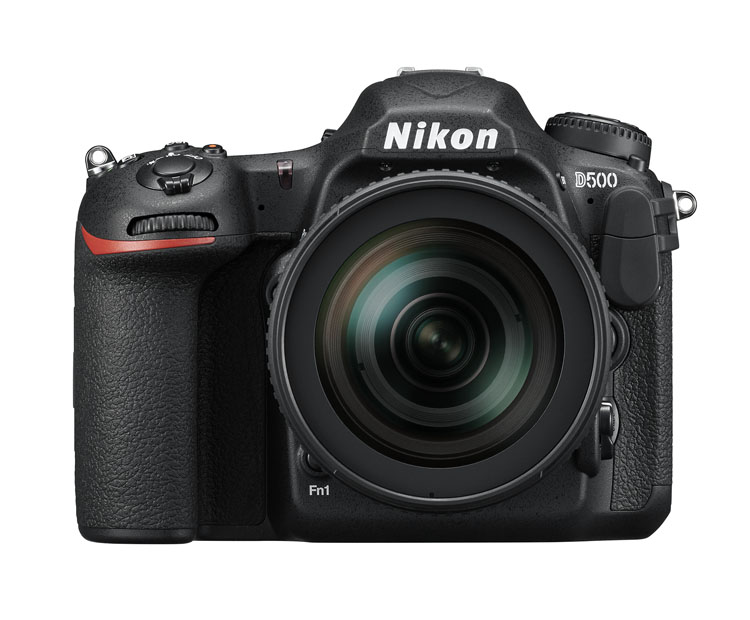
Nikon D500 review

The Nikon D500 – image courtesy of Nikon.

Price out the Nikon D500 on Amazon or B&H Photo’s site.

First impressions

Unlike many of the other DX cameras, it is quite large. People tend to think that cameras with cropped sensors are smaller, but the D500 is in the Pro range and you can see that just by looking at it. It looks like a camera that a professional photographer would use, and many indeed do.

One of the first things I noticed was how similar many of the controls and the layout is to the D800. In many ways, it seems like a cropped sensor version of that camera. This also means that most of the buttons are around the camera body, so you don’t have to keep going back to the menu to change settings. There are everywhere, but it doesn’t make it confusing. You can make changes without really having to stop and look at what you are doing.

Nikon D500 review

Sunset image shot with the Nikon D500.

If want to do long exposure photography there is a small blind in the viewfinder that will close to stop light leaking into your image. It means you never have to worry about whether or not you have the cover for it. You just need to remember to use it when doing long exposures. Very handy.

ISO and noise

The D500 is Nikon’s replacement for the popular D300 range that they stopping making a few years ago. The D300 was fast and great for many types of photography, however, the ISO range was not good. As soon as you increased the ISO the images became very noisy.

It also didn’t go very high, with ISO 3200 being the maximum. The D500 ISO goes up to 512,000, so it will get you images no matter the shooting conditions. The level of noise in the images is also significantly better and not as noticeable.

Review of the New Flagship DX Camera - The Nikon D500

Image shot using a tripod with the Nikon D500 at ISO 200.

Review of the New Flagship DX Camera - The Nikon D500

Image shot with the Nikon D500 hand held at ISO 6400.

Megapixels and image size

The camera is 20 megapixels, which is enough for most people. A RAW image is around 25 MB. Not as large as some cameras, but still large enough that you have to consider how you will store them. Jpegs are a lot smaller, but you don’t get as much information to work with as shooting RAW.

Battery

The battery is very similar to the battery for the D800 but it is a new version, so should only be used in the D500. If you have similar batteries for other cameras it is a good idea to mark them in some ways so they don’t get mixed up. You don’t want to be putting the wrong battery in the camera. While the battery is different the charger is the same.

The battery lasts a long time and you can safely go out for a day of shooting and not use much. Like most Nikon cameras you can go out and shoot for a few days without having to recharge it. Though that is dependent on how many photos you take. Of course, if you do a lot of chimping (image review on the camera) or use LiveView frequently the battery will run out faster. Likewise, if you’re shooting in the cold.

The batteries do typically last a long time as well. You can use a battery for quite a few years before you start noticing that it doesn’t last as long.

Remote shutter release

Review Nikon D500 DX camera

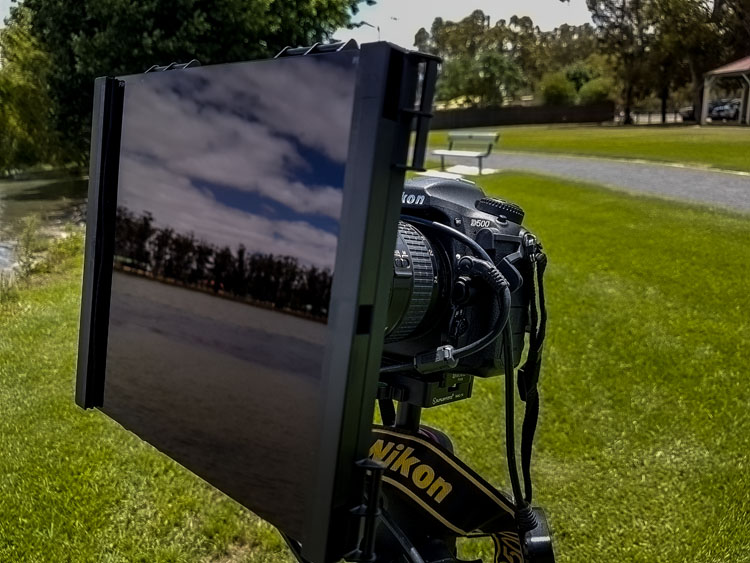
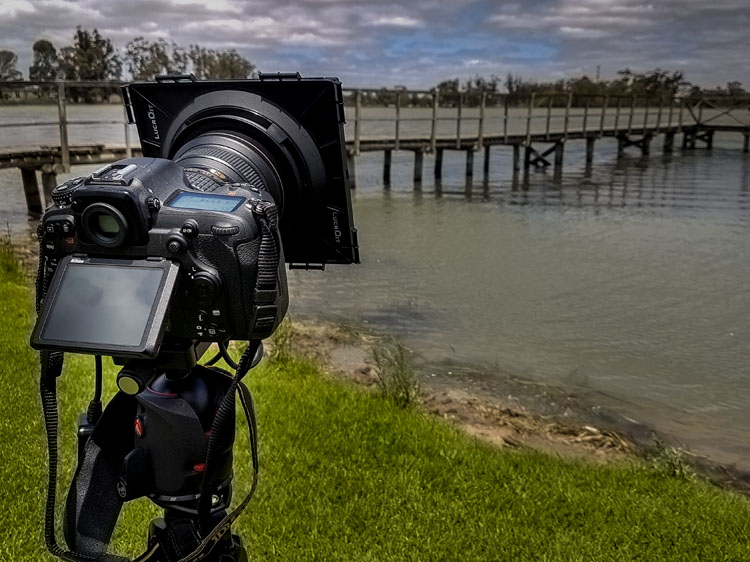
Using some ND filters and the MC-36 remote shutter release on the Nikon D500 for some long exposures.

When you are looking at a new camera you need to be aware of all the accessories and whether or not you will have to buy a lot of new ones. The remote shutter release that I purchased for the D300s, the MC-36, was fine for the D800, and it is also good to use on the D500. That makes it a good match for the gear I already have. It is something you need to consider anytime you are buying a camera, it isn’t just the expense of the camera, but what other equipment you may need as well.

Review Nikon D500 DX camera

A long exposure of some recently painted silos using the D500.

Focusing area

The focusing area takes up larger space in the Nikon D500 than it does in other bodies. It has the same focusing center as the Nikon D5, their top pro model, but on the cropped sensor of the D500. In practice, that means you can focus on subjects almost up to the very edges of the viewfinder. You can focus on a much larger area than other DX cameras.

If you want to use spot focusing, but have found it hard in the past because you couldn’t focus on subjects at the side, it is now possible to do that. Any camera that makes focusing easier for you has to be good.

Memory card


The D500 has two slots for memory cards. You can put an SD card in one, and the other is for XQD cards, which are reasonably new but only needed for a few Nikon cameras. It is mainly used in the higher end bodies that are fast and shoot a lot of frames per second, which is why the card is used. Normal cards would find it hard keeping up with the speed and writing the images. If you are taking photos at 10 frames a second it is important.

Apparently, you can buy the cards at all good camera stores. Though, you would also need a memory card reader for it as well.

Touchscreen

The screen at the back is a touchscreen which makes it easy to scroll through your images. It works a lot like your smartphone. You can make the images bigger or smaller and flip through them with your fingers.

leannecole-nikon-d500-review-15

The back screen of the D500 can be moved for better viewing and is also a touchscreen.

Crop factor

The Nikon D500 has the 1.5x crop factor. Basically, that means that if you have a full frame lens, like the 70-200mm, when you use it on the D500 the lens becomes essentially like a 105-300mm. It is the advantage of using a DX camera body with high-quality lenses.

Nikon D500 review

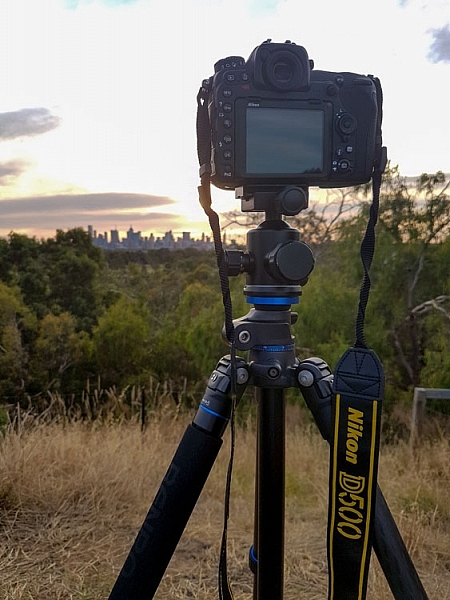
It is all set up to take some sunset photos of the city of Melbourne.

Who is the Nikon D500 for?

The most likely person to buy this camera is someone who is interested in the 1.5x crop factor. Photographers who can’t afford those great big long lenses, but want to be able to get as close as they can to the action. Having the ability to make a 300mm lens go to 450mm is fantastic. The longer the telephoto lens, the more expensive it is, so the cropped sensor is great for that reason.

leannecole-nikon-d500-review-20

The sunset shot with the Nikon D500. The DX camera allowed me to get a lot closer with the 80-200mm, this was at 277mm.

Sports photographers would also be interested where speed and getting closer to the action is very important. Full frame is great, but to get a camera that is fast enough to shoot lots of frames per second you would need to spend around $ 6500 on a Nikon D5 or similar. If you don’t have that kind of money, $ 2000 USD will get you the Nikon D500 which will do many of the things that the others can, but you also get the cropped sensor.

There are many other kinds of photographers who would benefit from the D500 as well. Bird and wildlife photographers would love being able to get more length with their lenses. The 10 frames per second capability of this camera would also be an advantage for capturing birds and animals on the move.

Macro photographers will get a lot closer to their subjects with their lenses, and when you put on extension tubes, a whole new world will be seen.

leannecole-nikon-d500-review-23

Taken using the D500 and the Nikon 105mm macro lens, with the cropped sensor you can get in a lot closer than you can with a full frame.

Snapbridge app

This is a new app that Nikon has developed that makes it possible to connect your smartphone with the camera. It is unlike others that use Wi-Fi to do it, Snapbridge stays connected to your phone all the time. You can upload photos, use it to take your photos, and it also keeps your camera’s firmware up to date.

It is available for Apple iPhones and Android, though it is a little harder to use with an Android.

Using the camera

I found the camera easy to handle and work my way around. Then again, I’ve been using Nikon cameras for many years, and as previously stated I found a lot of similarities with the D800. I found the weight fine, but others who picked it up thought it was heavy. Then again, you would expect a camera of this quality to be that heavy. Good quality cameras of this caliber are always a bit hefty.

The fast frame rate blew me away and as someone who always likes to bracket photos to get more options, I really enjoyed it. With the D800 I would never do more than three shot hand holding, but with the D500 I felt there was enough speed to let me do five. I also really enjoyed just listening to how fast it was.

leannecole-nikon-d500-review-14

Using the D500 for night photography in Melbourne.

If I had one criticism, it would be that there is an overall blue cast and how, in some cases, it made the blues far bluer than they really were. I’m not a fan of blue in images, so I didn’t like it, but I know a lot of other photographers would.

Overall

The Nikon D500 is a great camera and anyone who purchases it will really enjoy using it. Full frame is great, but if you are a photographer who likes to zoom in, then the DX may suit you more. If you shoot sports, birds, wildlife or macro, look at this camera, it could be just what you need.

Price out the Nikon D500 on Amazon or B&H Photo’s site.

leannecole-nikon-d500-review-19

The sun as it sets and the camera taking photos.

googletag.cmd.push(function() {
tablet_slots.push( googletag.defineSlot( “/1005424/_dPSv4_tab-all-article-bottom_(300×250)”, [300, 250], “pb-ad-78623” ).addService( googletag.pubads() ) ); } );

googletag.cmd.push(function() {
mobile_slots.push( googletag.defineSlot( “/1005424/_dPSv4_mob-all-article-bottom_(300×250)”, [300, 250], “pb-ad-78158” ).addService( googletag.pubads() ) ); } );

The post Review of the New Flagship DX Camera – The Nikon D500 by Leanne Cole appeared first on Digital Photography School.


Digital Photography School

 
Comments Off on Review of the New Flagship DX Camera – The Nikon D500

Posted in Photography


Red Cross & IKEA Install Replica of Real Syrian Apartment in Flagship Store

16 Nov

[ By WebUrbanist in Design & Guerilla Ads & Marketing. ]

ikea-mockup

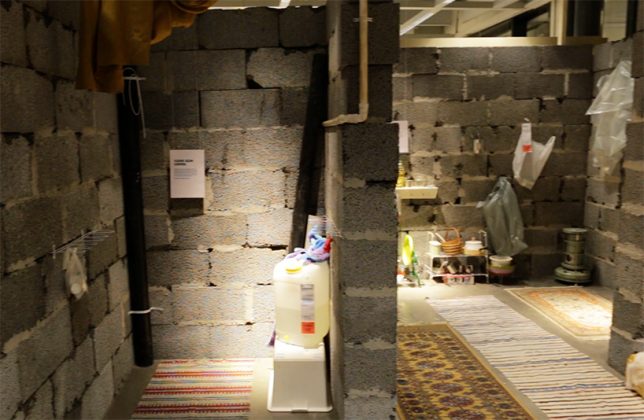
Amidst the colorfully furnished spaces mocked up in IKEA’s flagship store sits a place of jarring contrast, a replicated version of an actual 260-square-foot house that is home to a family of nine in Syria.

IKEA has done installations before and worked on flat-pack refugee shelters, but this piece really brings the problem home, putting it in front of consumers as they shop. In collaboration with the Red Cross, the displays also feature tags that offer people ways to help by donating to relief efforts.

ikea-replica-home

ikea-house-tag

ikea-syria-installation

The original house in Damascus, Syria after which this one in Slependen, Norway was modeled houses Rana and eight of her family members. Both the real and replica versions feature hard cinder block walls — the latter relays stories of the residents, how they live and what they lack in terms of food, medicine and clean water.

ikea-red-crosss-collaboration

ikea-interior

ikea-house-replica

“We had been working with the Red Cross for months, so we had a lot of footage from Syria,” said the agency behind the idea. “But no matter how emotional it was, nothing got close to the experience of visiting people in a war zone. We realised we could give Norwegians that experience at IKEA. At the one place where you think of and plan the future — the apartment served as a physical reminder of how lucky we are.”

Share on Facebook


[ By WebUrbanist in Design & Guerilla Ads & Marketing. ]

[ WebUrbanist | Archives | Galleries | Privacy | TOS ]


WebUrbanist

 
Comments Off on Red Cross & IKEA Install Replica of Real Syrian Apartment in Flagship Store

Posted in Creativity


Sony’s new flagship FDR-X3000 action cam shoots stabilized 4K video

09 Sep
The new Sony X3000 both offer image stabilization, with the X3000 (left) shooting 4K and the (center) Full HD. Both are sold in optional kits with the new, smaller live-view remote.

Sony has announced that the 4K-capable flagship FDR-X3000 action camera (previously announced in Japan) will go on sale in North America, along with the Full HD FDR-AS300 action camera. Both makes use of Sony’s Balanced Optical SteadyShot image stabilization (BOSS – yes, really), which can be used when shooting 4K video on the X3000 and Full HD on the AS300. 

Stabilized 4K footage from an action camera is a very big deal. Of the cameras included in our recent 2016 Action Camera roundup, only one is capable of stabilized 4K, and it’s an adventure tracker, not an action camera.

Both the X3000 and AS300 also feature new Zeiss lens designs, and utilize 8.2MP BSI Exmor R CMOS sensors with full sensor readout and no pixel binning. The models feature identical designs, and are smaller than previous Sony action cameras. The user interface has also been vastly improved.

The X3000 will be sold body-only for $ 400 and kitted with a new 30% smaller live view remote (X3000R) for $ 450. The AS300 will be sold body-only for $ 300 and kitted with the new live view remote (AS300R) for $ 450. Both will be available in North America in late September.

Press Release:

Sony Announces new Flagship 4K and HD Action Cams with Superior Image Stabilization

New 4K and HD POV Cameras Feature Balanced Optical SteadyShot® Image Stabilization, Live-View Remote, 4K Time-lapse Capture and other professional capabilities

SAN DIEGO, Sept. 9, 2016 – Sony Electronics, a worldwide leader in digital imaging, has today introduced their first POV cameras to feature the innovative Balanced Optical SteadyShot (B.O.SS) image stabilization technology, the FDR-X3000R 4K*  model and HDR-AS300R Full HD model.

The flagship feature of the two new cameras – Balanced Optical SteadyShot* – is an advanced form of image stabilization where internally, the camera’s lens and sensor are joined and moved together to compensate for camera shake caused by excessive motion, whether shooting handheld with optional accessories or during a fast-paced sporting activity. This is a particularly effective technology when paired with a POV action camera design as it ensures captured video footage is smooth and stable – even in 4K or high-frame-rate shooting modes.

Advanced Movie-Making Capabilities

The versatile new FDR-X3000R and HDR-AS300R Action Cam feature a new ZEISS® Tessar lens with significantly less lens distortion than previous models3. They are also equipped with a new back-illuminated Exmor R® CMOS sensor with large pixels designed for 16:9 aspect ratio video plus a powerful BIONZ X™ processor, ensuring that video quality remains consistently strong across all settings.

The new cameras utilize full pixel readout without pixel binning technology to produce exceptionally high resolution and accurate colors in both 4K (FDR-X3000R only) and Full HD videos. This allows them to read and process data from all of the sensor’s pixels, producing highly detailed video content with minimal noise and ‘jaggies’ in a variety of formats including the high data stream XAVC S™ codec (100Mbps in 4K and 50Mbps in Full HD) 4. The FDR-X3000R can also shoot 120p in Full HD and HDR-AS300R can shoot 120p in HD for impressive slow-motion footage 5. Both cameras offer a new angle of view adjustment, with a 3x smooth zoom or preset “wide”, “medium” and “narrow”6 settings. This allows shooters to get even closer to the action during movie recording, and reducing barrel distortion common with wide view POV cameras.

FDR-X3000R and HDR-AS300R each have a built-in stereo mic7 with wind noise reduction to reduce the impact of wind interference on overall audio quality, and are equipped with stereo microphone input for advanced recording.

LiveView Remote and User Interface

Sony’s new Action Cam models will be offered in a kit with a compact Live-View Remote8 that is about 30% smaller than previous9 version. The remote, with a mountable design, acts as an extension of the camera and allows users to see what is being recorded when the camera is not accessible. The remote has the ability to control various functionalities including shooting settings, start/stop recording, power on/off and more. It also features an “auto display off” mode that turns off its LCD screen display automatically during shooting in order to save power of both camera and remote.

The versatile remote accessory can be attached to various optional accessories such as Finger Grip (AKA-FGP1), Shooting Grip (VCT-STG1) or Handlebar Mount (VCT-HM2) using supplied mount adaptor, or worn as a wristband using supplied belt. Users can also utilize Sony’s PlayMemories Mobile™ application – available for both Android and iOS – to control the new Action Cam with a smart device10.

Based on extensive feedback from athletes, filmmakers and more casual users, the new cameras and Live-View Remote feature a more in-depth user interface and menu system, with a rich indication of camera settings that makes it easier to navigate menus and customize settings as needed. The new models also offers “Wi-Fi high power mode”, which extends to communication distance between the camera and Live-View Remote11 for more flexible shooting.

Additional Feature Enhancements

The FDR-X3000R and HDR-AS300R both include a unique Time-lapse Capture feature that shoots still images in pre-set intervals that can later be transformed into a stunning 4K time-lapse movie utilizing the Action Cam Movie Creator software12. The Action Cam App13 can also create time-lapse movies in Full HD.

Built-in GPS inherited from previous models3 is available, allowing location tracking and speedometer to be added to the video file when Action Cam Movie Creator is used. This also allows GPS Data Overlay on video to read your speed data and generate another video file14 that includes your route, speed information, etc.

Additionally, an updated version Sony’s own in-built movie creator – Highlight Movie Maker15 – is available in the new cameras. The innovative feature, which now utilizes face detection technology, automatically assembles footage into a video highlight package and pairs it with custom music for the ultimate viewing experience.

For the more advanced user, there are an expanded scope of manual controls and setting adjustments including white balance, and auto exposure shifting. Loop recording is also available, allowing users to maximize usage of available memory card space to ensure they get the exact shot they are looking for.

The FDR-X3000R and HDR-AS300R have a splash-proof body and are waterproof with supplied Underwater Housing (MPK-UWH1) 7 that is certified down to 197 ft. / 60m in depth. A new range of accessories for Action Cam has also been announced, including the Finger Grip (AKA-FGP1) that is an ideal travel accessory as it enables flexible one-handed shooting and the MC Protector (AKA-MCP1) for extra protection from lens scratches and dirt.

Pricing and Availability

The new Sony FDR-X3000 will be sold as body only for about $ 400 US ($ 550 CA), and will be offered as a kit (model FDR-X3000R) with the new Live-View Remote for about $ 550 US ($ 700 CA).

The new Sony HDR-AS300 will be sold as a body only for about $ 300 US ($ 400 CA) and will be offered as a kit (model HDR-AS300R) with the new Live-View Remote for about $ 450 US ($ 550 CA).

The new AKA-FGP1 finger grip will be sold for about $ 25 US ($ 40 CA), and the AKA-MCP1 lens shield will be sold for about $ 35 US ($ 50 CA).

All products will be available in North America in late September at authorized dealers.

Notes:

1) 3840 × 2160 pixels.
2) Distortion in image quality or out-of-focus may occur when used in close proximity to vibrating motors and engines. Image results can be improved by using Action Cam with optional accessory Motor Vibration Absorber for X3000/AS300 (AKA-MVA).
3) FDR-X1000V, HDR-AS200V.
4) A micro SDXC/SDHC Class 10 or higher is required for XAVC S recording. Micro SDXC/SDHC UHS-I U3 or higher is required for 4K 100Mbps recording.
5) Requires post-processing for slow-motion movie
6) Medium and narrow are not available in 4K, time-lapse capture, and high speed recording.
7) Recorded sound level is lower when using supplied Underwater Housing (MPK-UWH1).
8) Not sold separately. Included only as part of the FDR-X3000R, HDR-AS300R or HDR-AS50R.
9) Previous model is RM-LVR2.
10) Camera on/off control requires Bluetooth 4.0 compatible smartphone or tablet (iPhone/iPad or Android ver.5.0 or later) with PlayMemories Mobile ver. 5.5 or later.
11) The Live-View Remote may not be able to turn the camera on/off depending on the physical environment and the communication distance. The communication distance will be dependant on the physical environment and connected device.
12) Requires version 5.1 or later for Windows and 3.1 or later for Mac.
13) Requires version 2.0 or later of the application. Available for Android and iOS.
14) Requires version 5.2 or later for Windows and version 3.2 or later for Mac.
15) Requires a smartphone or tablet with PlayMemories Mobile ver.5.1 or later for the operation. Not available in XAVC S 4K, XAVC S HD 24p, and high speed recording modes.

Articles: Digital Photography Review (dpreview.com)

 
Comments Off on Sony’s new flagship FDR-X3000 action cam shoots stabilized 4K video

Posted in Uncategorized


Canon announces new flagship EOS C700 cinema camera

02 Sep

Canon has announced a new addition to its Cinema EOS line of professional cinematography cameras, the EOS C700, which appears to be the first camera from Canon to leverage the global shutter CMOS sensor technology the company revealed yesterday. The camera will be available in three variants: the C700, C700 PL, and C700 GS PL.

The EOS C700 and EOS C700 PL feature a Super 35mm 4.5K sensor with wide dynamic range, which Canon says extends to 15 stops of latitude. The EOS 700 GS PL features a Super 35mm 4K sensor with global shutter. Global shutter is a desirable feature for filmmakers as it allows the camera to capture data from the entire sensor at one time. In contrast, most CMOS sensors capture data using what is known as a rolling shutter, in which data is captured line by line as it comes off the sensor, and which is responsible for the ‘Jello’ effect often seen in digital video.

All three cameras support Canon’s standard Log gamma profiles (Canon Log3, Canon Log2, and CanonLog), and support frame rates up to 4K/60p and 2K/240p. Canon has also added the ability to record footage straight to Apple ProRes, a common editing format, in addition to Raw data capture and Canon’s own XF-AVC compressed codec. Additionally, these are the first Cinema EOS cameras to include a de-squeeze feature for live monitoring when shooting with anamorphic lenses.

Owners won’t be locked into a lens mount or sensor; the C700 will allow users to switch between EF and PL mounts, as well as between the standard CMOS sensor and the global shutter CMOS sensor. (Though this work will need to be done at a Canon service facility.) Canon gives users incentive to pair the camera with EF lenses as these will make it possible to take advantage of Dual Pixel autofocus, however those who choose PL mount versions will get compatibility with Cooke/i metadata communication technology.

Finally, Canon has partnered with Codex to provide a fully integrated, no cable workflow option with the Codex CDX-36150 recorder.

These look like impressive tools, and they come with a price tag to match. The EOS C700 and C700 PL are expected to go on sale in December with a list price of $ 35,000, while the EOS C700 GS PL should be available in January (2017) with a list price of $ 38,000.

Press Release:

Canon U.S.A., Inc. INTRODUCES NEW FLAGSHIP EOS C700 CINEMA CAMERA*

Ideal for Major 4K Cinema, Television, and On-Demand Streaming Productions

MELVILLE, N.Y., September 1, 2016 – Canon U.S.A., Inc., a leader in digital imaging solutions, announced today the next step in the evolution of the Cinema EOS family of professional cinematography products with the new EOS C700, EOS C700 PL and EOS C700 GS PL cinema cameras 

Featuring a completely new, customizable, modular design, the EOS C700 meets the demands of today’s productions – from feature films to documentaries to episodic dramas. The EOS C700 and EOS C700 PL cameras feature a Super 35mm 4.5K sensor1 with wide dynamic range, and can be ideal for productions requiring 4K UHD TV or 4K DCI cinema deliverables. The EOS C700 GS PL features a Super 35mm 4K sensor with a global shutter to enable the distortion-free capture of subjects moving at high speeds. In addition to supporting the earlier XF-AVC2 recording format, the cameras also support Apple® ProRes.

Recognizing that customers today demand flexibility and the ability to respond to the changing needs of productions, the EOS C700 allows users to convert between EF mount and PL mounts, and between a standard CMOS image sensor and a global shutter CMOS image sensor at Canon service facilities3. The EF lens mount provides compatibility with Canon’s diverse lineup of over 70 interchangeable EF lenses as well as enabling use of Canon’s Dual Pixel CMOS AF technology. While the EOS C700 PL and EOS C700 GS PL allow use of industry-standard PL lenses and compatibility with Cooke /i metadata communication technology.

For those wanting to shoot and deliver High Dynamic Range (HDR)4 content, the EOS C700 and EOS C700 PL are ideal – providing 15 stops of latitude5, Canon’s proprietary Log Gammas (Canon Log3, Canon Log2 and Canon Log) and renowned color science. Additionally, these cameras seamlessly integrate with Canon’s professional 4K displays (DP-V2420, DP-V2410 or DP-V1770) for on-set color management and review that conforms to SMPTE ST 20846 standards of HDR display.

To complement these powerful new acquisition tools, Canon has turned to its trusted partner Codex to provide a fully-integrated (no cables) recording and workflow option. The combination of the EOS C700 camera with the optional Codex CDX-36150 recorder allows for high-speed 4.5K RAW recording at up to 100FPS, 4K RAW at up to 120FPS, 4K ProRes at up to 60FPS, 2K ProRes at up to 240FPS and XF-AVC at up to 60FPS.

Canon’s new EOS C700, EOS C700 PL and EOS C700 GS PL are the first Cinema EOS cameras to support anamorphic shooting by utilizing a “de-squeeze” function for monitoring7, making possible the creation of images with the 2.39:1 aspect ratio typical of cinema productions. Furthermore, enabling Full HD high-frame-rate recording at a maximum of 240 fps (crop8), the camera enables smooth playback, even when slowed down, for great emotional visual expression. 

Along with the announcement of these cameras, Canon is also introducing optional accessories OLED 1920×1080 Electronic View Finder EVF-V70, Remote Operation Unit OU-700, Shoulder Support Unit SU-15, Shoulder Style Grip Unit SG-1 and B4 mount adapters MO-4E/MO-4P. 

The EOS C700 and EOS C700 PL are currently expected to go on sale in December 2016, while the EOS C700 GS PL is currently expected to go on sale in January 2017. The EOS C700 and EOS C700 PL will have a list of $ 35,000.00 each** and the EOS C700 GS PL will have a list price of $ 38,000.00**.  

†Based on weekly patent counts issued by United States Patent and Trademark Office.

*This device has not been authorized as required by the rules of the Federal Communications Commission. This device is not, and may not be offered for sale or lease, or sold or leased, until authorization is obtained. 

**Availability, pricing and specifications are subject to change without notice. Actual prices are set by individual dealers and may vary.

1 4.5K RAW recording will be supported following a firmware update (currently scheduled to be released at the end of March 2017, see chart below).

2 Canon’s proprietary video format that efficiently compresses video data.

3 Conversions will incur a fee and will be handled by Canon service facilities.

4 High Dynamic Range refers to a technique that enhances the contrast between light and dark values (the dynamic range) of an image.

5 15 stops achievable in EOS C700 and EOS C700 PL models in Canon Log2 mode. EOS C700 GS PL achieves 14 stops.

6 The wide dynamic range imaging standard recommended by the Society of Motion Picture & Television Engineers.

7 A lens that enables shooting with landscape-orientation compression and makes possible a characteristic blur effect.

8 A shooting function that creates a pseudo-telephoto effect using a portion of the sensor area.

Articles: Digital Photography Review (dpreview.com)

 
Comments Off on Canon announces new flagship EOS C700 cinema camera

Posted in Uncategorized


Sony announces Xperia XZ flagship device with triple-sensor camera

02 Sep

Sony has announced its new top-end device in the Xperia Z line at IFA in Berlin and in the camera department the new model comes with what the company calls ‘triple sensor’ technology. In practical terms this means that the Sony IMX300 1/2.3” 23MP image sensor with on-sensor phase detection is accompanied by a laser that measures the distance to the subject and improves AF speed and accuracy in low light; and an RGBC-IR sensor that measures the color values of a scene in order to fine-tune the white balance system. The hybrid AF-system is also predictive and can track subjects in motion.

The Sony G lens comes with a 24mm equivalent focal length and an F2.0 aperture. In video mode the camera can record footage in 4K resolution and the Xperia XZ is also the first device on which Sony has implemented 5-axis electronic video stabilization. At the front there is a 13MP 1/3″ sensor with F2.0 aperture and 1080p video, specifications that would have been worthy of a main camera not too long ago.

The Android 6.01 system is powered by a Qualcomm Snapdragon 820 chipset and 3GB of RAM. 32 or 64GB of internal storage are expandable via microSD card. Intelligent battery management means you are getting as much time as possible out of the 2900 mAh battery which also supports quick-charging. With a 1080p resolution and 5.2” diagonal the display specifications have not changed from previous high-end Xperia devices.

All the technology is wrapped up in an 8.1mm thin metal body with rounded edges, that is water and dust tight (IP65/68). A fingerprint sensor has been integrated into the power button for added security. The Sony Xperia XZ doesn’t offer any huge improvements over previous devices in the series but looks like a solid update. It will be available in Europe from October for €699 (approximately $ 780), there is no word on availability in other regions yet.

Articles: Digital Photography Review (dpreview.com)

 
Comments Off on Sony announces Xperia XZ flagship device with triple-sensor camera

Posted in Uncategorized


Faster flagship: Hands-on with the Fujifilm X-T2

07 Jul

Faster flagship: Hands-on with Fujifilm X-T2

When the X-Pro2 was announced earlier this year, it seemed only a matter of time before Fujifilm unveiled a replacement to its ‘other’ flagship, the X-T1. The just-announced X-T2 boasts the company’s newest 24MP sensor, an AF joystick and a significant speed boost.

Faster flagship: Hands-on with Fujifilm X-T2

Externally, the X-T2 looks virtually identical to the older X-T1, which is no bad thing. Fujifilm got a lot right in the X-T1, and its replacement doesn’t change the basic recipe. The new camera is about 70g heavier, but side-by-side, you’d be hard pushed to tell it apart from its predecessor.

Faster flagship: Hands-on with Fujifilm X-T2

The traditional Fujifilm top-plate, with its array of dials. From left: ISO > Shutter speed > exposure compensation.

One of the very few ergonomic differences between the X-T2 and its predecessor is the omission of a movie recording button from the upper-right of the top plate. This is made up for (sort of) by the addition of a movie recording position on the main exposure mode dial, but we’re not sure why Fujifilm would remove this button completely. 

Since we’re looking at the hot shoe, it’s worth mentioning that the camera can sync with flashes at 1/250 sec. The overall shutter speed range on the X-T2 is 30 – 1/8000 sec with the mechanical shutter, with a top speed of 1/32000 when you switch to the e-Shutter.

Faster flagship: Hands-on with Fujifilm X-T2

Keen eyes will spot the new movie recording position on the mode dial (upper left in this image). The X-T2 offers by far the most advanced movie recording specification of any Fujifilm camera, including 4K (3840 x 2160) video, which to be honest, was a major surprise when we first saw the camera’s spec sheet.

Traditionally a major weak point of Fujifilm’s X-series it seems like the company is really stepping up its efforts when it comes to video.

The X-T2’s electronic viewfinder appears to be unchanged from the excellent 2.36 million-dot, 0.5″ OLED found in the original X-T1, which is absolutely fine by us. 

Faster flagship: Hands-on with Fujifilm X-T2

A predictable – but very welcome – addition to the X-T2 is a dedicated AF joystick (shown here just beneath the ‘Q’ button). Inherited from the X-Pro2, this joystick makes placing the AF point extremely fast and easy – something that could definitely not be said of previous X-series cameras (and many mirrorless cameras in general). 

A less obvious change to the X-T2’s rear controls is a slightly longer travel and more positive tactile response from the buttons surrounding ‘Menu/OK’. These controls on the X-T1 were disconcertingly mushy. On the X-T2, when you push a button, you know it.

Speaking of autofocus, the Hybrid AF system on the X-T2 has 325 points in total, 169 of which are phase-detect. Fujifilm says that the data readout speed has been doubled compared to previous (undisclosed) models and that all focus points are sensitive to -3EV.

Faster flagship: Hands-on with Fujifilm X-T2

Speaking of tactile feedback, we were really hoping that the X-T2 would feature a touchscreen, like its baby brother the X70. No such luck. But at least it’s partially articulating – unlike the X-Pro2’s LCD. 

Faster flagship: Hands-on with Fujifilm X-T2

As well as tilting straight out, the rear screen can also be folded out to 45 degrees….

Faster flagship: Hands-on with Fujifilm X-T2

…and hinged sideways!

Faster flagship: Hands-on with Fujifilm X-T2

The major benefit of this kind of articulation is that it makes waist-level shooting easy even in the vertical orientation. 

Faster flagship: Hands-on with Fujifilm X-T2

Twin card slots can be found under a sprung door located on the X-T2’s grip. A rubber gasket seals the slots against dust and moisture incursion. 

Faster flagship: Hands-on with Fujifilm X-T2

The X-T2’s NP-W126S battery can be found nestled inside the grip, accessible from a door on the base of the camera. According to Fujifilm, a single battery should be expected to last for approximately 340 images. Not great, but typical for a mirrorless interchangeable lens camera.

You can’t quite see in this shot, but one deceptively major change in the X-T2 compared to its predecessor is that the tripod socket on the camera’s base has been centered to the lens axis, meaning that on most tripods, you won’t need to unscrew the camera from the tripod plate before you can access the battery compartment – a point of occasional frustration with the X-T1. 

Faster flagship: Hands-on with Fujifilm X-T2

If you need greater endurance (or you just have big hands) you might be interested in the optional VPB-XT2 grip. This grip takes two additional batteries, making three in total, extending the camera’s total battery life to more than 1000 shots.

There’s a ‘boost mode’ on the camera which uses the grip, increasing burst shooting from 8 to 11 fps (with the mechanical shutter), reducing shutter lag and blackout times and permitting up to 30 minutes of 4K video capture. Do note that if you want continuous autofocus, you’ll need to drop the frame rate down to 5 fps.

Faster flagship: Hands-on with Fujifilm X-T2

The two additional batteries slot into a neat little tray which fits into the grip like so. Here you can also see a plug that accepts a 9V power adapter, so the grip can be charged separate from the camera.

Faster flagship: Hands-on with Fujifilm X-T2

Any self-respecting battery grip offers duplicated vertical controls, and the VPB-XT2 is no different. Here you can see the duplicated shutter button, rear control dial (there’s another one on the front) and secondary AF positioning joystick. 

Faster flagship: Hands-on with Fujifilm X-T2

The X-T2 ships with a dedicated compact flashgun, the EF-X8. This can be used to command a group of external flashguns wirelessly – always a welcome feature on high-end cameras.

A new high-end flash – the EF-X500 – will also be available when the X-T2 launches. It has a guide number of 50m at ISO 100, supports high speed sync, includes a video lamp and covers a range of 24-105mm (or down to 20mm with the included wide panel). It’ll be priced at $ 449 when it ships in September.

Faster flagship: Hands-on with Fujifilm X-T2

The Fujifilm X-T2 will retail for $ 1599 body-only or with an 18-55mm F2.8-4.0 lens for $ 1899, and will be available in September. We’re headed to New York soon to interview senior Fujifilm executives – what should we ask them? Let us know in the comments. 

Articles: Digital Photography Review (dpreview.com)

 
Comments Off on Faster flagship: Hands-on with the Fujifilm X-T2

Posted in Uncategorized