We’ve seen what audio frequencies look like in mesmerizing resonance experiments using sand – so how does the same concept translate to a more volatile medium? The science video blog Veritasium carried out an experiment that uses flammable gas to create the pyromaniac music lover’s dream: an audio visualization in the form of fire.
It all comes down to the vibrations produced by sound. Veritasium teamed up with physics and chemistry demonstrators to create a ‘Pyro Board’ based on the Rubens’ Tube, also known as a standing wave flame tube. Invented by a German physicist, the Rubens’ Tube shows the relationship between sound waves and sound pressure.
Sealed at both ends and perforated along the top, the pipe is attached to a speaker or frequency generator at one side and a supply of flammable gas at the other. Variations in sound cause vibrations in the air to affect the flow rate of the gas, causing the flames to change in height.
The team translated this idea to two dimensions with what’s essentially a plane of bunson burners, with 2,500 holes. The louder the music is played, the higher the flames become.
Want More? Click for Great Related Content on WebUrbanist:
Sound of the Earth: Vinyl Globe Plays Music of the World
Spin this black globe and you’ll hear the music of the world. The Sound of the Earth by Yuri Suzuki is a spherical, interactive record player.
Click Here to Read More »»
Laser-Cut Record: Music Etched Onto Slices of Wood
Slices of wood take the place of traditional vinyl in these beautiful hand-crafted, laser-cut records by designer Amanda Ghassaei.
Click Here to Read More »»
SoundTank: Mobile Sound System or Armored Vehicle?
The SoundTank is an imposing sound system with a speaker-covered, faceted hydraulic lid capable of pushing out 4,000 watts.
Click Here to Read More »»
Chinese manufacturer Huawei has launched its 7-inch MediaPad X1 at Mobile World Congress in Barcelona. The MediaPad X1 comes with a 13MP Sony Exmor R BSI sensor in the rear camera and a 5MP front-unit. Imaging features include panorama shooting, 10-level auto-facial enhancement and voice-activated capture. Learn more on connect.dpreview.com
Chinese manufacturer Huawei has launched its 7-inch MediaPad X1 at Mobile World Congress in Barcelona. The MediaPad X1 comes with a 13MP Sony Exmor R BSI sensor in the rear camera and a 5MP front-unit. Imaging features include panorama shooting, 10-level auto-facial enhancement and voice-activated capture. Learn more on connect.dpreview.com
If you’ve been following my articles no doubt you have tried painting with light or using a wide-angle lens for landscape photography. You may have found some interesting ways to exploit the colour contrast between blue and orange and are definitely aware of the magical quality of the light during twilight.
Today’s technique brings all these elements together in a way that creates beautiful, dramatic and unusual images. It’s called steel wool spinning. The photos may look complicated but in reality it is easy to try out if you have the right equipment, a willing partner and pay attention to safety.
Here’s what you need:
Steel wool (you can get this from hardware stores, the finer grades are best).
A stainless steel whisk and a length of strong cord to tie it to.
Protective clothing, fire extinguisher and safety goggles. Burning steel wool is potentially dangerous. Don’t underestimate the potential danger – this article summarises the precautions you need to take. We are not responsible if you get burnt or set something alight.
A willing helper. You can use your camera’s self-timer and spin the steel wool yourself, but getting somebody to do it for you is much easier.
A dramatic location. One that looks good when viewed through a wide-angle lens. Also one where people are unlikely to suddenly walk into the immediate area and be hit by flying sparks, or with anything that is likely to catch alight.
Calm weather. The less wind the better.
A camera with a manual mode, a cable release or remote (the self-timer will do in a pinch), good tripod, wide-angle lens, UV filter and lens hood. Live View is also useful.
How to do it
Steel wool spinning really is very simple. Simply stuff the steel wool inside the whisk (I use masking tape to hold it in place), set it alight with the cigarette lighter, and get your helper to whirl it around in a circular motion. The burning sparks of steel wool fly out and fall to the ground, creating bright orange trails of light.
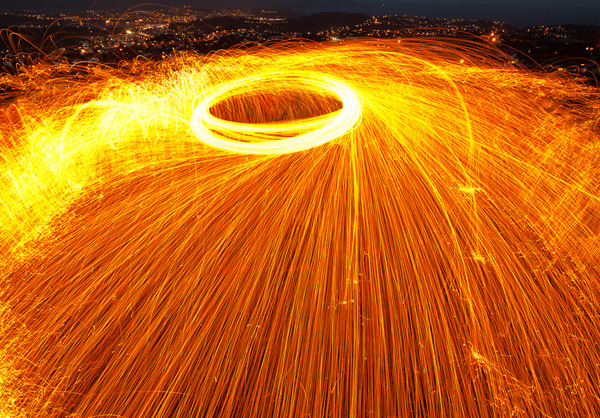
Focal length 21mm, shutter speed 15 seconds. Here, my helper span the whisk in a circle around her head.
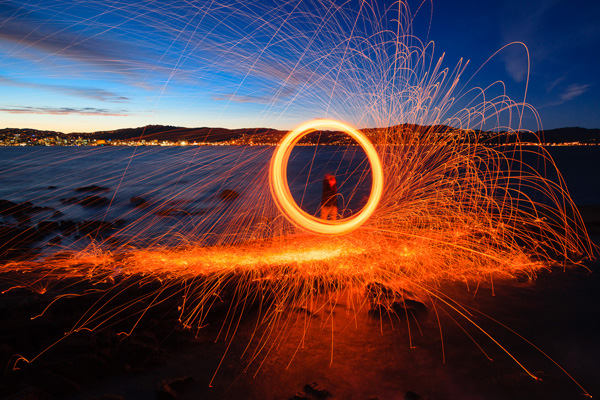
Focal length 19mm, shutter speed 15 seconds. My helper span the whisk in a circle in front of her, creating a different shape.
Put your camera on a tripod, and set your exposure using manual mode. Aim for a shutter speed of around eight to 15 seconds – there’s no harm in underexposing the background for dramatic effect (I find the steel wool burns for about ten seconds). You’ll need to be shooting at twilight, otherwise it will be too bright. The sparks won’t show up in daylight.
If you shoot while there’s still a little light left you the sky will have a nice deep blue colour. Some people use this technique at night and combine it with painting with light (using either torchlight or portable flash) to build up an image or to capture star trails.
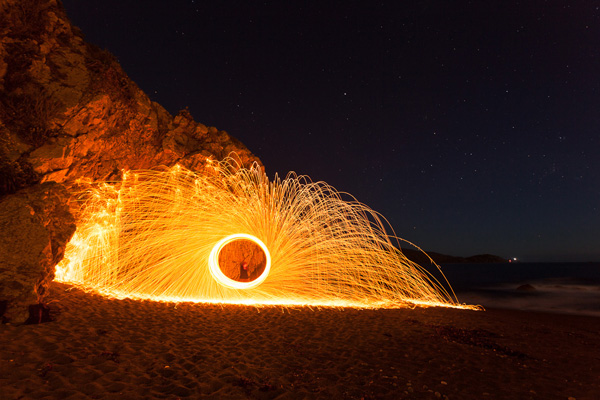
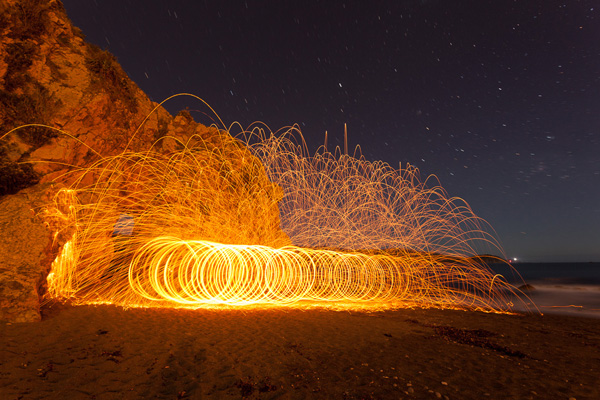
Focal length 17mm, shutter speed 30 seconds. This photo was taken after the light had faded from the sky. The 30 second shutter speed was required to capture the stars. Note that it doesn’t matter if the steel wool burns for less than the 30 second shutter speed. The idea of using a longer shutter speed is to reveal detail in the background. If I had used a shutter speed of 15 seconds, the burning steel wool would look the same (as it burns for around 10 seconds) but the background would be darker.
Focal length 17mm, shutter speed 215 seconds. The longer shutter speed has captured the movement of the stars. I asked my helper to spin the whisk in a circle as she walked along the beach, creating a different pattern.
Live View (if your camera has it) helps with focusing, as it may be too dark for you to focus on your subject properly. On my camera, there is enough detail in Live View to focus manually, even when it is too dark to see anything through the viewfinder. Set your camera to manual focus, focus on the person doing the steel wool spinning, and use a small aperture (f8-16) to compensate for any focusing errors. As this is a kind of landscape photo you’ll no doubt want the entire scene in focus anyway.
Shoot Raw so you can make fine adjustments to colour temperature and exposure in post-processing. In the meantime, set white balance to daylight – that will help the camera record the colours accurately.
If you’re using a wide-angle lens (recommended for the dramatic perspective) then move as close as you can to the arc of the burning sparks of steel wool for a strong composition. It is wise to wear clothing that covers as much skin as possible, plus a hat and safety goggles, in case one of those sparks lands on you. You should also use a UV filter to protect the front element of your lens from burning sparks.
Steel wool spinning inspiration
Take a look at these links for some more inspiration:
Flick Steel Wool Spinning group
Steel wool spinning at 500px
Raining Fire Photography (article)
Hopefully this article has inspired you to give steel wool spinning a try. Ultimately, it’s another form of painting with light – the light from the burning steel wool illuminates the landscape in a new and interesting way.
Have fun.
Mastering Photography
My ebook Mastering Photography: A Beginner’s Guide to Using Digital Cameras introduces you to photography and helps you make the most out of your digital cameras. It covers concepts such as lighting and composition as well as the camera settings you need to master manual mode and take photos like the ones in this article.
Post originally from: Digital Photography Tips.
Check out our more Photography Tips at Photography Tips for Beginners, Portrait Photography Tips and Wedding Photography Tips.
Playing With Fire: Steel Wool Spinning in the Landscape
The post Playing With Fire: Steel Wool Spinning in the Landscape by Andrew Gibson appeared first on Digital Photography School.
Please point me in the direction of the photography books.
Thank you.
Love, A photographer in need of a little inspiration.
If dust is settling on your camera and your creative juices need some stirring, the library is a great place to explore photographers and books on photography that’ll light that photo bug inside you. It’s always in there… sometimes it just needs a a little push in the right direction.
Learn some super simple tips on finding the photo books in your library and what to do once you’ve found them.
If you’ve got yourself a free afternoon, strap on your sneakers and head to the library to peruse the photo books and get inspired!
Find Photo Inspiration at the Library
p.s. We’re looking to re-invent what/how/where we publish online, and we’re seeking one amazing Editorial & Community Lead to lead the charge.
GETTING STARTED
Find your local library.
This is a handy website to discover where to locate the library in your hood.
Walk into the library and breath in the musty and awesome smell that is special only to a public library.
Lots of people have been in this institution and many of them have come out of it knowing something they didn’t when they walked in. Or they went in, used the restroom, and left.
But not you! You are going in to be inspired by photography and all of the wonder that comes along with looking at a photograph in print.
What’s great about the library is that you have access to all kinds of photo catalogs that aren’t available online.
You are part of this storied piece of public learning now.
Go forth brave photographer. Inspiration is now shooting out of your fingertips.
DO A LITTLE DIGGING
Thanks to Melvil Dewey and his Dewey Decimal System there is a super simple way to find the photo books in most libraries.
When at the library head straight to the stacks labeled 770.
All nonfiction books have a 3 digit number in front of them that corresponds with their subject matter. The 700 section of the library is The Arts section. All photo books start in the 770 section of the library. Anything with the numbers 770-779 on the binding is a photography book.
If you happen to be in a library that uses the Library of Congress system, then you’ll find the arts in section N.
Once at the photo stacks it’s pretty darn fun to run your hand over the books and see a name or binding that strikes your fancy.
Pull some books off of the shelf and find a cozy place to peruse what you just picked out.
A GOOD PLACE TO START
If you like to have a little more direction when you are searching for books here are some awesome books to look for.
Names of Photographers to Look for at the Library
Wegee (aka Arthur Fellig)
Scandal! Intrigue! Awesome black and white photographs from a man who beat the police to the scene of many a crime!
Lee Friedlander
Magic street photographs, idiosyncratic landscape photos, and bizarrely awesome self-portraits.
Francesca Woodman
Beautiful and sad stories told through images of the artist herself. If you love taking self-portraits, take a look at Ms. Woodman’s poignant images.
Since there are so many amazing photographers out there, here’s a starting list of 100 of the most influential photographers of all time.
Books on Photography
The Photographer’s Eye by John Szarkowski
A formative guide to the visual language of photography.
The Flame of Recognition by Edward Weston
A fascinating glimpse into the life of a photographer who was constantly on the lookout.
The Education of a Photographer edited by Charles T. Traub, Steven Heller, and Adam B. Bell
A great collection of essays about what it means to be a photographer now.
How-to Photo Books
Photography by Barbara London, John Upton, and Jim Stone
This book guides you to be your own photo teacher!
The Art of Photography: An Approach to Personal Expression by Bruce Barnbaum
Barnbaum explains photography in a way that won’t leave you saying “what?!!”
Image Transfer Workshop: Mixed Media Techniques for Successful Transfers by Darlene Olivia McElroy and Sandra Duran Wilson
Learn how to turn your photos into fun mixed media pieces.
Photojojo!: Insanely Great Photo Projects and DIY Ideas by Amit Gupta and Kelly Jensen
Lots of DIY ideas to help you inspire yourself and others with photo projects. From your favorite photo people: us!
Magazines Have Photos, Too!
Books aren’t the only sources for your photo research.
Magazines are full photos, and the amazing thing about the library is that they’re subscribed to basically every magazine ever.
Exploring magazines will introduce you to photography besides the kind you’ll find in the Arts section of the book stacks. You’ll see nature photography, fashion photography, interior design, and portraiture.
Magazines are also a great place to discover emerging photographers. PDN Magazine in particular does a fantastic job of featuring up and coming photogs.
Some more awesome magazines to check out: National Geographic, PDN, Vogue, American Photo, Kinfolk Magazine, Popular Photography, B&W, Wallpaper, Time, Vanity Fair.
TAKE NOTE
Bring a notebook, sketchbook or your phone to the library with you.
While you are joyfully perusing the books you’ve picked off the shelves take notes on photographers, photo tips, or quotes.
Write down words that come to you while looking at photographs. You don’t have to get crazy or put pressure on yourself… free associate as you flip pages. This is all for the joy of photography.
If a photo really grabs your attention write down what you are feeling as you look at the photo. Why did this one photo jump off of the page and into your heart?
Remember how you felt when you looked at the specific image while you are out taking your own beautiful photographs.
When you find you are in need of a little inspirational kick in the pants you can look through your notes and see what inspired you.
YOU CAN TAKE IT WITH YOU
Start an inspiration archive by designating a folder or binder for all things photography.
We feel it important to note that this is a compilation of things you love and is only for personal reference. We don’t believe in stealing artwork or infringing on copyrights.
Once you’ve found something that strikes your fancy make some photocopies of images that you really love and put them in your binder. You can categorize them into sections, like street photography, portraiture, or landscape. Think of it as a Pinterest board, but for your eyes only.
You can also put the notes you have taken in the binder as well.
Organize the images by photographer’s name, subject matter, however you like to look at later and get inspired whenever you are feeling a creative lull.
Related posts:
World Photography Day — Ideas & Inspiration to Celebrate All Things Photo Do you remember the first time you held a camera?…
DIY: Make Crazy Detailed Light Paintings with Photo Light Stencils Extra photos for bloggers: 1, 2, 3 Ever tried painting…
A Healthy Dose of Photo Inspiration — George Lange’s 2006 Photo Flipbook Every so often, we run across photos that make us…
Nikon has come under fire from animal welfare groups and some wildlife photographers over its new ‘Monarch’ line of rifle scopes, designed for game hunting. Marketed as being ‘Engineered for Safari’ Nikon claims that the new Monarch-series scopes are created ‘for those seeking dangerous game adventure on the Dark Continent’ – an archaic term for Africa. Nikon has manufactured ‘sports optics’ for many years, and is not alone (so does Pentax) but the marketing behind its newest Monarch line of scopes has caused a degree of anger. Click through for more details.
Benjamin Von Wong posted photos and a video from his impressive Paris photoshoot that combined fire, fireworks, and models into some dramatic imagery. ‘Since we were messing around with consumable effects,’ said VonWong in his blog, ‘each time we started a burn I had to be ready to constantly change up my camera settings to be able to compensate for the lighting conditions.’ (via FStoppers)
Poet, editor and activist Manal Al Sheikh says it is now lethal for her to be a writer in her home town of Nineveh, Iraq. We follow her as she prepares a new poem for a public reading, in Norwegian. Video Rating: 4 / 5
www.facebook.com www.olaenglund.com Really awesome active sounding pickups right here! I didn’t have a 6 string to put it in so thanks to Kent KRUNE Eriksson for letting me borrow his LTD, also thanks for installing them. Thanks to Jon Skäre for programming the drums. The song is an unreleased Feared song. Signal chain LTD – Kemper – Presonus Audiobox 1818VSL To download the Kemper profile I did for this video click here: www.oep.se Tabs for the song can be found here: www.sendspace.com Thanks to lefterisk1991 for tabbing the song
I really wish I could pump these videos out quicker but they are time consuming. Quality over quantity, right? haha Materials used in this video: Sculpey Clay- amzn.to Clay Tools- amzn.to Camera used for photos: Nikon D3000 amzn.to Camera used to record – Flip Cam ****UK FRIENDS**** If you live in the UK, then try using Amazon UK to search for the tools. It’s probably cheaper to buy from your local amazon than amazon usa, and you’ll avoid having to pay international shipping fees ! I managed to find Sculpey Clay so far, good luck! 🙂 Sculpey Clay – amzn.to *Twitter* twitter.com Music by: www.purple-planet.com








 Bring a notebook, sketchbook or your phone to the library with you.
 Start an inspiration archive by designating a folder or binder for all things photography.


