RSS
 

Posts Tagged ‘FEEL’

How to Help Your Clients Feel Comfortable In Front of Your Camera

09 May

Introduction

This article is an excerpt from the newly released and critically acclaimed Natural Light Couples Photography Workshop by SLR Lounge. This 8 hour workshop on DVD has been designed from the ground up to teach photographers how to create professional portraiture using just a camera, reflector and their creative eye. Master planning, posing, lighting, shooting and post producing beautiful natural light portraiture in this gold standard workshop. Learn more by clicking on any of the links above, or at the end of this article.

Article Overview

If you have ever shot portraiture, then you probably know how difficult it can be to get your subjects to be comfortable when in front of the camera. Probably one of the biggest challenges in creating a great portrait is getting your subject to emote the types of expressions that you want for your imagery. It is a challenge that every portrait photographers will face virtually on every single shoot, which is why it is such a large area of focus in our workshop.

We have found that the majority of people have a hard time in front of your camera for two primary reasons. If you can address and resolve these two issues, then you will immediately find an improvement in the emotion you are capturing within your subjects and images.

So, let’s jump in and discuss these two issues and how we can resolve them.

Reason 1. Clients Lack Basic Posing Experience

Professional actors and models are comfortable with being in front of a camera because for the most part they know how to act/pose in front of a camera. But, let’s be honest, as portrait photographers, the majority of our clients are going to be people that aren’t professional actors and models.

Instead you will generally have clients with little or no experience at all in front of a camera. Due to this lack of experience, your subjects are naturally going to be nervous because they do not know how to pose or what looks good in front of a camera.

The beginning of every shoot for our studio, Lin & Jirsa Photography, starts the exact same way. We start each portrait session by teaching our clients several simple posing techniques. We refer to our posing system as “Foundation Posing Framework” and we teach it extensively on the Natural Light Couples Photography Workshop and all the images that we will be showing here are from the workshop.

Now, when we instruct clients, we are avoiding a lot of the details and technical explanations. What we are doing, is simply giving them a foundation of what to do in general when posing. This Foundation Posing Framework creates a simple and common set of posing vocabulary making it incredibly simple to communicate poses to your subjects.

When starting the instruction, I ask my clients, “Have you ever wondered why celebrities always look good when they pose on the red carpet? It’s cause they know the posing basics! Do these things, and all your friends will wonder why you guys are so photogenic in every photo you take.”

Before teaching them the basics, I generally will take a quick photo of them. Once they have learned the basics, I take another portrait simply with the intent of showing them how big of a difference the posing tips made, and how great they look in the photo. Virtually every time my clients see that first great looking shot, they immediately and visibly relax. They now know that look great, and that they can rely on you, as the professional, for posing instruction. At this point, I remind them that I will be helping pose them throughout the shoot, so they don’t need to feel like they have to remember everything they just learned.

01-lack-of-experience

Now this entire process only takes about 10 minutes. You will not only start capturing better photos and expressions from the start of your shoot, you will also find that about half way through a portrait session, your clients will start doing all the posing on their own! All you have to do is use keywords from the Foundation Posing Framework and say, “V-up and look at each other” and boom, they do it all by themselves!

02-lack-of-experience

Reason 2. Your Clients Don’t Know You Yet

The second reason reason why your clients will feel awkward during the photo shoot is really common sense. It is simply because they are not comfortable with you yet. Hence, they will be more reserved with their emotions, (especially if they have just barely met you for the first time!) making it difficult to capture natural and genuine expressions.

The bottom line is that you will have to connect with your clients in a personal way, as quickly as possible, and have more than just a surface level “photographer-subject” relationship.

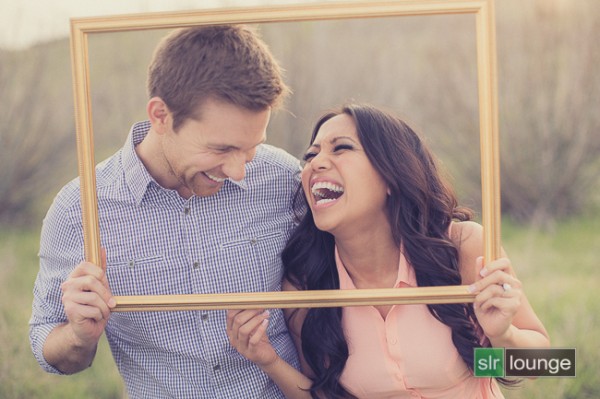
On the Natural Light Couples Photography Workshop, we show a lot of the interaction that I have with Ryan and Jackie. Ryan and Jackie are our actual clients, and this is my first time shooting them. So you can literally watch me build up this relationship during the shoot as I joke around and have fun with them.

Since each photographer has their own personality and shooting style, they will connect with their clients differently. I tend to joke around a lot with my clients, self-deprecate, poke fun, tell stories, etc. Anything I can to help them feel like I am their friend, not just their photographer.

Interestingly enough, I find that if I focus on the guy, making sure he is having a good time, the girl is quick to relax as well. This is because in general, we have found that guys generally are not into taking photos. Instead, the guy is going along with it essentially as a “favor” and the girl is constantly worrying about whether he is bored, having fun, acting natural, etc. So, once the guy is having a good time, the girl stops worrying about him and relaxes as well.

03-they-dont-know-you

04-they-dont-know-you

When Working with Solo Subjects Repeat Everything Above

The same rules still apply when shooting a subject solo, whether it is for portraiture, editorial or fashion. Prior to the photo shoot, we talk about everything except for photography with the client. Instead, get to know your client and just have a good time. This conversation before the shoot helps to break the ice and will make your client feel comfortable during the shoot since your client will look at you as more of a friend, a real person, and less as a photographer.

Once you start the shoot, remember to still coach your subject and show them some shots taken at the very beginning of the shoot. Seeing great photos of themselves right at the start of the shoot will again help them to realize they already look great, so they can relax and have a good time.  

If they point out something that they don’t like in your initial photos, you can keep that in mind throughout the rest of the shoot and maybe show them images again here and there to make sure they are happy with the photos.

Conclusion & Learn More!

If you are interested in learning more, join us on the Natural Light Couples Photography Workshop. This 8 hour workshop on DVD teaches photographers how to create professional portraiture using just a camera, reflector and their creative eye. We cover how to:

1. Plan and prepare a moodboard with clients
2. Pose and instruct clients using the Foundation Posing Framework
3. Modify and perfect the scene’s natural lighting with a simple reflector
4. Work through 5 different scenes and locations utilizing different set props and activities
5. Compose and shoot consistent, creative imagery
6. Post produce a professional final product

Learn more by Clicking Here.

Post originally from: Digital Photography Tips.

Check out our more Photography Tips at Photography Tips for Beginners, Portrait Photography Tips and Wedding Photography Tips.

How to Help Your Clients Feel Comfortable In Front of Your Camera


Digital Photography School

 
Comments Off on How to Help Your Clients Feel Comfortable In Front of Your Camera

Posted in Photography


Flower : EVOLUTION : See : FEEL : Beyond : OBVIOUS! Enjoy : the TEXTURE : the lines! :)

18 Jan

Some cool visual art images:

Flower : EVOLUTION : See : FEEL : Beyond : OBVIOUS! Enjoy : the TEXTURE : the lines! 🙂
visual art
Image by || UggBoy?UggGirl || PHOTO || WORLD || TRAVEL ||
Abstract art

Abstract art uses a visual language of form, color and line to create a composition which may exist with a degree of independence from visual references in the world. Western art had been, from the Renaissance up to the middle of the 19th century, underpinned by the logic of perspective and an attempt to reproduce an illusion of visible reality. The arts of cultures other than the European had become accessible and showed alternative ways of describing visual experience to the artist. By the end of the 19th century many artists felt a need to create a new kind of art which would encompass the fundamental changes taking place in technology, science and philosophy. The sources from which individual artists drew their theoretical arguments were diverse, and reflected the social and intellectual preoccupations in all areas of Western culture at that time.

Abstract art, nonfigurative art, nonobjective art, and nonrepresentational art are loosely related terms. They are similar, although perhaps not of identical meaning.

Abstraction indicates a departure from reality in depiction of imagery in art. This departure from accurate representation can be only slight, or it can be partial, or it can be complete. Abstraction exists along a continuum. Even art that aims for verisimilitude of the highest degree can be said to be abstract, at least theoretically, since perfect representation is likely to be exceedingly elusive. Artwork which takes liberties, altering for instance color and form in ways that are conspicuous, can be said to be partially abstract. Total abstraction bears no trace of any reference to anything recognizable. In geometric abstraction, for instance, one is unlikely to find references to naturalistic entities. Figurative art and total abstraction are almost mutually exclusive. But figurative and representational (or realistic) art often contains partial abstraction.

Both Geometric abstraction and Lyrical Abstraction are often totally abstract. Among the very numerous art movements that embody partial abstraction would be for instance fauvism in which color is conspicuously and deliberately altered vis-a-vis reality, and cubism, which blatantly alters the forms of the real life entities depicted.
EXPLORE MORE AND SOAR:
WIKIPEDIA = ABSTRACT = TO THE WORLD

Thoughts about abstract…….forms…….

As you see, I do not treat the creation of fiction, that to say the invention and development of fantasies, as a form of abstract thought. I dont wish to deny the uses of the intellect, but sometimes one has the intuition that the intellect by itself will lead one nowhere.
—J. M. Coetzee

Some more……..

Delight at having understood a very abstract and obscure system leads most people to believe in the truth of what it demonstrates.
—Georg C. Lichtenberg

Please MORE EXPLORE……..

Evil is the product of the ability of humans to make abstract that which is concrete.
—Jean-Paul Sartre

Flower : EVOLUTION : See : FEEL : Beyond : OBVIOUS! Enjoy : the TEXTURE : the lines! 🙂
visual art
Image by || UggBoy?UggGirl || PHOTO || WORLD || TRAVEL ||
Abstract art

Abstract art uses a visual language of form, color and line to create a composition which may exist with a degree of independence from visual references in the world. Western art had been, from the Renaissance up to the middle of the 19th century, underpinned by the logic of perspective and an attempt to reproduce an illusion of visible reality. The arts of cultures other than the European had become accessible and showed alternative ways of describing visual experience to the artist. By the end of the 19th century many artists felt a need to create a new kind of art which would encompass the fundamental changes taking place in technology, science and philosophy. The sources from which individual artists drew their theoretical arguments were diverse, and reflected the social and intellectual preoccupations in all areas of Western culture at that time.

Abstract art, nonfigurative art, nonobjective art, and nonrepresentational art are loosely related terms. They are similar, although perhaps not of identical meaning.

Abstraction indicates a departure from reality in depiction of imagery in art. This departure from accurate representation can be only slight, or it can be partial, or it can be complete. Abstraction exists along a continuum. Even art that aims for verisimilitude of the highest degree can be said to be abstract, at least theoretically, since perfect representation is likely to be exceedingly elusive. Artwork which takes liberties, altering for instance color and form in ways that are conspicuous, can be said to be partially abstract. Total abstraction bears no trace of any reference to anything recognizable. In geometric abstraction, for instance, one is unlikely to find references to naturalistic entities. Figurative art and total abstraction are almost mutually exclusive. But figurative and representational (or realistic) art often contains partial abstraction.

Both Geometric abstraction and Lyrical Abstraction are often totally abstract. Among the very numerous art movements that embody partial abstraction would be for instance fauvism in which color is conspicuously and deliberately altered vis-a-vis reality, and cubism, which blatantly alters the forms of the real life entities depicted.
EXPLORE MORE AND SOAR:
WIKIPEDIA = ABSTRACT = TO THE WORLD

Thoughts about abstract…….forms…….

As you see, I do not treat the creation of fiction, that to say the invention and development of fantasies, as a form of abstract thought. I dont wish to deny the uses of the intellect, but sometimes one has the intuition that the intellect by itself will lead one nowhere.
—J. M. Coetzee

Some more……..

Delight at having understood a very abstract and obscure system leads most people to believe in the truth of what it demonstrates.
—Georg C. Lichtenberg

Please MORE EXPLORE……..

Evil is the product of the ability of humans to make abstract that which is concrete.
—Jean-Paul Sartre

 
Comments Off on Flower : EVOLUTION : See : FEEL : Beyond : OBVIOUS! Enjoy : the TEXTURE : the lines! :)

Posted in Photographs


Glass : EVOLUTION : See : FEEL : Beyond : OBVIOUS! Enjoy : the TEXTURE : the lines! :)

18 Jan

Some cool visual art images:

Glass : EVOLUTION : See : FEEL : Beyond : OBVIOUS! Enjoy : the TEXTURE : the lines! 🙂
visual art
Image by || UggBoy?UggGirl || PHOTO || WORLD || TRAVEL ||
Abstract art

Abstract art uses a visual language of form, color and line to create a composition which may exist with a degree of independence from visual references in the world. Western art had been, from the Renaissance up to the middle of the 19th century, underpinned by the logic of perspective and an attempt to reproduce an illusion of visible reality. The arts of cultures other than the European had become accessible and showed alternative ways of describing visual experience to the artist. By the end of the 19th century many artists felt a need to create a new kind of art which would encompass the fundamental changes taking place in technology, science and philosophy. The sources from which individual artists drew their theoretical arguments were diverse, and reflected the social and intellectual preoccupations in all areas of Western culture at that time.

Abstract art, nonfigurative art, nonobjective art, and nonrepresentational art are loosely related terms. They are similar, although perhaps not of identical meaning.

Abstraction indicates a departure from reality in depiction of imagery in art. This departure from accurate representation can be only slight, or it can be partial, or it can be complete. Abstraction exists along a continuum. Even art that aims for verisimilitude of the highest degree can be said to be abstract, at least theoretically, since perfect representation is likely to be exceedingly elusive. Artwork which takes liberties, altering for instance color and form in ways that are conspicuous, can be said to be partially abstract. Total abstraction bears no trace of any reference to anything recognizable. In geometric abstraction, for instance, one is unlikely to find references to naturalistic entities. Figurative art and total abstraction are almost mutually exclusive. But figurative and representational (or realistic) art often contains partial abstraction.

Both Geometric abstraction and Lyrical Abstraction are often totally abstract. Among the very numerous art movements that embody partial abstraction would be for instance fauvism in which color is conspicuously and deliberately altered vis-a-vis reality, and cubism, which blatantly alters the forms of the real life entities depicted.
EXPLORE MORE AND SOAR:
WIKIPEDIA = ABSTRACT = TO THE WORLD

Thoughts about abstract…….forms…….

As you see, I do not treat the creation of fiction, that to say the invention and development of fantasies, as a form of abstract thought. I dont wish to deny the uses of the intellect, but sometimes one has the intuition that the intellect by itself will lead one nowhere.
—J. M. Coetzee

Some more……..

Delight at having understood a very abstract and obscure system leads most people to believe in the truth of what it demonstrates.
—Georg C. Lichtenberg

Please MORE EXPLORE……..

Evil is the product of the ability of humans to make abstract that which is concrete.
—Jean-Paul Sartre

Flower : EVOLUTION : See : FEEL : Beyond : OBVIOUS! Enjoy : the TEXTURE : the lines! 🙂
visual art
Image by || UggBoy?UggGirl || PHOTO || WORLD || TRAVEL ||
Abstract art

Abstract art uses a visual language of form, color and line to create a composition which may exist with a degree of independence from visual references in the world. Western art had been, from the Renaissance up to the middle of the 19th century, underpinned by the logic of perspective and an attempt to reproduce an illusion of visible reality. The arts of cultures other than the European had become accessible and showed alternative ways of describing visual experience to the artist. By the end of the 19th century many artists felt a need to create a new kind of art which would encompass the fundamental changes taking place in technology, science and philosophy. The sources from which individual artists drew their theoretical arguments were diverse, and reflected the social and intellectual preoccupations in all areas of Western culture at that time.

Abstract art, nonfigurative art, nonobjective art, and nonrepresentational art are loosely related terms. They are similar, although perhaps not of identical meaning.

Abstraction indicates a departure from reality in depiction of imagery in art. This departure from accurate representation can be only slight, or it can be partial, or it can be complete. Abstraction exists along a continuum. Even art that aims for verisimilitude of the highest degree can be said to be abstract, at least theoretically, since perfect representation is likely to be exceedingly elusive. Artwork which takes liberties, altering for instance color and form in ways that are conspicuous, can be said to be partially abstract. Total abstraction bears no trace of any reference to anything recognizable. In geometric abstraction, for instance, one is unlikely to find references to naturalistic entities. Figurative art and total abstraction are almost mutually exclusive. But figurative and representational (or realistic) art often contains partial abstraction.

Both Geometric abstraction and Lyrical Abstraction are often totally abstract. Among the very numerous art movements that embody partial abstraction would be for instance fauvism in which color is conspicuously and deliberately altered vis-a-vis reality, and cubism, which blatantly alters the forms of the real life entities depicted.
EXPLORE MORE AND SOAR:
WIKIPEDIA = ABSTRACT = TO THE WORLD

Thoughts about abstract…….forms…….

As you see, I do not treat the creation of fiction, that to say the invention and development of fantasies, as a form of abstract thought. I dont wish to deny the uses of the intellect, but sometimes one has the intuition that the intellect by itself will lead one nowhere.
—J. M. Coetzee

Some more……..

Delight at having understood a very abstract and obscure system leads most people to believe in the truth of what it demonstrates.
—Georg C. Lichtenberg

Please MORE EXPLORE……..

Evil is the product of the ability of humans to make abstract that which is concrete.
—Jean-Paul Sartre

 
Comments Off on Glass : EVOLUTION : See : FEEL : Beyond : OBVIOUS! Enjoy : the TEXTURE : the lines! :)

Posted in Photographs