RSS
 

Posts Tagged ‘Factory’

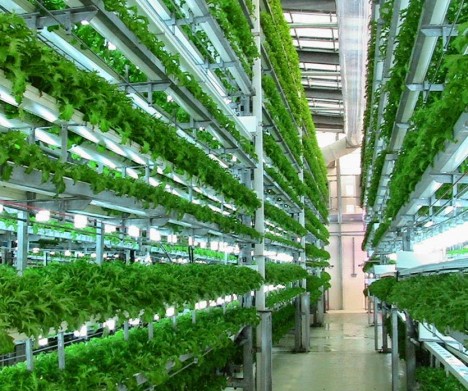
Veggie Factory: World’s First Vertical Farm Run Entirely By Robots

03 Feb

[ By WebUrbanist in Architecture & Offices & Commercial. ]

robofarming

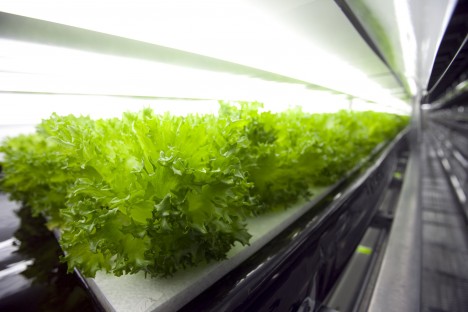
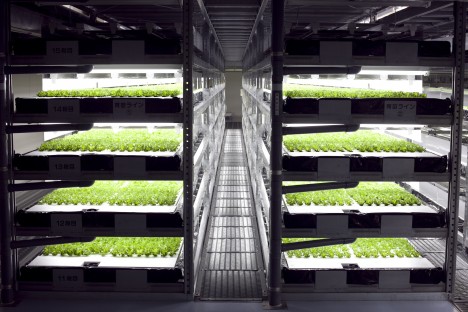
Taking vertical urban indoor farming efficiency to the next level, a new automated plant coming to Japan will be staffed entirely by robots and produce 30,000 heads of lettuce daily.

spread indoor farm

The so-called Vegetable Factory is a project of Spread, a Japanese company already operating vertical farms. Located in Kyoto, its small army of bots will various seed, water, trim and harvest the lettuce.  Spread’s new automation technology will not only produce more lettuce, it will also reduce labor costs by 50%, cut energy use by 30%, and recycle 98% of water needed to grow the crops.

spread stacked farm

“The use of machines and technology has been improving agriculture in this way throughout human history,” says J.J. Price of Spread, tells Tech Insider. “With the introduction of plant factories and their controlled environment, we are now able to provide the ideal environment for the crops.”

spread human farm

Like other vertical farms, the benefits of this approach are numerous, including: reduced waste, controlled runoff, more efficient use of space and the ability to produce food locally (reducing cost, time and waste associated with rural-to-urban transport). Meanwhile, the fear of automation is becoming a reality, say critics, while advocates point out that this will free up factory workers to potentially engage in more interesting occupations within the same industry (if herding robots is considered interesting, at least).

Share on Facebook


[ By WebUrbanist in Architecture & Offices & Commercial. ]

[ WebUrbanist | Archives | Galleries | Privacy | TOS ]


WebUrbanist

 
Comments Off on Veggie Factory: World’s First Vertical Farm Run Entirely By Robots

Posted in Creativity


Behind the scenes at Fujifilm’s factory in Sendai, Japan

02 Feb

Behind the Scenes of Fujifilm’s Factory in Sendai, Japan

After the official launch of the X-Pro2 recently in Tokyo, Fujifilm invited a select group of press to visit its Taiwa assembly plant near Sendai to see the camera being put together. As well as the X-Pro2, we were also able to see the assembly lines for the X-T1, X100T, and several lenses. Fujifilm has been making optics since the 1940s, and although the construction workers of that time would not recognize much of the technology used in lens construction today, a lot of the assembly is still done fairly traditionally, by hand. 

The first step when visiting any assembly plant, is to sterilize yourself. No, not like that, but by donning head-to-foot protective clothing and scrubbing your hands with alcohol. It’s a time-consuming, uncomfortable but necessary step in order to prevent contamination of the assembly line. I do very much regret keeping a sweater on underneath the overalls though. 

Behind the Scenes of Fujifilm’s Factory in Sendai, Japan

Here, a worker in Fujifilm’s Taiwa plant uses a sonic motorized screwdriver to assemble the company’s 56mm F1.2 prime lens. 

Behind the Scenes of Fujifilm’s Factory in Sendai, Japan

Journalists take photographs of the various lens groups that make up the new 100-400mm zoom, laid out on a table at Fujifilm’s Taiwa plant, which is about 20 miles outside of the city of Sendai. 

The elements themselves are not ground and polished in Sendai, but like other components they are shipped in, ready to be turned into complete lenses. Fujifilm has three additional facilities in Japan that mold and polish glass lens elements and machine various other components.

Behind the Scenes of Fujifilm’s Factory in Sendai, Japan

Here, a worker performs the delicate job of attaching the PCB to Fujifilm’s new 100-400mm telezoom. 

Behind the Scenes of Fujifilm’s Factory in Sendai, Japan

The 100-400mm zoom takes roughly 4 hours to assemble, in its progress from a box of bits to a finished lens. These lenses are almost complete, and await the final assembly and testing phases of their construction. 

Behind the Scenes of Fujifilm’s Factory in Sendai, Japan

Fujifilm’s new 100-400mm telezoom being assembled. As with other factories we’ve visited in Japan, a lot of the assembly is done by hand, and aside from calibration, there’s little automation in the assembly lines of either lenses, or cameras in Fujifilm’s factory. 

Behind the Scenes of Fujifilm’s Factory in Sendai, Japan

Here, a 100-400mm zoom undergoes final testing. This process (which involves racking the zoom and focus ring to various points, repeatedly) is partly automated – presumably to avoid the human operators from getting repetitive strain injury.

Almost all of the other calibration tests and checks are confidential, which means no photos. None taken by humans, anyway.

Behind the Scenes of Fujifilm’s Factory in Sendai, Japan

A 100-400mm gets the finishing touches added, prior to being boxed up for shipping. 

Behind the Scenes of Fujifilm’s Factory in Sendai, Japan

Several completed 100-400mm zooms are placed in plastic trays before being wrapped and boxed-up for shipping.

Behind the Scenes of Fujifilm’s Factory in Sendai, Japan

Here, a worker examines one of the groups destined to become part of Fujifilm’s much smaller 35mm F2 prime lens. 

Behind the Scenes of Fujifilm’s Factory in Sendai, Japan

Again, a majority of the steps in the assembly of this lens are manual, with little automation. 

Behind the Scenes of Fujifilm’s Factory in Sendai, Japan

We were impressed by just how many of the stages in assembly appear to be visual inspection. A single worker might inspect hundreds of these components in a day.

Behind the Scenes of Fujifilm’s Factory in Sendai, Japan

Here, lens groups are arranged in trays ready to be inspected.

Behind the Scenes of Fujifilm’s Factory in Sendai, Japan

Ultraviolet light is used to ‘cure’ the cement that holds elements securely in their groups. Gone are the days of screwing elements together using friction and using shims to adjust their precise alignment.  

Behind the Scenes of Fujifilm’s Factory in Sendai, Japan

Here, several 35mm F2 primes sit in trays awaiting the final stages of their assembly.  

Behind the Scenes of Fujifilm’s Factory in Sendai, Japan

The front bezel of the 35mm F2 is attached with four screws. Once this is done, the screws will be concealed by the nameplate ring. 

Behind the Scenes of Fujifilm’s Factory in Sendai, Japan

And here are the finished lenses with their nameplates attached, ready to be boxed and shipped. Much simpler than the 100-400mm zoom, the 35mm prime takes only about 80 minutes to assemble, in total. 

Behind the Scenes of Fujifilm’s Factory in Sendai, Japan

The day we toured Fujifilm’s factory was the first ‘official’ day of production for the new X-Pro2. Of course workers have been putting final shipping cameras together now for some time, under a veil of secrecy ahead of the product launch in mid-January.

Behind the Scenes of Fujifilm’s Factory in Sendai, Japan

Although outwardly similar to the original X-Pro1, the X-Pro2 is a completely redesigned, considerably more complex camera than the first X-series ILC. It should be – Fujifilm has had four years to gather feedback from users of the original camera. 

Behind the Scenes of Fujifilm’s Factory in Sendai, Japan

Like the lenses, the X-Pro2 arrives in Sendai as a collection of partly-finished components ready for final assembly. Here, a worker performs the delicate job of connecting the various wires and ribbon connectors that will bring the camera to life.

Behind the Scenes of Fujifilm’s Factory in Sendai, Japan

The X-Pro2’s firmware isn’t ‘hardwired’ but has to be manually uploaded to every camera individually, in one of the final stages of assembly before the cameras are boxed up for shipping. Doing it at this late stage decreases the risk that firmware will need to be loaded more than once if an update is required. 

Behind the Scenes of Fujifilm’s Factory in Sendai, Japan

Here, a worker is attaching the small plastic window over the X-Pro2’s focusing lamp before applying the leatherette material that covers much of the outside of the camera’s body.

Behind the Scenes of Fujifilm’s Factory in Sendai, Japan

One of the trickiest (and most manual) stages in the construction of the X-Pro2 is applying the leatherette material to the camera body. This is done slowly, carefully, and entirely by hand.

Behind the Scenes of Fujifilm’s Factory in Sendai, Japan

The material is carefully pressed into place around the lens throat, and various control points. Bubbles are worked out by scraping the material gently with a plastic ‘spudger’. 

Behind the Scenes of Fujifilm’s Factory in Sendai, Japan

The X-Pro2’s grip is attached using a very strong adhesive, and firm adhesion is ensured by placing the camera in a mechanical press that applies firm and even pressure to the join. 

Behind the Scenes of Fujifilm’s Factory in Sendai, Japan

Here, finished X-Pro2 bodies await final checks before being boxed up for shipping. 

Behind the Scenes of Fujifilm’s Factory in Sendai, Japan

The X-Pro2 isn’t the only camera that is put together in Sendai. Fujifilm also assembles the X-T1 in the same facility. Here, a collection of X-T1 top-plates await assembly.

Behind the Scenes of Fujifilm’s Factory in Sendai, Japan

And this is what happens next. The X-T1’s magnesium-alloy top-plates are introduced to the electronic viewfinder assembly, ready to be mated with the main body of the camera, further down the assembly line.  

Behind the Scenes of Fujifilm’s Factory in Sendai, Japan

Dials! Thousands of dials! Here, trays and trays of X-T1 ISO dials sit waiting to be introduced to their host cameras. 

Behind the Scenes of Fujifilm’s Factory in Sendai, Japan

A well as the X-Pro2 and X-T1, the Sendai plant is also home to the X100T assembly line. We wanted to take this lonely-looking X100T home with us, but apparently that’s not allowed.

Behind the Scenes of Fujifilm’s Factory in Sendai, Japan

That’s OK – we like the black ones more anyway. Here, a number of almost-finished X100T bodies sit in trays waiting for their rear control plate and LCD screens to be added. 

Sendai was badly hit by the earthquake of 2011, and some of the buildings at Fujifilm’s Taiwa plant had to be abandoned due to structural damage. One of those buildings housed the original assembly line for the X100, and after the earthquake, assembly was moved across the street and into the building that we visited.  

Behind the Scenes of Fujifilm’s Factory in Sendai, Japan

And here’s where they all end up – X-Pro2s, X-T1s, X100Ts and lenses. These large boxes contain finished products, ready to be shipped to retailers and distributors worldwide. 

Behind the Scenes of Fujifilm’s Factory in Sendai, Japan

Well, almost ready. Even once they’re placed in their retail packaging and stacked in the larger shipping boxes, one in 10 of all the cameras and lenses assembled in the factory are removed, unboxed, and checked by hand to ensure that any given batch is free from manufacturing defects. ‘Made in Japan’ really does mean something, even today. 

Behind the Scenes of Fujifilm’s Factory in Sendai, Japan

Happy 5th anniversary, Fujifilm X-series!

Articles: Digital Photography Review (dpreview.com)
 
Comments Off on Behind the scenes at Fujifilm’s factory in Sendai, Japan

Posted in Uncategorized


Old New Jersey Factory to House Earth’s Largest Vertical Farm

22 Apr

[ By WebUrbanist in Architecture & Offices & Commercial. ]

aerofarm factory floor

Opening this year in Newark, this 69,000-square-foot space will grow 2 million pounds of pesticide-free produce each year, turning an old steel factory into the largest indoor farm on the planet, 75 times more productive per square foot than open fields. This AeroFarms facility is to serve both as the company’s global headquarters as well as the anchor project for a Maker’s Village designed to grow business in the city and provide a prototype for scaleable urban agriculture.

aerofarms aerial image

Plants rooted in reusable microfleece cloth and stacked in modular planters will be sprayed by a nutrient mist and illuminated by LED lights. These crops require no soil, 95% less water and create no harmful runoff.  Located on a 3-acre industrial site in the Ironbound neighborhood, the structure will expand the role of affordable and local urban farming in the community and provide nearly 100 long-term jobs for residents. Such an approach offers a new potential future role to rundown industrial districts around the world, turning unused infrastructure in struggling cities into fresh indoor farming space.

aerofarm interior space

More on the process and key materials: a “reusable cloth medium [supports] seeding, germinating, growing, and harvesting.” This critical cloth “has a number of benefits such as durability and reusability, increased cleanliness and sanitation, and the efficient harvest of a dry and clean product.”

aerofarms hydpropnic indoor agriculture

In terms of LED innovation and efficiency, the company is “targeting specific wavelengths of light for more efficient photosynthesis and less energy consumption. LEDs can also be placed much closer to the plants, enabling greater vertical growing for even greater productivity per square foot.”

aerofarm facility rendering market

Aeroponics is the key to the solution, limiting the need for conventional watering and representing “a cutting-edge type of hydroponic technology that grows plants in a mist. The aeroponic mist most efficiently provides roots with the nutrients, hydration and oxygen needed, creating faster growing cycles and more biomass than other growing approaches. AeroFarms has designed its aeroponics as a closed-looped system, recirculating our nutrient solution and using over 95% less water than field farming.”

aerofarms leafy greens

“We are delighted to introduce AeroFarms, a farming and technology leader, to the City of Newark, creating jobs for local residents and greater access to locally grown produce for our community,” said Ron Beit, founding partner and CEO of RBH Group. “AeroFarms will anchor our broader ‘Makers Village’ development project in the Ironbound neighborhood that will compete toe-to-toe with the Brooklyn Navy Yard in terms of a superior cost structure and greater transmodal access, bringing 21st century ‘maker-type’ businesses to Newark and the State of New Jersey.”

Share on Facebook


[ By WebUrbanist in Architecture & Offices & Commercial. ]

[ WebUrbanist | Archives | Galleries | Privacy | TOS ]


WebUrbanist

 
Comments Off on Old New Jersey Factory to House Earth’s Largest Vertical Farm

Posted in Creativity


Making ‘Art’: We go inside Sigma’s lens factory

09 Mar

On our recent visit to Japan to attend the CP+ show in Yokohama we were fortunate to be invited to tour Sigma’s factory in Aizu. The Aizu factory is where almost all of Sigma’s lenses are manufactured, including the company’s impressive new ‘Art’ line of primes. Click through to take a virtual tour of the factory, in the company of Kazuto Yamaki, Sigma’s CEO. 

Articles: Digital Photography Review (dpreview.com)
 
Comments Off on Making ‘Art’: We go inside Sigma’s lens factory

Posted in Uncategorized


CP+ 2015 Sigma Interview – “small office, big factory”

05 Mar

At this year’s CP+ show in Yokohama Japan we made time to sit down with several senior executives from major manufacturers, including Sigma. In this interview with Kazuto Yamaki, CEO of Sigma, we spoke about the challenges of making lenses for ever-increasing pixel counts, the company’s ‘small office, big factory’ philosophy and why the company is continuing to make cameras. Read more

Articles: Digital Photography Review (dpreview.com)
 
Comments Off on CP+ 2015 Sigma Interview – “small office, big factory”

Posted in Uncategorized


A look inside Sigma’s lens factory

15 Feb

Screen_Shot_2014-02-14_at_10.18.33_AM.png

Sigma gives us another behind the scenes look at their Aizu, Japan lens factory in a video released during the CP+ trade show. It’s an artsy factory tour highlighting the craftsmanship and the process of how their lenses are assembled. They released a similar video during Photokina 2012 and have since gained some popularity with their higher end 35mm F1.4 DG HSM and the 120-300mm F2.8 DG OS HSM lenses. See video

News: Digital Photography Review (dpreview.com)

 
Comments Off on A look inside Sigma’s lens factory

Posted in Uncategorized


Where the sharpness comes from: A tour of Sigma’s factory

21 Sep

www.imaging-resource.com-crop.jpg

Some people are happy to shoot with lenses and think only of the results, but it can also be fascinating to think about how such complex, precision pieces of engineering are made. Some insight is provided by Dave Etchells over at Imaging Resource, who has just posted a story about his visit to Sigma’s factory in Aizu, Japan. However, no matter how hard you try, you can’t make every lens perfect – as Lensrentals Roger Cicala explains in his recent blog post. Click through for more.

News: Digital Photography Review (dpreview.com)
 
Comments Off on Where the sharpness comes from: A tour of Sigma’s factory

Posted in Uncategorized


The Egg Factory – Bisti Bandlands, New Mexico

11 Sep

Egg Factory - Bisti Badlands, New Mexico


The Bisti Badlands of New Mexico is one of the most intimidating yet beautiful landscapes I’ve visited. This open arid expanse quickly puts you in your place or rather makes you realize how out of place you are walking around. Extreme weather can dominate the area (heat, sand storms and extreme winds), but it is this harsh combination that has made many of the geological features there including the Egg Factory. The last time I was there I got an in person tour of these harsh conditions with winds up to 55mph making it nearly impossible to get a photo. Even amidst a windstorm it’s amazing to see an “alien” landscape in your own backyard.

Copyright Jim M. Goldstein, All Rights Reserved

The Egg Factory – Bisti Bandlands, New Mexico

The post The Egg Factory – Bisti Bandlands, New Mexico appeared first on JMG-Galleries – Landscape, Nature & Travel Photography.


Related Stories

  • The Egg Factory – Bisti Bandlands, New Mexico – Enclosure
  • Primitive Coast V + Thoughts On The Singh-Ray 10-Stop Mor-Slo Filter
  • Primitive Coast V + Thoughts On The Singh-Ray 10-Stop Mor-Slo Filter – Enclosure
Feed Ads by FeedBlitz
powered by ad choices


JMG-Galleries

 
Comments Off on The Egg Factory – Bisti Bandlands, New Mexico

Posted in Equipment


Nikon to build $6.3m DSLR factory in Laos to lower costs

21 Mar

shared:NikonLogo.png

Nikon has said it will spend around ¥600m (around $ 6.3m) to establish a factory in Laos. The factory will conduct part of the production process for the company’s entry- and mid-level DSLRs, with final assembly still taking part in the existing Ayutthaya plant in Thailand. The move aims to increase production capacity and help reduce costs, the company says. The announcement suggests all mass-market Nikons will still pass through Ayutthaya, where all production was halted for several months following a devastating flood in October 2011.

News: Digital Photography Review (dpreview.com)

 
Comments Off on Nikon to build $6.3m DSLR factory in Laos to lower costs

Posted in Uncategorized


Mobile 3D-Printed House Factory in a Shipping Container

14 Mar

[ By Steph in Architecture & Houses & Residential. ]

Dutch 3D Printed House 1

Yet another candidate has entered the race for the world’s first 3D-printed house, with a mobile 3D printing factory in a shipping container that can produce the components on-site. Dutch studio DUS Architects plan to use the ‘KamerMaker‘ machine to print a full-size canal house in Amsterdam, one piece at a time. Work will start within the next six months.

Dutch 3D printed House 2

The other two other concepts currently in the works, ProtoHouse 2.0 and Landscape House, also aim to get started on their own 3D houses by this summer.  What sets the DUS Architects concept apart is the fact that its printer is mobile. The KamerMaker is 3.5 meters high and easy to transport from one place to another.

Dutch 3D Printed House 3

The house, which will be built in a developing area along the Buiksloter-canal, will act as a hub for 3D printed architecture. DUS aims to print the entire facade this year, as well as the first room; other rooms will come later. Once complete, the first floor will become a ‘welcoming room.’ The entire construction site will be an event space to show off the capabilities of this technology.

Dutch 3D Printed House 4

The KamerMaker can print structures out of recyclable materials available on location, including biodegradable plastics, giving it great potential for emergency relief architecture. DUS plans to use polypropylene as well as plastic recycled on-site to build the facade and first floor of the house. Each room in the house will be dedicated to a certain type of research, including a ‘cook room’ where researchers will experiment with 3D printing in potato starch, and a ‘policy room’ where permits for printed structures will be discussed.

Share on Facebook


[ By Steph in Architecture & Houses & Residential. ]

[ WebUrbanist | Archives | Galleries | Privacy | TOS ]


WebUrbanist

 
Comments Off on Mobile 3D-Printed House Factory in a Shipping Container

Posted in Creativity