RSS
 

Posts Tagged ‘F56.3’

Sigma Announces 100-400mm F5-6.3 DG OS HSM lens

22 Feb

$ (document).ready(function() { SampleGalleryV2({“containerId”:”embeddedSampleGallery_4367973287″,”galleryId”:”4367973287″,”isEmbeddedWidget”:true,”standalone”:false,”selectedImageIndex”:0,”startInCommentsView”:false,”isMobile”:false}) });

Sigma has announced the 100-400mm F5-6.3 DG OS HSM, a relatively compact and lightweight optically stabilized super-telephoto lens with with a dust and splashproof mount. The lens weighs 1160g/41oz, is 182mm/7.2in long, and the lens’ front element has a 67mm diameter filter thread.

For zooming, the lens utilizes a standard twist mechanism, or the front of the lens can be pushed or pulled. It can focus down to 1.6m/5.2ft, and features a maximum magnification ratio of 1:3.8. The optical design comprises of 21 elements in 15 groups with four SLD (Special Low Dispersion) elements and a hypersonic motor with an updated algorithm.

Pricing will be announced at a later date.

Press Release

SIGMA 100-400mm F5-6.3 DG OS HSM

 Introducing the light bazooka-a new approach to the ultra-telephoto zoom

  1. Top performance with the specification and functionality of a more expensive unit
  2. Compact packaging with uncompromising image quality
  3. Push/pull zoom mechanism incorporated
  4. Telephoto plus macro functionality
  5. Other features?

A compact body and top performance in one complete package

An ultra-telephoto lens with an optical stabilizer (OS) system has several advantages. The OS allows the photographer to take photographs in unstable circumstances. The narrow angle of view makes it possible to dramatically compress perspective and flexible handling of the background. The photographer can thereby make the subject appear to jump out of the image, with the area in focus impressively sharp and clear. Nevertheless, ultra-telephoto lenses have traditionally had some disadvantages as well. As the nickname “bazooka” implies, they have tended to be big, heavy, and therefore burdensome to carry around. With the goal of creating an ultra-telephoto lens that is far more accessible, SIGMA incorporated all of its latest technologies into SIGMA 100-400mm F5-6.3 DG OS HSM | Contemporary. With its outstanding combination of optical performance and compactness, this is an ultra-telephoto lens that is a joy to carry and use. While keeping the robust functionality and exceptional image quality of an ultra-telephoto zoom lens intact, SIGMA has achieved amazingly compact packaging enclosing 400mm optics. Introducing the new and greatly enhanced “light bazooka” ultra-telephoto zoom lens.

SIGMA 100-400mm F5-6.3 DG OS HSM | Contemporary offers the compact size, lightweight, and high cost performance of a 70-300mm lens while delivering 400mm telephoto performance. This approach results in a tempting new ultra-telephoto choice for photographers. Offering a combination of stunning image quality and outstanding functionality, this lens satisfies the needs of pros and amateurs alike.

?Key features?

  1. Top performance with the specification and functionality of a more expensive unit

Since its release, the SIGMA 150-600mm F5-6.3 DG OS HSM | Contemporary has won photographers over with its strong fundamental performance and exceptional image quality. The new lens retains all of this performance in a compact 400mm ultra-telephoto zoom package with a filter size of just ?67mm and weight of just 1,160g. Yet it also comes with the full range of features and functions expected of an ultra-telephoto zoom: optical stabilizer (OS), hypersonic motor (HSM) with updated algorithm for fast autofocus, focus limiter, and more. In addition, this uncompromising specification becomes customizable with the available SIGMA USB Dock accessory.

  1. Compact packaging with uncompromising image quality

In designing this lens, SIGMA strived to push both compactness and image quality to the limit. Four SLD (Special Low Dispersion) glass lens elements and an optimized power distribution help minimize optical aberrations. Moreover, by taking special care to minimize transverse chromatic aberration, which cannot be corrected via aperture control, SIGMA has ensured outstanding image quality throughout the zoom range. 

  1. Push/pull zoom mechanism incorporated

For quick control of the angle of view, the zoom ring incorporates a push/pull mechanism in addition to the regular twist mechanism. The exclusive lens hood has also been designed to accommodate push/pull zooming and overall lens maneuverability. By making it possible to adjust the angle of view instantly, this lens gives photographers an even better chance of getting that crucial shot.

  1. Telephoto plus macro functionality

With a minimum shooting distance of 160cm and a maximum magnification ratio of 1:3.8, this lens can shoot either from a distance or up close. 

  1. Other features
  • Dust- and splash-proof mount

Since the area of the lens most vulnerable to dust and other foreign bodies is the mount, rubber sealing helps provide peace of mind.

  • All-new optical stabilizer (OS) unit with exclusive algorithm

Featuring a newly developed gyroscopic sensor and a new and exclusive algorithm, the all-new OS unit provides a powerful stabilization effect. An acceleration sensor detects camera shake in any direction—horizontal, vertical, or diagonal. This technology allows the OS to stabilize the image very effectively, regardless of whether the camera is being held in horizontal or vertical orientation.

  • Nikon electromagnetic diaphragm mechanism included

The Nikon mount version of this lens includes an electromagnetic diaphragm mechanism that allows it to receive the appropriate signals from the camera body. This feature ensures precision diaphragm control and stable Auto Exposure (AE) performance during continuous shooting.

Note: Functionality may be limited on some camera bodies. 

  • Rounded diaphragm 
  • Designed to minimize flare and ghosting
  • Compatible with the newly developed tele converters
  • Fast AF with full-time manual override

Note: The operation of full-time MF may vary based on mount type

  • Compatible with Mount Converter MC-11
  • Available SIGMA USB DOCK (Makes customization and flexible adjustment possible)
  • Available Mount Conversion Service (Allows use with another camera body)
  • High-precision, durable brass bayonet mount
  • Evaluation with SIGMA’s own MTF measuring system “A1”
  • Made in Japan (With outstanding craftsmanship)
  • The lens barrel is engraved with the year of release

Sigma 100-400mm F5-6.3 DG OS HSM | C specifications

Principal specifications
Lens type Zoom lens
Max Format size 35mm FF
Focal length 100–400 mm
Image stabilization Yes
Lens mount Canon EF, Nikon F (FX), Sigma SA Bayonet
Aperture
Maximum aperture F5–6.3
Minimum aperture F22
Aperture ring No
Number of diaphragm blades 9
Optics
Elements 21
Groups 15
Special elements / coatings Four SLD elements
Focus
Minimum focus 0.16 m (6.3)
Maximum magnification 0.26×
Autofocus Yes
Motor type Ring-type ultrasonic
Full time manual Yes
Focus method Internal
Distance scale No
DoF scale No
Physical
Weight 1160 g (2.56 lb)
Diameter 86 mm (3.4)
Length 182 mm (7.18)
Sealing Yes
Colour Black
Zoom method Push/Pull (extending)
Power zoom No
Filter thread 67.0 mm
Hood supplied Yes
Hood product code LH770-04
Tripod collar No
Other
Notes Rotating or push/pull zoom.

Articles: Digital Photography Review (dpreview.com)

 
Comments Off on Sigma Announces 100-400mm F5-6.3 DG OS HSM lens

Posted in Uncategorized


Sigma introduces trio of firmware updates for Quattro, MC-11 and 150-600mm F5-6.3

28 Oct

Lens and camera manufacturer Sigma has released three firmware updates that improve the functionality of its sd Quattro camera, the company’s MC-11 mount adapter and the two versions of its 150-600mm F5-6.3 zoom lens.

The update to the sd Quatrro camera deals with an issue that causes the camera to freeze when being controlled via the company’s Capture Pro tethered-shooting software package, while the update for the MC-11 prepares the device for Sigma’s new and forthcoming 12-24mm F4, 500mm F4 and 85mm F1.4 lenses. The MC-11 allows users to mount certain Sigma EF- and SA-mount lenses to Sony E-mount cameras, and the update improves AF accuracy of EF-mount lenses that aren’t fully compatible with the system. It also allows lenses with Optical Stabilizer built-in to switch off in-body stabilization systems to use the in-lens system even when the lens isn’t fully compatible with the MC-11. With the firmware installed the start-up time of the combination is also improved.

AF accuracy is also the main theme of the update to the 150-600mm F5-6.3 DG OS HSM Sports and Contemporary lenses in the Canon and Sigma mounts. The lenses will perform better when used with the MC-11 mount adapter, and with the sd Quattro in the case of the Sigma mount version. The update also reduces the sound made by the aperture blades in the Canon mount versions during filming both with and without the MC-11 – and the lenses are now fully functional with the Canon Digital Cinema Camera EOS C300 Mark ll.

Those with the Sigma USB dock can install these updates themselves, and those who don’t have it can take their lenses and MC-11 to a Sigma approved service center and have the firmware updates installed for free. For more information visit the Sigma website.

Manufacturer information:

SIGMA sd Quattro firmware download

Thank you for purchasing and using our products.
Sigma Corporation is pleased to announce that new firmware of SIGMA sd Quattro is available for download.

Benefit of the firmware update;

SIGMA sd Quattro [Ver.1.03]
It corrects the phenomenon where the camera stops responding to any operation after pressing [AF Capture] button, [AF Drive Only] button, and/or [MF Capture] button on SIGMA Capture Pro during shooting using SIGMA Capture Pro.

SIGMA sd Quattro firmware Ver.1.03 download page
http://www.sigma-global.com/en/download/cameras/firmware/

* SIGMA Photo Pro 6.4.1 is required to develop RAW data (X3F files, X3I files) taken with sd Quattro cameras with firmware Ver1.02 or later.

SIGMA Photo Pro 6.4.1 Download page
http://www.sigma-global.com/en/download/cameras/sigma-photo-pro/

Firmware Update for SIGMA 150-600mm F5-6.3 DG OS HSM | Sports / Contemporary in SIGMA and Canon mount

We would like to announce the availability of a new firmware update for the SIGMA 150-600mm F5-6.3 DG OS HSM | Sports in SIGMA and Canon mount, and the SIGMA 150-600mm F5-6.3 DG OS HSM | Contemporary in SIGMA and Canon mount. The firmware can be updated using SIGMA Optimization Pro.

The lens firmware update improves the AF accuracy and reduces the operating sound of the diaphragm blades when it is attached with the SIGMA MOUNT CONVERTER MC-11.

For customers who own the following applicable products and the SIGMA USB DOCK, please update the lens firmware using SIGMA Optimization Pro.

Applicable products
SIGMA 150-600mm F5-6.3 DG OS HSM | Sports – SIGMA and Canon mount
SIGMA 150-600mm F5-6.3 DG OS HSM | Contemporary – SIGMA and Canon mount

Benefits of this firmware update

  • It has improved the AF accuracy when the lens is attached with the SIGMA MOUNT CONVERTER MC-11.
  • For customers who own SIGMA MOUNT CONVERTER MC-11, it is necessary to update this to the latest firmware Ver1.02.
  • It has improved the AF accuracy of this lens when mounted on the SIGMA sd Quattro (SIGMA mount only).
  • It has reduced the operating sound of the lens diaphragm blades when attached with the SIGMA MOUNT CONVERTER MC-11 EF-E and used for shooting movies (Canon mount only).It has improved the AF accuracy when the lens is used for shooting movies as well as Live View on EOS DIGITAL SLR cameras (Canon mount only).*1
  • It has reduced the operating sound of the lens diaphragm blades when used for shooting movies on EOS DIGITAL SLR cameras (Canon mount only).*1
  • It is fully functional with the Canon Digital Cinema Camera EOS C300 Mark II.
  • *1 The degree of improvement differs depending on the camera used.

Please ensure the SIGMA Optimization Pro has been updated to Ver1.3.1 or later from the following download page before updating the lens firmware.

SIGMA Optimization Pro Download page
http://www.sigma-global.com/en/download/lenses/sigma-optimization-pro/

For customers who do not own the SIGMA USB DOCK, the lens firmware update will be provided free of charge but you will need to provide the proper documentation as listed in the instructions on the Service & Support section of our website

Firmware Update for SIGMA MOUNT CONVERTER MC-11

We would like to announce the availability of a new firmware update for the SIGMA MOUNT CONVERTER MC-11 EF-E and SA-E.

This firmware update supports the following new products; SIGMA 12-24mm F4 DG HSM | Art, which we started the delivery from October 2016, SIGMA 500mm F4 DG OS HSM | Sports and SIGMA 85mm F1.4 DG HSM | Art, which are scheduled to be delivered from November 2016. In addition, it has improved the operation when some lenses that are not fully compatible are attached. It has also corrected the phenomenon where the distortion correction figure is not indicated properly in the camera when the SIGMA 24-105mm F4 DG OS HSM | Art is attached.

For customers who own the SIGMA MOUNT CONVERTER MC-11, please update the firmware using SIGMA Optimization Pro.

Please ensure the SIGMA Optimization Pro has been updated to ver1.3.1 or later from the following download page before updating the MC-11 firmware.

SIGMA Optimization Pro Download page
http://www.sigma-global.com/en/download/lenses/sigma-optimization-pro/

Applicable products
 SIGMA MOUNT CONVERTER MC-11 EF-E
 SIGMA MOUNT CONVERTER MC-11 SA-E

Benefits of this firmware update

  • It is fully functional with the SIGMA 12-24mm F4 DG HSM | Art, the SIGMA 500mm F4 DG OS HSM | Sports and the SIGMA 85mm F1.4 DG HSM | Art lenses.
  • It has reduced the startup time between turning on the camera and taking an image by not initially driving the focus when the camera is turned on.
  • When lenses with Optical Stabilizer (OS) function that are not fully compatible with the SIGMA MOUNT CONVERTER MC-11 are attached with the SIGMA MOUNT CONVERTER MC-11 and mounted on a camera which incorporates a stabilizer unit, it enables the camera’s stabilizer unit to be turned off and the lens’s OS function to be turned on and off.
  • It has improved the AF accuracy of Canon EF lenses that are not fully compatible with the SIGMA MOUNT CONVERTER MC-11 (EF-E only).
  • It has corrected the phenomenon where the distortion correction figure is not indicated properly in the camera, when the SIGMA 24-105mm F4 DG OS HSM | Art is attached.

Articles: Digital Photography Review (dpreview.com)

 
Comments Off on Sigma introduces trio of firmware updates for Quattro, MC-11 and 150-600mm F5-6.3

Posted in Uncategorized


Got Reach? Tamron SP 150-600mm F5-6.3 G2 sample gallery

24 Oct

Tamron’s newly updated SP 150-600mm F5-6.3 G2 telephoto lens is weather sealed and sports a number of upgrades, including improved image quality over its previous iteration. The real question is how does it hold up in the real-world? We took the lens to the streets – and to the roof deck – to get a feel for its performance in this sample image gallery.  

See our Tamron 150-600mm F5-6.3 G2
real-world sample gallery

Articles: Digital Photography Review (dpreview.com)

 
Comments Off on Got Reach? Tamron SP 150-600mm F5-6.3 G2 sample gallery

Posted in Uncategorized


Photokina 2016: Hands-on with Tamron’s SP 150-600mm F5-6.3 Di VC USD G2

22 Sep

Hands-on with Tamron SP 150-600mm F5-6.3 Di VC USD G2

Tamron’s new SP 150-600mm F5-6.3 Di VC USD G2 might look like little more than a refined version the previous 150-600mm, but the new version is actually a substantial redesign. 

Hands-on with Tamron SP 150-600mm F5-6.3 Di VC USD G2

The ‘G2’ in the name stands for second generation, reflecting several improvements to the design, including the now-standard SP level of build quality, and revamped Vibration Correction (VC) offering up to 4.5 stops of compensation. Optical construction comprises 21 elements in 13 groups, including three LD (Low Dispersion) lens elements.

Hands-on with Tamron SP 150-600mm F5-6.3 Di VC USD G2

Tamron’s ‘SP’ (Special Performance) designation is given only to the company’s highest-performing lenses, and the SP 150-600mm is the first zoom in Tamron’s new SP lineup. It is compatible with Tamron’s ‘TAP-in’ Console, which allows the lens to be customized to user preferences.

Hands-on with Tamron SP 150-600mm F5-6.3 Di VC USD G2

The 150-600mm has three VC settings, and one additional custom option (enabled via the Tap-In Console) activates Vibration Correction in video mode. This view also shows the rubber seal around the lens-mount, which keeps dust and moisture from getting into the camera. 

Hands-on with Tamron SP 150-600mm F5-6.3 Di VC USD G2

At full extension, the SP 150-600mm is a hefty lens, but the relatively small maximum aperture range keeps the deign relatively compact considering the telephoto reach. On an APS-C format camera, the effective focal length range increases to about 233-930mm equivalent. 

Hands-on with Tamron SP 150-600mm F5-6.3 Di VC USD G2

In addition to the main zoom lock, which prevents the zoom from extending beyond 150mm, a ‘Flex Zoom Lock’ mechanism has been added to keep the lens barrel fixed at any focal length of your choosing. 

Hands-on with Tamron SP 150-600mm F5-6.3 Di VC USD G2

The SP 150-600mm F5-6.3 Di VC USD G2 was launched alongside two new teleconverters. The 1.4X and 2X converters are moisture and dust-resistant, and turn the 150-600mm into a 210-840mm or 300-1200mm equivalent zoom on full-frame, respectively. 

Articles: Digital Photography Review (dpreview.com)

 
Comments Off on Photokina 2016: Hands-on with Tamron’s SP 150-600mm F5-6.3 Di VC USD G2

Posted in Uncategorized


Sigma claims new firmware makes 150-600mm F5-6.3 AF up to 50% faster

15 Mar

Lens manufacturer Sigma has announced new firmware for its 150-600mm F5-6.3 DG OS HSM | Sports and Contemporary lenses, saying that it makes the autofocusing system up to 50% faster. The firmware applies to lenses fitted for Canon EOS and Nikon F cameras, and can be installed via the company’s USB dock and the Optimization Pro software program.

The company says that in normal conditions the improved HSM algorithm boosts the AF speed of the lenses by between 20% and 50%. The Optimization Pro software needed to install the firmware can be downloaded from the Sigma website.

Press release:


SIGMA 150-600mm F5-6.3 DG OS HSM | Sports / Contemporary
Firmware update for Canon and Nikon mount

We would like to announce the availability of a new firmware update for the SIGMA 150-600mm F5-6.3 DG OS HSM | Sports in Canon and Nikon mount, and the SIGMA 150-600mm F5-6.3 DG OS HSM | Contemporary in Canon and Nikon mount. This firmware update can be installed using SIGMA Optimization Pro, the dedicated software for the SIGMA USB DOCK.

Benefit of this firmware update
The latest firmware update improves the AF algorithm of 150-600mm F5-6.3 DG OS HSM lenses and further enhances AF speed by optimizing HSM (Hyper Sonic Motor) drive control. Depending on shooting conditions, it is expected to increase autofocus speed by approximately 20%, to a maximum of 50%, during normal shooting as well as when using “Speed Priority” set through SIGMA Optimization Pro.

For customers who own the SIGMA USB DOCK and applicable products listed below, please update the firmware using SIGMA Optimization Pro. Please ensure SIGMA Optimization Pro is updated to Version 1.2 before updating the lens firmware.

For customers who do not own a SIGMA USB DOCK, please contact Sigma Imaging (UK) Ltd for details about updating the firmware free of charge.

SIGMA Optimization Pro Download page
http://www.sigma-global.com/download/en

We appreciate your continued support for our company and products.

Articles: Digital Photography Review (dpreview.com)

 
Comments Off on Sigma claims new firmware makes 150-600mm F5-6.3 AF up to 50% faster

Posted in Uncategorized


Sigma announces two 150-600mm F/5-6.3 DG OS HSM zooms

12 Sep

Sigma has announced a pair of new telezoom lenses. Both described as the ‘150-600mm F/5-6.3 DG OS HSM’ one carries Sigma’s ‘Contemporary’ branding and one is positioned in its ‘Sport’ lineup. The sports version is dust and splash-proof, while both lenses boast new versions of Sigma’s optical image stabilization system. Under the hood though, their construction is significantly different. Read more 

Articles: Digital Photography Review (dpreview.com)

 
Comments Off on Sigma announces two 150-600mm F/5-6.3 DG OS HSM zooms

Posted in Uncategorized


Tamron SP 150-600mm F/5-6.3 Di VC USD lab test report

29 Jun

The Tamron SP 150-600mm F/5-6.3 Di VC USD is one of a select group of supertelephoto zooms for full frame SLRs that reaches or exceeds 400mm focal length, while still being reasonably portable. Its trump card over its closest competition lies in its longer focal length – at 600mm full zoom, it’ll let you get your subjects that bit larger in the frame. But does this result in an unacceptable compromise in optical quality? See the lens test data and our analysis

related news: Digital Photography Review (dpreview.com)

 
Comments Off on Tamron SP 150-600mm F/5-6.3 Di VC USD lab test report

Posted in Uncategorized


Tamron SP 150-600mm F/5-6.3 Di VC USD lab test report

26 Jun

lensreview-thingsmall1.png

The Tamron SP 150-600mm F/5-6.3 Di VC USD is one of a select group of supertelephoto zooms for full frame SLRs that reaches or exceeds 400mm focal length, while still being reasonably portable. Its trump card over its closest competition lies in its longer focal length – at 600mm full zoom, it’ll let you get your subjects that bit larger in the frame. But does this result in an unacceptable compromise in optical quality? See the lens test data and our analysis

News: Digital Photography Review (dpreview.com)

 
Comments Off on Tamron SP 150-600mm F/5-6.3 Di VC USD lab test report

Posted in Uncategorized


Lens Review Tamron SP 150-600mm f/5-6.3 Di VC USD

30 Apr


Tamron SP 150-600mm

Tamron SP 150-600mm f/5-6.3 Di VC USD was tested in April 2014.  The version of the lens tested is for the Canon DSLR mounts and it is compatible with both crop and full frame sensor bodies. The lens is also compatible with Nikon and Sony bodies.

On a Canon crop factor camera body the lens provides a field of view equivalence of 240-960mm. The lens has fast, silent focusing, Vibration Compensation and eBAND (Extended Bandwidth and Angular-Dependency) lens coating in addition to the conventional BBAR (Broad-Band Anti-Reflection) coating. These coatings are designed to reduce flare and ghosting, and to increase contrast. The lens has a moisture-sealed construction, and has 20 lens elements in 13 groups including three low dispersion (LD) elements and an iris diaphragm with nine rounded aperture blades.

What is in the box

The lens, a large lens hood, a removable tripod mount collar and a large fold out guide  or manual.

Specifications of the lens tested

  • Focal Length (full frame): 150-600mm
  • Aperture Maximum: f/5.0-6.3 Minimum: f/32.0-40.0
  • Camera Mount Type: Canon EF Format
  • Compatibility: 35mm Film / Full-Frame Digital Sensor, Canon (APS-C), Canon (APS-H)
  • Angle of view: 16° 25′ – 4° 8′
  • Minimum focus distance 8.86 ft (2.7 m)
  • Maximum reproduction ratio: 1:5
  • Lens elements/groups 20/13
  • Diaphragm blades: 9
  • Filter thread front: 95 mm
  • Dimensions (DxL): 4.16 x 10.15 in (105.6 x 257.8 mm)
  • Weight: 4.30 lb. (1.95 kg)

Handling and Features

This is a fairly large lens compared to the Canon 100-400 f/4-5.6 push-pull L series lens, and weighs 4.3 pounds as compared to the Canon 100-400 at 3.2 pounds. Tamron have used high quality plastics for the lens barrel in order to keep the weight down. Had this lens been made as an all metal construction, it would be much heavier and would not be as well balanced.

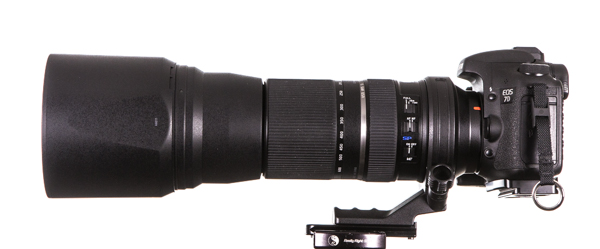
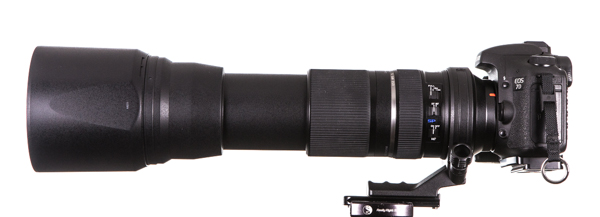
Tamron SP 150-600mm extend to 600 mm

The lens extend to 600 mm

The lens was tested using a Canon 5D Mk III and a Canon 7D. I found the lens reasonably well balanced while hand holding. It does get to be a bit of a strain during extended shooting so a tripod with a smaller gimbal style tripod head is advisable.

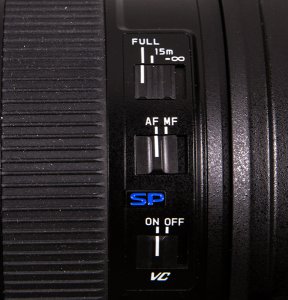
Switches on the Lens Barrel

Switches on the Lens Barrel

The lens is equipped with tripod mount, footed lens collar. An Arca Swiss style long lens plate was mounted for all tripod based testing.

The lens has three switches; each is a two position switch which is flush mounted on the lens barrel. The switches have a positive click and an audible feedback when operated. The switches are for: Autofocus/Manual focus, Vibration Compensation on or off, and focus limit. A lens lock at 150mm is also provided.

Lens Zoom Creep

The lens barrel tends to zoom creep over an extended period of time when positioned at an acute angle downward .  There is also some zoom creep when pointed directly upward.  The greater the angle the greater the creep. Extending an index finger to grip the lens barrel just beyond the zoom ring prevents any creep when the lens is handheld. Tamron has provided a lens barrel lock that will keep the lens locked in the 150 mm focal length position.  This is good during transport but Tamron should have considered making the lens lockable at all the major focal length positions.

Focusing

The autofocus is fast and fairly accurate. The lens uses a USD (Ultrasonic Silent Drive) focusing motor. The lens barrel has a two-stage focus limiter switch with a full and a 15 meter (49.2 feet) to infinity limited range. This is a very nice feature that prevents the lens from hunting through the whole focus range particularly when the subject is beyond 15 meters.

Manual focusing is reasonable as the focus ring is damped and very smooth. The position of the manual focusing ring could be improved as the lens collar comes in the way. For hand held operation it is preferable to rotate the collar 180 degrees or remove it entirely. Manual focus adjustments can be made in Auto or Manual focus modes as Full Time Manual is fully supported. The minimum focus distance is 8.9 feet/2.7 meters provides a magnification of 1:5. A focus window provides distances in meters and feet from the minimum focusing distance to infinity.

The front filter tread is 95mm and the front element does not rotate while focusing. This is a welcome feature, particularly for polarizing and split/graduated ND filter use.

TESTS

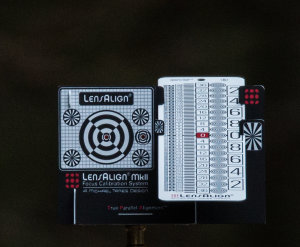
Micro Focus Calibration Tool

Micro Focus Calibration Tool

I set up the lens to test auto focus accuracy. Using a LensAlign Mk II micro focus adjustments were made at 150mm and 600mm. At 150mm no adjustment was needed while at 600mm a -5 was needed to correct for some back focusing.

The Ultrasonic Silent Drive (USM) motor in the lens is very quiet when focusing and the speed is comparable to the Canon 100-400mm f/4.05.6 IS L lens. At 600mm the lens first retracts to the closest focus distance before extending to the focus on the distant subject. Overall it does not affect the focus speed, as this phenomenon is controlled by the camera body. This issue was prevalent using both camera bodies.

Manual Focus

As mentioned earlier the manual focus ring is in an awkward position for my liking. The total rotation is 120 degrees and very manageable at shorter focal lengths but is not as well tuned at focal lengths greater than 450mm, and focus appears to have a slight lateral shift.

Once focus is established on a subject, varying the focal length does not maintain focus. Refocusing is required for any change in focal length.

Autofocus

The lens was tested using the most accurate center focus point on the Canon 5D MarkIII as well as the focus assist group.

With both bodies the “One Shot” (AF-S on Nikon) and “AI Servo” (AF-A on Nikon) focus methods performed well from focal lengths of 150mm to 400mm. At 500mm through 600mm the lens did not track well in AI Servo mode due to the high magnification, but was fine in One Shot (AF-S) mode. The lens was erratic, and if it dropped focus lock on the subject it rarely recovered to lock on again. Re-focusing was the only way to track a moving subject again. The loss of tracking is more apparent for subjects that are approaching the lens and less problematic for subjects moving left to right, or vice versa.

Vibration Compensation

Overall performance of image stabilization was very good. At focal lengths of 150 through 500 the lens maintains stability 2 to 3 stops below the hand held shutter speed guideline of 1/focal length as the minimum shutter speed. Hand holding at ISO 200 while looking through the viewfinder, one notices an image shift when the VC (IS) motors kick in.

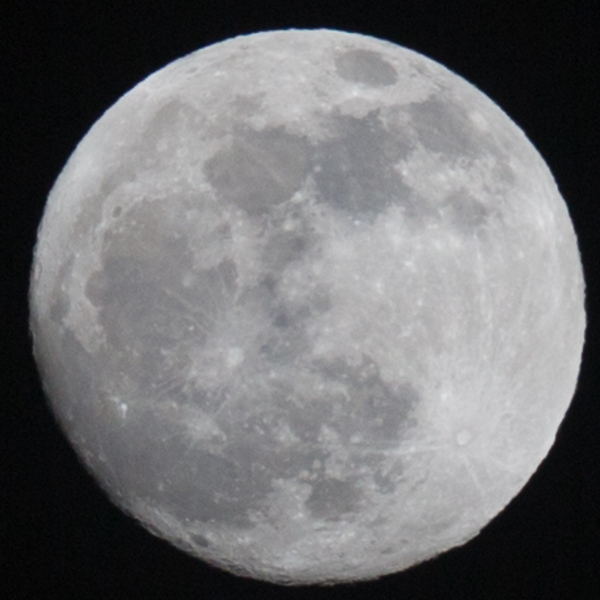
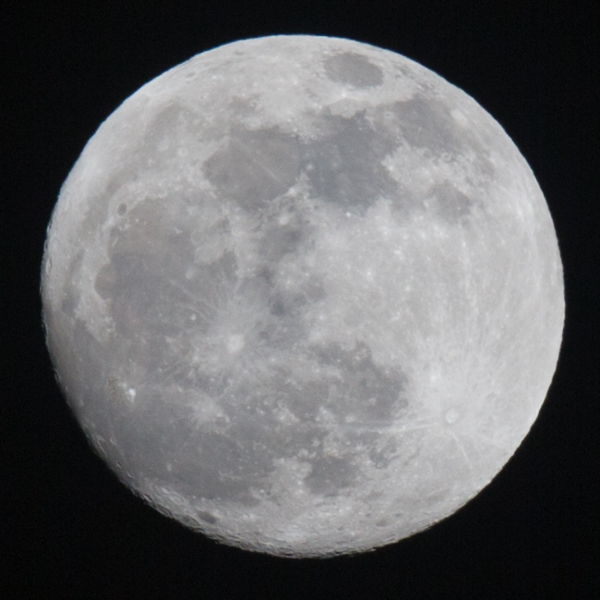
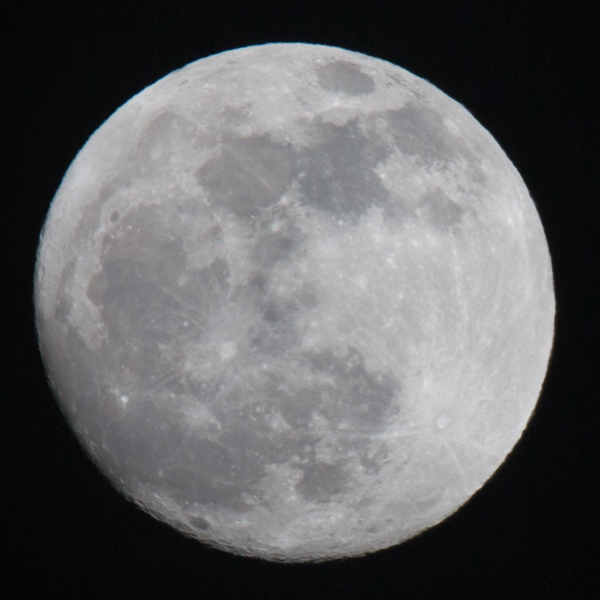
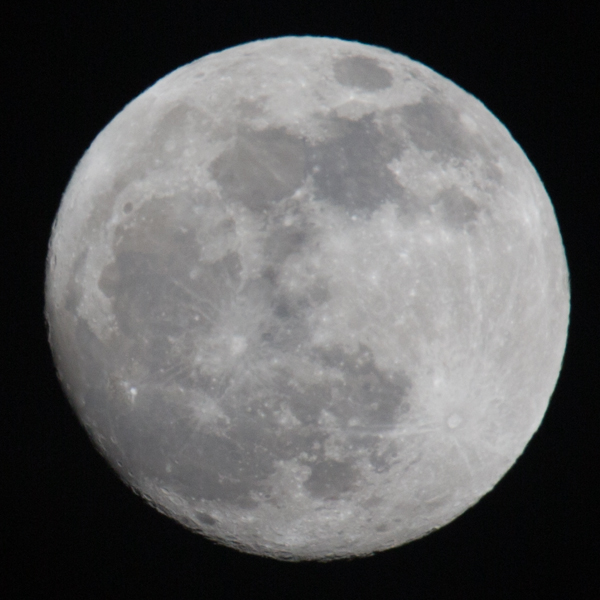
Here are some images of the full moon (cropped and sized to the same frame size) Settings used were: ISO 250, f/6.3, at 1/400th of a second, at focal lengths of 600mm, 500mm, 400mm and 300mm. The VC (IS) functions very well and is a pleasure to use.

Focal length 300 mm

Focal length 300mm

Focal length 400 mm

Focal length 400mm

Focal length 500 mm - some chromatic aberration is visible

Focal length 500mm – some chromatic aberration is visible

Focal length 600 mm - some chromatic aberration is visible

Focal length 600mm – some chromatic aberration is visible and there is a slight drop in sharpness

Test Results

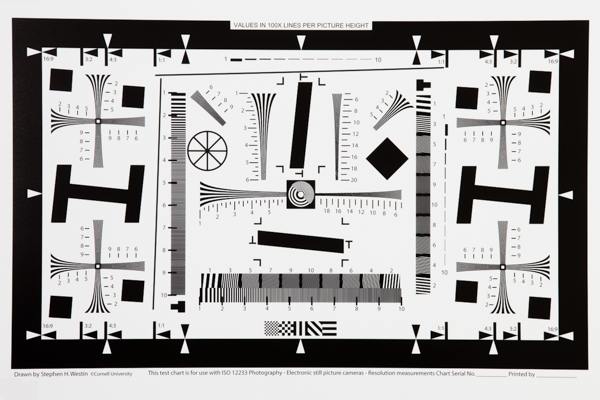
All controlled environment testing was done in the studio with constant lights and and a test chart as shown below.

lens sharpness chart

The Sweet Spots

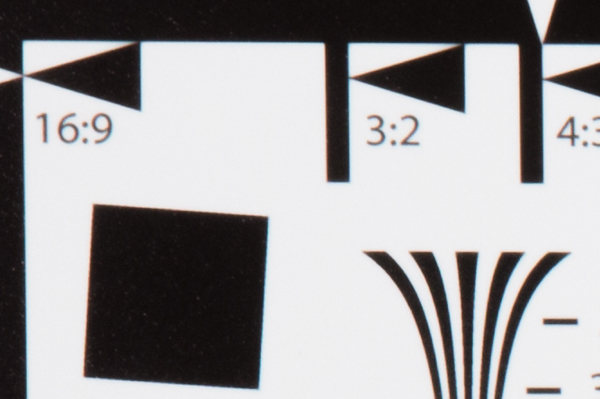
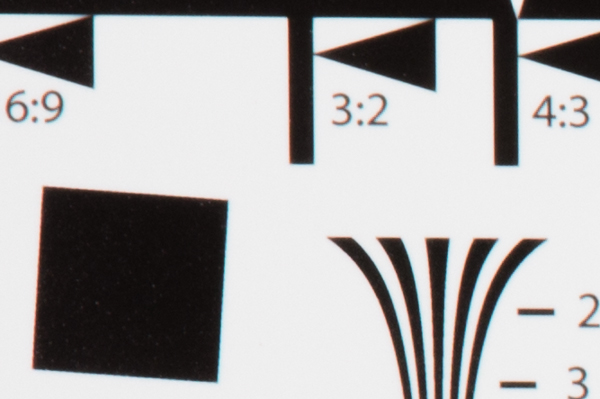
f/8.0 from 150-250mm:  at 300mm there is a loss of sharpness both in the center, as well as on the edges. At 400-600mm the center is sharp with some fall off toward the edges.

During tests, f/11 was found as a good aperture from 300-600mm. At 600 mm the edge fall off is pronounced, but that is also a factor of chromatic aberration. At the widest aperture in the 150-300mm range the lens has better overall sharpness from 200-300mm than at 150-200mm.

Aperture settings of f/8 through f/11 provide the best performance across the frame on a full frame sensor. f/5.6 through f/6.3 are good in the center. On a crop factor camera like the 7D the edge sharpness is acceptable in the f/6.3 to f/8.0 range at focal lengths of 300mm and higher while f/5.6 to f/6.3 is acceptable at focal lengths 300mm and below.

Pincushion Distortion

There is a slight amount of pincushion distortion through the entire focal length range of this lens. This distortion however, is minimal and very easily corrected using lens correction in Adobe Camera Raw or in Lightroom.

Edge Exposure Fall Off

Only visual testing was conducted for this test. The lens handles light fall off very well. It is most noticeable at f/22 but does not pose a problem at f/20. On the 7D body the frames captured at f/22 were acceptable with no cropping applied. f/20 is a very safe aperture for maximum “Depth of Field” and minimum edge fall off.

Chromatic Aberration

There is fringing at apertures of f/16 through f/22 at focal lengths of 400-600mm. Progressively getting pronounced as the focal length increases, it should be noted that though there is chromatic aberration it is not bad compared to other lenses in this class and could be considered low.

Chromatic aberration at 300 mm

Chromatic aberration at 300mm

Chromatic aberration at 400 mm

Chromatic aberration at 400mm

Chromatic aberration at 500 mm

Chromatic aberration at 500mm

Chromatic aberration at 400 mm

Chromatic aberration at 600mm

Pros and Cons

Pros

  • Great value for the price point
  • Very good build quality
  • Well damped focusing
  • Center sharpness throughout the range
  • Very quiet operation
  • Very good Vibration Compensation (Image Stabilization)
  • Low distortion and chromatic aberration

Cons

  • Position and rotational direction of focusing ring
  • Image shifting when VC (IS) engages
  • Edge sharpness fall-off at 600mm on a full frame body
  • Focus speed decreased at longer focal lengths

Conclusion

You might conclude from this list of cons, and some of the criticism, that the Tamron 150-600mm is not exceptional, but that would be very wrong. There are very few perfect lenses and the issues should be taken under consideration based on their significance for type of photographer who will use this lens, and the type of photography they do with it. This lens is a great performer, and the price point just can’t be beat. Used properly, and keeping its small limitations in mind, this lens will deliver excellent images and is a highly recommendable lens. It is an ideal hand holdable lens for nature and sports photographers.

Sample Images

Canon 7D, Tripod, ISO 250, f/9, 1/640 sec. As shot.

Canon 7D on tripod, at 600mm, ISO 250, f/9, 1/640th. As shot.

Image as above cropped to fill frame.

Image above, cropped to fill the frame.

Same image cropped to show head detail - crop size 280 x 187 pixels then zoomed to 600 pixels (Greater than 2X magnification)

Same image cropped to show head detail – crop size 280 x 187 pixels then zoomed to 600 pixels (Greater than 200% magnification)

_MG_8911-5

Canon 7D, at 500mm, hand held, ISO 2000, f/6.3, 1/125th

_MG_8801-2

Canon 7D, at 450mm, hand held, ISO 250, f/6.3, 1/1000th

_MG_8808-3

Canon 7D, at 600mm, on tripod, ISO 250, f/6.3, 1/200th

Image as above cropped to fill frame.

Image above, cropped to fill the frame.

Canon 7D, at 600 mm, hand held, ISO 250, f/6.3, 1/800 sec.

Canon 7D, at 600mm, hand held, ISO 250, f/6.3, 1/800th

A recent press release from Tamron announced  – TAMRON WINS TIPA AWARD 2014 FOR SP 150-600MM F/5-6.3 DI VC USD (MODEL A011) “BEST EXPERT DSLR LENS” These awards are presented each year by the Technical Image Press Association (TIPA) to top photo and imaging products.

The post Lens Review Tamron SP 150-600mm f/5-6.3 Di VC USD by Shiv Verma appeared first on Digital Photography School.


Digital Photography School

 
Comments Off on Lens Review Tamron SP 150-600mm f/5-6.3 Di VC USD

Posted in Photography


Tamron announces availability of 150-600mm F/5-6.3 telephoto zoom

16 Dec

Tamron_SP150-600mm_Di_VC_USD.png

Tamron has announced that its SP 150-600mm F/5-6.3 Di VC USD telephoto zoom will go on sale on December 19th in Japan, and 17th January 2014 in the USA. The lens will feature optical image stabilization and an Ultrasonic Silent Drive autofocus motor, and be compatible with both full frame and APS-C SLRs. It will be available first in Canon mount, with Nikon and Sony versions to follow. Pricing is still to be confirmed.

News: Digital Photography Review (dpreview.com)

 
Comments Off on Tamron announces availability of 150-600mm F/5-6.3 telephoto zoom

Posted in Uncategorized