RSS
 

Posts Tagged ‘eliminates’

Diverging Diamond: Novel Highway Design Eliminates Hazardous Left Turns

02 Jun

[ By WebUrbanist in Architecture & Cities & Urbanism. ]

diverging diamond interchange design

The diverging diamond interchange has been heralded as the new cloverleaf and condemned as pedestrian unfriendly, but it does do at least one thing remarkably well: it eliminates dangerous left-hand turns that tend to cause the worst kinds of accidents.

As confusing as they look, studies so far suggest they reduce crashes by up to a third and fatal crashes by more than half. At first look, these interchanges appear incredibly complex to navigate, but, on the ground, drivers find it easy to follow their directions.

diamond interchange diagram

Drivers never have to turn to get left, which is the most dangerous part of a typical interchange, merging their way into position instead. To accomplish this the roads cross and uncross gradually.

no left turn interchange

While these diamonds date back decades in France, they were only recently imported to the United States. A graduate student named Gilbert Chlewicki thought he had designed the system, only to discover it existed in Europe. There are now dozens of diverging diamonds in over 20 states across the US.

All of their benefits aside, diverging diamonds still have critics. Charles Marohn, an engineer and writer about bad road designs, maintains these interchanges are terrible for bikers and pedestrians. Of course, so are classic clover leafs.
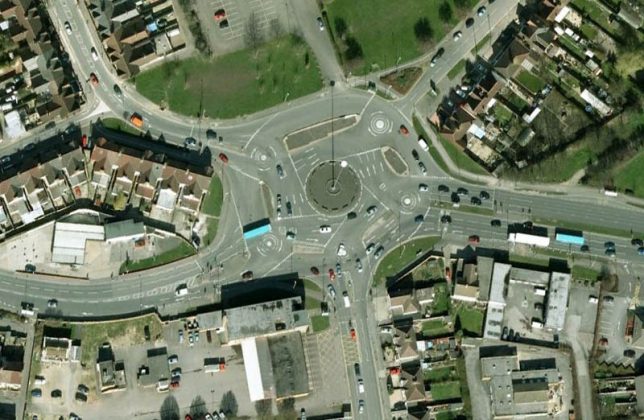
swindon roundabout

Like the infamous Magic Roundabout in England (with five smaller roundabouts circling a larger one), it may just take time for people to get used to the idea, too.

Share on Facebook


[ By WebUrbanist in Architecture & Cities & Urbanism. ]

[ WebUrbanist | Archives | Galleries | Privacy | TOS ]


WebUrbanist

 
Comments Off on Diverging Diamond: Novel Highway Design Eliminates Hazardous Left Turns

Posted in Creativity


FlatCam prototype eliminates lens using pinhole-like sensor mask

17 Feb
 

A team of researchers at Rice University are developing a thin, lensless camera called FlatCam, which replaces the traditional lens with a grid-like coded mask essentially made of multiple pinholes positioned directly over the sensor. From there, raw data from the camera – which looks nothing like an actual image – is sent to a computer where an algorithm demultiplexes the raw sensor measurements to reconstruct a photo.

FlatCam was developed by Richard Baraniuk and Ashok Veeraraghavan, and while it isn’t likely to replace traditional cameras, FlatCam could find use in a variety of applications where present imaging technology isn’t suitable. Due to its lensless design, FlatCam is thinner than a dime and can be ‘fabricated like microchips,’ decreasing costs.

Offering an example of possible future applications, Baraniuk explained, ‘We can make curved cameras, or wallpaper that’s actually a camera. You can have a camera on your credit card or a camera in an ultrathin tablet computer.’ The team’s paper details more potential applications, including surveillance, foldable cameras and wearable devices. They’ve even created a couple of video clips using the prototype camera.

In its present form, FlatCam produces 512 x 512 pixel images; however, the team expects better algorithms and improved manufacturing will one day result in higher resolutions. One of the salient issues mentioned in the paper surrounds noise: a linear demultiplexing system invariably adds noise from all the mathematical operations, with higher spatial frequencies experiencing even more ‘noise amplification’ that ultimately limits resolving ability. These are issues the researchers are actively working on.

The researchers recently talked about FlatCam on NPR’s All Things Considered; the episode can be streamed here.

Via: Rice University

Articles: Digital Photography Review (dpreview.com)

 
Comments Off on FlatCam prototype eliminates lens using pinhole-like sensor mask

Posted in Uncategorized