RSS
 

Posts Tagged ‘down’

Down and Dirty Guide to Milky Way Photography

16 Sep
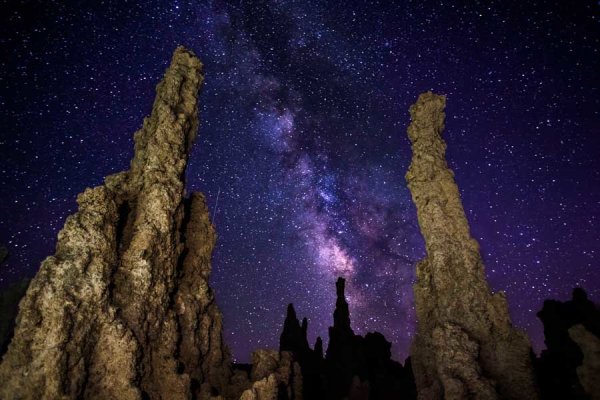
Another World | Mono Lake, California

Milky Way Over Mono Lake | James Brandon

Seeing the Milky Way with your own eyes is a life-changing, mind-blowing experience. It will put your place within the universe in to perspective and remind you just how small and insignificant we all are. The sad part is that most people have never seen it. Over half of our planet’s population lives in cities where seeing the Milky Way is all but impossible.

Even when people get out of the city and have a good view of the stars, they usually don’t focus on them long enough to find the Milky Way. It’s something that you either stumble onto by accident, or something that you have to plan ahead of time. Here’s a few quick tips for getting the Milky Way in your viewfinder and exposing it properly – your guide to Milky Way photography.

Research, Research, Research

Benjamin Franklin said so brilliantly that, “By failing to prepare, you are preparing to fail”. And it was Antoine de Saint-Exupéry that said, “A goal without a plan is just a wish”. So it goes with Milky Way photography. Sure, you can make a point to go out at night and see what you can find, but chances are you will be wasting your time.
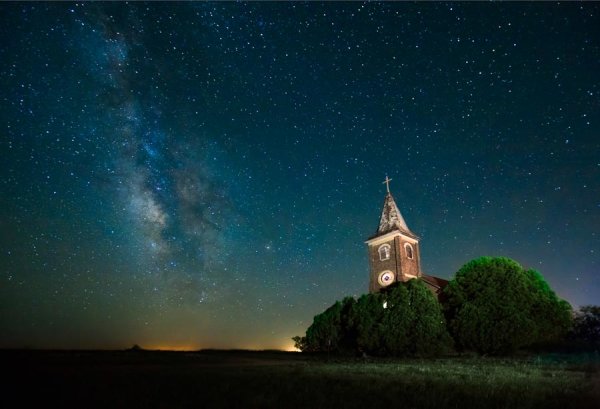
saint-john-milky-way-2

The Milky Way by Hemispheres

The Milky Way is only visible in your respective hemisphere during certain months of the year. If you’re in the northern hemisphere your best time to photograph the Milky Way is in the summer, with July being the peak month. Unfortunately, the summer months aren’t typically the best times for clear skies because of the heat and the clouds from all the storm systems. Summer nights are also short, therefore limiting access further to the night sky. Folks in the southern hemisphere have it better, with the winter months being the best time.

Don’t Forget the Moon!

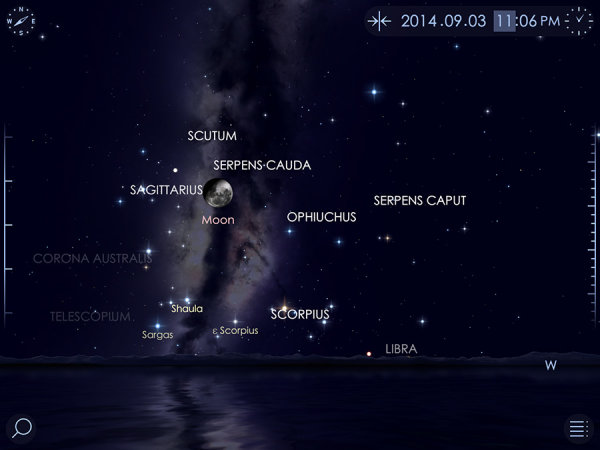
The moon can make or break your Milky Way shots. This is why planning is so important! Don’t make the mistake of finding a perfect subject, waiting for the Milky Way to line up, and then discovering that the moon is right in the middle of the celestial center. Having the moon obstructing the view of the Milky Way will, quite simply, ruin your shot.

There are two ways the moon can help your shot. One is by its total (or nearly total) absence in the sky. The other is by having the moon behind you, with the Milky Way in front of you (thereby providing a light source for your foreground).

The Best Astro App EVER
photo

Oh no! The moon is in the way!

All you need to do to plan a perfect night of Milky Way photography is a beautifully designed app called StarWalk 2 (sorry Android users, you’re simply out of luck here. I have an Android phone and I absolutely hate that I don’t have access to this). Luckily I have an iPad and it works beautifully on there.

StarWalk lets you interactively view the night sky from either your position, or any other position on earth, at whatever time of day you choose. As you change the time of day, the entire sky will magically begin to revolve around your position, revealing or concealing the Milky Way, the constellations and the moon.

So let’s say you decide to photograph Delicate Arch in Arches National Park. You discover through research that from beneath the arch looking toward it you will be facing east. All you really need to do now is choose a location in that general area, make the app point east and then scroll through the hours in the day to find when the Milky Way will rise above the horizon.

One of the jaw-dropping cool features of this app is that you can actually use it in the field with an image overlay. You can hold your iPad or iPhone out and the app will turn the camera on and look at what you’re seeing. It will then overlay the night sky onto your image so you can see what that view will look like at a certain time of day or night! How cool is that!?
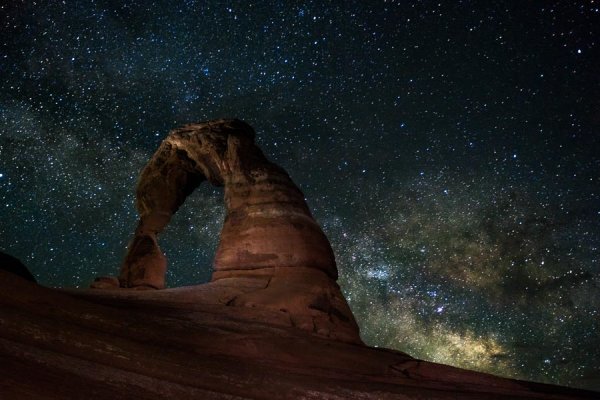
The Milky Way Over Delicate Arch | James Brandon

The Milky Way Over Delicate Arch | James Brandon

Having a Dark Sky is Crucial

While it’s not impossible to photograph the Milky Way in light polluted areas, it’s certainly not ideal. I live in the heard of the Dallas – Fort Worth metroplex and to really get a great view of the Milky Way I have to drive about three to four hours west. A great resource for locating extremely dark skies is the International Dark-Sky Association. They’ve got a list of locations that host some of the darkest skies in the world. Planning a trip to any of these places during the right time of the year will give you some of the clearest views of the Milky Way you will find anywhere. Trust me, you haven’t lived until you’ve stood beneath a Milky Way so bright that it lights the landscape in front of you. It’s truly a spiritual thing to witness.

Camera Settings

Photographing the Milky Way is quite different from any other subject you will attempt to capture. Like I said before, it really is a magical experience. Seeing the Milky Way with your own eyes is one thing, but wait until you see it appear on your camera’s LCD screen! You will quite possibly, literally jump for joy the first time you see it.

ISO is the first thing we’ll cover. In short, it needs to be set as high as possible while still maintaining a useable image quality. While this doesn’t mean that you need a pro level SLR, having one that performs exceedingly well in low light will certainly help. If your camera can produce quality images at ISO 1600 or even ISO 3200 you are going to be in great shape. If ISO 6400 or ISO 12800 is still workable, then you are going to knock it out of the park. Having your ISO set high means that your cameras sensor will be as sensitive as possible so that the maximum amount of light can be collected (which is very important at night).
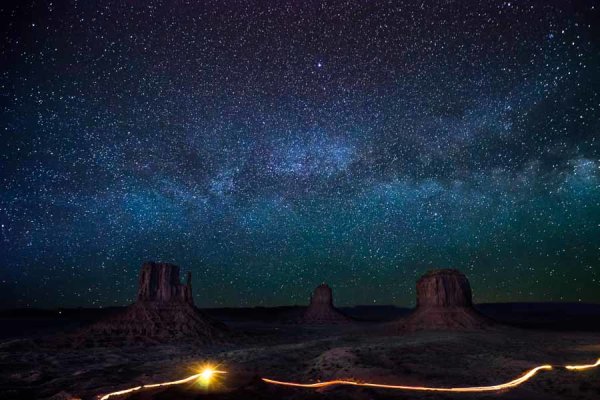
Milky Way Over Monument Valley | James Brandon

Milky Way Over Monument Valley | James Brandon

Next, select a shutter speed. Anywhere between 20-30 seconds is ideal. If you can get away with super high ISO levels, then go with 20 seconds. If you’re around ISO 1600-3200 then you may want to stick with 30 seconds. The only downside to 30 seconds is that you will have just the slightest hint of trails in your stars from the rotation of the earth. Not really a big deal though.

Finally, you need to set your aperture to be wide open, or very close to it. This is where having a lens that can open up to f/2.8, or larger, is really helpful.

All of these settings combined have one goal – to bring as much light as possible back to the cameras sensor.

Other Gear to Consider
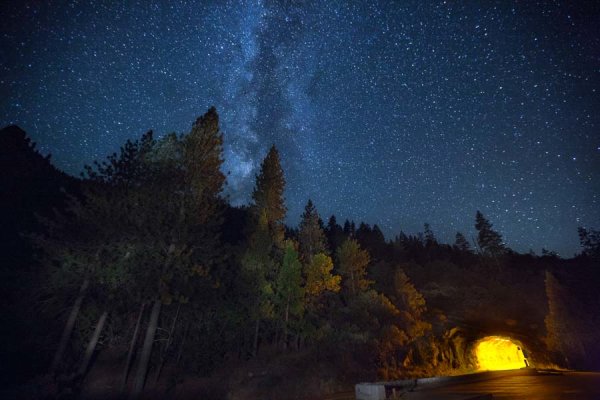
The Milky Way At Tunnel View In Yosemite

The Milky Way At Tunnel View In Yosemite

A good and sturdy tripod is worth its weight in gold. That is almost a literal statement if you go with something like a Really Right Stuff tripod, hehe. I got mine about a year ago (after saving up for quite a while) and will never consider another one. Having a good tripod means that your camera will be steady throughout the entire long exposure. If your tripod is cheap and made from plastic, or just a very flimsy aluminum or carbon fiber tripod, you will definitely have a hard time with long exposures. If your tripod has a hook underneath the center column, be sure to utilize it by hanging your camera bag there to weigh the whole thing down!

You’ll also want to set either a two second timer or use a cable release (remote trigger). Both of these methods get your hands off the camera for the entire duration of the exposure. If you try and press the shutter button down for a 30 second exposure, you will not be happy with the results.

Conclusion

The Milky Way is one of the most challenging and rewarding things you can get out and photograph. Doing it well requires planning and more planning. Don’t leave anything to chance. If you have more tips to add, questions or thoughts about the article, let me know in the comments below.

The post Down and Dirty Guide to Milky Way Photography by James Brandon appeared first on Digital Photography School.


Digital Photography School

 
Comments Off on Down and Dirty Guide to Milky Way Photography

Posted in Photography


Tramboarding: Hacked Wooden Pallet Slides Down Rail Tracks

15 Jul

[ By Steph in Technology & Vehicles & Mods. ]

Tramboarding 1

Four wheels fixed onto an ordinary wood pallet have transformed it into a skateboard of sorts that can slide down tram tracks in Bratislava, Slovakia. The rails in the city happen to be just the right width to fit a standard Europallet perfectly, turning the humble warehouse staple into a personal vehicle.

Tramboarding 4

Tramboarding 5

While the streetcar systems of many cities run on wider ‘broad gauge’ tracks, Bratislava is among those with a one-meter width. Other cities where the pallet tram hack would work include Antwerp, Basel, Belgrade, Bern, Frankfurt, Helsinki and Zurich. Watch it in action at Vimeo.

Tramboarding 3

Tramboarding 2

Slovakian artist Tomas Moravec says of his project, “A new transport vehicle brings change into the spatial perspective of a passenger in motion and generally changes the life of the city, through which the pallet can run, guided by a map of the city lines.”

Tramboarding 6

Where pallets were once used just a couple times and then thrown away, now they’re reclaimed for all sorts of projects, often requiring very little modification. Check out 13 DIY pallet projects for porch swings, home theaters and garden trellises, as well as 19 more clever pallet creations.

Share on Facebook


[ By Steph in Technology & Vehicles & Mods. ]

[ WebUrbanist | Archives | Galleries | Privacy | TOS ]


WebUrbanist

 
Comments Off on Tramboarding: Hacked Wooden Pallet Slides Down Rail Tracks

Posted in Creativity


5 Tips to Help You Slow Down and Take Better Photos

18 May

When you go out to take photos it can be tempting to start shooting right away with the goal of getting the ideal image or capturing the perfect picture. But before you get your camera out, it might be good to take the opposite approach and slow down. Way down. Let’s take a minute to consider some lessons you can learn from the age-old tale of the tortoise and the hare. Ironically, one of the most important things you can do when inspiration strikes is to move slowly like the tortoise, rather than rush along like the hare. The tortoise might not have been the quickest animal in the meadow, but he stuck it out and made it to the finish line while the hare had long since grown weary of the race and gave up altogether. As a photographer, it’s tempting to be a hare and race to photographic perfection, but if you look to the tortoise you see a much better example to follow.

image-001-mockingbird

Here are five tips to help you slow down and take better photos:

1. Study your surroundings

One of the most important elements of a good photograph is that of framing; how is your subject positioned relative to the environment? You might have already considered the subject of your photo (your child, your vehicle, a statue, a flower, etc.) but before you start racking up those pictures on your SD card, take a few minutes or more to consider where the subject is with respect to everything else in the area. Are there buildings, houses, or man-made structures that you could use to help make your subject stand out? Are there natural elements, like trees, shrubs, or rock formations that you could use to highlight features or colors of your subject? By pausing to consider everything else aside from your subject, you will be able to make better decisions about how to get the moments you are really striving to capture.

image-002-saint-francis

When I took this picture of Saint Francis on an overcast morning I had to consider not just the bust itself, but what else might help frame the photo. The quickest and most convenient option would have been to point my camera down and snap a picture, but by slowing down and taking time to consider everything else besides the statue it resulted in a much more pleasing image. I ended up crouching down low to the ground, and using the background elements to give the viewer a sense of space and context. By considering the environment and using that to inform my choice about how to take the photo, I was able to get a much better picture than I would have otherwise.

2. Wait for the light

You might not have a giant flash, or studio-style strobes and softboxes, but you can still get amazing pictures by using the best source of light anywhere – the sun. The downside is, you have to be patient if you really want to use it to its full potential. It might not be easy, but one of the best techniques you can utilize to take advantage of natural light is be patient and wait until it suits the needs of your photograph. Bright daylight is often not the best time to be outside and shooting, as the sun’s direct rays can be too harsh and create too much contrast especially if there are trees, building, or other elements casting big shadows.

image-003-bronze-man


Instead, take the tortoise approach and wait until the sun is lower on the horizon. An hour or so before sunset is one of the best times to be out taking pictures, as the low angle of the sun creates a much more pleasing source of light than when it’s directly overhead. Another good time to be shooting in nature is right after sunrise, as you still get the low angle and warm colors. I had to get up early to take this picture of a bronze pedestrian whom someone had bedecked with a bit of garland. But by waiting for the sunlight to be what I needed, rather than what happened to be available, I was able to get a much better photo.  It might not have been the quickest option, but it certainly yielded a much better image.

3. Be part of nature

Taking photos of wildlife does not always require a telephoto lens, but it does require patience. If you want to get good pictures of the animals around you, whether it’s in your backyard or on a hike up the mountains, it’s often best to be patient and let nature come to you. Animals will hear you coming and quickly scamper off, but if you stake out a good spot to wait for them you can be rewarded with some compelling photographic opportunities. A few weeks ago I wanted to get a picture of a squirrel, so I started chasing this one around while he looked for nuts and acorns. I soon realized this was an exercise in futility, as he kept running away from me! So instead I picked out one spot and just waited. After a while he crept back and started poking around near me, and I was able to get a decent picture.

Image003 squirrel

Nature can be a fickle mistress, and will often refuse to comply with what might seem like quite reasonable requests (“Hold still, little birdie! No, don’t fly away!”). But if you take time to be part of nature, and even let nature come to you, you will often be rewarded with much better photos than you could get by rushing into things.

image-005-snake

4. Let kids be kids

Trying to get a good picture of children can take all the fun out of a birthday party or an afternoon at the park. For many of us, our instinct is to be in control: “Look here everyone! Now say cheese!” Inevitably one kid will be smiling, one will be blinking, one will be staring off to the side, and one might even be crying. It might seem like getting a good picture of kids is almost impossible! Thankfully, there is hope. Instead of rushing like the hare to construct a greeting-card-worthy photograph, try taking the opposite approach and just let the kids play. Keep your camera ready, and use it to capture the kids just being themselves. The catch is, you could be waiting quite a while, but you (and the kids) will have much more fun in the process.

Image004 girl

I took this photo of my friend’s daughter while she and my son were playing around in the dirt, and even though it took a while and I got myself rather muddy in the process, I ended up with a picture that was far more interesting than all the posed ones we took earlier. Another advantage of this approach comes months later when you are looking through your pictures. Posed photos of children smiling at the camera might seem like a good idea at the time, but afterwards you will often find that these are not nearly as interesting as the ones where the kids are just playing around and acting natural. But if you are not willing to be patient and wait for these moments to happen, they will often slip by and be lost forever without you ever even noticing.

image-007-kids2

No fancy studio, no special camera gear- just sunlight and patience

5. Learn one new camera function, and learn it well

Cameras today have so many options, buttons, and dials it’s no wonder so many people shoot in Auto mode, and I can hardly blame them for doing so! Learning to operate your camera can be a daunting task, and if Auto takes pictures that are generally good enough, why bother with all the menus and knobs? I have seen so many people try to learn how to operate their cameras to take better pictures, but give up in frustration because it’s so overwhelming. The trick is to pick one thing and learn it thoroughly, and in doing so the various elements of exposure and photography will slowly start to come together.

For example if you shoot in Auto, try choosing the Aperture Priority mode (Av or A on your camera) and learn how to control the aperture of your lens to get better shots. Don’t worry about shutter speed, ISO, white balance, AE-L, or anything else just yet. All that is important, but it can wait. Once you spend a few days, weeks, or even longer getting the hang of adjusting the aperture, then move on to something else like the Shutter Priority mode (S or Tv on your camera) where you control the shutter speed and let the camera figure out the rest. You will soon start to see how the various elements of exposure (Aperture, Shutter, and ISO) affect one another, and how to control them to produce the amazing shots that have somehow always eluded your grasp.

By sticking with just one new camera function at a time you might not learn everything about your camera as quick as you would prefer, but you will likely avoid the frustration and burnout that often comes with trying to learn too many new concepts at once. After all, the hare might have gotten off to a quick start but we all know how that turned out. In photography, it pays to be more like the tortoise: slowing down might not seem ideal at first, but it will help you produce brilliant results in the end.

The post 5 Tips to Help You Slow Down and Take Better Photos by Simon Ringsmuth appeared first on Digital Photography School.


Digital Photography School

 
Comments Off on 5 Tips to Help You Slow Down and Take Better Photos

Posted in Photography


Micro-Cycle: Hubless Bike Folds Down & Fits into Backpack

09 May

[ By WebUrbanist in Technology & Vintage & Retro. ]

folding bicycle prototype design

Few folding bikes can boast such compact proportions (even when fully collapsed) as this umbrella-sized wonder you can sling at your side or slide into your shoulder bag.

portable umbrella sized bike

The Sada Bike bends the basic assumptions of bicycle design, but not in the same fashion as small-bike solutions. Instead of reducing the size of essential elements, which creates an awkward riding experience, Sada trades a rigid chassis and support-providing spokes for a jointed lightweight frame and reinforced rims that require less material.

portable folding urban bike

Experienced engineers will note their solution is not without its own unsolved questions, including the impact of putting weight along the edges of empty (even if rigid) wheel frames.

portable compact backpack bicycloe

Still, it is a start – while their may be balance and durability issues yet to address, the concept calls into question the premises behind existing standard, miniature and foldable bikes and pushes the potential limits of urban portability.

folding bike subway shot

In critique of other existing approaches, Sada’s creators note: “They have a small frame and wheels at the expense of stability, for the sake of compactness and portability during transport. The minimum size of the frame, in fact, penalizes the rider position while driving and the small size of the wheels significantly are affected by variations in terrain. On the other hand, the traditional bicycles, avoid these problems, but the rigid chassis makes them inflexible during transport on public transport.”

Share on Facebook


[ By WebUrbanist in Technology & Vintage & Retro. ]

[ WebUrbanist | Archives | Galleries | Privacy | TOS ]


WebUrbanist

 
Comments Off on Micro-Cycle: Hubless Bike Folds Down & Fits into Backpack

Posted in Creativity


Park & Slide: 100,000 Sign Up to Slip 300 Feet Down a Street

07 May

[ By WebUrbanist in Art & Installation & Sound. ]

urban slide go now

For one day only, residents of Bristol were offered just 360 ‘tickets to slide’ (out of nearly 100,000 applicants) down a main city street at over 10 miles an hour, surrounded by thousands of jealous onlookers.

urban installation art design

Inspired by the previous year’s heat wave and created by Luke Jerram, this participatory crowdfunded project was an inclusive, all-ages community endeavor, with sliders ranging from 5 to 73 years old.

urban slide go detail

The slide was installed on Park Street in Bristol as part of Make Sunday Special and the Bristol Art Weekender, drawing a mix of participants from within and beyond the city.

urban slide ticket line

urban slide in action

Plastic sheets over padded mats were shaped and held in place by hay bales – this simple canyon was then supplied with continuous water to ensure a smooth ride from top to bottom.

urban water slide build

urban public water slide

While he has no plan to tour his own creation, Luke is going to make the plans freely available for other people who want to follow suit, making public water slides in their own towns or cities around the world.

Share on Facebook


[ By WebUrbanist in Art & Installation & Sound. ]

[ WebUrbanist | Archives | Galleries | Privacy | TOS ]


WebUrbanist

 
Comments Off on Park & Slide: 100,000 Sign Up to Slip 300 Feet Down a Street

Posted in Creativity


Judge strikes down fine against drone photographer

14 Mar

Drone.jpeg

In a court case bound to have far-reaching implications for U.S.-based photographers looking to use drones or other model aircraft for commercial shoots, National Transportation Safety Board Judge Patrick G. Geraghty has stuck down an FAA suit against a photographer for his ‘reckless’ use of a drone. Model aircraft aficionados and photographers alike have reason to celebrate this ruling, though naturally the FAA has announced a decision to appeal. Learn more

News: Digital Photography Review (dpreview.com)

 
Comments Off on Judge strikes down fine against drone photographer

Posted in Uncategorized


Don’t Look Down: 50 Inspiring Examples of Rooftopping Photography

03 Mar

You have probably heard of a new photography fad called “rooftopping,” in which brave daredevils find the way to the top of skyscrapers and other tall buildings to snap majestic shots. Just imagine the buzz of the roof topper who reached the top of the highest building in the city and saw the incredibly breathtaking view. If you want to Continue Reading

The post Don’t Look Down: 50 Inspiring Examples of Rooftopping Photography appeared first on Photodoto.


Photodoto

 
Comments Off on Don’t Look Down: 50 Inspiring Examples of Rooftopping Photography

Posted in Photography


Olympus OM-D E-M10 brings E-M5 down to size

29 Jan

NC_F10_BLK_right_M14422R_BLK_off_RV.png

Olympus unveils the OM-D E-M10, a smaller and budget-friendly Micro Four Thirds ‘Digital OM’ with many parts borrowed from the E-M5 – including its 16 megapixel sensor. It also manages to snag a few features from the flagship E-M1, like a TruePic VII processor and built-in Wi-Fi for image transfer and remote control. It falls short of its siblings with ‘3-axis’ image stabilization rather than the ‘5-axis’ system in the E-M5 and E-M1, and doesn’t provide an accessory port, but these concessions help nudge the E-M10 to its attractive $ 699/£529 body-only price point.

News: Digital Photography Review (dpreview.com)

 
Comments Off on Olympus OM-D E-M10 brings E-M5 down to size

Posted in Uncategorized


Things we found stuffed down the back of CES 2014

13 Jan

ollocolors.jpg

CES 2014: After all of the meetings, hands-ons and reports were done, we spent a little time wandering the CES 2014 show floor, as we always do when time allows, and found a few interesting products on the side streets between the towering booths of major manufacturers. Many photo-focused products this year related to mobile in some way, standing beside an endless array of iCases, iKeyboards and iEverything else. Click through to see what we found when we left the beaten path…

News: Digital Photography Review (dpreview.com)

 
Comments Off on Things we found stuffed down the back of CES 2014

Posted in Uncategorized


Decay Down Under: 7 Abandoned Wonders of Australia

27 Nov

[ By Steph in 7 Wonders Series & Global. ]

Abandoned Australia Main

Whether covered in colorful graffiti or slowly disappearing under a profusion of moss and vines, Australia’s most intriguing abandoned places share the same sense of mournful decay as landmarks that are nearly lost to the ravages of time. These 7 wonders of abandoned Australia include historic tram stations, theme parks, asylums and factories.
Atlantis Marine Park, Yanchep, Western Australia

Abandoned Australia Atlantis Marine Park

(images via: tor lindstrand)

A massive statue of King Neptune still looks out over a marine park that’s been closed for nearly 25 years. Atlantis Marine Park opened in Yanchep, Western Australia in 1981 and hosted the typical array of aquarium wildlife like dolphins, sea lions, penguins and seals. But in the late 1980s, regulations about the size of enclosures for dolphins changed, and accommodating them proved too costly for the owners. All nine dolphins were rehabilitated and released back into the wild, but when three of them failed to thrive, they were relocated to another marine park.

Since then, the property has been in limbo, with much of the ruins retaken by nature. No fences keep out members of the public, so anyone can get in to take photos and enjoy the views of the ocean. Members of the community have petitioned to restore the park, but the property owners plan to develop the space for residential and commercial use.

Aradale Mental Hospital, Ararat, Victoria

Abandoned Australia Aradale Hospital 1

Abandoned Australia Aradale Mental Hospital 2

(images via: aradale ghost tours)

Built in 1863, Aradale Mental Hospital was an Australian psychiatric hospital built to accommodate the burgeoning population of ‘lunatics’ in Victoria. Designed as a town within a town, it had its own gardens, markets, orchard, vineyards, pig farm and other livestock along with hundreds of staff. The Victorian complex was built high on a hill and held thousands of patients in 18 wards until 1993. It held female prisoners until 2001 during the renovation of a nearby facility, and then closed for good. Companies like Aradale Ghost Tours now take curious visitors through the complex, including the morgue.

And how was it that Victoria was home to so many so-called lunatics? It was common during that time, all over the world, for people with conditions like Down Syndrome, epilepsy or autism to be declared insane. Sometimes, all it took was postpartum depression, homosexuality or ‘promiscuous behavior’ to be institutionalized for life.

Helensburgh Train Station, New South Wales

Abandoned Australia Helensburgh Train Station

(image via: robert montgomery)

Sometimes the most striking abandonments are those that are so overgrown, they’re almost entirely hidden. Such is the case with the Helensburgh train station in New South Wales. Left to decay since 1915, when a new station was built about 200 meters to the north, this stone-walled relic is all rust and rotting wood, lush with ferns, moss and ivy. Unsurprisingly, it’s an irresistible attraction for photographers – check out some stunning photos by Tom Jarman at Urban Ghosts Media.

Rozelle Tram Depot, Glebe, New South Wales

Abandoned Australia Rozelle Tram Depot 1

Abandoned Australia Rozelle Tram Depot 2

(images via: wikimedia commons)

Once the second-largest tram depot servicing Sydney and among the most sophisticated public tramway systems in the world, the Rozelle station in Glebe was open from 1918 until 1958. Six 1930s trams, mostly gutted on the inside, still sit inside the station so many decades later. Though they may have been abandoned inside this massive concrete and steel facility, they’re now practically works of modern urban art, brightly colored and covered in layer upon layer of graffiti. The trams were in near-mint condition prior to 2000, and could have been beautiful historical artifacts if not for the vandalism that began around that time. The whole property has been purchased by a developer, who plans to turn the site into medium density housing.

Next Page – Click Below to Read More:
Decay Down Under 7 Abandoned Wonders Of Australia

Share on Facebook


[ By Steph in 7 Wonders Series & Global. ]

[ WebUrbanist | Archives | Galleries | Privacy | TOS ]


WebUrbanist

 
Comments Off on Decay Down Under: 7 Abandoned Wonders of Australia

Posted in Creativity