RSS
 

Posts Tagged ‘Door’

Photographer turned his front door into a large format camera to capture portraits during the pandemic

15 Aug
The ongoing COVID-19 pandemic has made social distancing critically important. While creating distance is good for our physical health, it is difficult for photographers, especially portrait photographers. To overcome this challenge, Kyle Roper, the producer behind The Skyscraper Camera Project, transformed the front door of his home into a large-format analog camera. This has allowed him to safely capture portraits and launch a new photo series, Door Frames.
A look at the makeshift front door camera form inside Roper’s living room.

Given ample time at home and the desire to continue creating images while observing social distancing restrictions, Roper converted his front door into a camera obscura using magnetic dry erase board, gaffer’s tape, cardboard boxes, a dark cloth, c-stand, clamps and sandbags. For photo paper and film, Roper uses Ilford RC IV Multigrade Photo Paper, Ilford Direct Positive Paper and Ilford Ortho 80 Plus. His lens of choice is a Nikkor-W 300mm F5.6 lens in a Copal shutter.

An overview of all the elements of the front door camera.

Roper states that he was inspired by his friend, Brendan Barry, an artist and camera builder we’ve featured many times before. Roper was also inspirited by the work of Dorothea Lange and Francesca Woodman. The former is a particularly interesting inspiration given Lange’s famous documentary and photojournalism work for the Farm Security Administration during the Great Depression.

The conveniently-located window in Roper’s front door.

Of Door Frames, Roper says, ‘When you have nothing but an abundance of time, you take the time and slow things down. You find that these antiquated processes can reveal and create such beauty.’ Below is a collection of portraits Roper captured with his front door camera:

$ (document).ready(function() { SampleGalleryV2({“containerId”:”embeddedSampleGallery_5564799738″,”galleryId”:”5564799738″,”isEmbeddedWidget”:true,”selectedImageIndex”:0,”isMobile”:false}) });

In order to communicate with his subjects outside, Roper speaks to them from inside his home using a speakerphone. Roper then affixes his photographic paper on the image box using the magnetic dry erase board and captures an image with his Nikkor lens wide open because his photo paper is ISO 3 or 6. Once an image is captured, Roper develops it in his bathroom, which he has converted into a darkroom.

Prints in the process of being made in Roper’s makeshift darkroom.

To view more Kyle Roper’s work, visit his website and follow him on Instagram.


Image credits: All photos used with permission from Kyle Roper

Articles: Digital Photography Review (dpreview.com)

 
Comments Off on Photographer turned his front door into a large format camera to capture portraits during the pandemic

Posted in Uncategorized


Ricoh releases SDK for Pentax cameras, opening the door to 3rd party remote control apps

17 May

Ricoh has released a software development kit (SDK) for Pentax cameras that allows third-party developers to create mobile and desktop apps that can control the camera remotely via USB cable or Wi-Fi.

The wireless package is available for Android and iOS. The USB-version can be downloaded for Microsoft .NET Framework and for C++ (Linux, Windows or MacOS). Both variants offer functions for controlling Pentax’s DSLRs and medium format cameras remotely, including photo and video capture, live view and adjustment of camera settings.

The SDK should allow for straightforward development of sophisticated remote control apps and other, more specialized, camera software, without any need for reverse engineering.

Free downloads and comprehensive documentation are available on Ricoh’s dedicated API website.

Articles: Digital Photography Review (dpreview.com)

 
Comments Off on Ricoh releases SDK for Pentax cameras, opening the door to 3rd party remote control apps

Posted in Uncategorized


No Exit: Bricked Train Door Blocks German Subway Commuters

01 May

[ By WebUrbanist in Art & Installation & Sound. ]

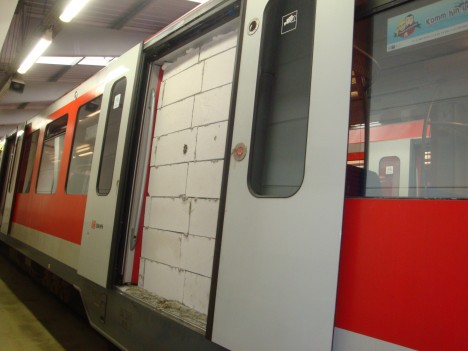
brick blocked train car

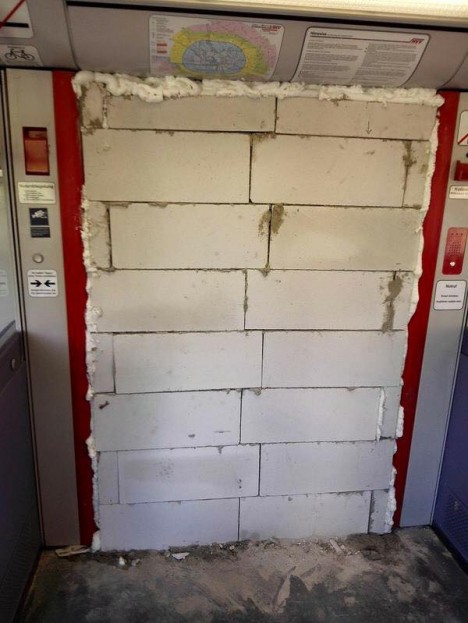
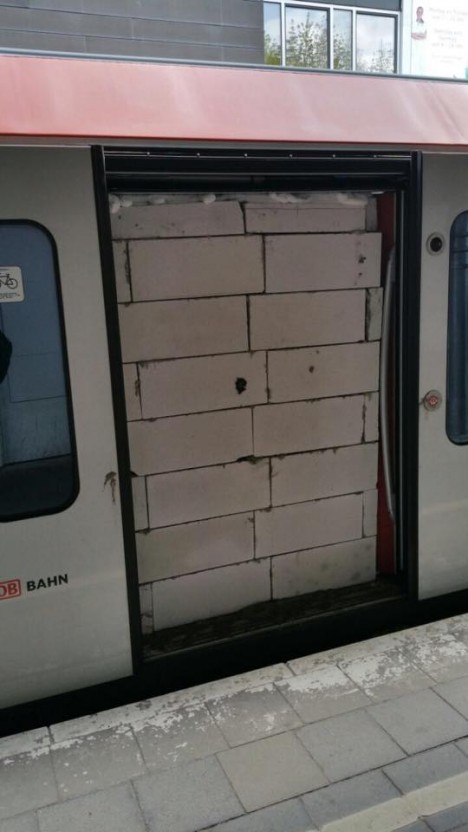
Presumed a prank at first by online skeptics, authorities have since confirmed that these precisely-stacked cinder blocks were indeed carefully assembled and bonded together to fully block the door of an S-Bahn train in Hamburg.

brick blocked train line

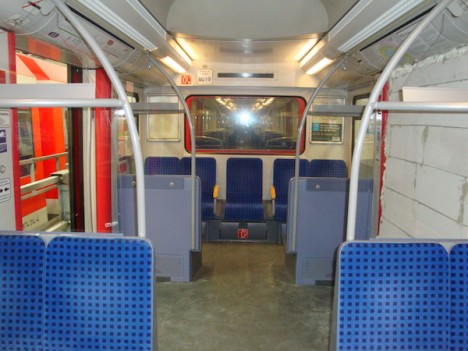
Placed inside the actual sliding doors, the bricks proved a surprise when the aperture slide open to reveal the blockage. Passengers who managed to board before the intervention was reported were forced to exit at an upcoming station while an investigation was performed and the problem ultimately fixed.

bricked train interior view

While some may be amused and no one was trapped inside the car, blocked by blocks, the impacts were significant for those faced with cleaning up after this vandalism. The train was routed to a depot and the wall carefully broken down piece by piece, the story ending 12 hours and an estimated 10,000 dollars later.

bricked subway car line

With no sign of the perpetrators, the biggest clue is the professionalism with which the wall was assembled, apparently by a team of people with construction expertise. With no one claiming credit, overtly or anonymously, one is left to wonder whether some reference to the Berlin Wall was intended or if this was an attempt at some other kind of art or message.

Share on Facebook


[ By WebUrbanist in Art & Installation & Sound. ]

[ WebUrbanist | Archives | Galleries | Privacy | TOS ]


WebUrbanist

 
Comments Off on No Exit: Bricked Train Door Blocks German Subway Commuters

Posted in Creativity


Rich Door, Poor Door: Segregated Entrances Spark Controversy

30 Jul

[ By WebUrbanist in Architecture & Houses & Residential. ]

rich door front entrance

Mayor Bill de Blasio and the Department of Housing Preservation and Development has come under attack by critics for approving  building plans in NYC that include separate entrances for affordable-housing tenants and luxury-condo owners. The debate raises other questions about the urban poor and the mixing of classes in this city and beyond.

rich door entrance scandal

40 Riverside Boulevard, an Upper West Side project of the Extell Development Company, is the property at the heart of this particular controversy. Its 55 street-facing units for low-income residents have helped permit its developers to create many of the other 219 additional units to be sold at market rates and take advantage of associated tax breaks. The aggregate effect of the benefits? An estimated $ 100 million in added floor space value for this 33-story tower.

rich door extel example

The now-approved plans call for a back-alley entryway for second-class residents and a more prominent front entrance for its full-priced buyers. Detractors say the separation of entryways defeats the intention of the program, effectively segregating low-income from regular housing. Arguments on the flip side suggest that the city should focus its efforts developing less-valuable land elsewhere for subsidized housing projects.

rich door lobby entrance

The Inclusionary Housing Program to which Extell applied is meant to encourage integrated complexes and, in exchange, allow developers to build larger structures on coveted urban sites. At issue is the notion that this development may follow the letter but not the spirit of the system, which, in theory, should be arbitrated by the HPD, but in practice has become part of a larger public discourse.

rich poor divide interior

The heated and ongoing debate has caused Manhattan Borough President Gale Brewer to promise a rejection of any future plans that similarly separate out entrances. Whether that will truly help solve the island’s long-term affordable-neighborhoods issue, though, remains to be seen.

Share on Facebook


[ By WebUrbanist in Architecture & Houses & Residential. ]

[ WebUrbanist | Archives | Galleries | Privacy | TOS ]


WebUrbanist

 
Comments Off on Rich Door, Poor Door: Segregated Entrances Spark Controversy

Posted in Creativity


Getting Your Foot in the Door as a Freelance Assignment Photographer

23 Jun

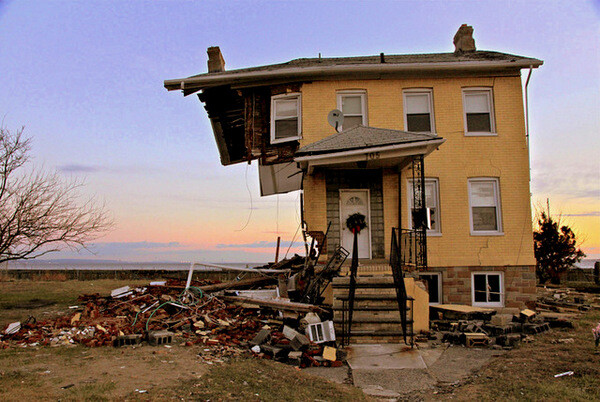
Hurricane Sandy

One of the biggest changes photography has seen over the last 10 years is in photojournalism and documentary photography. Some will see this change as good while others will see this change as bad. The improvements made to consumer DSLR cameras, lenses and editing software have opened the doors for many photography hobbyists to engage in documentary photography.

Gone are the days when having a good camera and access to a darkroom separated the professional photographer from the amateur photographer. The playing field has been levelled and it is open season for anyone to take part. Within this new landscape there is an abundance of opportunities for you to possibly earn a little extra cash by taking photos for your local paper, magazines or online news outlets.

The assignments will always vary. You may be asked to cover a government meeting or the opening of a new business. You may be taking pictures for a human interest story about a unique person in your town. You could be asked to cover a local high school football game or be asked to rush to the scene of an accident. You may find yourself taking pictures of a festival or a gala dinner featuring some movers and shakers.
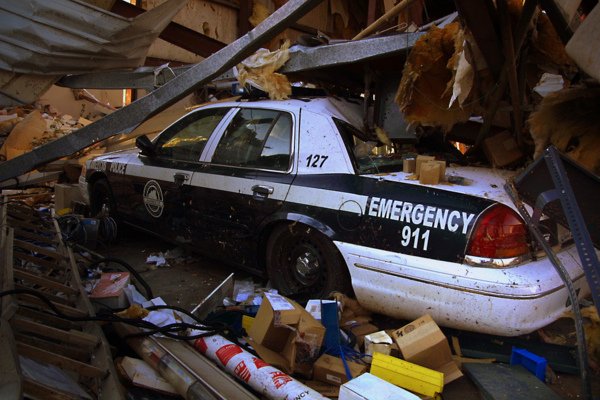
Police Car

Below is a list of tips that will help you be a better assignment or documentary photographer, and possibly get your foot in the door to get some jobs.

PRACTICE. KNOW YOUR GEAR.

In many regards, photography starts with the gear. It is important to know the limitations of your equipment. It is equally important to know the areas in which your equipment performs well. No matter what camera and lens you are working with, your equipment will have limitations. Don’t spend time wishing for, or wanting a different lens or camera. Use what you have to the best of its ability. A better lens in some warehouse, is not going to help you now.

ASK QUESTIONS OF YOUR ASSIGNMENT EDITOR

As an assignment photographer you should be prepped before you go out by the editor of the publication, or the writer of the story. If you have any questions, ask them! I have never had an assignment editor react poorly to me asking questions about a piece they are asking me to cover.

Ignorance can be overcome by asking questions. Overcoming stupid is more challenging. Don’t be stupid. If you are not clear about what is expected of you, ask questions until you and your editor are on the same page.

WHO? WHAT? WHEN? WHERE? WHY? HOW?

Speaking of questions, do your pictures answer the ones above? Try to take pictures that answer as many of these questions as possible. While it will be very challenging to capture one picture that addresses all of them, shoot with the idea that your pictures are answering as many as possible.
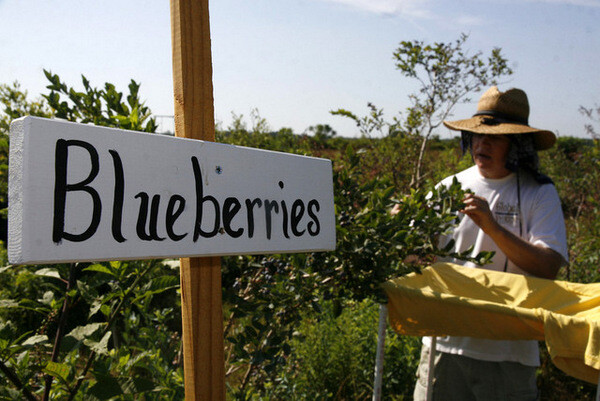
Blueberry Season

DO YOUR OWN RESEARCH

After you have asked the necessary questions of your assignment editor, do your own research on the subject. This will help you develop ideas, understand how events may unfold, or which images will be more important than others. Don’t expect your editor to tell you exactly what picture to get. They are hiring you, in part, because of your vision. Conducting a little research before you go out will help you find your vision.

COME WITH AN IDEA IN MIND

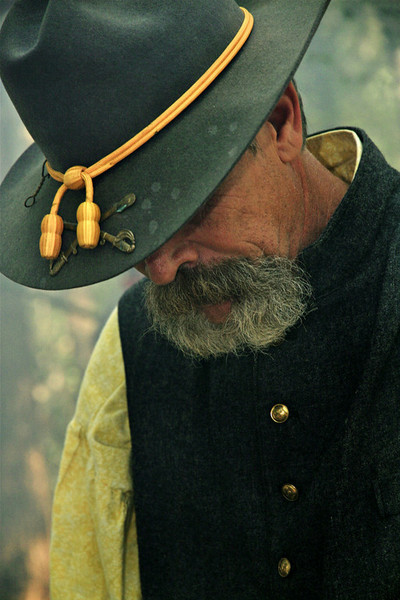
After researching your subject, think of shots that you want to capture and work toward those pictures when you are in the field. But don’t knock yourself too much if you don’t get “the” picture you wanted. Documentary photographers have little (or no) control over what happens. Come with an idea that will keep your mind centred, but be prepared to adjust your ideas accordingly as the events unfold before you.
Civil War

START BY PLAYING

Once you arrive, begin by playing with your exposure settings and shooting styles. This will ensure that you, and your camera, are properly set up when the moment arrives. In the same way athletes warm up before a race or a game you need to begin by getting your mind and your gear in proper condition before the event begins.

BE INVISIBLE

Remember, you are there to document what others are doing. The story is not about you. Do what you can to stay out of the way to allow events to unfold naturally. If you are too intrusive your subjects will not relax and you will not be documenting natural events. Stay out of the way and let events unfold in front of you.

TIGHT. MEDIUM. WIDE.

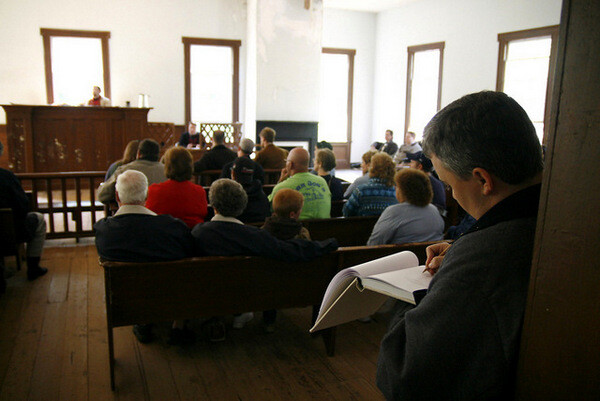
Take wide, medium and tight shots of what you are covering. As an example, if you are covering a town hall meeting be sure to get a wide shot that shows all of the filled, or empty chairs, in the room. A medium shot may be a waist-up shot of someone at the podium. A tight shot would be a head shot of someone expressing emotion as they discuss the subject of the meeting or as they listen to the presenters speak.
Westville Meeting

FOCUS

Proper focus is critical in all photography. It is essential in documentary photography and photojournalism. Your focal point tells the viewer what they should be looking at. If you are still taking pictures at that town hall meeting you can have two very different pictures of someone at the podium if one picture is focused on the speaker and another picture is focused on all of the microphones that the presenter is speaking into. One picture shows who was talking and the other picture shows how many people (news outlets) were there to cover the event. Each picture has its own meaning and that is derived from the focal point.

ANTICIPATE

I make a lot of sports analogies when talking about documentary photography because, in many regards, photojournalism and documentary photography is a sport. Just as a quarterback has to read the defence as he stands behind the centre, a documentary photographer has to have his eyes and attention in several places at once. By keeping a constant vigil on your surroundings you will see a picture developing in the same way a quarterback sees a play developing. The great ones always seem to be a few seconds ahead of the action.
Semana Santa

BE PROFESSIONAL

A professional attitude will help to guarantee two things. One, it will help to ensure that those around you understand that you have a job to do and they will permit you to do your job as long as you maintain a professional demeanour. The other thing a professional attitude will bring to you is another assignment. If word gets back to your editor that you were forcing people to behave in a certain way or that you interfered with the event to get a shot, you may not get another chance to work for that editor again because you have embarrassed them (and yourself) in your attempts to get a great picture.

BACK UP YOUR WORK

Once you get back home or to the office, back up your pictures. It doesn’t matter if you put them on a second hard drive, upload them to the cloud or put them on a disk. Make sure that you have copies of your pictures in more than one place in the event that the originals become damaged, destroyed or lost.
Farm to Fork

CAPTION YOUR PHOTOS

Your job as an assignment photographer doesn’t end when you back up your pictures. More times than not you will be asked to caption your photos. Your assignment editor will have no idea of the names of the people in your pictures. It will be up to you to write a brief description for each picture you are turning in. An easy way to do this is to answer the questions, who, what, when, where and why when making captions. “How” may not always be relevant.

DON’T OVER EDIT YOUR PICTURES

If you are asked to turn in edited pictures, don’t over-edit your work. Photojournalism and documentary photography are about the real world. In a strict sense you should only adjust the contrast of your picture. Some news outlets shun adding too much color and all news outlets shun the removal or addition of elements into a picture.
Habitat Vans

BE EASY TO WORK WITH

Being easy to work with is incredibly important in today’s freelance assignment photography landscape. It is becoming easier and easier to take quality pictures with less than professional equipment. Photographers are becoming very replaceable as there are more and more people with photo skills itching to get a little credit and maybe even a little money. Make sure you have an easy payment process. Make sure it is easy to get in touch with you, and that you respond quickly to emails and phone calls. Make sure you are open to your editor’s suggestions and that you are willing to go the extra mile to make them happy. Make it a no-brainer for them to rehire you because there are more photographers behind you just waiting for their chance.

This is a great time to get your foot in the door as a freelance assignment photographer. It’s not easy work and it’s not always sexy. But with hard work, a good eye, a professional attitude and determination you can find yourself on a short list of photographers that assignment editors want to use again and again.

The post Getting Your Foot in the Door as a Freelance Assignment Photographer by Scott Umstattd appeared first on Digital Photography School.


Digital Photography School

 
Comments Off on Getting Your Foot in the Door as a Freelance Assignment Photographer

Posted in Photography


Pill Pack Printer: Personal Pharmacy Delivered to Your Door

07 Mar

[ By WebUrbanist in Design & Products & Packaging. ]

pill pack date stamp

Remembering to take your medicine can be hard if you have lots of pills to pop on a daily basis, but this one-stop, custom-printed packaging solution promises to help you get and stay on schedule once and for all.

pillpack product roll redesign

Another ingenious example of mass-customization, the PillPack system provides a rolled-up and ready-to-go answer to an everyday problem that many people face. Each box is tailored to the individual schedule and dosage of a particular person.

Aside from solving issues like reminders and refills, this chronologically-arranged roll design addresses an issue inherent in pill bottles themselves: the difficulty of seeing how many you have left and thus determining whether you have taken (or forgotten) today’s dose. Extending its goal of pill-taking simplicity, PillPack also offers vitamin pills and supplements alongside prescription meds.

pill pack pharmacy home

The system itself is not a new idea – retirement homes and other long-term-care facilities have been using similar patient-specific rolls to dispense drugs for some time. PillPack, however, brings that functionality to the masses, adding useful designer touches for customers and delivering it all right to the door of their own home.

pill pack shipping contents

The packs are semi-transparent so the consumer can see what they are taking before opening them.  They are also stamped directly with dosing information and a list of the medications contained within. Each pack tears off easily from the roll, but retains its individually-stamped date – a useful featured in case you pull it off and set it down next to your nightstand to remember the next morning. The additional possibility are myriad – presumably having all of your vitamin, supplement and prescription pills in the same system could help people (and doctors) analyze interactions and avoid dangerous combinations as well.

Share on Facebook


[ By WebUrbanist in Design & Products & Packaging. ]

[ WebUrbanist | Archives | Galleries | Privacy | TOS ]


WebUrbanist

 
Comments Off on Pill Pack Printer: Personal Pharmacy Delivered to Your Door

Posted in Creativity


Samsung publishes Galaxy Camera kernel code – opening door to developers

14 Nov

samsung_galaxycamera4g.png

Samsung has publicly released the kernel code for its Android-based Galaxy Camera, as it regularly does for its smartphones.The kernel is the core of the operating system including software that controls the hardware. In the short term, independent developers are discussing using the code to enable phone calls from the device but, beyond this, a publicly available kernel gives developers and hackers a greater insight into the Galaxy Camera’s workings than we’ve ever seen for a camera.

News: Digital Photography Review (dpreview.com)

 
Comments Off on Samsung publishes Galaxy Camera kernel code – opening door to developers

Posted in Uncategorized


FOTR Bag End Front Door Footage in 3D!

06 Aug

I couldn’t resist giving this video the anaglyph 3D treatment.. and as before you need a pair of the famous red and blue glasses to view.. also the further away you are the better 3D effect… 🙂 Year: 2002 source: www.thelordoftherings.net

 
3 Comments

Posted in 3D Videos