RSS
 

Posts Tagged ‘Don’t’

Don’t Know What to Shoot? These 4 Photography Exercises Will Keep You Motivated

19 Jun

Whether you’re just getting into photography, or if you’ve been at it for years; you can keep yourself rejuvenated, and keep the creative juices flowing by always trying new things.

If you’re feeling uninspired photographically, that’s a sign that you need to shake things up by trying something completely different, or at least something that isn’t your usual style. You might be surprised at how small exercises can boost your creativity while teaching you new techniques and solidifying old principles in your mind.

Who knows, you might even discover a new passion!

To give your brain a little kick in the butt, challenge yourself to try some of these photography exercises. Even if they aren’t new to you, going out shooting with a new purpose feels refreshing and may lead to something completely new.
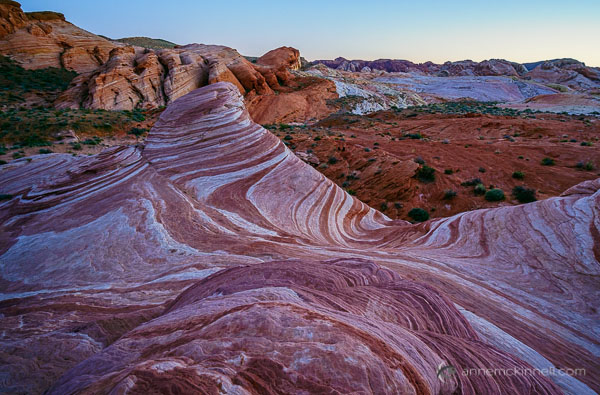
Fire Wave at Valley of Fire State Park, Nevada, by Anne McKinnell

Fire Wave at The Valley of Fire State Park, Nevada, taken from a high perspective on an opposite hilltop

1. Change your perspective

Photographers often get in the habit of shooting at eye-level which tends to make photos repetitive and somewhat common. We know this, and so we take the odd shot on our knees or even occasionally lying on the ground.

But is this really enough? Aren’t there other vantage points?

Challenge yourself to go out shooting and never shoot from eye-level for a whole day. Instead, find a new vantage point any time you take a picture. Get yourself up high above your subject, and crouch and shoot from a low angle. But that’s just the beginning. Ideally, you should try shooting your subject from a variety of angles.

Take one shot from below and one from above. Then, take one even lower, and one even higher, if possible. Then, step back a bit. Then step forward. Move to your right, and move to your left. Taking the same picture from many positions adds variety and will help you understand it better. Plus, you may discover a way of seeing something that you didn’t expect.

If you resolve to do this with every picture you take, you’ll begin to really understand the subtle effect that perspective has on an image, which points of view work for which subjects, and how this can inform your shooting style from here on out.
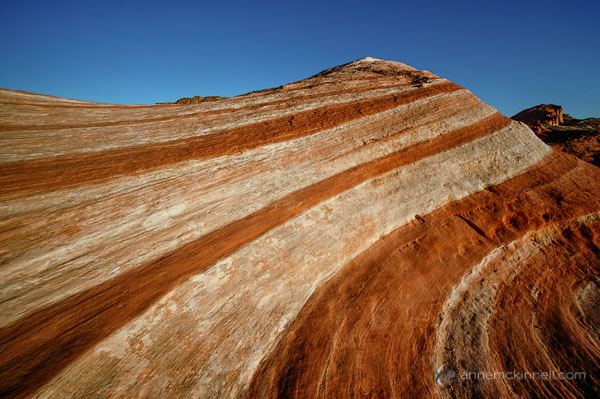
Fire Wave at Valley of Fire State Park, Nevada, by Anne McKinnell

Another perspective on Fire Wave, this time taken up close, from a low angle.

2. Create a story

Rather than trying to capture your subject in one single image, try doing a series instead. Create what LIFE Magazine coined a “photo essay” – a series of images surrounding a single subject or group of subjects, each of which pinpoints a different aspect of its nature. This can be as simple as zooming in on its finer details, or photographing it in different contexts. This method of doing things defines the subject not only by how it appears in a single moment, but also by the way it changes (and the way it stays the same) over several moments. It also helps to craft your visual storytelling abilities.

Choose one subject and cover it completely, the way a journalist would. Do this either by photographing every aspect of it you can think of, photographing it through the course of a day, or by revisiting it over and over throughout a week. Include shots at different distances and using different focal lengths – include some close-up details and some wide compositions – and whittle all the shots down to around ten final images, making sure that no two photos are alike. When you have your picks, try to organize them in an order that tells a coherent story, whether it’s narrated or implied.

Terlingua Ghost Town Texas by Anne McKinnell

These three photos are from Terlingua, a ghost town in Texas.

3. Shoot in Black and White

For a whole day, turn your camera to Black and White mode and don’t take it off. Of course, you can convert your RAW images to black and white after-the-fact in post-processing, but as an exercise, try shooting them in Black and White.

At first the limitation may seem frustrating, but Black and White photography requires a completely different way of seeing the world in terms of shape, form, and contrast, rather than through the common visual cues that you’re used to. Composing your photos in this way will invariably improve your compositions in colour photography, too. You can play with contrast settings in-camera or in post-processing to perfect the highlight to shadow ratio which defines a good monochrome image.
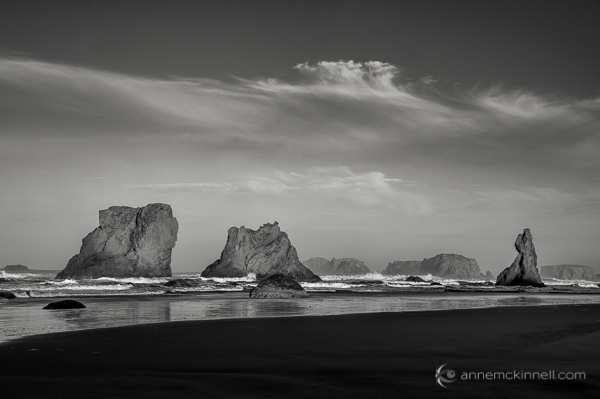
Bandon Beach, Oregon, by Anne McKinnell

Bandon Beach, Oregon.

4. Make manual long exposures

For this exercise, you’re going to take full advantage of digital photography’s instant feedback, and use it to play with making manual long exposures.

With your DSLR mounted firmly on a tripod, set the ISO to 100, set the aperture to the smallest opening (the largest f number like f/22 for example), and set the shutter speed to Bulb mode. When the camera is to Bulb mode, the shutter will stay open for as long as the shutter button is held down, but it’s a better idea to attach a wired remote shutter release to prevent camera shake.

Once you have your composition and your focus set, press and hold the button on the remote to hold the shutter open for a few counted seconds. Just guess how many seconds will be required based on the light level. Then, check your results. If the image is too bright, try again, but count half as many seconds. If the image is too dark, count twice as many seconds – or more, if necessary. Do this over and over again, in different scenarios and lighting situations. This practice will hone your ability to read the levels of light present at any given time.

You’ll get the most interesting results if there is a certain amount of movement in your frame, such as drifting clouds in the sky, crowds of people, or running water. The longer your exposure is, the more blurred that movement will appear to the point where water may seem like nothing more than mist, and people will disappear from the image altogether. If you have a solid neutral density filter your exposures can be even longer, creating more extreme effects.

Folly Beach Pier, Charleston, South Carolina by Anne McKinnell

Folly Beach Pier, Charleston, South Carolina – 2 second exposure.
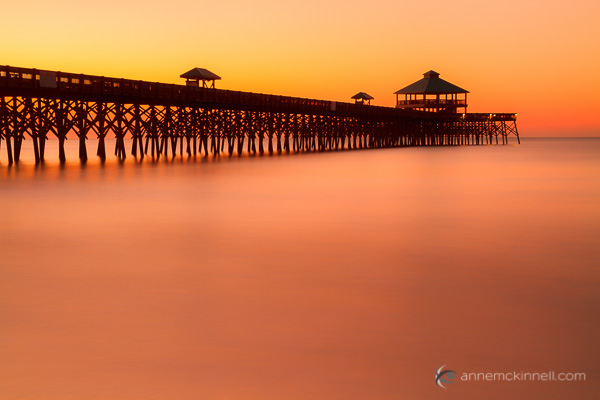
Folly Beach Pier, Charleston, South Carolina by Anne McKinnell

Folly Beach Pier, Charleston, South Carolina – 30 second exposure.

Don’t wait until you start feeling uninspired to try these exercises! Keep your photography energized and creative by trying something new on a regular basis. Even if it doesn’t turn out to be your “thing”, it’s fun and you’re bound to learn something.

The post Don’t Know What to Shoot? These 4 Photography Exercises Will Keep You Motivated by Anne McKinnell appeared first on Digital Photography School.


Digital Photography School

 
Comments Off on Don’t Know What to Shoot? These 4 Photography Exercises Will Keep You Motivated

Posted in Photography


Don’t Miss The Big Picture Natural World Photography Competition

17 Mar


Big Picture Natural World Photography Competition

One of the best science museums in the world and a local favorite of mine here in San Francisco,  the California Academy of Science is in the final stretch of their Natural World Photography Competition. Winners have their photographs exhibited at the museum and are eligible to win a grand prize of $ 5000. Categories include “Land Mammals”, “Birds”, “Insects, Reptiles, Marine Mammals, Fish and Amphibians”, “Waterscapes, Landscapes and Plant Life” and “Conservation Imagery”. I should also note that the terms of the competition are  photographer friendly.

If you want to enter do so by the deadline of March 31st, 2014. Don’t miss it.

Enter the Big Picture Natural World Photography Competition

Also…

The contest is sponsored by the late Calumet, but from my conversation with the organizers there is no impact to prizes.

Have fun and good luck with your entries!

Copyright Jim M. Goldstein, All Rights Reserved

Don’t Miss The Big Picture Natural World Photography Competition

The post Don’t Miss The Big Picture Natural World Photography Competition appeared first on JMG-Galleries – Landscape, Nature & Travel Photography.


Related Stories

  • Don’t Miss The Big Picture Natural World Photography Competition – Enclosure
  • In Defense of Pretty Pictures – Enclosure
  • In Defense of Pretty Pictures
Feed Ads by FeedBlitz
powered by ad choices


JMG-Galleries

 
Comments Off on Don’t Miss The Big Picture Natural World Photography Competition

Posted in Equipment


Canon Interview: ‘We don’t see the smartphone as an enemy’

04 Mar

DSCF7300-1.JPG

Recently, editor Barnaby Britton had the opportunity to interview senior figures at Canon Inc. on two occasions, in Japan. The first meetings were held in late 2013 at Canon’s headquarters in Tokyo, and a follow-up interview was arranged at the recent CP+ show in Yokohama. Topics covered include the future of Canon’s mirrorless system, how Canon is innovating in its DSLRs and what 4K video means for photographers. Click through for the full interview.

News: Digital Photography Review (dpreview.com)

 
Comments Off on Canon Interview: ‘We don’t see the smartphone as an enemy’

Posted in Uncategorized


Don’t Look Down: 50 Inspiring Examples of Rooftopping Photography

03 Mar

You have probably heard of a new photography fad called “rooftopping,” in which brave daredevils find the way to the top of skyscrapers and other tall buildings to snap majestic shots. Just imagine the buzz of the roof topper who reached the top of the highest building in the city and saw the incredibly breathtaking view. If you want to Continue Reading

The post Don’t Look Down: 50 Inspiring Examples of Rooftopping Photography appeared first on Photodoto.


Photodoto

 
Comments Off on Don’t Look Down: 50 Inspiring Examples of Rooftopping Photography

Posted in Photography


Don’t leave pictures stranded: Eye-Fi Mobi SD card review

21 Feb

Mobi-Feature.jpg

If you’re looking for a Wi-Fi card that’s simple to setup and blasts images off into cyberspace in a matter of seconds while you take advantage of your camera’s far superior image quality (compared to a phone), you can’t go wrong with the Eye-Fi Mobi. How does the Mobi stack up against the pricier Eye-Fi Pro X2 card? Find out in our review

News: Digital Photography Review (dpreview.com)

 
Comments Off on Don’t leave pictures stranded: Eye-Fi Mobi SD card review

Posted in Uncategorized


Perspective in Photography – Don’t just stand there move your feet!

21 Jan

Photographers often fall into the bad habit of shooting everything we see from eye-level. We are walking around, something catches our eye, and we take a picture right from where we are standing. If you want to make an immediate impact in your photography, you need to get out of your eye-level (or tripod-level) rut. You need a change in perspective.

McEnaney road

Sure, you can change your composition by zooming in or out with your lens, but if you want to change your perspective, you are going to need to move. Don’t let your feet, or your tripod, root you to the spot: get ready for some bending, turning, walking, and climbing. Start working with perspective in photography, your images will thank you for it.

Get Low

Get your camera down towards ground level, and see how it impacts your perspective. Getting down low allows you to feature the foreground of your composition, and gives your viewer context for the rest of the photograph. Use a wide angle lens to feature the foreground, while pulling the viewer into the image, as below.

McEnaney wide angle leaves

Getting down low can change the way your viewer feels or reacts to your subject. Getting low can make your subject appear taller or more imposing. Subjects viewed from below can look commanding and powerful. Even a simple sunflower can be seen to tower above its surroundings.

McEnaney sunflower

Getting low can also completely disorient your viewer. This near water-level view becomes a study in colour and texture, as the water and the fallen autumn leaves interact with each other. From eye level, this would simply have been a photograph looking down into a storm gutter. Getting low simplifies the composition and puts the viewer into a different, and unique perspective than their everyday viewpoint.

McEnaney gutter

Get Up High or Look Up High

You can get low and look at subjects from their level, but you can also get up high and take in your subject from above. Getting well above your normal line-of-sight will certainly give you a new perspective. In the photograph below, the other tourists on the decks below give context to the passing iceberg, as seen from the cruise ship. This higher-up view also provides a sense of scale for the large size of the ice berg and hints at the size of the ship.

McEnaney iceberg

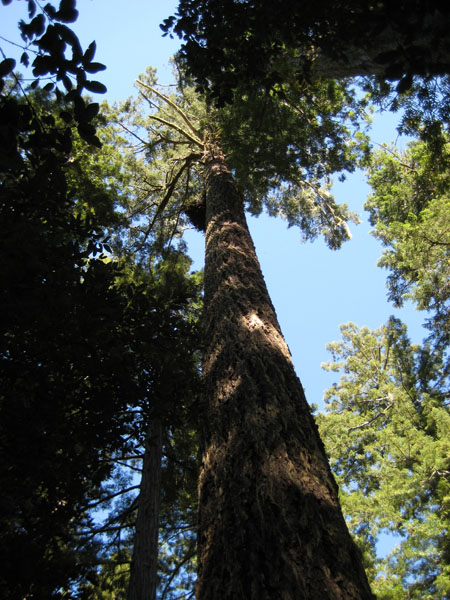
If you do not want to physically get up high, standing and shooting does not mean you only have to shoot straight ahead. Spend some time looking up, and you will find plenty to improve your compositions and your perspective. With very tall subjects, looking up from below will accentuate their height and size. The power and immensity of these redwood trees are best emphasized by looking up, from directly below.

McEnaney redwood

Go for the Lateral

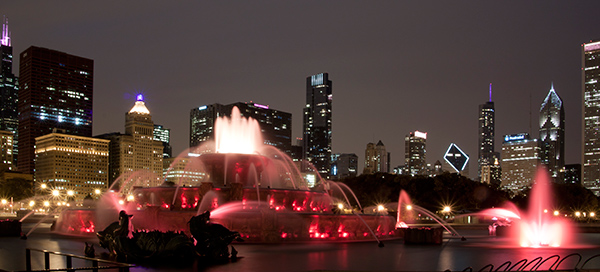
Finally, do not forget to think laterally. Beyond just changing your stance or your direction of shooting, you also need to remember to move yourself. Talk the time to walk around your subject, to consider the background and foreground. Think about how all the pieces of your final composition fit together. Your first view and your first angle are often not the best available, but you cannot be sure until you have taken the time to investigate others. Walking all the way around Buckingham Fountain allowed me to choose this final composition and perspective featuring the downtown Chicago skyline. I also made the choice to position the spray from the fountain directly in front of a building to make it more visible.

McEnaney fountain 600

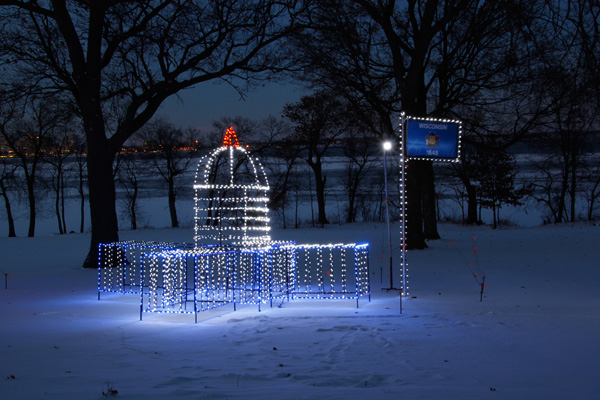
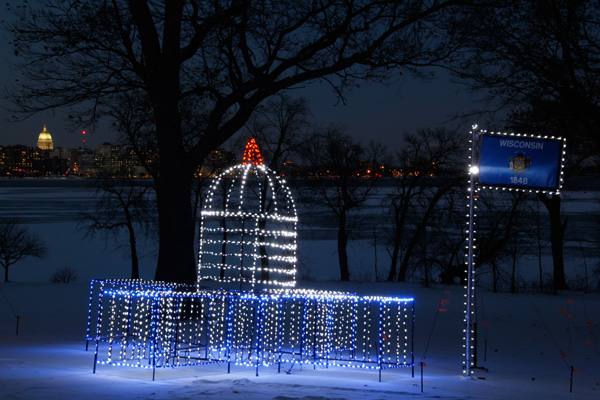
Moving your feet can change the way that different objects in your photograph interact with each other. While the top photograph of the Wisconsin Capitol in lights was an adequate shot, moving just a few feet to the right and squatting down allowed me to feature the lit outline in the foreground with the actual Capitol building in the background. This juxtaposition of elements improves the story-telling ability of the photograph.

McEnaney lit capitol

McEnaney double capitol

Summary

Do not fall into the trap of shooting everything you see at eye-level, just as you see it. Take the time to explore your subject, and considering changing your perspective. Get low and see what changes, get up high and explore a new view, or move laterally and watch different interactions occur and disappear between objects.

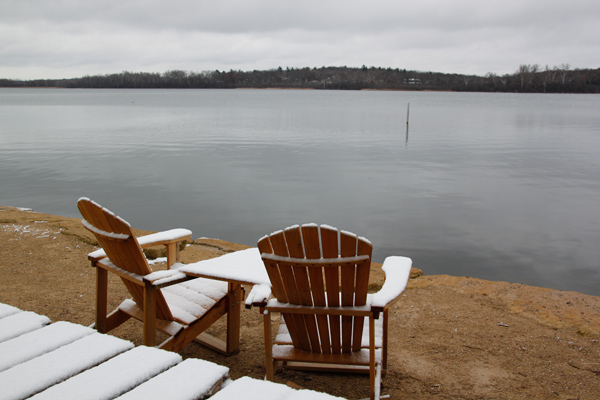
McEnaney chairs from above

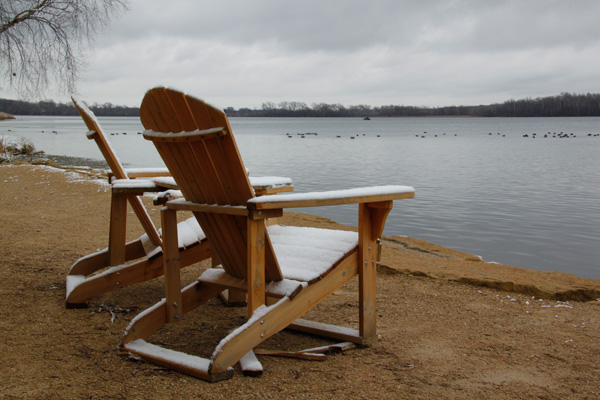
McEnaney chairs get low

You may have a hard time choosing a favourite view: from above to emphasize the view of the foreground lake, or get low to show the expanded context and the threatening winter sky? Share your thoughts or your own perspective images in the comments below!

The post Perspective in Photography – Don’t just stand there move your feet! by Katie McEnaney appeared first on Digital Photography School.


Digital Photography School

 
Comments Off on Perspective in Photography – Don’t just stand there move your feet!

Posted in Photography


Don’t Miss Out: Soon These 12 Photography Training Deals Will Be Gone Forever

30 Dec

With the countdown to the end of 2013 we’re also closing in on the time that our 12 Photography Deals of 2013 will be ending.

NewImage

In just a few hours (as the calendar ticks over into 2014 US Eastern Time) these fantastic deals will close forever. Among them are some great savings to be had – up to 77% off resources that will help you make 2014 the year of great photos!

The Most Popular Deals of 2013

A number of people have messaged me for my personal recommendations on which deals I think are best. Of course it will depend upon your needs but here are the deals in order of ‘best sellers’ so you can see what others bought this year:

  1. Day 12: $ 10 Day – where we offered 10 dPS (including our portrait lighting, travel photography and kids photography eBooks) for $ 10 each as well as a couple of great $ 10 bundles of eBooks from Ed Verosky and Andrew Gibson.
  2. Day 7: 77% off Living Landscapes – this $ 7 Landscape Photography eBook deal almost took our servers down it was so popular! There’s also an option to bundle it with 4 Jay Patel eBooks.
  3. Day 9: 77% off Photo Nuts and Post – another $ 7 deal, this one on Post Production Techniques is perfect for those of you looking to learn some great Post Processing Techniques (there’s also an option to get all 5 Neil Creek eBooks for $ 90 off!)
  4. Day 11: $ 40 off Kelby Training – this deal gets you hundreds of hours of photography training from some of the world’s best photographers for just cents a day.
  5. Day 5: 65% off Portraits, Making the Shot – our 2nd most popular eBook ever and yours for just $ 7.
  6. Day 6: 75% off The Art of Black and White Photography – for just $ 24 you can get Udemy’s most popular course.
  7. Day 3: 60% off Going Pro – thinking of making money from your photography? This one is for you.
  8. Day 2: 60% off James Brandon’s ’10 Most Common Photography Mistakes and How to Fix Them’ – just $ 12 for this great course.
  9. Day 8: Save 30% on Fro Knows Photo Beginners Guide – if you’re new to photography then this is a great introduction to get you hands on.
  10. Day 1: 65% off our Natural Light eBook – another $ 7 dPS eBook on one of our most popular eBooks. It’ll help you take great natural light images (there’s also an option to get your hands on all 3 Mitchell Kanashkevich eBooks and save $ 35.
  11. Day 10: Save 37% on Mastering Photography eBook By Andrew Gibson – a great beginners guide to using your digital camera.
  12. Day 4: Save 50% on the Amazing Fundamentals of Digital Photography course – 5 massive days of training for just $ 74. The perfect way to set up 2014.

See all these deals on our 12 Days of Christmas page but don’t delay, these deals end as the clock strikes midnight and we see in 2014 (US Eastern time).

The post Don’t Miss Out: Soon These 12 Photography Training Deals Will Be Gone Forever by Darren Rowse appeared first on Digital Photography School.


Digital Photography School

 
Comments Off on Don’t Miss Out: Soon These 12 Photography Training Deals Will Be Gone Forever

Posted in Photography


Want to remember something? Don’t take a photo

14 Dec

Selfie.jpg

Nowadays we snap photos of every detail of our lives — the food we eat, what our cat is doing, the quirky things we see, the places we go — and we do this in an effort document and remember those experiences. But a new study, published in Psychological Science, suggests it’s possible that the act of taking pictures may actually lessen our ability to recall details of a subject. Learn more

News: Digital Photography Review (dpreview.com)

 
Comments Off on Want to remember something? Don’t take a photo

Posted in Uncategorized


Why I Don’t Support “Black Day” at Flickr

08 Dec

Why I Don't Support Flickr Black Day

If you notice something different about photos on Flickr today, it might just be “black day.” Over the past week or so, hundreds (maybe thousands) of users who dislike an impending photo page change (and in many cases, redesign changes from earlier this year) have organized and are protesting by posting black protest images to their Flickr accounts today, December 8th.

Here is why I don’t support this protest.

Flickr users have protested quite literally *everything* that has ever been changed to the site. Every change over the past decade or so that Flickr has been around, has been meet by strong resistance. When Flickr added video, when Flickr required Yahoo accounts to sign in, and certainly design changes most of all, all of these and so many more have been met with various protest movements.

The “who moved my cheese” crowd is strong with Flickr.

At the same time, in order to improve and grow Flickr *MUST* change. Flickr must evolve. Flickr must improve.

Whether or not Flickr gets their design changes right or wrong, they simply must move forward and compete with other photo sharing sites today. Hopefully they get it more right than wrong, but I simply can’t support something that’s primary premise is based on not changing for the sake of, well, not changing. That is how things die. As good as Flickr is, it can always improve, and if the site is paralyzed by the “no change” crowd it cannot innovate and grow.

Competition in the photo sharing space is stronger than it ever has been. Flickr, Google+, Instagram, Twitter, Facebook, Pinterest, SmugMug, Behance, 500px and more are all competing for our photos and our attention. If Flickr is going to survive as a contender in this space, they must produce a more compelling experience than they have in the past.

Many of those currently protesting design changes on Flickr are loud, very loud — and some are some of the rudest, vulgar and offensive people I’ve ever come across online. They way they trashed Marissa Mayer and other Flickr employees’ *personal* photostreams after the last redesign was way over the line.

Even as a large protest group, however, this group most certainly does NOT represent the majority opinion on Flickr. Most (the silent majority) Flickr users couldn’t be bothered to get worked up about anything and quite simply don’t care enough about whatever happens at some photo sharing site to have much of an opinion one way or the other.

For this silent majority, the best tool Flickr has is data. The best thing that they can do is watch how the majority use the site and react to changes based on their online usage patterns and actions. I suspect that recent design changes on Flickr have contributed to more users, more views, and more engagement — despite what a small, but vocal, minority might want you to believe.

Only Flickr has access to this data, but I suspect that they are quite happy with usage results (even just going by my own anecdotal increase in activity that I’ve seen on the site as changes have been rolled out this year).

Now, as far as the new photo page redesign goes, mostly I like it. I say mostly, because even as I’ve used the page (it’s in an optional opt in or out beta form right now), I usually end up turning it off and going back to the old page. It simply is missing too much functionality that I rely on and need to use Flickr at present.

For example, I need to be able to click on the faves button and see who has faved my photo. That is important (and pretty basic) social information that I want access to. At present you cannot do this with the new photo page (but it is planned per Flickr’s feedback page). Assuming Flickr gets all of the basic functionality right in the final product though, I like the design better in general.

I also like the redesign changes that Flickr implemented earlier this year. I think that the justified layout combined with infinite scroll is the fastest, most efficient, way to consume photos on the internet today. Both Google and Facebook use infinite scroll. While some people have claimed that Flickr is slower for them, it is not for me. Images load very quickly on a modern laptop with a broadband internet connection. I also don’t have bandwidth caps on my primary internet connections.

Flickr has never been faster and I’ve been able to see more images on Flickr this year than any year previous due to these efficiency improvements.

I think Flickr needs to change even more in fact — mostly around social. There is still so much that could be improved on Flickr from a social standpoint.

The primary role of a social network should be as a social lubricant. Flickr should be obsessed with social, much more than it feels that they are. How can Flickr create even more social interaction? How can Flickr turn online social interaction into offline social interaction? How can Flickr make it easier and easier to favorite and comment on photos? How can Flickr show me more photos that I like (and will interact with socially) and less photos that I do not like?

These are the questions Flickr should be asking as they innovate and improve, and, yes, change.

Why does Explore still exist as it does? It’s so broken. Why are power users blacklisted from Explore? Shouldn’t Flickr care about their power users?

Explore is boring to me because it is not customized to me. Flickr has so much data about me. Why aren’t they analyzing my data to provide me a better photo exploration tool? Flickr knows whose photos I favorite. Flickr knows what tags on photos I favorite (and with image recognition analysis in the future, even more).

Flickr knows the geolocational location of photos that I favorite. Why is Flickr wasting valuable Explore real estate by showing me photos with watermarks when I hate watermarks? Why is Flickr showing me images of overcooked HDR? Explore has so much potential to truly provide a compelling image discovery system and yet it still falls flat.

I hope more change is coming to Flickr, not less. 2013 was the most innovative year of Flickr since Yahoo purchased them. Hopefully 2014 will be every bit as good.

More comments on this at the original Flickr photo here and on Facebook here.


Thomas Hawk Digital Connection

 
Comments Off on Why I Don’t Support “Black Day” at Flickr

Posted in Photography


The 5 Stupidest Photography Errors You Don’t Even Know You’re Making

22 Nov

They can happen to anyone who thinks he’s a good photographer. They can even happen to a professional photographer who has had years and years of experience in the industry! What…is “they?” In this case, “they” is a reference to the absolutely worst photography errors that you don’t even know you’re making. No matter how good you are or think Continue Reading

The post The 5 Stupidest Photography Errors You Don’t Even Know You’re Making appeared first on Photodoto.


Photodoto

 
Comments Off on The 5 Stupidest Photography Errors You Don’t Even Know You’re Making

Posted in Photography